
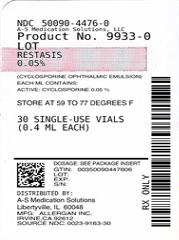
RESTASIS cyclosporine .5 mg/mL Emulsion, 30 vials — NDC 50090-4476-0 (Billing 50090-4476-00)
This is a package of 30 vials of RESTASIS cyclosporine .5 mg/mL Emulsion from A-S Medication Solutions, marketed since Apr 2003 and currently FDA-listed. It is this product's only package size.
NDC database record
One package, one record: these facts belong to NDC 50090-4476-0 alone.
- Record
- FDA NDC Directory package listing · Human prescription drug
- Code segments
- 50090 labeler · 4476 product · 0 package
- Package marketed since
- Aug 26, 2019
- Sample package
- No — commercial package
- Listing certified through
- Dec 31, 2026
- Billing quantity
- 30 EA per package
- Barcode (UPC-A, from the NDC)
- 3 5009044760 6
- FDA record last changed
- Jul 24, 2026
Identity & classification
Regulatory identifiers FDA, NLM and CMS codes for this package
Drug-database identifiers Medi-Span GPI and First Databank GCN / HICL / AHFS classification
- GSN (GCN sequence number): 051820
- GCN: 19216
- GPI-14 (Medi-Span): 86720020001620
- HICL (First Databank): 004524
- AHFS class code: 52:08.00.00
- RxCUI (RxNorm): 2572292
Where does this data come from?
- FDA openFDA NDC Directory · synced Oct 1, 2026
- FDA label on DailyMed · label index refreshed Oct 5, 2026
- RxNorm (NLM RxNav) · catalog refreshed Oct 1, 2026
- Medi-Span GPI (licensed)
- First Databank (licensed) · refreshed Oct 1, 2026
RxNorm drug class
This medicine belongs to the Calcineurin Inhibitor Immunosuppressant class.
Where does this data come from?
- RxClass (NLM) · catalog refreshed Oct 1, 2026
Clinical
Ophthalmic cyclosporine is used to increase tear production in people with dry eye disease. Cyclosporine is in a class of medications called immunomodulators. It works by decreasing swelling in the eye to allow for tear production.
Read the full MedlinePlus article ↗- It depends on the product. Oral forms help prevent organ rejection after kidney, liver or heart transplants. Some oral products also treat severe rheumatoid arthritis and severe pl...
- Oral modified forms like Neoral and Gengraf are taken twice a day. Keep your timing and meal routine consistent from day to day. Follow your prescriber's directions and the label.
- No, avoid grapefruit and grapefruit juice. They raise cyclosporine levels in your blood, which can increase side effects.
- Not on your own. Modified products such as Neoral and Gengraf are not interchangeable with Sandimmune, and switching needs your doctor's supervision and extra blood level checks.
Patient education
Supplement & herbal interactions
Some supplements/herbs that may interact with Cyclosporine — tap one for details:
Cyclosporine may be associated with lower levels of 1 nutrient — worth a chat with your pharmacist, not a cause for alarm.
Where does this data come from?
- MedlinePlus (NLM) · refreshed Oct 1, 2026
- FDA label on DailyMed · label index refreshed Oct 5, 2026
Ask a licensed pharmacist directly — free, answered by our team.
Pricing
A drug doesn't have one price. Each row is a different public payment system, and none is what you'd pay at the counter — that depends on your insurance. The ⓘ on each row explains what it measures.
| Price system | Per mL | Per package |
|---|---|---|
| Retail pharmacies payNADAC · weekly | Not in the retail survey — common for institutional, discontinued, or low-volume packs. | |
| Medicaid paysCMS SDUD · 12 mo | No recent Medicaid claims on file for this NDC — rare and low-volume NDCs are suppressed in the public data. | |
| Medicare drug plans payPart D · Q2 2026 | $10.27 | $123.18 / 12 ml |
Where does this data come from?
- CMS NADAC weekly file
- CMS ASP pricing files · refreshed Sep 20, 2026
- CMS Medicaid State Drug Utilization Data · refreshed Oct 5, 2026
- CMS Part D plan pricing files · refreshed Sep 24, 2026
- VA National Acquisition Center price file
Packaging — all sizes for this product
| Package NDC | Description | Marketing start | Marketing end | Status |
|---|---|---|---|---|
| 50090-4476-00 You're viewing this Main listing | 30 VIAL, SINGLE-USE in 1 TRAY / .4 mL in 1 VIAL, SINGLE-USE | 2019-08-26 | — | Active |
Therapeutic equivalents
| Product | Labeler | Pack | NADAC/unit | TE | Status | Price vs. this |
|---|---|---|---|---|---|---|
| Cyclosporine .5 mg/mL 24979-0126-18 | Upsher-Smith | 60 vials | $0.909 | AB | Availability likely | — |
| Cyclosporine .5 mg/mL 00378-8760-58 | Mylan | 6 pouches | $1.180 | AB | Availability likely | — |
| Cyclosporine .5 mg/mL 00480-4076-30 | Teva | 6 pouches | $1.180 | AB | Availability likely | — |
| Cyclosporine .5 mg/mL 10702-0808-03 | KVK-TECH, | 30 vials | $1.180 | AB | Availability likely | — |
| Cyclosporine .5 mg/mL 60505-6202-01 | Apotex | 30 vials | $1.180 | AB | Availability likely | — |
| Cyclosporine .5 mg/mL 68180-0214-30 | Lupin | 30 vials | $1.180 | AB | Availability likely | — |
| Cyclosporine .5 mg/mL 71656-0012-30 | Saptalis | 6 pouches | $1.180 | AB | Availability likely | — |
| Cyclosporine .5 mg/mL 73043-0005-01 | Devatis | 3 pouches | $1.180 | AB | Availability likely | — |
| Restasis MultiDose .5 mg/mL 00023-5301-05 | Allergan, | 1 bottle | $112.322 | AB | Availability likely | — |
| Restasis .5 mg/mL 00023-9163-12 | Allergan, | 5 vials | — | AB | FDA listed | — |
| Restasis .5 mg/mLthis 50090-4476-00 | A-S | 30 vials | — | AB | FDA listed | — |
| Cyclosporine .5 mg/mL 69238-1023-03 | Amneal | 3 pouches | — | AB | Discontinued | — |
| Cyclosporine .5 mg/mL 69097-0292-03 | Cipla | 2 pouches | — | AB | FDA listed | — |
Where does this data come from?
- FDA openFDA NDC Directory · synced Oct 1, 2026
- FDA Orange Book · refreshed Oct 3, 2026
- CMS NADAC weekly file
Availability & generic status
FDA-approved generic versions are listed, and recent pricing/market data suggests they may be available — see Therapeutic equivalents.
Why the date isn’t exact: Generic timing can change because patents may be challenged, settled, licensed, added, removed, or worked around with a narrower label — and FDA approval does not always mean a pharmacy can get the generic today.
🛈 What do these terms mean?
- Patent
- Legal protection listed in the Orange Book that may delay generic approval or launch. Issued by the U.S. Patent & Trademark Office.
- Substance patent
- Covers the active drug molecule itself — the hardest to design around. A generic generally can’t launch until it expires.
- Formulation (product) patent
- Covers a specific formulation or dosage form. A generic can sometimes work around it with a different formulation.
- Method-of-use patent
- A patent covering one specific approved use of the drug — not necessarily the whole molecule. A generic can sometimes launch with a “skinny label” that carves out the protected use and keeps the others.
- Skinny label
- A generic label that omits a still-patented use when the FDA allows it — letting a generic reach the market for the unprotected uses.
- Exclusivity
- FDA-granted marketing protection, separate from patents — e.g. 5-yr new chemical entity, 7-yr orphan drug, or a +6-month pediatric extension.
- Paragraph IV
- A generic applicant’s formal challenge to a listed patent. It can potentially lead to earlier generic entry, but often involves litigation or a settlement.
- RLD / RS
- Reference Listed Drug — the brand product the FDA uses as the reference for generic applications. Reference Standard — the product the FDA expects generics to compare against in bioequivalence testing.
- TE / AB rating
- FDA therapeutic-equivalence rating. An AB rating generally means the FDA considers a generic therapeutically equivalent to — and substitutable for — the brand.
- LOE (loss of exclusivity)
- The latest patent or exclusivity currently listed — the loss-of-exclusivity / latest-listed-protection date shown on this page. Paragraph-IV challenges and settlements can move the real date earlier; FDA approval and a manufacturer’s decision to market can move it later.
Built from the FDA Orange Book. The bars above are scaled to each protection’s expiry; the red LOE marker is the last one to lapse.
| Patent | Type | Use code | Expires |
|---|---|---|---|
| US 8292129 ↗ delist req. | Drug product | — | Feb 25, 2031 |
| US 9676525 ↗ delist req. | Drug product | — | Feb 7, 2034 |
| US 9669974 ↗ delist req. | Drug product | — | May 11, 2034 |
| US 8561859 ↗ delist req. | Drug product | — | Apr 16, 2032 |
Is there a generic version of RESTASIS 0.05% EYE EMULSION?
The FDA approved a generic — why can’t I get it at my pharmacy yet?
Why do different websites show different generic release dates?
What does “FDA listed” mean?
What does a patent or protection date mean here?
What does “current Orange Book estimate” mean?
Can a generic come out before the last patent expires?
Can a generic come out after the listed dates?
What is the difference between patents and exclusivity?
Why are there multiple patent dates?
Where does this data come from?
- FDA Orange Book · refreshed Oct 3, 2026
Inactive Ingredients / Excipients
Inactive ingredients, also called excipients, are components of the drug product other than the active ingredient. They may include fillers, dyes, coatings, preservatives, flavors, or other formulation ingredients.
🧪 Avoiding an ingredient? See Cyclosporine inactive ingredients by manufacturer: every current product's list side by side, so you can ask your pharmacy for the version that does not list it.
💡 Tap an ingredient (hover on desktop) to see what it is and why it’s used.
-
UNII 71DD5V995L
A synthetic polymer derived from acrylic acid, crosslinked to form a gel-like substance. It thickens formulations, improves texture, and helps distribute active ingredients evenly in topical products like creams and gels.
-
UNII D5340Y2I9G
Castor oil is a natural plant-based oil used in medicines as a lubricant, laxative agent, and solvent. It helps medicine ingredients dissolve or flow smoothly and can aid bowel movement in formulations designed for that purpose.
-
UNII PDC6A3C0OX
Glycerin is a clear, thick liquid derived from plant oils or fats. It acts as a humectant to retain moisture, a sweetener, and a solvent in medications.
-
UNII 6OZP39ZG8H
Polysorbate 80 is a synthetic emulsifier derived from sorbitol and oleic acid. It helps mix oil and water-based ingredients together in medications and improves how the product disperses in the body.
-
UNII 55X04QC32I
A strong alkaline chemical used to adjust and maintain the pH balance of liquid medicines. It helps keep the medicine stable and ensures it stays effective during storage.
-
UNII 059QF0KO0R
Water is a liquid solvent that dissolves and mixes ingredients together in liquid medicines, syrups, and injections. It helps distribute the active drug evenly throughout the product.
6 inactive ingredients listed in the exact product block matched to this NDC.
Where does this data come from?
ingredient classCode="IACT" elements from the exact product block matched by this NDC. Label-section narrative from DailyMed / the openFDA label index is shown separately when available.- FDA label on DailyMed · label index refreshed Oct 5, 2026
- FDA openFDA NDC Directory · synced Oct 1, 2026
Inactive ingredient FAQ
Are inactive ingredients the same for every manufacturer?
Why might an inactive ingredient be missing?
Can inactive ingredients matter?
Manufacturer & labeler
More NDCs from A-S Medication Solutions labeler code 50090
- Olmesartan Medoxomil 40 mg Tablet, Film Coated NDC 50090-4451-0
- Promethazine Hydrochloride 25 mg Tablet NDC 50090-4452-0
- Promethazine Hydrochloride 25 mg Tablet NDC 50090-4453-0
- Azithromycin 200 mg/5mL Powder, For Suspension NDC 50090-4458-0
- Xarelto rivaroxaban 20 mg Tablet, Film Coated NDC 50090-4468-0
- Xarelto rivaroxaban 10 mg Tablet, Film Coated NDC 50090-4469-0
- HUMIRA Adalimumab Kit NDC 50090-4487-0
- HUMALOG Insulin lispro 100 [iU]/mL Injection, Solution NDC 50090-4488-0
- Losartan Potassium 50 mg Tablet, Film Coated NDC 50090-4489-0
- JARDIANCE Empagliflozin 10 mg Tablet, Film Coated NDC 50090-4492-0
- NOVOLOG insulin aspart 100 [iU]/mL Injection, Solution NDC 50090-4500-0
- Advair Diskus fluticasone propionate and salmeterol 50 ug; 250 ug Powder NDC 50090-4502-0
Where does this data come from?
- FDA openFDA NDC Directory · synced Oct 1, 2026
- Drugs@FDA
Full prescribing information FDA SPL
🎯 Indications and Usage ▾
1 IN DICATIONS AND USAGE RESTASIS ® ophthalmic emulsion is indicated to increase tear production in patients whose tear production is presumed to be suppressed due to ocular inflammation associated with keratoconjunctivitis sicca. Increased tear production was not seen in patients currently taking topical anti-inflammatory drugs or using punctal plugs. RESTASIS ® is a calcineurin inhibitor immunosuppressant indicated to increase tear production in patients whose tear production is presumed to be suppressed due to ocular inflammation associated with keratoconjunctivitis sicca.
Increased tear production was not seen in patients currently taking topical anti-inflammatory drugs or using punctal plugs. ( 1 )
⏱️ Dosage and Administration ▾
2 D OSAGE AND ADMINISTRATION Invert the unit dose vial a few times to obtain a uniform, white, opaque emulsion before using. Instill one drop of RESTASIS ® ophthalmic emulsion twice a day in each eye approximately 12 hours apart. RESTASIS ® can be used concomitantly with lubricant eye drops, allowing a 15-minute interval between products.
Discard vial immediately after use. Instill one drop of RESTASIS ® ophthalmic emulsion twice a day in each eye approximately 12 hours apart. ( 2 )
💊 Dosage Forms and Strengths ▾
3 DOSAGE FORMS AND STRENGTHS Ophthalmic emulsion containing cyclosporine 0.5 mg/mL Cyclosporine ophthalmic emulsion 0.5 mg/mL ( 3 )
⛔ Contraindications ▾
4 C ONTRAINDICATIONS RESTASIS ® is contraindicated in patients with known or suspected hypersensitivity to any of the ingredients in the formulation. Hypersensitivity ( 4 )
⚠️ Warnings and Cautions ▾
5 W ARNINGS AND P RECAUTIONS To avoid the potential for eye injury and contamination, be careful not to touch the vial tip to your eye or other surfaces. ( 5.1 ) 5. 1 Potential for Eye Injury and Contamination Be careful not to touch the vial tip to your eye or other surfaces to avoid potential for eye injury and contamination.
5.2Use with Contact Lenses RESTASIS ® should not be administered while wearing contact lenses. Patients with decreased tear production typically should not wear contact lenses. If contact lenses are worn, they should be removed prior to the administration of the emulsion. Lenses may be reinserted 15 minutes following administration of RESTASIS ® ophthalmic emulsion.
🤒 Adverse Reactions ▾
6 A DVERSE R EACTIONS The following serious adverse reactions are described elsewhere in the labeling: Potential for Eye Injury and Contamination [ see Warnings and Precautions ( 5.1 ) ] The most common adverse reaction following the use of RESTASIS ® was ocular burning (17%). ( 6.1 ) To report SUSPECTED ADVERSE REACTIONS, contact Allergan at 1-800-433-8871 or FDA at 1-800-FDA-1088 or www.fda.gov/medwatch.
6.1Clinical Trials Experience Because clinical trials are conducted under widely varying conditions, adverse reaction rates observed in the clinical trials of a drug cannot be directly compared to rates in the clinical trials of another drug and may not reflect the rates observed in practice. In clinical trials, the most common adverse reaction following the use of RESTASIS ® was ocular burning (17%). Other reactions reported in 1% to 5% of patients included conjunctival hyperemia, discharge, epiphora, eye pain, foreign body sensation, pruritus, stinging, and visual disturbance (most often blurring).
6.2Post-marketing Experience The following adverse reactions have been identified during post approval use of RESTASIS ® . Because these reactions are reported voluntarily from a population of uncertain size, it is not always possible to reliably estimate their frequency or establish a causal relationship to drug exposure. Reported reactions have included: hypersensitivity (including eye swelling, urticaria, rare cases of severe angioedema, face swelling, tongue swelling, pharyngeal edema, and dyspnea); and superficial injury of the eye (from the vial tip touching the eye during administration).
👥 Use in Specific Populations ▾
8 U SE IN SPECIFIC P OPULATIONS
8.1Pregnancy Risk Summary Clinical administration of cyclosporine ophthalmic emulsion 0.05% is not detected systemically following topical ocular administration [ see Clinical Pharmacology ( 12.3 ) ], and maternal use is not expected to result in fetal exposure to the drug. Oral administration of cyclosporine to pregnant rats or rabbits did not produce teratogenicity at clinically relevant doses [ see Data ]. Data Animal Data At maternally toxic doses (30 mg/kg/day in rats and 100 mg/kg/day in rabbits), cyclosporine oral solution (USP) was teratogenic as indicated by increased pre- and postnatal mortality, reduced fetal weight and skeletal retardations.
These doses (normalized to body surface area) are 5,000 and 32,000 times greater, respectively, than the daily recommended human dose of one drop (approximately 28 mcL) of cyclosporine ophthalmic emulsion 0.05% twice daily into each eye of a 60 kg person (0.001 mg/kg/day), assuming that the entire dose is absorbed. No evidence of embryofetal toxicity was observed in rats or rabbits receiving cyclosporine during organogenesis at oral doses up to 17 mg/kg/day or 30 mg/kg/day, respectively. These doses in rats and rabbits are approximately 3,000 and 10,000 times greater, respectively, than the daily recommended human dose.
An oral dose of 45 mg/kg/day cyclosporine administered to rats from Day 15 of pregnancy until Day 21 postpartum produced maternal toxicity and an increase in postnatal mortality in offspring. This dose is 7,000 times greater than the daily recommended human dose. No adverse effects in dams or offspring were observed at oral doses up to 15 mg/kg/day (2,000 times greater than the daily recommended human dose).
8.2Lactation Risk Summary Cyclosporine is known to appear in human milk following systemic administration, but its presence in human milk following topical treatment has not been investigated. Although blood concentrations are undetectable following topical administration of RESTASIS ® ophthalmic emulsion [see Clinical Pharmacology ( 12.3 )] , caution should be exercised when RESTASIS ® is administered to a nursing woman. The developmental and health benefits of breastfeeding should be considered along with the mother’s clinical need for RESTASIS ® and any potential adverse effects on the breast-fed child from cyclosporine.
8.4Pediatric Use Safety and efficacy have not been established in pediatric patients below the age of 16.
8.5Geriatric Use No overall difference in safety or effectiveness has been observed between elderly and younger patients.
🤰 Pregnancy ▾
8.1Pregnancy Risk Summary Clinical administration of cyclosporine ophthalmic emulsion 0.05% is not detected systemically following topical ocular administration [ see Clinical Pharmacology ( 12.3 ) ], and maternal use is not expected to result in fetal exposure to the drug. Oral administration of cyclosporine to pregnant rats or rabbits did not produce teratogenicity at clinically relevant doses [ see Data ]. Data Animal Data At maternally toxic doses (30 mg/kg/day in rats and 100 mg/kg/day in rabbits), cyclosporine oral solution (USP) was teratogenic as indicated by increased pre- and postnatal mortality, reduced fetal weight and skeletal retardations.
These doses (normalized to body surface area) are 5,000 and 32,000 times greater, respectively, than the daily recommended human dose of one drop (approximately 28 mcL) of cyclosporine ophthalmic emulsion 0.05% twice daily into each eye of a 60 kg person (0.001 mg/kg/day), assuming that the entire dose is absorbed. No evidence of embryofetal toxicity was observed in rats or rabbits receiving cyclosporine during organogenesis at oral doses up to 17 mg/kg/day or 30 mg/kg/day, respectively. These doses in rats and rabbits are approximately 3,000 and 10,000 times greater, respectively, than the daily recommended human dose.
An oral dose of 45 mg/kg/day cyclosporine administered to rats from Day 15 of pregnancy until Day 21 postpartum produced maternal toxicity and an increase in postnatal mortality in offspring. This dose is 7,000 times greater than the daily recommended human dose. No adverse effects in dams or offspring were observed at oral doses up to 15 mg/kg/day (2,000 times greater than the daily recommended human dose).
🧒 Pediatric Use ▾
8.4Pediatric Use Safety and efficacy have not been established in pediatric patients below the age of 16.
🧓 Geriatric Use ▾
8.5Geriatric Use No overall difference in safety or effectiveness has been observed between elderly and younger patients.
🧬 Clinical Pharmacology ▾
12 C LINICAL PHARMACOLOGY
12.1Mechanism of Action Cyclosporine is an immunosuppressive agent when administered systemically. In patients whose tear production is presumed to be suppressed due to ocular inflammation associated with keratoconjunctivitis sicca, cyclosporine emulsion is thought to act as a partial immunomodulator. The exact mechanism of action is not known.
12.3Pharmacokinetics Blood cyclosporine A concentrations were measured using a specific high pressure liquid chromatography-mass spectrometry assay. Blood concentrations of cyclosporine, in all the samples collected, after topical administration of RESTASIS ® 0.05%, twice daily, in humans for up to 12 months, were below the quantitation limit of 0.1 ng/mL. There was no detectable drug accumulation in blood during 12 months of treatment with RESTASIS ® ophthalmic emulsion.
🧬 Mechanism of Action ▾
12.1Mechanism of Action Cyclosporine is an immunosuppressive agent when administered systemically. In patients whose tear production is presumed to be suppressed due to ocular inflammation associated with keratoconjunctivitis sicca, cyclosporine emulsion is thought to act as a partial immunomodulator. The exact mechanism of action is not known.
📦 How Supplied / Storage and Handling ▾
16 H OW SUPPLIED /S TORAGE AND H ANDLING Product: 50090-4476 NDC: 50090-4476-0 .4 mL in a VIAL, SINGLE-USE / 30 in a TRAY
📦 Storage and Handling ▾
Storage: Store at 15°-25°C (59°-77°F).
📋 Description ▾
11 D ESCRIPTION RESTASIS ® (cyclosporine ophthalmic emulsion) 0.05% contains a topical calcineurin inhibitor immunosuppressant with anti-inflammatory effects. Cyclosporine’s chemical name is Cyclo[[( E )-(2 S ,3 R ,4 R )-3-hydroxy-4-methyl-2-(methylamino)-6-octenoyl]-L-2-aminobutyryl- N -methylglycyl- N -methyl-L-leucyl-L-valyl- N -methyl-L-leucyl-L-alanyl-D-alanyl- N -methyl-L-leucyl- N -methyl-L-leucyl- N -methyl-L-valyl] and it has the following structure: Structural Formula Formula: C 62 H 111 N 11 O 12 Mol. Wt.: 1202.6 Cyclosporine is a fine white powder.
RESTASIS ® appears as a white opaque to slightly translucent homogeneous emulsion. It has an osmolality of 230 to 320 mOsmol/kg and a pH of 6.5-8.0. Each mL of RESTASIS ® ophthalmic emulsion contains: Active: cyclosporine 0.05%.
Inactives: glycerin; castor oil; polysorbate 80; carbomer copolymer type A; purified water; and sodium hydroxide to adjust pH. The following structure for RESTASIS® (cyclosporine ophthalmic emulsion) 0.05% contains a topical calcineurin inhibitor immunosuppressant with anti-inflammatory effects. Cyclosporine’s chemical name is Cyclo[[(E)-(2S,3R,4R)-3-hydroxy-4-methyl-2-(methylamino)-6-octenoyl]-L-2-aminobutyryl-N-methylglycyl-N-methyl-L-leucyl-L-valyl-N-methyl-L-leucyl-L-alanyl-D-alanyl-N-methyl-L-leucyl-N-methyl-L-leucyl-N-methyl-L-valyl].
💬 Information for Patients ▾
17 P ATIENT COUNSELING INFORMA T ION Handling the Container Advise patients to not allow the tip of the vial to touch the eye or any surface, as this may contaminate the emulsion. Advise patients to not touch the vial tip to their eye to avoid the potential for injury to the eye [ see Warnings and Preca u tions ( 5.1 ) ]. Use with Contact Lens es RESTASIS ® should not be administered while wearing contact lenses.
Patients with decreased tear production typically should not wear contact lenses. Advise patients that if contact lenses are worn, they should be removed prior to the administration of the emulsion. Lenses may be reinserted 15 minutes following administration of RESTASIS ® ophthalmic emulsion [ see Warnings and Precautions ( 5.2 ) ] .
Administration Advise patients that the emulsion from one individual single-use vial is to be used immediately after opening for administration to one or both eyes, and the remaining contents should be discarded immediately after administration. © 2017 Allergan. All rights reserved. All trademarks are the property of their respective owners.
Patented. See www.allergan.com/patents Irvine, CA 92612 Made in the U.S.A. 71876US19 Allergan
🧬 Pharmacokinetics ▾
12.3Pharmacokinetics Blood cyclosporine A concentrations were measured using a specific high pressure liquid chromatography-mass spectrometry assay. Blood concentrations of cyclosporine, in all the samples collected, after topical administration of RESTASIS ® 0.05%, twice daily, in humans for up to 12 months, were below the quantitation limit of 0.1 ng/mL. There was no detectable drug accumulation in blood during 12 months of treatment with RESTASIS ® ophthalmic emulsion.
🔬 Clinical Studies ▾
14 C LINICAL S TUDIES Four multicenter, randomized, adequate and well-controlled clinical studies were performed in approximately 1,200 patients with moderate to severe keratoconjunctivitis sicca. RESTASIS ® demonstrated statistically significant increases in Schirmer wetting of 10 mm versus vehicle at six months in patients whose tear production was presumed to be suppressed due to ocular inflammation. This effect was seen in approximately 15% of RESTASIS ® ophthalmic emulsion-treated patients versus approximately 5% of vehicle-treated patients.
Increased tear production was not seen in patients currently taking topical anti-inflammatory drugs or using punctal plugs. No increase in bacterial or fungal ocular infections was reported following administration of RESTASIS ® .
🧪 Nonclinical Toxicology ▾
13 N ONCLINICAL T OXICOLOGY
13.1Carcinogenesis, Mutagenesis, Impairment of Fertility Carcinogenesis Systemic carcinogenicity studies were conducted in male and female mice and rats. In the 78-week oral (diet) mouse study, at doses of 1, 4, and 16 mg/kg/day, evidence of a statistically significant trend was found for lymphocytic lymphomas in females, and the incidence of hepatocellular carcinomas in mid-dose males significantly exceeded the control value. In the 24-month oral (diet) rat study, conducted at 0.5, 2, and 8 mg/kg/day, pancreatic islet cell adenomas significantly exceeded the control rate in the low dose level.
The hepatocellular carcinomas and pancreatic islet cell adenomas were not dose related. The low doses in mice and rats are approximately 80 times greater (normalized to body surface area) than the daily recommended human dose of one drop (approximately 28 mcL) of 0.05% RESTASIS ® twice daily into each eye of a 60 kg person (0.001 mg/kg/day), assuming that the entire dose is absorbed. Mutagenesis Cyclosporine has not been found to be mutagenic/genotoxic in the Ames Test, the V79-HGPRT Test, the micronucleus test in mice and Chinese hamsters, the chromosome-aberration tests in Chinese hamster bone-marrow, the mouse dominant lethal assay, and the DNA-repair test in sperm from treated mice.
A study analyzing sister chromatid exchange (SCE) induction by cyclosporine using human lymphocytes in vitro gave indication of a positive effect (i.e., induction of SCE). Impairment of Fertility No impairment in fertility was demonstrated in studies in male and female rats receiving oral doses of cyclosporine up to 15 mg/kg/day (approximately 2,000 times the human daily dose of 0.001 mg/kg/day normalized to body surface area) for 9 weeks (male) and 2 weeks (female) prior to mating.
📄 Carcinogenesis, Mutagenesis, Impairment of Fertility ▾
13.1Carcinogenesis, Mutagenesis, Impairment of Fertility Carcinogenesis Systemic carcinogenicity studies were conducted in male and female mice and rats. In the 78-week oral (diet) mouse study, at doses of 1, 4, and 16 mg/kg/day, evidence of a statistically significant trend was found for lymphocytic lymphomas in females, and the incidence of hepatocellular carcinomas in mid-dose males significantly exceeded the control value. In the 24-month oral (diet) rat study, conducted at 0.5, 2, and 8 mg/kg/day, pancreatic islet cell adenomas significantly exceeded the control rate in the low dose level.
The hepatocellular carcinomas and pancreatic islet cell adenomas were not dose related. The low doses in mice and rats are approximately 80 times greater (normalized to body surface area) than the daily recommended human dose of one drop (approximately 28 mcL) of 0.05% RESTASIS ® twice daily into each eye of a 60 kg person (0.001 mg/kg/day), assuming that the entire dose is absorbed. Mutagenesis Cyclosporine has not been found to be mutagenic/genotoxic in the Ames Test, the V79-HGPRT Test, the micronucleus test in mice and Chinese hamsters, the chromosome-aberration tests in Chinese hamster bone-marrow, the mouse dominant lethal assay, and the DNA-repair test in sperm from treated mice.
A study analyzing sister chromatid exchange (SCE) induction by cyclosporine using human lymphocytes in vitro gave indication of a positive effect (i.e., induction of SCE). Impairment of Fertility No impairment in fertility was demonstrated in studies in male and female rats receiving oral doses of cyclosporine up to 15 mg/kg/day (approximately 2,000 times the human daily dose of 0.001 mg/kg/day normalized to body surface area) for 9 weeks (male) and 2 weeks (female) prior to mating.
📄 Package Label / Principal Display Panel ▾
cyclosporine Label Image
Medicare Part D spend CMS · PART D · 2026 (Q1)
About this NDC listing & data coverage
What data is (and isn’t) available for this NDC — tap to expand
| NDC identity (package / product / labeler codes) | ✓ Available |
| Labeler | ✓ Available |
| Product & package description | ✓ Available |
| Marketing category & status | ✓ Available |
| Active ingredient / dosage form / route | ✓ Available |
| FDA label (SPL via DailyMed) | ✓ Available |
| Package photos | ✓ Available |
| Inactive ingredients (structured) | ✓ Available |
| NADAC pharmacy acquisition price (CMS) | — Not published for this NDC CMS publishes NADAC only for NDCs reported in its retail-pharmacy survey. |
| Orange Book / therapeutic-equivalence data | ✓ Available |
| HCPCS J-code billing crosswalk | — Not published for this NDC Most self-administered / retail products have no J-code — that is normal. |
| Medicaid utilization (CMS SDUD) | — Not published for this NDC CMS reports utilization only for NDCs with Medicaid claims above its privacy threshold. |