
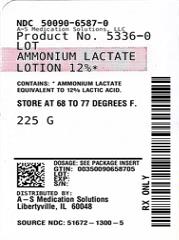
Ammonium Lactate 120 mg/g Lotion, 225 g — NDC 50090-6587-0 (Billing 50090-6587-00)
This is a package of 225 g of Ammonium Lactate 120 mg/g Lotion from A-S Medication Solutions, marketed since May 2004 and currently FDA-listed. It is this product's only package size.
Identity & classification
Regulatory identifiers FDA, NLM and CMS codes for this package
Drug-database identifiers Medi-Span GPI and First Databank GCN / HICL / AHFS classification
- GSN (GCN sequence number): 005826
- GCN: 20941
- HICL (First Databank): 015560
- AHFS class code: 84:24.04.00
- RxCUI (RxNorm): 197362
Where does this data come from?
- FDA openFDA NDC Directory · synced Oct 1, 2026
- FDA label on DailyMed · label index refreshed Oct 1, 2026
- RxNorm (NLM RxNav) · catalog refreshed Oct 1, 2026
- Medi-Span GPI (licensed)
- First Databank (licensed) · refreshed Oct 1, 2026
RxNorm drug class
This medicine belongs to the Organic acids class.
Where does this data come from?
- RxClass (NLM) · catalog refreshed Oct 1, 2026
Clinical
Ammonium lactate is used to treat xerosis (dry or scaly skin) and ichthyosis vulgaris (an inherited dry skin condition) in adults and children. Ammonium lactate is in a class of medications called alpha-hydroxy acids. It works by increasing skin hydration.
Read the full MedlinePlus article ↗Patient education
Supplement & herbal interactions
Where does this data come from?
- MedlinePlus (NLM) · refreshed Oct 1, 2026
- FDA label on DailyMed · label index refreshed Oct 1, 2026
Ask a licensed pharmacist directly — free, answered by our team.
Pricing
A drug doesn't have one price. Each row is a different public payment system, and none is what you'd pay at the counter — that depends on your insurance. The ⓘ on each row explains what it measures.
| Price system | Per g | Per package |
|---|---|---|
| Retail pharmacies payNADAC · weekly | Not in the retail survey — common for institutional, discontinued, or low-volume packs. | |
| Medicaid paysCMS SDUD · 12 mo | No recent Medicaid claims on file for this NDC — rare and low-volume NDCs are suppressed in the public data. | |
| Medicare drug plans payPart D · Q2 2026 | $0.0857 | $19.28 / 225 g |
Where does this data come from?
- CMS NADAC weekly file
- CMS ASP pricing files · refreshed Sep 20, 2026
- CMS Medicaid State Drug Utilization Data · refreshed Oct 3, 2026
- CMS Part D plan pricing files · refreshed Sep 24, 2026
- VA National Acquisition Center price file
Packaging — all sizes for this product
| Package NDC | Description | Marketing start | Marketing end | Status |
|---|---|---|---|---|
| 50090-6587-00 You're viewing this Main listing | 225 g in 1 BOTTLE, PLASTIC | 2023-08-10 | — | Active |
Therapeutic equivalents
| Product | Labeler | Pack | NADAC/unit | TE | Status | Price vs. this |
|---|---|---|---|---|---|---|
| Ammonium Lactate 120 mg/g 51672-1301-00 | Sun | 385 g | $0.067 | AB | Availability likely | — |
| Ammonium Lactate 12 g/100g 45802-0419-26 | Padagis | 400 g | $0.072 | AB | Availability likely | — |
| Ammonium Lactate 120 mg/g 51672-1300-05 | Sun | 225 g | $0.073 | AB | Availability likely | — |
| Ammonium Lactate 120 mg/gthis 50090-6587-00 | A-S | 225 g | — | AB | FDA listed | — |
| Ammonium Lactate 12 g/100g 63629-8610-01 | Bryant | 225 g | — | AB | FDA listed | — |
| Ammonium Lactate 12 g/100g 63629-8611-01 | Bryant | 400 g | — | AB | FDA listed | — |
| Ammonium Lactate 12 g/100g 72162-1407-02 | Bryant | 225 g | — | AB | FDA listed | — |
| Ammonium Lactate 120 mg/g 70518-3619-00 | REMEDYREPACK | 2 tubes | — | AB | FDA listed | — |
Where does this data come from?
- FDA openFDA NDC Directory · synced Oct 1, 2026
- FDA Orange Book · refreshed Sep 3, 2026
- CMS NADAC weekly file
Availability & generic status
This product is an FDA-approved generic. Other versions of the same drug are listed under Therapeutic equivalents, least expensive first.
Where does this data come from?
- FDA Orange Book · refreshed Sep 3, 2026
Inactive Ingredients / Excipients
Inactive ingredients, also called excipients, are components of the drug product other than the active ingredient. They may include fillers, dyes, coatings, preservatives, flavors, or other formulation ingredients.
💡 Tap an ingredient (hover on desktop) to see what it is and why it’s used.
-
UNII 936JST6JCN
Cetyl alcohol is a waxy, fatty substance derived from plant or animal sources. It acts as an emulsifier and thickener in medicines, helping blend oil and water components and giving products a smooth, creamy texture.
-
UNII PDC6A3C0OX
Glycerin is a clear, thick liquid derived from plant oils or fats. It acts as a humectant to retain moisture, a sweetener, and a solvent in medications.
-
UNII 230OU9XXE4
A waxy substance made from glycerin and stearic acid that acts as an emulsifier to blend oily and watery ingredients together. It also helps thicken and stabilize the medicine's texture.
-
UNII 6HQ855798J
Laureth-4 is a synthetic detergent made from lauryl alcohol and ethylene oxide. It acts as an emulsifier and solubilizer, helping blend oil and water-based ingredients and improve how the body absorbs the active drug.
-
UNII N6K5787QVP
Light mineral oil is a clear, odorless liquid derived from petroleum. In medicines, it acts as a lubricant and emollient to help the product spread smoothly and improve texture.
-
UNII 6M3P64V0NC
A fine powder made from magnesium, aluminum, and silicon compounds. It absorbs moisture and helps keep medicine ingredients from clumping or separating, so the product stays stable and flows smoothly during manufacturing.
-
UNII A2I8C7HI9T
Methylparaben is a preservative derived from benzoic acid that prevents growth of bacteria, fungi, and mold in medicines. It extends the product's shelf life and maintains safety during storage.
-
UNII YD01N1999R
A waxy substance made from polyethylene glycol and stearic acid. It helps mix oil and water-based ingredients together and serves as an emulsifier and solubilizer in liquid and semi-solid medicines.
-
UNII 13A4J4NH9I
A synthetic emulsifier derived from stearic acid and polyethylene glycol. It helps mix oil and water-based ingredients together in liquid medicines and creams to create a smooth, uniform product.
-
UNII 6DC9Q167V3
Propylene glycol is a clear liquid derived from petroleum or vegetable sources. It acts as a solvent, humectant, and preservative in medicines, helping dissolve active ingredients and maintain product stability.
-
UNII Z8IX2SC1OH
Propylparaben is a chemical preservative used to prevent bacterial and fungal growth in medicines and personal care products. It helps extend shelf life and maintain product safety during storage.
-
UNII 059QF0KO0R
Water is a liquid solvent that dissolves and mixes ingredients together in liquid medicines, syrups, and injections. It helps distribute the active drug evenly throughout the product.
12 inactive ingredients listed in the exact product block matched to this NDC.
Where does this data come from?
ingredient classCode="IACT" elements from the exact product block matched by this NDC. Label-section narrative from DailyMed / the openFDA label index is shown separately when available.- FDA label on DailyMed · label index refreshed Oct 1, 2026
- FDA openFDA NDC Directory · synced Oct 1, 2026
Inactive ingredient FAQ
Are inactive ingredients the same for every manufacturer?
Why might an inactive ingredient be missing?
Can inactive ingredients matter?
Manufacturer & labeler
Where does this data come from?
- FDA openFDA NDC Directory · synced Oct 1, 2026
- Drugs@FDA
Full prescribing information FDA SPL
🎯 Indications and Usage ▾
INDICATIONS AND USAGE Ammonium Lactate Lotion is indicated for the treatment of dry, scaly skin (xerosis) and ichthyosis vulgaris and for temporary relief of itching associated with these conditions.
⏱️ Dosage and Administration ▾
DOSAGE AND ADMINISTRATION Shake well. Apply to the affected areas and rub in thoroughly. Use twice daily or as directed by a physician.
⛔ Contraindications ▾
CONTRAINDICATIONS Ammonium Lactate Lotion is contraindicated in those patients with a history of hypersensitivity to any of the label ingredients.
⚠️ Warnings ▾
WARNINGS Sun exposure to areas of the skin treated with Ammonium Lactate Lotion, 12% should be minimized or avoided (see PRECAUTIONS section). The use of Ammonium Lactate Lotion should be discontinued if hypersensitivity is observed.
🤒 Adverse Reactions ▾
ADVERSE REACTIONS The most frequent adverse experiences in patients with xerosis are transient stinging (1 in 30 patients), burning (1 in 30 patients), erythema (1 in 50 patients) and peeling (1 in 60 patients). Other adverse reactions which occur less frequently are irritation, eczema, petechiae, dryness and hyperpigmentation. Due to the more severe initial skin conditions associated with ichthyosis, there was a higher incidence of transient stinging, burning and erythema (each occurring in 1 in 10 patients).
🤰 Pregnancy ▾
Pregnancy Teratogenic effects Animal reproduction studies have been performed in rats and rabbits at doses up to 0.7 and 1.5 times the human dose respectively (600 mg/kg/day, corresponding to 3600 mg/m 2 /day in the rat and 7200 mg/m 2 /day in the rabbit) and have revealed no evidence of impaired fertility or harm to the fetus due to ammonium lactate formulations. There are, however, no adequate and well-controlled studies in pregnant women. Because animal reproduction studies are not always predictive of human response, Ammonium Lactate Lotion should be used during pregnancy only if clearly needed.
🧒 Pediatric Use ▾
Pediatric Use Safety and effectiveness of Ammonium Lactate Lotion have been demonstrated in infants and children. No unusual toxic effects were reported.
🧓 Geriatric Use ▾
Geriatric Use Clinical studies of Ammonium Lactate Lotion 12% did not include sufficient numbers of subjects aged 65 and over to determine whether they respond differently from younger subjects. Other reported clinical experience has not identified differences in responses between elderly and younger patients. In general, dose selection for an elderly patient should be cautious.
🆘 Overdosage ▾
OVERDOSAGE The oral administration of Ammonium Lactate Lotion to rats and mice showed this drug to be practically non-toxic (LD 50 >15 mL/kg).
🧬 Clinical Pharmacology ▾
CLINICAL PHARMACOLOGY Lactic acid is an alpha-hydroxy acid. It is a normal constituent of tissues and blood. The alpha-hydroxy acids (and their salts) may act as humectants when applied to the skin.
This property may influence hydration of the stratum corneum. In addition, lactic acid, when applied to the skin, may act to decrease corneocyte cohesion. The mechanism(s) by which this is accomplished is not yet known.
An in vitro study of percutaneous absorption of Ammonium Lactate Lotion using human cadaver skin indicates that approximately 5.8% of the material was absorbed after 68 hours.
📦 How Supplied / Storage and Handling ▾
HOW SUPPLIED Product: 50090-6587 NDC: 50090-6587-0 225 g in a BOTTLE, PLASTIC
📋 Description ▾
DESCRIPTION *Ammonium Lactate Lotion, 12% specially formulates 12% lactic acid, as ammonium lactate to provide a lotion pH of 4.5 to 5.5. Ammonium Lactate Lotion also contains cetyl alcohol, glycerin, glyceryl monostearate, laureth-4, light mineral oil, magnesium aluminum silicate, methylcellulose, methylparaben, polyoxyethylene 100 stearate, polyoxyl stearate type II, propylene glycol, propylparaben, purified water, and for pH adjustment: lactic acid. Lactic acid is a racemic mixture of 2-hydroxypropanoic acid and has the following structural formula: Chemical Structure
💬 Information for Patients ▾
Information for Patients Patients using Ammonium Lactate Lotion, 12% should receive the following information and instructions: This medication is to be used as directed by the physician, and should not be used for any disorder other than for which it was prescribed. It is for external use only. Avoid contact with eyes, lips, or mucous membranes.
Patients should minimize or avoid use of this product on areas of the skin that may be exposed to natural or artificial sunlight, including the face. If sun exposure is unavoidable, clothing should be worn to protect the skin. This medication may cause transient stinging or burning when applied to skin with fissures, erosions, or abrasions (for example, after shaving the legs).
If the skin condition worsens with treatment, the medication should be promptly discontinued.
⚠️ Precautions ▾
PRECAUTIONS General For external use only. Stinging or burning may occur when applied to skin with fissures, erosions or that is otherwise abraded (for example, after shaving the legs). Caution is advised when used on the face because of the potential for irritation.
The potential for post-inflammatory hypo- or hyperpigmentation has not been studied. Information for Patients Patients using Ammonium Lactate Lotion, 12% should receive the following information and instructions: This medication is to be used as directed by the physician, and should not be used for any disorder other than for which it was prescribed. It is for external use only.
Avoid contact with eyes, lips, or mucous membranes. Patients should minimize or avoid use of this product on areas of the skin that may be exposed to natural or artificial sunlight, including the face. If sun exposure is unavoidable, clothing should be worn to protect the skin.
This medication may cause transient stinging or burning when applied to skin with fissures, erosions, or abrasions (for example, after shaving the legs). If the skin condition worsens with treatment, the medication should be promptly discontinued. Carcinogenesis, Mutagenesis, Impairment of Fertility The topical treatment of CD-1 mice with 12%, 21% or 30% ammonium lactate formulations for two years did not produce a significant increase in dermal or systemic tumors in the absence of increased exposure to ultraviolet radiation.
The maximum systemic exposure of the mice in this study was 0.7 times the maximum possible systemic exposure in humans. However, a long-term photocarcinogenicity study in hairless albino mice suggested that topically applied 12% ammonium lactate formulations enhanced the rate of ultraviolet light-induced skin tumor formation. The mutagenic potential of ammonium lactate formulations was evaluated in the Ames assay and in the mouse in vivo micronucleus assay, both of which were negative.
In dermal Segment I and III studies with ammonium lactate formulations there were no effects observed in fertility or pre- or post-natal development parameters in rats at dose levels of 300 mg/kg/day (1800 mg/m 2 /day), approximately 0.4 times the human topical dose. Pregnancy Teratogenic effects Animal reproduction studies have been performed in rats and rabbits at doses up to 0.7 and 1.5 times the human dose respectively (600 mg/kg/day, corresponding to 3600 mg/m 2 /day in the rat and 7200 mg/m 2 /day in the rabbit) and have revealed no evidence of impaired fertility or harm to the fetus due to ammonium lactate formulations.
There are, however, no adequate and well-controlled studies in pregnant women. Because animal reproduction studies are not always predictive of human response, Ammonium Lactate Lotion should be used during pregnancy only if clearly needed. Nursing Mothers Although lactic acid is a normal constituent of blood and tissues, it is not known to what extent this drug affects normal lactic acid levels in human milk.
Because many drugs are excreted in human milk, caution should be exercised when Ammonium Lactate Lotion is administered to a nursing woman. Pediatric Use Safety and effectiveness of Ammonium Lactate Lotion have been demonstrated in infants and children. No unusual toxic effects were reported.
Geriatric Use Clinical studies of Ammonium Lactate Lotion 12% did not include sufficient numbers of subjects aged 65 and over to determine whether they respond differently from younger subjects. Other reported clinical experience has not identified differences in responses between elderly and younger patients. In general, dose selection for an elderly patient should be cautious.
🍼 Nursing Mothers ▾
Nursing Mothers Although lactic acid is a normal constituent of blood and tissues, it is not known to what extent this drug affects normal lactic acid levels in human milk. Because many drugs are excreted in human milk, caution should be exercised when Ammonium Lactate Lotion is administered to a nursing woman.
📄 Carcinogenesis, Mutagenesis, Impairment of Fertility ▾
Carcinogenesis, Mutagenesis, Impairment of Fertility The topical treatment of CD-1 mice with 12%, 21% or 30% ammonium lactate formulations for two years did not produce a significant increase in dermal or systemic tumors in the absence of increased exposure to ultraviolet radiation. The maximum systemic exposure of the mice in this study was 0.7 times the maximum possible systemic exposure in humans. However, a long-term photocarcinogenicity study in hairless albino mice suggested that topically applied 12% ammonium lactate formulations enhanced the rate of ultraviolet light-induced skin tumor formation.
The mutagenic potential of ammonium lactate formulations was evaluated in the Ames assay and in the mouse in vivo micronucleus assay, both of which were negative. In dermal Segment I and III studies with ammonium lactate formulations there were no effects observed in fertility or pre- or post-natal development parameters in rats at dose levels of 300 mg/kg/day (1800 mg/m 2 /day), approximately 0.4 times the human topical dose.
📄 Package Label / Principal Display Panel ▾
AMMONIUM LACTATE Label Image
Medicare Part D spend CMS · PART D · 2026 (Q1)
About this NDC listing & data coverage
What data is (and isn’t) available for this NDC — tap to expand
| NDC identity (package / product / labeler codes) | ✓ Available |
| Labeler | ✓ Available |
| Product & package description | ✓ Available |
| Marketing category & status | ✓ Available |
| Active ingredient / dosage form / route | ✓ Available |
| FDA label (SPL via DailyMed) | ✓ Available |
| Package photos | ✓ Available |
| Inactive ingredients (structured) | ✓ Available |
| NADAC pharmacy acquisition price (CMS) | — Not published for this NDC CMS publishes NADAC only for NDCs reported in its retail-pharmacy survey. |
| Orange Book / therapeutic-equivalence data | ✓ Available |
| HCPCS J-code billing crosswalk | — Not published for this NDC Most self-administered / retail products have no J-code — that is normal. |
| Medicaid utilization (CMS SDUD) | — Not published for this NDC CMS reports utilization only for NDCs with Medicaid claims above its privacy threshold. |