
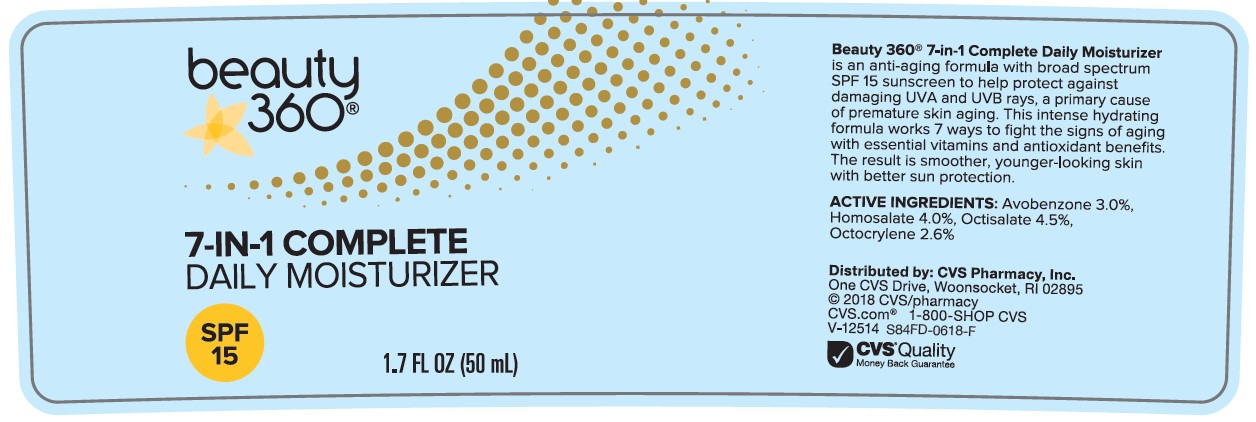
CVS Beauty 360 7-in-1 Complete Daily Moisturizer Anti-Aging Formula with Broad Spectrum SPF 15 Sunscreen Avobenzone, Homosalate, Octisalate, Octocrylene 30 mg/mL; 40 mg/mL; 26 mg/mL; 45 mg/mL Lotion
🆔 Identity & classification
Where does this data come from?
🏭 Manufacturer & labeler
Where does this data come from?
🩺 Clinical
This is a topical lotion formulated as a daily moisturizer with added sun protection. It contains four UV-filtering agents (avobenzone, homosalate, octisalate, and octocrylene) that are commonly used in sunscreen products to help protect skin from ultraviolet radiation. The product is marketed as an over-the-counter monograph drug, meaning it follows FDA's established rules for sunscreen and moisturizer ingredients rather than undergoing individual product review.
Patient education
Supplement & herbal interactions
Where does this data come from?
Ask a licensed pharmacist directly — free, answered by our team.
🧪 Inactive Ingredients / Excipients
Inactive ingredients, also called excipients, are components of the drug product other than the active ingredient. They may include fillers, dyes, coatings, preservatives, flavors, or other formulation ingredients.
💡 Tap an ingredient (hover on desktop) to see what it is and why it’s used.
-
UNII 9E8X80D2L0
A synthetic form of vitamin E used as an antioxidant and preservative in medications. It helps prevent the active ingredients from degrading when exposed to oxygen or light.
-
UNII XF417D3PSL
Anhydrous citric acid is a sour, crystalline powder derived from citric acid with water removed. In medicines, it acts as a buffer to control pH, adds tartness to improve taste, and helps tablets disintegrate.
-
UNII PQ6CK8PD0R
Ascorbic acid, also known as vitamin C, is a white crystalline powder. It serves as an antioxidant to prevent degradation of other ingredients and may also function as a preservative in the formulation.
-
UNII 1P9D0Z171K
BHT is a synthetic antioxidant that prevents fats and oils in medicines from breaking down and becoming rancid. It helps keep the product stable and effective during storage.
-
UNII 3XUS85K0RA
Butylene glycol is a clear liquid derived from petroleum or plants that acts as a humectant, solvent, and preservative booster in medicines. It helps keep formulations stable, dissolve active ingredients, and maintain moisture in topical products.
-
UNII 9I2BJY2J17
A plant extract from tea flowers used as a natural coloring agent and antioxidant in medicines. It helps maintain product stability and may provide a subtle color to the formulation.
-
UNII 00YIU5438U
Caprylyl glycol is a clear liquid derived from coconut oil. In medicines, it acts as a humectant to retain moisture, a preservative booster to prevent microbial growth, and a solvent to help dissolve or mix other ingredients.
-
UNII 09FUA47KNA
Cetearyl glucoside is a plant-derived surfactant made from vegetable oils and glucose. It helps oils and water mix together in creams and lotions, and can also soften and smooth the skin feel of the product.
-
UNII 2DMT128M1S
A waxy solid derived from plant or animal sources. It acts as an emulsifier to blend oil and water components, and also thickens the medicine to give it the right texture and consistency.
-
UNII 936JST6JCN
Cetyl alcohol is a waxy, fatty substance derived from plant or animal sources. It acts as an emulsifier and thickener in medicines, helping blend oil and water components and giving products a smooth, creamy texture.
-
UNII 92RU3N3Y1O
Dimethicone is a silicone-based oil that acts as an anti-foaming agent and lubricant in medicines. It reduces gas bubbles in liquid formulations and helps coat and protect the stomach lining when ingested.
-
UNII OSA9UP217S
Dimethiconol is a silicone-based lubricant and anti-foaming agent. It reduces friction between tablet components and prevents foam formation during manufacturing and storage.
-
UNII 9G1OE216XY
Docosanol is a waxy, fatty alcohol derived from plant sources. It acts as an emollient and thickener in topical medicines, helping to soften the skin and improve product texture and stability.
-
UNII 7FLD91C86K
Edetate disodium is a chemical compound that binds and removes certain metal ions. In medicines, it acts as a preservative and stabilizer by preventing metals like calcium from interfering with the product's shelf life and consistency.
-
UNII PDC6A3C0OX
Glycerin is a clear, thick liquid derived from plant oils or fats. It acts as a humectant to retain moisture, a sweetener, and a solvent in medications.
-
UNII KEH0A3F75J
Hexylene glycol is a clear liquid alcohol used as a solvent and preservative in medicines. It helps dissolve other ingredients and keeps the product stable during storage.
-
UNII UG00KM4WR7
A plastic polymer used as a container material and film coating. It helps protect the medicine from moisture and air exposure during storage and shipping.
-
UNII 86FQE96TZ4
A synthetic polymer, this ingredient acts as a thickener and suspending agent in liquid formulations. It helps maintain uniform consistency and keeps particles evenly distributed throughout the medicine.
-
UNII 918X1OUF1E
Isohexadecane is a synthetic hydrocarbon oil used as an emollient and solvent in topical medicines. It helps dissolve active ingredients and improves spreadability and absorption through the skin.
-
UNII Q41S464P1R
A synthetic peptide (short protein-like molecule) used in skincare and cosmetic formulations as an active conditioning ingredient to help improve skin texture and appearance. It may function as a humectant or skin-conditioning agent in topical products.
-
UNII RV743D216M
A synthetic peptide derived from fatty acids and amino acids. It functions as a skin-conditioning agent and emollient in topical formulations, helping soften and smooth the product texture while supporting skin hydration.
-
UNII WV9CM0O67Z
Panthenol is a humectant and skin-conditioning agent derived from pantothenic acid. It's added to medicines to help retain moisture and soothe skin irritation.
-
UNII W4X7H8GYFM
Polyethylene glycol (PEA) is a synthetic polymer derived from petroleum. It functions as a solvent, lubricant, and binder in medications to improve texture, reduce sticking, and help bind ingredients together.
-
UNII YD01N1999R
A waxy substance made from polyethylene glycol and stearic acid. It helps mix oil and water-based ingredients together and serves as an emulsifier and solubilizer in liquid and semi-solid medicines.
-
UNII 50C1307PZG
Pentylene glycol is a humectant and preservative helper derived from petroleum or plant sources. It draws moisture into the product and helps prevent bacterial growth, keeping medicines stable during storage.
-
UNII HIE492ZZ3T
Phenoxyethanol is a synthetic preservative and antimicrobial agent used to prevent bacterial and fungal growth in medicines and cosmetic products, extending shelf life and maintaining product safety.
-
UNII 7T1F30V5YH
A synthetic emulsifier derived from sorbitol and oleic acid. It helps mix oil and water-based ingredients together and keeps them from separating in liquid formulations.
-
UNII CAL22UVI4M
A synthetic emulsifier derived from sorbitol and fatty acids. It helps mix oil and water-based ingredients together and improves the texture and stability of the medicine.
-
UNII 4ELV7Z65AP
Stearic acid is a fatty acid derived from plant or animal sources. It acts as a binder and lubricant in tablets and capsules, helping them hold together and flow smoothly during manufacturing.
-
UNII 2KR89I4H1Y
Stearyl alcohol is a waxy, fatty substance derived from natural oils or made synthetically. It acts as an emulsifier and thickener in medicines, helping mix ingredients together and give the product the right texture.
-
UNII 5926LC4S7M
Sucrose dilaurate is a synthetic compound made from sugar and lauric acid. It acts as an emulsifier and surfactant to help mix and stabilize ingredients that normally don't blend well together in medicines.
-
UNII 15FIX9V2JP
Titanium dioxide is a bright white mineral powder commonly used as a colorant and opacifying agent. It makes pills and tablets white or lighter in color and helps make coatings non-transparent.
-
UNII 9O3K93S3TK
Trolamine is an alkaline compound used as a pH buffer and emulsifier in medicines. It helps neutralize acids, stabilize formulations, and enable mixing of oil and water-based ingredients.
-
UNII 059QF0KO0R
Water is a liquid solvent that dissolves and mixes ingredients together in liquid medicines, syrups, and injections. It helps distribute the active drug evenly throughout the product.
34 inactive ingredients listed in the exact product block matched to this NDC.
Label-section wording can be broader than the structured product block and may mention additional formulation ingredients.
Where does this data come from?
ingredient classCode="IACT" elements from the exact product block matched by this NDC. Label-section narrative from DailyMed / the openFDA label index is shown separately when available.Inactive ingredient FAQ
Are inactive ingredients the same for every manufacturer?
Why might an inactive ingredient be missing?
Can inactive ingredients matter?
💲 Pricing
A drug doesn't have one price. Each row is a different public payment system, and none is what you'd pay at the counter — that depends on your insurance. The ⓘ on each row explains what it measures.
| Price system | Per g | Per package |
|---|---|---|
| Retail pharmacies payNADAC · weekly | Not in the retail survey — common for institutional, discontinued, or low-volume packs. | |
| Medicaid paysCMS SDUD · 12 mo | No recent Medicaid claims on file for this NDC — rare and low-volume NDCs are suppressed in the public data. | |
| Medicare drug plans payPart D · quarterly | No Part D plan price is available for this NDC in our data. | |
Where does this data come from?
🔁 Therapeutic equivalents
| Product | Labeler | Pack | NADAC/unit | TE | Status | Price vs. this |
|---|---|---|---|---|---|---|
| CVS Beauty 360 7-in-1 Complete Daily Moisturizer Anti-Aging Formula with Broad Spectrum SPF 15 Sunscreen 30 mg/mL; 40 mg/mL; 26 mg/mL; 45 mg/mLthis 51316-0049-01 | CVS | 1 bottle | — | — | FDA listed | — |
Where does this data come from?
⏳ Availability & generic status
We did not find an FDA-approved generic match for this exact strength, form and route.
Where does this data come from?
🔬 Reported adverse events (FAERS)
Top reported reactions
Age at onset
Reporter sex
Serious outcomes
Where does this data come from?
📦 Packaging — all sizes for this product
| Package NDC | Description | Marketing start | Status |
|---|---|---|---|
| 51316-0049-01 You're viewing this | 1 BOTTLE, PLASTIC in 1 BOX (51316-049-01) / 50 mL in 1 BOTTLE, PLASTIC (51316-049-17) | 2018-06-13 | Active |
🧭 About this NDC listing & data coverage
What data is (and isn’t) available for this NDC — tap to expand
| NDC identity (package / product / labeler codes) | ✓ Available |
| Labeler | ✓ Available |
| Product & package description | ✓ Available |
| Marketing category & status | ✓ Available |
| Active ingredient / dosage form / route | ✓ Available |
| FDA label (SPL via DailyMed) | ✓ Available |
| Package photos | ✓ Available |
| Inactive ingredients (structured) | ✓ Available |
| NADAC pharmacy acquisition price (CMS) | — Not published for this NDC CMS publishes NADAC only for NDCs reported in its retail-pharmacy survey. |
| Orange Book / therapeutic-equivalence data | — Not published for this NDC Applies only to products approved under an NDA/ANDA; many listings are out of scope. |
| HCPCS J-code billing crosswalk | — Not published for this NDC Most self-administered / retail products have no J-code — that is normal. |
| Medicaid utilization (CMS SDUD) | — Not published for this NDC CMS reports utilization only for NDCs with Medicaid claims above its privacy threshold. |
Questions about this listing
Is this NDC FDA-approved?
Why is there no price listed?
Is the NDC printed on the package the same as the 11-digit billing NDC?
What do the three segments of this NDC mean?
Is this package still being marketed?
Who lists this product with the FDA?
Do I need a prescription for this product?
Where does this data come from?
📄 FDA label — Drug Facts FDA SPL
🎯 Indications and Usage ▾
Uses helps prevent sunburn if used as directed with other sun protection measures (see Directions ), decreases the risk of skin cancer and early skin aging caused by the sun
⏱️ Dosage and Administration ▾
Directions • apply liberally 15 minutes before sun exposure •use a water resistant sunscreen if swimming or sweating • reapply at least every 2 hours • Sun Protection Measures. Spending time in the sun increases your risk of skin cancer and early skin aging. To decrease this risk, regularly use a sunscreen with a Broad Spectrum SPF value of 15 or higher and other sun protection measures including: • limit time in the sun, especially from 10 a.m. - 2 p.m. • wear long-sleeved shirts, pants, hats, and sunglasses • children under 6 months: Ask a doctor
⚠️ Warnings ▾
Warnings For external use only
🧪 Active Ingredient ▾
Active ingredients Avobenzone 3.0%, Homosalate 4.0%, Octisalate 4.5%, Octocrylene 2.6%
🧪 Inactive Ingredients ▾
Inactive ingredients WATER, GLYCERIN, CETEARYL ALCOHOL, SUCROSE DILAURATE, PISUM SATIVUM (PEA) EXTRACT, BUTYLENE GLYCOL, PALMITOYL OLIGOPEPTIDE, PALMITOYL TETRAPEPTIDE-7, POLYETHYLENE, DIMETHICONE, HYDROXYETHYL ACRYLATE/SODIUM ACRYLOYLDIMETHYL TAURATE COPOLYMER, PENTYLENE GLYCOL, ASCORBIC ACID, CAMELLIA SINENSIS LEAF EXTRACT, STEARYL ALCOHOL, ISOHEXADECANE, CETYL ALCOHOL, PANTHENOL, TOCOPHERYL ACETATE, BEHENYL ALCOHOL, DIMETHICONOL, CETEARYL GLUCOSIDE, PEG-100 STEARATE, DISODIUM EDTA, STEARIC ACID, BHT, POLYSORBATE 60, CAPRYLYL GLYCOL, PHENOXYETHANOL, HEXYLENE GLYCOL, TRIETHANOLAMINE, CITRIC ACID, CARBOMER, POLYSORBATE-20, TITANIUM DIOXIDE.
🎯 Purpose ▾
Purpose Sunscreen