
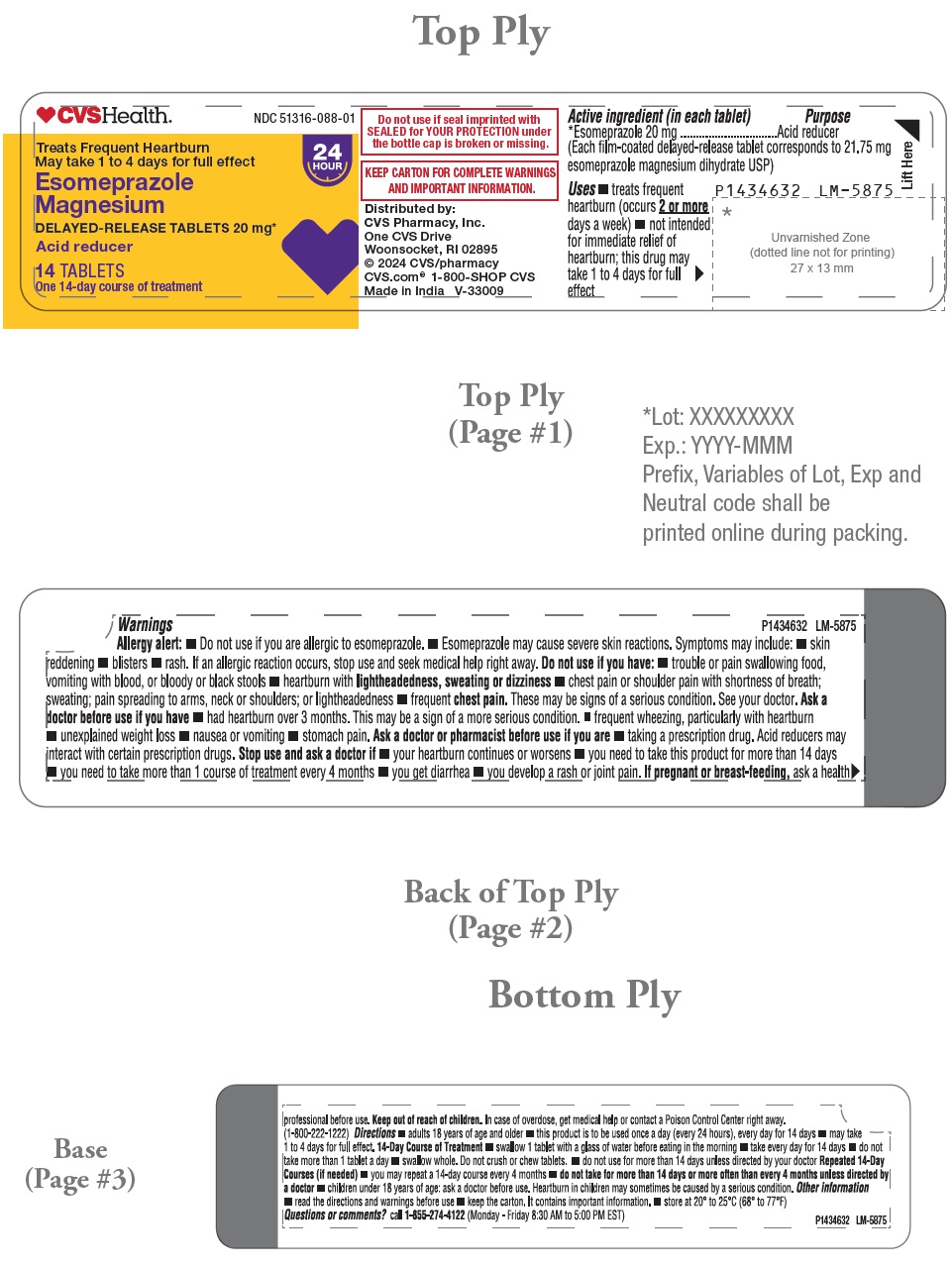
Esomeprazole Magnesium 20 mg Tablet, Delayed Release, 14-count
Other active recalls for Esomeprazole Magnesium (different manufacturers) — 3 · tap to view
🆔 Identity & classification
Where does this data come from?
🏷️ RxNorm drug class
This medicine belongs to the Proton Pump Inhibitor class.
Where does this data come from?
🏭 Manufacturer & labeler
Where does this data come from?
🩺 Clinical
- It's blocking the 'acid pump' — a tiny enzyme in your stomach lining that releases acid. By shutting down that pump, esomeprazole cuts the amount of acid your stomach produces, giv...
- What is esomeprazole actually doing in my body?
- Before eating is best — ideally at least 30 minutes before your first meal of the day. Food can reduce how much of the medicine your body absorbs by nearly half, so timing really d...
- Should I take it before or after eating?
Patient education
Supplement & herbal interactions
Some supplements/herbs that may interact with Esomeprazole Magnesium — tap one for details:
Esomeprazole Magnesium may be associated with lower levels of 9 nutrients — worth a chat with your pharmacist, not a cause for alarm.
Where does this data come from?
Ask a licensed pharmacist directly — free, answered by our team.
🧪 Inactive Ingredients / Excipients
Inactive ingredients, also called excipients, are components of the drug product other than the active ingredient. They may include fillers, dyes, coatings, preservatives, flavors, or other formulation ingredients.
💡 Tap an ingredient (hover on desktop) to see what it is and why it’s used.
-
UNII 68401960MK
Crospovidone is a synthetic polymer made from polyvinylpyrrolidone. It acts as a disintegrant, helping tablets break apart quickly in the stomach so the medicine dissolves and absorbs into the body.
-
UNII IY9XDZ35W2
Dextrose is a simple sugar derived from corn or other sources. It serves as a filler and sweetener in medicines to add bulk, improve taste, and help stabilize the medication's form.
-
UNII 1K09F3G675
Ferric oxide red is an inorganic iron compound used as a colorant in medicines. It gives tablets, capsules, or other dosage forms a red or reddish tint for identification and appearance.
-
UNII EX438O2MRT
Ferric oxide yellow is a naturally occurring iron compound used as a colorant in medications. It gives tablets, capsules, and other forms a yellow or golden hue for identification and appearance.
-
UNII KC98RO82HJ
A waxy substance made from glycerin and fatty acids. It acts as an emulsifier to help mix oil and water components, and as a thickener to give the medicine proper texture and consistency.
-
UNII KZQ570MOA5
A plant-based thickener and binder made from cellulose. It helps hold tablet ingredients together, controls how quickly the medicine dissolves, and improves texture in liquid formulations.
-
UNII 0VUT3PMY82
Hypromellose 2910 is a plant-derived thickening agent made from cellulose. In medicines, it forms protective coatings on tablets or capsules, controls how fast the drug releases, and thickens liquid formulations.
-
UNII 0WZ8WG20P6
Hypromellose 2910 is a plant-based cellulose derivative that acts as a thickener, binder, and film-coating agent. It helps control how quickly the medicine dissolves and protects the tablet or capsule from moisture and light.
-
UNII 7773C1ROEU
Low-substituted hydroxypropyl cellulose is a plant-derived thickener and binder made from cellulose. In medicines, it helps bind tablet ingredients together, controls how quickly the medicine dissolves, and improves texture in liquids and semi-solid formulations.
-
UNII 0E53J927NA
Magnesium carbonate is a mineral powder used in medicines as a filler to add bulk and as a buffer to help regulate acidity in the formulation.
-
UNII 3A3U0GI71G
Magnesium oxide is a mineral compound that acts as a buffer and filler in medications. It helps neutralize stomach acid and adds bulk to the tablet or capsule formulation.
-
UNII NX76LV5T8J
A synthetic plastic polymer made from methacrylic acid and ethyl acrylate. It's used as a coating or binder to control how and where the medicine dissolves in your digestive system.
-
UNII W7YXH6D4BD
A plant-derived cellulose processed into tiny crystals. It serves as a binder to hold tablet ingredients together and as a filler to give the medicine its shape and size.
-
UNII 91B875MM4H
A plant-derived cellulose processed into tiny crystals. It acts as a filler to give tablets bulk and shape, and helps the medicine break apart properly when swallowed.
-
UNII 30IQX730WE
Polyethylene glycol 6000 is a synthetic polymer made from ethylene glycol units. It acts as a binder, filler, and solubilizer in medicines to help hold ingredients together, add bulk, and improve how well active drugs dissolve and absorb.
-
UNII 6OZP39ZG8H
Polysorbate 80 is a synthetic emulsifier derived from sorbitol and oleic acid. It helps mix oil and water-based ingredients together in medications and improves how the product disperses in the body.
-
UNII ETJ7Z6XBU4
Silicon dioxide is a naturally occurring mineral used as a glidant and anti-caking agent. It helps powder ingredients flow smoothly and prevents clumping during manufacturing and storage.
-
UNII 368GB5141J
A detergent and foaming agent derived from coconut or palm oil. In medications, it helps break down and mix oil and water-based ingredients, aids in tablet disintegration, and improves how the drug dissolves and spreads in the mouth or digestive system.
-
UNII 7CV7WJK4UI
Sodium stearyl fumarate is a synthetic compound made from stearyl alcohol and fumaric acid. It acts as a lubricant and glidant in tablets and capsules, helping ingredients flow smoothly during manufacturing and preventing sticking.
-
UNII O8232NY3SJ
A plant-based carbohydrate derived from corn kernels. It acts as a filler to add bulk, a binder to hold ingredients together, and a disintegrant to help the tablet break apart in your stomach for absorption.
-
UNII C151H8M554
A natural sugar derived from sugar cane or sugar beets. It's used as a sweetener, filler, and binder to improve taste, add bulk, and help hold tablet or capsule ingredients together.
-
UNII 7SEV7J4R1U
A powder made from a naturally occurring mineral. In medicines, talc works as a glidant and anti-caking agent, helping tablets and capsules flow smoothly during manufacturing and preventing clumping.
-
UNII 15FIX9V2JP
Titanium dioxide is a bright white mineral powder commonly used as a colorant and opacifying agent. It makes pills and tablets white or lighter in color and helps make coatings non-transparent.
-
UNII 8Z96QXD6UM
Triethyl citrate is a clear liquid derived from citric acid. It acts as a plasticizer and solvent in tablet coatings and film formulations, helping the coating remain flexible and adhere properly to the medicine.
24 inactive ingredients listed in the exact product block matched to this NDC.
Label-section wording can be broader than the structured product block and may mention additional formulation ingredients.
Where does this data come from?
ingredient classCode="IACT" elements from the exact product block matched by this NDC. Label-section narrative from DailyMed / the openFDA label index is shown separately when available.Inactive ingredient FAQ
Are inactive ingredients the same for every manufacturer?
Why might an inactive ingredient be missing?
Can inactive ingredients matter?
💲 Pricing
A drug doesn't have one price. Each row is a different public payment system, and none is what you'd pay at the counter — that depends on your insurance. The ⓘ on each row explains what it measures.
| Price system | Per each | Per package |
|---|---|---|
| Retail pharmacies payNADAC · weekly | Not in the retail survey — common for institutional, discontinued, or low-volume packs. | |
| Medicaid paysCMS SDUD · 12 mo | No recent Medicaid claims on file for this NDC — rare and low-volume NDCs are suppressed in the public data. | |
| Medicare drug plans payPart D · quarterly | No Part D plan price is available for this NDC in our data. | |
Where does this data come from?
🔁 Therapeutic equivalents
| Product | Labeler | Pack | NADAC/unit | TE | Status | Price vs. this |
|---|---|---|---|---|---|---|
| Esomeprazole Magnesium 20 mg 00363-0361-42 | WALGREEN | 14 tablets | — | — | FDA listed | — |
| Esomeprazole Magnesium 20 mg 00363-1353-14 | Walgreens | 14 tablets | — | — | FDA listed | — |
| Acid Reducer 20 mg 00363-9977-14 | Walgreens | 14 tablets | — | — | FDA listed | — |
| Nexium 24HR 20 mg 00573-2451-14 | Haleon | 14 tablets | — | — | FDA listed | — |
| Esomeprazole Magnesium 20 mg 43598-0069-42 | Dr. | 14 tablets | — | — | FDA listed | — |
| Esomeprazole Magnesium 20 mgthis 51316-0088-01 | CVS | 14 tablets | — | — | FDA listed | — |
| Esomeprazole Magnesium 20 mg 51316-0563-14 | CVS | 14 tablets | — | — | FDA listed | — |
| Esomeprazole Magnesium 20 mg 58602-0840-05 | Aurohealth | 14 tablets | — | — | FDA listed | — |
| Acid Reducer 20 mg 59726-0056-14 | P | 14 tablets | — | — | Discontinued | — |
| Acid Reducer 20 mg 69842-0679-14 | CVS | 14 tablets | — | — | FDA listed | — |
| Esomeprazole Magnesium 20 mg 70000-0695-01 | Cardinal | 14 tablets | — | — | FDA listed | — |
| Esomeprazole 20 mg 72036-0982-42 | HARRIS | 42 tablets | — | — | FDA listed | — |
| Esomeprazole Magnesium 20 mg 75907-0119-27 | Dr. | 14 tablets | — | — | FDA listed | — |
Where does this data come from?
⏳ Availability & generic status
This product is an FDA-approved generic. Other versions of the same drug are listed under Therapeutic equivalents, least expensive first.
Where does this data come from?
📊 Medicare Part D spend CMS · PART D · 2026 (Q1)
📦 Packaging — all sizes for this product
| Package NDC | Description | Marketing start | Status |
|---|---|---|---|
| 51316-0088-01 You're viewing this | 1 BOTTLE in 1 CARTON (51316-088-01) / 14 TABLET, DELAYED RELEASE in 1 BOTTLE | 2024-07-04 | Active |
| 51316-0088-05 | 3 BOTTLE in 1 CARTON (51316-088-05) / 14 TABLET, DELAYED RELEASE in 1 BOTTLE | 2024-07-04 | Active |
Pack size FAQ
What quantity is in NDC 51316-0088-01?
What NDC number is used to bill for this package of Esomeprazole Magnesium 20 mg Tablet, Delayed Release?
🧭 About this NDC listing & data coverage
What data is (and isn’t) available for this NDC — tap to expand
| NDC identity (package / product / labeler codes) | ✓ Available |
| Labeler | ✓ Available |
| Product & package description | ✓ Available |
| Marketing category & status | ✓ Available |
| Active ingredient / dosage form / route | ✓ Available |
| FDA label (SPL via DailyMed) | ✓ Available |
| Package photos | ✓ Available |
| Inactive ingredients (structured) | ✓ Available |
| NADAC pharmacy acquisition price (CMS) | — Not published for this NDC CMS publishes NADAC only for NDCs reported in its retail-pharmacy survey. |
| Orange Book / therapeutic-equivalence data | — Not published for this NDC Applies only to products approved under an NDA/ANDA; many listings are out of scope. |
| HCPCS J-code billing crosswalk | — Not published for this NDC Most self-administered / retail products have no J-code — that is normal. |
| Medicaid utilization (CMS SDUD) | — Not published for this NDC CMS reports utilization only for NDCs with Medicaid claims above its privacy threshold. |
Questions about this listing
Why is there no price listed?
Is the NDC printed on the package the same as the 11-digit billing NDC?
What do the three segments of this NDC mean?
Is this package still being marketed?
Does this product come in other package sizes?
Who lists this product with the FDA?
Do I need a prescription for this product?
Where does this data come from?
📄 FDA label — Drug Facts FDA SPL
🎯 Indications and Usage ▾
Uses treats frequent heartburn (occurs 2 or more days a week) not intended for immediate relief of heartburn; this drug may take 1 to 4 days for full effect
⏱️ Dosage and Administration ▾
Directions adults 18 years of age and older this product is to be used once a day (every 24 hours), every day for 14 days may take 1 to 4 days for full effect 14-Day Course of Treatment swallow 1 tablet with a glass of water before eating in the morning take every day for 14 days do not take more than 1 tablet a day swallow whole. Do not crush or chew tablets. do not use for more than 14 days unless directed by your doctor Repeated 14-Day Courses (if needed) you may repeat a 14-day course every 4 months do not take for more than 14 days or more often than every 4 months unless directed by a doctor children under 18 years of age: ask a doctor before use.
Heartburn in children may sometimes be caused by a serious condition. Other information read the directions and warnings before use keep the carton. It contains important information. store at 20° to 25°C (68° to 77°F)
⚠️ Warnings ▾
Warnings Allergy alert: ■ Do not use if you are allergic to esomeprazole. ■ Esomeprazole may cause severe skin reactions. Symptoms may include: ■ skin reddening ■ blisters ■ rash If an allergic reaction occurs, stop use and seek medical help right away.
🧪 Active Ingredient ▾
Drug Facts Active ingredient (in each tablet) *Esomeprazole 20 mg (Each film-coated delayed-release tablet corresponds to 21.75 mg esomeprazole magnesium dihydrate USP)
🧪 Inactive Ingredients ▾
Inactive ingredients colloidal silicon dioxide, crospovidone, hydroxy propyl cellulose, hypromellose, low substituted hydroxy propyl cellulose, magnesium carbonate, magnesium oxide, methacrylic acid and ethyl acrylate copolymer dispersion (which contains copolymer based on ethyl acrylate and methacrylic acid, polysorbate 80 and sodium lauryl sulfate), microcrystalline cellulose, mono and di-glycerides, polyethylene glycol, polysorbate 80, red iron oxide, sodium stearyl fumarate, sugar spheres [which contains liquid glucose, starch (maize) and sucrose], talc, titanium dioxide, triethyl citrate and yellow iron oxide.
Questions or comments? call 1-855-274-4122 (Monday – Friday 8:30 AM to 5:00 PM EST) Tips for Managing Heartburn Avoid foods or drinks that are more likely to cause heartburn, such as rich, spicy, fatty and fried foods, chocolate, caffeine, alcohol and even some acidic fruits and vegetables. Eat slowly and do not eat big meals. Do not eat late at night or just before bedtime.
Do not lie flat or bend over soon after eating. Raise the head of your bed. Wear loose-fitting clothing around your stomach.
If you are overweight, lose weight. If you smoke, quit smoking. Distributed by: CVS Pharmacy, Inc.
One CVS Drive, Woonsocket, RI 02895 © 2024 CVS/pharmacy CVS.com ® 1-800-SHOP CVS Made in India
🎯 Purpose ▾
Purpose Acid reducer