
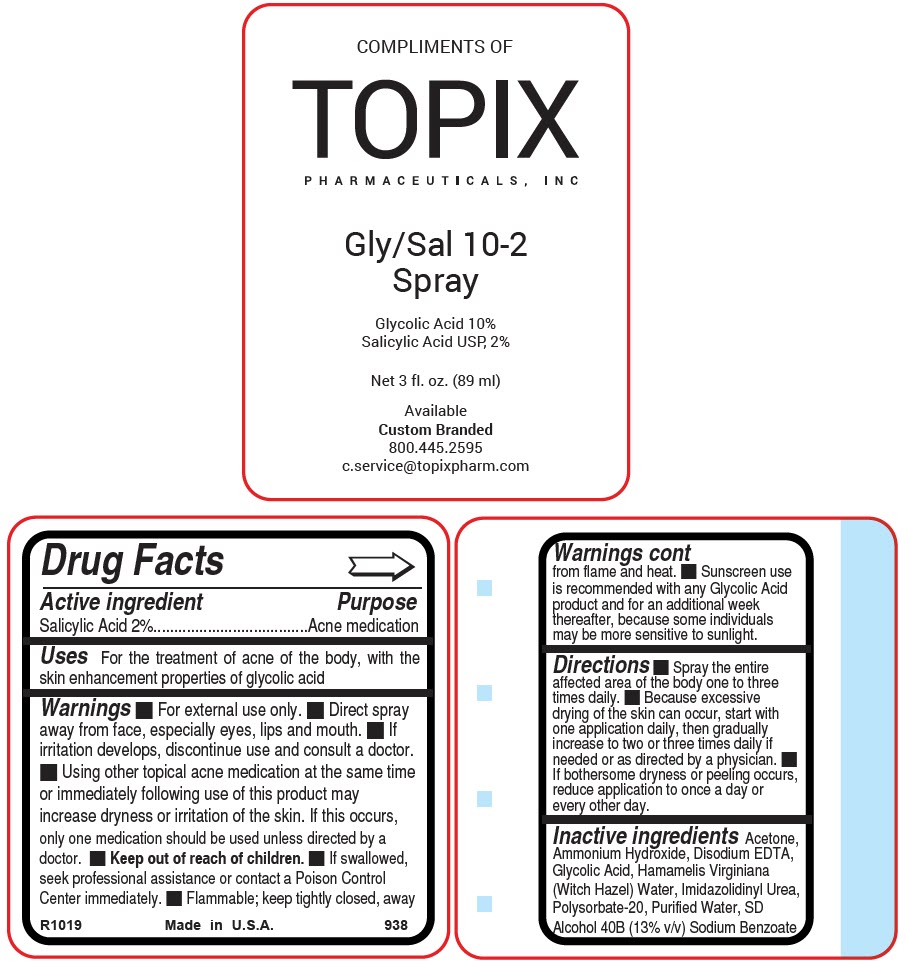
Gly-Sal 10-2 Salicylic Acid 20 mg/mL Liquid, 89 mL — NDC 51326-938-01 (Billing 51326-0938-01)
This is a package of 89 mL of Gly-Sal 10-2 Salicylic Acid 20 mg/mL Liquid from Topiderm, Inc., marketed since Jun 2019 and currently FDA-listed. It is this product's only package size.
NDC database record
One package, one record: these facts belong to NDC 51326-938-01 alone.
- Record
- FDA NDC Directory package listing · Human OTC drug
- Code segments
- 51326 labeler · 938 product · 01 package
- Package marketed since
- Jun 10, 2019
- Sample package
- No — commercial package
- Listing certified through
- Dec 31, 2026
- Barcode (UPC-A, from the NDC)
- 3 5132693801 1
- FDA record last changed
- Jul 24, 2026
Identity & classification
Regulatory identifiers FDA, NLM and CMS codes for this package
- RxCUI (RxNorm): 1048903
Where does this data come from?
- FDA openFDA NDC Directory · synced Oct 8, 2026
- FDA label on DailyMed · label index refreshed Oct 8, 2026
- RxNorm (NLM RxNav) · catalog refreshed Oct 8, 2026
- Medi-Span GPI (licensed)
- First Databank (licensed) · refreshed Oct 8, 2026
RxNorm drug class
This medicine belongs to the Salicylic acid and derivatives class.
Where does this data come from?
- RxClass (NLM) · catalog refreshed Oct 8, 2026
Clinical
Topical salicylic acid is used to help clear and prevent pimples and skin blemishes in people who have acne. Topical salicylic acid is also used to treat skin conditions that involve scaling or overgrowth of skin cells such as psoriasis (a skin disease in which red, scaly patches form on some areas of the body), ichthyoses (inborn conditions that cause skin dryness and scaling), dandruff, corns, calluses, and warts on the hands or feet. Topical salicylic acid should not be used to treat genital warts, warts on the face, warts with hair growing from them, warts in the nose or mouth, moles, or b...
Read the full MedlinePlus article ↗- It is used in a facial routine for acne-prone and oil-prone skin. The routine includes a cleanser, serum, toner and emulsion. Salicylic acid helps loosen and shed dead skin cells.
- Use the cleanser morning and evening, and the serum in the morning after cleansing. Use the toner in the evening on dry skin, and the emulsion at night after cleansing. Avoid your...
- Mild stinging, burning, itching, dryness and extra peeling can happen. If dryness or peeling bothers you, try using the serum or toner every other day. If it gets excessive, stop a...
- It is best not to. Using another topical acne medication at the same time makes irritation and dryness more likely. If you get irritated, use only one at a time.
Patient education
Supplement & herbal interactions
Where does this data come from?
- MedlinePlus (NLM) · refreshed Oct 8, 2026
- FDA label on DailyMed · label index refreshed Oct 8, 2026
Ask a licensed pharmacist directly — free, answered by our team.
Pricing
A drug doesn't have one price. Each row is a different public payment system, and none is what you'd pay at the counter — that depends on your insurance. The ⓘ on each row explains what it measures.
| Price system | Per mL | Per package |
|---|---|---|
| Retail pharmacies payNADAC · weekly | Not in the retail survey — common for institutional, discontinued, or low-volume packs. | |
| Medicaid paysCMS SDUD · 12 mo | No recent Medicaid claims on file for this NDC — rare and low-volume NDCs are suppressed in the public data. | |
| Medicare drug plans payPart D · quarterly | No Part D plan price is available for this NDC in our data. | |
Where does this data come from?
- CMS NADAC weekly file
- CMS ASP pricing files · refreshed Sep 20, 2026
- CMS Medicaid State Drug Utilization Data · refreshed Oct 9, 2026
- CMS Part D plan pricing files · refreshed Sep 24, 2026
- VA National Acquisition Center price file
Packaging — all sizes for this product
| Package NDC | Description | Marketing start | Marketing end | Status |
|---|---|---|---|---|
| 51326-0938-01 You're viewing this Main listing | 89 mL in 1 BOTTLE, PLASTIC | 2019-06-10 | — | Active |
Therapeutic equivalents
| Product | Labeler | Pack | NADAC/unit | TE | Status | Price vs. this |
|---|---|---|---|---|---|---|
| Differin Acne Clearing Body 2 g/100g 00299-4132-00 | Galderma | 170 g | — | — | FDA listed | — |
| PanOxyl Acne Banishing Body (Spray) 2 g/100g 00316-0297-01 | Crown | 170 g | — | — | FDA listed | — |
| Ology Acne Clearing Body Mist 20 mg/mL 00363-9659-10 | Walgreens | 1 tube | — | — | FDA listed | — |
| Sulfur 8 Scalp Therapy Medicated Dandruff Control 20 mg/mL 12022-0032-00 | J. | 355 ml | — | — | FDA listed | — |
| Doo Gro Braids Twists Locs Dandruff Control Moisturizing 20 mg/mL 12022-0041-00 | J. | 335 ml | — | — | FDA listed | — |
| Topicals Clearly Mist 20 mg/mL 51326-0307-01 | Topiderm, | 1 bottle | — | — | FDA listed | — |
| Gly-Sal 10-2 20 mg/mLthis 51326-0938-01 | Topiderm, | 89 ml | — | — | FDA listed | — |
| Pacifica Bacne Warrior 2 g/100mg 61197-0103-00 | Pacifica | 177 mg | — | — | FDA listed | — |
| Neutrogena Stubborn Body Acne Treatment 20 mg/mL 69968-0758-06 | Kenvue | 162 ml | — | — | FDA listed | — |
| Tiege Hanley Acne All Over Body 2 g/100g 71714-0005-01 | Tiege | 1 canister | — | — | FDA listed | — |
| Acne Banishing Body 2 g/100g 72667-0218-06 | Inspec | 170 g | — | — | Discontinued | — |
| Body Acne Treatment 20 mg/g 73318-7007-03 | Skin | 1 bottle | — | — | FDA listed | — |
| Naturium Salicylic Acid Body 2% 20 mg/mL 76354-0124-01 | e.l.f. | 120 ml | — | — | FDA listed | — |
| e.l.f Skin Acne-Treating Body Mist 20 mg/mL 76354-0418-01 | e.l.f. | 1 bottle | — | — | FDA listed | — |
| Bha Toner 2 g/100mL 83286-0018-01 | Drmtlgy, | 189 ml | — | — | FDA listed | — |
| PAPATUI Acne Fighting Body 2 g/100g 83850-0200-00 | PAPATUI, | 170 g | — | — | FDA listed | — |
| First Aid Beauty Body Acne Clearing Mist 2 g/100mL 84126-0120-88 | The | 1 bottle | — | — | FDA listed | — |
| Saltair Acne Bodyspray 2 g/100g 87290-0003-04 | Saltair | 1 bottle | — | — | FDA listed | — |
| Kugig Acne Treatment Sprayer 2 g/100mL 87722-0001-01 | Guangdong | 100 ml | — | — | FDA listed | — |
| Skin Pharmacy Advanced Acne Therapy Clarifying Daily Cleanser 20 mg/mL 69842-0064-01 | CVS | 148 ml | — | — | FDA listed | — |
| Skinpharmacy Advanced Acne Therapy Overnight Salicylic Acid 20 mg/mL 69842-0066-01 | CVS | 1 tube | — | — | FDA listed | — |
| SKIN MEDICA Purifying Foaming Wash 20 mg/mL 00023-4948-05 | Allergan, | 1 bottle | — | — | FDA listed | — |
| Differin Acne Clearing Body Scrub 20 mg/mL 00299-4609-00 | Galderma | 237 ml | — | — | FDA listed | — |
| Sulfur 8 Anti-Dandruff Braid 20 mg/mL 12022-0021-00 | J. | 356 ml | — | — | FDA listed | — |
| Sulfur 8 Fresh Anti-Dandruff 20 mg/mL 12022-0028-00 | J. | 355 ml | — | — | FDA listed | — |
| Sulfur 8 Medicated Dandruff with Salicylic Acid 20 mg/mL 12022-0039-00 | J. | 222 ml | — | — | FDA listed | — |
| Glovers Therapeutic Care 20 mg/mL 12022-0040-00 | J. | 118 ml | — | — | FDA listed | — |
| Signature Care Acne Treatment 20 mg/mL 21130-0722-77 | SAFEWAY, | 177 ml | — | — | FDA listed | — |
| Kiehls Since 1851 Dermatologist Solutions Truly Targeted Acne Clearing Solution 20 mg/mL 49967-0055-01 | L'Oreal | 1 bottle | — | — | FDA listed | — |
| Thayers Since 1847 Natural Remedies Blemish Clearing Witch Hazel Aloe Vera Formula Pads 20 mg/mL 49967-0705-01 | L'Oreal | 60 applicators | — | — | FDA listed | — |
| Dr. Gross AB Acne Daily Breakout 20 mg/mL 51326-0179-01 | Topiderm, | 1 bottle | — | — | FDA listed | — |
| Replenix Acne Gly-Sal 2-2 Foaming Cleanser 20 mg/mL 51326-0929-06 | Topiderm, | 200 ml | — | — | FDA listed | — |
| Medicated Wash 20 mg/mL 67226-1021-01 | Vivier | 150 ml | — | — | FDA listed | — |
| L BRI Pure n Natural Deep Clean Toner 20 mg/mL 71238-0218-00 | L'BRI | 188 ml | — | — | FDA listed | — |
| Peach and Lily Peaches Slices Acne Exfoliating toner 20 mg/mL 81515-0501-01 | Peach | 120 ml | — | — | FDA listed | — |
| Doing The Work Salicylic Acid Acne Treatment 20 mg/mL 84234-0001-00 | Personal | 1 bottle | — | — | FDA listed | — |
| Byoma Acne Clearing Cleanser 20 mg/mL 84821-0007-01 | Byoma | 175 ml | — | — | FDA listed | — |
| PHOFAY Salicylic Acid Acne Treatment Essence 20 mg/mL 87080-0001-00 | Hangzhou | 1 bottle | — | — | FDA listed | — |
| Hero Pore Release Blackhead Clearing 20 mg/mL 10237-0001-00 | Church | 100 ml | — | — | FDA listed | — |
| Up and Up Acne Wash 20 mg/mL 11673-0024-54 | TARGET | 269.1 ml | — | — | FDA listed | — |
| Gly-Sal 5-2 20 mg/mL 51326-0927-01 | Topiderm, | 200 ml | — | — | FDA listed | — |
| Clean and Clear Essentials Acne Toner 20 mg/mL 69968-0820-08 | Kenvue | 240 ml | — | — | FDA listed | — |
| Viaderma Clear Acne Treatment 20 mg/mL 71262-0017-15 | VIADERMA | 1 bottle | — | — | FDA listed | — |
| Naturium Salicylic Acid Serum 2% 20 mg/mL 76354-0122-01 | e.l.f. | 1 bottle | — | — | FDA listed | — |
| OXY Volcanic Ash Acne Face Wash 20 mg/mL 10742-8334-01 | The | 207 ml | — | — | FDA listed | — |
| Clean and Clear Essentials Deep Cleaning Astringent 20 mg/mL 69968-0209-08 | Kenvue | 240 ml | — | — | FDA listed | — |
| Neutrogena Oil Free Acne Wash 20 mg/mL 69968-0675-01 | Kenvue | 12 tubes | — | — | Discontinued | — |
| Neutrogena Oil Free Acne Wash 20 mg/mL 69968-0770-01 | Kenvue | 12 tubes | — | — | Discontinued | — |
| CeraVe Developed with Dermatologists BHA Exfoliating Toner Acne Treatment 20 mg/mL 82046-0291-01 | L'Oreal | 237 ml | — | — | FDA listed | — |
| Byoma Acne Clearing Body Wash 20 mg/mL 84821-0005-01 | Byoma | 400 ml | — | — | FDA listed | — |
| Nativae Milia Acne Serum 20 mg/mL 85065-0557-00 | CDE | 30 ml | — | — | FDA listed | — |
| pHisoderm Clear Confidence Daily Gel Face Wash 20 mg/mL 10742-1412-01 | The | 177 ml | — | — | FDA listed | — |
| Thayers Since 1847 Natural Remedies Double Action Acne Serum 20 mg/mL 49967-0062-01 | L'Oreal | 1 bottle | — | — | FDA listed | — |
| Exuviance Daily Acne Peel 20 mg/mL 58414-0017-02 | NeoStrata | 1 bottle | — | — | FDA listed | — |
| Atrix Clarifying Toner 20 mg/mL 59088-0444-08 | PureTek | 118 ml | — | — | FDA listed | — |
| Neutrogena Clear Pore Oil-Eliminating Astringent 20 mg/mL 69968-0028-08 | Kenvue | 236 ml | — | — | FDA listed | — |
| Sunday Riley Peacekeeper Acne Treatment Serum 20 mg/mL 73001-0505-01 | Sunday | 1 pouch | — | — | FDA listed | — |
| Replenix Gly-Sal 10-2 cleanser 20 mg/mL 51326-0928-01 | Topiderm, | 200 ml | — | — | FDA listed | — |
| Clenziderm Daily Care Foaming Cleanser Acne Treatment 20 mg/mL 62032-0610-11 | Obagi | 118 ml | — | — | FDA listed | — |
| Neutrogena Body Clear Body Wash Pink Grapefruit 20 mg/mL 69968-0910-09 | Kenvue | 250 ml | — | — | FDA listed | — |
| Amazon Basics Acne Wash Acne treatment 20 mg/mL 72288-0955-01 | AMAZON.COM | 177 ml | — | — | FDA listed | — |
| e.l.f. PLZ Clarify Facial Oil 20 mg/mL 76354-0419-01 | e.l.f. | 1 bottle | — | — | FDA listed | — |
| Lancome Paris Clarifique BX-Interceptor Topical Acne Clearing Treatment 20 mg/mL 82046-0955-01 | LOreal | 1 bottle | — | — | FDA listed | — |
| Personal Day Doing the Work Daily Exfoliating Treatment 20 mg/mL 84234-0002-00 | Personal | 1 bottle | — | — | FDA listed | — |
| Thayers Since 1847 Natural Remedies Blemish Clearing Witch Hazel Aloe Vera Formula Toner 20 mg/mL 49967-0523-01 | L'Oreal | 355 ml | — | — | FDA listed | — |
| Lancome Paris Clarifique BX-Interceptor Topical Acne Clearing Treatment 20 mg/mL 51150-0995-01 | SICOS | 1 bottle | — | — | FDA listed | — |
| Clenziderm Pore Therapy Acne Treatment 20 mg/mL 62032-0612-04 | Obagi | 148 ml | — | — | FDA listed | — |
| Neutrogena Oil Free Acne Stress Control Triple Action Toner 20 mg/mL 69968-0521-08 | Kenvue | 237 ml | — | — | FDA listed | — |
| Acne Control Cleanser 20 mg/mL 79903-0339-12 | Walmart | 355 ml | — | — | FDA listed | — |
| Target Up and Up Salicylic Acid Acne Wash 20 mg/mL 82442-0014-87 | TARGET | 236.5 ml | — | — | FDA listed | — |
| Replenix Gly-Sal 2-2 20 mg/mL 51326-0925-01 | Topiderm, | 200 ml | — | — | FDA listed | — |
| Neutrogena Oil-Free Acne Wash Sensitive Skin Facial Cleanser Fragrance Free 20 mg/mL 69968-0889-01 | Kenvue | 14 ml | — | — | FDA listed | — |
| Neutrogena Oil-Free Acne Wash Daily Scrub 20 mg/mL 69968-0908-04 | Kenvue | 124 ml | — | — | FDA listed | — |
| Neutrogena Oil-Free Acne Stress Control Power Clear Scrub 20 mg/mL 69968-0909-04 | Kenvue | 125 ml | — | — | FDA listed | — |
| The Inkey List 360 Acne Clearing Serum 20 mg/mL 81136-0028-01 | Brand | 1 bottle | — | — | FDA listed | — |
| Acne Wash 20 mg/mL 63940-0053-54 | Harmon | 269 ml | — | — | FDA listed | — |
| AGE Bright Clearing Serum 20 mg/mL 68479-0184-00 | Dermalogica, | 3 ml | — | — | FDA listed | — |
| Clean and Clear Acne Exfoliating Cleanser 20 mg/mL 69968-0822-05 | Kenvue | 148 ml | — | — | FDA listed | — |
| Neutrogena Oil Free Acne Wash Pink Grapefruit Facial Cleanser 20 mg/mL 69968-0926-06 | Kenvue | 177 ml | — | — | FDA listed | — |
| Neutrogena Evenly Clear Acne Cleanser 20 mg/mL 69968-0942-01 | Kenvue | 12 tubes | — | — | FDA listed | — |
| pHisoderm Clear Confidence Body Wash 20 mg/mL 10742-1442-01 | The | 295 ml | — | — | FDA listed | — |
| Phisoderm Anti Blemish Body Wash 20 mg/mL 10742-8451-01 | The | 295 ml | — | — | FDA listed | — |
| Neutrogena Oil Free Acne Wash Pink Grapefruit Facial Cleanser 20 mg/mL 69968-0686-06 | Kenvue | 177 ml | — | — | FDA listed | — |
| Salicylic acid 20 mg/mL 76162-0414-32 | Topco | 355 ml | — | — | FDA listed | — |
| Bubble Super Clear Blemish Prevention Serum 20 mg/mL 83509-0001-01 | BUBBLE | 1 bottle | — | — | FDA listed | — |
| Satinique Anti Dandruff Scalp and Hair 20 mg/mL 10056-0536-00 | Access | 280 ml | — | — | FDA listed | — |
| Kroger Clarify Care Acne Wash 20 mg/mL 30142-0945-77 | THE | 177 ml | — | — | FDA listed | — |
| Neutrogena All in 1 Acne Control Daily Scrub 20 mg/mL 69968-0092-04 | Kenvue | 124 ml | — | — | FDA listed | — |
| Neutrogena Body Clear Body Wash 20 mg/mL 69968-0655-09 | Kenvue | 250 ml | — | — | FDA listed | — |
| Neutrogena Oil-Free Acne Wash Pink Grapefruit Foaming Scrub 20 mg/mL 69968-0912-02 | Kenvue | 59 ml | — | — | FDA listed | — |
| Mara Clear Skin Mineral Milk Acne Treatment 20 mg/mL 81461-0002-00 | Mara | 30 ml | — | — | FDA listed | — |
| Atrix Antibacterial Wash 20 mg/mL 59088-0445-08 | PURETEK | 118 ml | — | — | FDA listed | — |
| Neutrogena Oil Free Acne Stress Control Triple Action Toner 20 mg/mL 69968-0925-08 | Kenvue | 236 ml | — | — | FDA listed | — |
| L BRI Deep Clean Toner 20 mg/mL 71238-0921-00 | L'BRI | 177 ml | — | — | FDA listed | — |
| Acne Control Cleanser 20 mg/mL 51316-0893-01 | CVS | 237 ml | — | — | FDA listed | — |
| RFA Purifying Cleanser Clear and Clarify 20 mg/mL 51326-0502-01 | Topiderm, | 1 bottle | — | — | FDA listed | — |
Where does this data come from?
- FDA openFDA NDC Directory · synced Oct 8, 2026
- FDA Orange Book · refreshed Oct 3, 2026
- CMS NADAC weekly file
Availability & generic status
We did not find an FDA-approved generic match for this exact strength, form and route.
Where does this data come from?
- FDA Orange Book · refreshed Oct 3, 2026
Inactive Ingredients / Excipients
Inactive ingredients, also called excipients, are components of the drug product other than the active ingredient. They may include fillers, dyes, coatings, preservatives, flavors, or other formulation ingredients.
🧪 Avoiding an ingredient? See Salicylic Acid Topical inactive ingredients by manufacturer: every current product's list side by side, so you can ask your pharmacy for the version that does not list it.
💡 Tap an ingredient (hover on desktop) to see what it is and why it’s used.
-
UNII 5OCF3O11KX
A plant-derived surfactant made from coconut oil. It helps mix oil and water ingredients together in the formulation and can improve how the medicine spreads or feels on the skin.
-
UNII 7FLD91C86K
Edetate disodium is a chemical compound that binds and removes certain metal ions. In medicines, it acts as a preservative and stabilizer by preventing metals like calcium from interfering with the product's shelf life and consistency.
-
UNII WZB9127XOA
A synthetic red dye used to color medications and make them easier to identify. It serves as a colorant in tablets, capsules, and liquid formulations.
-
UNII I753WB2F1M
FD&C Yellow No. 5 is a synthetic yellow colorant approved by the FDA. It is added to medicines to make pills, tablets, or liquids visually distinct and easier to identify.
-
100 mg / 1 mL
UNII 0WT12SX38S
Glycolic acid is an alpha-hydroxy acid derived from sugar cane that helps dissolve and remove dead skin cells. In topical medicines, it works as an exfoliant and pH adjuster to improve skin penetration and product effectiveness.
-
UNII W2ZU1RY8B0
A plant extract from green tea leaves. It's used as an antioxidant ingredient to help preserve the medicine and maintain its stability during storage.
-
UNII 5Q87K461JO
A synthetic conditioning agent derived from linoleic acid and propylene glycol. It works as an antistatic agent and hair conditioner in topical formulations, helping reduce friction and improve product spreadability.
-
UNII 7T1F30V5YH
A synthetic emulsifier derived from sorbitol and oleic acid. It helps mix oil and water-based ingredients together and keeps them from separating in liquid formulations.
-
UNII 353VA59XH8
A synthetic surfactant derived from petroleum-based alcohols. It helps dissolve and mix oil and water components in liquid formulations, improving the medicine's consistency and how active ingredients distribute throughout the product.
-
UNII O9W3D3YF5U
A synthetic surfactant derived from petroleum-based olefins. It helps dissolve or suspend active ingredients and other substances in liquid formulations, improving how the medicine mixes and flows.
-
UNII 9O3K93S3TK
Trolamine is an alkaline compound used as a pH buffer and emulsifier in medicines. It helps neutralize acids, stabilize formulations, and enable mixing of oil and water-based ingredients.
-
UNII 059QF0KO0R
Water is a liquid solvent that dissolves and mixes ingredients together in liquid medicines, syrups, and injections. It helps distribute the active drug evenly throughout the product.
-
UNII C32PQ86DH4
Zinc PCA is a zinc salt of pyroglutamic acid, a naturally occurring amino acid derivative. It's used in medications as a skin-conditioning agent and to help maintain product stability and texture in topical formulations.
13 inactive ingredients listed in the exact product block matched to this NDC.
Label-section wording can be broader than the structured product block and may mention additional formulation ingredients.
Where does this data come from?
ingredient classCode="IACT" elements from the exact product block matched by this NDC. Label-section narrative from DailyMed / the openFDA label index is shown separately when available.- FDA label on DailyMed · label index refreshed Oct 8, 2026
- FDA openFDA NDC Directory · synced Oct 8, 2026
Inactive ingredient FAQ
Are inactive ingredients the same for every manufacturer?
Why might an inactive ingredient be missing?
Can inactive ingredients matter?
Manufacturer & labeler
More NDCs from Topiderm, Inc. labeler code 51326
- Sanix Alcohol Hand Rub .62 mL/mL Liquid NDC 51326-900-08
- Gly-Sal 2-2 Pads Salicylic Acid 20 mg Cloth NDC 51326-923-01
- Replenix Gly-Sal 2-2 salicylic acid 20 mg/mL Liquid NDC 51326-925-01
- Gly-Sal 5-2 Salicylic Acid 20 mg/mL Liquid NDC 51326-927-01
- Replenix Gly-Sal 10-2 cleanser salicylic acid 20 mg/mL Liquid NDC 51326-928-01
- Replenix Acne Gly-Sal 2-2 Foaming Cleanser Salicylic Acid 20 mg/mL Liquid NDC 51326-929-06
- Blemish Correcting Serum Salicylic Acid 109 mg/mL Liquid NDC 51326-940-01
Where does this data come from?
- FDA openFDA NDC Directory · synced Oct 8, 2026
- Drugs@FDA
FDA label — Drug Facts FDA SPL
🎯 Indications and Usage ▾
Uses For the treatment of acne of the body, with the skin enhancement properties of glycolic acid
⏱️ Dosage and Administration ▾
Directions Spray the entire affected area of the body one to three times daily. Because excessive drying of the skin can occur, start with one application daily, then gradually increase to two or three times daily if needed or as directed by a physician. If bothersome dryness or peeling occurs, reduce application to once a day or every other day.
⚠️ Warnings ▾
Warnings For external use only. Direct spray away from face, especially eyes, lips and mouth. If irritation develops, discontinue use and consult a doctor.
Using other topical acne medication at the same time or immediately following use of this product may increase dryness or irritation of the skin. If this occurs, only one medication should be used unless directed by a doctor. Keep out of reach of children.
If swallowed, seek professional assistance or contact a Poison Control Center immediately. Flammable; keep tightly closed, away from flame and heat. Sunscreen use is recommended with any Glycolic Acid product and for an additional week thereafter, because some individuals may be more sensitive to sunlight.
🧪 Active Ingredient ▾
Active ingredient Salicylic Acid 2%
🧪 Inactive Ingredients ▾
Inactive ingredients Acetone, Ammonium Hydroxide, Disodium EDTA, Glycolic Acid, Hamamelis Virginiana (Witch Hazel) Water, Imidazolidinyl Urea, Polysorbate-20, Purified Water, SD Alcohol 40B (13% v/v) Sodium Benzoate
🎯 Purpose ▾
Purpose Acne medication
📄 Keep Out of Reach of Children ▾
Keep out of reach of children. If swallowed, seek professional assistance or contact a Poison Control Center immediately. Flammable; keep tightly closed, away from flame and heat. Sunscreen use is recommended with any Glycolic Acid product and for an additional week thereafter, because some individuals may be more sensitive to sunlight.
📄 Package Label / Principal Display Panel ▾
PRINCIPAL DISPLAY PANEL - 89 ml Bottle Label COMPLIMENTS OF TOPIX PHARMACEUTICALS, INC Gly/Sal 10-2 Spray Glycolic Acid 10% Salicylic Acid USP, 2% Net 3 fl. oz. (89 ml) Available Custom Branded 800.445.2595 [email protected] PRINCIPAL DISPLAY PANEL - 89 ml Bottle Label
Medicare Part D spend CMS · PART D · 2026 (Q1)
About this NDC listing & data coverage
What data is (and isn’t) available for this NDC — tap to expand
| NDC identity (package / product / labeler codes) | ✓ Available |
| Labeler | ✓ Available |
| Product & package description | ✓ Available |
| Marketing category & status | ✓ Available |
| Active ingredient / dosage form / route | ✓ Available |
| FDA label (SPL via DailyMed) | ✓ Available |
| Package photos | ✓ Available |
| Inactive ingredients (structured) | ✓ Available |
| NADAC pharmacy acquisition price (CMS) | — Not published for this NDC CMS publishes NADAC only for NDCs reported in its retail-pharmacy survey. |
| Orange Book / therapeutic-equivalence data | — Not published for this NDC Applies only to products approved under an NDA/ANDA; many listings are out of scope. |
| HCPCS J-code billing crosswalk | — Not published for this NDC Most self-administered / retail products have no J-code — that is normal. |
| Medicaid utilization (CMS SDUD) | — Not published for this NDC CMS reports utilization only for NDCs with Medicaid claims above its privacy threshold. |