
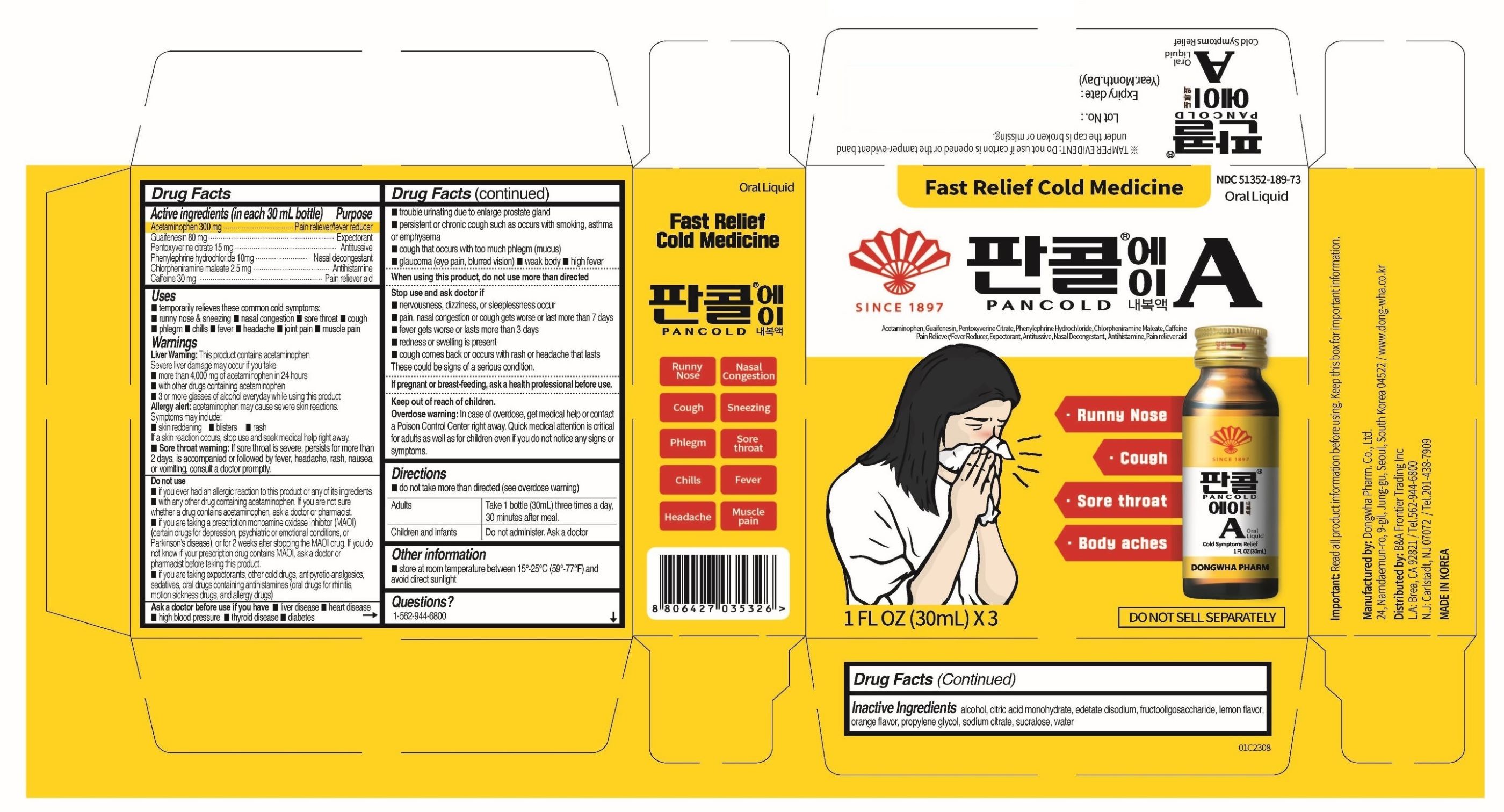
PANCOLD A Acetaminophen, Guaifenesin, Pentoxyverine citrate, Phenylpehrine Hydcrochloride, Chlorpheniramine Maleate, Caffeine Anhydrous 15 mg/30mL; 300 mg/30mL; 80 mg/30mL; 2.5 mg/30mL; 30 mg/30mL; 10 mg/30mL Liquid — NDC 51352-0189-75 package photo

PANCOLD A Acetaminophen, Guaifenesin, Pentoxyverine citrate, Phenylpehrine Hydcrochloride, Chlorpheniramine Maleate, Caffeine Anhydrous 15 mg/30mL; 300 mg/30mL; 80 mg/30mL; 2.5 mg/30mL; 30 mg/30mL; 10 mg/30mL Liquid

by DONGWHA PHARM. CO. LTD. · 5 BOTTLE in 1 CASE (51352-189-75) / 30 mL in 1 BOTTLE
NDC 51352-0189-75
🏷️ FDA NDC (as labeled) 51352-189-75 billing pads the product segment with a zero
This package
Contains30 mL in 1 bottle Pack sizes2 compare ↓
Also comes in: 3 bottles 51352-0189-73
OTC Discontinued Non-controlled ⚠ Discontinued by firm
🗂️ Data synced Sep 17, 2026 · sources: openFDA · FDA label (DailyMed) · FDA Orange & Purple Book · First Databank · CMS NADAC, ASP, Medicare & Medicaid · RxNorm
📋 All sources & update times →
⚠️
Excluded from the active FDA NDC Directory. The labeler reported this product as discontinued, so it is excluded from the active NDC Directory. A label may still appear on DailyMed, but the NDC is no longer in the current FDA NDC Directory. Search the FDA NDC Directory ↗

🆔 Identity & classification

FDA NDC (as labeled) 51352-189-75
Product NDC 51352-189
11-digit billing NDC 51352018975
UNII 4SH0MFJ5HJ, 362O9ITL9D, 495W7451VQ, V1Q0O9OJ9Z, 3G6A5W338E, 04JA59TNSJ
UPC 8806427035326
Application # M012
SPL Set ID fc8f1807-d344-ccc2-e053-6294a90a5089
Established class (EPC) Expectorant; Central Nervous System Stimulant; Methylxanthine
Physiologic effect Decreased Respiratory Secretion Viscosity; Increased Respiratory Secretions; Central Nervous System Stimulation
Chemical class Xanthines
DEA schedule Non-controlled
Marketing category OTC MONOGRAPH DRUG
Marketing status Discontinued
FDA listing status Discontinued by firm
Marketing start 2023-07-01
Marketing end 2028-06-04
Route ORAL
Dosage form LIQUID
Substance PENTOXYVERINE CITRATE; ACETAMINOPHEN; GUAIFENESIN; CHLORPHENIRAMINE MALEATE; CAFFEINE; PHENYLEPHRINE HYDROCHLORIDE
Why two NDCs? The FDA registers this code as 51352-189-75 — a 5-3-2 layout, and that's what's printed on the package and shown on DailyMed. For insurance claims, every NDC is standardized to a uniform 11-digit 5-4-2 format by adding a zero to the product segment → 51352-0189-75. Same drug, same package — only the format differs.
Where does this data come from?
Identifiers from the FDA openFDA NDC Directory and Structured Product Labeling; RxCUI from RxNorm (NLM); GPI from Medi-Span; GCN / HIC / AHFS / legend from First Databank.

🏭 Manufacturer & labeler

LabelerDONGWHA PHARM. CO. LTD.
FDA applicationM012 (OTC MONOGRAPH DRUG)
Labeler code51352
First marketedJul 2023
Product typeHuman Otc Drug
The labeler markets the product; the application holder owns the FDA approval. They’re often the same company but can differ (e.g. a repackager or an authorized generic). A mailing address / phone appears here when the manufacturer includes it in the product’s FDA label (not all do).
Where does this data come from?
Labeler, application holder and registered establishment from the FDA openFDA NDC Directory and Drugs@FDA; address/contact from the product’s FDA label.

🩺 Clinical

🧪 What is this product?

Pancold A is an oral liquid OTC combination product containing six active ingredients. Acetaminophen is typically used to reduce fever and relieve pain, while phenylephrine hydrochloride functions as a decongestant to help ease nasal congestion. Guaifenesin is an expectorant commonly used to help thin mucus, and chlorpheniramine maleate is an antihistamine that may help reduce allergy symptoms. Pentoxyverine citrate and caffeine are included to help suppress cough and promote alertness, respectively. This product is marketed under FDA's OTC monograph rules for cough and cold combination medicines.

Where does this data come from?
Plain-language summary from MedlinePlus (U.S. National Library of Medicine); supplement & herbal interactions and nutrient depletion data from the Natural Medicines database; our full guide is HelloPharmacist editorial content.

💊 What it looks like

FlavorOrange
One label can cover several strengths, so colors may be combined — always confirm a loose pill against the dispensed prescription label or a pharmacist.
Where does this data come from?
Physical description (imprint, shape, color, scoring, coating) from this product’s FDA Structured Product Labeling (SPL), mirrored from DailyMed / openFDA.

🧪 Inactive Ingredients / Excipients

Inactive ingredients, also called excipients, are components of the drug product other than the active ingredient. They may include fillers, dyes, coatings, preservatives, flavors, or other formulation ingredients.

💡 Tap an ingredient (hover on desktop) to see what it is and why it’s used.

  • 0.5 mL / 30 mL UNII 3K9958V90M
    A liquid solvent derived from fermentation or chemical synthesis. In medicines, alcohol dissolves active ingredients, helps preserve the product, and improves how the body absorbs certain drugs.
  • 29 mg / 30 mL UNII 2968PHW8QP
    A weak organic acid derived from citrus fruits or made through fermentation. It works as a buffer to control pH, a preservative to extend shelf life, and a flavoring agent in medications.
  • 3 mg / 30 mL UNII 7FLD91C86K
    Edetate disodium is a chemical compound that binds and removes certain metal ions. In medicines, it acts as a preservative and stabilizer by preventing metals like calcium from interfering with the product's shelf life and consistency.
  • UNII 24RS0A988O
    Lemon is a citrus fruit extract used as a natural flavoring agent and acidulant to add tart taste and help preserve medicines while improving their palatability.
  • UNII 5EVU04N5QU
    A natural or synthetic colorant that gives the medicine an orange hue. It helps identify the medication and may improve appearance.
  • UNII 6DC9Q167V3
    Propylene glycol is a clear liquid derived from petroleum or vegetable sources. It acts as a solvent, humectant, and preservative in medicines, helping dissolve active ingredients and maintain product stability.
  • 7.5 g / 30 mL UNII 8LLD82AE3S
    A naturally derived sweetener and prebiotic carbohydrate extracted from sugar cane stems. It sweetens the medicine, improves taste, and may help with texture and stability in the formulation.
  • 32.4 mg / 30 mL UNII 1Q73Q2JULR
    Sodium citrate is a salt derived from citric acid. It works as a buffer to maintain the medicine's pH level and may also help improve taste or act as a preservative in the formulation.
  • 10 mg / 30 mL UNII 96K6UQ3ZD4
    Sucralose is a synthetic sweetener made from sugar. It's added to medicines to improve taste without adding calories, helping make bitter or unpleasant-tasting drugs easier to take.
  • UNII 059QF0KO0R
    Water is a liquid solvent that dissolves and mixes ingredients together in liquid medicines, syrups, and injections. It helps distribute the active drug evenly throughout the product.

10 inactive ingredients listed in the exact product block matched to this NDC.

The official label also statesInactive Ingredients:: alcohol, citric acid monohydrate, edetate disodium, fructooligosaccharide, lemon flavor, orange flavor, propylene glycol, sodium citrate, sucralose, water

Label-section wording can be broader than the structured product block and may mention additional formulation ingredients.

Where does this data come from?
Data sourced from official FDA Structured Product Labeling (SPL) via DailyMedingredient classCode="IACT" elements from the exact product block matched by this NDC. Label-section narrative from DailyMed / the openFDA label index is shown separately when available.

Inactive ingredient FAQ

Are inactive ingredients the same for every manufacturer?
No. Inactive ingredients can differ by manufacturer, dosage form, strength, and package / product version.
Why might an inactive ingredient be missing?
Some SPLs do not provide a complete structured inactive-ingredient list, and older or unusual labels may only include the information in narrative text.
Can inactive ingredients matter?
Yes. They can matter for allergies, intolerances, dyes, gluten / lactose concerns, preservatives, and formulation differences — but confirm with a pharmacist or the manufacturer when it’s clinically important.

💲 Pricing

A drug doesn't have one price. Each row is a different public payment system, and none is what you'd pay at the counter — that depends on your insurance. The ⓘ on each row explains what it measures.

Price systemPer mLPer package
Retail pharmacies payNADAC · weekly Not in the retail survey — common for institutional, discontinued, or low-volume packs.
Medicaid paysCMS SDUD · 12 mo No recent Medicaid claims on file for this NDC — rare and low-volume NDCs are suppressed in the public data.
Medicare drug plans payPart D · quarterly No Part D plan price is available for this NDC in our data.
ℹ️
No price is published for this exact package yet. CMS surveys NADAC per package size, so a different pack of the same drug often has one.
Try another pack size: 3 bottles
Where does this data come from?
NADAC (National Average Drug Acquisition Cost) is the CMS weekly pharmacy-acquisition-cost survey — what pharmacies pay. ASP (Average Sales Price) is the CMS Medicare Part B drug-payment file, published quarterly. Medicaid pays is computed by us from CMS State Drug Utilization Data (total reimbursed ÷ units, trailing 12 months) — gross of rebates and inclusive of dispensing fees, so it reflects what Medicaid paid, not an acquisition cost. Medicare drug plans pay is the median negotiated point-of-sale unit cost across plans listing this NDC in the CMS quarterly Prescription Drug Plan pricing files, before rebates. The VA pays is the federal contract price (FSS, and the statutory Big 4 ceiling where listed) from the VA National Acquisition Center pharmaceutical price file. All are free public government data; each measures a different payer, so the figures are not directly comparable.

🔁 Therapeutic equivalents

ProductLabelerPackNADAC/unitTEStatusPrice vs. this
Pancold A 15 mg/30mL; 300 mg/30mL; 80 mg/30mL; 2.5 mg/30mL; 30 mg/30mL; 10 mg/30mLthis 51352-0189-75 DONGWHA 5 bottles Discontinued
About this product: other versions of the same ingredient, strength and form are listed above, least expensive first, with FDA equivalence ratings where available.
Where does this data come from?
Equivalents are other NDCs of the same ingredient, form and route from the openFDA NDC Directory, ranked least-expensive-first by NADAC. Therapeutic-equivalence (AB) ratings come from the FDA Orange Book; biologics use the FDA Purple Book for biosimilar & interchangeable status.

Availability & generic status

🏛️
2023
On the market since
Jul 2023
📍
2026
Currently FDA-listed
3 years listed
🔒
·
No generic listed yet
brand only
ℹ️No FDA-approved generic found

We did not find an FDA-approved generic match for this exact strength, form and route.

Where does this data come from?
Patents and exclusivity from the FDA Orange Book (small-molecule drugs), refreshed from public FDA data. Generic launch timing is an estimate, not a guarantee.

📦 Packaging — all sizes for this product

Package NDCDescription Marketing startStatus
51352-0189-73 3 BOTTLE in 1 CASE (51352-189-73) / 30 mL in 1 BOTTLE 2023-07-01 Active
51352-0189-75 You're viewing this 5 BOTTLE in 1 CASE (51352-189-75) / 30 mL in 1 BOTTLE 2023-12-07 Discontinued by firm

Pack size FAQ

What quantity is in NDC 51352-0189-75?
NDC 51352-0189-75 is listed by the FDA — 5 bottle in 1 case / 30 ml in 1 bottle.
What NDC number is used to bill for this package of PANCOLD A Acetaminophen, Guaifenesin, Pentoxyverine citrate, Phenylpehrine Hydcrochloride, Chlorpheniramine Maleate, Caffeine Anhydrous 15 mg/30mL; 300 mg/30mL; 80 mg/30mL; 2.5 mg/30mL; 30 mg/30mL; 10 mg/30mL Liquid?
Bill NDC 51352-0189-75 — the 11-digit billing format is 51352018975. Pharmacy and medical claims use the 11-digit form; the FDA label may print a shorter form of the same code.

🧭 About this NDC listing & data coverage

Over-the-counter (OTC) product No longer marketed (per FDA listing data)
What data is (and isn’t) available for this NDC — tap to expand
NDC identity (package / product / labeler codes) ✓ Available
Labeler ✓ Available
Product & package description ✓ Available
Marketing category & status ✓ Available
Active ingredient / dosage form / route ✓ Available
FDA label (SPL via DailyMed) ✓ Available
Package photos ✓ Available
Inactive ingredients (structured) ✓ Available
NADAC pharmacy acquisition price (CMS) — Not published for this NDC CMS publishes NADAC only for NDCs reported in its retail-pharmacy survey.
Orange Book / therapeutic-equivalence data — Not published for this NDC Applies only to products approved under an NDA/ANDA; many listings are out of scope.
HCPCS J-code billing crosswalk — Not published for this NDC Most self-administered / retail products have no J-code — that is normal.
Medicaid utilization (CMS SDUD) — Not published for this NDC CMS reports utilization only for NDCs with Medicaid claims above its privacy threshold.
“Not published” reflects what the public FDA / CMS / NLM sources provide for this exact package code — it is a property of the data feeds, not a judgment about the product.

Questions about this listing

Is this NDC FDA-approved?
An NDC listing does not by itself establish FDA approval — the NDC Directory records that a product is listed with FDA, not that it was reviewed and approved. This listing's marketing category is "Otc Monograph Drug". Products approved under an application carry an NDA, ANDA, or BLA number.
Why is there no price listed?
The pricing shown on our NDC pages comes from CMS NADAC, a voluntary survey of retail community pharmacy invoices. CMS does not publish a NADAC for every NDC — packages outside the retail survey (institutional and hospital products, bulk packages, discontinued items, and many OTC items) may never receive one. A missing price reflects the survey's scope, not this product's actual cost, and does not mean the product is free or unavailable.
What does the discontinued status mean for this NDC?
The labeler reported a marketing end date (or the listing was delisted), so this specific package is no longer actively marketed. Remaining stock may still be dispensed for a time, and the NDC stays valid for historical records and claims — but data feeds (pricing, labeling) typically stop updating for it. Other package sizes or other manufacturers' versions of the same medication may still be marketed — see the equivalents section where available.
Is the NDC printed on the package the same as the 11-digit billing NDC?
Yes, they identify this exact package in different formats. The FDA registers it as 51352-189-75, which is what is printed on the packaging and shown on DailyMed. Insurance claims use a fixed 11-digit 5-4-2 format, so the short segment is padded with a leading zero: 51352-0189-75, written without dashes as 51352018975. The Identity section at the top of this page lists every form of this code.
What do the three segments of this NDC mean?
In 51352-0189-75, the first segment (51352) is the labeler code FDA assigned to DONGWHA PHARM. CO. LTD.; the middle segment (0189) identifies this specific product — its ingredient, strength, and dosage form; and the last segment (75) identifies this exact package size and type. Together they name one specific package of one specific product.
Does this product come in other package sizes?
Yes — the FDA directory lists 1 other package presentation of this same product, including 3 bottles (51352-0189-73). Each has its own NDC and its own page — see the package list near the top of this page.
Who lists this product with the FDA?
DONGWHA PHARM. CO. LTD. is the labeler of record for this NDC — the company under whose FDA-assigned code the package is listed. The labeler may be the manufacturer itself or a distributor marketing the product under its own code.
Do I need a prescription for this product?
This NDC is listed with FDA as an over-the-counter product, so it does not require a prescription. Follow the package directions, and ask your pharmacist if you are unsure whether it is right for you.
This page identifies an FDA-listed package (the NDC) and reports public regulatory and pricing data about the listing. It is reference information, not a medical recommendation — talk to your pharmacist or prescriber about your own medication.
Where does this data come from?
Listing facts (marketing category, packager status, marketing dates) from the FDA openFDA NDC Directory; label availability from DailyMed; pricing coverage from CMS NADAC; equivalence scope from the FDA Orange Book.

📄 FDA label — Drug Facts FDA SPL

The complete FDA label for this product — the official Drug Facts labeling, verbatim, section by section. Jump with a chip, search within the label, or expand everything.
🎯 Indications and Usage 27 words

INDICATIONS & USAGE Uses temporarily relieves these common cold symptoms: runny nose & sneezing nasal congestion sore throat cough phlegm chills fever headache joint pain muscle pain

⏱️ Dosage and Administration 35 words

DOSAGE & ADMINISTRATION Directions do not take more than directed (see overdose warning) Adults: Take 1 bottle (30mL) three times a day, 30 minutes after meal. Children and infants: Do not administer. Ask a doctor.

⚠️ Warnings 99 words

WARNINGS SECTION Warnings Liver Warning: This product contains acetaminophen. Severe liver damage may occur if you take more than 4,000 mg of acetaminophen in 24 hours with other drugs containing acetaminophen 3 or more glasses of alcohol everyday while using this product Allergy alert: acetaminophen mat cause severe skin reactions. Symptoms may include: skin reddening blisters rash If a skin reaction occurs, stop use and seek medical help right away.

Sore throat warning: If sore throat is severe, persists for more than 2 days, is accompanied or followed by fever, headache, rash, nausea, or vomiting, consult a doctor promptly.

🆘 Overdosage 40 words

OVERDOSAGE Overdose warning: In case of overdose, get medical help or contact a Poison Control Center right away. Quick medical attention is critical for adults as well as for children even if you do not notice any signs or symptom.

📦 Storage and Handling 16 words

STORAGE AND HANDLING Other nformation store at room temperature between 15°-25°C (59°-77°F) and avoid direct sunlight

🧪 Active Ingredient 30 words

ACTIVE INGREDIENTS Active ingredients (in each 30 mL bottle) Acetaminophen 300 mg Guaifenesin 80 mg Pentoxyverine citrate 15 mg Phenylephrine Hydrochloride 10 mg Chlorpheniramine maleate 2.5 mg Caffeine 30 mg

🧪 Inactive Ingredients 22 words

INACTIVE INGREDIENTS Inactive Ingredients: : alcohol, citric acid monohydrate, edetate disodium, fructooligosaccharide, lemon flavor, orange flavor, propylene glycol, sodium citrate, sucralose, water

🎯 Purpose 12 words

PURPOSE Pain Reliever-Fever Reducer, Expectorant, Antitussive, Nasal Decongestant, Antihistamine, Pain reliever aid

Source: FDA Structured Product Labeling, mirrored from DailyMed / openFDA. Prefer the government’s original formatting? View this label on DailyMed ↗
For educational and professional reference only — not medical advice. Pricing reflects published NADAC and CMS ASP (free public data) and may differ from your acquisition cost; always verify before billing or dispensing.