
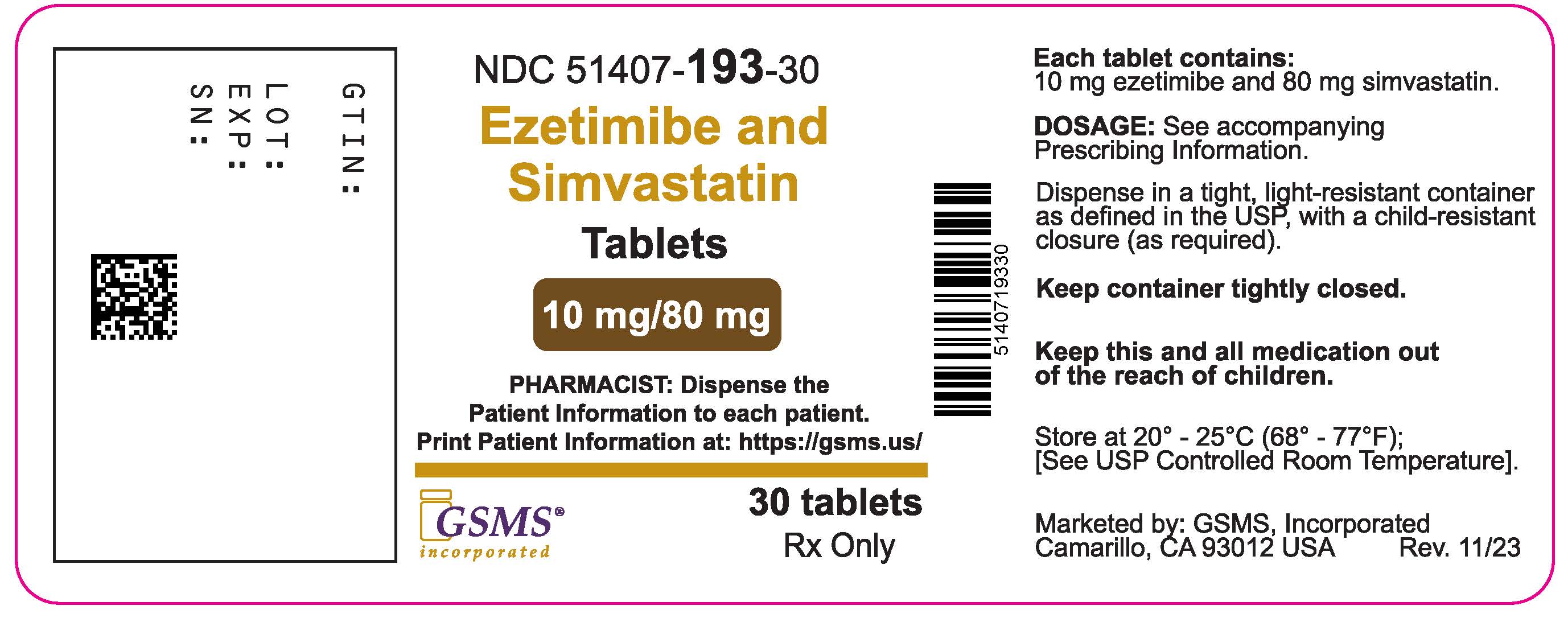
Ezetimibe and Simvastatin 10 mg; 80 mg Tablet, 90-count — NDC 51407-193-90 (Billing 51407-0193-90)
This is a package of 90 tablets of Ezetimibe and Simvastatin 10 mg; 80 mg Tablet from Golden State Medical Supply, Inc., marketed since Apr 2017 and currently FDA-listed, this package's marketing is listed to end Nov 2026.
Other active recalls for Ezetimibe And Simvastatin (different manufacturers) — 1 · tap to view
Past resolved recalls for this product (2)
Identity & classification
Regulatory identifiers FDA, NLM and CMS codes for this package
Drug-database identifiers Medi-Span GPI and First Databank GCN / HICL / AHFS classification
- GSN (GCN sequence number): 057864
- GCN: 23126
- GPI-14 (Medi-Span): 39994002300350
- HICL (First Databank): 026505
- AHFS class code: 24:06.05.00
- RxCUI (RxNorm): 476345
Where does this data come from?
- FDA openFDA NDC Directory · synced Oct 1, 2026
- FDA label on DailyMed · label index refreshed Oct 1, 2026
- RxNorm (NLM RxNav) · catalog refreshed Oct 1, 2026
- Medi-Span GPI (licensed)
- First Databank (licensed) · refreshed Oct 1, 2026
RxNorm drug class
This medicine belongs to the Dietary Cholesterol Absorption Inhibitor class.
Where does this data come from?
- RxClass (NLM) · catalog refreshed Oct 1, 2026
Clinical
Ezetimibe is used along with diet, alone or in combination with another cholesterol-lowering medications (HMG-CoA reductase inhibitors [statins]) to reduce the amount of low-density lipoprotein (LDL) cholesterol ('bad cholesterol') in the blood in adults and children 10 years of age or older who have familial heterozygous hypercholesterolemia (an inherited condition in which cholesterol cannot be removed from the body normally). It is also used along with diet, alone or in combination with other cholesterol-lowering medications (HMG-CoA reductase inhibitors [statins] or fenofibrate) in adults...
Read the full MedlinePlus article ↗- It lowers LDL cholesterol when diet alone hasn’t been enough. That includes high cholesterol and inherited forms. Vytorin’s simvastatin is also used to reduce heart attack, stroke...
- Take one tablet by mouth in the evening, with or without food. If you miss a dose, take it as soon as you remember, but don’t double up the next one. If you take cholestyramine or...
- Common ones are headache, muscle aches, diarrhea, cold-like symptoms and higher liver enzymes on blood tests. Most people do fine. Tell me or your doctor if anything bothers you.
- Call promptly for muscle pain, tenderness or weakness you can’t explain, especially with fever or feeling unwell. Also call for yellow skin or eyes, or signs of allergic reaction l...
Patient education
Supplement & herbal interactions
Where does this data come from?
- MedlinePlus (NLM) · refreshed Oct 1, 2026
- FDA label on DailyMed · label index refreshed Oct 1, 2026
Ask a licensed pharmacist directly — free, answered by our team.
Pricing
A drug doesn't have one price. Each row is a different public payment system, and none is what you'd pay at the counter — that depends on your insurance. The ⓘ on each row explains what it measures.
| Price system | Per each | Per package |
|---|---|---|
| Retail pharmacies payNADAC · weekly | Not in the retail survey — common for institutional, discontinued, or low-volume packs. | |
| Medicaid paysCMS SDUD · 12 mo | No recent Medicaid claims on file for this NDC — rare and low-volume NDCs are suppressed in the public data. | |
| Medicare drug plans payPart D · Q2 2026 | $0.4456 | $40.10 / 90 tablets |
Where does this data come from?
- CMS NADAC weekly file
- CMS ASP pricing files · refreshed Sep 20, 2026
- CMS Medicaid State Drug Utilization Data · refreshed Oct 3, 2026
- CMS Part D plan pricing files · refreshed Sep 24, 2026
- VA National Acquisition Center price file
Packaging — all sizes for this product
| Package NDC | Description | Marketing start | Marketing end | Status |
|---|---|---|---|---|
| 51407-0193-05 51407-193-05 Main listing | 500 TABLET in 1 BOTTLE | 2019-04-29 | Nov 30, 2026 | Active |
| 51407-0193-30 51407-193-30 | 30 TABLET in 1 BOTTLE | 2019-04-29 | — | Discontinued by firm |
| 51407-0193-90 You're viewing this | 90 TABLET in 1 BOTTLE | 2019-04-29 | Nov 30, 2026 | Active |
You're viewing one of 3 pack sizes for this product.
Pack size FAQ
What quantity is in this package?
How does this package differ from NDC 51407-0193-30?
What NDC number is used to bill for this package of Ezetimibe and Simvastatin 10 mg; 80 mg Tablet?
Therapeutic equivalents
| Product | Labeler | Pack | NADAC/unit | TE | Status | Price vs. this |
|---|---|---|---|---|---|---|
| ezetimibe and simvastatin 10 mg/1; 80 mg 16714-0781-01 | NORTHSTAR | 30 tablets | $0.285 | AB | Availability likely | — |
| Ezetimibe and Simvastatin 10 mg/1; 80 mg 43598-0745-05 | Dr.Reddys | 500 tablets | $0.285 | AB | Availability likely | — |
| Ezetimibe and Simvastatin 10 mg/1; 80 mg 69238-1158-03 | Amneal | 30 tablets | $0.577 | — | Discontinued | — |
| Ezetimibe and Simvastatin 10 mg/1; 80 mgthis 51407-0193-90 | Golden | 90 tablets | — | AB | FDA listed | — |
| Ezetimibe and Simvastatin 10 mg/1; 80 mg 59651-0838-30 | Aurobindo | 30 tablets | — | AB | FDA listed | — |
| Ezetimibe and Simvastatin 10 mg/1; 80 mg 67877-0510-05 | Ascend | 500 tablets | — | AB | FDA listed | — |
| ezetimibe and simvastatin 10 mg/1; 80 mg 68462-0324-05 | Glenmark | 500 tablets | — | AB | FDA listed | — |
| Vytorin 10 mg/1; 80 mg 78206-0177-01 | Organon | 30 tablets | — | AB | FDA listed | — |
Where does this data come from?
- FDA openFDA NDC Directory · synced Oct 1, 2026
- FDA Orange Book · refreshed Sep 3, 2026
- CMS NADAC weekly file
Availability & generic status
This product is an FDA-approved generic. Other versions of the same drug are listed under Therapeutic equivalents, least expensive first.
Where does this data come from?
- FDA Orange Book · refreshed Sep 3, 2026
What it looks like
Where does this data come from?
- FDA label on DailyMed · label index refreshed Oct 1, 2026
Inactive Ingredients / Excipients
Inactive ingredients, also called excipients, are components of the drug product other than the active ingredient. They may include fillers, dyes, coatings, preservatives, flavors, or other formulation ingredients.
💡 Tap an ingredient (hover on desktop) to see what it is and why it’s used.
-
UNII REK4960K2U
Butylated hydroxyanisole is a synthetic preservative that prevents oils and fats in medicines from spoiling or becoming rancid. It keeps the medicine stable and extends its shelf life.
-
UNII OP1R32D61U
Microcrystalline cellulose is a purified form of cellulose, a natural fiber from plant sources. It acts as a binder and filler in tablets and capsules, helping hold ingredients together and give the medicine its shape and size.
-
UNII 2968PHW8QP
A weak organic acid derived from citrus fruits or made through fermentation. It works as a buffer to control pH, a preservative to extend shelf life, and a flavoring agent in medications.
-
UNII M28OL1HH48
Croscarmellose sodium is a plant-based substance derived from cellulose. It acts as a disintegrant, helping tablets and capsules break down quickly in the digestive system so the medicine can be absorbed.
-
UNII R75537T0T4
Hypromellose 2910 is a plant-derived thickening agent made from cellulose. It serves as a binder that holds tablet ingredients together, a film-coating for pills, and a viscosity controller in liquids.
-
UNII EWQ57Q8I5X
Lactose monohydrate is a natural sugar derived from milk. It serves as a filler and binder in tablets and capsules, helping create the proper size, texture, and consistency of the medicine.
-
UNII 70097M6I30
Magnesium stearate is a salt made from magnesium and stearic acid, a fatty substance. It's used in tablets and capsules as a lubricant and glidant to help ingredients flow smoothly during manufacturing and prevent sticking.
-
UNII 8D4SNN7V92
Propyl gallate is a synthetic antioxidant derived from gallic acid. It prevents oils and fats in the medicine from oxidizing and spoiling, helping the product stay stable and effective during storage.
8 inactive ingredients listed in the exact product block matched to this NDC.
Where does this data come from?
ingredient classCode="IACT" elements from the exact product block matched by this NDC. Label-section narrative from DailyMed / the openFDA label index is shown separately when available.- FDA label on DailyMed · label index refreshed Oct 1, 2026
- FDA openFDA NDC Directory · synced Oct 1, 2026
Inactive ingredient FAQ
Are inactive ingredients the same for every manufacturer?
Why might an inactive ingredient be missing?
Can inactive ingredients matter?
Manufacturer & labeler
Where does this data come from?
- FDA openFDA NDC Directory · synced Oct 1, 2026
- Drugs@FDA
Full prescribing information FDA SPL
🎯 Indications and Usage ▾
1 INDICATIONS AND USAGE Therapy with lipid-altering agents should be only one component of multiple risk factor intervention in individuals at significantly increased risk for atherosclerotic vascular disease due to hypercholesterolemia. Drug therapy is indicated as an adjunct to diet when the response to a diet restricted in saturated fat and cholesterol and other nonpharmacologic measures alone has been inadequate. Ezetimibe and simvastatin tablets, which contain a cholesterol absorption inhibitor and an HMG-CoA reductase inhibitor (statin), are indicated as adjunctive therapy to diet to: reduce elevated total-C, LDL-C, Apo B, TG, and non-HDL-C, and to increase HDL-C in patients with primary (heterozygous familial and non-familial) hyperlipidemia or mixed hyperlipidemia.
( 1.1 ) reduce elevated total-C and LDL-C in patients with homozygous familial hypercholesterolemia (HoFH), as an adjunct to other lipid-lowering treatments. ( 1.2 ) Limitations of Use ( 1.3 ) No incremental benefit of ezetimibe and simvastatin tablets on cardiovascular morbidity and mortality over and above that demonstrated for simvastatin has been established. Ezetimibe and simvastatin tablets have not been studied in Fredrickson Type I, III, IV, and V dyslipidemias.
1.1Primary Hyperlipidemia Ezetimibe and simvastatin tablets are indicated for the reduction of elevated total cholesterol (total-C), low-density lipoprotein cholesterol (LDL-C), apolipoprotein B (Apo B), triglycerides (TG), and non-high-density lipoprotein cholesterol (non-HDL-C), and to increase high-density lipoprotein cholesterol (HDL-C) in patients with primary (heterozygous familial and non-familial) hyperlipidemia or mixed hyperlipidemia.
1.2Homozygous Familial Hypercholesterolemia (HoFH) Ezetimibe and simvastatin tablets are indicated for the reduction of elevated total-C and LDL-C in patients with homozygous familial hypercholesterolemia, as an adjunct to other lipid-lowering treatments (e.g., LDL apheresis) or if such treatments are unavailable.
1.3Limitations of Use No incremental benefit of ezetimibe and simvastatin tablets on cardiovascular morbidity and mortality over and above that demonstrated for simvastatin has been established. Ezetimibe and simvastatin tablets have not been studied in Fredrickson type I, III, IV, and V dyslipidemias.
⏱️ Dosage and Administration ▾
2 DOSAGE AND ADMINISTRATION Dose range is 10 mg/10 mg/day to 10 mg/40 mg/day. ( 2.1 ) Recommended usual starting dose is 10 mg/10 mg or 10 mg/20 mg/day. ( 2.1 ) Due to the increased risk of myopathy, including rhabdomyolysis, use of the 10 mg/80 mg dose of ezetimibe and simvastatin tablets should be restricted to patients who have been taking ezetimibe and simvastatin tablets 10 mg/80 mg chronically (e.g., for 12 months or more) without evidence of muscle toxicity.
( 2.2 ) Patients who are currently tolerating the 10 mg/80 mg dose of ezetimibe and simvastatin tablets who need to be initiated on an interacting drug that is contraindicated or is associated with a dose cap for simvastatin should be switched to an alternative statin or statin-based regimen with less potential for the drug-drug interaction. ( 2.2 ) Due to the increased risk of myopathy, including rhabdomyolysis, associated with the 10 mg/80 mg dose of ezetimibe and simvastatin tablets, patients unable to achieve their LDL-C goal utilizing the 10 mg/40 mg dose of ezetimibe and simvastatin tablets should not be titrated to the 10 mg/80 mg dose, but should be placed on alternative LDL-C-lowering treatment(s) that provides greater LDL-C lowering.
( 2.2 ) Dosing of ezetimibe and simvastatin tablets should occur either ≥ 2 hours before or ≥ 4 hours after administration of a bile acid sequestrant. ( 2.3 , 7.5 )
2.1Recommended Dosing The usual dosage range is 10 mg/10 mg/day to 10 mg/40 mg/day. The recommended usual starting dose is 10 mg/10 mg/day or 10 mg/20 mg/day. Ezetimibe and simvastatin tablets should be taken as a single daily dose in the evening, with or without food.
Patients who require a larger reduction in LDL-C (greater than 55%) may be started at 10 mg/40 mg/day in the absence of moderate to severe renal impairment (estimated glomerular filtration rate less than 60 mL/min/1.73 m 2 ). After initiation or titration of ezetimibe and simvastatin tablets, lipid levels may be analyzed after 2 or more weeks and dosage adjusted, if needed.
2.2Restricted Dosing for 10 mg/80 mg Due to the increased risk of myopathy, including rhabdomyolysis, particularly during the first year of treatment, use of the 10 mg/80 mg dose of ezetimibe and simvastatin tablets should be restricted to patients who have been taking ezetimibe and simvastatin tablets 10 mg/80 mg chronically (e.g., for 12 months or more) without evidence of muscle toxicity [ see Warnings and Precautions ( 5.1 ) ]. Patients who are currently tolerating the 10 mg/80 mg dose of ezetimibe and simvastatin tablets who need to be initiated on an interacting drug that is contraindicated or is associated with a dose cap for simvastatin should be switched to an alternative statin or statin-based regimen with less potential for the drug-drug interaction.
Due to the increased risk of myopathy, including rhabdomyolysis, associated with the 10 mg/80 mg dose of ezetimibe and simvastatin tablets, patients unable to achieve their LDL-C goal utilizing the 10 mg/40 mg dose of ezetimibe and simvastatin tablets should not be titrated to the 10 mg/80 mg dose, but should be placed on alternative LDL-C-lowering treatment(s) that provides greater LDL-C lowering.
2.3Coadministration with Other Drugs Patients taking Verapamil, Diltiazem, or Dronedarone The dose of ezetimibe and simvastatin tablets should not exceed 10 mg/10 mg/day [ see Warnings and Precautions ( 5.1 ), Drug Interactions ( 7.3 ), and Clinical Pharmacology ( 12.3 ) ]. Patients taking Amiodarone, Amlodipine or Ranolazine The dose of ezetimibe and simvastatin tablets should not exceed 10 mg/20 mg/day [ see Warnings and Precautions ( 5.1 ), Drug Interactions ( 7.3 ), and Clinical Pharmacology ( 12.3 ) ]. Patients taking Bile Acid Sequestrants Dosing of ezetimibe and simvastatin tablets should occur either greater than or equal to 2 hours before or greater than or equal to 4 hours after administration of a bile acid sequestrant [ see Drug Interactions ( 7.5 ) ].
2.4Patients… [Excerpted — this section continues on DailyMed.]
💊 Dosage Forms and Strengths ▾
3 DOSAGE FORMS AND STRENGTHS Ezetimibe and simvastatin tablets, 10 mg/10 mg are white to off-white, capsule-shaped tablets, debossed with "TEVA" on one side of the tablet and with "7584" on the other side. Ezetimibe and simvastatin tablets, 10 mg/20 mg are white to off-white, capsule-shaped tablets, debossed with "TEVA" on one side of the tablet and with "7585" on the other side. Ezetimibe and simvastatin tablets, 10 mg/40 mg are white to off-white, capsule-shaped tablets, debossed with "TEVA" on one side of the tablet and with "7586" on the other side.
Ezetimibe and simvastatin tablets, 10 mg/80 mg are white to off-white, capsule-shaped tablets, debossed with "TEVA" on one side of the tablet and with "7587" on the other side. (or) Ezetimibe and simvastatin tablets, 10 mg/10 mg are white to off-white,capsule-shaped tablets, debossed with "DRL" on one side of the tablet and with "583" on the other side. Ezetimibe and simvastatin tablets, 10 mg/20 mg are white to off-white,capsule-shaped tablets, debossed with "DRL" on one side of the tablet and with "584" on the other side.
Ezetimibe and simvastatin tablets, 10 mg/40 mg are white to off-white,capsule-shaped tablets, debossed with "DRL" on one side of the tablet and with "585" on the other side. Ezetimibe and simvastatin tablets, 10 mg/80 mg are white to off-white,capsule-shaped tablets, debossed with "DRL" on one side of the tablet and with "586" on the other side. Tablets (ezetimibe mg/simvastatin mg): 10 mg/10 mg, 10 mg/20 mg, 10 mg/40 mg, and 10 mg/80 mg ( 3 )
⛔ Contraindications ▾
4 CONTRAINDICATIONS Ezetimibe and simvastatin tablets are contraindicated in the following conditions: Concomitant administration of strong CYP3A4 inhibitors (e.g., itraconazole, ketoconazole, posaconazole, voriconazole, HIV protease inhibitors, boceprevir, telaprevir, erythromycin, clarithromycin, telithromycin, nefazodone, and cobicistat-containing products) [ see Warnings and Precautions ( 5.1 ) ]. Concomitant administration of gemfibrozil, cyclosporine, or danazol [ see Warnings and Precautions ( 5.1 ) ]. Hypersensitivity to any component of this medication [ see Adverse Reactions ( 6.2 ) ].
Active liver disease or unexplained persistent elevations in hepatic transaminase levels [ see Warnings and Precautions ( 5.3 ) ]. Women who are pregnant or may become pregnant. Serum cholesterol and triglycerides increase during normal pregnancy, and cholesterol or cholesterol derivatives are essential for fetal development.
Because HMG-CoA reductase inhibitors (statins), such as simvastatin, decrease cholesterol synthesis and possibly the synthesis of other biologically active substances derived from cholesterol, ezetimibe and simvastatin tablets may cause fetal harm when administered to a pregnant woman. Atherosclerosis is a chronic process and the discontinuation of lipid-lowering drugs during pregnancy should have little impact on the outcome of long-term therapy of primary hypercholesterolemia. There are no adequate and well-controlled studies of ezetimibe and simvastatin tablet use during pregnancy; however, in rare reports congenital anomalies were observed following intrauterine exposure to statins.
In rat and rabbit animal reproduction studies, simvastatin revealed no evidence of teratogenicity. Ezetimibe and simvastatin tablets should be administered to women of childbearing age only when such patients are highly unlikely to conceive. If the patient becomes pregnant while taking this drug, ezetimibe and simvastatin tablets should be discontinued immediately and the patient should be apprised of the potential hazard to the fetus [ see Use in Specific Populations ( 8.1 ) ].
Nursing mothers. It is not known whether simvastatin is excreted into human milk; however, a small amount of another drug in this class does pass into breast milk. Because statins have the potential for serious adverse reactions in nursing infants, women who require ezetimibe and simvastatin tablet treatment should not breastfeed their infants [ see Use in Specific Populations ( 8.3 ) ].
Concomitant administration of strong CYP3A4 inhibitors. ( 4 , 5.1 ) Concomitant administration of gemfibrozil, cyclosporine, or danazol. ( 4 , 5.1 ) Hypersensitivity to any component of this medication ( 4 , 6.2 ) Active liver disease or unexplained persistent elevations of hepatic transaminase levels ( 4 , 5.3 ) Women who are pregnant or may become pregnant ( 4 , 8.1 ) Nursing mothers ( 4 , 8.3 )
⚠️ Warnings and Cautions ▾
5 WARNINGS AND PRECAUTIONS Patients should be advised of the increased risk of myopathy, including rhabdomyolysis, with the 10 mg/80 mg dose. ( 5.1 ) Patients should be advised to report promptly any unexplained and/or persistent muscle pain, tenderness, or weakness. Ezetimibe and simvastatin tablets should be discontinued immediately if myopathy is diagnosed or suspected.
( 5.1 ). Skeletal muscle effects (e.g., myopathy and rhabdomyolysis): Risks increase with higher doses and concomitant use of certain medicines. Predisposing factors include advanced age (≥65), female gender, uncontrolled hypothyroidism, and renal impairment.
Rare cases of rhabdomyolysis with acute renal failure secondary to myoglobinuria have been reported. ( 4 , 5.1 , 8.5 , 8.6 ). Immune-Mediated Necrotizing Myopathy (IMNM): There have been rare reports of IMNM, an autoimmune myopathy, associated with statin use.
IMNM is characterized by: proximal muscle weakness and elevated serum creatine kinase, which persist despite discontinuation of statin treatment; positive anti-HMG CoA reductase antibody; muscle biopsy showing necrotizing myopathy; and improvement with immunosuppressive agents. ( 5.2 ). Liver enzyme abnormalities: Persistent elevations in hepatic transaminases can occur.
Check liver enzyme tests before initiating therapy and as clinically indicated thereafter. ( 5.3 )
5.1Myopathy/Rhabdomyolysis Simvastatin occasionally causes myopathy manifested as muscle pain, tenderness or weakness with creatine kinase above ten times the upper limit of normal (ULN). Myopathy sometimes takes the form of rhabdomyolysis with or without acute renal failure secondary to myoglobinuria, and rare fatalities have occurred. The risk of myopathy is increased elevated plasma levels of simvastatin and simvastatin acid.
Predisposing factors for myopathy include advanced age (≥ 65 years), female gender, uncontrolled hypothyroidism, and renal impairment. Chinese patients may be at increased risk for myopathy [see Use in Specific Populations (8.8) ] The risk of myopathy, including rhabdomyolysis, is dose related. In a clinical trial database in which 41,413 patients were treated with simvastatin, 24,747 (approximately 60%) of whom were enrolled in studies with a median follow-up of at least 4 years, the incidence of myopathy was approximately 0.03% and 0.08% at 20 and 40 mg/day, respectively.
The incidence of myopathy with 80 mg (0.61%) was disproportionately higher than that observed at the lower doses. In these trials, patients were carefully monitored and some interacting medicinal products were excluded. In a clinical trial in which 12,064 patients with a history of myocardial infarction were treated with simvastatin (mean follow-up 6.7 years), the incidence of myopathy (defined as unexplained muscle weakness or pain with a serum creatine kinase [CK] > 10 times upper limit of normal [ULN]) in patients on 80 mg/day was approximately 0.9% compared with 0.02% for patients on 20 mg/day.
The incidence of rhabdomyolysis (defined as myopathy with a CK > 40 times ULN) in patients on 80 mg/day was approximately 0.4% compared with 0% for patients on 20 mg/day. The incidence of myopathy, including rhabdomyolysis, was highest during the first year and then notably decreased during the subsequent years of treatment. In this trial, patients were carefully monitored and some interacting medicinal products were excluded.
The risk of myopathy, including rhabdomyolysis, is greater in patients on simvastatin 80 mg compared with other statin therapies with similar or greater LDL-C-lowering efficacy and compared with lower doses of simvastatin. Therefore, the 10 mg/80 mg dose of ezetimibe and simvastatin tablets should be used only in patients who have been taking ezetimibe and simvastatin tablets 10 mg/80 mg chronically (e.g., for 12 months or more) without evidence of muscle toxicity [ see Dosage and Administration, Restricted Dosing for 10 mg/80 mg ( 2.2 ) ].
If, however, a patient who is c… [Excerpted — this section continues on DailyMed.]
🤒 Adverse Reactions ▾
6 ADVERSE REACTIONS The following serious adverse reactions are discussed in greater detail in other sections of the label: Rhabdomyolysis and myopathy [ see Warnings and Precautions ( 5.1 ) ] Liver enzyme abnormalities [ see Warnings and Precautions ( 5.3 ) ] Common (incidence ≥ 2% and greater than placebo) adverse reactions in clinical trials: headache, increased ALT, myalgia, upper respiratory tract infection, and diarrhea. ( 6.1 ) To report SUSPECTED ADVERSE REACTIONS, contact Dr. Reddy’s Laboratories, Inc. at 1-888-375-3784 or FDA at 1-800-FDA-1088 or www.fda.gov/medwatch .
6.1Clinical Trials Experience Ezetimibe and Simvastatin Tablets Because clinical trials are conducted under widely varying conditions, adverse reaction rates observed in the clinical trials of a drug cannot be directly compared to rates in the clinical trials of another drug and may not reflect the rates observed in practice. In the ezetimibe and simvastatin tablet placebo-controlled clinical trials database of 1,420 patients (age range 20 to 83 years, 52% women, 87% Caucasians, 3% Blacks, 5% Hispanics, 3% Asians) with a median treatment duration of 27 weeks, 5% of patients on ezetimibe and simvastatin tablets and 2.2% of patients on placebo discontinued due to adverse reactions.
The most common adverse reactions in the group treated with ezetimibe and simvastatin tablets that led to treatment discontinuation and occurred at a rate greater than placebo were: Increased ALT (0.9%) Myalgia (0.6%) Increased AST (0.4%) Back pain (0.4%) The most commonly reported adverse reactions (incidence ≥ 2% and greater than placebo) in controlled clinical trials were: headache (5.8%), increased ALT (3.7%), myalgia (3.6%), upper respiratory tract infection (3.6%), and diarrhea (2.8%). Ezetimibe and simvastatin tablets have been evaluated for safety in more than 10,189 patients in clinical trials.
Table 2 summarizes the frequency of clinical adverse reactions reported in ≥ 2% of patients treated with ezetimibe and simvastatin tablets (n = 1,420) and at an incidence greater than placebo, regardless of causality assessment, from four placebo-controlled trials. Table 2 1 Clinical Adverse Reactions Occurring in ≥ 2% of Patients Treated with Ezetimibe and Simvastatin Tablets and at an Incidence Greater than Placebo, Regardless of Causality Placebo Ezetimibe 10 mg Simvastatin 2 Ezetimibe and Simvastatin 2 Body System/Organ Class (%) (%) (%) (%) Adverse Reaction n = 371 n = 302 n = 1234 n = 1420 Body as a whole – general disorders Headache 5.4 6.0 5.9
5.8Gastrointestinal system disorders Diarrhea 2.2 5.0 3.7
2.8Infections and infestations Influenza 0.8 1.0 1.9
2.3Upper respiratory tract infection 2.7 5.0 5.0
3.6Musculoskeletal and connective tissue disorders Myalgia 2.4 2.3 2.6
3.6Pain in extremity 1.3 3.0 2.0 2.3 1. Includes two placebo-controlled combination studies in which the active ingredients equivalent to ezetimibe and simvastatin tablets were coadministered and two placebo-controlled studies in which ezetimibe and simvastatin tablets were administered. 2 .
All doses. Study of Heart and Renal Protection In SHARP, 9,270 patients were allocated to ezetimibe and simvastatin tablets 10 mg/20 mg daily (n = 4,650) or placebo (n = 4,620) for a median follow-up period of 4.9 years. The proportion of patients who permanently discontinued study treatment as a result of either an adverse event or abnormal safety blood result was 10.4% vs.
9.8% among patients allocated to ezetimibe and simvastatin and placebo, respectively. Comparing those allocated to ezetimibe and simvastatin vs. placebo, the incidence of myopathy (defined as unexplained muscle weakness or pain with a serum CK > 10 times ULN) was 0.2% vs. 0.1% and the incidence of rhabdomyolysis (defined as myopathy with a CK > 40 times ULN) was 0.09% vs.
0.02%, respectively. Consecutive elevations of transaminases (> 3 X ULN) occurred in 0.7% vs. 0.6%, respectively.
Patients were asked about the occurrence of unexplained m… [Excerpted — this section continues on DailyMed.]
🔄 Drug Interactions ▾
7 DRUG INTERACTIONS [ See Clinical Pharmacology ( 12.3 ). ] Ezetimibe and Simvastatin Tablets Drug Interactions Associated With Increased Risk of Myopathy/Rhabdomyolysis ( 2.3 , 2.4 , 4 , 5.1 , 7.1 , 7.2 , 7.3 , 7.8 , 12.3 ) Interacting Agents Prescribing Recommendations Strong CYP3A4 Inhibitors, (e.g., itraconazole, ketoconazole, posaconazole, voriconazole, erythromycin, clarithromycin, telithromycin, HIV protease inhibitors, boceprevir, telaprevir, nefazodone, cobicistat-containing products), gemfibrozil, cyclosporine, danazol Contraindicated with ezetimibe and simvastatin tablets Niacin (≥1 g/day) For Chinese patients, not recommended with ezetimibe and simvastatin tablets Verapamil, diltiazem, dronedarone Do not exceed 10 mg/10 mg ezetimibe and simvastatin tablets, daily Amiodarone, amlodipine, ranolazine Do not exceed 10 mg/20 mg ezetimibe and simvastatin tablets, daily Lomitapide For patients with HoFH, do not exceed 10 mg/20 mg ezetimibe and simvastatin tablets 1 Daptomycin Temporally suspend ezetimibe and simvastatin tablets Grapefruit juice Avoid grapefruit juice 1.
For patients with HoFH who have been taking 80 mg simvastatin chronically (e.g., for 12 months or more) without evidence of muscle toxicity, do not exceed 10 mg/40 mg ezetimibe and simvastatin tablets when taking lomitapide. • Coumarin anticoagulants: simvastatin prolongs INR. Achieve stable INR prior to starting ezetimibe and simvastatin tablets. Monitor INR frequently until stable upon initiation or alteration of ezetimibe and simvastatin tablet therapy.
( 7.8 ) • Cholestyramine: Combination decreases exposure of ezetimibe. ( 2.3 , 7.5 ) • Other Lipid-lowering Medications: Use with fenofibrates or lipid-modifying doses (≥1 g/day) of niacin increases the risk of adverse skeletal muscle effects. Caution should be used when prescribing with ezetimibe and simvastatin tablets.
( 5.1 , 7.2 , 7.4 ) • Fenofibrates: Combination increases exposure of ezetimibe. If cholelithiasis is suspected in a patient receiving ezetimibe and a fenofibrate, gallbladder studies are indicated and alternative lipid-lowering therapy should be considered. ( 7.2 , 7.7 , 12.3 )
7.1Strong CYP3A4 Inhibitors, Cyclosporine, or Danazol Strong CYP3A4 inhibitors: The risk of myopathy is increased by reducing the elimination of the simvastatin component of ezetimibe and simvastatin tablets. Hence when ezetimibe and simvastatin tablets are used with an inhibitor of CYP3A4 (e.g., as listed below), elevated plasma levels of HMG-CoA reductase inhibitory activity increases the risk of myopathy and rhabdomyolysis, particularly with higher doses of ezetimibe and simvastatin tablets [ see Warnings and Precautions ( 5.1 ) and Clinical Pharmacology ( 12.3 ) ].
Concomitant use of drugs labeled as having a strong inhibitory effect on CYP3A4 is contraindicated [ see Contraindications ( 4 ) ]. If treatment with itraconazole, ketoconazole, posaconazole, voriconazole, erythromycin, clarithromycin or telithromycin is unavoidable, therapy with ezetimibe and simvastatin tablets must be suspended during the course of treatment. Cyclosporine or Danazol: The risk of myopathy, including rhabdomyolysis is increased by concomitant administration of cyclosporine or danazol.
Therefore, concomitant use of these drugs is contraindicated [ see Contraindications ( 4 ), Warnings and Precautions ( 5.1 ) and Clinical Pharmacology ( 12.3 ) ].
7.2Lipid-Lowering Drugs That Can Cause Myopathy When Given Alone Gemfibrozil: Contraindicated with ezetimibe and simvastatin tablets [ see Contraindications ( 4 ) and Warnings and Precautions ( 5.1 ) ]. Fenofibrates (e.g., fenofibrate and fenofibric acid): Caution should be used when prescribing with ezetimibe and simvastatin tablets [ see Warnings and Precautions ( 5.1 ) and Drug Interactions ( 7.7 ) ].
7.3Amiodarone, Dronedarone, Ranolazine, or Calcium Channel Blockers The risk of myopathy, including rhabdomyolysis, is increased by concomitant administration of amiodarone, dronedarone… [Excerpted — this section continues on DailyMed.]
👥 Use in Specific Populations ▾
8 USE IN SPECIFIC POPULATIONS Moderate to severe renal impairment: Doses exceeding 10 mg/20 mg/day should be used with caution and close monitoring ( 2.5 , 8.6 ) Chinese patients: May be at higher risk of myopathy; monitor appropriately (5.1 , 8.8 )
8.1Pregnancy Terotogenic Effects Pregnancy Category X. [ See Contraindications ( 4 ). ] Ezetimibe and Simvastatin Tablets Ezetimibe and simvastatin tablets are contraindicated in women who are or may become pregnant. Lipid-lowering drugs offer no benefit during pregnancy, because cholesterol and cholesterol derivatives are needed for normal fetal development. Atherosclerosis is a chronic process, and discontinuation of lipid-lowering drugs during pregnancy should have little impact on long-term outcomes of primary hypercholesterolemia therapy.
There are no adequate and well-controlled studies of ezetimibe and simvastatin tablet use during pregnancy; however, there are rare reports of congenital anomalies in infants exposed to statins in utero . Animal reproduction studies of simvastatin in rats and rabbits showed no evidence of teratogenicity. Serum cholesterol and triglycerides increase during normal pregnancy, and cholesterol or cholesterol derivatives are essential for fetal development.
Because statins, such as simvastatin, decrease cholesterol synthesis and possibly the synthesis of other biologically active substances derived from cholesterol, ezetimibe and simvastatin tablets may cause fetal harm when administered to a pregnant woman. If ezetimibe and simvastatin tablets are used during pregnancy or if the patient becomes pregnant while taking this drug, the patient should be apprised of the potential hazard to the fetus. Women of childbearing potential, who require ezetimibe and simvastatin tablet treatment for a lipid disorder, should be advised to use effective contraception.
For women trying to conceive, discontinuation of ezetimibe and simvastatin tablets should be considered. If pregnancy occurs, ezetimibe and simvastatin tablets should be immediately discontinued. Ezetimibe In oral (gavage) embryo-fetal development studies of ezetimibe conducted in rats and rabbits during organogenesis, there was no evidence of embryolethal effects at the doses tested (250, 500, 1000 mg/kg/day).
In rats, increased incidences of common fetal skeletal findings (extra pair of thoracic ribs, unossified cervical vertebral centra, shortened ribs) were observed at 1000 mg/kg/day (~ 10 times the human exposure at 10 mg daily based on AUC 0-24hr for total ezetimibe). In rabbits treated with ezetimibe, an increased incidence of extra thoracic ribs was observed at 1000 mg/kg/day (150 times the human exposure at 10 mg daily based on AUC 0-24hr for total ezetimibe). Ezetimibe crossed the placenta when pregnant rats and rabbits were given multiple oral doses.
Multiple-dose studies of ezetimibe coadministered with statins in rats and rabbits during organogenesis result in higher ezetimibe and statin exposures. Reproductive findings occur at lower doses in coadministration therapy compared to monotherapy. Simvastatin Simvastatin was not teratogenic in rats or rabbits at doses (25, 10 mg/kg/day, respectively) that resulted in 3 times the human exposure based on mg/m 2 surface area.
However, in studies with another structurally-related statin, skeletal malformations were observed in rats and mice. There are rare reports of congenital anomalies following intrauterine exposure to statins. In a review 1 of approximately 100 prospectively followed pregnancies in women exposed to simvastatin or another structurally-related statin, the incidences of congenital anomalies, spontaneous abortions and fetal deaths/stillbirths did not exceed what would be expected in the general population.
The number of cases is adequate only to exclude a 3 to 4 fold increase in congenital anomalies over the background incidence. In 89% of the prospectively followed pregnancies, drug treatment was initiated prior to pregnancy an… [Excerpted — this section continues on DailyMed.]
🤰 Pregnancy ▾
8.1Pregnancy Terotogenic Effects Pregnancy Category X. [ See Contraindications ( 4 ). ] Ezetimibe and Simvastatin Tablets Ezetimibe and simvastatin tablets are contraindicated in women who are or may become pregnant. Lipid-lowering drugs offer no benefit during pregnancy, because cholesterol and cholesterol derivatives are needed for normal fetal development. Atherosclerosis is a chronic process, and discontinuation of lipid-lowering drugs during pregnancy should have little impact on long-term outcomes of primary hypercholesterolemia therapy.
There are no adequate and well-controlled studies of ezetimibe and simvastatin tablet use during pregnancy; however, there are rare reports of congenital anomalies in infants exposed to statins in utero . Animal reproduction studies of simvastatin in rats and rabbits showed no evidence of teratogenicity. Serum cholesterol and triglycerides increase during normal pregnancy, and cholesterol or cholesterol derivatives are essential for fetal development.
Because statins, such as simvastatin, decrease cholesterol synthesis and possibly the synthesis of other biologically active substances derived from cholesterol, ezetimibe and simvastatin tablets may cause fetal harm when administered to a pregnant woman. If ezetimibe and simvastatin tablets are used during pregnancy or if the patient becomes pregnant while taking this drug, the patient should be apprised of the potential hazard to the fetus. Women of childbearing potential, who require ezetimibe and simvastatin tablet treatment for a lipid disorder, should be advised to use effective contraception.
For women trying to conceive, discontinuation of ezetimibe and simvastatin tablets should be considered. If pregnancy occurs, ezetimibe and simvastatin tablets should be immediately discontinued. Ezetimibe In oral (gavage) embryo-fetal development studies of ezetimibe conducted in rats and rabbits during organogenesis, there was no evidence of embryolethal effects at the doses tested (250, 500, 1000 mg/kg/day).
In rats, increased incidences of common fetal skeletal findings (extra pair of thoracic ribs, unossified cervical vertebral centra, shortened ribs) were observed at 1000 mg/kg/day (~ 10 times the human exposure at 10 mg daily based on AUC 0-24hr for total ezetimibe). In rabbits treated with ezetimibe, an increased incidence of extra thoracic ribs was observed at 1000 mg/kg/day (150 times the human exposure at 10 mg daily based on AUC 0-24hr for total ezetimibe). Ezetimibe crossed the placenta when pregnant rats and rabbits were given multiple oral doses.
Multiple-dose studies of ezetimibe coadministered with statins in rats and rabbits during organogenesis result in higher ezetimibe and statin exposures. Reproductive findings occur at lower doses in coadministration therapy compared to monotherapy. Simvastatin Simvastatin was not teratogenic in rats or rabbits at doses (25, 10 mg/kg/day, respectively) that resulted in 3 times the human exposure based on mg/m 2 surface area.
However, in studies with another structurally-related statin, skeletal malformations were observed in rats and mice. There are rare reports of congenital anomalies following intrauterine exposure to statins. In a review 1 of approximately 100 prospectively followed pregnancies in women exposed to simvastatin or another structurally-related statin, the incidences of congenital anomalies, spontaneous abortions and fetal deaths/stillbirths did not exceed what would be expected in the general population.
The number of cases is adequate only to exclude a 3 to 4 fold increase in congenital anomalies over the background incidence. In 89% of the prospectively followed pregnancies, drug treatment was initiated prior to pregnancy and was discontinued at some point in the first trimester when pregnancy was identified. 1 Manson, J.M., Freyssinges, C., Ducrocq, M.B., Stephenson, W.P., Postmarketing Surveillance of Lovastatin and Simvastatin Exposure During Pregnancy, Reproductive… [Excerpted — this section continues on DailyMed.]
🧒 Pediatric Use ▾
8.4Pediatric Use The effects of ezetimibe coadministered with simvastatin (n = 126) compared to simvastatin monotherapy (n = 122) have been evaluated in adolescent boys and girls with heterozygous familial hypercholesterolemia (HeFH). In a multicenter, double-blind, controlled study followed by an open-label phase, 142 boys and 106 postmenarchal girls, 10 to 17 years of age (mean age 14.2 years, 43% females, 82% Caucasians, 4% Asian, 2% Blacks, 13% multiracial) with HeFH were randomized to receive either ezetimibe coadministered with simvastatin or simvastatin monotherapy.
Inclusion in the study required 1) a baseline LDL-C level between 160 and 400 mg/dL and 2) a medical history and clinical presentation consistent with HeFH. The mean baseline LDL-C value was 225 mg/dL (range: 161 to 351 mg/dL) in the ezetimibe coadministered with simvastatin group compared to 219 mg/dL (range: 149 to 336 mg/dL) in the simvastatin monotherapy group. The patients received coadministered ezetimibe and simvastatin (10 mg, 20 mg, or 40 mg) or simvastatin monotherapy (10 mg, 20 mg, or 40 mg) for 6 weeks, coadministered ezetimibe and 40 mg simvastatin or 40 mg simvastatin monotherapy for the next 27 weeks, and open-label coadministered ezetimibe and simvastatin (10 mg, 20 mg, or 40 mg) for 20 weeks thereafter.
The results of the study at Week 6 are summarized in Table 3 . Results at Week 33 were consistent with those at Week 6. Table 3: Mean Percent Difference at Week 6 Between the Pooled Ezetimibe Coadministered with Simvastatin Group and the Pooled Simvastatin Monotherapy Group in Adolescent Patients with Heterozygous Familial Hypercholesterolemia Total-C LDL-C Apo B Non-HDL-C TG 1 HDL-C Mean percent difference between treatment groups -12% -15% -12% -14% -2% +0.1% 95% Confidence Interval (-15%, -9%) (-18%, -12%) (-15%, -9%) (-17%, -11%) (-9, +4) (-3, +3) 1.
For triglycerides, median % change from baseline. From the start of the trial to the end of Week 33, discontinuations due to an adverse reaction occurred in 7 (6%) patients in the ezetimibe coadministered with simvastatin group and in 2 (2%) patients in the simvastatin monotherapy group. During the trial, hepatic transaminase elevations (two consecutive measurements for ALT and/or AST ≥ 3 X ULN) occurred in four (3%) individuals in the ezetimibe coadministered with simvastatin group and in two (2%) individuals in the simvastatin monotherapy group.
Elevations of CPK (≥ 10 X ULN) occurred in two (2%) individuals in the ezetimibe coadministered with simvastatin group and in zero individuals in the simvastatin monotherapy group. In this limited controlled study, there was no significant effect on growth or sexual maturation in the adolescent boys or girls, or on menstrual cycle length in girls. Coadministration of ezetimibe with simvastatin at doses greater than 40 mg/day has not been studied in adolescents.
Also, ezetimibe and simvastatin tablets have not been studied in patients younger than 10 years of age or in pre-menarchal girls. Ezetimibe Based on total ezetimibe (ezetimibe + ezetimibe-glucuronide) there are no pharmacokinetic differences between adolescents and adults. Pharmacokinetic data in the pediatric population < 10 years of age are not available.
Simvastatin The pharmacokinetics of simvastatin has not been studied in the pediatric population.
🧓 Geriatric Use ▾
8.5Geriatric Use Of the 10,189 patients who received ezetimibe and simvastatin tablets in clinical studies, 3,242 (32%) were 65 and older (this included 844 (8%) who were 75 and older). No overall differences in safety or effectiveness were observed between these subjects and younger subjects, and other reported clinical experience has not identified differences in responses between the elderly and younger patients but greater sensitivity of some older individuals cannot be ruled out. Since advanced age (≥ 65 years) is a predisposing factor for myopathy, ezetimibe and simvastatin tablets should be prescribed with caution in the elderly [ see Clinical Pharmacology ( 12.3 ) ].
Because advanced age (≥ 65 years) is a predisposing factor for myopathy, including rhabdomyolysis, ezetimibe and simvastatin tablets should be prescribed with caution in the elderly. In a clinical trial of patients treated with simvastatin 80 mg/day, patients ≥ 65 years of age had an increased risk of myopathy, including rhabdomyolysis, compared to patients < 65 years of age [ see Warnings and Precautions ( 5.1 ) and Clinical Pharmacology ( 12.3 ) ].
🆘 Overdosage ▾
10 OVERDOSAGE Ezetimibe and Simvastatin Tablets No specific treatment of overdosage with ezetimibe and simvastatin tablets can be recommended. In the event of an overdose, symptomatic and supportive measures should be employed. Ezetimibe In clinical studies, administration of ezetimibe, 50 mg/day to 15 healthy subjects for up to 14 days, or 40 mg/day to 18 patients with primary hyperlipidemia for up to 56 days, was generally well tolerated.
A few cases of overdosage have been reported; most have not been associated with adverse experiences. Reported adverse experiences have not been serious. Simvastatin Significant lethality was observed in mice after a single oral dose of 9 g/m 2 .
No evidence of lethality was observed in rats or dogs treated with doses of 30 and 100 g/m 2 , respectively. No specific diagnostic signs were observed in rodents. At these doses the only signs seen in dogs were emesis and mucoid stools.
A few cases of overdosage with simvastatin have been reported; the maximum dose taken was 3.6 g. All patients recovered without sequelae. The dialyzability of simvastatin and its metabolites in man is not known at present.
🧬 Clinical Pharmacology ▾
12 CLINICAL PHARMACOLOGY
12.1Mechanism of Action Ezetimibe and Simvastatin Tablets Plasma cholesterol is derived from intestinal absorption and endogenous synthesis. Ezetimibe and simvastatin tablets contain ezetimibe and simvastatin, two lipid-lowering compounds with complementary mechanisms of action. Ezetimibe and simvastatin tablets reduce elevated total-C, LDL-C, Apo B, TG, and non-HDL-C, and increases HDL-C through dual inhibition of cholesterol absorption and synthesis.
Ezetimibe Ezetimibe reduces blood cholesterol by inhibiting the absorption of cholesterol by the small intestine. The molecular target of ezetimibe has been shown to be the sterol transporter, Niemann-Pick C1-Like 1 (NPC1L1), which is involved in the intestinal uptake of cholesterol and phytosterols. In a 2 week clinical study in 18 hypercholesterolemic patients, ezetimibe inhibited intestinal cholesterol absorption by 54%, compared with placebo.
Ezetimibe had no clinically meaningful effect on the plasma concentrations of the fat-soluble vitamins A, D, and E and did not impair adrenocortical steroid hormone production. Ezetimibe localizes at the brush border of the small intestine and inhibits the absorption of cholesterol, leading to a decrease in the delivery of intestinal cholesterol to the liver. This causes a reduction of hepatic cholesterol stores and an increase in clearance of cholesterol from the blood; this distinct mechanism is complementary to that of statins [ see Clinical Studies ( 14 ) ].
Simvastatin Simvastatin is a prodrug and is hydrolyzed to its active β-hydroxyacid form, simvastatin acid, after administration. Simvastatin is a specific inhibitor of 3-hydroxy-3-methylglutaryl-coenzyme A (HMG-CoA) reductase, the enzyme that catalyzes the conversion of HMG-CoA to mevalonate, an early and rate limiting step in the biosynthetic pathway for cholesterol. In addition, simvastatin reduces very-low-density lipoproteins (VLDL) and TG and increases HDL-C.
12.2Pharmacodynamics Clinical studies have demonstrated that elevated levels of total-C, LDL-C and Apo B, the major protein constituent of LDL, promote human atherosclerosis. In addition, decreased levels of HDL-C are associated with the development of atherosclerosis. Epidemiologic studies have established that cardiovascular morbidity and mortality vary directly with the level of total-C and LDL-C and inversely with the level of HDL-C.
Like LDL, cholesterol-enriched triglyceride-rich lipoproteins, including VLDL, intermediate-density lipoproteins (IDL), and remnants, can also promote atherosclerosis. The independent effect of raising HDL-C or lowering TG on the risk of coronary and cardiovascular morbidity and mortality has not been determined.
12.3Pharmacokinetics The results of a bioequivalence study in healthy subjects demonstrated that the ezetimibe and simvastatin 10 mg/10 mg to 10 mg/80 mg combination tablets are bioequivalent to coadministration of corresponding doses of ezetimibe and simvastatin as individual tablets. Absorption Ezetimibe After oral administration, ezetimibe is absorbed and extensively conjugated to a pharmacologically active phenolic glucuronide (ezetimibe-glucuronide). Simvastatin The availability of the β-hydroxyacid to the systemic circulation following an oral dose of simvastatin was found to be less than 5% of the dose, consistent with extensive hepatic first-pass extraction.
Effect of Food on Oral Absorption Ezetimibe Concomitant food administration (high-fat or non-fat meals) had no effect on the extent of absorption of ezetimibe when administered as 10 mg tablets. The C max value of ezetimibe was increased by 38% with consumption of high-fat meals. Simvastatin Relative to the fasting state, the plasma profiles of both active and total inhibitors of HMG-CoA reductase were not affected when simvastatin was administered immediately before an American Heart Association recommended low-fat meal.
Distribution Ezetimibe Ezetimibe and ezetimibe-glucuronide are hig… [Excerpted — this section continues on DailyMed.]
🧬 Mechanism of Action ▾
12.1Mechanism of Action Ezetimibe and Simvastatin Tablets Plasma cholesterol is derived from intestinal absorption and endogenous synthesis. Ezetimibe and simvastatin tablets contain ezetimibe and simvastatin, two lipid-lowering compounds with complementary mechanisms of action. Ezetimibe and simvastatin tablets reduce elevated total-C, LDL-C, Apo B, TG, and non-HDL-C, and increases HDL-C through dual inhibition of cholesterol absorption and synthesis.
Ezetimibe Ezetimibe reduces blood cholesterol by inhibiting the absorption of cholesterol by the small intestine. The molecular target of ezetimibe has been shown to be the sterol transporter, Niemann-Pick C1-Like 1 (NPC1L1), which is involved in the intestinal uptake of cholesterol and phytosterols. In a 2 week clinical study in 18 hypercholesterolemic patients, ezetimibe inhibited intestinal cholesterol absorption by 54%, compared with placebo.
Ezetimibe had no clinically meaningful effect on the plasma concentrations of the fat-soluble vitamins A, D, and E and did not impair adrenocortical steroid hormone production. Ezetimibe localizes at the brush border of the small intestine and inhibits the absorption of cholesterol, leading to a decrease in the delivery of intestinal cholesterol to the liver. This causes a reduction of hepatic cholesterol stores and an increase in clearance of cholesterol from the blood; this distinct mechanism is complementary to that of statins [ see Clinical Studies ( 14 ) ].
Simvastatin Simvastatin is a prodrug and is hydrolyzed to its active β-hydroxyacid form, simvastatin acid, after administration. Simvastatin is a specific inhibitor of 3-hydroxy-3-methylglutaryl-coenzyme A (HMG-CoA) reductase, the enzyme that catalyzes the conversion of HMG-CoA to mevalonate, an early and rate limiting step in the biosynthetic pathway for cholesterol. In addition, simvastatin reduces very-low-density lipoproteins (VLDL) and TG and increases HDL-C.
📦 How Supplied / Storage and Handling ▾
16 HOW SUPPLIED/STORAGE AND HANDLING Ezetimibe and simvastatin tablets are available as follows: 10 mg/10 mg- white to off-white, capsule-shaped tablets, debossed with "DRL" on one side of the tablet and with "583" on the other side. They contain 10 mg of ezetimibe and 10 mg of simvastatin. They are available in : Bottles of 30 NDC 51407-190-30 Bottles of 90 NDC 51407-190-90 Bottles of 1000 NDC 51407-190-10 10 mg/20 mg- white to off-white, capsule-shaped tablets, debossed with "DRL" on one side of the tablet and with "584" on the other side.
They contain 10 mg of ezetimibe and 20 mg of simvastatin. They are available in : Bottles of 30 NDC 51407-191-30 Bottles of 90 NDC 51407-191-90 Bottles of 1000 NDC 51407-191-10 10 mg/40 mg- white to off-white, capsule-shaped tablets, debossed with "DRL" on one side of the tablet and with "585" on the other side. They contain 10 mg of ezetimibe and 40 mg of simvastatin.
They are available in : Bottles of 30 NDC 51407-192-30 Bottles of 90 NDC 51407-192-90 Bottles of 500 NDC 51407-192-05 Bottles of 1000 NDC 51407-192-01 10 mg/80 mg- white to off-white, capsule-shaped tablets, debossed with "DRL" on one side of the tablet and with "586" on the other side. They contain 10 mg of ezetimibe and 80 mg of simvastatin. They are available in : Bottles of 30 NDC 51407-193-30 Bottles of 90 NDC 51407-193-90 Bottles of 500 NDC 51407-193-05 Storage Store at 20 to 25°C (68 to 77°F) [See USP Controlled Room Temperature].
Keep container tightly closed. Dispense in a tight, light-resistant container as defined in the USP, with a child-resistant closure (as required).
📋 Description ▾
11 DESCRIPTION Ezetimibe and simvastatin tablets contain ezetimibe, a selective inhibitor of intestinal cholesterol and related phytosterol absorption, and simvastatin, an HMG-CoA reductase inhibitor. The chemical name of ezetimibe is 1-(4-fluorophenyl)-3( R )-[3-(4-fluorophenyl)-3( S )-hydroxypropyl]-4( S )-(4-hydroxyphenyl)-2-azetidinone.The molecular formula is C 24 H 21 F 2 NO 3 and its molecular weight is 409.4. Ezetimibe is a white, crystalline powder that is freely to very soluble in ethanol, methanol, and acetone and practically insoluble in water.
Its structural formula is: Simvastatin, an inactive lactone, is hydrolyzed to the corresponding β-hydroxyacid form, which is an inhibitor of HMG-CoA reductase. Simvastatin is butanoic acid, 2,2-dimethyl-, 1,2,3,7,8,8a-hexahydro-3,7-dimethyl-8-[2-(tetrahydro-4-hydroxy-6-oxo-2 H -pyran-2-yl)ethyl]-1-naphthalenyl ester, [1 S -[1α,3 α,7β,8β(2 S *,4 S *),8aβ]].The molecular formula of simvastatin is C 25 H 38 O 5 and its molecular weight is 418.57. Simvastatin is a white to off-white powder that is practically insoluble in water and freely soluble in chloroform, methanol and ethanol.
Its structural formula is: Ezetimibe and simvastatin tablets are available for oral use containing 10 mg of ezetimibe, and 10 mg of simvastatin (ezetimibe and simvastatin tablets, 10 mg/10 mg), 20 mg of simvastatin (ezetimibe and simvastatin tablets, 10 mg/20 mg), 40 mg of simvastatin (ezetimibe and simvastatin tablets, 10 mg/40 mg), or 80 mg of simvastatin (ezetimibe and simvastatin tablets, 10 mg/80 mg). Each tablet contains the following inactive ingredients: butylated hydroxyanisole, citric acid monohydrate, croscarmellose sodium, hypromellose, lactose monohydrate, magnesium stearate, microcrystalline cellulose, and propyl gallate. ezetimibe structural formula simvastatin structural formula
💬 Information for Patients ▾
17 PATIENT COUNSELING INFORMATION Advise the patient to read the FDA-approved patient labeling (Patient Information). Patients should be advised to adhere to their National Cholesterol Education Program (NCEP)-recommended diet, a regular exercise program, and periodic testing of a fasting lipid panel. Patients should be advised about substances they should not take concomitantly with ezetimibe and simvastatin tablets [ see Contraindications ( 4 ) and Warnings and Precautions ( 5.1 ) ].
Patients should also be advised to inform other healthcare professionals prescribing a new medication or increasing the dose of an existing medication that they are taking ezetimibe and simvastatin tablets.
17.1Muscle Pain All patients starting therapy with ezetimibe and simvastatin tablets should be advised of the risk of myopathy, including rhabdomyolysis, and told to report promptly any unexplained muscle pain, tenderness or weakness particularly if accompanied by malaise or fever or if these muscle signs or symptoms persist after discontinuing ezetimibe and simvastatin tablets. Patients using the 10 mg/80 mg dose should be informed that the risk of myopathy, including rhabdomyolysis, is increased with the use of the 10 mg/80 mg dose.
The risk of myopathy, including rhabdomyolysis, occurring with use of ezetimibe and simvastatin tablets is increased when taking certain types of medication or consuming grapefruit juice. Patients should discuss all medication, both prescription and over the counter, with their healthcare professional.
17.2Liver Enzymes It is recommended that liver function tests be performed before the initiation of ezetimibe and simvastatin tablets, and thereafter when clinically indicated. All patients treated with ezetimibe and simvastatin tablets should be advised to report promptly any symptoms that may indicate liver injury, including fatigue, anorexia, right upper abdominal discomfort, dark urine or jaundice.
17.3Pregnancy Women of childbearing age should be advised to use an effective method of birth control to prevent pregnancy while using ezetimibe and simvastatin tablets. Discuss future pregnancy plans with your patients, and discuss when to stop taking ezetimibe and simvastatin tablets if they are trying to conceive. Patients should be advised that if they become pregnant they should stop taking ezetimibe and simvastatin tablets and call their healthcare professional.
17.4Breastfeeding Women who are breastfeeding should be advised to not use ezetimibe and simvastatin tablets. Patients who have a lipid disorder and are breastfeeding should be advised to discuss the options with their healthcare professional.
🍼 Nursing Mothers ▾
8.3Nursing Mothers It is not known whether simvastatin is excreted in human milk. Because a small amount of another drug in this class is excreted in human milk and because of the potential for serious adverse reactions in nursing infants, women taking simvastatin should not nurse their infants. A decision should be made whether to discontinue nursing or discontinue drug, taking into account the importance of the drug to the mother [ see Contraindications ( 4 ) ].
In rat studies, exposure to ezetimibe in nursing pups was up to half of that observed in maternal plasma. It is not known whether ezetimibe or simvastatin are excreted into human breast milk. Because a small amount of another drug in the same class as simvastatin is excreted in human milk and because of the potential for serious adverse reactions in nursing infants, women who are nursing should not take ezetimibe and simvastatin tablets [ see Contraindications ( 4 ) ].
🧬 Pharmacokinetics ▾
12.3Pharmacokinetics The results of a bioequivalence study in healthy subjects demonstrated that the ezetimibe and simvastatin 10 mg/10 mg to 10 mg/80 mg combination tablets are bioequivalent to coadministration of corresponding doses of ezetimibe and simvastatin as individual tablets. Absorption Ezetimibe After oral administration, ezetimibe is absorbed and extensively conjugated to a pharmacologically active phenolic glucuronide (ezetimibe-glucuronide). Simvastatin The availability of the β-hydroxyacid to the systemic circulation following an oral dose of simvastatin was found to be less than 5% of the dose, consistent with extensive hepatic first-pass extraction.
Effect of Food on Oral Absorption Ezetimibe Concomitant food administration (high-fat or non-fat meals) had no effect on the extent of absorption of ezetimibe when administered as 10 mg tablets. The C max value of ezetimibe was increased by 38% with consumption of high-fat meals. Simvastatin Relative to the fasting state, the plasma profiles of both active and total inhibitors of HMG-CoA reductase were not affected when simvastatin was administered immediately before an American Heart Association recommended low-fat meal.
Distribution Ezetimibe Ezetimibe and ezetimibe-glucuronide are highly bound (> 90%) to human plasma proteins. Simvastatin Both simvastatin and its β-hydroxyacid metabolite are highly bound (approximately 95%) to human plasma proteins. When radiolabeled simvastatin was administered to rats, simvastatin-derived radioactivity crossed the blood-brain barrier.
Metabolism and Excretion Ezetimibe Ezetimibe is primarily metabolized in the small intestine and liver via glucuronide conjugation with subsequent biliary and renal excretion. Minimal oxidative metabolism has been observed in all species evaluated. In humans, ezetimibe is rapidly metabolized to ezetimibe-glucuronide.
Ezetimibe and ezetimibe-glucuronide are the major drug-derived compounds detected in plasma, constituting approximately 10 to 20% and 80 to 90% of the total drug in plasma, respectively. Both ezetimibe and ezetimibe-glucuronide are eliminated from plasma with a half-life of approximately 22 hours for both ezetimibe and ezetimibe-glucuronide. Plasma concentration-time profiles exhibit multiple peaks, suggesting enterohepatic recycling.
Following oral administration of 14 C-ezetimibe (20 mg) to human subjects, total ezetimibe (ezetimibe + ezetimibe-glucuronide) accounted for approximately 93% of the total radioactivity in plasma. After 48 hours, there were no detectable levels of radioactivity in the plasma. Approximately 78% and 11% of the administered radioactivity were recovered in the feces and urine, respectively, over a 10 day collection period.
Ezetimibe was the major component in feces and accounted for 69% of the administered dose, while ezetimibe-glucuronide was the major component in urine and accounted for 9% of the administered dose. Simvastatin Simvastatin is a lactone that is readily hydrolyzed in vivo to the corresponding β-hydroxyacid, a potent inhibitor of HMG-CoA reductase. Inhibition of HMG-CoA reductase is a basis for an assay in pharmacokinetic studies of the β-hydroxyacid metabolites (active inhibitors) and, following base hydrolysis, active plus latent inhibitors (total inhibitors) in plasma following administration of simvastatin.
The major active metabolites of simvastatin present in human plasma are the β-hydroxyacid of simvastatin and its 6′-hydroxy, 6′-hydroxymethyl, and 6′-exomethylene derivatives. Following an oral dose of 14 C-labeled simvastatin in man, 13% of the dose was excreted in urine and 60% in feces. Plasma concentrations of total radioactivity (simvastatin plus 14 C-metabolites) peaked at 4 hours and declined rapidly to about 10% of peak by 12 hours postdose.
Specific Populations Geriatric Patients Ezetimibe In a multiple-dose study with ezetimibe given 10 mg once daily for 10 days, plasma concentrations for total ezetimibe were about 2 fold h… [Excerpted — this section continues on DailyMed.]
🧬 Pharmacodynamics ▾
12.2Pharmacodynamics Clinical studies have demonstrated that elevated levels of total-C, LDL-C and Apo B, the major protein constituent of LDL, promote human atherosclerosis. In addition, decreased levels of HDL-C are associated with the development of atherosclerosis. Epidemiologic studies have established that cardiovascular morbidity and mortality vary directly with the level of total-C and LDL-C and inversely with the level of HDL-C.
Like LDL, cholesterol-enriched triglyceride-rich lipoproteins, including VLDL, intermediate-density lipoproteins (IDL), and remnants, can also promote atherosclerosis. The independent effect of raising HDL-C or lowering TG on the risk of coronary and cardiovascular morbidity and mortality has not been determined.
🔬 Clinical Studies ▾
14 CLINICAL STUDIES
14.1Primary Hyperlipidemia Ezetimibe and Simvastatin Tablets Ezetimibe and simvastatin tablets reduce total-C, LDL-C, Apo B, TG, and non-HDL-C, and increases HDL-C in patients with hyperlipidemia. Maximal to near maximal response is generally achieved within 2 weeks and maintained during chronic therapy. Ezetimibe and simvastatin tablets are effective in men and women with hyperlipidemia.
Experience in non-Caucasians is limited and does not permit a precise estimate of the magnitude of the effects of ezetimibe and simvastatin tablets. Five multicenter, double-blind studies conducted with either ezetimibe and simvastatin tablets or coadministered ezetimibe and simvastatin equivalent to ezetimibe and simvastatin tablets in patients with primary hyperlipidemia are reported: two were comparisons with simvastatin, two were comparisons with atorvastatin, and one was a comparison with rosuvastatin. In a multicenter, double-blind, placebo-controlled, 12 week trial, 1,528 hyperlipidemic patients were randomized to one of ten treatment groups: placebo, ezetimibe (10 mg), simvastatin (10 mg, 20 mg, 40 mg, or 80 mg), or ezetimibe and simvastatin tablets (10 mg/10 mg, 10 mg/20 mg, 10 mg/40 mg, or 10 mg/80 mg).
When patients receiving ezetimibe and simvastatin tablets were compared to those receiving all doses of simvastatin, ezetimibe and simvastatin tablets significantly lowered total-C, LDL-C, Apo B, TG, and non-HDL-C. The effects of ezetimibe and simvastatin tablets on HDL-C were similar to the effects seen with simvastatin. Further analysis showed ezetimibe and simvastatin tablets significantly increased HDL-C compared with placebo (see Table 7 ).
The lipid response to ezetimibe and simvastatin tablets was similar in patients with TG levels greater than or less than 200 mg/dL. Table 7: Response to Ezetimibe and Simvastatin Tablets in Patients with Primary Hyperlipidemia (Mean For triglycerides, median % change from baseline. % Change from Untreated Baseline2) Treatment (Daily Dose) N Total-C LDL-C Apo B HDL-C TG Non-HDL-C Pooled data (All ezetimibe and simvastatin tablet doses) Ezetimibe and simvastatin tablet doses pooled (10 mg/10 mg to 10 mg/80 mg) significantly reduced total-C, LDL-C, Apo B, TG, and non-HDL-C compared to simvastatin and significantly increased HDL-C compared to placebo.
609 -38 -53 -42 +7 -24 -49 Pooled data (All simvastatin doses) 622 -28 -39 -32 +7 -21 -36 Ezetimibe 10 mg 149 -13 -19 -15 +5 -11 -18 Placebo 148 -1 -2 0 0 -2 -2 Ezetimibe and simvastatin tablets by dose 10 mg/10 mg 152 -31 -45 -35 +8 -23 -41 10 mg/20 mg 156 -36 -52 -41 +10 -24 -47 10 mg/40 mg 147 -39 -55 -44 +6 -23 -51 10 mg/80 mg 154 -43 -60 -49 +6 -31 -56 Simvastatin by dose 10 mg 158 -23 -33 -26 +5 -17 -30 20 mg 150 -24 -34 -28 +7 -18 -32 40 mg 156 -29 -41 -33 +8 -21 -38 80 mg 158 -35 -49 -39 +7 -27 -45 In a multicenter, double-blind, controlled, 23 week study, 710 patients with known CHD or CHD risk equivalents, as defined by the NCEP ATP III guidelines, and an LDL-C ≥ 130 mg/dL were randomized to one of four treatment groups: coadministered ezetimibe and simvastatin equivalent to ezetimibe and simvastatin tablets (10 mg/10 mg, 10 mg/20 mg, and 10 mg/40 mg) or simvastatin 20 mg.
Patients not reaching an LDL-C < 100 mg/dL had their simvastatin dose titrated at 6 week intervals to a maximal dose of 80 mg. At Week 5, the LDL-C reductions with ezetimibe and simvastatin tablets 10 mg/10 mg, 10 mg/20 mg, or 10 mg/40 mg were significantly larger than with simvastatin 20 mg (see Table 8 ). Table 8: Response to Ezetimibe and Simvastatin Tablets after 5 Weeks in Patients with CHD or CHD Risk Equivalents and an LDL-C ≥ 130 mg/dL Simvastatin Ezetimibe and Simvastatin Tablets, Ezetimibe and Simvastatin Tablets, Ezetimibe and Simvastatin Tablets, 20 mg 10 mg/10 mg 10 mg/20 mg 10 mg/40 mg N 253 251 109 97 Mean baseline LDL-C 174 165 167 171 Percent change LDL-C -38 -47 -53 -59 In a multicenter, double-blind, 6 week study, 1,902 patients wi… [Excerpted — this section continues on DailyMed.]
🧪 Nonclinical Toxicology ▾
13 NONCLINICAL TOXICOLOGY
13.1Carcinogenesis, Mutagenesis, Impairment of Fertility Ezetimibe and Simvastatin Tablets No animal carcinogenicity or fertility studies have been conducted with the combination of ezetimibe and simvastatin. The combination of ezetimibe with simvastatin did not show evidence of mutagenicity in vitro in a microbial mutagenicity (Ames) test with Salmonella typhimurium and Escherichia coli with or without metabolic activation. No evidence of clastogenicity was observed in vitro in a chromosomal aberration assay in human peripheral blood lymphocytes with ezetimibe and simvastatin with or without metabolic activation.
There was no evidence of genotoxicity at doses up to 600 mg/kg with the combination of ezetimibe and simvastatin (1:1) in the in vivo mouse micronucleus test. Ezetimibe A 104 week dietary carcinogenicity study with ezetimibe was conducted in rats at doses up to 1500 mg/kg/day (males) and 500 mg/kg/day (females) (~ 20 times the human exposure at 10 mg daily based on AUC 0-24hr for total ezetimibe). A 104 week dietary carcinogenicity study with ezetimibe was also conducted in mice at doses up to 500 mg/kg/day (> 150 times the human exposure at 10 mg daily based on AUC 0-24hr for total ezetimibe).
There were no statistically significant increases in tumor incidences in drug-treated rats or mice. No evidence of mutagenicity was observed in vitro in a microbial mutagenicity (Ames) test with Salmonella typhimurium and Escherichia coli with or without metabolic activation. No evidence of clastogenicity was observed in vitro in a chromosomal aberration assay in human peripheral blood lymphocytes with or without metabolic activation.
In addition, there was no evidence of genotoxicity in the in vivo mouse micronucleus test. In oral (gavage) fertility studies of ezetimibe conducted in rats, there was no evidence of reproductive toxicity at doses up to 1000 mg/kg/day in male or female rats (~ 7 times the human exposure at 10 mg daily based on AUC 0-24hr for total ezetimibe). Simvastatin In a 72 week carcinogenicity study, mice were administered daily doses of simvastatin of 25, 100, and 400 mg/kg body weight, which resulted in mean plasma drug levels approximately 1, 4, and 8 times higher than the mean human plasma drug level, respectively, (as total inhibitory activity based on AUC) after an 80 mg oral dose.
Liver carcinomas were significantly increased in high-dose females and mid- and high-dose males with a maximum incidence of 90% in males. The incidence of adenomas of the liver was significantly increased in mid- and high-dose females. Drug treatment also significantly increased the incidence of lung adenomas in mid- and high-dose males and females.
Adenomas of the Harderian gland (a gland of the eye of rodents) were significantly higher in high-dose mice than in controls. No evidence of a tumorigenic effect was observed at 25 mg/kg/day. In a separate 92 week carcinogenicity study in mice at doses up to 25 mg/kg/day, no evidence of a tumorigenic effect was observed (mean plasma drug levels were 1 times higher than humans given 80 mg simvastatin as measured by AUC).
In a two-year study in rats at 25 mg/kg/day, there was a statistically significant increase in the incidence of thyroid follicular adenomas in female rats exposed to approximately 11 times higher levels of simvastatin than in humans given 80 mg simvastatin (as measured by AUC). A second two-year rat carcinogenicity study with doses of 50 and 100 mg/kg/day produced hepatocellular adenomas and carcinomas (in female rats at both doses and in males at 100 mg/kg/day). Thyroid follicular cell adenomas were increased in males and females at both doses; thyroid follicular cell carcinomas were increased in females at 100 mg/kg/day.
The increased incidence of thyroid neoplasms appears to be consistent with findings from other statins. These treatment levels represented plasma drug levels (AUC) of approximately 7 and 15 times (males) and 22 and 25… [Excerpted — this section continues on DailyMed.]
📄 Carcinogenesis, Mutagenesis, Impairment of Fertility ▾
13.1Carcinogenesis, Mutagenesis, Impairment of Fertility Ezetimibe and Simvastatin Tablets No animal carcinogenicity or fertility studies have been conducted with the combination of ezetimibe and simvastatin. The combination of ezetimibe with simvastatin did not show evidence of mutagenicity in vitro in a microbial mutagenicity (Ames) test with Salmonella typhimurium and Escherichia coli with or without metabolic activation. No evidence of clastogenicity was observed in vitro in a chromosomal aberration assay in human peripheral blood lymphocytes with ezetimibe and simvastatin with or without metabolic activation.
There was no evidence of genotoxicity at doses up to 600 mg/kg with the combination of ezetimibe and simvastatin (1:1) in the in vivo mouse micronucleus test. Ezetimibe A 104 week dietary carcinogenicity study with ezetimibe was conducted in rats at doses up to 1500 mg/kg/day (males) and 500 mg/kg/day (females) (~ 20 times the human exposure at 10 mg daily based on AUC 0-24hr for total ezetimibe). A 104 week dietary carcinogenicity study with ezetimibe was also conducted in mice at doses up to 500 mg/kg/day (> 150 times the human exposure at 10 mg daily based on AUC 0-24hr for total ezetimibe).
There were no statistically significant increases in tumor incidences in drug-treated rats or mice. No evidence of mutagenicity was observed in vitro in a microbial mutagenicity (Ames) test with Salmonella typhimurium and Escherichia coli with or without metabolic activation. No evidence of clastogenicity was observed in vitro in a chromosomal aberration assay in human peripheral blood lymphocytes with or without metabolic activation.
In addition, there was no evidence of genotoxicity in the in vivo mouse micronucleus test. In oral (gavage) fertility studies of ezetimibe conducted in rats, there was no evidence of reproductive toxicity at doses up to 1000 mg/kg/day in male or female rats (~ 7 times the human exposure at 10 mg daily based on AUC 0-24hr for total ezetimibe). Simvastatin In a 72 week carcinogenicity study, mice were administered daily doses of simvastatin of 25, 100, and 400 mg/kg body weight, which resulted in mean plasma drug levels approximately 1, 4, and 8 times higher than the mean human plasma drug level, respectively, (as total inhibitory activity based on AUC) after an 80 mg oral dose.
Liver carcinomas were significantly increased in high-dose females and mid- and high-dose males with a maximum incidence of 90% in males. The incidence of adenomas of the liver was significantly increased in mid- and high-dose females. Drug treatment also significantly increased the incidence of lung adenomas in mid- and high-dose males and females.
Adenomas of the Harderian gland (a gland of the eye of rodents) were significantly higher in high-dose mice than in controls. No evidence of a tumorigenic effect was observed at 25 mg/kg/day. In a separate 92 week carcinogenicity study in mice at doses up to 25 mg/kg/day, no evidence of a tumorigenic effect was observed (mean plasma drug levels were 1 times higher than humans given 80 mg simvastatin as measured by AUC).
In a two-year study in rats at 25 mg/kg/day, there was a statistically significant increase in the incidence of thyroid follicular adenomas in female rats exposed to approximately 11 times higher levels of simvastatin than in humans given 80 mg simvastatin (as measured by AUC). A second two-year rat carcinogenicity study with doses of 50 and 100 mg/kg/day produced hepatocellular adenomas and carcinomas (in female rats at both doses and in males at 100 mg/kg/day). Thyroid follicular cell adenomas were increased in males and females at both doses; thyroid follicular cell carcinomas were increased in females at 100 mg/kg/day.
The increased incidence of thyroid neoplasms appears to be consistent with findings from other statins. These treatment levels represented plasma drug levels (AUC) of approximately 7 and 15 times (males) and 22 and 25 times (females) the mean… [Excerpted — this section continues on DailyMed.]
📄 Patient Package Insert ▾
PATIENT INFORMATION EZETIMIBE (ee-ZET-ah-mybe) AND SIMVASTATIN (sim-vah-STAH-tin) TABLETS Read this Patient Information carefully before you start taking ezetimibe and simvastatin tablets and each time you get a refill. There may be new information. This information does not take the place of talking with your doctor about your medical condition or your treatment.
If you have any questions about ezetimibe and simvastatin tablets, ask your doctor. Only your doctor can determine if ezetimibe and simvastatin tablets are right for you. What are ezetimibe and simvastatin tablets?
Ezetimibe and simvastatin tablets are a prescription medicine that contains 2 cholesterol-lowering medicines, ezetimibe and simvastatin. Ezetimibe and simvastatin tablets are used along with diet to: lower the level of your “bad” cholesterol (LDL) increase the level of your “good” cholesterol (HDL) lower the level of fat in your blood (triglycerides) Ezetimibe and simvastatin tablets are for patients who cannot control their cholesterol levels by diet and exercise alone. Ezetimibe and simvastatin tablets have not been shown to reduce heart attacks or strokes more than simvastatin alone.
It is not known if ezetimibe and simvastatin tablets are safe and effective in children under 10 years of age or in girls who have not started their period (menses). The usual dose of ezetimibe and simvastatin tablets is 10 mg/10 mg to 10 mg/40 mg 1 time each day. Ezetimibe and simvastatin tablets 10 mg/80 mg increase your chance of developing muscle damage.
The 10 mg/80 mg dose should only be used by people who: have been taking ezetimibe and simvastatin tablets 10 mg/80 mg chronically (such as 12 months or more) without having muscle damage do not need to take certain other medicines with ezetimibe and simvastatin tablets that would increase your chance of getting muscle damage. If you are unable to reach your LDL-cholesterol goal using ezetimibe and simvastatin tablets 10 mg/40 mg, your doctor should switch you to another cholesterol-lowering medicine. Who should not take ezetimibe and simvastatin tablets?
Do not take ezetimibe and simvastatin tablets if you take: Certain anti-fungal medicines including: itraconazole ketoconazole posaconazole voriconazole HIV protease inhibitors (indinavir, nelfinavir, ritonavir, saquinavir, tipranavir, or atazanavir) Certain hepatitis C virus protease inhibitors (such as boceprevir or telaprevir) Certain antibiotics, including: erythromycin clarithromycin telithromycin nefazodone medicines containing cobicistat A fibric acid medicine for lowering cholesterol called gemfibrozil cyclosporine danazol Ask your doctor or pharmacist for a list of these medicines if you are not sure.
Also do not take ezetimibe and simvastatin tablets if you: are allergic to ezetimibe or simvastatin or any of the ingredients in ezetimibe and simvastatin tablets. See the end of this leaflet for a complete list of ingredients in ezetimibe and simvastatin tablets. have liver problems. are pregnant or plan to become pregnant. Ezetimibe and simvastatin tablets may harm your unborn baby.
If you are a woman of childbearing age, you should use an effective method of birth control to prevent pregnancy while using ezetimibe and simvastatin tablets. If you become pregnant while taking ezetimibe and simvastatin tablets, stop taking ezetimibe and simvastatin tablets and call your doctor. are breastfeeding or plan to breastfeed. It is not known if ezetimibe and simvastatin pass into your breast milk.
You and your doctor should decide the best way to feed your baby if you take ezetimibe and simvastatin tablets. What should I tell my doctor before and while taking ezetimibe and simvastatin tablets? Tell your doctor if you: •have unexplained muscle aches or weakness •have kidney problems • have or have had liver problems or drink more than 2 glasses of alcohol daily • have thyroid problems • are 65 years of age or older • are Chinese Also see “ What are the possible side effect… [Excerpted — this section continues on DailyMed.]
📄 Recent Major Changes ▾
RECENT MAJOR CHANGES SECTION Myopathy/Rhabdomyolysis (5.1) 10/2019 Immune-Mediated Necrotizing Myopathy (5.2) 9/2020 Warnings and Precautions Myopathy/Rhabdomyolysis (5.1) 10/2019 Immune-Mediated Necrotizing Myopathy (5.2) 9/2020
📄 Package Label / Principal Display Panel ▾
Ezetimibe and Simvastatin Tablets, 10mg/10mg - container Label 30s Count 51407-190-30LB.jpg
Ezetimibe and Simvastatin Tablets, 10mg/20mg - Container Label 30s Count 51407-191-30LB.jpg
Ezetimibe and Simvastatin Tablets, 10mg/40mg - Container Label 30s Count 51407-192-30LB.jpg
Ezetimibe and Simvastatin Tablets, 10mg/80mg - Container Label 30s Count 51407-193-30LB.jpg
About this NDC listing & data coverage
What data is (and isn’t) available for this NDC — tap to expand
| NDC identity (package / product / labeler codes) | ✓ Available |
| Labeler | ✓ Available |
| Product & package description | ✓ Available |
| Marketing category & status | ✓ Available |
| Active ingredient / dosage form / route | ✓ Available |
| FDA label (SPL via DailyMed) | ✓ Available |
| Package photos | ✓ Available |
| Inactive ingredients (structured) | ✓ Available |
| NADAC pharmacy acquisition price (CMS) | — Not published for this NDC CMS publishes NADAC only for NDCs reported in its retail-pharmacy survey. |
| Orange Book / therapeutic-equivalence data | ✓ Available |
| HCPCS J-code billing crosswalk | — Not published for this NDC Most self-administered / retail products have no J-code — that is normal. |
| Medicaid utilization (CMS SDUD) | — Not published for this NDC CMS reports utilization only for NDCs with Medicaid claims above its privacy threshold. |