
POTASSIUM CHLORIDE 149 mg/mL Injection, Solution, Concentrate, 20 mL — NDC 51662-1421-1 (Billing 51662-1421-01)
This is a package of 20 mL of POTASSIUM CHLORIDE 149 mg/mL Injection, Solution, Concentrate from HF Acquisition Co LLC, DBA HealthFirst, marketed since Oct 2019 and currently FDA-listed. It is this product's only package size.
NDC database record
One package, one record: these facts belong to NDC 51662-1421-1 alone.
- Record
- FDA NDC Directory package listing · Human prescription drug
- Code segments
- 51662 labeler · 1421 product · 1 package
- Package marketed since
- Oct 18, 2019
- Sample package
- No — commercial package
- Listing certified through
- Dec 31, 2026
- Barcode (UPC-A, from the NDC)
- 3 5166214211 0
- FDA record last changed
- Jul 24, 2026
Other active recalls for Potassium Chloride (different manufacturers) — 6 · tap to view
Identity & classification
Regulatory identifiers FDA, NLM and CMS codes for this package
- RxCUI (RxNorm): 1860139
Where does this data come from?
- FDA openFDA NDC Directory · synced Oct 8, 2026
- FDA label on DailyMed · label index refreshed Oct 8, 2026
- RxNorm (NLM RxNav) · catalog refreshed Oct 8, 2026
- Medi-Span GPI (licensed)
- First Databank (licensed) · refreshed Oct 8, 2026
RxNorm drug class
This medicine belongs to the Potassium class.
Where does this data come from?
- RxClass (NLM) · catalog refreshed Oct 8, 2026
Clinical
- It treats and prevents low potassium. Doctors often use it when you take diuretics or lose fluids through diarrhea or vomiting and food alone isn't enough. The injection is used in...
- Take tablets and capsules with meals, not on an empty stomach, to protect your stomach. Powders and liquids need to be diluted first. Follow your prescriber's directions and keep y...
- The most common issue is stomach upset. Taking it with food helps. Call your doctor if you have severe vomiting, belly pain, swelling or bleeding, since that can mean an ulcer or b...
- Check with me first. Blood pressure medicines such as ACE inhibitors and ARBs, spironolactone, and NSAIDs can raise potassium. Triamterene and amiloride should be avoided with it.
Patient education
Supplement & herbal interactions
Some supplements/herbs that may interact with Potassium Chloride (prescription drug) — tap one for details:
Where does this data come from?
- MedlinePlus (NLM) · refreshed Oct 8, 2026
- FDA label on DailyMed · label index refreshed Oct 8, 2026
Ask a licensed pharmacist directly — free, answered by our team.
Pricing
A drug doesn't have one price. Each row is a different public payment system, and none is what you'd pay at the counter — that depends on your insurance. The ⓘ on each row explains what it measures.
| Price system | Per mL | Per package |
|---|---|---|
| Retail pharmacies payNADAC · weekly | Not in the retail survey — common for institutional, discontinued, or low-volume packs. | |
| Medicaid paysCMS SDUD · 12 mo | No recent Medicaid claims on file for this NDC — rare and low-volume NDCs are suppressed in the public data. | |
| Medicare drug plans payPart D · Q2 2026 | $0.1236 | $2.47 / 20 ml |
Where does this data come from?
- CMS NADAC weekly file
- CMS ASP pricing files · refreshed Sep 20, 2026
- CMS Medicaid State Drug Utilization Data · refreshed Oct 9, 2026
- CMS Part D plan pricing files · refreshed Sep 24, 2026
- VA National Acquisition Center price file
Packaging — all sizes for this product
| Package NDC | Description | Marketing start | Marketing end | Status |
|---|---|---|---|---|
| 51662-1421-01 You're viewing this Main listing | 20 mL in 1 VIAL, SINGLE-DOSE | 2019-10-18 | — | Active |
Therapeutic equivalents
| Product | Labeler | Pack | NADAC/unit | TE | Status | Price vs. this |
|---|---|---|---|---|---|---|
| Potassium Chloride 2 meq/mL 00404-9936-10 | Henry | 1 vial | — | AP | FDA listed | — |
| Potassium Chloride 149 mg/mL 00409-6653-05 | Hospira, | 25 vials | — | AP | FDA listed | — |
| Potassium Chloride 149 mg/mLthis 51662-1421-01 | HF | 20 ml | — | AP | FDA listed | — |
| Potassium Chloride 2 meq/mL 63323-0965-05 | Fresenius | 25 vials | — | AP | FDA listed | — |
| Potassium Chloride 149 mg/mL 51662-1387-01 | HF | 10 ml | — | AP | FDA listed | — |
| Potassium Chloride 149 mg/mL 00409-6635-01 | Hospira, | 25 vials | — | AP | FDA listed | — |
| Potassium Chloride 149 mg/mL 00409-6651-06 | Hospira, | 25 vials | — | AP | FDA listed | — |
| Potassium Chloride 149 mg/mL 00404-9937-10 | Henry | 1 vial | — | AP | FDA listed | — |
Where does this data come from?
- FDA openFDA NDC Directory · synced Oct 8, 2026
- FDA Orange Book · refreshed Oct 9, 2026
- CMS NADAC weekly file
Availability & generic status
This product is an FDA-approved generic. Other versions of the same drug are listed under Therapeutic equivalents, least expensive first.
Where does this data come from?
- FDA Orange Book · refreshed Oct 9, 2026
Inactive Ingredients / Excipients
Inactive ingredients, also called excipients, are components of the drug product other than the active ingredient. They may include fillers, dyes, coatings, preservatives, flavors, or other formulation ingredients.
🧪 Avoiding an ingredient? See Potassium Chloride inactive ingredients by manufacturer: every current product's list side by side, so you can ask your pharmacy for the version that does not list it.
💡 Tap an ingredient (hover on desktop) to see what it is and why it’s used.
-
UNII QTT17582CB
A strong acid used to adjust and maintain the proper pH level in liquid medicines, ensuring stability and preventing breakdown of active ingredients.
-
UNII 059QF0KO0R
Water is a liquid solvent that dissolves and mixes ingredients together in liquid medicines, syrups, and injections. It helps distribute the active drug evenly throughout the product.
2 inactive ingredients listed in the exact product block matched to this NDC.
Where does this data come from?
ingredient classCode="IACT" elements from the exact product block matched by this NDC. Label-section narrative from DailyMed / the openFDA label index is shown separately when available.- FDA label on DailyMed · label index refreshed Oct 8, 2026
- FDA openFDA NDC Directory · synced Oct 8, 2026
Inactive ingredient FAQ
Are inactive ingredients the same for every manufacturer?
Why might an inactive ingredient be missing?
Can inactive ingredients matter?
Manufacturer & labeler
More NDCs from HF Acquisition Co LLC, DBA HealthFirst labeler code 51662
- LIDOCAINE HCI AND EPINEPHRINE WITH .005 mg/mL; 20 mg/mL Injection, Solution NDC 51662-1412-1
- PROTAMINE SULFATE 10 mg/mL Injection, Solution NDC 51662-1414-1
- LIDOCAINE HCI 5 mg/mL Injection, Solution NDC 51662-1416-1
- NALBUPHINE HCI 20 mg/mL Injection, Solution NDC 51662-1418-1
- LIDOCAINE HCI 10 mg/mL; 10 ug/mL Injection, Solution NDC 51662-1419-1
- NALBUPHINE HCI 10 mg/mL Injection, Solution NDC 51662-1420-1
- LIDOCAINE HCI 20 mg/mL Injection, Solution NDC 51662-1422-1
- Nitroglycerin Lingual 400 ug Spray NDC 51662-1423-1
- GLYCOPYRROLATE .2 mg/mL Injection NDC 51662-1425-1
- NALOXONE HYDROCHLORIDE .4 mg/mL Injection, Solution NDC 51662-1426-1
- ESMOLOL HYDROCHLORIDE 10 mg/mL Injection NDC 51662-1427-1
- TIGAN(R) (TRIMETHOBENZAMIDE HYDROCHLORIDE) 100 mg/mL Injection NDC 51662-1430-1
Where does this data come from?
- FDA openFDA NDC Directory · synced Oct 8, 2026
- Drugs@FDA
Full prescribing information FDA SPL
🎯 Indications and Usage ▾
Indications and Usage Section Potassium Chloride for Injection Concentrate, USP is indicated in the treatment of potassium deficiency states when oral replacement is not feasible.
⏱️ Dosage and Administration ▾
Dosage & Administration Section Potassium Chloride for Injection Concentrate, USP must be diluted before administration. Care must be taken to ensure there is complete mixing of the potassium chloride with the large volume fluid, particularly if soft or bag type containers are used. The dose and rate of administration are dependent upon the specific condition of each patient.
If the serum potassium level is greater than 2.5 mEq/liter, potassium can be given at a rate not to exceed 10 mEq/hour in a concentration of up to 40 mEq/liter. The 24-hour total dose should not exceed 200 mEq. If urgent treatment is indicated (serum potassium level less than 2.0 mEq/liter with electrocardiographic changes and/or muscle paralysis) potassium chloride may be infused very cautiously at a rate of up to 40 mEq/hour.
In such cases, continuous cardiac monitoring is essential. As much as 400 mEq may be administered in a 24 hour period. In critical conditions, potassium chloride may be administered in saline (unless contraindicated), rather than in dextrose containing fluids, as dextrose may lower serum potassium levels.
Prior to entering vial, remove the metal seal and cleanse the rubber closure with a suitable antiseptic agent. Parenteral drug products should be inspected visually for particulate matter and discoloration, whenever solution and container permit. TO PREVENT NEEDLE-STICK INJURIES, NEEDLES SHOULD NOT BE RECAPPED, PURPOSELY BENT, OR BROKEN BY HAND.
⛔ Contraindications ▾
Contraindications Section Potassium Chloride for Injection Concentrate, USP is contraindicated in diseases where high potassium levels may be encountered, and in patients with hyperkalemia, renal failure and in conditions in which potassium retention is present.
⚠️ Warnings ▾
Warnings To avoid potassium intoxication, do not infuse solutions rapidly. In patients with severe renal insufficiency, administration of potassium chloride may cause potassium intoxication and life threatening hyperkalemia. The administration of intravenous solutions can cause fluid and/or solute overload resulting in dilution of serum electrolyte concentrations, overhydration, congested states or pulmonary edema.
The risk of dilutional states is inversely proportional to the electrolyte concentration. The risk of solute overload causing congested states with peripheral and pulmonary edema is directly proportional to the electrolyte concentration. WARNING: This product contains aluminum that may be toxic.
Aluminum may reach toxic levels with prolonged parenteral administration if kidney function is impaired. Premature neonates are particularly at risk because their kidneys are immature, and they require large amounts of calcium and phosphate solutions, which contain aluminum. Research indicates that patients with impaired kidney function, including premature neonates, who receive parenteral levels of aluminum at greater than 4 to 5 mcg/kg/day accumulate aluminum at levels associated with central nervous system and bone toxicity.
Tissue loading may occur at even lower rates of administration.
🤒 Adverse Reactions ▾
Adverse Reactions Reactions which may occur because of the solution or the technique of administration include febrile response, infection at the site of injection, venous thrombosis or phlebitis extending from the site of injection, extravasation, hypervolemia, and hyperkalemia. Too rapid infusion of hypertonic solutions may cause local pain and, rarely, vein irritation. Rate of administration should be adjusted according to tolerance.
Reactions reported with the use of potassium-containing solutions include nausea, vomiting, abdominal pain and diarrhea. The signs and symptoms of potassium intoxication include paresthesias of the extremities, areflexia, muscular or respiratory paralysis, mental confusion, weakness, hypotension, cardiac arrhythmias, heart block, electrocardiographic abnormalities and cardiac arrest. Potassium deficits result in disruption of neuromuscular function, and intestinal ileus and dilatation.
If an adverse reaction does occur, discontinue the infusion, evaluate the patient, institute appropriate therapeutic countermeasures and save the remainder of the fluid for examination if deemed necessary.
🆘 Overdosage ▾
Overdosage Section In the event of fluid overload during parenteral therapy, re-evaluate the patient's condition, and institute appropriate corrective treatment. In the event of overdosage with potassium-containing solutions, discontinue the infusion immediately, and institute corrective therapy to reduce serum potassium levels. Treatment of hyperkalemia includes the following: 1.
Dextrose Injection USP, 10% or 25%, containing 10 units of crystalline insulin per 20 grams of dextrose administered intravenously, at a rate of 300 to 500 mL per hour. 2. Absorption and exchange of potassium using sodium or ammonium cycle cation exchange resin, orally and as retention enema.
3. Hemodialysis and peritoneal dialysis. The use of potassium-containing foods or medications must be eliminated.
However, in cases of digitalization, too rapid a lowering of plasma potassium concentration can cause digitalis toxicity.
🧬 Clinical Pharmacology ▾
Clinical Pharmacology Section Potassium is the chief cation of body cells (160 mEq/liter of intracellular water) and is concerned with the maintenance of body fluid composition and electrolyte balance. Potassium participates in carbohydrate utilization and protein synthesis, and is critical in the regulation of nerve conduction and muscle contraction, particularly in the heart. Chloride, the major extracellular anion, closely follows the metabolism of sodium, and changes in the acid-base balance of the body are reflected by changes in the chloride concentration.
Normally about 80 to 90% of the potassium intake is excreted in the urine, the remainder in the stools and, to a small extent, in perspiration. The kidney does not conserve potassium well so that during fasting, or in patients on a potassium-free diet, potassium loss from the body continues, resulting in potassium depletion. A deficiency of either potassium or chloride will lead to a deficit of the other.
📦 How Supplied / Storage and Handling ▾
How Supplied Section POTASSIUM CHLORIDE FOR INJECTION CONCENTRATE, USP is supplied in the following dosage forms. NDC 51662-1421 POTASSIUM CHLORIDE FOR INJECTION CONCENTRATE, USP 40 mEq/20 mL (2 mEq/mL) 20mL VIAL HF Acquisition Co LLC, DBA HealthFirst Mukilteo, WA 98275 Also supplied in the following manufacture supplied dosage forms Potassium Chloride for Injection Concentrate, USP, is supplied in single-dose containers as follows: Store at 20 to 25°C (68 to 77°F). [See USP Controlled Room Temperature.] Distributed by Hospira Inc., Lake Forest, IL 60045 USA LAB-1319-1.0 Revised: 5/2018 How Supplied Hospira
📋 Description ▾
Description Potassium Chloride for Injection Concentrate, USP, is a sterile, nonpyrogenic, concentrated solution of potassium chloride, USP in water for injection administered by intravenous infusion only after dilution in a larger volume of fluid. They are provided in the following variety of concentrations and sizes comprising a choice of single-dose containers, all designed to provide the commonly prescribed amounts of potassium chloride for single-dose infusion after dilution in suitable large volume parenterals. * May contain hydrochloric acid for pH adjustment.
The solutions contain no bacteriostat, antimicrobial agent or added buffer (except for pH adjustment) and each is intended only for single-dose injection (after dilution). When smaller doses are required, discard the unused portion. The pH is 4.6 (4.0 to 8.0).
Potassium Chloride for Injection Concentrate, USP (appropriately diluted) is a parenteral fluid and electrolyte replenisher. Potassium Chloride, USP is chemically designated KCl, a white granular powder freely soluble in water. The semi-rigid material used for the plastic vials is fabricated from a specially formulated polyolefin.
It is a copolymer of ethylene and propylene. The safety of the plastic has been confirmed by tests in animals according to USP biological standards for plastic containers. The container requires no vapor barrier to maintain the proper drug concentration.
Description Chart
⚠️ Precautions ▾
Precautions General Clinical evaluation and periodic laboratory determinations are necessary to monitor changes in fluid balance, electrolyte concentrations, and acid-base balance during prolonged parenteral therapy or whenever the condition of the patient warrants such evaluation. Significant deviations from normal concentrations may require the use of additional electrolyte supplements, or the use of electrolyte-free dextrose solutions to which individualized electrolyte supplements may be added. Potassium therapy should be guided primarily by serial electrocardiograms, especially in patients receiving digitalis.
Serum potassium levels are not necessarily indicative of tissue potassium levels. Solutions containing potassium should be used with caution in the presence of cardiac disease, particularly in the presence of renal disease, and in such instances, cardiac monitoring is recommended. Solutions containing dextrose should be used with caution in patients with overt or known subclinical diabetes mellitus, or carbohydrate intolerance for any reason.
If the administration is controlled by a pumping device, care must be taken to discontinue pumping action before the container runs dry or air embolism may result. Pregnancy Teratogenic Effects: Animal reproduction studies have not been conducted with potassium chloride. It is also not known whether potassium chloride can cause fetal harm when administered to a pregnant woman or can affect reproduction capacity.
Potassium chloride should be given to a pregnant woman only if clearly needed.
📄 Package Label / Principal Display Panel ▾
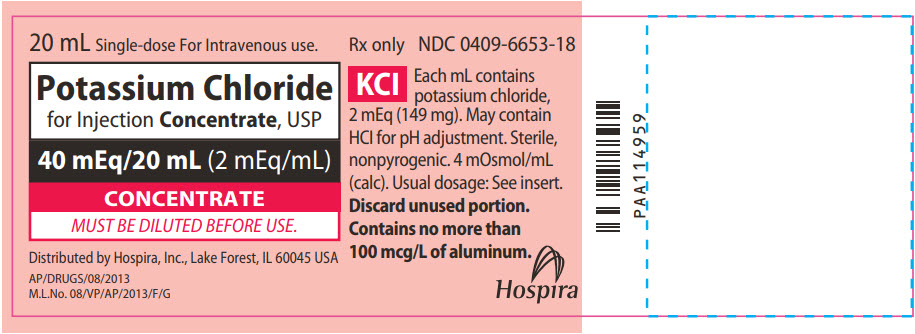
Principal Display Panel - Vial Label 20 mL Single-dose For Intravenous use. Potassium Chloride for Injection Concentrate, USP 40 mEq/20 mL (2 mEq/mL) CONCENTRATE MUST BE DILUTED BEFORE USE. Distributed by Hospira, Inc., Lake Forest, IL 60045 USA AP/DRUGS/08/2013 M.L.No. 08/VP/AP/2013/F/G Vial Label
Principal Display Panel - Serialized Vial Serialized Label
Medicare Part D spend CMS · PART D · 2026 (Q1)
About this NDC listing & data coverage
What data is (and isn’t) available for this NDC — tap to expand
| NDC identity (package / product / labeler codes) | ✓ Available |
| Labeler | ✓ Available |
| Product & package description | ✓ Available |
| Marketing category & status | ✓ Available |
| Active ingredient / dosage form / route | ✓ Available |
| FDA label (SPL via DailyMed) | ✓ Available |
| Package photos | ✓ Available |
| Inactive ingredients (structured) | ✓ Available |
| NADAC pharmacy acquisition price (CMS) | — Not published for this NDC CMS publishes NADAC only for NDCs reported in its retail-pharmacy survey. |
| Orange Book / therapeutic-equivalence data | ✓ Available |
| HCPCS J-code billing crosswalk | — Not published for this NDC Most self-administered / retail products have no J-code — that is normal. |
| Medicaid utilization (CMS SDUD) | — Not published for this NDC CMS reports utilization only for NDCs with Medicaid claims above its privacy threshold. |