
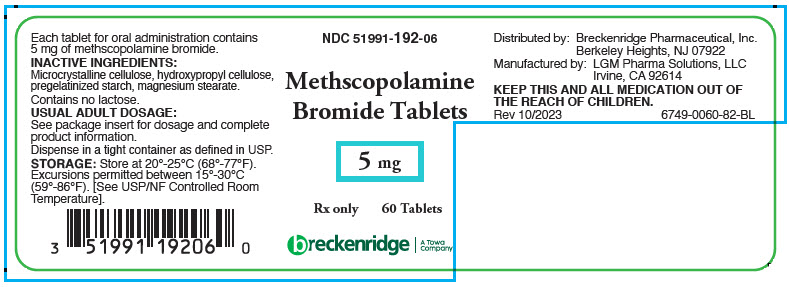
Methscopolamine Bromide 5 mg Tablet, 60-count — NDC 51991-192-06 (Billing 51991-0192-06)
This is a package of 60 tablets of Methscopolamine Bromide 5 mg Tablet from Breckenridge Pharmaceutical, Inc., marketed since May 2012 and currently FDA-listed; retail pharmacies pay about $1.53 per tablet (NADAC). It is the main listing for this product, which comes in 2 package sizes.
Identity & classification
Regulatory identifiers FDA, NLM and CMS codes for this package
Drug-database identifiers Medi-Span GPI and First Databank GCN / HICL / AHFS classification
- GSN (GCN sequence number): 052836
- GCN: 20077
- GPI-14 (Medi-Span): 49102060100320
- HICL (First Databank): 013809
- AHFS class code: 12:08.08.00
- RxCUI (RxNorm): 314088
Where does this data come from?
- FDA openFDA NDC Directory · synced Oct 1, 2026
- FDA label on DailyMed · label index refreshed Oct 1, 2026
- RxNorm (NLM RxNav) · catalog refreshed Oct 1, 2026
- Medi-Span GPI (licensed)
- First Databank (licensed) · refreshed Oct 1, 2026
RxNorm drug class
This medicine belongs to the Anticholinergic class.
Where does this data come from?
- RxClass (NLM) · catalog refreshed Oct 1, 2026
Clinical
Patient education
Supplement & herbal interactions
Some supplements/herbs that may interact with Methscopolamine Bromide — tap one for details:
Where does this data come from?
- MedlinePlus (NLM) · refreshed Oct 1, 2026
- FDA label on DailyMed · label index refreshed Oct 1, 2026
Ask a licensed pharmacist directly — free, answered by our team.
Pricing
A drug doesn't have one price. Each row is a different public payment system, and none is what you'd pay at the counter — that depends on your insurance. The ⓘ on each row explains what it measures.
| Price system | Per ea | Per package |
|---|---|---|
| Retail pharmacies payNADAC · weekly | $1.532 | $91.90 / 60 tablets |
| Medicaid paysCMS SDUD · 12 mo | No recent Medicaid claims on file for this NDC — rare and low-volume NDCs are suppressed in the public data. | |
| Medicare drug plans payPart D · Q2 2026 | $1.18 | $70.65 / 60 tablets |
Where does this data come from?
- CMS NADAC weekly file · file of Sep 30, 2026
- CMS ASP pricing files · refreshed Sep 20, 2026
- CMS Medicaid State Drug Utilization Data · refreshed Oct 3, 2026
- CMS Part D plan pricing files · refreshed Sep 24, 2026
- VA National Acquisition Center price file
Packaging — all sizes for this product
| Package NDC | Description | Per unit | Per pack | Marketing start | Marketing end | Status |
|---|---|---|---|---|---|---|
| 51991-0192-06 You're viewing this Main listing | 60 TABLET in 1 BOTTLE | $1.53 / ea | $91.90 | 2012-05-21 | — | Active |
| 51991-0192-60 51991-192-60 | 5 BLISTER PACK in 1 BOX / 12 TABLET in 1 BLISTER PACK | — | — | 2012-05-21 | — | Active |
Pack size FAQ
What quantity is in this package?
How does this package differ from NDC 51991-0192-60?
What NDC number is used to bill for this package of Methscopolamine Bromide 5 mg Tablet?
Prices are the latest CMS NADAC pharmacy acquisition cost per NDC; per-pack figures are per-unit × pack quantity, shown only when the pack is denominated in the same measure NADAC prices.
Therapeutic equivalents
| Product | Labeler | Pack | NADAC/unit | TE | Status | Price vs. this |
|---|---|---|---|---|---|---|
| Methscopolamine Bromide 5 mgthis 51991-0192-06 | Breckenridge | 60 tablets | $1.532 | AA | Availability likely | — |
| Methscopolamine Bromide 5 mg 72319-0030-02 | i3 | 60 tablets | $1.532 | AA | Availability likely | — |
| Methscopolamine Bromide 5 mg 76385-0101-60 | Unichem | 60 tablets | $1.532 | AA | Availability likely | — |
| Methscopolamine Bromide 5 mg 43063-0741-60 | PD-Rx | 60 tablets | — | AA | FDA listed | — |
| Methscopolamine Bromide 5 mg 72162-2472-06 | Bryant | 60 tablets | — | AA | FDA listed | — |
Where does this data come from?
- FDA openFDA NDC Directory · synced Oct 1, 2026
- FDA Orange Book · refreshed Oct 3, 2026
- CMS NADAC weekly file · file of Sep 30, 2026
Availability & generic status
This product is an FDA-approved generic. Other versions of the same drug are listed under Therapeutic equivalents, least expensive first.
Where does this data come from?
- FDA Orange Book · refreshed Oct 3, 2026
What it looks like
Where does this data come from?
- FDA label on DailyMed · label index refreshed Oct 1, 2026
Inactive Ingredients / Excipients
Inactive ingredients, also called excipients, are components of the drug product other than the active ingredient. They may include fillers, dyes, coatings, preservatives, flavors, or other formulation ingredients.
💡 Tap an ingredient (hover on desktop) to see what it is and why it’s used.
-
UNII RFW2ET671P
Hydroxypropyl cellulose is a plant-derived thickening agent made from cellulose. It acts as a binder to hold tablet ingredients together and as a film-former to coat tablets or control how fast the medicine releases.
-
UNII 70097M6I30
Magnesium stearate is a salt made from magnesium and stearic acid, a fatty substance. It's used in tablets and capsules as a lubricant and glidant to help ingredients flow smoothly during manufacturing and prevent sticking.
-
UNII OP1R32D61U
Microcrystalline cellulose is a purified form of cellulose, a natural fiber from plant sources. It acts as a binder and filler in tablets and capsules, helping hold ingredients together and give the medicine its shape and size.
-
UNII O8232NY3SJ
A plant-based carbohydrate derived from corn kernels. It acts as a filler to add bulk, a binder to hold ingredients together, and a disintegrant to help the tablet break apart in your stomach for absorption.
4 inactive ingredients listed in the exact product block matched to this NDC.
Where does this data come from?
ingredient classCode="IACT" elements from the exact product block matched by this NDC. Label-section narrative from DailyMed / the openFDA label index is shown separately when available.- FDA label on DailyMed · label index refreshed Oct 1, 2026
- FDA openFDA NDC Directory · synced Oct 1, 2026
Inactive ingredient FAQ
Are inactive ingredients the same for every manufacturer?
Why might an inactive ingredient be missing?
Can inactive ingredients matter?
Manufacturer & labeler
Where does this data come from?
- FDA openFDA NDC Directory · synced Oct 1, 2026
- Drugs@FDA
Full prescribing information FDA SPL
🎯 Indications and Usage ▾
INDICATIONS AND USAGE Adjunctive therapy for the treatment of peptic ulcer. METHSCOPOLAMINE BROMIDE HAS NOT BEEN SHOWN TO BE EFFECTIVE IN CONTRIBUTING TO THE HEALING OF PEPTIC ULCER, DECREASING THE RATE OF RECURRENCE OR PREVENTING COMPLICATIONS.
⏱️ Dosage and Administration ▾
DOSAGE AND ADMINISTRATION The average dosage of Methscopolamine Bromide Tablets, USP is 2.5 mg one-half hour before meals and 2.5 to 5 mg at bedtime. A starting dose of 12.5 mg daily will be clinically effective in most patients without the production of appreciable side effects. If the patient is experiencing symptoms such as severe abdominal pain or cramping which demand prompt relief, the drug may be started on a daily dosage of 20 mg, administered in doses of 5 mg one-half hour before meals and at bedtime.
If very unpleasant side effects develop promptly, the daily dosage should be reduced. If neither symptomatic relief nor side effects appear, the daily dosage may be increased. Some patients have tolerated 30 mg daily with no unpleasant reactions.
Patients whose dosage has been reduced to eliminate or modify side effects often continue to show adequate response both subjectively in relief of symptoms and objectively as measured by antisecretory effects. The ultimate aim of therapy is to arrive at a dosage which provides maximal clinical effectiveness with a minimum of unpleasant side effects. Many patients report no side effects on a dosage which gives complete relief of symptoms.
On the other hand, some patients have reported severe side effects without appreciable symptomatic relief. Such patients must be considered unsuited for this therapy. Usually they have been or will prove to be similarly intolerant to other anticholinergic drugs.
If methscopolamine bromide is to be used in a patient who gives a history of such intolerance, it should be started at a low dosage.
⛔ Contraindications ▾
CONTRAINDICATIONS Glaucoma; obstructive uropathy (e.g., bladder neck obstruction due to prostatic hypertrophy); obstructive disease of the gastrointestinal tract (e.g., pyloroduodenal stenosis); paralytic ileus; intestinal atony of the elderly or debilitated patient; unstable cardiovascular status in acute hemorrhage; severe ulcerative colitis; toxic megacolon complicating ulcerative colitis; myasthenia gravis. Methscopolamine Bromide Tablets, USP 2.5 mg and 5 mg, are contraindicated in patients who are hypersensitive to methscopolamine bromide or related drugs.
⚠️ Warnings ▾
WARNINGS In the presence of high environmental temperature, heat prostration (fever and heat stroke due to decreased sweating) can occur with drug use. Diarrhea may be an early symptom of incomplete intestinal obstruction, especially in patients with ileostomy or colostomy. In this instance treatment with this drug would be inappropriate and possibly harmful.
Methscopolamine bromide may produce drowsiness or blurred vision. The patient should be cautioned regarding activities requiring mental alertness such as operating a motor vehicle or other machinery or performing hazardous work while taking this drug. With overdosage, a curare-like action may occur, i.e., neuromuscular blockade leading to muscular weakness and possible paralysis.
🤒 Adverse Reactions ▾
ADVERSE REACTIONS The following adverse reactions have been observed, but there is not enough data to support an estimate of frequency. Cardiovascular: Tachycardia, palpitation. Allergic: Severe allergic reaction or drug idiosyncrasies including anaphylaxis.
CNS: Headaches, nervousness, mental confusion, drowsiness, dizziness. Special Senses: Blurred vision, dilation of the pupil, cycloplegia, increased ocular tension, loss of taste. Renal: Urinary hesitancy and retention.
Gastrointestinal: Nausea, vomiting, constipation, bloated feeling. Dermatologic: Decreased sweating, urticaria and other dermal manifestations. Miscellaneous: Xerostomia, weakness, insomnia, impotence, suppression of lactation.
🔄 Drug Interactions ▾
4. Drug interactions Additive anticholinergic effects may result from concomitant use with antipsychotics, tricyclic antidepressants, and other drugs with anticholinergic effects. Concomitant administration with antacids may interfere with the absorption of methscopolamine bromide.
🤰 Pregnancy ▾
6. Pregnancy Teratogenic effects Pregnancy Category C Animal reproduction studies have not been conducted with methscopolamine bromide. It is also not known whether methscopolamine bromide can cause fetal harm when administered to a pregnant woman or can affect reproduction capacity. Methscopolamine bromide should be given to a pregnant woman only if clearly needed.
🧒 Pediatric Use ▾
8. Pediatric use Safety and efficacy in children have not been established.
🆘 Overdosage ▾
OVERDOSAGE The symptoms of overdosage with Methscopolamine Bromide Tablets, USP 2.5 mg and 5 mg, progress from intensification of the usual side effects to CNS disturbances (from restlessness and excitement to psychotic behavior), circulatory changes (flushing, fall in blood pressure, circulatory failure), respiratory failure, paralysis, and coma. Measures to be taken are (1) induction of emesis and (2) injection of physostigmine 0.5 to 2 mg intravenously, and repeated as necessary up to a total of 5 mg. Fever may be treated symptomatically (alcohol sponging, ice packs).
Excitement of a degree which demands attention may be managed with sodium thiopental 2% solution given slowly intravenously or chloral hydrate (100-200 mL of a 2% solution) by rectal infusion. In the event of progression of the curare-like effect to paralysis of the respiratory muscles, artificial respiration should be instituted and maintained until effective respiratory action returns. The oral LD 50 in rats is 1,352 to 2,617 mg/kg.
No data is available on the dialyzability of methscopolamine bromide.
🧬 Clinical Pharmacology ▾
CLINICAL PHARMACOLOGY Methscopolamine bromide is an anticholinergic agent which possesses most of the pharmacologic actions of that drug class. These include reduction in volume and total acid content of gastric secretion, inhibition of gastrointestinal motility, inhibition of salivary excretion, dilation of the pupil and inhibition of accommodation with resulting blurring of vision. Large doses may result in tachycardia.
PHARMACOKINETICS Methscopolamine bromide is a quaternary ammonium derivative of scopolamine. As a class, these agents are poorly and unreliably absorbed. 1,2 Total absorption of quaternary ammonium derivatives of the alkaloids is 10-25%.
Rate of absorption is not available. Quaternary ammonium salts have limited absorption from intact skin, and conjunctival penetration is poor. 1 Little is known of the fate and excretion of most of these agents.
1 Following oral administration, drug effects appear in about one hour and persist for 4 to 6 hours. 2 Methscopolamine bromide has limited ability to cross the blood-brain barrier. 3,4,5 The drug is excreted primarily in the urine and bile, or as unabsorbed drug in feces.
2 There is no data on the presence of methscopolamine in breast milk; traces of atropine have been found after administration of atropine. 1
📦 How Supplied / Storage and Handling ▾
HOW SUPPLIED Methscopolamine Bromide Tablets, USP 2.5 mg are available as white, round tablets, debossed with "B" on one side and "191" on the other side, in the following package size: Bottles of 100 (NDC# 51991-191-01) Methscopolamine Bromide Tablets, USP 5 mg are available as white, oval tablets, debossed with "B192" on one side, and no debossing on the other side, in the following package size: Bottles of 60 (NDC# 51991-192-06) Box of 60 (5 blisters of 12 tablets) (NDC 51991-192-60) STORAGE Store at 20°-25°C (68°-77°F).
Excursions permitted between 15°-30°C (59°-86°F). [See USP Controlled Room Temperature] Dispense in a tight container as defined in USP. KEEP THIS AND ALL MEDICATIONS OUT OF THE REACH OF CHILDREN.
📦 Storage and Handling ▾
STORAGE Store at 20°-25°C (68°-77°F). Excursions permitted between 15°-30°C (59°-86°F). [See USP Controlled Room Temperature] Dispense in a tight container as defined in USP. KEEP THIS AND ALL MEDICATIONS OUT OF THE REACH OF CHILDREN.
📋 Description ▾
DESCRIPTION Methscopolamine Bromide Tablets, USP 2.5 mg and 5 mg contain methscopolamine bromide, USP, an anticholinergic, which occurs as white crystals, or as a white odorless crystalline powder. Methscopolamine bromide melts at about 225°C with decomposition. The drug is freely soluble in water, slightly soluble in alcohol, and insoluble in acetone and in chloroform.
The chemical name for methscopolamine bromide is 3-Oxa-9-azoniatricyclo [3.3.1.0 2,4 ]nonane, 7-(3-hydroxy-1-oxo-2-phenylpropoxy)-9, 9-dimethyl-, bromide, [7(S)-(1α, 2β, 4β, 5α, 7β)]-and the molecular weight is 398.30. The structural formula is represented below: Methscopolamine Bromide Tablets, USP 2.5 mg for oral administration contain 2.5 mg of methscopolamine bromide, USP. Methscopolamine Bromide Tablets, USP 5 mg for oral administration contain 5 mg of methscopolamine bromide, USP.
Inactive ingredients microcrystalline cellulose, hydroxypropyl cellulose, pregelatinized starch, magnesium stearate. Contains no lactose. Chemical Structure
💬 Information for Patients ▾
2. Information for patient See statement under WARNINGS .
⚠️ Precautions ▾
PRECAUTIONS 1. General precautions Use Methscopolamine Bromide Tablets, USP 2.5 mg and 5 mg, with caution in the elderly and in all patients with: autonomic neuropathy; hepatic or renal disease; or ulcerative colitis – large doses may suppress intestinal motility to the point of producing a paralytic ileus and for this reason precipitate or aggravate "toxic megacolon," a serious complication of the disease. The drug also should be used with caution in patients having hyperthyroidism, coronary heart disease, congestive heart failure, tachyarrhythmia, tachycardia, hypertension, or prostatic hypertrophy.
2. Information for patient See statement under WARNINGS . 3.
Laboratory tests Progress of the peptic ulcer under treatment should be followed by upper gastrointestinal contrast radiology or endoscopy to insure healing. Stool tests for occult blood and blood hemoglobin or hematocrit values should be followed to rule out bleeding from the ulcer. 4.
Drug interactions Additive anticholinergic effects may result from concomitant use with antipsychotics, tricyclic antidepressants, and other drugs with anticholinergic effects. Concomitant administration with antacids may interfere with the absorption of methscopolamine bromide. 5.
Carcinogenesis, mutagenesis, impairment of fertility No long-term studies in animals have been performed to evaluate carcinogenic potential. 6. Pregnancy Teratogenic effects Pregnancy Category C Animal reproduction studies have not been conducted with methscopolamine bromide.
It is also not known whether methscopolamine bromide can cause fetal harm when administered to a pregnant woman or can affect reproduction capacity. Methscopolamine bromide should be given to a pregnant woman only if clearly needed. 7.
Nursing mothers It is not known whether this drug is excreted in human milk. Because many drugs are excreted in human milk, caution should be exercised when methscopolamine bromide is administered to a nursing woman. Anticholinergic drugs may suppress lactation.
8. Pediatric use Safety and efficacy in children have not been established.
🍼 Nursing Mothers ▾
7. Nursing mothers It is not known whether this drug is excreted in human milk. Because many drugs are excreted in human milk, caution should be exercised when methscopolamine bromide is administered to a nursing woman. Anticholinergic drugs may suppress lactation.
🧬 Pharmacokinetics ▾
PHARMACOKINETICS Methscopolamine bromide is a quaternary ammonium derivative of scopolamine. As a class, these agents are poorly and unreliably absorbed. 1,2 Total absorption of quaternary ammonium derivatives of the alkaloids is 10-25%.
Rate of absorption is not available. Quaternary ammonium salts have limited absorption from intact skin, and conjunctival penetration is poor. 1 Little is known of the fate and excretion of most of these agents.
1 Following oral administration, drug effects appear in about one hour and persist for 4 to 6 hours. 2 Methscopolamine bromide has limited ability to cross the blood-brain barrier. 3,4,5 The drug is excreted primarily in the urine and bile, or as unabsorbed drug in feces.
2 There is no data on the presence of methscopolamine in breast milk; traces of atropine have been found after administration of atropine. 1
🔒 Drug Abuse and Dependence ▾
DRUG ABUSE AND DEPENDENCE Not applicable.
📄 Carcinogenesis, Mutagenesis, Impairment of Fertility ▾
5. Carcinogenesis, mutagenesis, impairment of fertility No long-term studies in animals have been performed to evaluate carcinogenic potential.
📚 References ▾
REFERENCES Gilman A, Gilman AB, Goodman LA, eds. The Pharmacological Basis of Therapeutics. 6th ed.
New York: MacMillan Publishing Company.1980. American Hospital Formulary Service. American Society of Hospital Pharmacists.
Bethesda, Maryland. Domino EF, Corasen G. Central and Peripheral Effects of Muscarinic Cholinergic Blocking Agents in Man.
Anesthesiology 1967;28:568-574. Mogensen L, Orinius E. Arrhythmic Complications after Parasympathetic Treatment of Bradyarrhythmias in a Coronary Care Unit.
Acta Med Scand 1971;190:495-498. Neeld JB Jr., et al. Cardiac Rate and Rhythm Changes with Atropine and Methscopolamine.
Clin Pharmacol Ther 1975;17(3):290-295.
📄 Package Label / Principal Display Panel ▾
PRINCIPAL DISPLAY PANEL - 2.5 mg Tablet Bottle Label NDC 51991-191-01 Methscopolamine Bromide Tablets 2.5 mg Rx only 100 Tablets breckenridge A Towa Company PRINCIPAL DISPLAY PANEL - 2.5 mg Tablet Bottle Label
PRINCIPAL DISPLAY PANEL - 5 mg Tablet Bottle Label NDC 51991-192-06 Methscopolamine Bromide Tablets 5 mg Rx only 60 Tablets breckenridge A Towa Company PRINCIPAL DISPLAY PANEL - 5 mg Tablet Bottle Label