
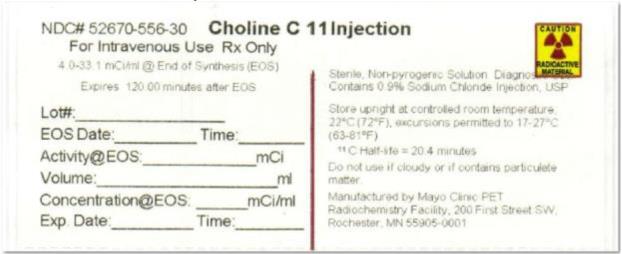
Choline C 11 33.1 mCi/mL Injection, 30 mL — NDC 52670-556-30 (Billing 52670-0556-30)
This is a package of 30 mL of Choline C 11 33.1 mCi/mL Injection from Mayo Clinic, marketed since Sep 2012 and currently FDA-listed. It is this product's only package size.
Identity & classification
Regulatory identifiers FDA, NLM and CMS codes for this package
Where does this data come from?
- FDA openFDA NDC Directory · synced Oct 1, 2026
- FDA label on DailyMed · label index refreshed Oct 1, 2026
- RxNorm (NLM RxNav) · catalog refreshed Oct 1, 2026
- Medi-Span GPI (licensed)
- First Databank (licensed) · refreshed Oct 1, 2026
Clinical
Patient education
Supplement & herbal interactions
Where does this data come from?
- MedlinePlus (NLM) · refreshed Oct 1, 2026
- FDA label on DailyMed · label index refreshed Oct 1, 2026
Ask a licensed pharmacist directly — free, answered by our team.
Pricing
A drug doesn't have one price. Each row is a different public payment system, and none is what you'd pay at the counter — that depends on your insurance. The ⓘ on each row explains what it measures.
| Price system | Per each | Per package |
|---|---|---|
| Retail pharmacies payNADAC · weekly | Not in the retail survey — common for institutional, discontinued, or low-volume packs. | |
| Medicaid paysCMS SDUD · 12 mo | No recent Medicaid claims on file for this NDC — rare and low-volume NDCs are suppressed in the public data. | |
| Medicare drug plans payPart D · quarterly | No Part D plan price is available for this NDC in our data. | |
Where does this data come from?
- CMS NADAC weekly file
- CMS ASP pricing files · refreshed Sep 20, 2026
- CMS Medicaid State Drug Utilization Data · refreshed Oct 3, 2026
- CMS Part D plan pricing files · refreshed Sep 24, 2026
- VA National Acquisition Center price file
Packaging — all sizes for this product
| Package NDC | Description | Marketing start | Marketing end | Status |
|---|---|---|---|---|
| 52670-0556-30 You're viewing this Main listing | 30 mL in 1 VIAL | 2012-09-12 | — | Active |
Therapeutic equivalents
| Product | Labeler | Pack | NADAC/unit | TE | Status | Price vs. this |
|---|---|---|---|---|---|---|
| Choline C 11 33.1 mCi/mLthis 52670-0556-30 | Mayo | 30 ml | — | AP | FDA listed | — |
Where does this data come from?
- FDA openFDA NDC Directory · synced Oct 1, 2026
- FDA Orange Book · refreshed Sep 3, 2026
- CMS NADAC weekly file
Availability & generic status
The FDA lists approved generic versions of this medicine, but that does not always mean a pharmacy can get one today. Patent rules, launch agreements, supply and pricing can affect when generics actually arrive.
Where does this data come from?
- FDA Orange Book · refreshed Sep 3, 2026
Inactive Ingredients / Excipients
Inactive ingredients, also called excipients, are components of the drug product other than the active ingredient. They may include fillers, dyes, coatings, preservatives, flavors, or other formulation ingredients.
💡 Tap an ingredient (hover on desktop) to see what it is and why it’s used.
-
UNII 451W47IQ8X
Sodium chloride is common table salt. It's used in medicines as a buffer to maintain proper pH, as a filler to add bulk, or to adjust the osmotic balance in liquid formulations.
1 inactive ingredient listed in the exact product block matched to this NDC.
Where does this data come from?
ingredient classCode="IACT" elements from the exact product block matched by this NDC. Label-section narrative from DailyMed / the openFDA label index is shown separately when available.- FDA label on DailyMed · label index refreshed Oct 1, 2026
- FDA openFDA NDC Directory · synced Oct 1, 2026
Inactive ingredient FAQ
Are inactive ingredients the same for every manufacturer?
Why might an inactive ingredient be missing?
Can inactive ingredients matter?
Manufacturer & labeler
Where does this data come from?
- FDA openFDA NDC Directory · synced Oct 1, 2026
- Drugs@FDA
Full prescribing information FDA SPL
🎯 Indications and Usage ▾
1 INDICATIONS AND USAGE Choline C 11 Injection is indicated for positron emission tomography (PET) imaging of patients with suspected prostate cancer recurrence and non-informative bone scintigraphy, computerized tomography (CT) or magnetic resonance imaging (MRI). In these patients, 11 C-choline PET imaging may help identify potential sites of prostate cancer recurrence for subsequent histologic confirmation. Suspected prostate recurrence is based upon elevated blood prostate specific antigen (PSA) levels following initial therapy.
In clinical studies, images were produced with PET/CT coregistration. Limitation of U se: 11 C-choline PET imaging is not a replacement for histologic verification of recurrent prostate cancer. Choline C 11 Injection is a radioactive diagnostic agent for positron emission tomography (PET) imaging of patients with suspected prostate cancer recurrence and non-informative bone scintigraphy, computerized tomography (CT) or magnetic resonance imaging.
In these patients, 11 C-choline PET imaging may help identify potential sites of prostate cancer recurrence for subsequent histologic confirmation. Suspected prostate recurrence is based upon elevated blood prostate specific antigen (PSA) levels following initial therapy. In clinical studies, images were produced with PET/CT coregistration.
Limitation of U se: 11 C-choline PET imaging is not a replacement for histologic verification of recurrent prostate cancer ( 1 ).
⏱️ Dosage and Administration ▾
2 DOSAGE AND ADMINISTRATION Aseptically withdraw Choline C 11 Injection from its container and administer 370 – 740 MBq (10 – 20 mCi) as a bolus intravenous injection. The radioactivity dose (370 – 740 MBq, 10 – 20 mCi) is chosen based on patient body dimensions and the characteristics of the image acquisition system ( 2.1 ). Initiate imaging immediately after administration of Choline C 11 Injection and acquire static emission images 0 – 15 minutes from the time of injection ( 2.5 ).
The effective radiation absorbed dose from 740 MBq (20 mCi) dose of Choline C 11 Injection is approximately 3.22 mSv (0.32 rem) in an adult ( 2.4 ). Image interpretation: Refer to full prescribing information ( 2.5 ).
2.1Radiation Safety – Drug Handling Choline C 11 Injection is a radioactive drug and should be handled with appropriate safety measures to minimize radiation exposure during administration. Use waterproof gloves and effective shielding when handling Choline C 11 Injection. Radiopharmaceuticals, including Choline C 11 Injection, should only be used by or under the control of physicians who are qualified by specific training and experience in the safe use and handling of radioactive materials, and whose experience and training have been approved by the appropriate governmental agency authorized to license the use of radionuclides.
2.2Recommended Dose and Administration Instructions The recommended dose is 370 – 740 MBq (10 – 20 mCi) administered as a bolus intravenous injection. The radioactivity dose (370 – 740 MBq, 10 – 20 mCi) is chosen based on patient body dimensions and the characteristics of the image acquisition system Inspect Choline C 11 Injection visually for particulate matter and discoloration before administration. Do not use the drug if the solution contains particulate matter or is discolored.
Aseptically withdraw Choline C 11 Injection from its container and administer the drug as a bolus through a peripheral venous catheter. Dispose of any unused drug in a safe manner, in compliance with applicable regulations.
2.3Patient Preparation Prior to administration of Choline C 11 Injection: Fasting for at least six hours is recommended to minimize the potential for dietary choline interference with radioactivity uptake in tissue. Ensure that the patient is well hydrated and encourage voiding when imaging is completed.
2.4R adiation Dosimetry The estimated radiation absorbed doses for adults from intravenous injection of Choline C 11 Injection are shown in Table 1. These estimates are calculated from data in Tolvanen 1 and using OLINDA/EXM (Organ Level Internal Dose Assessment/Exponential Modeling) software from Vanderbilt University. 2 Table 1: Estimated Radiation Absorbed Dose Per Unit Activity for Adults, Choline C 11 Injection Organ/Tissue Mean Absorbed Dose P er Unit Administered Activity ( μ Gy/MBq) b Adrenals
3.59 Bone - Osteogenic Cells
4.81 Bone - Red Marrow
1.90 Brain
1.16 Breast
1.39 Gallbladder Wall
4.54 GI a – Lower Large Intestine Wall
1.81 GI a - Small Intestine
2.35 GI a - Stomach Wall
6.00 GI a – Upper Large Intestine Wall
6.41 Heart wall
3.43 Kidneys
20.62 Liver
20.11 Lungs
4.59 Muscle
2.54 Ovaries
2.02 Pancreas
29.19 Skin
1.22 Spleen
9.16 Testes
1.36 Thymus
1.69 Thyroid
1.49 Urinary Bladder Wall
3.41 Uterus
1.96 Total body
2.97Effective Dose (μSv/MBq) c 4.35 a Gastrointestinal b Assumed radiation weighting factor, w r , (formerly defined as quality factor, Q) of 1 for conversion of absorbed dose (Gray or rad) to dose equivalent (Sieverts or rem) for C 11. To obtain radiation absorbed dose in rad/mCi from the above table, multiply the dose in μGy/MBq by 0.0037, (e.g., 3.59 μGy/MBq × 0.0037 = 0.0133 rad/mCi). c Radiation tissue weighting factors, w T , used in the calculation of effective dose are from 1990 Recommendations of the International Commission on Radiological Protection, ICRP Publication 60 (1991).
To obtain radiation absorbed dose in rem/mCi from above table, multiply the dose in μGy/MBq by… [Excerpted — this section continues on DailyMed.]
💊 Dosage Forms and Strengths ▾
3 DOSAGE FORMS AND STRENGTHS Choline C 11 Injection contains 148 – 1,225 MBq (4 – 33.1 mCi) per milliliter of 11 C-choline at end of synthesis (EOS) calibration time in aqueous 0.9% sodium chloride solution. Choline C 11 Injection contains 148 – 1,225 MBq (4 – 33.1 mCi) per milliliter of 11 C-choline at end of synthesis calibration time in aqueous 0.9% sodium chloride solution ( 3 ).
⛔ Contraindications ▾
4 CONTRAINDICATIONS None. None ( 4 ).
⚠️ Warnings and Cautions ▾
5 WARNINGS AND PRECAUTIONS Imaging errors have been reported; blood PSA levels < 2 ng/mL have been associated with poor imaging performance ( 5.1 ). Allergic reactions: have emergency resuscitation equipment and personnel readily available ( 5.2 ). Radiation risk: Choline C 11 Injection contributes to a patient’s long-term cumulative radiation exposure. Ensure safe handling to protect the patient and health care worker ( 5.3 ).
5.1Imaging Errors Imaging errors have been reported with 11 C-choline PET and PET/CT imaging. A negative image does not rule out the presence of recurrent prostate cancer and a positive image does not confirm the presence of recurrent cancer. 11C-choline uptake is not specific for prostate cancer and may occur with other types of cancer (such as lung carcinoma and brain tumors).
Clinical correlation, including histopathological evaluation of the suspected recurrence site, is essential to proper use of the PET imaging information. Blood PSA levels < 2 ng/mL have been associated with poor performance of 11 C-choline PET imaging (higher numbers of false positive and false negative results) [see Clinical Studies (14) ] . Tissue inflammation as well as prostatic hyperplasia have been associated with false positive 11 C-choline PET images.
Concomitant colchicine or androgen-deprivation therapeutic drugs (such as luteinizing hormone-releasing analogs and anti-androgen drugs) may interfere with 11 C-choline PET imaging. One published report of 18 F-methylcholine PET imaging indicated that discontinuation of colchicine for two weeks resolved the colchicine effect. The impact of discontinuation of androgen-deprivation therapy upon 11 C-choline PET imaging has not been established [see Drug Interactions (7) ] .
5.2Allergic Reactions As with any injectable drug product, allergic reactions and anaphylaxis may occur. Emergency resuscitation equipment and personnel should be immediately available.
5.3Radiation Risks Choline C 11 Injection contributes to a patient’s overall long-term cumulative radiation exposure. Long-term cumulative radiation exposure is associated with an increased risk for cancer. Safe handling should be ensured to minimize radiation exposure to the patient and health care workers [ see Dosage and Administration (2.1) ].
🤒 Adverse Reactions ▾
6 ADVERSE REACTIONS Exclusive of an uncommon, mild injection site reaction, no adverse reactions to 11 C-choline have been reported. Exclusive of an uncommon, mild injection site reaction, no other adverse reactions have been reported ( 6 ). To report SUSPECTED ADVERSE REACTIONS, contact Division of Nuclear Medicine, Department of Radiology, Mayo Clinic at 507-284-2511 or FDA at 1-800-FDA-1088 or www.fda.gov/medwatch
🔄 Drug Interactions ▾
7 DRUG INTERACTIONS Colchicine and androgen-deprivation therapeutic drugs have been reported to interfere with choline-based PET imaging [ see Warnings and Precautions (5.1) ]. The impact of androgen-deprivation therapeutic drugs upon 11 C-choline PET imaging may depend upon the hormonal responsiveness of a patient’s recurrent prostate cancer. Clinical studies have not established this relationship but published reports suggest 11 C-choline PET imaging may be productive in patients with “hormone resistant” recurrent prostate cancer even if the patients are receiving anti-androgen therapy.
Imaging may prove unproductive or misleading due to failed or insufficient 11 C-choline uptake in patients with hormone-responsive cancer if the patients are receiving androgen-deprivation therapy. Colchicine and androgen-deprivation therapeutic drugs may interfere with 11 C-choline PET/CT imaging performance ( 5.1 ).
👥 Use in Specific Populations ▾
8 USE IN SPECIFIC POPULATIONS
8.1Pregnancy Pregnancy Category C. There are no adequate and well controlled studies with Choline C 11 Injection in pregnant women and the fetal radiation dose from a 11 C-choline PET imaging study is unknown. It is not known whether Choline C 11 Injection can cause fetal harm when administered to a pregnant woman or can affect reproduction capacity.
Animal reproduction studies have not been conducted with 11 C-choline. All radiopharmaceuticals, including Choline C 11 Injection, have a potential to cause fetal harm. The likelihood of fetal harm depends on the stage of fetal development and the magnitude of the radiopharmaceutical dose.
Assess pregnancy status before administering Choline C 11 Injection to a female of child bearing potential. Choline C 11 Injection should be given to a pregnant woman only if clearly needed.
8.3Nursing Mothers Choline C 11 Injection is not indicated for use in women. It is not known whether Choline C 11 Injection is excreted in human milk. Because many drugs are excreted in human milk and because of the potential for radiation exposure to nursing infants from Choline C 11 Injection, nursing mothers should use alternative infant nutrition sources (e.g., stored breast milk or infant formula) and pump and discard breast milk for 8 hours (>10 half lives of radioactive decay for 11 C isotope) after administration of the drug or avoid use of the drug, taking into account the importance of the drug to the mother.
8.4Pediatric Use The safety and effectiveness of Choline C 11 Injection have not been established in pediatric patients.
🤰 Pregnancy ▾
8.1Pregnancy Pregnancy Category C. There are no adequate and well controlled studies with Choline C 11 Injection in pregnant women and the fetal radiation dose from a 11 C-choline PET imaging study is unknown. It is not known whether Choline C 11 Injection can cause fetal harm when administered to a pregnant woman or can affect reproduction capacity.
Animal reproduction studies have not been conducted with 11 C-choline. All radiopharmaceuticals, including Choline C 11 Injection, have a potential to cause fetal harm. The likelihood of fetal harm depends on the stage of fetal development and the magnitude of the radiopharmaceutical dose.
Assess pregnancy status before administering Choline C 11 Injection to a female of child bearing potential. Choline C 11 Injection should be given to a pregnant woman only if clearly needed.
🧒 Pediatric Use ▾
8.4Pediatric Use The safety and effectiveness of Choline C 11 Injection have not been established in pediatric patients.
🧬 Clinical Pharmacology ▾
12 CLINICAL PHARMACOLOGY
12.1Mechanism of Action Choline C 11 Injection is a radiolabeled analog of choline, a precursor molecule essential for the biosynthesis of cell membrane phospholipids. Choline is involved in synthesis of the structural components of cell membranes, as well as modulation of trans-membrane signaling. Increased phospholipid synthesis (i.e., increased uptake of choline) has been associated with cell proliferation and the transformation process that occurs in tumor cells.
12.2Pharmacodynamics In a study of men with prostatic hyperplasia or primary prostate cancer, PET imaging showed 11 C-choline radioactivity accumulated rapidly within the prostate; uptake appeared to peak by five minutes following injection of the drug and activity was retained over the subsequent 30 minute scanning period. Little uptake was observed in the bladder and rectum.
12.3Pharmacokinetics Distribution: 11 C-choline distributes mainly to the pancreas, kidneys, liver, spleen and colon [ see Dosage and Administration (2.4) ]. Based upon the relatively low urinary excretion of radioactivity, renal distribution is predominantly to the organ itself, rather than via formation of urine. Metabolism: Following intravenous administration, 11 C-choline undergoes metabolism resulting in the detection of 11 C-betaine as the major metabolite in blood.
In a study of patients with prostate cancer or brain disorders, the fractional activities of 11 C-choline and 11 C-betaine in human arterial plasma appeared to reach a plateau within 25 minutes, with 11 C-betaine representing 82± 9% of the total 11 C detected at that time point. A small amount of unmetabolized 11 C-choline was detected within the blood at the final sampling time point (40 minutes). Elimination: Urinary excretion of 11 C-choline was < 2% of the injected radioactivity at 1.5 hours after injection of the drug.
The rate of 11 C-choline excretion in urine was 0.014 mL/min.
🧬 Mechanism of Action ▾
12.1Mechanism of Action Choline C 11 Injection is a radiolabeled analog of choline, a precursor molecule essential for the biosynthesis of cell membrane phospholipids. Choline is involved in synthesis of the structural components of cell membranes, as well as modulation of trans-membrane signaling. Increased phospholipid synthesis (i.e., increased uptake of choline) has been associated with cell proliferation and the transformation process that occurs in tumor cells.
📦 How Supplied / Storage and Handling ▾
16 HOW SUPPLIED/STORAGE AND HANDLING
16.1How Supplied Choline C 11 Injection is packaged in a single dose glass vial containing between 148 MBq to 1,225 MBq (4 mCi to 33.1 mCi) per milliliter of 11 C-choline at EOS calibration time in aqueous 0.9% sodium chloride solution.
16.2Storage and Handling Store Choline C 11 Injection at 25°C (77°F); excursions permitted to 15 – 30°C (59 – 86°F) (see USP Controlled Room Temperature). Use the solution within 120 minutes of EOS calibration.
16.1How Supplied Choline C 11 Injection is packaged in a single dose glass vial containing between 148 MBq to 1,225 MBq (4 mCi to 33.1 mCi) per milliliter of 11 C-choline at EOS calibration time in aqueous 0.9% sodium chloride solution.
📦 Storage and Handling ▾
16.2Storage and Handling Store Choline C 11 Injection at 25°C (77°F); excursions permitted to 15 – 30°C (59 – 86°F) (see USP Controlled Room Temperature). Use the solution within 120 minutes of EOS calibration.
📋 Description ▾
11 DESCRIPTION
11.1Chemical Characteristics Choline C 11 Injection is a positron emitting radiopharmaceutical that is used for diagnostic purposes in conjunction with PET imaging. The active ingredient, 11 C-choline, has the molecular formula of C 4 11 CH 14 NOCl with a molecular weight of 138.63 g and has the following chemical structure: Choline C 11 Injection is provided as a ready to use sterile, pyrogen-free, clear and colorless solution. Each milliliter contains 148 – 1,225 MBq (4 – 33.1 mCi) of 11 C-choline at EOS calibration time in aqueous 0.9% sodium chloride solution.
The pH of the solution is between 4.5 and 7.5. C-11 choline chloride structure
11.2Physical Characteristics Carbon 11 is a cyclotron-produced radionuclide that decays to Boron 11 by positron emission and has a physical half life of 20.4 minutes (Table 2). Table 2: Principal Radiation Emission Data for 11 C Radiation/Emission % Per Disintegration Energy Positron (β+) 99.76 960.2 keV (Max.) Gamma (±)* 199.5 511 keV *Produced by positron annihilation The specific gamma ray constant (point source air kerma coefficient) for 11 C-choline is
5.8R/mCi-hr at 1 cm. Selected coefficients of attenuation are listed in Table 3 as a function of lead shield thickness. For example, the use of 39 mm thickness of lead will attenuate the external radiation by a factor of about 1,000.
Table 3: Radiation Attenuation of 511 keV Photons by lead (Pb) shielding Shield Thickness (Pb) mm Coefficient of Attenuation 4 0.5 8 0.25 13 0.1 26 0.01 39 0.001 52 0.0001 Table 4 lists fractions remaining at selected time intervals from the calibration time. This information may be used to correct for physical decay of the radionuclide. Table 4: Physical Decay Chart for 11 C Minutes Fraction Remaining 0* 1.000 5 0.844 10 0.712 15 0.600 20 0.507 25 0.427 30 0.360 *Calibration time
💬 Information for Patients ▾
17 PAT IENT COUNSELING INFORMATION Instruct patients to drink plenty of water or other fluids (as tolerated) in the four hours before their PET/CT study. Instruct patients to void after completion of each image acquisition session and as often as possible for one hour after the PET/CT scan ends. Manufactured by: Mayo Clinic PET Radiochemistry Facility 200 1 st St SW Rochester, MN 55905 Mayo Clinic PET Radiochemistry Facility 5861 E Mayo Blvd Phoenix, AZ 85054 Distributed by: Mayo Clinic PET Radiochemistry Facility 200 1 st St SW Rochester, MN 55905 Mayo Clinic PET Radiochemistry Facility 5861 E Mayo Blvd Phoenix, AZ 85054
🍼 Nursing Mothers ▾
8.3Nursing Mothers Choline C 11 Injection is not indicated for use in women. It is not known whether Choline C 11 Injection is excreted in human milk. Because many drugs are excreted in human milk and because of the potential for radiation exposure to nursing infants from Choline C 11 Injection, nursing mothers should use alternative infant nutrition sources (e.g., stored breast milk or infant formula) and pump and discard breast milk for 8 hours (>10 half lives of radioactive decay for 11 C isotope) after administration of the drug or avoid use of the drug, taking into account the importance of the drug to the mother.
🧬 Pharmacokinetics ▾
12.3Pharmacokinetics Distribution: 11 C-choline distributes mainly to the pancreas, kidneys, liver, spleen and colon [ see Dosage and Administration (2.4) ]. Based upon the relatively low urinary excretion of radioactivity, renal distribution is predominantly to the organ itself, rather than via formation of urine. Metabolism: Following intravenous administration, 11 C-choline undergoes metabolism resulting in the detection of 11 C-betaine as the major metabolite in blood.
In a study of patients with prostate cancer or brain disorders, the fractional activities of 11 C-choline and 11 C-betaine in human arterial plasma appeared to reach a plateau within 25 minutes, with 11 C-betaine representing 82± 9% of the total 11 C detected at that time point. A small amount of unmetabolized 11 C-choline was detected within the blood at the final sampling time point (40 minutes). Elimination: Urinary excretion of 11 C-choline was < 2% of the injected radioactivity at 1.5 hours after injection of the drug.
The rate of 11 C-choline excretion in urine was 0.014 mL/min.
🧬 Pharmacodynamics ▾
12.2Pharmacodynamics In a study of men with prostatic hyperplasia or primary prostate cancer, PET imaging showed 11 C-choline radioactivity accumulated rapidly within the prostate; uptake appeared to peak by five minutes following injection of the drug and activity was retained over the subsequent 30 minute scanning period. Little uptake was observed in the bladder and rectum.
🔬 Clinical Studies ▾
14 CLINICAL STUDIES A systematic review of published reports identified four studies that contained data sufficient to compare 11 C-choline PET imaging to histopathology (truth standard) among patients with suspected prostate cancer recurrence and non-informative conventional imaging (for most patients, CT or MRI). In general, the suspected recurrence criteria consisted of at least two sequential PSA levels of > 0.2 ng/mL for men who had undergone prostatectomy and PSA levels of ≥ 2 ng/mL above the post-therapy nadir for men who had undergone radiotherapy.
The studies were predominantly single clinical site experiences and image acquisition generally surveyed radioactivity distribution from the base of the pelvis to the base of the skull. Prospective studies : Two studies examined the ability of 11 C-choline PET/CT to detect prostate cancer in pelvic and/or retroperitoneal lymph nodes among patients who had previously undergone radical prostatectomy. Both studies used a truth standard of lymph node histopathology.
11 C-choline images were interpreted by readers masked to clinical information; surgical resection of lymph nodes was performed by surgeons aware of the 11 C-choline PET/CT results. In Study One 3 , 25 patients who underwent 11 C-choline PET/CT and conventional imaging (CT or MRI) were scheduled to undergo pelvic or pelvic plus retroperitoneal lymphadenectomy following the imaging identification of suspected lymph node metastases. The median PSA was 2.0 ng/mL (range 0.2 to 23.1 ng/mL).
The study excluded subjects with metastatic disease detected by bone scintigraphy or isolated prostatic fossa recurrence. Among the 25 patients, 21 had positive 11 C-choline PET/CT scans; histopathology verified cancer in 19 of these patients. Lymph node histopathology detected no cancer among the four patients who had surgery based only on positive conventional imaging; 11 C-choline PET/CT was negative in all four patients.
The study report included information for patients who had non-informative conventional imaging (CT or MRI, bone scintigraphy and transrectal ultrasound), as shown in Table 5. In Study Two 4 , 15 patients were scheduled to undergo pelvic or pelvis plus retroperitoneal lymphadenectomy solely based upon positive 11 C-choline PET/CT imaging in the setting of negative conventional imaging (ultrasound and/or CT and/or MRI and/or bone scintigraphy). The median PSA was 2.0 ng/mL (range 1.0 to 8.0 ng/mL); all patients had previously undergone radical prostatectomy.
Eight of the 15 patients had cancer verified by lymph node histology; histology detected no cancer in seven patients. Retrospective Studies: Two studies were retrospective reviews of patients who underwent 11 C-choline PET/CT and had histopathology obtained from biopsy of the prostatic fossa or other suspected recurrence sites. In Study Three 5 , 11 C-choline PET/CT imaging was performed among 36 patients with suspected prostate cancer recurrence and 13 subjects without suspected recurrence (controls).
Prostatic fossa biopsies were performed among the patients with suspected recurrence. All the patients and control subjects had previously undergone radical prostatectomy; patient with suspected recurrence had no evidence of cancer using conventional clinical evaluations, including trans-rectal ultrasound and bone scintigraphy. PET/CT scans were interpreted by readers masked to clinical information.
Median PSA was 2.0 ng/mL (range 0.3 – 12.1 ng/mL) for patients with suspected recurrence and 0.1 ng/mL (range 0.0 – 0.2 ng/mL) in control subjects. Prostatic fossa biopsy showed cancer in 33 of the 36 patients with suspected recurrence. PET/CT scans were positive in 25 of the 36 patients; two patients had false positive scans (one scan in a control subject and one scan in a suspected recurrence subject who had no cancer detected on prostatic fossa biopsy).
Among the 13 control subjects, 12 had negative PET/CT scans. In Study Four 6 ,7 , 34 patients with negative conven… [Excerpted — this section continues on DailyMed.]
🧪 Nonclinical Toxicology ▾
13 NONCLINICAL TOXICOLOGY
13.1Carcinogenesis, Mutagenesis, Impairment of Fertility Long term studies have not been performed to evaluate the carcinogenic potential of Choline C 11 Injection. The mutagenic potential of Choline C 11 Injection has not been adequately evaluated; however, any radiopharmaceutical, including Choline C 11 Injection, has the potential to be mutagenic. The effect of Choline C 11 Injection on fertility has not been evaluated.
📄 Carcinogenesis, Mutagenesis, Impairment of Fertility ▾
13.1Carcinogenesis, Mutagenesis, Impairment of Fertility Long term studies have not been performed to evaluate the carcinogenic potential of Choline C 11 Injection. The mutagenic potential of Choline C 11 Injection has not been adequately evaluated; however, any radiopharmaceutical, including Choline C 11 Injection, has the potential to be mutagenic. The effect of Choline C 11 Injection on fertility has not been evaluated.
📚 References ▾
15 REFERENCES 1 Tolvanen T, Yli-Kerttula T, Ujula T, Autio A, Lehikoinen P, Minn J, RoivinenA; Biodistribution and radiation dosimetry of [ 11 C] choline: a comparison between rat and human data. Eur J Nucl Med Mol Imaging . 2010; 37:874-83.
2 OLINDA/EXM software, Version 1.1. Vanderbilt University, 2007. 3 Scattoni V, Picchio M, Suardi N, Messa C, Freschi M, Roscigno M, Da Pozzo L, Bocciardi A, Rigatti P, Fazio F.
Detection of lymph-node metastases with integrated [ 11 C]choline PET/CT in patients with PSA failure after radical retropubic prostatectomy: results confirmed by open pelvic-retroperitoneal lymphadenectomy. Eur Urol . 2007; 52:423-9.
4 Rinnab L, Mottaghy FM, Simon J, Volkmer BG, de Petriconi R, Hautmann RE, Wittbrodt M, Egghart G, Moeller P, Blumstein N, Resks S, Kuefer R. [ 11 C]choline PET/CT for targeted salvage lymph node dissection in patients with biochemical recurrence after primary curative therapy for prostate cancer. Urologia Int . 2008; 81:191-7.
5 Reske SN, Blumstein NM, Glatting G. [ 11 C]choline PET/CT imaging in occult local relapse of prostate cancer after radical prostatectomy. Eur J Med Mol Imaging . 2008; 35:9-17.
6 Mitchell C, Kwon E, Lowe V, Hung J, Rangel L, Karnes RJ. Impact of 11C-choline PET/CT scan on detection of recurrent prostate cancer in men with biochemical recurrence following failed initial treatment; supplemented with subject-level data. J Urol.
2012; 187:e823. 7 Mitchell C, Kwon E, Lowe V, Hung J, Rangel L, Karnes RJ. Detection of consolidated disease recurrences of prostate cancer by 11C-choline PET/Scan: results confirmed by surgical resection; supplemented with subject-level data.
J Urol. 2012; 187:e823.
📄 Package Label / Principal Display Panel ▾
PRINCIPAL DISPLAY PANEL NDC# 52670-556-30 Choline C 11 Injection For Intravenous Use Rx Only NDC# 52670-556-30 Choline C 11 Injection For Intravenous Use Rx Only
About this NDC listing & data coverage
What data is (and isn’t) available for this NDC — tap to expand
| NDC identity (package / product / labeler codes) | ✓ Available |
| Labeler | ✓ Available |
| Product & package description | ✓ Available |
| Marketing category & status | ✓ Available |
| Active ingredient / dosage form / route | ✓ Available |
| FDA label (SPL via DailyMed) | ✓ Available |
| Package photos | ✓ Available |
| Inactive ingredients (structured) | ✓ Available |
| NADAC pharmacy acquisition price (CMS) | — Not published for this NDC CMS publishes NADAC only for NDCs reported in its retail-pharmacy survey. |
| Orange Book / therapeutic-equivalence data | ✓ Available |
| HCPCS J-code billing crosswalk | — Not published for this NDC Most self-administered / retail products have no J-code — that is normal. |
| Medicaid utilization (CMS SDUD) | — Not published for this NDC CMS reports utilization only for NDCs with Medicaid claims above its privacy threshold. |