
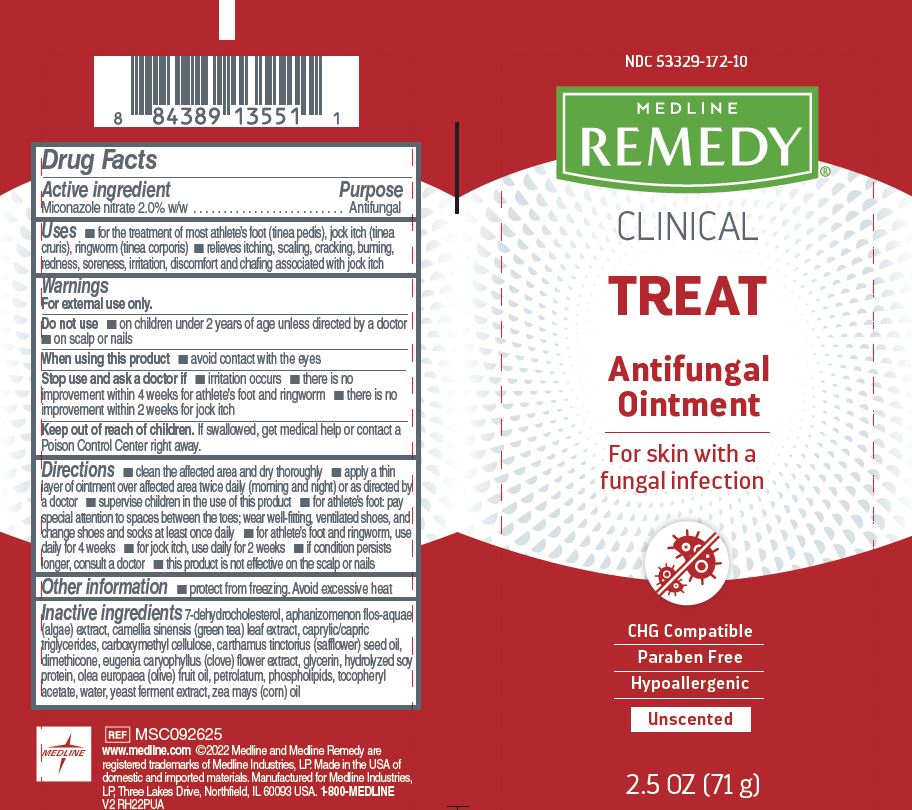
Medline miconazol nitrate 2 g/100g Ointment, 71 g
🆔 Identity & classification
Where does this data come from?
🏷️ RxNorm drug class
This medicine belongs to the Azole Antifungal class.
Where does this data come from?
🏭 Manufacturer & labeler
Where does this data come from?
🩺 Clinical
Topical miconazole is used to treat tinea corporis(ringworm; fungal skin infection that causes a red scaly rash on different parts of the body), tinea cruris (jock itch; fungal infection of the skin in the groin or buttocks), and tinea pedis (athlete's foot; fungal infection of the skin on the feet and between the toes). Miconazole is in a class of antifungal medications called imidazoles. It works by stopping the growth of fungi that cause infection. Not all products should be used to treat all of these conditions. Please read the label for each product to select the one to treat your conditi...
Read the full MedlinePlus article ↗- For a 7-night vaginal cream, you insert one full applicator into your vagina at bedtime for 7 nights in a row. If you have itching or irritation on the outside, squeeze a small amo...
- I bought a miconazole cream for a vaginal yeast infection — how do I use it correctly?
- Yes — topical miconazole creams and powders are specifically made for those conditions. For athlete's foot and ringworm, you'd apply it to clean, dry skin twice a day for 4 weeks....
- Can I use miconazole cream on my skin for athlete's foot or jock itch?
Patient education
Supplement & herbal interactions
Where does this data come from?
Ask a licensed pharmacist directly — free, answered by our team.
🧪 Inactive Ingredients / Excipients
Inactive ingredients, also called excipients, are components of the drug product other than the active ingredient. They may include fillers, dyes, coatings, preservatives, flavors, or other formulation ingredients.
💡 Tap an ingredient (hover on desktop) to see what it is and why it’s used.
-
UNII BK1IU07GKF
A steroid compound naturally found in skin and other tissues. It serves as a precursor ingredient that helps stabilize the formulation and may support the product's intended chemical stability.
-
UNII 9E8X80D2L0
A synthetic form of vitamin E used as an antioxidant and preservative in medications. It helps prevent the active ingredients from degrading when exposed to oxygen or light.
-
UNII 49VG1X560X
A blue-green algae used as a natural colorant and nutritional ingredient in some formulations. It adds color to the medicine and may serve as a filler or binder to give the product structure and form.
-
UNII 05JZI7B19X
A plant-based thickener made from cellulose that holds water and creates texture. It works as a binder and thickening agent to give the medicine its proper consistency and help ingredients blend together.
-
UNII K48IKT5321
A plant extract from clove buds used as a flavoring agent and natural fragrance in medications. It adds taste and aroma to improve how the medicine smells and tastes.
-
UNII 8470G57WFM
Corn oil is a vegetable oil extracted from corn kernels. It's used in medicines as a solvent to dissolve active ingredients and help the body absorb them, and sometimes as a lubricant in capsules.
-
UNII 92RU3N3Y1O
Dimethicone is a silicone-based oil that acts as an anti-foaming agent and lubricant in medicines. It reduces gas bubbles in liquid formulations and helps coat and protect the stomach lining when ingested.
-
UNII PDC6A3C0OX
Glycerin is a clear, thick liquid derived from plant oils or fats. It acts as a humectant to retain moisture, a sweetener, and a solvent in medications.
-
UNII W2ZU1RY8B0
A plant extract from green tea leaves. It's used as an antioxidant ingredient to help preserve the medicine and maintain its stability during storage.
-
UNII H1109Z9J4N
A natural emulsifier derived from soybean oil. It helps mix oil and water-based ingredients together, ensuring even distribution of active ingredients throughout the medicine.
-
UNII 1394NXB9L6
A plant-derived protein from soybeans that has been broken down into smaller pieces using enzymes. It acts as a binder and texture agent, helping hold ingredients together and improve the product's consistency and mouthfeel.
-
UNII C9H2L21V7U
A fat derived from coconut or palm oil containing shorter fatty acid chains. It serves as a solvent and carrier to help dissolve or suspend active ingredients, improving absorption and stability in liquid formulations.
-
UNII 6UYK2W1W1E
A natural oil extracted from olives. It acts as an emollient and lubricant in formulations, helping to soften ingredients and improve how the medicine spreads or flows.
-
UNII 4T6H12BN9U
Petrolatum is a purified mineral oil-based jelly derived from petroleum. In medicines, it acts as an emollient, lubricant, and moisture barrier to soften skin, reduce friction, and help prevent water loss from formulations.
-
UNII R2Z4507WJN
A plant-derived oil combined with polyglycerols to create an emulsifier. It helps mix water and oil-based ingredients together in formulations and may also serve as a solubilizer to improve ingredient distribution.
-
UNII 059QF0KO0R
Water is a liquid solvent that dissolves and mixes ingredients together in liquid medicines, syrups, and injections. It helps distribute the active drug evenly throughout the product.
-
UNII 3NY3SM6B8U
A microorganism used as a natural source of B vitamins and proteins. In medications, yeast serves as a nutrient supplement and may help with tablet binding or act as a filler to give the product proper form and stability.
17 inactive ingredients listed in the exact product block matched to this NDC.
Label-section wording can be broader than the structured product block and may mention additional formulation ingredients.
Where does this data come from?
ingredient classCode="IACT" elements from the exact product block matched by this NDC. Label-section narrative from DailyMed / the openFDA label index is shown separately when available.Inactive ingredient FAQ
Are inactive ingredients the same for every manufacturer?
Why might an inactive ingredient be missing?
Can inactive ingredients matter?
💲 Pricing
A drug doesn't have one price. Each row is a different public payment system, and none is what you'd pay at the counter — that depends on your insurance. The ⓘ on each row explains what it measures.
| Price system | Per g | Per package |
|---|---|---|
| Retail pharmacies payNADAC · weekly | Not in the retail survey — common for institutional, discontinued, or low-volume packs. | |
| Medicaid paysCMS SDUD · 12 mo | No recent Medicaid claims on file for this NDC — rare and low-volume NDCs are suppressed in the public data. | |
| Medicare drug plans payPart D · quarterly | No Part D plan price is available for this NDC in our data. | |
Where does this data come from?
🔁 Therapeutic equivalents
| Product | Labeler | Pack | NADAC/unit | TE | Status | Price vs. this |
|---|---|---|---|---|---|---|
| Critic Aid Clear AF 20 mg/g 11701-0067-14 | Coloplast | 142 g | — | — | FDA listed | — |
| Green Tetterine 2 g/100g 12258-0241-01 | S.S.S. | 1 can | — | — | FDA listed | — |
| White Tetterine 2 g/100g 12258-0242-01 | S.S.S. | 1 tube | — | — | FDA listed | — |
| Triple Antifungal 2 g/100g 16864-0040-02 | Advantice | 1 tube | — | — | FDA listed | — |
| Medline 2 g/100gthis 53329-0172-10 | Medline | 71 g | — | — | FDA listed | — |
| Antifungal 2 g/100g 84722-3060-00 | VIVE | 1 g | — | — | FDA listed | — |
Where does this data come from?
⏳ Availability & generic status
We did not find an FDA-approved generic match for this exact strength, form and route.
Where does this data come from?
🔬 Reported adverse events (FAERS)
Top reported reactions
Age at onset
Reporter sex
Serious outcomes
Where does this data come from?
📦 Packaging — all sizes for this product
| Package NDC | Description | Marketing start | Status |
|---|---|---|---|
| 53329-0172-10 You're viewing this | 71 g in 1 TUBE (53329-172-10) | 2024-01-01 | Active |
🧭 About this NDC listing & data coverage
What data is (and isn’t) available for this NDC — tap to expand
| NDC identity (package / product / labeler codes) | ✓ Available |
| Labeler | ✓ Available |
| Product & package description | ✓ Available |
| Marketing category & status | ✓ Available |
| Active ingredient / dosage form / route | ✓ Available |
| FDA label (SPL via DailyMed) | ✓ Available |
| Package photos | ✓ Available |
| Inactive ingredients (structured) | ✓ Available |
| NADAC pharmacy acquisition price (CMS) | — Not published for this NDC CMS publishes NADAC only for NDCs reported in its retail-pharmacy survey. |
| Orange Book / therapeutic-equivalence data | — Not published for this NDC Applies only to products approved under an NDA/ANDA; many listings are out of scope. |
| HCPCS J-code billing crosswalk | — Not published for this NDC Most self-administered / retail products have no J-code — that is normal. |
| Medicaid utilization (CMS SDUD) | — Not published for this NDC CMS reports utilization only for NDCs with Medicaid claims above its privacy threshold. |
Questions about this listing
Is this NDC FDA-approved?
Why is there no price listed?
Is the NDC printed on the package the same as the 11-digit billing NDC?
What do the three segments of this NDC mean?
Is this package still being marketed?
Who lists this product with the FDA?
Do I need a prescription for this product?
Where does this data come from?
📄 FDA label — Drug Facts FDA SPL
🎯 Indications and Usage ▾
Uses for the treatment of most athlete's foot (tinea pedis), jock itch (tinea cruris), ringworm (tinea corporis) relieves itching, scaling, cracking, burning, redness, soreness, irritation, discomfort and chafing associated with jock itch
⏱️ Dosage and Administration ▾
Directions clean the affected area and dry thoroughly apply a thin layer of ointment over affected area twice daily (morning and night) or as directed by a doctor supervise children in the use of this product for athlete’s foot: pay special attention to spaces between the toes; wear well-fitting, ventilated shoes, and change shoes and socks at least once daily for athlete’s foot and ringworm, use daily for 4 weeks for jock itch, use daily for 2 weeks if condition persists longer, consult a doctor this product is not effective on the scalp or nails
⚠️ Warnings ▾
Warnings For external use only. Do not use on children under 2 years of age unless directed by a doctor on scalp or nails When using this product avoid contact with eyes Stop use and ask a doctor if irritation occurs there is no improvement within 4 weeks for athlete's foot and ringworm there is no improvement within 2 weeks for jock itch Keep out of reach of children. If swallowed, get medical help or contact a Poison Control Center right away.
🧪 Active Ingredient ▾
Active ingredient Miconazole nitrate 2.0% w/w
🧪 Inactive Ingredients ▾
Inactive ingredient 7-dehydrocholesterol, aphanizomenon flos-aquae (algae) extract, camellia sinensis (green tea) leaf extract, caprylic/capric triglycerides, carboxymethyl cellulose, carthamus tinctorius (safflower) seed oil, dimethicone, eugenia caryophyllus (clove) flower extract, glycerin, hydrolyzed soy protein, olea europaea (olive) fruit oil, petrolatum, phospholipids, tocopheryl acetate, water, yeast ferment extract, zea mays (corn) oil
🎯 Purpose ▾
Purpose Antifungal