
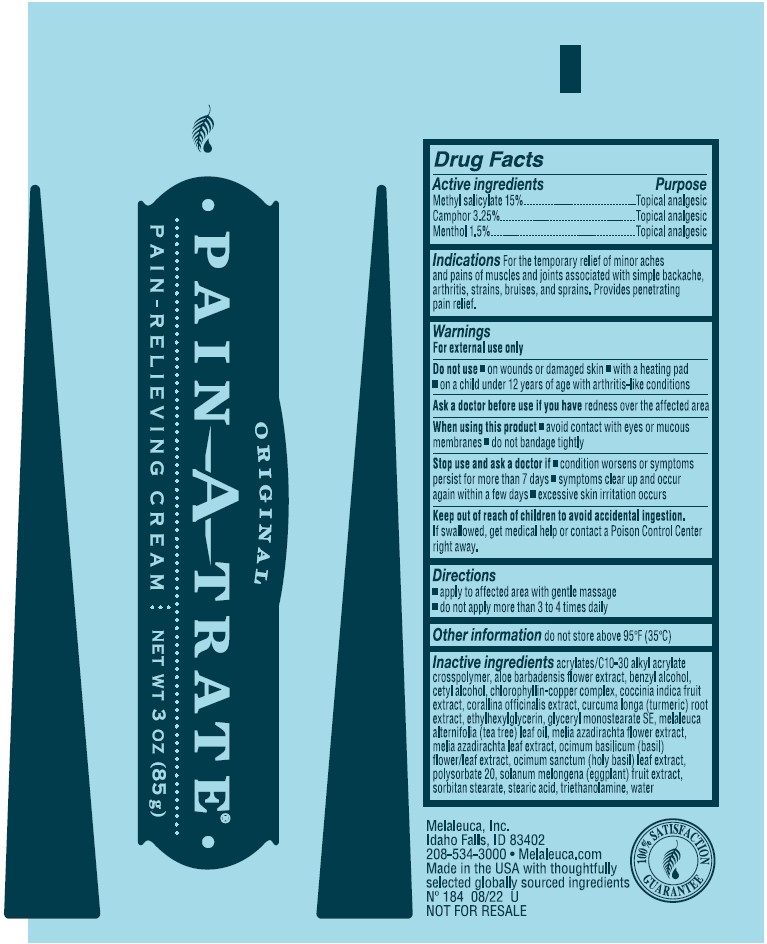
Original Pain-A-Trate Pain-Relieving Cream Camphor and Menthol and Methyl Salicylate 32.5 mg/g; 15 mg/g; 150 mg/g Cream, 85 g
🆔 Identity & classification
Where does this data come from?
🏭 Manufacturer & labeler
Where does this data come from?
🩺 Clinical
Original Pain-A-Trate is a topical cream marketed as an over-the-counter monograph product. It contains camphor, menthol, and methyl salicylate, which are commonly used in pain-relief creams applied to the skin. These ingredients are typically chosen for their warming or cooling sensations and their traditional use in topical products intended to address minor aches and discomfort in muscles and joints.
Patient education
Supplement & herbal interactions
Where does this data come from?
Ask a licensed pharmacist directly — free, answered by our team.
🧪 Inactive Ingredients / Excipients
Inactive ingredients, also called excipients, are components of the drug product other than the active ingredient. They may include fillers, dyes, coatings, preservatives, flavors, or other formulation ingredients.
💡 Tap an ingredient (hover on desktop) to see what it is and why it’s used.
-
UNII 575DY8C1ER
Aloe vera flower is a natural plant extract used in medicines as a skin-soothing agent and emollient. It helps soften and moisturize formulations, particularly in topical products like creams and lotions.
-
UNII 3TE8A92UPM
Azadirachta indica flower is a botanical extract from the neem plant. It may be used in formulations for its traditional preservative or antioxidant properties to help maintain product stability.
-
UNII HKY915780T
A plant extract from the neem tree, used as a natural flavoring agent and preservative in medicines. It may help maintain product stability and add bitter taste characteristics.
-
UNII LKG8494WBH
Benzyl alcohol is a clear liquid used as a preservative and solvent in medicines. It helps prevent bacterial and fungal growth and dissolves other ingredients to create uniform liquid formulations.
-
UNII 59TL3WG5CO
A synthetic polymer made by crosslinking acrylic acid with allyl sucrose. It thickens liquids, forms gels, and helps control how fast the medicine is released in your body.
-
UNII 936JST6JCN
Cetyl alcohol is a waxy, fatty substance derived from plant or animal sources. It acts as an emulsifier and thickener in medicines, helping blend oil and water components and giving products a smooth, creamy texture.
-
UNII VLJ6WOT3K5
A plant extract from the Coccinia indica fruit, used in herbal and traditional formulations. It may serve as a natural flavoring agent, colorant, or active botanical component depending on the product's intended use.
-
UNII 4004498D06
A red algae extract used as a natural colorant and pH buffer in medicines. It provides reddish tones to tablets and capsules while helping maintain stable acidity levels in the formulation.
-
UNII W5488JUO8U
A plant extract from turmeric root used as a natural colorant and flavoring agent in medicines. It provides yellow-to-orange color and mild spice flavor to tablets, capsules, and liquids.
-
UNII 147D247K3P
Ethylhexylglycerin is a synthetic preservative used to prevent bacteria and mold from growing in medicines and personal care products. It helps keep the product safe and stable throughout its shelf life.
-
UNII FCZ5MH785I
A waxy substance made from glycerin and stearic acid. It works as an emulsifier to help mix oil and water ingredients together, and as a thickener to give the medicine its proper texture and consistency.
-
UNII 7SAB275FP2
A plant extract made from basil flowers and leaves. It's used in medicines as a flavoring agent and may help preserve the product by providing natural antimicrobial properties.
-
UNII AVG2506KDV
A plant-derived oil extracted from holy basil leaves, used as a flavoring agent and fragrance component to improve the taste and aroma of the medicine.
-
UNII 7T1F30V5YH
A synthetic emulsifier derived from sorbitol and oleic acid. It helps mix oil and water-based ingredients together and keeps them from separating in liquid formulations.
-
UNII VAC44EX123
A green pigment derived from chlorophyll that binds to copper. It's used as a colorant and may help reduce odors in formulations.
-
UNII 5DS5EE0N93
Solanum melongena whole is eggplant, a plant-derived ingredient. It may serve as a natural filler, colorant, or source of plant material in formulations.
-
UNII NVZ4I0H58X
A waxy substance made from sorbitol and stearic acid. It acts as an emulsifier and stabilizer, helping keep oil and water mixed together and preventing separation in the medicine.
-
UNII 4ELV7Z65AP
Stearic acid is a fatty acid derived from plant or animal sources. It acts as a binder and lubricant in tablets and capsules, helping them hold together and flow smoothly during manufacturing.
-
UNII VIF565UC2G
Tea tree oil is an essential oil extracted from the leaves of the Australian tea tree plant. In medicines, it typically serves as a flavoring agent, fragrance, or antimicrobial component in topical formulations.
-
UNII 9O3K93S3TK
Trolamine is an alkaline compound used as a pH buffer and emulsifier in medicines. It helps neutralize acids, stabilize formulations, and enable mixing of oil and water-based ingredients.
-
UNII 059QF0KO0R
Water is a liquid solvent that dissolves and mixes ingredients together in liquid medicines, syrups, and injections. It helps distribute the active drug evenly throughout the product.
21 inactive ingredients listed in the exact product block matched to this NDC.
Label-section wording can be broader than the structured product block and may mention additional formulation ingredients.
Where does this data come from?
ingredient classCode="IACT" elements from the exact product block matched by this NDC. Label-section narrative from DailyMed / the openFDA label index is shown separately when available.Inactive ingredient FAQ
Are inactive ingredients the same for every manufacturer?
Why might an inactive ingredient be missing?
Can inactive ingredients matter?
💲 Pricing
A drug doesn't have one price. Each row is a different public payment system, and none is what you'd pay at the counter — that depends on your insurance. The ⓘ on each row explains what it measures.
| Price system | Per g | Per package |
|---|---|---|
| Retail pharmacies payNADAC · weekly | Not in the retail survey — common for institutional, discontinued, or low-volume packs. | |
| Medicaid paysCMS SDUD · 12 mo | No recent Medicaid claims on file for this NDC — rare and low-volume NDCs are suppressed in the public data. | |
| Medicare drug plans payPart D · quarterly | No Part D plan price is available for this NDC in our data. | |
Where does this data come from?
🔁 Therapeutic equivalents
| Product | Labeler | Pack | NADAC/unit | TE | Status | Price vs. this |
|---|---|---|---|---|---|---|
| Original Pain-A-Trate Pain-Relieving Cream 32.5 mg/g; 15 mg/g; 150 mg/gthis 54473-0335-03 | Melaleuca, | 85 g | — | — | FDA listed | — |
Where does this data come from?
⏳ Availability & generic status
We did not find an FDA-approved generic match for this exact strength, form and route.
Where does this data come from?
🔬 Reported adverse events (FAERS)
Top reported reactions
Reporter sex
Where does this data come from?
📦 Packaging — all sizes for this product
| Package NDC | Description | Marketing start | Status |
|---|---|---|---|
| 54473-0335-03 You're viewing this | 85 g in 1 TUBE (54473-335-03) | 2021-10-01 | Active |
🧭 About this NDC listing & data coverage
What data is (and isn’t) available for this NDC — tap to expand
| NDC identity (package / product / labeler codes) | ✓ Available |
| Labeler | ✓ Available |
| Product & package description | ✓ Available |
| Marketing category & status | ✓ Available |
| Active ingredient / dosage form / route | ✓ Available |
| FDA label (SPL via DailyMed) | ✓ Available |
| Package photos | ✓ Available |
| Inactive ingredients (structured) | ✓ Available |
| NADAC pharmacy acquisition price (CMS) | — Not published for this NDC CMS publishes NADAC only for NDCs reported in its retail-pharmacy survey. |
| Orange Book / therapeutic-equivalence data | — Not published for this NDC Applies only to products approved under an NDA/ANDA; many listings are out of scope. |
| HCPCS J-code billing crosswalk | — Not published for this NDC Most self-administered / retail products have no J-code — that is normal. |
| Medicaid utilization (CMS SDUD) | — Not published for this NDC CMS reports utilization only for NDCs with Medicaid claims above its privacy threshold. |
Questions about this listing
Is this NDC FDA-approved?
Why is there no price listed?
Is the NDC printed on the package the same as the 11-digit billing NDC?
What do the three segments of this NDC mean?
Is this package still being marketed?
Who lists this product with the FDA?
Do I need a prescription for this product?
Where does this data come from?
📄 FDA label — Drug Facts FDA SPL
🎯 Indications and Usage ▾
Indications For the temporary relief of minor aches and pains of muscles and joints associated with simple backache, arthritis, strains, bruises, sprains. Provides penetrating pain relief.
⏱️ Dosage and Administration ▾
Directions apply to affected area with gentle massage do not apply more than 3 to 4 times daily
⚠️ Warnings ▾
Warnings For external use only
📦 Storage and Handling ▾
Other information do not store above 95°F (35°C)
🧪 Active Ingredient ▾
Active ingredients Camphor 3.25% Menthol, 1.5% Methyl Salicylate, 15%
🧪 Inactive Ingredients ▾
Inactive ingredients acrylates/C10-30 alkyl acrylate crosspolymer, aloe barbadensis flower extract, benzyl alcohol, cetyl alcohol, chlorophyllin-copper complex, coccinia indica fruit extract, corallina officianalis extract, curcuma longa (turmeric) root extract, ethylhexylglyverin, glyceryl monostearate SE, melaleuca alternifolia (tea tree) leaf oil, melia azadirachta flower extract, melia azadirachta leaf extract, ocimum basilicum (basil) flower/leaf extract, ocimum sanctum (holy basil) leaf extract, polysorbate 20, solanum melongena (eggplant) fruit extract, sorbitan stearate, stearic acid, triethanolamine, water
🎯 Purpose ▾
Purpose Topical analgesic