
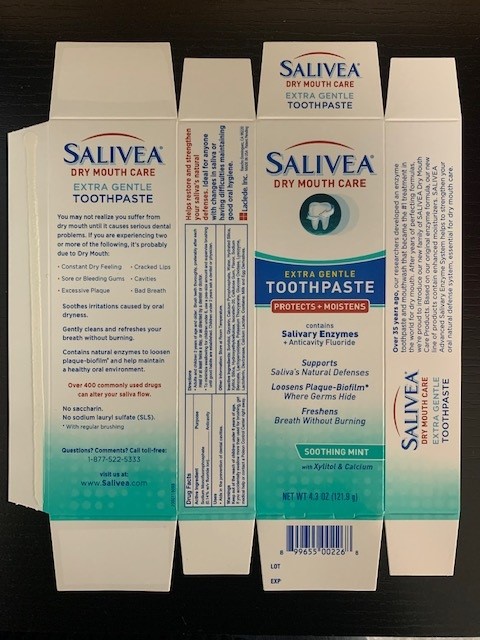
Salivea Fluoride Toothpaste 1.4 mg/g Paste, Dentifrice, 21 g
🆔 Identity & classification
Where does this data come from?
🏷️ RxNorm drug class
This medicine belongs to the Caries prophylactic agents class.
Where does this data come from?
🏭 Manufacturer & labeler
Where does this data come from?
🩺 Clinical
Salivea Fluoride Toothpaste is an over-the-counter dental paste containing sodium monofluorophosphate, a fluoride compound. Fluoride is commonly used in toothpaste products to help strengthen tooth enamel and is typically used as part of regular oral hygiene routines. This product is classified as an OTC monograph drug, meaning it is marketed under FDA's general rules for fluoride toothpastes rather than as an individually reviewed application.
Patient education
Supplement & herbal interactions
Where does this data come from?
Ask a licensed pharmacist directly — free, answered by our team.
💊 What it looks like
Where does this data come from?
🧪 Inactive Ingredients / Excipients
Inactive ingredients, also called excipients, are components of the drug product other than the active ingredient. They may include fillers, dyes, coatings, preservatives, flavors, or other formulation ingredients.
💡 Tap an ingredient (hover on desktop) to see what it is and why it’s used.
-
UNII 2URQ2N32W3
Calcium lactate is a salt compound made from calcium and lactic acid. It serves as a binder to hold tablet ingredients together and as a source of calcium in the formulation.
-
UNII X69NU20D19
Calcium pyrophosphate is a mineral salt compound used in medications as a buffering agent and pH regulator. It helps stabilize the medicine and can also serve as a filler to provide bulk to tablets or capsules.
-
UNII K679OBS311
Carboxymethylcellulose sodium is a plant-derived thickening agent made from cellulose. In medicines, it acts as a binder to hold ingredients together, a disintegrant to help the tablet break apart, or a thickener in liquids.
-
UNII N2161X1O5O
A protein enzyme derived from Penicillium mold that breaks down dextran, a thick sugar polymer. It's used in some formulations as a preservative or to improve flow and consistency of the product.
-
UNII 0T8392U5N1
Glucose oxidase is an enzyme derived from fungi that breaks down glucose. It's used in medicines as a preservative and oxygen scavenger to protect other ingredients from degradation and extend shelf life.
-
UNII PDC6A3C0OX
Glycerin is a clear, thick liquid derived from plant oils or fats. It acts as a humectant to retain moisture, a sweetener, and a solvent in medications.
-
UNII Y6O7T4G8P9
Hydrated silica is a fine powder form of silicon dioxide with absorbed water. It works as an anti-caking agent and absorbent in medicines, helping powders stay free-flowing and preventing clumping.
-
UNII 8136Y38GY5
A plant-derived thickening agent made from cellulose. It increases the thickness and consistency of liquid medicines, helping them coat surfaces and flow smoothly.
-
UNII O020065R7Z
A synthetic emulsifier derived from isocetyl alcohol and ethylene oxide. It helps mix oil and water-based ingredients together and improves the texture and stability of creams, lotions, and ointments.
-
UNII KG21X1090A
A milk protein derived from cow's milk. It acts as a preservative and antimicrobial agent to help protect the medicine from contamination and extend shelf life.
-
UNII 01UIN5OC49
A natural enzyme from cow's milk that acts as a preservative. It helps prevent bacterial growth in the medication, extending shelf life without adding synthetic preservatives.
-
UNII 968JKA7T33
Lysozyme is a natural enzyme derived from egg white or produced through fermentation. It acts as a preservative by breaking down bacterial cell walls, helping keep the medicine stable and fresh during storage.
-
UNII FV98Z8GITP
A natural flavoring from mint plants. It's added to medicines to mask bitter tastes and improve how the medicine tastes, making it easier to take.
-
UNII TM7213864A
Potassium thiocyanate is a chemical salt used in some medicines as a preservative to help prevent bacterial and fungal growth, keeping the product stable during storage.
-
UNII ETJ7Z6XBU4
Silicon dioxide is a naturally occurring mineral used as a glidant and anti-caking agent. It helps powder ingredients flow smoothly and prevents clumping during manufacturing and storage.
-
UNII OJ245FE5EU
Sodium benzoate is a salt derived from benzoic acid, a preservative. It's added to medicines to prevent growth of bacteria, fungi, and other microorganisms that could spoil the product.
-
UNII 506T60A25R
Sorbitol is a natural sugar alcohol derived from glucose. It serves as a sweetener, humectant, and bulking agent in medications to improve taste and help maintain moisture in the product.
-
UNII 059QF0KO0R
Water is a liquid solvent that dissolves and mixes ingredients together in liquid medicines, syrups, and injections. It helps distribute the active drug evenly throughout the product.
-
UNII VCQ006KQ1E
Xylitol is a naturally occurring sugar alcohol derived from plants. It's used in medicines as a sweetener, bulking agent, and to improve taste, especially in liquid formulations and chewable tablets.
19 inactive ingredients listed in the exact product block matched to this NDC.
Label-section wording can be broader than the structured product block and may mention additional formulation ingredients.
Where does this data come from?
ingredient classCode="IACT" elements from the exact product block matched by this NDC. Label-section narrative from DailyMed / the openFDA label index is shown separately when available.Inactive ingredient FAQ
Are inactive ingredients the same for every manufacturer?
Why might an inactive ingredient be missing?
Can inactive ingredients matter?
💲 Pricing
A drug doesn't have one price. Each row is a different public payment system, and none is what you'd pay at the counter — that depends on your insurance. The ⓘ on each row explains what it measures.
| Price system | Per g | Per package |
|---|---|---|
| Retail pharmacies payNADAC · weekly | Not in the retail survey — common for institutional, discontinued, or low-volume packs. | |
| Medicaid paysCMS SDUD · 12 mo | No recent Medicaid claims on file for this NDC — rare and low-volume NDCs are suppressed in the public data. | |
| Medicare drug plans payPart D · quarterly | No Part D plan price is available for this NDC in our data. | |
Where does this data come from?
🔁 Therapeutic equivalents
| Product | Labeler | Pack | NADAC/unit | TE | Status | Price vs. this |
|---|---|---|---|---|---|---|
| Salivea 1.4 mg/gthis 54897-0701-14 | Laclede, | 21 g | — | — | FDA listed | — |
Where does this data come from?
⏳ Availability & generic status
We did not find an FDA-approved generic match for this exact strength, form and route.
Where does this data come from?
📦 Packaging — all sizes for this product
| Package NDC | Description | Marketing start | Status |
|---|---|---|---|
| 54897-0701-13 | 121.9 g in 1 TUBE (54897-701-13) | 2018-02-19 | Active |
| 54897-0701-14 You're viewing this | 21 g in 1 TUBE (54897-701-14) | 2025-01-01 | Active |
Pack size FAQ
What quantity is in NDC 54897-0701-14?
What is the difference between NDC 54897-0701-14 and NDC 54897-0701-13?
What NDC number is used to bill for this package of Salivea Fluoride Toothpaste 1.4 mg/g Paste, Dentifrice?
🧭 About this NDC listing & data coverage
What data is (and isn’t) available for this NDC — tap to expand
| NDC identity (package / product / labeler codes) | ✓ Available |
| Labeler | ✓ Available |
| Product & package description | ✓ Available |
| Marketing category & status | ✓ Available |
| Active ingredient / dosage form / route | ✓ Available |
| FDA label (SPL via DailyMed) | ✓ Available |
| Package photos | ✓ Available |
| Inactive ingredients (structured) | ✓ Available |
| NADAC pharmacy acquisition price (CMS) | — Not published for this NDC CMS publishes NADAC only for NDCs reported in its retail-pharmacy survey. |
| Orange Book / therapeutic-equivalence data | — Not published for this NDC Applies only to products approved under an NDA/ANDA; many listings are out of scope. |
| HCPCS J-code billing crosswalk | — Not published for this NDC Most self-administered / retail products have no J-code — that is normal. |
| Medicaid utilization (CMS SDUD) | — Not published for this NDC CMS reports utilization only for NDCs with Medicaid claims above its privacy threshold. |
Questions about this listing
Is this NDC FDA-approved?
Why is there no price listed?
Is the NDC printed on the package the same as the 11-digit billing NDC?
What do the three segments of this NDC mean?
Is this package still being marketed?
Does this product come in other package sizes?
Who lists this product with the FDA?
Do I need a prescription for this product?
Where does this data come from?
📄 FDA label — Drug Facts FDA SPL
🎯 Indications and Usage ▾
USES Aids in the prevention of dental cavities.
⏱️ Dosage and Administration ▾
DIRECTIONS Adults and children 2 years of age and older: Brush teeth thoroughly, preferably after each meal or at least twice a day, or as directed by a dentist or doctor. To minimize swallowing for children under 6, use a pea-size amount and supervise brushing until good habits are established. Children under 2 years ask a dentist or physician.
⚠️ Warnings ▾
WARNINGS Keep out of the reach of children under 6 years of age. If you accidentally swallow more than used for brushing, get medical help or contact a Poison Control Center right away.
📦 Storage and Handling ▾
OTHER INFORMATION Store at Room Temperature.
🧪 Active Ingredient ▾
ACTIVE INGREDIENT Sodium Monofluorophosphate (0.14% w/v fluoride ion)
🧪 Inactive Ingredients ▾
INACTIVE INGREDIENTS Sorbitol, Glycerin, Calcium Pyrophosphate, Water, Hydrated Silica, Xylitol, Silica, Hydroxyethylcellulose, Isoceteth-20, Cellulose Gum, Flavor, Sodium Benzoate, Lactoperoxidase, Potassium Thiocyanate, Glucose Oxidase, Lysozyme, Lactoferrin, Dextranase, Calcium Lactate.
🎯 Purpose ▾
PURPOSE Anticavity