
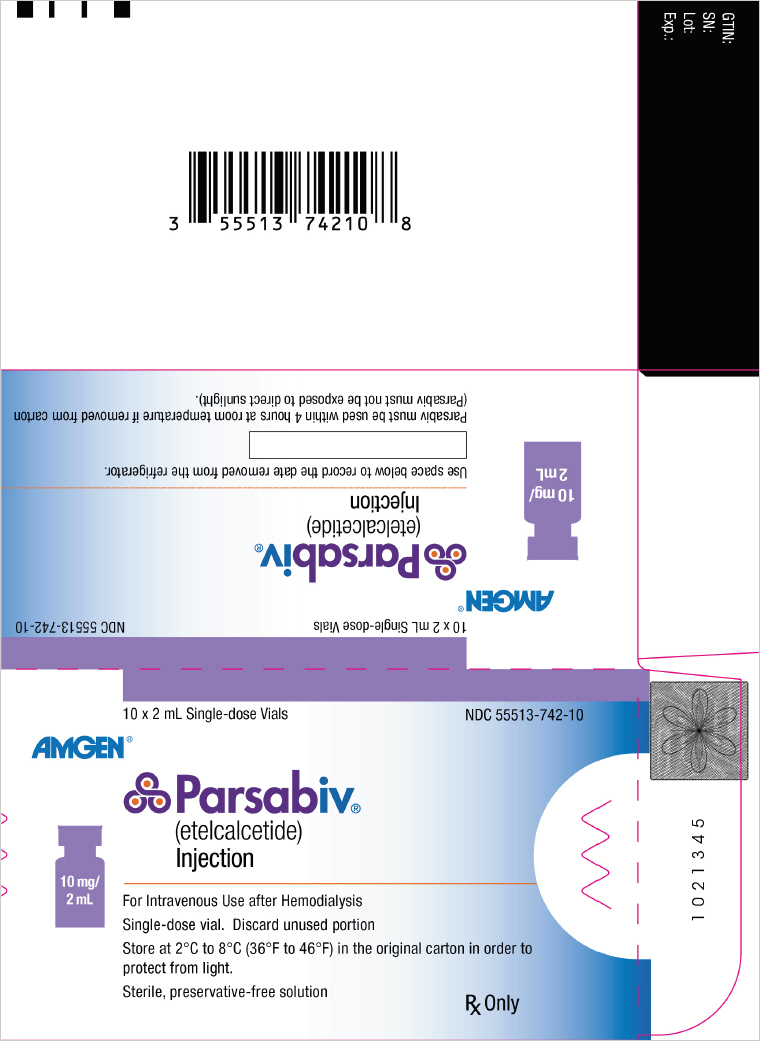
PARSABIV etelcalcetide 10 mg/2mL Injection, Solution
🆔 Identity & classification
Where does this data come from?
🏷️ RxNorm drug class
This medicine belongs to the Calcium-sensing Receptor Agonist class.
Where does this data come from?
🏭 Manufacturer & labeler
Where does this data come from?
🩺 Clinical
- Parsabiv is used to treat a condition called secondary hyperparathyroidism — that's when your parathyroid glands go into overdrive because of chronic kidney disease. If you're on h...
- No, Parsabiv is not a pill — it's an injection given directly into your IV line at the end of each hemodialysis session, three times a week. A nurse or dialysis technician handles...
- How will I receive this medication? Do I take it as a pill?
- The most common issue is low blood calcium, which can cause muscle cramps, tingling or numbness, and in serious cases, seizures or heart rhythm problems. You might also notice naus...
Patient education
Supplement & herbal interactions
Where does this data come from?
Ask a licensed pharmacist directly — free, answered by our team.
🧪 Inactive Ingredients / Excipients
Inactive ingredients, also called excipients, are components of the drug product other than the active ingredient. They may include fillers, dyes, coatings, preservatives, flavors, or other formulation ingredients.
💡 Tap an ingredient (hover on desktop) to see what it is and why it’s used.
-
UNII QTT17582CB
A strong acid used to adjust and maintain the proper pH level in liquid medicines, ensuring stability and preventing breakdown of active ingredients.
-
17 mg / 2 mL
UNII 451W47IQ8X
Sodium chloride is common table salt. It's used in medicines as a buffer to maintain proper pH, as a filler to add bulk, or to adjust the osmotic balance in liquid formulations.
-
UNII 55X04QC32I
A strong alkaline chemical used to adjust and maintain the pH balance of liquid medicines. It helps keep the medicine stable and ensures it stays effective during storage.
-
2.4 mg / 2 mL
UNII AB6MNQ6J6L
Succinic acid is an organic acid derived from natural sources or chemical synthesis. In medications, it functions as a buffer to help maintain the proper pH level and may also serve as a preservative or flavor enhancer in formulations.
4 inactive ingredients listed in the exact product block matched to this NDC.
Where does this data come from?
ingredient classCode="IACT" elements from the exact product block matched by this NDC. Label-section narrative from DailyMed / the openFDA label index is shown separately when available.Inactive ingredient FAQ
Are inactive ingredients the same for every manufacturer?
Why might an inactive ingredient be missing?
Can inactive ingredients matter?
💲 Pricing
A drug doesn't have one price. Each row is a different public payment system, and none is what you'd pay at the counter — that depends on your insurance. The ⓘ on each row explains what it measures.
| Price system | Per mL | Per package |
|---|---|---|
| Retail pharmacies payNADAC · weekly | Not in the retail survey — common for institutional, discontinued, or low-volume packs. | |
| Medicaid paysCMS SDUD · 12 mo | $152.08 | $3,041.55 / 20 ml |
| Medicare drug plans payPart D · quarterly | No Part D plan price is available for this NDC in our data. | |
| Medicare Part B allowsASP · J0606 | No ASP payment limit on file for J0606 this quarter. | |
Where does this data come from?
🧾 Billing & reimbursement
Where does this data come from?
🔁 Therapeutic equivalents
| Product | Labeler | Pack | NADAC/unit | TE | Status | Price vs. this |
|---|---|---|---|---|---|---|
| Parsabiv 10 mg/2mLthis 55513-0742-10 | Amgen, | 10 vials | — | — | FDA listed | — |
Where does this data come from?
⏳ Availability & generic status
We did not find an FDA-approved generic match for this exact strength, form and route. Patent/protection dates below may affect future generic timing.
Why the date isn’t exact: Generic timing can change because patents may be challenged, settled, licensed, added, removed, or worked around with a narrower label — and FDA approval does not always mean a pharmacy can get the generic today.
🛈 What do these terms mean?
- Patent
- Legal protection listed in the Orange Book that may delay generic approval or launch. Issued by the U.S. Patent & Trademark Office.
- Substance patent
- Covers the active drug molecule itself — the hardest to design around. A generic generally can’t launch until it expires.
- Formulation (product) patent
- Covers a specific formulation or dosage form. A generic can sometimes work around it with a different formulation.
- Method-of-use patent
- A patent covering one specific approved use of the drug — not necessarily the whole molecule. A generic can sometimes launch with a “skinny label” that carves out the protected use and keeps the others.
- Skinny label
- A generic label that omits a still-patented use when the FDA allows it — letting a generic reach the market for the unprotected uses.
- Exclusivity
- FDA-granted marketing protection, separate from patents — e.g. 5-yr new chemical entity, 7-yr orphan drug, or a +6-month pediatric extension.
- Paragraph IV
- A generic applicant’s formal challenge to a listed patent. It can potentially lead to earlier generic entry, but often involves litigation or a settlement.
- RLD / RS
- Reference Listed Drug — the brand product the FDA uses as the reference for generic applications. Reference Standard — the product the FDA expects generics to compare against in bioequivalence testing.
- TE / AB rating
- FDA therapeutic-equivalence rating. An AB rating generally means the FDA considers a generic therapeutically equivalent to — and substitutable for — the brand.
- LOE (loss of exclusivity)
- The latest patent or exclusivity currently listed — the loss-of-exclusivity / latest-listed-protection date shown on this page. Paragraph-IV challenges and settlements can move the real date earlier; FDA approval and a manufacturer’s decision to market can move it later.
Built from the FDA Orange Book. The bars above are scaled to each protection’s expiry; the red LOE marker is the last one to lapse.
| Patent | Type | Use code | Expires |
|---|---|---|---|
| US 8999932 ↗ | Drug substance | U-2014 | Feb 7, 2031 |
| US 9701712 ↗ | Drug substance | U-2014 | Jul 29, 2030 |
| US 8999932 ↗ | Drug substance | U-2014 | Feb 7, 2031 |
| US 8999932 ↗ | Drug substance | U-2014 | Feb 7, 2031 |
| US 9701712 ↗ | Drug substance | U-2014 | Jul 29, 2030 |
| US 9701712 ↗ | Drug substance | U-2014 | Jul 29, 2030 |
| US 11959486 ↗ | Method of use | U-2014 | Jun 27, 2034 |
| US 11959486 ↗ | Method of use | U-2014 | Jun 27, 2034 |
| US 11959486 ↗ | Method of use | U-2014 | Jun 27, 2034 |
| US 10344765 ↗ | Drug product | — | Jun 27, 2034 |
| US 9278995 ↗ | Drug substance | — | Jul 29, 2030 |
| US 9278995 ↗ | Drug substance | — | Jul 29, 2030 |
| US 11162500 ↗ | Drug product | — | Jun 27, 2034 |
| US 9820938 ↗ | Drug product | — | Jun 27, 2034 |
| US 8377880 ↗ | Drug substance | — | Jul 29, 2030 |
| US 11162500 ↗ | Drug product | — | Jun 27, 2034 |
| US 8377880 ↗ | Drug substance | — | Jul 29, 2030 |
| US 9820938 ↗ | Drug product | — | Jun 27, 2034 |
| US 9278995 ↗ | Drug substance | — | Jul 29, 2030 |
| US 10344765 ↗ | Drug product | — | Jun 27, 2034 |
| US 11162500 ↗ | Drug product | — | Jun 27, 2034 |
| US 10344765 ↗ | Drug product | — | Jun 27, 2034 |
| US 9820938 ↗ | Drug product | — | Jun 27, 2034 |
| US 8377880 ↗ | Drug substance | — | Jul 29, 2030 |
Is there a generic version of PARSABIV 10 MG/2 ML VIAL?
The FDA approved a generic — why can’t I get it at my pharmacy yet?
Why do different websites show different generic release dates?
What does “FDA listed” mean?
What does a patent or protection date mean here?
What does “current Orange Book estimate” mean?
Can a generic come out before the last patent expires?
Can a generic come out after the listed dates?
What is the difference between patents and exclusivity?
Why are there multiple patent dates?
Where does this data come from?
🗺️ Medicaid utilization & spend
💊 Medicaid utilization by pack size
🔬 Reported adverse events (FAERS)
Top reported reactions
Age at onset
Reporter sex
Serious outcomes
Where does this data come from?
📦 Packaging — all sizes for this product
| Package NDC | Description | Marketing start | Status |
|---|---|---|---|
| 55513-0742-10 You're viewing this | 10 VIAL, SINGLE-DOSE in 1 CARTON (55513-742-10) / 2 mL in 1 VIAL, SINGLE-DOSE (55513-742-01) | 2017-04-03 | Active |
| 55513-0742-20 | 10 VIAL, SINGLE-DOSE in 1 CARTON (55513-742-20) / 2 mL in 1 VIAL, SINGLE-DOSE (55513-742-01) | 2025-08-01 | Active |
In Medicaid, this is the most-dispensed pack of this product — about 100% of fills over the last four reported quarters. See all packs ↓
Pack size FAQ
What quantity is in NDC 55513-0742-10?
What NDC number is used to bill for this package of PARSABIV etelcalcetide 10 mg/2mL Injection, Solution?
🧭 About this NDC listing & data coverage
What data is (and isn’t) available for this NDC — tap to expand
| NDC identity (package / product / labeler codes) | ✓ Available |
| Labeler | ✓ Available |
| Product & package description | ✓ Available |
| Marketing category & status | ✓ Available |
| Active ingredient / dosage form / route | ✓ Available |
| FDA label (SPL via DailyMed) | ✓ Available |
| Package photos | ✓ Available |
| Inactive ingredients (structured) | ✓ Available |
| NADAC pharmacy acquisition price (CMS) | — Not published for this NDC CMS publishes NADAC only for NDCs reported in its retail-pharmacy survey. |
| Orange Book / therapeutic-equivalence data | ✓ Available |
| HCPCS J-code billing crosswalk | ✓ Available |
| Medicaid utilization (CMS SDUD) | ✓ Available |
Questions about this listing
Why is there no price listed?
Is the NDC printed on the package the same as the 11-digit billing NDC?
What do the three segments of this NDC mean?
Is this package still being marketed?
Does this product come in other package sizes?
Who lists this product with the FDA?
Do I need a prescription for this product?
Does this product have a billing J-code?
Where does this data come from?
📄 Full prescribing information FDA SPL
🎯 Indications and Usage ▾
1 INDICATIONS AND USAGE PARSABIV is indicated for the treatment of secondary hyperparathyroidism (HPT) in adult patients with chronic kidney disease (CKD) on hemodialysis. PARSABIV is a calcium-sensing receptor agonist indicated for: Secondary hyperparathyroidism (HPT) in adult patients with chronic kidney disease (CKD) on hemodialysis. ( 1 ) Limitations of Use: PARSABIV has not been studied in adult patients with parathyroid carcinoma, primary hyperparathyroidism, or with CKD who are not on hemodialysis and is not recommended for use in these populations.
Limitations of Use: PARSABIV has not been studied in adult patients with parathyroid carcinoma, primary hyperparathyroidism, or with chronic kidney disease who are not on hemodialysis and is not recommended for use in these populations .
⏱️ Dosage and Administration ▾
2 DOSAGE AND ADMINISTRATION Ensure corrected serum calcium is at or above the lower limit of normal prior to initiation, dose increase, or re-initiation. ( 2.1 ) The recommended starting dose is 5 mg administered by intravenous bolus injection three times per week at the end of hemodialysis treatment. ( 2.1 ) The maintenance dose is individualized and determined by titration based on parathyroid hormone (PTH) and corrected serum calcium response.
The dose range is 2.5 to 15 mg three times per week. ( 2.1 ) The dose may be increased in 2.5 mg or 5 mg increments no more frequently than every 4 weeks. ( 2.2 ) Measure serum calcium within 1 week after initiation or dose adjustment and every 4 weeks for maintenance.
( 2.2 ) Measure PTH after 4 weeks from initiation or dose adjustment. ( 2.2 ) Decrease or temporarily discontinue PARSABIV in individuals with PTH levels below the target range. ( 2.2 ) Consider decreasing or temporarily discontinuing PARSABIV or use concomitant therapies to increase corrected serum calcium in patients with a corrected serum calcium below the lower limit of normal but at or above 7.5 mg/dL without symptoms of hypocalcemia.
( 2.2 ) Stop PARSABIV and treat hypocalcemia if the corrected serum calcium falls below 7.5 mg/dL or patients report symptoms of hypocalcemia. ( 2.2 ) Do not mix or dilute prior to administration. ( 2.3 ) Administer by intravenous bolus injection into the venous line of the dialysis circuit after hemodialysis, during rinse back or intravenously after rinse back.
Administer a sufficient volume of saline, e.g. 150 mL of rinse back, after injection into the dialysis tubing. If administered after rinse back, administer PARSABIV intravenously followed by at least 10 mL of saline flush.
( 2.3 )
2.1Recommended Dosing Ensure corrected serum calcium is at or above the lower limit of normal prior to PARSABIV initiation, a PARSABIV dose increase, or re-initiation of PARSABIV therapy after a dosing interruption [see Dosage and Administration (2.2) and Warnings and Precautions (5.1) ] . The recommended starting dose of PARSABIV is 5 mg administered by intravenous (IV) bolus injection three times per week at the end of hemodialysis treatment [see Dosage and Administration (2.3) ] . The maintenance dose of PARSABIV is individualized and determined by titration based on parathyroid hormone (PTH) and corrected serum calcium response [see Dosage and Administration (2.2) ] .
The maintenance dose is the dose that maintains PTH levels within the recommended target range and corrected serum calcium within the normal range. The lowest maintenance dose of PARSABIV is 2.5 mg three times per week, and the highest maintenance dose of PARSABIV is 15 mg three times per week . Administer PARSABIV only at the end of hemodialysis treatment.
If a regularly scheduled hemodialysis treatment is missed, DO NOT administer any missed doses. Resume PARSABIV at the end of the next hemodialysis treatment at the prescribed dose. If doses of PARSABIV are missed for more than 2 weeks, re-initiate PARSABIV at the recommended starting dose of 5 mg (or 2.5 mg if that was the patient's last dose).
2.2Monitoring and Dose Adjustment Monitor corrected serum calcium and PTH levels during dose initiation, dose adjustment, and dose maintenance according to the schedule in Table 1. Table 1: Recommended Schedule for Monitoring Corrected Serum Calcium and Parathyroid Hormone Levels during PARSABIV Treatment Dose Initiation or Dose Adjustment Maintenance Corrected Serum Calcium Levels 1 week after Every 4 weeks Parathyroid Hormone Levels 4 weeks after Per clinical practice Titrate PARSABIV dose based on PTH and corrected serum calcium response.
At the maintenance dose, PTH levels should be within the recommended target range and corrected serum calcium within the normal range. Increase the dose of PARSABIV in 2.5 mg or 5 mg increments in individuals with corrected serum calcium within the normal range and PTH levels above the recommended ta…
💊 Dosage Forms and Strengths ▾
3 DOSAGE FORMS AND STRENGTHS PARSABIV is a single-dose, clear, and colorless solution available as follows: Injection: 2.5 mg/0.5 mL solution in a single-dose vial Injection: 5 mg/mL solution in a single-dose vial Injection: 10 mg/2 mL solution (5 mg/mL) in a single-dose vial Injection: 2.5 mg/0.5 mL solution in a single-dose vial ( 3 ) Injection: 5 mg/mL solution in a single-dose vial ( 3 ) Injection: 10 mg/2 mL solution in a single-dose vial ( 3 )
⛔ Contraindications ▾
4 CONTRAINDICATIONS PARSABIV is contraindicated in patients with known hypersensitivity to etelcalcetide or any of its excipients. ( 4 ) Hypersensitivity PARSABIV is contraindicated in patients with known hypersensitivity to etelcalcetide or any of its excipients. Hypersensitivity reactions, including face edema and anaphylactic reaction, have occurred with PARSABIV [see Adverse Reactions (6) ] .
⚠️ Warnings and Cautions ▾
5 WARNINGS AND PRECAUTIONS Hypocalcemia: Sometimes severe. Severe hypocalcemia can cause paresthesias, myalgias, muscle spasms, seizures, QT prolongation, and ventricular arrhythmias. Patients predisposed to QT interval prolongation, ventricular arrhythmias, and seizures may be at increased risk and require close monitoring.
Educate patients on the symptoms of hypocalcemia and advise them to contact a healthcare provider if they occur. ( 5.1 ) Worsening Heart Failure: Reductions in corrected serum calcium may be associated with congestive heart failure, however, a causal relationship to PARSABIV could not be completely excluded. Closely monitor patients for worsening signs and symptoms of heart failure.
( 5.2 ) Upper Gastrointestinal (GI) Bleeding: Patients with risk factors for upper GI bleeding may be at increased risk. Monitor patients and promptly evaluate and treat any suspected GI bleeding. ( 5.3 ) Adynamic Bone: May develop if PTH levels are chronically suppressed.
If PTH levels decrease below the recommended target range, the dose of PARSABIV should be reduced or discontinued. ( 5.4 )
5.1Hypocalcemia PARSABIV lowers serum calcium [see Adverse Reactions (6.1) ] and can lead to hypocalcemia, sometimes severe. Significant lowering of serum calcium can cause paresthesias, myalgias, muscle spasms, seizures, QT interval prolongation, and ventricular arrhythmia. QT Interval Prolongation and Ventricular Arrhythmia In the combined placebo-controlled studies, more patients treated with PARSABIV experienced a maximum increase from baseline of greater than 60 msec in the QTcF interval (0% placebo versus 1.2% PARSABIV).
In these studies, the incidence of a maximum post-baseline predialysis QTcF > 500 msec in the placebo and PARSABIV groups was 1.9% and 4.8%, respectively [see Adverse Reactions (6.1) ] . Patients with congenital long QT syndrome, history of QT interval prolongation, family history of long QT syndrome or sudden cardiac death, and other conditions that predispose to QT interval prolongation and ventricular arrhythmia may be at increased risk for QT interval prolongation and ventricular arrhythmias if they develop hypocalcemia due to PARSABIV.
Closely monitor corrected serum calcium and QT interval in patients at risk receiving PARSABIV. Seizures Significant reductions in corrected serum calcium may lower the threshold for seizures. Patients with a history of seizure disorder may be at increased risk for seizures if they develop hypocalcemia due to PARSABIV.
Monitor corrected serum calcium in patients with seizure disorders receiving PARSABIV. Risk of Hypocalcemia with Other Serum Calcium Lowering Products Concurrent administration of PARSABIV with another oral calcium-sensing receptor agonist could result in severe, life-threatening hypocalcemia. Patients switching from cinacalcet to PARSABIV should discontinue cinacalcet for at least 7 days prior to initiating PARSABIV [see Dosage and Administration (2.4) ] .
Closely monitor corrected serum calcium in patients receiving PARSABIV and concomitant therapies known to lower serum calcium. Monitoring Serum Calcium and Patient Education Measure corrected serum calcium prior to initiation of PARSABIV. Do not initiate in patients if the corrected serum calcium is less than the lower limit of normal.
Monitor corrected serum calcium within 1 week after initiation or dose adjustment and every 4 weeks during treatment with PARSABIV [see Dosage and Administration (2.2) ] . Educate patients on the symptoms of hypocalcemia and advise them to contact a healthcare provider if they occur. Management of Hypocalcemia If corrected serum calcium falls below the lower limit of normal or symptoms of hypocalcemia develop, start or increase calcium supplementation (including calcium, calcium-containing phosphate binders, and/or vitamin D sterols or increases in dialysate calcium concentration).
PARSABIV dose reduction or discontinuation of PARSABIV may be necessary [see Dosage and Administrat…
🤒 Adverse Reactions ▾
6 ADVERSE REACTIONS The following adverse reactions are discussed in greater detail in other sections of the labeling: Hypocalcemia [see Warnings and Precautions (5.1) ] Worsening Heart Failure [see Warnings and Precautions (5.2) ] Upper Gastrointestinal Bleeding [see Warnings and Precautions (5.3) ] Adynamic Bone [see Warnings and Precautions (5.4) ] The most common adverse reactions (≥ 5%) were blood calcium decreased, muscle spasms, diarrhea, nausea, vomiting, headache, hypocalcemia, and paresthesia. ( 6 ) To report SUSPECTED ADVERSE REACTIONS, contact Amgen Inc. at 1-800-77-AMGEN (1-800-772-6436) or FDA at 1-800-FDA-1088 or www.fda.gov/medwatch.
6.1Clinical Trials Experience Because clinical trials are conducted under widely varying conditions, adverse reaction rates observed in the clinical trials of a drug cannot be directly compared with rates in the clinical trials of another drug and may not reflect the rates observed in clinical practice. The data in Table 2 are derived from two placebo-controlled clinical studies in patients with chronic kidney disease and secondary hyperparathyroidism on hemodialysis. The data reflect exposure of 503 patients to PARSABIV with a mean duration of exposure to PARSABIV of 23.6 weeks.
The mean age of patients was approximately 58 years, and 60% of the patients were male. Of the total patients, 67% were Caucasian, 28% were Black or African American, 2.6% were Asian, 1.2% were Native Hawaiian or Other Pacific Islander, and 1.6% were categorized as Other. Table 2 shows common adverse reactions associated with the use of PARSABIV in the pool of placebo-controlled studies.
These adverse reactions occurred more commonly on PARSABIV than on placebo and were reported in at least 5% of patients treated with PARSABIV. Table 2: Adverse Reactions Reported in ≥ 5% of PARSABIV-Treated Patients Adverse Reaction Included adverse reactions reported with at least 1% greater incidence in the PARSABIV group compared to the placebo group Placebo (N = 513) PARSABIV (N = 503) Blood calcium decreased Asymptomatic reductions in calcium below 7.5 mg/dL or clinically significant asymptomatic reductions in corrected serum calcium between 7.5 and < 8.3 mg/dL (that required medical management) 10% 64% Muscle spasms 7% 12% Diarrhea 9% 11% Nausea 6% 11% Vomiting 5% 9% Headache 6% 8% Hypocalcemia Symptomatic reductions in corrected serum calcium < 8.3 mg/dL 0.2% 7% Paresthesia Paresthesia includes preferred terms of paresthesia and hypoesthesia 1% 6% Other adverse reactions associated with the use of PARSABIV but reported in < 5% of patients in the PARSABIV group in the two placebo-controlled clinical studies were: Hyperkalemia: 3% and 4% for placebo and PARSABIV, respectively.
Hospitalization for Heart Failure: 1% and 2% for placebo and PARSABIV, respectively. Myalgia: 0.2% and 2% for placebo and PARSABIV, respectively. Hypophosphatemia: 0.2% and 1% for placebo and PARSABIV, respectively.
Description of Selected Adverse Reactions Hypocalcemia In the combined placebo-controlled studies, a higher proportion of patients on PARSABIV developed at least one corrected serum calcium value below 7.0 mg/dL (7.6% PARSABIV, 3.1% placebo), below 7.5 mg/dL (27% PARSABIV, 5.5% placebo), and below 8.3 mg/dL (79% PARSABIV, 19% placebo). In the combined placebo-controlled studies, 1% of patients in the PARSABIV group and 0% of patients in the placebo group discontinued treatment due to an adverse reaction attributed to a low corrected serum calcium.
Hypophosphatemia In the combined placebo-controlled studies, 18% of patients treated with PARSABIV and 8.2% of patients treated with placebo had at least one measured phosphorus level below the lower normal limit (i.e., 2.2 mg/dL). QTc Interval Prolongation Secondary to Hypocalcemia In the combined placebo-controlled studies, more patients treated with PARSABIV experienced a maximum increase from baseline of greater than 60 msec in the QTcF interval (0% placebo versus 1.2% PARSABIV). The p…
👥 Use in Specific Populations ▾
8 USE IN SPECIFIC POPULATIONS Lactation: PARSABIV is not recommended when breastfeeding. ( 8.2 )
8.1Pregnancy Risk Summary There are no available data on the use of PARSABIV in pregnant women. In animal reproduction studies, effects were seen at doses associated with maternal toxicity that included hypocalcemia. In a pre- and post-natal study in rats administered etelcalcetide during organogenesis through delivery and weaning, there was a slight increase in perinatal pup mortality, delay in parturition, and transient effects on pup growth at exposures 1.8 times the human exposure for the clinical dose of 15 mg three times per week.
There was no effect on sexual maturation, neurobehavioral, or reproductive function in the rat offspring. In embryo-fetal studies, when rats and rabbits were administered etelcalcetide during organogenesis, reduced fetal growth was observed at exposures 2.7 and 7 times exposures for the clinical dose, respectively. The estimated background risk of major birth defects and miscarriage for the indicated population is unknown.
In the U.S. general population, the estimated background risk of major birth defects and miscarriage in clinically recognized pregnancies is 2-4% and 15-20%, respectively. Data Animal Data There were no effects on embryo-fetal development in Sprague-Dawley rats when etelcalcetide was dosed at 0.75, 1.5, and 3 mg/kg/day by the intravenous route during organogenesis (pre-mating to gestation day 17) at exposures up to 1.8 times human exposures at the clinical dose of 15 mg three times per week based on AUC. No effects on embryo-fetal development were observed in New Zealand White rabbits at doses of etelcalcetide of 0.375, 0.75, and 1.5 mg/kg by the intravenous route (gestation day 7 to 19), representing up to 4.3 times human exposures based on AUC.
In separate studies at higher doses of 4.5 mg/kg in rats (gestation days 6 to 17) and 2.25 mg/kg in rabbits (gestation days 7 to 20), representing 2.7- and 7-fold clinical exposures, respectively, there was reduced fetal growth associated with maternal toxicities of hypocalcemia, tremoring, and reductions in body weight and food consumption. In a pre- and post-natal development study in Sprague-Dawley rats administered etelcalcetide at 0.75, 1.5, and 3 mg/kg/day by the intravenous route (gestation day 7 to lactation day 20), there was a slight increase in perinatal pup mortality, delay in parturition, and transient reductions in post-natal growth at 3 mg/kg/day (representing 1.8-fold human exposures at the clinical dose of 15 mg three times per week based on AUC), associated with maternal toxicities of hypocalcemia, tremoring, and reductions in body weight and food consumption.
There were no effects on sexual maturation, neurobehavioral, or reproductive function at up to 3 mg/kg/day, representing exposures up to 1.8-fold human exposure based on AUC.
8.2Lactation Risk Summary There are no data regarding the presence of PARSABIV in human milk or effects on the breastfed infant or on milk production. Studies in rats showed [ 14 C]-etelcalcetide was present in the milk at concentrations similar to plasma. Because of the potential for PARSABIV to cause adverse effects in breastfed infants including hypocalcemia, advise women that use of PARSABIV is not recommended while breastfeeding.
Data Presence in milk was assessed following a single intravenous dose of [ 14 C]-etelcalcetide in lactating rats at maternal exposures similar to the exposure at the human clinical dose of 15 mg three times per week. [ 14 C]-etelcalcetide-derived radioactivity was present in milk at levels similar to plasma.
8.4Pediatric Use The safety and efficacy of PARSABIV have not been established in pediatric patients.
8.5Geriatric Use Of the 503 patients in placebo-controlled studies who received PARSABIV, 177 patients (35.2%) were ≥ 65 years old and 72 patients (14%) were ≥ 75 years old. No clinically significant differences in safety or efficacy were observed betwee…
🤰 Pregnancy ▾
8.1Pregnancy Risk Summary There are no available data on the use of PARSABIV in pregnant women. In animal reproduction studies, effects were seen at doses associated with maternal toxicity that included hypocalcemia. In a pre- and post-natal study in rats administered etelcalcetide during organogenesis through delivery and weaning, there was a slight increase in perinatal pup mortality, delay in parturition, and transient effects on pup growth at exposures 1.8 times the human exposure for the clinical dose of 15 mg three times per week.
There was no effect on sexual maturation, neurobehavioral, or reproductive function in the rat offspring. In embryo-fetal studies, when rats and rabbits were administered etelcalcetide during organogenesis, reduced fetal growth was observed at exposures 2.7 and 7 times exposures for the clinical dose, respectively. The estimated background risk of major birth defects and miscarriage for the indicated population is unknown.
In the U.S. general population, the estimated background risk of major birth defects and miscarriage in clinically recognized pregnancies is 2-4% and 15-20%, respectively. Data Animal Data There were no effects on embryo-fetal development in Sprague-Dawley rats when etelcalcetide was dosed at 0.75, 1.5, and 3 mg/kg/day by the intravenous route during organogenesis (pre-mating to gestation day 17) at exposures up to 1.8 times human exposures at the clinical dose of 15 mg three times per week based on AUC. No effects on embryo-fetal development were observed in New Zealand White rabbits at doses of etelcalcetide of 0.375, 0.75, and 1.5 mg/kg by the intravenous route (gestation day 7 to 19), representing up to 4.3 times human exposures based on AUC.
In separate studies at higher doses of 4.5 mg/kg in rats (gestation days 6 to 17) and 2.25 mg/kg in rabbits (gestation days 7 to 20), representing 2.7- and 7-fold clinical exposures, respectively, there was reduced fetal growth associated with maternal toxicities of hypocalcemia, tremoring, and reductions in body weight and food consumption. In a pre- and post-natal development study in Sprague-Dawley rats administered etelcalcetide at 0.75, 1.5, and 3 mg/kg/day by the intravenous route (gestation day 7 to lactation day 20), there was a slight increase in perinatal pup mortality, delay in parturition, and transient reductions in post-natal growth at 3 mg/kg/day (representing 1.8-fold human exposures at the clinical dose of 15 mg three times per week based on AUC), associated with maternal toxicities of hypocalcemia, tremoring, and reductions in body weight and food consumption.
There were no effects on sexual maturation, neurobehavioral, or reproductive function at up to 3 mg/kg/day, representing exposures up to 1.8-fold human exposure based on AUC.
🧒 Pediatric Use ▾
8.4Pediatric Use The safety and efficacy of PARSABIV have not been established in pediatric patients.
🧓 Geriatric Use ▾
8.5Geriatric Use Of the 503 patients in placebo-controlled studies who received PARSABIV, 177 patients (35.2%) were ≥ 65 years old and 72 patients (14%) were ≥ 75 years old. No clinically significant differences in safety or efficacy were observed between patients ≥ 65 years and younger patients (≥ 18 and < 65 years old). No differences in plasma concentrations of etelcalcetide were observed between patients ≥ 65 years and younger patients (≥ 18 and < 65 years old).
🆘 Overdosage ▾
10 OVERDOSAGE There is no clinical experience with PARSABIV overdosage. Overdosage of PARSABIV may lead to hypocalcemia with or without clinical symptoms and may require treatment. Although PARSABIV is cleared by dialysis, hemodialysis has not been studied as a treatment for PARSABIV overdosage.
In the event of overdosage, corrected serum calcium should be checked and patients should be monitored for symptoms of hypocalcemia, and appropriate measures should be taken [see Warnings and Precautions (5.1) ] .
🧬 Clinical Pharmacology ▾
12 CLINICAL PHARMACOLOGY
12.1Mechanism of Action Etelcalcetide is a calcimimetic agent that allosterically modulates the calcium-sensing receptor (CaSR). Etelcalcetide binds to the CaSR and enhances activation of the receptor by extracellular calcium. Activation of the CaSR on parathyroid chief cells decreases PTH secretion.
12.2Pharmacodynamics Following a single intravenous bolus administration of etelcalcetide, PTH levels decreased within 30 minutes post-dose. In the single-dose study, the extent and duration of the reduction in PTH increased with increasing dose. Reduction in PTH levels correlated with plasma etelcalcetide concentrations in hemodialysis patients.
The reduction in PTH resulted in reductions in calcium and attenuation of post-dialytic phosphate elevation. The effect of reducing PTH levels was maintained throughout the 6-month dosing period when etelcalcetide was administered by intravenous bolus three times a week.
12.3Pharmacokinetics The pharmacokinetics of etelcalcetide is linear and does not change over time following single (5 to 60 mg) and multiple intravenous doses (2.5 to 20 mg) in chronic kidney disease patients with secondary hyperparathyroidism requiring hemodialysis. Etelcalcetide exhibited tri-exponential decay following intravenous administration. Based on population pharmacokinetic analysis, following three times a week intravenous dosing at the end of each 3- to 6-hour hemodialysis session in chronic kidney disease patients, etelcalcetide plasma levels reached steady state in 7-8 weeks after dosing with a predicted accumulation ratio of 3- to 4-fold, and the effective half-life was 3 to 4 days.
Distribution In the population pharmacokinetics model, volume of distribution at steady state (V ss ) was approximately 796 L. Etelcalcetide is predominately bound to plasma albumin by reversible covalent binding. Non-covalent binding of etelcalcetide to plasma proteins is low with a fraction unbound ratio of 0.53.
The ratio of blood-to-plasma [ 14 C]-etelcalcetide concentrations is approximately 0.6. Elimination Metabolism Etelcalcetide is not metabolized by CYP450 enzymes. Etelcalcetide is biotransformed in blood by reversible disulfide exchange with endogenous thiols to predominantly form conjugates with serum albumin.
Following a single radiolabeled dose of etelcalcetide in chronic kidney disease patients with secondary hyperparathyroidism requiring hemodialysis, the plasma exposure of biotransformation products is approximately 5-fold higher than that of etelcalcetide and their concentration-time course parallels that of etelcalcetide. Excretion Etelcalcetide is cleared by renal excretion in patients with normal renal function, while hemodialysis is the predominant elimination pathway in chronic kidney disease patients requiring hemodialysis.
In chronic kidney disease patients on hemodialysis, etelcalcetide was removed with a hemodialysis clearance value of
7.66L/hr. Following a single radiolabeled dose of etelcalcetide in chronic kidney disease patients with secondary hyperparathyroidism requiring hemodialysis, approximately 60% of [ 14 C]-etelcalcetide was recovered in dialysate, and approximately 7% recovered in urine and feces combined over 175 days of collection period. Specific Populations Effects of Body Weight, Gender, Race, and Age Results of population pharmacokinetic analyses indicate that body weight (29 to 163 kg), gender, race, and age (20 to 93 years of age) do not influence the pharmacokinetics of etelcalcetide.
The pharmacokinetics of etelcalcetide in patients ≥ 65 years of age and in patients < 65 years of age is similar. Drug Interactions In Vitro Assessment of Drug Interactions Etelcalcetide did not inhibit or induce CYP450 enzymes, and is not a substrate of CYP450 enzymes. Etelcalcetide was not a substrate of efflux and uptake transporter proteins (P-glycoprotein [Pgp], breast cancer resistance protein [BCRP], organic anion transporter [OAT] 1 and 3, organic anion polypept…
🧬 Mechanism of Action ▾
12.1Mechanism of Action Etelcalcetide is a calcimimetic agent that allosterically modulates the calcium-sensing receptor (CaSR). Etelcalcetide binds to the CaSR and enhances activation of the receptor by extracellular calcium. Activation of the CaSR on parathyroid chief cells decreases PTH secretion.
📦 How Supplied / Storage and Handling ▾
16 HOW SUPPLIED/STORAGE AND HANDLING PARSABIV (etelcalcetide) injection is supplied in a single-dose vial (type I glass) with stopper (fluoropolymer laminated elastomeric) and an aluminum seal with flip-off dust cover containing 5 mg/mL of etelcalcetide as a ready-to-use clear and colorless solution in the following strengths: 2.5 mg/0.5 mL Carton of 10 single-dose vials NDC 55513-740-10 NDC 55513-740-20 5 mg/mL Carton of 10 single-dose vials NDC 55513-741-10 NDC 55513-741-20 10 mg/2 mL Carton of 10 single-dose vials NDC 55513-742-10 NDC 55513-742-20 Storage Store in the original carton in refrigerator at 2°C to 8°C (36°F to 46°F) to protect from light.
Once removed from the refrigerator: Do not expose to temperatures above 25°C (77°F). Use within 7 days if stored in the original carton. Use within 4 hours and do not expose to direct sunlight if removed from the original carton.
📦 Storage and Handling ▾
Storage Store in the original carton in refrigerator at 2°C to 8°C (36°F to 46°F) to protect from light. Once removed from the refrigerator: Do not expose to temperatures above 25°C (77°F). Use within 7 days if stored in the original carton. Use within 4 hours and do not expose to direct sunlight if removed from the original carton.
📋 Description ▾
11 DESCRIPTION PARSABIV (etelcalcetide) is a synthetic peptide calcium-sensing receptor agonist. Etelcalcetide is a white to off-white powder with a molecular formula of C 38 H 73 N 21 O 10 S 2 ∙xHCl (4 ≤ x ≤ 5) and a molecular weight of 1047.5 g/mol (monoisotopic; free base). It is soluble in water.
The hydrochloride salt of etelcalcetide is described chemically as N-acetyl-D-cysteinyl-S-(L-cysteine disulfide)-D-alanyl-D-arginyl-D-arginyl-D-arginyl-D-alanyl-D-argininamide hydrochloride. PARSABIV (etelcalcetide) injection is supplied in a single-dose vial containing 5 mg/mL of etelcalcetide as a sterile, preservative-free, ready-to-use clear and colorless solution for intravenous injection. Each PARSABIV single-dose vial contains 2.5 mg etelcalcetide (equivalent to 2.88 mg etelcalcetide as hydrochloride salt) or 5 mg etelcalcetide (equivalent to 5.77 mg etelcalcetide as hydrochloride salt) or 10 mg etelcalcetide (equivalent to 11.54 mg etelcalcetide as hydrochloride salt).
PARSABIV single-dose vial is formulated with 0.85% (w/v) sodium chloride, 10 mM succinic acid, and adjusted to pH 3.3 with sodium hydroxide and/or hydrochloric acid. Chemical Structure
💬 Information for Patients ▾
17 PATIENT COUNSELING INFORMATION Hypocalcemia Advise patients to report symptoms of hypocalcemia, including paresthesias, myalgias, muscle spasms, and seizures, to their healthcare provider [see Warnings and Precautions (5.1) ] . Heart Failure Advise patients with heart failure that use of PARSABIV may worsen their heart failure and additional monitoring may be required [see Warnings and Precautions (5.2) ] . Upper Gastrointestinal Bleeding Advise patients to report any symptoms of upper gastrointestinal bleeding to their healthcare provider [see Warnings and Precautions (5.3) ] .
Laboratory Monitoring Inform patients of the importance of regular blood tests, in order to monitor the safety and efficacy of PARSABIV therapy. Lactation Advise women that use of PARSABIV is not recommended while breastfeeding [see Use in Specific Populations (8.2) ] .