
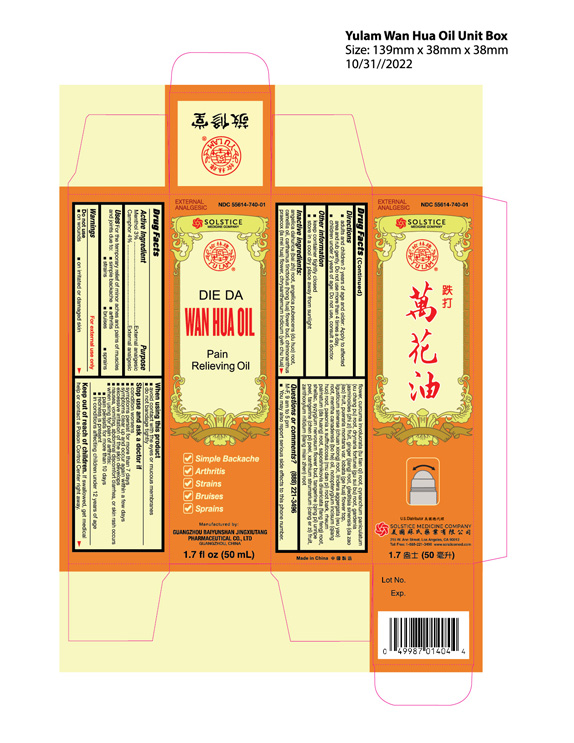
YULAM DIE DA WAN HUA PAIN RELIEVING Menthol and Camphor 3 g/100mL; 4 g/100mL Oil — NDC 55614-740-01 (Billing 55614-0740-01)
This is a package of YULAM DIE DA WAN HUA PAIN RELIEVING Menthol and Camphor 3 g/100mL; 4 g/100mL Oil from MADISON ONE ACME INC, marketed since Jun 2023 and currently FDA-listed, this package's marketing is listed to end Jun 2027. It is this product's only package size.
NDC database record
One package, one record: these facts belong to NDC 55614-740-01 alone.
- Record
- FDA NDC Directory package listing · Human OTC drug
- Code segments
- 55614 labeler · 740 product · 01 package
- Package marketed since
- Jun 1, 2023
- Package marketing ended
- Jun 1, 2027
- Sample package
- No — commercial package
- Barcode (UPC-A, from the NDC)
- 3 5561474001 0
- FDA record last changed
- Aug 27, 2026
Identity & classification
Regulatory identifiers FDA, NLM and CMS codes for this package
- RxCUI (RxNorm): 2619676
Where does this data come from?
- FDA openFDA NDC Directory · synced Oct 1, 2026
- FDA label on DailyMed · label index refreshed Oct 5, 2026
- RxNorm (NLM RxNav) · catalog refreshed Oct 1, 2026
- Medi-Span GPI (licensed)
- First Databank (licensed) · refreshed Oct 1, 2026
Clinical
Yulam Die Da Wan Hua Pain Relieving is a topical oil product containing menthol and camphor. This is an over-the-counter monograph drug, meaning it is marketed under FDA's established category rules for topical pain-relief products. Menthol and camphor are commonly used in topical preparations for their cooling and warming sensations, which are typically intended to provide temporary comfort to muscles and joints when applied to the skin.
Patient education
Supplement & herbal interactions
Where does this data come from?
- MedlinePlus (NLM) · refreshed Oct 1, 2026
- FDA label on DailyMed · label index refreshed Oct 5, 2026
Ask a licensed pharmacist directly — free, answered by our team.
Pricing
A drug doesn't have one price. Each row is a different public payment system, and none is what you'd pay at the counter — that depends on your insurance. The ⓘ on each row explains what it measures.
| Price system | Per each | Per package |
|---|---|---|
| Retail pharmacies payNADAC · weekly | Not in the retail survey — common for institutional, discontinued, or low-volume packs. | |
| Medicaid paysCMS SDUD · 12 mo | No recent Medicaid claims on file for this NDC — rare and low-volume NDCs are suppressed in the public data. | |
| Medicare drug plans payPart D · quarterly | No Part D plan price is available for this NDC in our data. | |
Where does this data come from?
- CMS NADAC weekly file
- CMS ASP pricing files · refreshed Sep 20, 2026
- CMS Medicaid State Drug Utilization Data · refreshed Oct 5, 2026
- CMS Part D plan pricing files · refreshed Sep 24, 2026
- VA National Acquisition Center price file
Packaging — all sizes for this product
| Package NDC | Description | Marketing start | Marketing end | Status |
|---|---|---|---|---|
| 55614-0740-01 You're viewing this Main listing | 1 BOTTLE, PLASTIC in 1 BOX / 50 mL in 1 BOTTLE, PLASTIC | 2022-11-02 | Jun 1, 2027 | Active |
Therapeutic equivalents
| Product | Labeler | Pack | NADAC/unit | TE | Status | Price vs. this |
|---|---|---|---|---|---|---|
| Yulam Die Da Wan Hua Pain Relieving 3 g/100mL; 4 g/100mLthis 55614-0740-01 | MADISON | 1 bottle | — | — | FDA listed | — |
Where does this data come from?
- FDA openFDA NDC Directory · synced Oct 1, 2026
- FDA Orange Book · refreshed Oct 3, 2026
- CMS NADAC weekly file
Availability & generic status
We did not find an FDA-approved generic match for this exact strength, form and route.
Where does this data come from?
- FDA Orange Book · refreshed Oct 3, 2026
Inactive Ingredients / Excipients
Inactive ingredients, also called excipients, are components of the drug product other than the active ingredient. They may include fillers, dyes, coatings, preservatives, flavors, or other formulation ingredients.
💡 Tap an ingredient (hover on desktop) to see what it is and why it’s used.
-
UNII 1V63N2S972
A plant extract from angelica dahurica root used in traditional formulations. It may function as a flavoring agent, fragrance component, or natural ingredient to add therapeutic appeal to the medicine.
-
UNII 0MF1EI01KJ
Angelica pubescens root is a plant-derived ingredient used as a flavoring agent and traditional botanical component in some herbal and natural formulations to enhance taste and provide characteristic aroma.
-
UNII T1PE06G0VE
Camellia oil is a plant-based oil extracted from camellia seeds. It's used in medicines as an emollient and lubricant to improve texture and help ingredients blend smoothly together.
-
UNII B86IS274O0
A plant extract from safflower flower buds used as a natural colorant and flavoring agent in medicines. It provides color and taste to make the product more appealing.
-
UNII 5Y143KS0YL
A plant extract from wintersweet flowers used in traditional formulations. It may function as a botanical ingredient to enhance flavor, aroma, or provide natural coloring in the medicine.
-
UNII I6OER6U04L
A plant extract from chrysanthemum flowers used as a natural colorant and flavoring agent in medicines. It may contribute mild taste or visual appeal to the final product.
-
UNII EW5ECF6XAX
A plant extract from the roots of Curcuma involucrata, a relative of turmeric. It may be used as a natural colorant or flavoring agent in the medicine.
-
UNII CZP7EPR012
A plant-derived ingredient from the root of Cynanchum paniculatum. It may function as a binder or thickening agent to help hold the medicine together or improve its consistency in the formulation.
-
UNII 731W842X8Q
A plant extract from the Drynaria fortunei fern root, traditionally used in herbal medicine. In formulations, it may serve as an active botanical ingredient or functional additive, though its specific role depends on the product type.
-
UNII 7CTH8MD549
A natural plant extract from gardenia fruit used as a colorant in medicines. It provides yellow to orange coloring and may help preserve product stability.
-
UNII C5529G5JPQ
Ginger is a plant-derived ingredient used as a flavoring agent to add taste and aroma to medicines. It may also provide mild soothing properties to support product palatability.
-
UNII A6W0J6UO7Q
A plant-derived extract from the fruit of the Chinese honey locust tree. It serves as a natural thickener and emulsifier to help blend ingredients and create a smooth, uniform texture in medicines.
-
UNII 32SLT970XO
A plant extract from Chinese ligusticum root, traditionally used in herbal medicine. In pharmaceutical formulations, it may serve as an active botanical ingredient or flavor component, though its specific excipient role varies by product.
-
UNII 517Q7XRT2T
A plant-derived ingredient from the root of Lindera aggregata. It may be used as a natural flavoring agent, fragrance component, or traditional botanical extract in formulations.
-
UNII J1BO4MHT2L
A plant material from Canadian mint that provides flavor and aroma to the medicine. It's used to improve taste and make the product more pleasant to take.
-
UNII 5Z2WW4J6RI
A plant root extract used in traditional herbal formulations. It may function as an active botanical ingredient or flavoring agent, though in many modern medicines it serves primarily to support the product's traditional composition and stability.
-
UNII BUG255FE7X
A plant-derived ingredient from tree peony root bark. It's used in traditional formulations as a natural filler and may help stabilize the medicine's consistency and appearance.
-
UNII HAM6R1WA7O
A plant extract from kudzu flowering tops used as a natural flavoring or coloring agent in medicines. It may help mask taste or add color to the final product.
-
UNII G025DAL7CE
A plant extract from rhubarb root used as a natural colorant and flavoring agent in medicines. It may also help stimulate bowel movement in laxative formulations.
-
UNII 8H84LFK2QD
A plant root extract used in traditional herbal preparations. It serves as an active botanical ingredient that may provide flavor and natural properties to the formulation.
-
UNII 46N107B71O
Shellac is a natural resin secreted by the lac beetle. It's used as a coating on tablets and capsules to control how quickly the medicine dissolves and to improve appearance and stability.
-
UNII 7FA55IY5H8
A plant-derived ingredient from flower buds of Syzygium nervosum. Used in formulations as a flavoring agent, colorant, or traditional botanical component to enhance taste or appearance.
-
UNII JU3D414057
A natural plant extract from tangerine fruit peel used as a flavoring agent and color contributor. It adds tangerine taste and may provide a slight orange tint to medicines.
-
UNII B077C3NLJV
A natural plant extract from unripe tangerine fruit peel, used as a flavor ingredient to add citrus taste and aroma to medicines.
-
UNII TN770YC17C
A plant-derived ingredient from the Xanthium strumarium fruit. It's used in formulations as a natural binder and filler to help hold the medicine together and add bulk to tablets or capsules.
-
UNII L2CQZ81759
A plant extract from the root of Zanthoxylum nitidum, a shrub native to Asia. It's used in formulations as a flavoring agent and to support preservation of the medicine.
26 inactive ingredients listed in the exact product block matched to this NDC.
Label-section wording can be broader than the structured product block and may mention additional formulation ingredients.
Where does this data come from?
ingredient classCode="IACT" elements from the exact product block matched by this NDC. Label-section narrative from DailyMed / the openFDA label index is shown separately when available.- FDA label on DailyMed · label index refreshed Oct 5, 2026
- FDA openFDA NDC Directory · synced Oct 1, 2026
Inactive ingredient FAQ
Are inactive ingredients the same for every manufacturer?
Why might an inactive ingredient be missing?
Can inactive ingredients matter?
Manufacturer & labeler
More NDCs from MADISON ONE ACME INC labeler code 55614
- HUO LUO PAIN RELIEVING CAMPHOR, MENTHOL, METHYL SALICYLATE 10 g/100mL; 16 g/100mL; 50 g/100mL Oil NDC 55614-671-01
- JOSEPHS LION PAIN RELIEVING Camphor, Menthol, Methyl Salicylate 5 g/100mL; 8 g/100mL; 10 g/100mL Oil NDC 55614-680-01
- QIAN LI ZHUI FENG PAIN RELIEVING Camphor, Menthol, and Methyl Salicylate 10 g/100mL; 15 g/100mL; 48 g/100mL Oil NDC 55614-690-01
- Wu Yang Brand Pain Relieving Medicated Menthol and Camphor 5 g/100g; 3 g/100g Plaster NDC 55614-700-01
- HEI GUI PAIN RELIEVING Camphor and Methyl Salicylate 5 g/100mL; 50 g/100mL Oil NDC 55614-711-01
- E Mei Shan Medicated Camphor and Menthol 31 mg; 26 mg Plaster NDC 55614-730-01
Where does this data come from?
- FDA openFDA NDC Directory · synced Oct 1, 2026
- Drugs@FDA
FDA label — Drug Facts FDA SPL
🎯 Indications and Usage ▾
Uses For the temporary relief of minor aches and pains of muscles and joints due to: ■ simple backache ■ arthritis ■ strains ■ bruises ■ sprains
⏱️ Dosage and Administration ▾
Directions ■ adults and children 2 years of age and older: Apply to affected area and rub gently. Do not use for more than 4 times a day. ■ children under 2 years of age: Do not use, consult a doctor.
⚠️ Warnings ▾
Warnings For external use only
🤒 Adverse Reactions ▾
Report any unexpected side effects from the use of this product to the FDA MedWatch Program.
📦 Storage and Handling ▾
Other information ■ keep container tightly closed ■ store in a cool dry place away from sunlight
🧪 Active Ingredient ▾
Active ingredient Menthol 3% Camphor 4%
🧪 Inactive Ingredients ▾
Inactive ingredients angelica dahurica (bai zhi) root, angelica pubescens (du huo) root, camellia oil, carthamus tinctorius (hong hua) flower bud, chimonanthus praecox (la mei hua) flower, chrysanthemum indicum (yeh chu hua) flower, curcuma involucrata (tu tian qi) root, cynanchum paniculatum (xu chang pu) root, drynaria fortunei (gu sui bu) root, gardenia jasminoides (zhi zi) fruit, ginger (jiang) root, gleditsia sinensis (da zao jiao) fruit, pueraria montana var. lobata (ge hua) flower top, ligusticum sinense (chuan xiong) root, lindera aggergata (wu yao) root, mentha canadensis (bo he) oil, notopterygium incisum (qiang huo) root, paeonia x suffruticosa (mu dan pi) root bark, rheum palmatum (da huang) root, saposhnikovia divaricata (fang feng) root, shellac, syzygium nervosum flower bud, tangerine (qing pi) unripe peel, tangerine (chen pi) peel, xanthium strumarium (cang er zi) fruit, zanthoxylum nitidum (liang mian zhen) root.
🎯 Purpose ▾
Purpose External analgesic External analgesic
📄 Do Not Use ▾
Do not use ■ on wounds ■ on irritated or damaged skin
📄 When Using This Product ▾
When using this product ■ avoid contact with the eyes or mucous membranes ■ do not bandage tightly
📄 Stop Use and Ask a Doctor If ▾
Stop use and ask a doctor if ■ condition worsens ■ symptoms persist for more than 7 days ■ symptoms clear up and occur again within a few days ■ excessive irritation of the skin develops ■ nausea, vomiting, abdominal discomfort, diarrhea, or skin rash occurs ■ when using for pain of arthritis: ■ pain persists for more than 10 days ■ redness is present ■ in conditions affecting children under 12 years of age
📄 Keep Out of Reach of Children ▾
Keep out of reach of children to avoid accidental poisoning. If swallowed, get medical help or contact a Poison Control Center right away.
📄 Questions or Comments ▾
Questions or comments? (888) 221-3496 M-F 9 am to 5 pm ■ you may also report serious side effects to this phone number
📄 Package Label / Principal Display Panel ▾
YULAM DIE DA WAN HUA PAIN RELIEVING OIL NDC 55614-740-01 EXTERNAL ANALGESIC
1.7 FL OZ (50 ML) IMAGE OF BOX
About this NDC listing & data coverage
What data is (and isn’t) available for this NDC — tap to expand
| NDC identity (package / product / labeler codes) | ✓ Available |
| Labeler | ✓ Available |
| Product & package description | ✓ Available |
| Marketing category & status | ✓ Available |
| Active ingredient / dosage form / route | ✓ Available |
| FDA label (SPL via DailyMed) | ✓ Available |
| Package photos | ✓ Available |
| Inactive ingredients (structured) | ✓ Available |
| NADAC pharmacy acquisition price (CMS) | — Not published for this NDC CMS publishes NADAC only for NDCs reported in its retail-pharmacy survey. |
| Orange Book / therapeutic-equivalence data | — Not published for this NDC Applies only to products approved under an NDA/ANDA; many listings are out of scope. |
| HCPCS J-code billing crosswalk | — Not published for this NDC Most self-administered / retail products have no J-code — that is normal. |
| Medicaid utilization (CMS SDUD) | — Not published for this NDC CMS reports utilization only for NDCs with Medicaid claims above its privacy threshold. |