
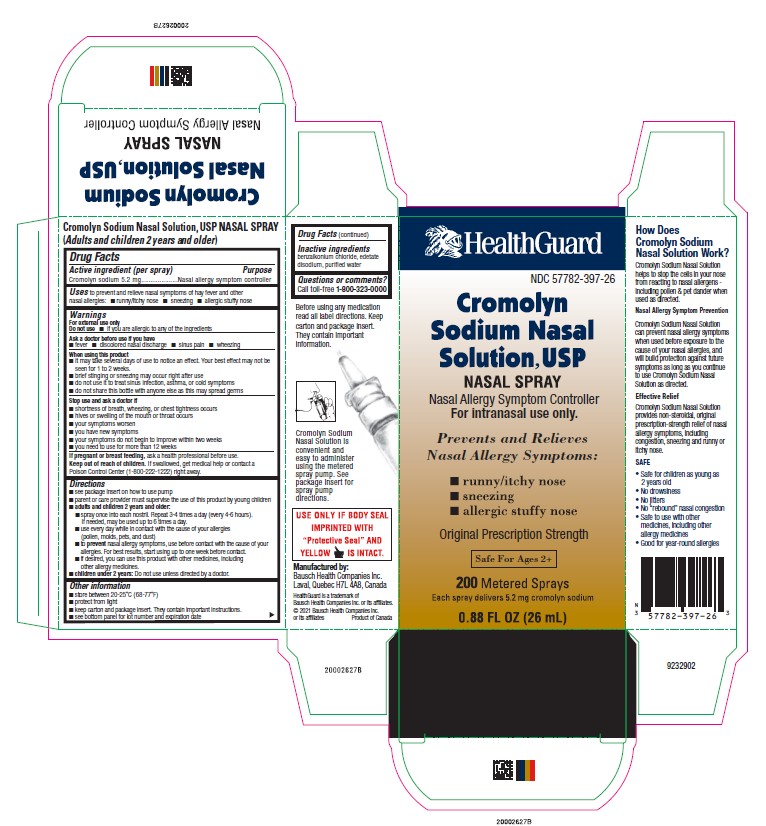
Cromolyn Sodium 5.2 mg Spray, Metered — NDC 57782-397-26 (Billing 57782-0397-26)
This is a package of Cromolyn Sodium 5.2 mg Spray, Metered from Bausch & Lomb Incorporated, marketed since Jul 2001 and currently FDA-listed; retail pharmacies pay about $0.2588 per mL (NADAC). It is this product's only package size.
NDC database record
One package, one record: these facts belong to NDC 57782-397-26 alone.
- Record
- FDA NDC Directory package listing · Human OTC drug
- Code segments
- 57782 labeler · 397 product · 26 package
- Package marketed since
- Jul 3, 2001
- Sample package
- No — commercial package
- Listing certified through
- Dec 31, 2026
- Barcode (UPC-A, from the NDC)
- 3 5778239726 3
- Medicaid fills, this package
- 4,094 prescriptions in the last four reported quarters
- FDA record last changed
- Jul 24, 2026
Identity & classification
Regulatory identifiers FDA, NLM and CMS codes for this package
Drug-database identifiers Medi-Span GPI and First Databank GCN / HICL / AHFS classification
- GSN (GCN sequence number): 011689
- GCN: 46790
- GPI-14 (Medi-Span): 42405030103410
- HICL (First Databank): 004526
- AHFS class code: 48:10.32.00
- RxCUI (RxNorm): 1797851
Where does this data come from?
- FDA openFDA NDC Directory · synced Oct 8, 2026
- FDA label on DailyMed · label index refreshed Oct 8, 2026
- RxNorm (NLM RxNav) · catalog refreshed Oct 1, 2026
- Medi-Span GPI (licensed)
- First Databank (licensed) · refreshed Oct 8, 2026
RxNorm drug class
This medicine belongs to the Mast Cell Stabilizer class.
Where does this data come from?
- RxClass (NLM) · catalog refreshed Oct 1, 2026
Clinical
Cromolyn is used to prevent and treat stuffy nose, sneezing, runny nose, and other symptoms caused by allergies. It works by preventing the release of substances that cause inflammation (swelling) in the air passages of the nose. This medication is sometimes prescribed for other uses; ask your doctor or pharmacist for more information.
Read the full MedlinePlus article ↗- It helps prevent and relieve nasal symptoms of hay fever and other nasal allergies. That means a runny or itchy nose, sneezing and an allergic stuffy nose.
- It may take several days to notice a difference. Your best effect may not show up for 1 to 2 weeks. If you have not improved after two weeks, check in with your doctor.
- Adults and children 2 and older generally spray once in each nostril, 3 to 4 times a day. Use it daily while you are around your triggers. To prevent symptoms, start up to a week b...
- Some people have brief stinging or sneezing right after a spray. That is usually short-lived. Stop and get help if you have wheezing, chest tightness, hives, or swelling of the mou...
Patient education
Supplement & herbal interactions
Some supplements/herbs that may interact with Cromolyn Sodium — tap one for details:
Where does this data come from?
- MedlinePlus (NLM) · refreshed Oct 8, 2026
- FDA label on DailyMed · label index refreshed Oct 8, 2026
Ask a licensed pharmacist directly — free, answered by our team.
Pricing
A drug doesn't have one price. Each row is a different public payment system, and none is what you'd pay at the counter — that depends on your insurance. The ⓘ on each row explains what it measures.
| Price system | Per mL | Per package |
|---|---|---|
| Retail pharmacies payNADAC · weekly | $0.259 | — |
| Medicaid paysCMS SDUD · 12 mo | $0.4310 | — |
| Medicare drug plans payPart D · quarterly | No Part D plan price is available for this NDC in our data. | |
Where does this data come from?
- CMS NADAC weekly file · file of Feb 21, 2024
- CMS ASP pricing files · refreshed Sep 20, 2026
- CMS Medicaid State Drug Utilization Data · through Q4 2025
- CMS Part D plan pricing files · refreshed Sep 24, 2026
- VA National Acquisition Center price file
Packaging — all sizes for this product
| Package NDC | Description | Marketing start | Marketing end | Status |
|---|---|---|---|---|
| 57782-0397-26 You're viewing this Main listing | 1 BOTTLE in 1 CARTON / 200 SPRAY, METERED in 1 BOTTLE | 2001-07-03 | — | Active |
Therapeutic equivalents
| Product | Labeler | Pack | NADAC/unit | TE | Status | Price vs. this |
|---|---|---|---|---|---|---|
| Cromolyn Sodium 5.2 mgthis 57782-0397-26 | Bausch | 1 bottle | $0.259 | — | FDA listed | — |
| NasalCrom 5.2 mg 52183-0199-13 | Prestige | 1 bottle | — | — | FDA listed | — |
Where does this data come from?
- FDA openFDA NDC Directory · synced Oct 8, 2026
- FDA Orange Book · refreshed Oct 3, 2026
- CMS NADAC weekly file · file of Feb 21, 2024
Availability & generic status
This product is an FDA-approved generic. Other versions of the same drug are listed under Therapeutic equivalents, least expensive first.
Where does this data come from?
- FDA Orange Book · refreshed Oct 3, 2026
Inactive Ingredients / Excipients
Inactive ingredients, also called excipients, are components of the drug product other than the active ingredient. They may include fillers, dyes, coatings, preservatives, flavors, or other formulation ingredients.
🧪 Avoiding an ingredient? See Cromolyn Sodium Nasal Solution inactive ingredients by manufacturer: every current product's list side by side, so you can ask your pharmacy for the version that does not list it.
💡 Tap an ingredient (hover on desktop) to see what it is and why it’s used.
-
UNII F5UM2KM3W7
Benzalkonium chloride is a chemical compound that works as a preservative and antimicrobial agent in medications. It prevents bacterial and fungal growth in liquid formulations to keep the product safe during storage and use.
-
UNII 7FLD91C86K
Edetate disodium is a chemical compound that binds and removes certain metal ions. In medicines, it acts as a preservative and stabilizer by preventing metals like calcium from interfering with the product's shelf life and consistency.
-
UNII 059QF0KO0R
Water is a liquid solvent that dissolves and mixes ingredients together in liquid medicines, syrups, and injections. It helps distribute the active drug evenly throughout the product.
3 inactive ingredients listed in the exact product block matched to this NDC.
Label-section wording can be broader than the structured product block and may mention additional formulation ingredients.
Where does this data come from?
ingredient classCode="IACT" elements from the exact product block matched by this NDC. Label-section narrative from DailyMed / the openFDA label index is shown separately when available.- FDA label on DailyMed · label index refreshed Oct 8, 2026
- FDA openFDA NDC Directory · synced Oct 8, 2026
Inactive ingredient FAQ
Are inactive ingredients the same for every manufacturer?
Why might an inactive ingredient be missing?
Can inactive ingredients matter?
Manufacturer & labeler
Where does this data come from?
- FDA openFDA NDC Directory · synced Oct 8, 2026
- Drugs@FDA
FDA label — Drug Facts FDA SPL
🎯 Indications and Usage ▾
Uses to prevent and relieve nasal symptoms of hay fever and other nasal allergies: • runny/itchy nose • sneezing • allergic stuffy nose
⏱️ Dosage and Administration ▾
Directions • see package insert on how to use pump • parent or care provider must supervise the use of this product by young children • adults and children 2 years and older: • spray once into each nostril. Repeat 3-4 times a day (every 4-6 hours). If needed, may be used up to 6 times a day. • use every day while in contact with the cause of your allergies (pollen, molds, pets, and dust) • to prevent nasal allergy symptoms, use before contact with the cause of your allergies.
For best results, start using up to one week before contact. • if desired, you can use this product with other medicines, including other allergy medicines. • children under 2 years: Do not use unless directed by a doctor.
⚠️ Warnings ▾
Warnings For external use only Do not use • if you are allergic to any of the ingredients Ask a doctor before use if you have • fever • discolored nasal discharge • sinus pain • wheezing When using this product • it may take several days of use to notice an effect. Your best effect may not be seen for 1 to 2 weeks. • brief stinging or sneezing may occur right after use • do not use it to treat sinus infection, asthma, or cold symptoms • do not share this bottle with anyone else as this may spread germs Stop use and ask a doctor if • shortness of breath, wheezing, or chest tightness occurs • hives or swelling of the mouth or throat occurs • your symptoms worsen • you have new symptoms • your symptoms do not begin to improve within two weeks • you need to use for more than 12 weeks If pregnant or breast feeding, ask a health professional before use.
Keep out of reach of children. If swallowed, get medical help or contact a Poison Control Center (1-800-222-1222) right away.
🧪 Active Ingredient ▾
Active ingredient (per spray) Cromolyn sodium 5.2 mg
🧪 Inactive Ingredients ▾
Inactive ingredients benzalkonium chloride, edetate disodium, purified water
🎯 Purpose ▾
Purpose Nasal allergy symptom controller
📄 Do Not Use ▾
Do not use • if you are allergic to any of the ingredients
📄 Ask a Doctor Before Use If ▾
Ask a doctor before use if you have • fever • discolored nasal discharge • sinus pain • wheezing
📄 When Using This Product ▾
When using this product • it may take several days of use to notice an effect. Your best effect may not be seen for 1 to 2 weeks. • brief stinging or sneezing may occur right after use • do not use it to treat sinus infection, asthma, or cold symptoms • do not share this bottle with anyone else as this may spread germs
📄 Stop Use and Ask a Doctor If ▾
Stop use and ask a doctor if • shortness of breath, wheezing, or chest tightness occurs • hives or swelling of the mouth or throat occurs • your symptoms worsen • you have new symptoms • your symptoms do not begin to improve within two weeks • you need to use for more than 12 weeks
🤰 If Pregnant or Breast-Feeding ▾
If pregnant or breast feeding, ask a health professional before use.
📄 Keep Out of Reach of Children ▾
Keep out of reach of children. If swallowed, get medical help or contact a Poison Control Center (1-800-222-1222) right away.
📄 Questions or Comments ▾
Questions or comments? Call toll-free 1-800-323-0000
📄 Package Label / Principal Display Panel ▾
Package/Label Principal Display Panel HealthGuard NDC 57782-397-26 Cromolyn Sodium Nasal Solution, USP NASAL SPRAY Nasal Allergy Symptom Controller For intranasal use only. Prevents and Relieves Nasal Allergy Symptoms: • runny/itchy nose • sneezing • allergic stuffy nose Original Prescription Strength Safe For Ages 2+ 200 Metered Sprays Each spray delivers 5.2 mg cromolyn sodium