
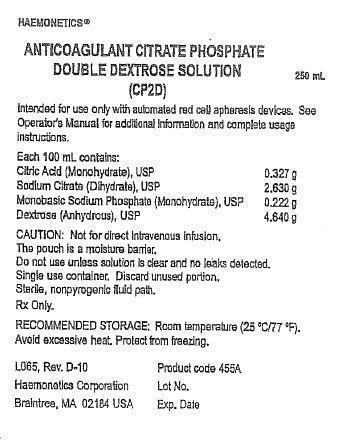
Haemonetics Anticoagulant Citrate Phosphate Double Dextrose Solution (CP2D) CITRIC ACID MONOHYDRATE, TRISODIUM CITRATE DIHYDRATE, SODIUM PHOSPHATE, MONOBASIC, MONOHYDRATE, ANHYDROUS 464; 32.7; 22.2; 263 mg/mL; mg/mL; mg/mL; mg/mL Solution, 250 mL
🆔 Identity & classification
Where does this data come from?
🏭 Manufacturer & labeler
Where does this data come from?
🩺 Clinical
Patient education
Supplement & herbal interactions
Where does this data come from?
Ask a licensed pharmacist directly — free, answered by our team.
🧪 Inactive Ingredients / Excipients
Inactive ingredients, also called excipients, are components of the drug product other than the active ingredient. They may include fillers, dyes, coatings, preservatives, flavors, or other formulation ingredients.
💡 Tap an ingredient (hover on desktop) to see what it is and why it’s used.
-
UNII 059QF0KO0R
Water is a liquid solvent that dissolves and mixes ingredients together in liquid medicines, syrups, and injections. It helps distribute the active drug evenly throughout the product.
1 inactive ingredient listed in the exact product block matched to this NDC.
Where does this data come from?
ingredient classCode="IACT" elements from the exact product block matched by this NDC. Label-section narrative from DailyMed / the openFDA label index is shown separately when available.Inactive ingredient FAQ
Are inactive ingredients the same for every manufacturer?
Why might an inactive ingredient be missing?
Can inactive ingredients matter?
💲 Pricing
A drug doesn't have one price. Each row is a different public payment system, and none is what you'd pay at the counter — that depends on your insurance. The ⓘ on each row explains what it measures.
| Price system | Per mL | Per package |
|---|---|---|
| Retail pharmacies payNADAC · weekly | Not in the retail survey — common for institutional, discontinued, or low-volume packs. | |
| Medicaid paysCMS SDUD · 12 mo | No recent Medicaid claims on file for this NDC — rare and low-volume NDCs are suppressed in the public data. | |
| Medicare drug plans payPart D · quarterly | No Part D plan price is available for this NDC in our data. | |
Where does this data come from?
🔁 Therapeutic equivalents
| Product | Labeler | Pack | NADAC/unit | TE | Status | Price vs. this |
|---|---|---|---|---|---|---|
| Haemonetics Anticoagulant Citrate Phosphate Double Dextrose Solution (CP2D) 464; 32.7; 22.2; 263 mg/mL; mg/mL; mg/mL; mg/mLthis 57826-0455-02 | Haemonetics | 250 ml | — | — | Discontinued | — |
Where does this data come from?
⏳ Availability & generic status
We did not find an FDA-approved generic match for this exact strength, form and route.
Where does this data come from?
📦 Packaging — all sizes for this product
| Package NDC | Description | Marketing start | Status |
|---|---|---|---|
| 57826-0455-02 You're viewing this | 250 mL in 1 BAG (57826-455-02) | 2013-01-10 | Inactivated by FDA |
🧭 About this NDC listing & data coverage
What data is (and isn’t) available for this NDC — tap to expand
| NDC identity (package / product / labeler codes) | ✓ Available |
| Labeler | ✓ Available |
| Product & package description | ✓ Available |
| Marketing category & status | ✓ Available |
| Active ingredient / dosage form / route | ✓ Available |
| FDA label (SPL via DailyMed) | ✓ Available |
| Package photos | ✓ Available |
| Inactive ingredients (structured) | ✓ Available |
| NADAC pharmacy acquisition price (CMS) | — Not published for this NDC CMS publishes NADAC only for NDCs reported in its retail-pharmacy survey. |
| Orange Book / therapeutic-equivalence data | — Not published for this NDC Applies only to products approved under an NDA/ANDA; many listings are out of scope. |
| HCPCS J-code billing crosswalk | — Not published for this NDC Most self-administered / retail products have no J-code — that is normal. |
| Medicaid utilization (CMS SDUD) | — Not published for this NDC CMS reports utilization only for NDCs with Medicaid claims above its privacy threshold. |
Questions about this listing
Why is there no price listed?
What does the discontinued status mean for this NDC?
Is the NDC printed on the package the same as the 11-digit billing NDC?
What do the three segments of this NDC mean?
Who lists this product with the FDA?
Do I need a prescription for this product?
Where does this data come from?
📄 Full prescribing information FDA SPL
🎯 Indications and Usage ▾
I. Indications for Use The Haemonetics 250mL Anticoagulant Citrate Phosphate Double Dextrose (CP2D) and 250mL Additive Solution Formula 3 (AS-3) nutrient solution are intended to be used only with automated apheresis devices for collecting human blood and blood components. The anticoagulant solution is metered by the apheresis machine into the collected whole blood.
It is not to be infused directly into the donor. After the anticoagulant is used, the bag in which it was contained is discarded. When collecting plasma in the RBCP protocol, the plasma is collected into an empty plasma collection bag.
One hundred milliliters (100ml) of AS-3 is transferred into one RBC collection bag when using the RBCP protocol or 2 separate bags when using the 2RBC protocol. AS-3 solution provides nutrients to keep the red blood cells viable for 42 days when refrigerated. CP2D is also indicated for the collection of FFP and PF24 plasma, collected and stored plasma collected using the 822, 822-2P and 822F-2P disposable sets may be frozen within 8 hours (FFP) or within 24 hours which includes 8 hours room temperature storage and 16 hours refrigeration storage (PF24).
The 300mL AS-3 is used in conjunction with automated red blood cell washing devices. AS-3 serves as the nutrient solution for storage of the red blood cell product after deglycerolization. The red blood cells are washed using the Model 215 System.
AS-3 is used for priming the disposable and for the last wash of the red blood cells. The washed cells are then re-suspended in 100mL of the AS-3 before transfer into a product collection bag or storage bag. Additive Solution Formula 3 (AS-3) provides nutrients to keep the washed red blood cells viable for up to 14 days after washing when refrigerated.
Neither the CP2D nor the AS-3 container is used for the storage of blood or blood components.
⏱️ Dosage and Administration ▾
Dosage and Administration: CP2D Anticoagulant Solution and AS-3 Solution may be used with Haemonetics apheresis devices. See the Haemonetics Operation Manual for full operating instructions. Prior to use of the solutions, check the solutions for leaks by squeezing each of the bags firmly. If leaks are found, discard the solution.
💊 Dosage Forms and Strengths ▾
Dosage Form The container for all CP2D and AS-3 solutions is a flexible polyvinyl chloride (PVC) bag sized for holding the appropriate amount of solution. The bag has a single port that is used for bag filling. The port is sealed after filling with a male luer assembly (CP2D) or female luer assembly (AS-3).
Both the male and female luers are gamma irradiated prior to use. The plastic bag is contained in an overwrap which is added prior to sterilization. The formulations for these products are as follows: Citrate Phosphate Double Dextrose Solution (CP2D) Each 100 mL contains: Citric Acid (Monohydrate), USP 0.327 g Sodium Citrate (Dihydrate), USP 2.630 g Monobasic Sodium Phosphate (Monohydrate), USP 0.222 g Dextrose (Anhydrous), USP 4.640 g Additive Solution 3 (AS-3) Each 100mL contains: Citric Acid (Monohydrate), USP 0.042 g Monobasic Sodium Phosphate (Monohydrate), USP 0.276 g Sodium Chloride, USP 0.410 g Adenine, USP 0.030 g Dextrose (Anhydrous), USP 1.000 g Sodium Citrate (Dihydrate), USP 0.588 g containing 15 mEq of Sodium.
⚠️ Warnings and Cautions ▾
IV. Warnings and Cautions Contraindications: None known Precautions for use: • Solutions are NOT INTENDED FOR DIRECT INFUSION. • Do not use if particulate matter is present or if the solution is cloudy Note: Some opacity of the plastic container due to moisture absorbance by the PVC during the sterilization process may be observed. This is normal and does not affect the quality or the safety of the product.
This white, hazy appearance will diminish gradually over time. This advice only applies to the plastic container. Do not use if the solution itself is cloudy or contains particulate matter. •Do not use if the container is damaged, leaking or if there is any visible sign of deterioration.
Note: The over wrap serves as a moisture barrier. Upon removing the solution bag, small droplets of condensation may be present in the packaging. This is considered normal.
After removing the over wrap gently squeeze the inner bag which protects the sterility of the solution. Discard if any leaks are observed or if an excessive amount of solution is noted within the over wrap. • Do not reuse solution. Discard any unused or partially used solutions. • Protect from sharp objects. • Verify that solutions have been appropriately connected to avoid leaks. • The set should be loaded and primed for use within 8 hours of the start of the collection. • Carry out the apheresis procedure in accordance with the detailed instructions of the manufacturer of the apheresis device.
🤒 Adverse Reactions ▾
Adverse Reactions: Donors being reinfused with citrated blood or blood components may experience side effects due to the presence of citrate. Patients being transfused with the blood components could also experience a reaction to the citrated blood components. The major symptom experienced by donors is paraesthesia.
Should this occur the reinfusion should be stopped or the reinfusion rate decreased. In the event of inadvertent bolus of the product administer calcium gluconate.
🆘 Overdosage ▾
Overdosage: Both solutions are intended to be used only with automated apheresis devices for collecting human blood and blood components. CP2D is used as an anticoagulant solution and AS-3 is intended for use a nutrient solution. Neither solution is intended for direct infusion.
📦 How Supplied / Storage and Handling ▾
How Supplied: 250mL CP2D Anticoagulant Solution is supplied in flexible PVC containers with a sterile, non-pyrogenic fluid path. 250mL and 300mL AS-3 Nutrient Solution is supplied in flexible PVC containers with a sterile, non-pyrogenic fluid path.
📦 Storage and Handling ▾
Storage and Handling: Room temperature (25°C/77°F). Avoid excessive heat. Protect from freezing.