
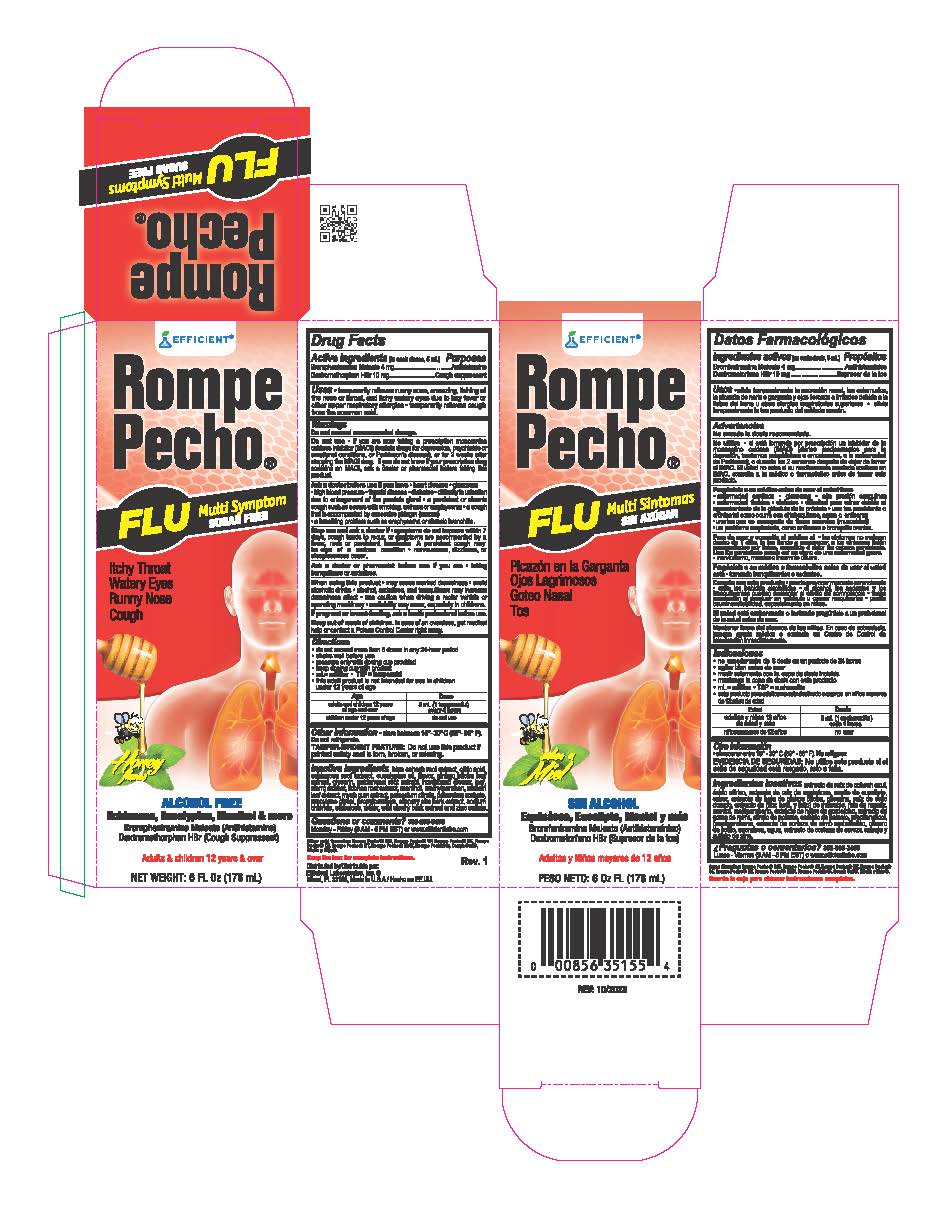
Rompe Pecho SF Flu SF Flu Brompheniramine Maleate, Dextromethorphan HBr 10 mg/5mL; 4 mg/5mL Liquid, 178 mL
🆔 Identity & classification
Where does this data come from?
🏷️ RxNorm drug class
This medicine belongs to the Substituted alkylamines class.
Where does this data come from?
🏭 Manufacturer & labeler
Where does this data come from?
🩺 Clinical
Brompheniramine is used to treat allergy and cold symptoms: sneezing runny nose itching of the nose or throat red, itchy, watery eyes Brompheniramine is in a class of medications called antihistamines. It works by blocking the action of histamine, a substance in the body that causes allergic symptoms.
Read the full MedlinePlus article ↗Rompe Pecho SF Flu is an over-the-counter oral liquid cough and cold product. It contains brompheniramine maleate, an antihistamine typically used to reduce allergy symptoms and runny nose, and dextromethorphan hydrobromide, a cough suppressant commonly used to reduce coughing. This is an OTC monograph drug, meaning it is marketed according to FDA category rules for this type of product rather than through an individual drug application.
Patient education
Supplement & herbal interactions
Where does this data come from?
Ask a licensed pharmacist directly — free, answered by our team.
🧪 Inactive Ingredients / Excipients
Inactive ingredients, also called excipients, are components of the drug product other than the active ingredient. They may include fillers, dyes, coatings, preservatives, flavors, or other formulation ingredients.
💡 Tap an ingredient (hover on desktop) to see what it is and why it’s used.
-
UNII XF417D3PSL
Anhydrous citric acid is a sour, crystalline powder derived from citric acid with water removed. In medicines, it acts as a buffer to control pH, adds tartness to improve taste, and helps tablets disintegrate.
-
UNII JTJ6HH6YEH
A plant extract from blue cohosh root. It may be used as a natural flavoring or botanical ingredient in some formulations, though its specific role varies by product.
-
UNII D982V7VT3P
A plant extract from the narrow-leafed coneflower root, used as a natural flavor, color, or botanical ingredient in some formulations to add taste and appearance to the medicine.
-
UNII 2R04ONI662
Eucalyptus oil is a fragrant liquid extracted from eucalyptus tree leaves. It's used in medicines as a flavor, scent, or soothing agent in topical products and cough preparations.
-
UNII Y5967KO1JH
A concentrated oil extracted from ginkgo biloba leaves. It's used in medicines as a flavoring agent and to deliver the plant's active compounds in liquid or semi-solid formulations.
-
UNII PDC6A3C0OX
Glycerin is a clear, thick liquid derived from plant oils or fats. It acts as a humectant to retain moisture, a sweetener, and a solvent in medications.
-
UNII ZW3Z11D0JV
A plant extract from goldenseal root, used as a natural colorant and flavoring agent in some medicines. It may also have mild preservative properties in certain formulations.
-
UNII Y9H1V576FH
Honey is a natural sweetener made by bees from flower nectar. In medicines, it adds sweetness to improve taste and may help soothe throat irritation in lozenges or syrups.
-
UNII K08036XEJV
Horehound is a plant extract used as a flavoring agent in medicines. It adds a distinctive bitter or minty taste to help mask unpleasant flavors in syrups and lozenges.
-
UNII 61ZBX54883
Licorice is a natural extract from the licorice plant root. It's used in medicines as a flavoring agent to mask bitter tastes and improve how the medicine tastes.
-
UNII L7T10EIP3A
A cooling compound from mint plants used as a flavoring agent and to create a fresh sensation in medicines. It helps mask bitter tastes and improve how the product feels in the mouth.
-
UNII A2I8C7HI9T
Methylparaben is a preservative derived from benzoic acid that prevents growth of bacteria, fungi, and mold in medicines. It extends the product's shelf life and maintains safety during storage.
-
UNII 9936O846LI
A plant extract from mullein leaves used as a natural flavoring agent and to add texture or body to liquid formulations. It may help improve the taste or mouthfeel of the medicine.
-
UNII JC71GJ1F3L
Myrrh is a natural resin obtained from a tree, traditionally used in medicines and perfumes. It may serve as a flavoring agent, fragrance, or mild preservative in formulations.
-
UNII 86R1NVR0HW
A salt derived from citric acid and potassium. It acts as a buffer to regulate acidity in the medicine and may also help with disintegration or dissolution of the tablet.
-
UNII 1VPU26JZZ4
Potassium sorbate is a salt derived from sorbic acid, a naturally occurring preservative. It prevents growth of mold, yeast, and some bacteria, extending the medicine's shelf life.
-
UNII 6DC9Q167V3
Propylene glycol is a clear liquid derived from petroleum or vegetable sources. It acts as a solvent, humectant, and preservative in medicines, helping dissolve active ingredients and maintain product stability.
-
UNII Z8IX2SC1OH
Propylparaben is a chemical preservative used to prevent bacterial and fungal growth in medicines and personal care products. It helps extend shelf life and maintain product safety during storage.
-
UNII 5D48E975HA
A natural extract from wild cherry bark, used as a flavoring agent to mask bitter tastes in medicines and improve palatability of the product.
-
UNII 451W47IQ8X
Sodium chloride is common table salt. It's used in medicines as a buffer to maintain proper pH, as a filler to add bulk, or to adjust the osmotic balance in liquid formulations.
-
UNII 96K6UQ3ZD4
Sucralose is a synthetic sweetener made from sugar. It's added to medicines to improve taste without adding calories, helping make bitter or unpleasant-tasting drugs easier to take.
-
UNII 91QY4PXU8Q
A natural plant extract from the inner bark of the slippery elm tree. It's used in medicines as a binder and thickening agent to help hold ingredients together and improve texture.
-
UNII 059QF0KO0R
Water is a liquid solvent that dissolves and mixes ingredients together in liquid medicines, syrups, and injections. It helps distribute the active drug evenly throughout the product.
-
UNII 89DS0H96TB
Zinc sulfate is a mineral salt used in medications as a source of zinc. It functions as an active nutritional ingredient in some formulations and may also serve as a buffer or pH stabilizer in tablets and liquids.
24 inactive ingredients listed in the exact product block matched to this NDC.
Label-section wording can be broader than the structured product block and may mention additional formulation ingredients.
Where does this data come from?
ingredient classCode="IACT" elements from the exact product block matched by this NDC. Label-section narrative from DailyMed / the openFDA label index is shown separately when available.Inactive ingredient FAQ
Are inactive ingredients the same for every manufacturer?
Why might an inactive ingredient be missing?
Can inactive ingredients matter?
💲 Pricing
A drug doesn't have one price. Each row is a different public payment system, and none is what you'd pay at the counter — that depends on your insurance. The ⓘ on each row explains what it measures.
| Price system | Per mL | Per package |
|---|---|---|
| Retail pharmacies payNADAC · weekly | Not in the retail survey — common for institutional, discontinued, or low-volume packs. | |
| Medicaid paysCMS SDUD · 12 mo | No recent Medicaid claims on file for this NDC — rare and low-volume NDCs are suppressed in the public data. | |
| Medicare drug plans payPart D · quarterly | No Part D plan price is available for this NDC in our data. | |
Where does this data come from?
🔁 Therapeutic equivalents
| Product | Labeler | Pack | NADAC/unit | TE | Status | Price vs. this |
|---|---|---|---|---|---|---|
| Rompe Pecho CF CF 10 mg/5mL; 4 mg/5mL 58593-0001-06 | Efficient | 178 ml | — | — | FDA listed | — |
| Rompe Pecho SF Flu SF Flu 10 mg/5mL; 4 mg/5mLthis 58593-0002-06 | Efficient | 178 ml | — | — | FDA listed | — |
| Rompe Pecho CF 4 mg/5mL; 10 mg/5mL 65852-0013-06 | Dextrum | 1 bottle | — | — | FDA listed | — |
Where does this data come from?
⏳ Availability & generic status
We did not find an FDA-approved generic match for this exact strength, form and route.
Where does this data come from?
📦 Packaging — all sizes for this product
| Package NDC | Description | Marketing start | Status |
|---|---|---|---|
| 58593-0002-06 You're viewing this | 178 mL in 1 BOTTLE (58593-002-06) | 2023-10-01 | Active |
🧭 About this NDC listing & data coverage
What data is (and isn’t) available for this NDC — tap to expand
| NDC identity (package / product / labeler codes) | ✓ Available |
| Labeler | ✓ Available |
| Product & package description | ✓ Available |
| Marketing category & status | ✓ Available |
| Active ingredient / dosage form / route | ✓ Available |
| FDA label (SPL via DailyMed) | ✓ Available |
| Package photos | ✓ Available |
| Inactive ingredients (structured) | ✓ Available |
| NADAC pharmacy acquisition price (CMS) | — Not published for this NDC CMS publishes NADAC only for NDCs reported in its retail-pharmacy survey. |
| Orange Book / therapeutic-equivalence data | — Not published for this NDC Applies only to products approved under an NDA/ANDA; many listings are out of scope. |
| HCPCS J-code billing crosswalk | — Not published for this NDC Most self-administered / retail products have no J-code — that is normal. |
| Medicaid utilization (CMS SDUD) | — Not published for this NDC CMS reports utilization only for NDCs with Medicaid claims above its privacy threshold. |
Questions about this listing
Is this NDC FDA-approved?
Why is there no price listed?
Is the NDC printed on the package the same as the 11-digit billing NDC?
What do the three segments of this NDC mean?
Is this package still being marketed?
Who lists this product with the FDA?
Do I need a prescription for this product?
Where does this data come from?
📄 FDA label — Drug Facts FDA SPL
🎯 Indications and Usage ▾
Uses temporarily relieves runny nose, sneezing, itching of the nose or throat, and itchy watery eyes due to hay fever or other upper respiratory allergies temporarily relieves cough from the common cold
⏱️ Dosage and Administration ▾
Directions Do not exceed more than 6 doses in any 24-hour period Shake well before use measure only with dosing cup provided keep dosing cup with product mL=miliiter TSP=teaspoonful this adult product is not intended for use in children under 12 years of age Age Dose adults and children 12 years of age and over 5 mL (1 teaspoonfuls) every 4 hours children under 6 years of age do not use
⚠️ Warnings ▾
Warnings Do not exceed recommended dosage. Do not use If you are taking a prescription monoamine oxidase inhibitor (MAOI) (certain drugs for depression, psychiatric, or emotional conditions or Parkinson’s disease), or for 2 weeks after stopping the MAOI drug. If you do not know if your prescription drug contains an MAOI; ask your doctor or pharmacist before taking this product.
🧪 Active Ingredient ▾
Active Ingredients: (in each teaspoonful 5 ml.) Purpose Brompheniramine Maleate 4mg ................................................ Antihistamine Dextromethorphan HBr 10 mg .................................................... Cough Suppressant
🧪 Inactive Ingredients ▾
Inactive Ingredients: Blue Cohosh root extract, citric acid, Echinacea root extract, Eucalyptus Oil, Flavor, Ginkgo Biloba leaf extract, glycerin, Golden Seal root extract, Honey, Horehound (flower, leaf, stem) extract, Licorice Root extract, Menthol, Methylparaben, Mullein leaf extract, Myrrh gum extract, Potassium Citrate, Potassium Sorbate, Propylene Glycol, Propylparaben, Slippery Elm Bark extract, Sodium Chloride, Sucralose, Water, Wild Cherry Bark extract and Zinc Sulfate.
🎯 Purpose ▾
Purpose Antihistamine Cough Suppressant