
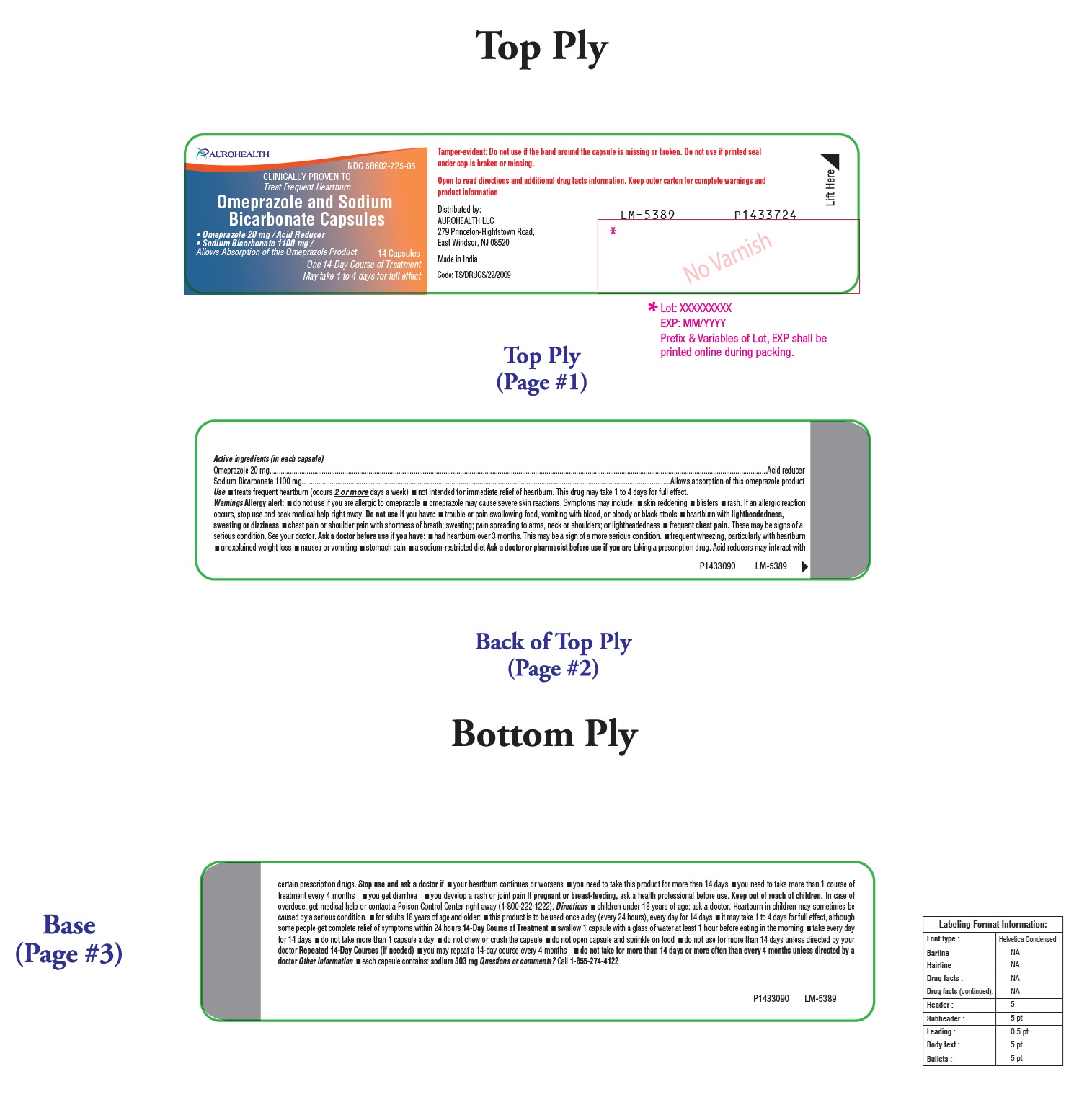
Omeprazole and Sodium Bicarbonate 20 mg; 1100 mg Capsule, 14-count — NDC 58602-725-05 (Billing 58602-0725-05)
This is a package of 14 capsules of Omeprazole and Sodium Bicarbonate 20 mg; 1100 mg Capsule from Aurohealth LLC, marketed since Dec 2023 and currently FDA-listed. It is the main listing for this product, which comes in 3 package sizes.
Identity & classification
Regulatory identifiers FDA, NLM and CMS codes for this package
- RxCUI (RxNorm): 616539
Where does this data come from?
- FDA openFDA NDC Directory · synced Oct 1, 2026
- FDA label on DailyMed · label index refreshed Oct 1, 2026
- RxNorm (NLM RxNav) · catalog refreshed Oct 1, 2026
- Medi-Span GPI (licensed)
- First Databank (licensed) · refreshed Oct 1, 2026
RxNorm drug class
This medicine belongs to the Salt solutions class.
Where does this data come from?
- RxClass (NLM) · catalog refreshed Oct 1, 2026
Clinical
Prescription omeprazole is used alone or with other medications to treat the symptoms of gastroesophageal reflux disease (GERD), a condition in which backward flow of acid from the stomach causes heartburn and possible injury of the esophagus (the tube between the throat and stomach) in adults and children 1 year of age and older. Prescription omeprazole is used to treat damage from GERD in adults and children 1 month of age and older. Prescription omeprazole is used to allow the esophagus to heal and prevent further damage to the esophagus in adults and children 1 year of age and older with G...
Read the full MedlinePlus article ↗- It lowers stomach acid. Prescription versions treat ulcers, GERD and erosive esophagitis, and over-the-counter versions treat frequent heartburn in adults. Zegerid oral suspension...
- Take it once a day, at least 1 hour before eating, usually in the morning. Swallow capsules whole with water and don’t chew, crush or open them. If you use the powder, mix it in 2...
- Use it for 14 days. You can repeat a course every 4 months if needed. If you need it longer or more often, talk to a doctor first.
- How long can I use the over-the-counter version?
Patient education
Supplement & herbal interactions
Where does this data come from?
- MedlinePlus (NLM) · refreshed Oct 1, 2026
- FDA label on DailyMed · label index refreshed Oct 1, 2026
Ask a licensed pharmacist directly — free, answered by our team.
Pricing
A drug doesn't have one price. Each row is a different public payment system, and none is what you'd pay at the counter — that depends on your insurance. The ⓘ on each row explains what it measures.
| Price system | Per each | Per package |
|---|---|---|
| Retail pharmacies payNADAC · weekly | Not in the retail survey — common for institutional, discontinued, or low-volume packs. | |
| Medicaid paysCMS SDUD · 12 mo | No recent Medicaid claims on file for this NDC — rare and low-volume NDCs are suppressed in the public data. | |
| Medicare drug plans payPart D · Q2 2026 | $1.66 | $23.24 / 14 capsules |
Where does this data come from?
- CMS NADAC weekly file
- CMS ASP pricing files · refreshed Sep 20, 2026
- CMS Medicaid State Drug Utilization Data · refreshed Oct 2, 2026
- CMS Part D plan pricing files · refreshed Sep 24, 2026
- VA National Acquisition Center price file
Packaging — all sizes for this product
| Package NDC | Description | Marketing start | Marketing end | Status |
|---|---|---|---|---|
| 58602-0725-05 You're viewing this Main listing | 1 BOTTLE in 1 CARTON / 14 CAPSULE in 1 BOTTLE | 2023-12-22 | — | Active |
| 58602-0725-57 58602-725-57 | 2 BOTTLE in 1 CARTON / 14 CAPSULE in 1 BOTTLE | 2023-12-22 | — | Active |
| 58602-0725-60 58602-725-60 | 3 BOTTLE in 1 CARTON / 14 CAPSULE in 1 BOTTLE | 2023-12-22 | — | Active |
Pack size FAQ
What quantity is in this package?
How does this package differ from NDC 58602-0725-57?
What NDC number is used to bill for this package of Omeprazole and Sodium Bicarbonate 20 mg; 1100 mg Capsule?
Therapeutic equivalents
| Product | Labeler | Pack | NADAC/unit | TE | Status | Price vs. this |
|---|---|---|---|---|---|---|
| Omeprazole and Sodium Bicarbonate 20 mg/1; 1100 mg 27241-0031-03 | Ajanta | 30 capsules | $0.629 | AB | Availability likely | — |
| omeprazole sodium bicarbonate 20 mg/1; 1100 mg 69097-0913-02 | Cipla | 30 capsules | $0.629 | AB | Availability likely | — |
| Good Sense Omeprazole and Sodium Bicarbonate 20 mg/1; 1100 mg 00113-0058-03 | L. | 14 capsules | — | — | FDA listed | — |
| Omeprazole and sodium bicarbonate 20 mg/1; 1100 mg 00363-0732-03 | Walgreen | 14 capsules | — | — | FDA listed | — |
| Omeprazole and sodium bicarbonate 20 mg/1; 1100 mg 37808-0732-01 | H | 14 capsules | — | — | FDA listed | — |
| omeprazole and sodium bicarbonate 20 mg/1; 1100 mg 41250-0938-03 | Meijer | 14 capsules | — | — | FDA listed | — |
| Omeprazole and Sodium Bicarbonate 20 mg/1; 1100 mg 50228-0363-05 | ScieGen | 500 capsules | — | AB | FDA listed | — |
| Omeprazole, Sodium bicarbonate 20 mg/1; 1100 mg 53041-0664-77 | Guardian | 30 capsules | — | AB | FDA listed | — |
| Omeprazole And Sodium Bicarbonate 20 mg/1; 1100 mgthis 58602-0725-05 | Aurohealth | 14 capsules | — | — | FDA listed | — |
| Omeprazole and Sodium Bicarbonate 20 mg/1; 1100 mg 59779-0732-01 | CVS | 14 capsules | — | — | FDA listed | — |
| Zegerid 20 mg/1; 1100 mg 68012-0102-30 | Santarus, | 30 capsules | — | — | FDA listed | — |
| Omeprazole and Sodium Bicarbonate 20 mg/1; 1100 mg 68682-0102-30 | Oceanside | 30 capsules | — | — | FDA listed | — |
| basic care omeprazole and sodium bicarbonate 20 mg/1; 1100 mg 72288-0732-03 | Amazon.com | 14 capsules | — | — | FDA listed | — |
| equate omeprazole and sodium bicarbonate 20 mg/1; 1100 mg 79903-0013-03 | WALMART | 14 capsules | — | — | FDA listed | — |
| Zegerid OTC 20 mg/1; 1100 mg 82632-0100-01 | Riley | 14 capsules | — | — | FDA listed | — |
| Zegerid OTC 20 mg/1; 1100 mg 82632-0699-01 | Riley | 14 capsules | — | — | FDA listed | — |
| Omeprazole and Sodium Bicarbonate 20 mg/1; 1100 mg 85509-1031-01 | PHOENIX | 15 capsules | — | AB | FDA listed | — |
Where does this data come from?
- FDA openFDA NDC Directory · synced Oct 1, 2026
- FDA Orange Book · refreshed Sep 3, 2026
- CMS NADAC weekly file
Availability & generic status
This product is an FDA-approved generic. Other versions of the same drug are listed under Therapeutic equivalents, least expensive first.
Where does this data come from?
- FDA Orange Book · refreshed Sep 3, 2026
What it looks like
Where does this data come from?
- FDA label on DailyMed · label index refreshed Oct 1, 2026
Inactive Ingredients / Excipients
Inactive ingredients, also called excipients, are components of the drug product other than the active ingredient. They may include fillers, dyes, coatings, preservatives, flavors, or other formulation ingredients.
💡 Tap an ingredient (hover on desktop) to see what it is and why it’s used.
-
UNII XF417D3PSL
Anhydrous citric acid is a sour, crystalline powder derived from citric acid with water removed. In medicines, it acts as a buffer to control pH, adds tartness to improve taste, and helps tablets disintegrate.
-
UNII M28OL1HH48
Croscarmellose sodium is a plant-based substance derived from cellulose. It acts as a disintegrant, helping tablets and capsules break down quickly in the digestive system so the medicine can be absorbed.
-
UNII J9EQA3S2JM
FD&C Blue No. 1 Aluminum Lake is a blue colorant made by combining FD&C Blue No. 1 dye with aluminum salts. It is used to color tablets, capsules, and other medicines for easy identification and appearance.
-
UNII 2G86QN327L
Gelatin is a protein derived from animal collagen, commonly used in medicines as a gelling agent and capsule material. It helps create soft or hard capsule shells that hold and release medication, and can also thicken liquid formulations.
-
UNII 70097M6I30
Magnesium stearate is a salt made from magnesium and stearic acid, a fatty substance. It's used in tablets and capsules as a lubricant and glidant to help ingredients flow smoothly during manufacturing and prevent sticking.
-
UNII 6OZP39ZG8H
Polysorbate 80 is a synthetic emulsifier derived from sorbitol and oleic acid. It helps mix oil and water-based ingredients together in medications and improves how the product disperses in the body.
-
UNII 1VPU26JZZ4
Potassium sorbate is a salt derived from sorbic acid, a naturally occurring preservative. It prevents growth of mold, yeast, and some bacteria, extending the medicine's shelf life.
-
UNII 6DC9Q167V3
Propylene glycol is a clear liquid derived from petroleum or vegetable sources. It acts as a solvent, humectant, and preservative in medicines, helping dissolve active ingredients and maintain product stability.
-
UNII 46N107B71O
Shellac is a natural resin secreted by the lac beetle. It's used as a coating on tablets and capsules to control how quickly the medicine dissolves and to improve appearance and stability.
-
UNII 368GB5141J
A detergent and foaming agent derived from coconut or palm oil. In medications, it helps break down and mix oil and water-based ingredients, aids in tablet disintegration, and improves how the drug dissolves and spreads in the mouth or digestive system.
-
UNII 15FIX9V2JP
Titanium dioxide is a bright white mineral powder commonly used as a colorant and opacifying agent. It makes pills and tablets white or lighter in color and helps make coatings non-transparent.
11 inactive ingredients listed in the exact product block matched to this NDC.
Label-section wording can be broader than the structured product block and may mention additional formulation ingredients.
Where does this data come from?
ingredient classCode="IACT" elements from the exact product block matched by this NDC. Label-section narrative from DailyMed / the openFDA label index is shown separately when available.- FDA label on DailyMed · label index refreshed Oct 1, 2026
- FDA openFDA NDC Directory · synced Oct 1, 2026
Inactive ingredient FAQ
Are inactive ingredients the same for every manufacturer?
Why might an inactive ingredient be missing?
Can inactive ingredients matter?
Manufacturer & labeler
Where does this data come from?
- FDA openFDA NDC Directory · synced Oct 1, 2026
- Drugs@FDA
FDA label — Drug Facts FDA SPL
🎯 Indications and Usage ▾
Use treats frequent heartburn (occurs 2 or more days a week) not intended for immediate relief of heartburn. This drug may take 1 to 4 days for full effect
⏱️ Dosage and Administration ▾
Directions for adults 18 years of age and older this product is to be used once a day (every 24 hours), every day for 14 days it may take 1 to 4 days for full effect; although some people get complete relief of symptoms within 24 hours
⚠️ Warnings ▾
Warnings Allergy alert: • do not use if you are allergic to omeprazole. • omeprazole may cause severe skin reactions. Symptoms may include: • skin reddening • blisters • rash If an allergic reaction occurs, stop use and seek medical help right away.
If pregnant or breast-feeding, ask a health professional before use.
🧪 Active Ingredient ▾
Active ingredients (in each capsule) Omeprazole 20 mg Sodium Bicarbonate 1100 mg
🧪 Inactive Ingredients ▾
Inactive ingredients citric acid anhydrous, croscarmellose sodium, FD&C blue #1 aluminum lake, gelatin, magnesium stearate, polysorbate 80, potassium sorbate, propylene glycol, shellac, sodium lauryl sulphate and titanium dioxide.
🎯 Purpose ▾
Purpose Acid reducer Allows absorption of this omeprazole product
About this NDC listing & data coverage
What data is (and isn’t) available for this NDC — tap to expand
| NDC identity (package / product / labeler codes) | ✓ Available |
| Labeler | ✓ Available |
| Product & package description | ✓ Available |
| Marketing category & status | ✓ Available |
| Active ingredient / dosage form / route | ✓ Available |
| FDA label (SPL via DailyMed) | ✓ Available |
| Package photos | ✓ Available |
| Inactive ingredients (structured) | ✓ Available |
| NADAC pharmacy acquisition price (CMS) | — Not published for this NDC CMS publishes NADAC only for NDCs reported in its retail-pharmacy survey. |
| Orange Book / therapeutic-equivalence data | — Not published for this NDC Applies only to products approved under an NDA/ANDA; many listings are out of scope. |
| HCPCS J-code billing crosswalk | — Not published for this NDC Most self-administered / retail products have no J-code — that is normal. |
| Medicaid utilization (CMS SDUD) | — Not published for this NDC CMS reports utilization only for NDCs with Medicaid claims above its privacy threshold. |