
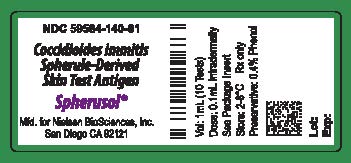
Spherusol Coccidioides immitis Spherule-Derived Skin Test Antigen 12.7 ug/mL Injection, Solution, 1 mL
🆔 Identity & classification
Where does this data come from?
🏷️ RxNorm drug class
This medicine belongs to the Skin Test Antigen class.
Where does this data come from?
🏭 Manufacturer & labeler
Where does this data come from?
🩺 Clinical
Patient education
Supplement & herbal interactions
Where does this data come from?
Ask a licensed pharmacist directly — free, answered by our team.
🧪 Inactive Ingredients / Excipients
Inactive ingredients, also called excipients, are components of the drug product other than the active ingredient. They may include fillers, dyes, coatings, preservatives, flavors, or other formulation ingredients.
💡 Tap an ingredient (hover on desktop) to see what it is and why it’s used.
-
.0045 mL / 1 mL
UNII 339NCG44TV
Phenol is a chemical compound derived from coal tar or petroleum. It serves as a preservative and antimicrobial agent in medicines, helping prevent bacterial and fungal growth to keep the product stable and safe during storage.
-
.00014 g / 1 mL
UNII 91MBZ8H3QO
Sodium borate is an inorganic salt compound used in medicines as a buffer to help maintain a stable pH level, and sometimes as a mild preservative or cleansing agent in topical formulations.
-
.009 g / 1 mL
UNII 451W47IQ8X
Sodium chloride is common table salt. It's used in medicines as a buffer to maintain proper pH, as a filler to add bulk, or to adjust the osmotic balance in liquid formulations.
-
.99 mL / 1 mL
UNII 059QF0KO0R
Water is a liquid solvent that dissolves and mixes ingredients together in liquid medicines, syrups, and injections. It helps distribute the active drug evenly throughout the product.
4 inactive ingredients listed in the exact product block matched to this NDC.
Where does this data come from?
ingredient classCode="IACT" elements from the exact product block matched by this NDC. Label-section narrative from DailyMed / the openFDA label index is shown separately when available.Inactive ingredient FAQ
Are inactive ingredients the same for every manufacturer?
Why might an inactive ingredient be missing?
Can inactive ingredients matter?
💲 Pricing
A drug doesn't have one price. Each row is a different public payment system, and none is what you'd pay at the counter — that depends on your insurance. The ⓘ on each row explains what it measures.
| Price system | Per mL | Per package |
|---|---|---|
| Retail pharmacies payNADAC · weekly | Not in the retail survey — common for institutional, discontinued, or low-volume packs. | |
| Medicaid paysCMS SDUD · 12 mo | No recent Medicaid claims on file for this NDC — rare and low-volume NDCs are suppressed in the public data. | |
| Medicare drug plans payPart D · quarterly | No Part D plan price is available for this NDC in our data. | |
Where does this data come from?
🔁 Therapeutic equivalents
| Product | Labeler | Pack | NADAC/unit | TE | Status | Price vs. this |
|---|---|---|---|---|---|---|
| Spherusol 12.7 ug/mLthis 59584-0140-01 | Nielsen | 1 ml | — | — | FDA listed | — |
Where does this data come from?
⏳ Availability & biosimilar status
Biologics have no small-molecule generics; biosimilar competition is tracked in the FDA Purple Book.
Why the date isn’t exact: Biosimilar timing can change because patents may be challenged, settled, licensed, added or removed, and litigation can move the real date earlier or later.
🛈 What do these terms mean?
- Biologic patent
- A patent the reference product’s maker has publicly listed. A biosimilar generally can’t launch until these expire — unless they’re invalidated or resolved in a settlement.
- Reference-product exclusivity
- A flat 12 years of FDA market protection from the biologic’s first licensure (the BPCIA). No biosimilar can be licensed before it ends, regardless of patents.
- Interchangeable exclusivity
- The first interchangeable biosimilar can earn a period as the only interchangeable version (pharmacists can substitute it without the prescriber).
- Earliest biosimilar (LOE)
- The latest of all the dates above — the soonest a biosimilar can realistically reach the market. Litigation and settlements can move it earlier.
Biologics have no small-molecule “generics” — competition comes from FDA-licensed biosimilars, tracked in the FDA Purple Book.
| Code | What it grants | Expires |
|---|---|---|
| RefProduct | Reference-product exclusivity (12-year, BPCIA) — no biosimilar can be licensed before this date | Jul 29, 2023 |
Is there a biosimilar for SPHERUSOL VIAL?
Why do different websites show different biosimilar dates?
Can a biosimilar launch before the last patent expires?
What does “current Purple Book estimate” mean?
What does “FDA listed” mean?
What does a patent or protection date mean here?
Where does this data come from?
📦 Packaging — all sizes for this product
| Package NDC | Description | Marketing start | Status |
|---|---|---|---|
| 59584-0140-01 You're viewing this | 1 mL in 1 VIAL, MULTI-DOSE (59584-140-01) | 2020-06-01 | Active |
🧭 About this NDC listing & data coverage
What data is (and isn’t) available for this NDC — tap to expand
| NDC identity (package / product / labeler codes) | ✓ Available |
| Labeler | ✓ Available |
| Product & package description | ✓ Available |
| Marketing category & status | ✓ Available |
| Active ingredient / dosage form / route | ✓ Available |
| FDA label (SPL via DailyMed) | ✓ Available |
| Package photos | ✓ Available |
| Inactive ingredients (structured) | ✓ Available |
| NADAC pharmacy acquisition price (CMS) | — Not published for this NDC CMS publishes NADAC only for NDCs reported in its retail-pharmacy survey. |
| Orange Book / therapeutic-equivalence data | ✓ Available |
| HCPCS J-code billing crosswalk | — Not published for this NDC Most self-administered / retail products have no J-code — that is normal. |
| Medicaid utilization (CMS SDUD) | — Not published for this NDC CMS reports utilization only for NDCs with Medicaid claims above its privacy threshold. |
Questions about this listing
Why is there no price listed?
Is the NDC printed on the package the same as the 11-digit billing NDC?
What do the three segments of this NDC mean?
Is this package still being marketed?
Who lists this product with the FDA?
Do I need a prescription for this product?
Where does this data come from?
📄 Full prescribing information FDA SPL
🚨 Boxed Warning ▾
WARNING The expected response to Spherusol ® is a local area of inflammation at the site of the skin test. The reaction is usually dime to quarter size reaching maximum diameter between 24 and 48 hours. Larger accelerated reactions can occur, which may require treatment with local cold compresses and anti-inflammatory medication.
( 2.3 , 6.1 ) Systemic reactions can occur with skin test antigens and in certain individuals these reactions may be life-threatening or cause death. Emergency measures and personnel trained in their use should be immediately available. Patients should be observed for at least 20 minutes following the administration of a skin test.
( 6.2 ) Spherusol ® should never be given intravenously. ( 5 ) To report SUSPECTED ADVERSE REACTIONS, contact Nielsen BioSciences, Inc. at (855) 855-1212 or MEDWATCH, Food and Drug Administration (FDA), 5600 Fishers Lane, Rockville, MD 20852-9782. Telephone: (800) 332-1088 or www.vaers.hhs.gov .
( 6.2 ) WARNING See full prescribing information for complete boxed warning The expected response to Spherusol ® is a local area of inflammation at the site of the skin test. The reaction is usually dime to quarter size reaching maximum diameter between 24 and 48 hours. Larger accelerated reactions can occur, which may require treatment with local cold compresses and anti-inflammatory medication.
( 2.3 , 6.1 ) Systemic reactions can occur with skin test antigens and in certain individuals these reactions may be life-threatening or cause death. Emergency measures and personnel trained in their use should be immediately available. Patients should be observed for at least 20 minutes following the administration of a skin test.
( 5.3 , 6.2 ) Spherusol ® should never be given intravenously. ( 5 ) To report SUSPECTED ADVERSE REACTIONS, contact Nielsen BioSciences, Inc. at (855) 855-1212 or MEDWATCH, Food and Drug Administration (FDA), 5600 Fishers Lane, Rockville, MD 20852-9782. Telephone: (800) 332-1088 or www.vaers.hhs.gov .
( 6.2 )
🎯 Indications and Usage ▾
1 INDICATIONS AND USAGE Spherusol ® is a skin test antigen indicated for the detection of delayed-type hypersensitivity to Coccidioides immitis in individuals with a history of pulmonary coccidioidomycosis. Spherusol ® is approved for use in individuals 18-64 years of age. The use of Spherusol ® to detect delayed-type hypersensitivity responses in a general population with unknown exposure to C. immitis has not been evaluated.
Persons with acute or disseminated coccidioidomycosis may not develop a delayed-type hypersensitivity response to Spherusol ® . Persons with immunodeficiency and a history of coccidioidomycosis may not develop a delayed-type hypersensitivity response to Spherusol ® . Spherusol ® is a skin test antigen indicated for the detection of delayed-type hypersensitivity to Coccidioides immitis in individuals with a history of pulmonary coccidioidomycosis.
Spherusol ® is approved for use in individuals 18-64 years of age. The use of Spherusol ® to detect delayed-type hypersensitivity responses in a general population with unknown exposure to C. immitis has not been evaluated. Persons with acute or disseminated coccidioidomycosis may not develop a delayed-type hypersensitivity response to Spherusol ® .
Persons with immunodeficiency and a history of coccidioidomycosis may not develop a delayed-type hypersensitivity response to Spherusol ® .( 1 )
⏱️ Dosage and Administration ▾
2 DOSAGE AND ADMINISTRATION A single 0.1 mL intradermal injection. Induration at injection site to be evaluated 48 hours after administration. ( 2.1 , 2.3 )
2.1Preparation for Administration Spherusol ® is a clear, colorless sterile solution for intradermal administration. Parenteral drug products should be inspected visually for particulate matter and discoloration prior to administration, whenever solution and container permit. If any of these conditions exists, the skin test antigen should not be administered.
2.2Administration: Spherusol ® is administered as a 0.1 mL dose by intradermal injection to the volar surface of the forearm using a tuberculin syringe (0.5 or 1.0 mL) and a ½ inch 26-27 gauge needle. The needle should be inserted bevel side up in the skin at a 15-20 degree angle. Intradermal injection of 0.1 mL Spherusol ® will result in a bleb 5-10 mm in diameter at the injection site.
2.3Skin Test Assessment The injection site should be assessed for induration at 48 hours (±4 hours) following administration. The response to the skin test should be measured by taking the mean of the orthogonal diameters of the area of induration. A mean induration of ≥ 5 mm is considered a positive delayed-type hypersensitivity response to Spherusol ® . Repeat administration of Spherusol ® has not been evaluated.
💊 Dosage Forms and Strengths ▾
3 DOSAGE FORMS AND STRENGTHS Spherusol ® is a solution for intradermal injection supplied in a 1 mL multi-dose vial. Each 0.1 mL dose contains 1.27 mcg of spherule-derived Coccidioides immitis antigen. Multi-dose vial (1 mL) containing a solution of spherule-derived C. immitis antigen, 1.27 mcg per 0.1mL. ( 3 )
⛔ Contraindications ▾
4 CONTRAINDICATIONS A severe allergic reaction (e.g., anaphylaxis) to Spherusol ® , or any component of Spherusol ® or other coccidioidin products is a contraindication to administration. Severe allergic reaction (e.g., anaphylaxis) to Spherusol ® , or any component of Spherusol ® or other coccidioidin products. ( 4 )
⚠️ Warnings and Cautions ▾
5 WARNINGS AND PRECAUTIONS Acute hypersensitivity reactions and anaphylaxis have occurred following the administration of other skin test antigens and may occur in individuals following the administration of Spherusol ® . ( 5.1 ) Patients receiving beta-blocking drugs may be refractive to the usual dose of epinephrine in cases of hypersensitivity. ( 5.2 ) Any condition or agent that impairs or attenuates delayed type hypersensitivity reactions, including infections and use of immunosuppressive drugs, can potentially cause a false negative reaction to Spherusol ® .
( 5.3 )
5.1Prevention and Management of Acute Hypersensitivity Reactions Prior to administration, the healthcare provider should review the medical history for possible skin test sensitivity and previous skin test related adverse reactions to assess the risks and benefits. Immediate hypersensitivity, to include severe systemic reactions, may occur following administration of skin test antigens. Medications and equipment to manage possible anaphylactic reactions should be available for immediate use.
Patients should be observed for a minimum of 30 minutes following administration to assess for adverse reactions.
5.2Patients on Beta Blockers Patients receiving beta blockers may be unresponsive to the usual doses of epinephrine used to treat serious systemic reactions, including anaphylaxis.
5.3Immunosuppression Any condition or agent that impairs or attenuates delayed-type hypersensitivity reactions, including infections and use of immunosuppressive drugs, can potentially cause a false negative reaction to Spherusol ® . [see Drug Interactions ( 7.1 )]
🤒 Adverse Reactions ▾
6 ADVERSE REACTIONS The most commonly reported local adverse reactions were itching and swelling (>75%) and pain (>15%) within 7 days of administration.( 6.1 ) To report SUSPECTED ADVERSE REACTIONS, contact Nielsen Biosciences, Inc. at (855) 855-1212 or Food and Drug Administration (FDA) at 1-800-332-1088 or www.vaers.hhs.gov . ( 6.3 )
6.1Clinical Trials Experience Because clinical trials are conducted under widely varying conditions, adverse reaction rates observed in the clinical trials of a skin test antigen cannot be directly compared to rates in the clinical trials of another skin test antigen, and may not reflect the rates observed in practice. As with any skin test antigen, there is the possibility that broad use of Spherusol ® could reveal adverse reactions not observed in clinical trials. In a double-blinded placebo-controlled clinical trial conducted in areas of the U.S. endemic for C. immitis (Bakersfield, CA and Tucson, AZ), 54 adults (23-64 years of age) with a history of pulmonary coccidioidomycosis of at least 45 days duration, diagnosed by clinical findings, radiography and serological and/or mycological evidence of the disease, received a single dose of Spherusol ® concomitantly with two licensed skin test extracts (Candin ® and Trichophyton) and two controls (product diluent [thimerosal ≤0.0001%] and saline).
Each intradermal injection of 0.1 mL of reagent was given at pre-determined sites on the right and left forearms. Solicited local adverse reactions and systemic adverse events occurring within 7 days after injection were recorded by study subjects via diary card. These events were also recorded on case report forms (CRFs) by study personnel during clinical visits 48 hours and 7 days following injections.
Diary cards and CRFs did not record solicited local reactions by specific site. Local adverse reactions and systemic adverse events that occurred within 7 days were monitored until resolution. Reports of unsolicited adverse events and serious adverse events that occurred within 7 days after administration were collected on the diary cards or reported at study visits.
Table 1 lists the percentage of subjects reporting solicited local reactions (at any site) and solicited systemic adverse events within 7 days following the administration of Spherusol ® , Candin ® , Trichophyton, diluent control and placebo control. Table 1. Frequency of Solicited Local Reactions and Systemic Adverse Events within 7 days of Administration of Spherusol ® , Candin ® , Trichophyton, Diluent Control and Saline Control in Subjects with a History of Pulmonary Coccidioidomycosis (N=53) Symptom Frequency (%) Local ∗ Any Mild Moderate Severe Itching 85 36 47 2 Swelling 79 36 41 2 Pain 17 13 4 0 Necrosis/Ulceration 4 2 0 2 Systemic Increased heart rate 4 2 2 0 Weakness 6 2 4 0 Faintness 0 0 0 0 Dizziness 2 2 0 0 Nausea/cramps 2 2 0 0 Flu-like symptoms 7 2 6 0 Difficulty breathing/shortness of breath 0 0 0 0 Any = Percentage of subjects experiencing adverse event of any intensity; Mild = Barely noticeable, not bothersome; Moderate = Distinctly noticeable discomfort; Severe = Needs medical attention. ∗ Local reactions occurring at any injection site Of subjects with severe reactions, one subject required treatment with oral corticosteroids for ulceration and swelling.
Based on investigator's determination the reaction was at the site of Trichophyton injection. All severe reactions resolved without sequelae. During the 7 days following administration two subjects reported unsolicited adverse events: one subject reported joint pain, fatigue, cough, sensitivity at a test site (test site not specified), and one subject with erythema immediately after administration (test site not specified).
The intensities of these unsolicited adverse events were not recorded. No serious adverse events or deaths were reported during the clinical study.
6.2To report SUSPECTED ADVERSE REACTIONS, contact Nielsen BioSciences, Inc. at (855) 855-1212 or MEDWA…
🔄 Drug Interactions ▾
7 DRUG INTERACTIONS Corticosteroids and immunosuppressive agents may suppress the response to the skin test.( 7.1 )
7.1Corticosteroids and Immunosuppressives Corticosteroids and Immunosuppressive agents may suppress the response to the skin test. Pharmacologic doses of corticosteroids may suppress the response to skin test antigens after two weeks of therapy. The mechanism of suppression is thought to involve a decrease in monocytes and lymphocytes, particularly T-cells.
The normal DTH response usually returns to pre-treatment levels within several weeks after steroid therapy is discontinued. (5) The use of Spherusol ® has not been evaluated during or following the use of corticosteroids or immunosuppressive agents.
7.2Antifungal Medications It is not known if concurrent treatment with antifungal medications interferes with delayed-type hypersensitivity responses to Spherusol ® in patients with a history of pulmonary coccidioidomycosis.
👥 Use in Specific Populations ▾
8 USE IN SPECIFIC POPULATIONS The safety and effectiveness of Spherusol ® in pregnant and nursing women have not been established. ( 8.1 , 8.3 )
8.1Pregnancy The safety and effectiveness of Spherusol ® in pregnant women have not been established. Pregnancy Category C Animal reproduction studies have not been conducted with Spherusol ® . It is also not known whether Spherusol ® can cause fetal harm when administered to a pregnant woman or affect reproduction capacity. Spherusol ® should be given to a pregnant woman only if clearly needed.
8.2Labor and Delivery No information is available to assess the effects of Spherusol ® on childbirth.
8.3Nursing Mothers The safety and effectiveness of Spherusol ® in nursing women have not been established. It is not known whether Spherusol ® is excreted in human milk. However, because the potential exists for Spherusol ® to be excreted in human milk, caution should be exercised when administering Spherusol ® to a nursing woman.
8.4Pediatric Use The safety and effectiveness of Spherusol ® in the pediatric population have not been established.
8.5Geriatric Use The safety and effectiveness of Spherusol ® have not been established in individuals >65 years of age.
🤰 Pregnancy ▾
8.1Pregnancy The safety and effectiveness of Spherusol ® in pregnant women have not been established. Pregnancy Category C Animal reproduction studies have not been conducted with Spherusol ® . It is also not known whether Spherusol ® can cause fetal harm when administered to a pregnant woman or affect reproduction capacity. Spherusol ® should be given to a pregnant woman only if clearly needed.
🧒 Pediatric Use ▾
8.4Pediatric Use The safety and effectiveness of Spherusol ® in the pediatric population have not been established.
🧓 Geriatric Use ▾
8.5Geriatric Use The safety and effectiveness of Spherusol ® have not been established in individuals >65 years of age.
🧬 Clinical Pharmacology ▾
12 CLINICAL PHARMACOLOGY
12.1Mechanism of Action In individuals with a history of pulmonary coccidioidomycosis Spherusol ® is thought to elicit a cellular immune reaction to C. immitis , as evidenced by a delayed-type hypersensitivity (DTH) response to Coccidioidin (1,2,3,4) . The general mechanism of the DTH response is based on the interaction of antigen with CD 4 and CD 8 lymphocytes followed by the secretion of interleukins and other lymphokines from macrophage cells. The release of effector molecules causes endothelial cells lining the blood vessels to become permeable and allows fibrinogen to escape into the surrounding tissue where it is converted to fibrin.
The deposition of fibrin and the accumulation of T-cells and monocytes within the extracellular spaces cause the tissue to swell and become indurated. This process is usually detectable in 18 hours and peaks at 48 hours. (5)
🧬 Mechanism of Action ▾
12.1Mechanism of Action In individuals with a history of pulmonary coccidioidomycosis Spherusol ® is thought to elicit a cellular immune reaction to C. immitis , as evidenced by a delayed-type hypersensitivity (DTH) response to Coccidioidin (1,2,3,4) . The general mechanism of the DTH response is based on the interaction of antigen with CD 4 and CD 8 lymphocytes followed by the secretion of interleukins and other lymphokines from macrophage cells. The release of effector molecules causes endothelial cells lining the blood vessels to become permeable and allows fibrinogen to escape into the surrounding tissue where it is converted to fibrin.
The deposition of fibrin and the accumulation of T-cells and monocytes within the extracellular spaces cause the tissue to swell and become indurated. This process is usually detectable in 18 hours and peaks at 48 hours. (5)
📦 How Supplied / Storage and Handling ▾
16 HOW SUPPLIED/STORAGE AND HANDLING Spherusol ® is available in 1 mL multidose vial. NDC# 59584-140-01: multi-dose vial. Store refrigerated at 2° to 8°C (35° to 46°F). Do not freeze. Discard if frozen. Do not use after expiration date.
📋 Description ▾
11 DESCRIPTION Spherusol ® is a sterile aqueous solution of extracts of C. immitis spherules. The multi-dose vial contains 0.9% sodium chloride and 0.014% sodium borate with 0.4% phenol as a preservative. Residual thimerosal from the manufacturing process is present at a concentration of ≤0.0001% (<0.05 mcg mercury/0.1 mL dose).
Each 0.1 mL dose contains 1.27 mcg of spherule-derived antigen. The potency of each lot of Spherusol ® is determined in sensitized guinea pigs.
💬 Information for Patients ▾
17 PATIENT COUNSELING INFORMATION Patients should be: Informed of the potential benefits and risks of skin testing with Spherusol ® . Instructed to report any adverse events to their healthcare provider.