
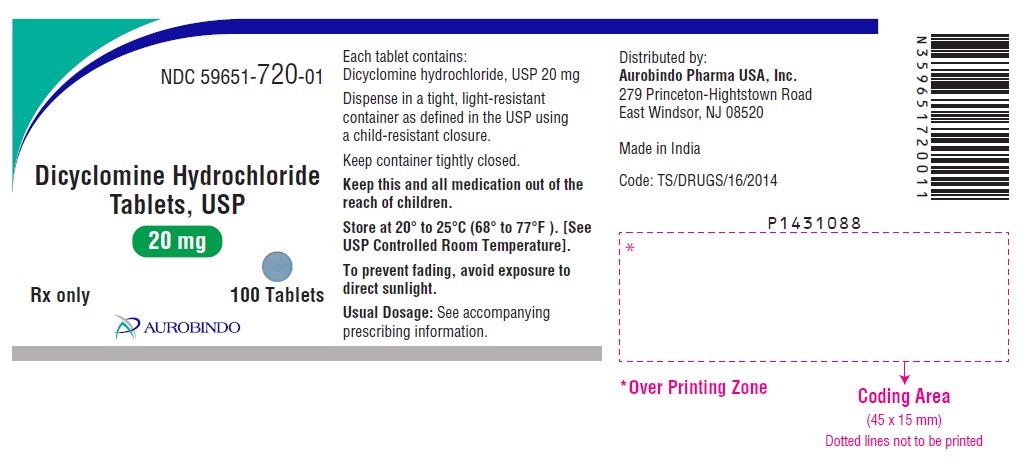
Dicyclomine Hydrochloride 20 mg Tablet, 100-count — NDC 59651-720-01 (Billing 59651-0720-01)
This is a package of 100 tablets of Dicyclomine Hydrochloride 20 mg Tablet from Aurobindo Pharma Limited, marketed since Apr 2023 and currently FDA-listed; retail pharmacies pay about $0.0590 per tablet (NADAC). It is the main listing for this product, which comes in 2 package sizes.
Other active recalls for Dicyclomine Hydrochloride (different manufacturers) — 1 · tap to view
Identity & classification
Regulatory identifiers FDA, NLM and CMS codes for this package
Drug-database identifiers Medi-Span GPI and First Databank GCN / HICL / AHFS classification
- GSN (GCN sequence number): 004924
- GCN: 19331
- GPI-14 (Medi-Span): 49103010100305
- HICL (First Databank): 002045
- AHFS class code: 12:08.08.00
- RxCUI (RxNorm): 991086
Where does this data come from?
- FDA openFDA NDC Directory · synced Oct 1, 2026
- FDA label on DailyMed · label index refreshed Oct 1, 2026
- RxNorm (NLM RxNav) · catalog refreshed Oct 1, 2026
- Medi-Span GPI (licensed)
- First Databank (licensed) · refreshed Oct 1, 2026
RxNorm drug class
This medicine belongs to the Anticholinergic class.
Where does this data come from?
- RxClass (NLM) · catalog refreshed Oct 1, 2026
Clinical
- It treats functional bowel/irritable bowel syndrome. It helps calm the spasms and cramping in your intestines.
- The capsules, tablets and solution are taken by mouth, generally four times a day. Your prescriber may adjust the amount after a week or so. If you miss a dose, just carry on with...
- Dry mouth, dizziness and blurred vision are the most common. Nausea, drowsiness, weakness and nervousness can happen too. Be careful driving until you know how it affects you.
- Call if you feel confused, see or hear things that aren't there, have a racing heartbeat, or can't pass urine. Also call if you overheat without sweating or have diarrhea with a co...
Patient education
Supplement & herbal interactions
Where does this data come from?
- MedlinePlus (NLM) · refreshed Oct 1, 2026
- FDA label on DailyMed · label index refreshed Oct 1, 2026
Ask a licensed pharmacist directly — free, answered by our team.
Pricing
A drug doesn't have one price. Each row is a different public payment system, and none is what you'd pay at the counter — that depends on your insurance. The ⓘ on each row explains what it measures.
| Price system | Per ea | Per package |
|---|---|---|
| Retail pharmacies payNADAC · weekly | $0.059 | $5.90 / 100 tablets |
| Medicaid paysCMS SDUD · 12 mo | $0.1923 | $19.23 / 100 tablets |
| Medicare drug plans payPart D · Q2 2026 | $0.1535 | $15.35 / 100 tablets |
Where does this data come from?
- CMS NADAC weekly file · file of Sep 30, 2026
- CMS ASP pricing files · refreshed Sep 20, 2026
- CMS Medicaid State Drug Utilization Data · through Q1 2026
- CMS Part D plan pricing files · refreshed Sep 24, 2026
- VA National Acquisition Center price file
Packaging — all sizes for this product
| Package NDC | Description | Per unit | Per pack | Marketing start | Marketing end | Status |
|---|---|---|---|---|---|---|
| 59651-0720-01 You're viewing this Main listing | 100 TABLET in 1 BOTTLE | $0.0590 / ea | $5.90 | 2023-04-25 | — | Active |
| 59651-0720-99 59651-720-99 | 1000 TABLET in 1 BOTTLE | $0.0590 / ea | $59.00 | 2023-04-25 | — | Active |
You're viewing the smallest of 2 pack sizes for this product.
This pack has the lowest per-ea cost of the 2 priced pack sizes ($0.0590 NADAC).
In Medicaid, this is the most-dispensed pack of this product — about 68% of fills over the last four reported quarters. See all packs ↓
Pack size FAQ
What quantity is in this package?
How does this package differ from NDC 59651-0720-99?
What NDC number is used to bill for this package of Dicyclomine Hydrochloride 20 mg Tablet?
Prices are the latest CMS NADAC pharmacy acquisition cost per NDC; per-pack figures are per-unit × pack quantity, shown only when the pack is denominated in the same measure NADAC prices.
Therapeutic equivalents
| Product | Labeler | Pack | NADAC/unit | TE | Status | Price vs. this |
|---|---|---|---|---|---|---|
| Dicyclomine hydrochloride 20 mg 00832-6052-10 | Upsher-Smith | 1000 tablets | $0.056 | AB | Discontinued | save 5% |
| Dicyclomine 20 mg 00143-1227-01 | Hikma | 100 tablets | $0.059 | AB | Availability likely | — |
| Dicyclomine Hydrochloride 20 mg 00527-1282-01 | Lannett | 100 tablets | $0.059 | AB | Availability likely | — |
| Dicyclomine Hydrochloride 20 mg 00591-0795-01 | Actavis | 100 tablets | $0.059 | — | Availability likely | — |
| Dicyclomine Hydrochloride 20 mg 00904-6988-61 | Major | 100 tablets | $0.059 | AB | Availability likely | — |
| Dicyclomine hydrochloride 20 mg 16571-0259-01 | Rising | 100 tablets | $0.059 | AB | Availability likely | — |
| Dicyclomine Hydrochloride 20 mg 24979-0200-01 | Upsher-Smith | 100 tablets | $0.059 | AB | Availability likely | — |
| Dicyclomine hydrochloride 20 mg 31722-0079-01 | Camber | 100 tablets | $0.059 | AB | Availability likely | — |
| Dicyclomine Hydrochloride 20 mgthis 59651-0720-01 | Aurobindo | 100 tablets | $0.059 | AB | Availability likely | — |
| Dicyclomine Hydrochloride 20 mg 60687-0380-01 | American | 100 tablets | $0.059 | AB | Availability likely | — |
| Dicyclomine Hydrochloride 20 mg 62135-0428-12 | Chartwell | 120 tablets | $0.059 | AB | Availability likely | — |
| Dicyclomine Hydrochloride 20 mg 69452-0311-20 | Bionpharma | 100 tablets | $0.059 | AB | Availability likely | — |
| Dicyclomine hydrochloride 20 mg 72888-0119-00 | Advagen | 1000 tablets | $0.059 | AB | Availability likely | — |
| Dicyclomine Hydrochloride 20 mg 73473-0902-01 | Solaris | 100 tablets | $0.059 | AB | Availability likely | — |
| Dicyclomine hydrochloride 20 mg 00615-8622-39 | NCS | 30 tablets | — | AB | FDA listed | — |
| Dicyclomine Hydrochloride 20 mg 43063-0045-04 | PD-Rx | 4 tablets | — | AB | FDA listed | — |
| Dicyclomine Hydrochloride 20 mg 50090-1577-00 | A-S | 30 tablets | — | AB | FDA listed | — |
| Dicyclomine Hydrochloride 20 mg 50090-7309-00 | A-S | 30 tablets | — | AB | FDA listed | — |
| Dicyclomine hydrochloride 20 mg 50090-7732-00 | A-S | 30 tablets | — | AB | FDA listed | — |
| Dicyclomine Hydrochloride 20 mg 50090-7882-00 | A-S | 30 tablets | — | AB | FDA listed | — |
| Dicyclomine Hydrochloride 20 mg 51407-0821-12 | Golden | 120 tablets | — | AB | FDA listed | — |
| Dicyclomine Hydrochloride 20 mg 51655-0257-26 | Northwind | 90 tablets | — | AB | FDA listed | — |
| Dicyclomine hydrochloride 20 mg 51655-0548-26 | Northwind | 90 tablets | — | AB | FDA listed | — |
| Dicyclomine Hydrochloride 20 mg 51655-0940-26 | Northwind | 90 tablets | — | AB | FDA listed | — |
| Dicyclomine Hydrochloride 20 mg 60760-0665-30 | St. | 30 tablets | — | AB | FDA listed | — |
| Dicyclomine hydrochloride 20 mg 60760-0802-30 | St. | 30 tablets | — | AB | FDA listed | — |
| Dicyclomine Hydrochloride 20 mg 60760-0931-30 | St. | 30 tablets | — | AB | FDA listed | — |
| Dicyclomine Hydrochloride 20 mg 63187-0410-15 | Proficient | 15 tablets | — | AB | FDA listed | — |
| Dicyclomine Hydrochloride 20 mg 63187-0784-15 | Proficient | 15 tablets | — | AB | FDA listed | — |
| Dicyclomine Hydrochloride 20 mg 67046-1164-03 | Coupler | 30 tablets | — | AB | FDA listed | — |
| Dicyclomine hydrochloride 20 mg 67296-2142-01 | Redpharm | 10 tablets | — | AB | FDA listed | — |
| Dicyclomine Hydrochloride 20 mg 67296-2154-01 | Redpharm | 15 tablets | — | AB | FDA listed | — |
| Dicyclomine hydrochloride 20 mg 67296-2175-01 | Redpharm | 10 tablets | — | AB | FDA listed | — |
| Dicyclomine Hydrochloride 20 mg 67296-2226-05 | Bionpharma | 56 tablets | — | AB | Discontinued | — |
| Dicyclomine Hydrochloride 20 mg 68071-3255-01 | NuCare | 10 tablets | — | AB | FDA listed | — |
| Dicyclomine Hydrochloride 20 mg 68071-3555-03 | NuCare | 30 tablets | — | AB | FDA listed | — |
| Dicyclomine Hydrochloride 20 mg 68071-3606-06 | NuCare | 6 tablets | — | AB | FDA listed | — |
| Dicyclomine Hydrochloride 20 mg 68071-3645-03 | NuCare | 30 tablets | — | AB | FDA listed | — |
| Dicyclomine Hydrochloride 20 mg 68071-3648-06 | NuCare | 100 tablets | — | AB | FDA listed | — |
| Dicyclomine 20 mg 68071-3782-03 | NuCare | 30 tablets | — | AB | FDA listed | — |
| Dicyclomine hydrochloride 20 mg 68071-3885-02 | NuCare | 20 tablets | — | AB | FDA listed | — |
| Dicyclomine hydrochloride 20 mg 68071-3916-06 | NuCare | 6 tablets | — | AB | FDA listed | — |
| Dicyclomine Hydrochloride 20 mg 68071-4782-01 | NuCare | 10 tablets | — | AB | FDA listed | — |
| Dicyclomine hydrochloride 20 mg 68071-5298-03 | NuCare | 30 tablets | — | AB | FDA listed | — |
| Dicyclomine Hydrochloride 20 mg 68788-7811-02 | Preferred | 20 tablets | — | AB | FDA listed | — |
| Dicyclomine Hydrochloride 20 mg 68788-8751-02 | Preferred | 20 tablets | — | AB | FDA listed | — |
| Dicyclomine Hydrochloride 20 mg 70518-1767-00 | REMEDYREPACK | 30 tablets | — | AB | Discontinued | — |
| Dicyclomine Hydrochloride 20 mg 70518-3917-00 | REMEDYREPACK | 30 tablets | — | AB | FDA listed | — |
| Dicyclomine Hydrochloride 20 mg 70518-4393-00 | REMEDYREPACK | 30 tablets | — | AB | FDA listed | — |
| Dicyclomine hydrochloride 20 mg 70518-4555-00 | REMEDYREPACK | 180 tablets | — | AB | FDA listed | — |
| Dicyclomine Hydrochloride 20 mg 71335-0425-01 | Bryant | 30 tablets | — | AB | FDA listed | — |
| Dicyclomine hydrochloride 20 mg 71335-2226-01 | Bryant | 30 tablets | — | AB | FDA listed | — |
| Dicyclomine Hydrochloride 20 mg 71335-2341-01 | Bryant | 30 tablets | — | AB | FDA listed | — |
| Dicyclomine Hydrochloride 20 mg 71335-2506-00 | Bryant | 10 tablets | — | AB | FDA listed | — |
| Dicyclomine Hydrochloride 20 mg 71610-0209-09 | Aphena | 9000 tablets | — | AB | FDA listed | — |
| Dicyclomine Hydrochloride 20 mg 72162-1077-03 | Bryant | 30 tablets | — | AB | FDA listed | — |
| Dicyclomine Hydrochloride 20 mg 72162-2612-00 | Bryant | 1000 tablets | — | AB | FDA listed | — |
| Dicyclomine hydrochloride 20 mg 72789-0466-01 | PD-Rx | 100 tablets | — | AB | FDA listed | — |
| Dicyclomine Hydrochloride 20 mg 72789-0539-01 | PD-Rx | 100 tablets | — | AB | FDA listed | — |
| Dicyclomine Hydrochloride 20 mg 82868-0103-30 | Northwind | 30 tablets | — | AB | FDA listed | — |
| Dicyclomine Hydrochloride 20 mg 87441-0007-01 | Unit | 30 tablets | — | AB | FDA listed | — |
| Dicyclomine Hydrochloride 20 mg 67296-2294-04 | Redpharm | 15 tablets | — | AB | FDA listed | — |
| Dicyclomine hydrochloride 20 mg 68788-4146-03 | Preferred | 30 tablets | — | AB | FDA listed | — |
| Dicyclomine hydrochloride 20 mg 67296-2311-02 | Redpharm | 15 tablets | — | AB | FDA listed | — |
| dicyclomine hydrochloride 20 mg 00054-0885-25 | Hikma | 100 tablets | — | AB | FDA listed | — |
| Dicyclomine hydrochloride 20 mg 50090-8090-00 | A-S | 30 tablets | — | AB | FDA listed | — |
Where does this data come from?
- FDA openFDA NDC Directory · synced Oct 1, 2026
- FDA Orange Book · refreshed Sep 3, 2026
- CMS NADAC weekly file · file of Sep 30, 2026
Availability & generic status
This product is an FDA-approved generic. Other versions of the same drug are listed under Therapeutic equivalents, least expensive first.
Where does this data come from?
- FDA Orange Book · refreshed Sep 3, 2026
Inactive Ingredients / Excipients
Inactive ingredients, also called excipients, are components of the drug product other than the active ingredient. They may include fillers, dyes, coatings, preservatives, flavors, or other formulation ingredients.
Where does this data come from?
IACT rows and label-wide narrative are kept separate; availability and product-level specificity depend on the submitted label.- FDA label on DailyMed · label index refreshed Oct 1, 2026
- FDA openFDA NDC Directory · synced Oct 1, 2026
Inactive ingredient FAQ
Are inactive ingredients the same for every manufacturer?
Why might an inactive ingredient be missing?
Can inactive ingredients matter?
Manufacturer & labeler
Where does this data come from?
- FDA openFDA NDC Directory · synced Oct 1, 2026
- Drugs@FDA
Full prescribing information FDA SPL
🎯 Indications and Usage ▾
1 INDICATIONS AND USAGE Dicyclomine hydrochloride is indicated for the treatment of patients with functional bowel/ irritable bowel syndrome. Dicyclomine is an antispasmodic and anticholinergic (antimuscarinic) agent indicated for the treatment of functional bowel/irritable bowel syndrome ( 1 )
⏱️ Dosage and Administration ▾
2 DOSAGE AND ADMINISTRATION Dosage must be adjusted to individual patient needs. Dosage for dicyclomine must be adjusted to individual patient needs ( 2 ). If a dose is missed, patients should continue the normal dosing schedule ( 2 ).
Oral in adults ( 2.1 ): Starting dose: 20 mg 4 times a day. After a week treatment with the starting dose, the dose may be escalated to 40 mg 4 times a day, unless side effects limit dosage escalation Discontinue dicyclomine if efficacy not achieved or side effects require doses less than 80 mg per day after 2 weeks of treatment
2.1Oral Dosage and Administration in Adults The recommended initial dose is 20 mg 4 times a day. After one week treatment with the initial dose, the dose may be increased to 40 mg 4 times a day unless side effects limit dosage escalation. If efficacy is not achieved within 2 weeks or side effects require doses below 80 mg per day, the drug should be discontinued.
Documented safety data are not available for doses above 80 mg daily for periods longer than 2 weeks.
💊 Dosage Forms and Strengths ▾
3 DOSAGE FORMS AND STRENGTHS Dicyclomine hydrochloride tablets, USP are available containing 20 mg of dicyclomine hydrochloride, USP. The 20 mg tablets are a blue, round, flat-faced, beveled edge tablet debossed with D 20 on one side of the tablet and blank on the other side. Dicyclomine hydrochloride tablets 20 mg ( 3 )
⛔ Contraindications ▾
4 CONTRAINDICATIONS Dicyclomine hydrochloride is contraindicated in infants less than 6 months of age [see Use in Specific Populations (8.4) ], nursing mothers [see Use in Specific Populations (8.3) ] and in patients with: unstable cardiovascular status in acute hemorrhage myasthenia gravis [see Warnings and Precautions (5.4) ] glaucoma [see Adverse Reactions (6.3) and Drug Interactions (7.1) ] obstructive uropathy [see Warnings and Precautions (5.8) ] obstructive disease of the gastrointestinal tract [see Warnings and Precautions (5.5) ] severe ulcerative colitis [see Warnings and Precautions (5.7) ] reflux esophagitis Infants less than 6 months of age ( 4 ) Nursing mothers ( 4 ) Unstable cardiovascular status in acute hemorrhage ( 4 ) Myasthenia gravis ( 4 ) Glaucoma ( 4 ) Obstructive uropathy ( 4 ) Obstructive disease of the gastrointestinal tract ( 4 ) Severe ulcerative colitis ( 4 ) Reflux esophagitis ( 4 )
⚠️ Warnings and Cautions ▾
5 WARNINGS AND PRECAUTIONS Cardiovascular conditions : worsening of conditions ( 5.2 ) Peripheral and central nervous system : heat prostration can occur with drug use (fever and heat stroke due to decreased sweating); drug should be discontinued and supportive measures instituted ( 5.3 ) Psychosis and delirium have been reported in patients sensitive to anticholinergic drugs (such as elderly patients and/or in patients with mental illness): signs and symptoms resolve within 12 to 24 hours after discontinuation of dicyclomine ( 5.3 ) Myasthenia Gravis : overdose may lead to muscular weakness and paralysis.
Dicyclomine should be given to patients with myasthenia gravis only to reduce adverse muscarinic effects of an anticholinesterase ( 5.4 ) Incomplete intestinal obstruction : diarrhea may be an early symptom especially in patients with ileostomy or colostomy. Treatment with dicyclomine would be inappropriate and possibly fatal ( 5.5 ) Salmonella dysenteric patients : due to risk of toxic megacolon ( 5.6 ) Ulcerative colitis : Dicyclomine should be used with caution in these patients; large doses may suppress intestinal motility or aggravate the serious complications of toxic megacolon ( 5.7 ) Prostatic hypertrophy : Dicyclomine should be used with caution in these patients; may lead to urinary retention ( 5.8 ) Hepatic and renal disease : should be used with caution ( 5.9 ) Geriatric : use with caution in elderly who may be more susceptible to dicyclomine’s adverse events ( 5.10 )
5.2Cardiovascular Conditions Dicyclomine hydrochloride needs to be used with caution in conditions characterized by tachyarrhythmia such as thyrotoxicosis, congestive heart failure and in cardiac surgery, where they may further accelerate the heart rate. Investigate any tachycardia before administration of dicyclomine hydrochloride. Care is required in patients with coronary heart disease, as ischemia and infarction may be worsened, and in patients with hypertension [see Adverse Reactions (6.3) ].
5.3Peripheral and Central Nervous System The peripheral effects of dicyclomine hydrochloride are a consequence of their inhibitory effect on muscarinic receptors of the autonomic nervous system. They include dryness of the mouth with difficulty in swallowing and talking, thirst, reduced bronchial secretions, dilatation of the pupils (mydriasis) with loss of accommodation (cycloplegia) and photophobia, flushing and dryness of the skin, transient bradycardia followed by tachycardia, with palpitations and arrhythmias, and difficulty in micturition, as well as reduction in the tone and motility of the gastrointestinal tract leading to constipation [see Adverse Reactions (6) ].
In the presence of high environmental temperature heat prostration can occur with drug use (fever and heat stroke due to decreased sweating). It should also be used cautiously in patients with fever. If symptoms occur, the drug should be discontinued and supportive measures instituted.
Because of the inhibitory effect on muscarinic receptors within the autonomic nervous system, caution should be taken in patients with autonomic neuropathy. Central nervous system (CNS) signs and symptoms include confusional state, disorientation, amnesia, hallucinations, dysarthria, ataxia, coma, euphoria, fatigue, insomnia, agitation and mannerisms and inappropriate affect. Psychosis and delirium have been reported in sensitive individuals (such as elderly patients and/ or in patients with mental illness) given anticholinergic drugs.
These CNS signs and symptoms usually resolve within 12 to 24 hours after discontinuation of the drug. Dicyclomine may produce drowsiness, dizziness or blurred vision. The patient should be warned not to engage in activities requiring mental alertness, such as operating a motor vehicle or other machinery or performing hazardous work while taking dicyclomine.
5.4Myasthenia Gravis With overdosage, a curare-like action may occur (i.e., neuromuscular blockade leading to muscul… [Excerpted — this section continues on DailyMed.]
🤒 Adverse Reactions ▾
6 ADVERSE REACTIONS The pattern of adverse effects seen with dicylomine is mostly related to its pharmacological actions at muscarinic receptors [see Clinical Pharmacology (12) ]. They are a consequence of the inhibitory effect on muscarinic receptors within the autonomic nervous system. These effects are dose-related and are usually reversible when treatment is discontinued.
The most serious adverse reactions reported with dicyclomine hydrochloride include cardiovascular and central nervous system symptoms [see Warnings and Precautions (5.2 , 5.3) ]. The most serious adverse reactions include cardiovascular and central nervous system symptoms. The most common adverse reactions (> 5% of patients) are dizziness, dry mouth, vision blurred, nausea, somnolence, asthenia and nervousness ( 6 ) To report SUSPECTED ADVERSE REACTIONS, contact Aurobindo Pharma USA, Inc. at 1-866-850-2876 or FDA at 1-800-FDA-1088 or www.fda.gov/medwatch.
6.1Clinical Trials Experience Because clinical trials are conducted under widely varying conditions, adverse reaction rates observed in the clinical trials of a drug cannot be directly compared to rates in the clinical trials of another drug and may not reflect the rates observed in practice. The data described below reflect exposure in controlled clinical trials involving over 100 patients treated for functional bowel/irritable bowel syndrome with dicyclomine hydrochloride at initial doses of 160 mg daily (40 mg 4 times a day).
In these trials most of the side effects were typically anticholinergic in nature and were reported by 61% of the patients. Table 1 presents adverse reactions ( MedDRA 13.0 preferred terms) by decreasing order of frequency in a side-by-side comparison with placebo. Table 1: Adverse reactions experienced in controlled clinical trials with decreasing order of frequency MedDRA Preferred Term Dicyclomine Hydrochloride (40 mg four times a day) % Placebo % Dry Mouth 33 5 Dizziness 40 5 Vision Blurred 27 2 Nausea 14 6 Somnolence 9 1 Asthenia 7 1 Nervousness 6 2 Nine percent (9%) of patients were discontinued from dicyclomine because of one or more of these side effects (compared with 2% in the placebo group).
In 41% of the patients with side effects, side effects disappeared or were tolerated at the 160 mg daily dose without reduction. A dose reduction from 160 mg daily to an average daily dose of 90 mg was required in 46% of the patients with side effects who then continued to experience a favorable clinical response; their side effects either disappeared or were tolerated.
6.2Postmarketing Experience The following adverse reactions, presented by system organ class in alphabetical order, have been identified during post approval use of dicyclomine. Because these reactions are reported voluntarily from a population of uncertain size, it is not always possible to reliably estimate their frequency or establish a causal relationship to drug exposure. Cardiac Disorders: palpitations, tachyarrhythmias Eye Disorders: cycloplegia, mydriasis, vision blurred Gastrointestinal Disorders: abdominal distension, abdominal pain, constipation, dry mouth, dyspepsia, nausea, vomiting General Disorders and Administration Site Conditions: fatigue, malaise Immune System Disorders: drug hypersensitivity including face edema, angioedema, anaphylactic shock Nervous System Disorders: dizziness, headache, somnolence, syncope Psychiatric Disorders: As with the other anticholinergic drugs, cases of delirium or symptoms of delirium such as amnesia (or transient global amnesia), agitation, confusional state, delusion, disorientation, hallucination (including visual hallucination) as well as mania, mood altered and pseudodementia, have been reported with the use of dicyclomine.
Nervousness and insomnia have also been reported. Reproductive System and Breast Disorders: suppressed lactation Respiratory, Thoracic and Mediastinal Disorders: dyspnoea, nasal congestion Skin and Subcutaneous Tissue Disorder: dermatitis al… [Excerpted — this section continues on DailyMed.]
🔄 Drug Interactions ▾
7 DRUG INTERACTIONS Antiglaucoma agents : anticholinergics antagonize antiglaucoma agents and may increase intraoccular pressure ( 7 ) Anticholinergic agents : may affect the gastrointestinal absorption of various drugs; may also increase certain actions or side effects of other anticholinergic drugs ( 7 ) Antacids : interfere with the absorption of anticholinergic agents ( 7 )
7.1Antiglaucoma Agents Anticholinergics antagonize the effects of antiglaucoma agents. Anticholinergic drugs in the presence of increased intraocular pressure may be hazardous when taken concurrently with agents such as corticosteroids. Use of dicyclomine in patients with glaucoma is not recommended [see Contraindications (4) ].
7.2Other Drugs with Anticholinergic Activity The following agents may increase certain actions or side effects of anticholinergic drugs including dicyclomine: amantadine, antiarrhythmic agents of Class I (e.g., quinidine), antihistamines, antipsychotic agents (e.g., phenothiazines), benzodiazepines, MAO inhibitors, narcotic analgesics (e.g., meperidine), nitrates and nitrites, sympathomimetic agents, tricyclic antidepressants and other drugs having anticholinergic activity.
7.3Other Gastrointestinal Motility Drugs Interaction with other gastrointestinal motility drugs may antagonize the effects of drugs that alter gastrointestinal motility, such as metoclopramide.
7.4Effect of Antacids Because antacids may interfere with the absorption of anticholinergic agents including dicyclomine, simultaneous use of these drugs should be avoided.
7.5Effect on Absorption of Other Drugs Anticholinergic agents may affect gastrointestinal absorption of various drugs by affecting on gastrointestinal motility, such as slowly dissolving dosage forms of digoxin; increased serum digoxin concentration may result.
7.6Effect on Gastric Acid Secretion The inhibiting effects of anticholinergic drugs on gastric hydrochloric acid secretion are antagonized by agents used to treat achlorhydria and those used to test gastric secretion.
👥 Use in Specific Populations ▾
8 USE IN SPECIFIC POPULATIONS Pregnancy: use only if clearly needed ( 8.1 ) Pediatric Use: Safety and effectiveness not established ( 8.4 ) Hepatic and renal impairment: caution must be taken with patients with significantly impaired hepatic and renal function ( 8.6 )
8.1Pregnancy Pregnancy Category B: Adequate and well-controlled studies have not been conducted with dicyclomine in pregnant women at the recommended doses of 80 mg/day to 160 mg/day. However, epidemiologic studies did not show an increased risk of structural malformations among babies born to women who took products containing dicyclomine hydrochloride at doses up to 40 mg/day during the first trimester of pregnancy. Reproduction studies have been performed in rats and rabbits at doses up to 33 times the maximum recommended human dose based on 160 mg/day (3 mg/kg) and have revealed no evidence of harm to the fetus due to dicyclomine.
Because animal reproduction studies are not always predictive of human response, this drug should be used during pregnancy only if clearly needed.
8.3Nursing Mothers Dicyclomine is contraindicated in women who are breastfeeding. Dicyclomine hydrochloride is excreted in human milk. Because of the potential for serious adverse reactions in breast-fed infants from dicyclomine, a decision should be made whether to discontinue nursing or to discontinue the drug, taking into account the importance of the drug to the mother [see Use in Specific Populations (8.4) ].
8.4Pediatric Use Safety and effectiveness in pediatric patients have not been established. Dicyclomine is contraindicated in infants less than 6 months of age [see Contraindications (4) ]. There are published cases reporting that the administration of dicyclomine hydrochloride to infants has been followed by serious respiratory symptoms (dyspnea, shortness of breath, breathlessness, respiratory collapse, apnea and asphyxia), seizures, syncope, pulse rate fluctuations, muscular hypotonia, and coma and death, however; no causal relationship has been established.
8.5Geriatric Use Clinical studies of dicyclomine did not include sufficient numbers of subjects aged 65 and over to determine whether they respond differently from younger subjects. Other reported clinical experience has not identified differences in responses between the elderly and younger patients. In general, dose selection for an elderly patient should be cautious, usually starting at the low end of the dosing range in adults, reflecting the greater frequency of decreased hepatic, renal or cardiac function and of concomitant disease or other drug therapy.
Because elderly patients are more likely to have decreased renal function, care should be taken in dose selection, and it may be useful to monitor renal function.
8.6Renal Impairment Effects of renal impairment on PK, safety and efficacy of dicyclomine have not been studied. Dicyclomine drug is known to be substantially excreted by the kidney, and the risk of toxic reactions to this drug may be greater in patients with impaired renal function. Dicyclomine should be administered with caution in patients with renal impairment.
8.7Hepatic Impairment Effects of renal impairment on PK, safety and efficacy of dicyclomine have not been studied. Dicyclomine should be administered with caution in patients with hepatic impairment.
🤰 Pregnancy ▾
8.1Pregnancy Pregnancy Category B: Adequate and well-controlled studies have not been conducted with dicyclomine in pregnant women at the recommended doses of 80 mg/day to 160 mg/day. However, epidemiologic studies did not show an increased risk of structural malformations among babies born to women who took products containing dicyclomine hydrochloride at doses up to 40 mg/day during the first trimester of pregnancy. Reproduction studies have been performed in rats and rabbits at doses up to 33 times the maximum recommended human dose based on 160 mg/day (3 mg/kg) and have revealed no evidence of harm to the fetus due to dicyclomine.
Because animal reproduction studies are not always predictive of human response, this drug should be used during pregnancy only if clearly needed.
🧒 Pediatric Use ▾
8.4Pediatric Use Safety and effectiveness in pediatric patients have not been established. Dicyclomine is contraindicated in infants less than 6 months of age [see Contraindications (4) ]. There are published cases reporting that the administration of dicyclomine hydrochloride to infants has been followed by serious respiratory symptoms (dyspnea, shortness of breath, breathlessness, respiratory collapse, apnea and asphyxia), seizures, syncope, pulse rate fluctuations, muscular hypotonia, and coma and death, however; no causal relationship has been established.
🧓 Geriatric Use ▾
8.5Geriatric Use Clinical studies of dicyclomine did not include sufficient numbers of subjects aged 65 and over to determine whether they respond differently from younger subjects. Other reported clinical experience has not identified differences in responses between the elderly and younger patients. In general, dose selection for an elderly patient should be cautious, usually starting at the low end of the dosing range in adults, reflecting the greater frequency of decreased hepatic, renal or cardiac function and of concomitant disease or other drug therapy.
Because elderly patients are more likely to have decreased renal function, care should be taken in dose selection, and it may be useful to monitor renal function.
🆘 Overdosage ▾
10 OVERDOSAGE In case of an overdose, patients should contact a physician, poison control center (1-800-222-1222), or emergency room. The signs and symptoms of overdosage include: headache; nausea; vomiting; blurred vision; dilated pupils; hot, dry skin; dizziness; dryness of the mouth; difficulty in swallowing; and CNS stimulation including convulsion. A curare-like action may occur (i.e., neuromuscular blockade leading to muscular weakness and possible paralysis).
One reported event included a 37 year old who reported numbness on the left side, cold fingertips, blurred vision, abdominal and flank pain, decreased appetite, dry mouth and nervousness following ingestion of 320 mg daily (four 20 mg tablets 4 times daily). These events resolved after discontinuing the dicyclomine. The acute oral LD 50 of the drug is 625 mg/kg in mice.
The amount of drug in a single dose that is ordinarily associated with symptoms of overdosage or that is likely to be life threatening, has not been defined. The maximum human oral dose recorded was 600 mg by mouth in a 10 month old child and approximately 1500 mg in an adult, each of whom survived. In three of the infants who died following administration of dicyclomine hydrochloride [see Warnings and Precautions (5.1) ], the blood concentrations of drug were 200 ng/mL, 220 ng/mL, and 505 ng/mL.
It is not known if dicyclomine is dialyzable. Treatment should consist of gastric lavage, emetics and activated charcoal. Sedatives (e.g., short-acting barbiturates, benzodiazepines) may be used for management of overt signs of excitement.
If indicated, an appropriate parenteral cholinergic agent may be used as an antidote.
🧬 Clinical Pharmacology ▾
12 CLINICAL PHARMACOLOGY
12.1Mechanism of Action Dicyclomine relieves smooth muscle spasm of the gastrointestinal tract. Animal studies indicate that this action is achieved via a dual mechanism: a specific anticholinergic effect (antimuscarinic) at the acetylcholine-receptor sites with approximately 1/8 the milligram potency of atropine ( in vitro , guinea pig ileum); and a direct effect upon smooth muscle (musculotropic) as evidenced by dicyclomine’s antagonism of bradykinin- and histamine-induced spasms of the isolated guinea pig ileum.
Atropine did not affect responses to these two agonists. In vivo studies in cats and dogs showed dicyclomine to be equally potent against acetylcholine (ACh)- or barium chloride (BaCl 2 )-induced intestinal spasm while atropine was at least 200 times more potent against effects of ACh than BaCl 2 . Tests for mydriatic effects in mice showed that dicyclomine was approximately 1/500 as potent as atropine; antisialagogue tests in rabbits showed dicyclomine to be 1/300 as potent as atropine.
12.2Pharmacodynamics Dicyclomine can inhibit the secretion of saliva and sweat, decrease gastrointestinal secretions and motility, cause drowsiness, dilate the pupils, increase heart rate and depress motor function.
12.3Pharmacokinetics Absorption and Distribution: In man, dicyclomine is rapidly absorbed after oral administration, reaching peak values within 60 to 90 minutes. Mean volume of distribution for a 20 mg oral dose is approximately
3.65L/kg suggesting extensive distribution in tissues. Elimination: The metabolism of dicyclomine was not studied. The principal route of excretion is via the urine (79.5% of the dose).
Excretion also occurs in the feces, but to a lesser extent (8.4%). Mean half-life of plasma elimination in one study was determined to be approximately 1.8 hours when plasma concentrations were measured for 9 hours after a single dose. In subsequent studies, plasma concentrations were followed for up to 24 hours after a single dose, showing a secondary phase of elimination with a somewhat longer half-life.
🧬 Mechanism of Action ▾
12.1Mechanism of Action Dicyclomine relieves smooth muscle spasm of the gastrointestinal tract. Animal studies indicate that this action is achieved via a dual mechanism: a specific anticholinergic effect (antimuscarinic) at the acetylcholine-receptor sites with approximately 1/8 the milligram potency of atropine ( in vitro , guinea pig ileum); and a direct effect upon smooth muscle (musculotropic) as evidenced by dicyclomine’s antagonism of bradykinin- and histamine-induced spasms of the isolated guinea pig ileum.
Atropine did not affect responses to these two agonists. In vivo studies in cats and dogs showed dicyclomine to be equally potent against acetylcholine (ACh)- or barium chloride (BaCl 2 )-induced intestinal spasm while atropine was at least 200 times more potent against effects of ACh than BaCl 2 . Tests for mydriatic effects in mice showed that dicyclomine was approximately 1/500 as potent as atropine; antisialagogue tests in rabbits showed dicyclomine to be 1/300 as potent as atropine.
📦 How Supplied / Storage and Handling ▾
16 HOW SUPPLIED/STORAGE AND HANDLING Dicyclomine hydrochloride tablets, USP are available containing 20 mg of dicyclomine hydrochloride, USP. The 20 mg tablets are a blue, round, flat-faced, beveled edge tablet debossed with D 20 on one side of the tablet and blank on the other side. They are available as follows: Bottles of 100 tablets NDC 59651-720-01 Bottles of 1000 tablets NDC 59651-720-99 Store at 20° to 25°C (68° to 77°F). [See USP Controlled Room Temperature.] To prevent fading, avoid exposure to direct sunlight.
Dispense in a tight, light-resistant container as defined in the USP using a child-resistant closure.
📋 Description ▾
11 DESCRIPTION Dicyclomine hydrochloride is an antispasmodic and anticholinergic (antimuscarinic) agent. Chemically, dicyclomine hydrochloride is [bicyclohexyl]-1-carboxylic acid, 2-(diethylamino) ethyl ester, hydrochloride with the following structural formula, molecular weight, and molecular formula: Dicyclomine hydrochloride, USP occurs as a white crystalline powder. It is soluble in water, freely soluble in alcohol and chloroform, and very slightly soluble in ether.
Dicyclomine hydrochloride tablets, USP for oral administration contain 20 mg of dicyclomine hydrochloride, USP. In addition each tablet contains the following inactive ingredients: anhydrous lactose, colloidal silicon dioxide, FD&C Blue No. 1 Aluminum Lake, magnesium stearate, microcrystalline cellulose, pregelatinized starch (corn) and sodium lauryl sulfate.
Chemical Formula
💬 Information for Patients ▾
17 PATIENT COUNSELING INFORMATION
17.2Use in Infants Inform parents and caregivers not to administer dicyclomine in infants less than 6 months of age [see Use in Specific Populations (8.4) ].
17.3Use in Nursing Mothers Advise lactating women that dicyclomine should not be used while breastfeeding their infants [see Use in Specific Populations (8.3 , 8.4) ].
17.4Peripheral and Central Nervous System In the presence of a high environmental temperature, heat prostration can occur with dicyclomine use (fever and heat stroke due to decreased sweating). If symptoms occur, the drug should be discontinued and a physician contacted. Dicyclomine may produce drowsiness or blurred vision.
The patient should be warned not to engage in activities requiring mental alertness, such as operating a motor vehicle or other machinery or to perform hazardous work while taking dicyclomine [see Warnings and Precautions (5.3) ]. Distributed by: Aurobindo Pharma USA, Inc. 279 Princeton-Hightstown Road East Windsor, NJ 08520 Manufactured by: Aurobindo Pharma Limited Hyderabad-500 032, India Revised: 03/2023
🍼 Nursing Mothers ▾
8.3Nursing Mothers Dicyclomine is contraindicated in women who are breastfeeding. Dicyclomine hydrochloride is excreted in human milk. Because of the potential for serious adverse reactions in breast-fed infants from dicyclomine, a decision should be made whether to discontinue nursing or to discontinue the drug, taking into account the importance of the drug to the mother [see Use in Specific Populations (8.4) ].
🧬 Pharmacokinetics ▾
12.3Pharmacokinetics Absorption and Distribution: In man, dicyclomine is rapidly absorbed after oral administration, reaching peak values within 60 to 90 minutes. Mean volume of distribution for a 20 mg oral dose is approximately
3.65L/kg suggesting extensive distribution in tissues. Elimination: The metabolism of dicyclomine was not studied. The principal route of excretion is via the urine (79.5% of the dose).
Excretion also occurs in the feces, but to a lesser extent (8.4%). Mean half-life of plasma elimination in one study was determined to be approximately 1.8 hours when plasma concentrations were measured for 9 hours after a single dose. In subsequent studies, plasma concentrations were followed for up to 24 hours after a single dose, showing a secondary phase of elimination with a somewhat longer half-life.
🧬 Pharmacodynamics ▾
12.2Pharmacodynamics Dicyclomine can inhibit the secretion of saliva and sweat, decrease gastrointestinal secretions and motility, cause drowsiness, dilate the pupils, increase heart rate and depress motor function.
🔬 Clinical Studies ▾
14 CLINICAL STUDIES In controlled clinical trials involving over 100 patients who received drug, 82% of patients treated for functional bowel/irritable bowel syndrome with dicyclomine hydrochloride at initial doses of 160 mg daily (40 mg 4 times daily) demonstrated a favorable clinical response compared with 55% treated with placebo (p < 0.05).
🧪 Nonclinical Toxicology ▾
13 NONCLINICAL TOXICOLOGY
13.1Carcinogenesis, Mutagenesis, Impairment of Fertility Long-term animal studies have not been conducted to evaluate the carcinogenic potential of dicyclomine. In studies in rats at doses of up to 100 mg/kg/day, dicyclomine produced no deleterious effects on breeding, conception or parturition.
📄 Carcinogenesis, Mutagenesis, Impairment of Fertility ▾
13.1Carcinogenesis, Mutagenesis, Impairment of Fertility Long-term animal studies have not been conducted to evaluate the carcinogenic potential of dicyclomine. In studies in rats at doses of up to 100 mg/kg/day, dicyclomine produced no deleterious effects on breeding, conception or parturition.
📄 Package Label / Principal Display Panel ▾
PACKAGE LABEL-PRINCIPAL DISPLAY PANEL - 20 mg (100 Tablet Bottle) NDC 59651-720-01 Dicyclomine Hydrochloride Tablets, USP 20 mg Rx only 100 Tablets AUROBINDO PACKAGE LABEL-PRINCIPAL DISPLAY PANEL - 20 mg (100 Tablet Bottle)