
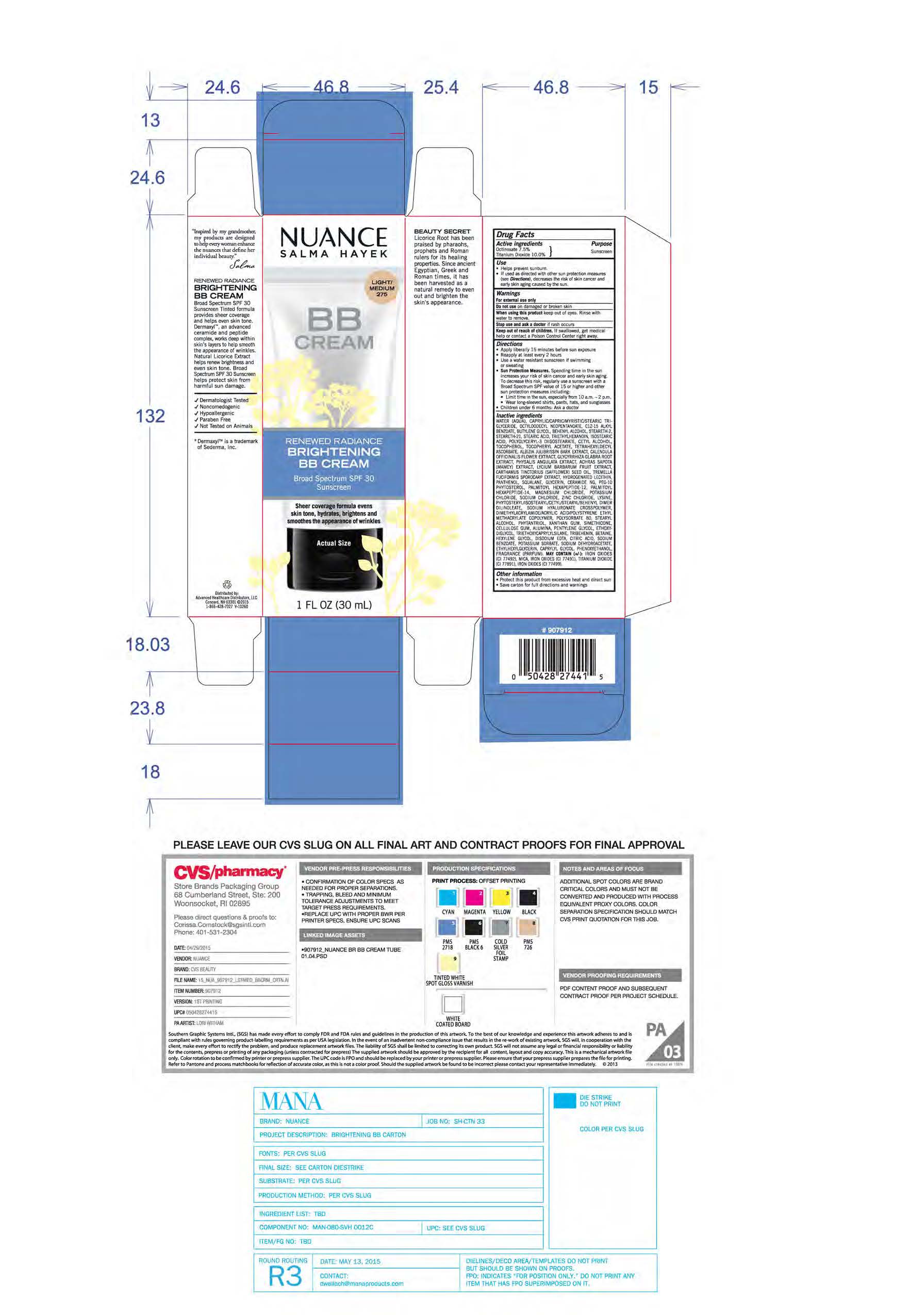
Nuance Salma Hayek Renewed Radiance Brightening BB Cream Broad Spectrum SPF 30 Sunscreen 7.5 g/100g; 10 g/100g Lotion, 30 g
🆔 Identity & classification
Where does this data come from?
🏭 Manufacturer & labeler
Where does this data come from?
🩺 Clinical
This is a topical lotion marketed as a cosmetic and over-the-counter sunscreen product under FDA's OTC monograph rules. It contains two active sunscreen ingredients: octinoxate and titanium dioxide, which are typically used as ultraviolet light filters to help protect skin from sun damage. The product is formulated as a tinted moisturizing cream (BB cream) and is labeled to provide broad spectrum sun protection with an SPF of 30.
Patient education
Supplement & herbal interactions
Where does this data come from?
Ask a licensed pharmacist directly — free, answered by our team.
🧪 Inactive Ingredients / Excipients
Inactive ingredients, also called excipients, are components of the drug product other than the active ingredient. They may include fillers, dyes, coatings, preservatives, flavors, or other formulation ingredients.
💡 Tap an ingredient (hover on desktop) to see what it is and why it’s used.
-
UNII 9E8X80D2L0
A synthetic form of vitamin E used as an antioxidant and preservative in medications. It helps prevent the active ingredients from degrading when exposed to oxygen or light.
-
UNII 0J9G6W44DV
A plant extract from the bark of the silk tree, used as a natural binding and thickening agent in some formulations to help hold ingredients together and add consistency to the medicine.
-
UNII XF417D3PSL
Anhydrous citric acid is a sour, crystalline powder derived from citric acid with water removed. In medicines, it acts as a buffer to control pH, adds tartness to improve taste, and helps tablets disintegrate.
-
UNII DQG8119XKJ
A waxy compound derived from behenic acid and benzoic acid. It serves as a lubricant and emollient in topical formulations, helping the medicine spread smoothly and improving texture.
-
UNII 3SCV180C9W
Betaine is a naturally occurring organic compound found in plants and animals. In medicines, it acts as an osmoprotectant and stabilizer, helping maintain the product's moisture balance and preserve its chemical stability during storage.
-
UNII 3XUS85K0RA
Butylene glycol is a clear liquid derived from petroleum or plants that acts as a humectant, solvent, and preservative booster in medicines. It helps keep formulations stable, dissolve active ingredients, and maintain moisture in topical products.
-
UNII GC844VRD7E
A synthetic fatty acid ester derived from plant oils and lactic acid. It acts as an emulsifier and solvent to help mix oil and water-based ingredients and improve how the medicine dissolves or spreads in the body.
-
UNII P0M7O4Y7YD
A plant extract from calendula flowers, traditionally used in formulations. It typically serves as a botanical ingredient that may provide color, fragrance, or skin-conditioning properties to topical products.
-
UNII ZF29F7IK5I
A blend of plant-derived fats that helps dissolve and deliver active ingredients. It acts as a solvent and carrier in liquid or soft capsule formulations, improving how the body absorbs certain drugs.
-
UNII 00YIU5438U
Caprylyl glycol is a clear liquid derived from coconut oil. In medicines, it acts as a humectant to retain moisture, a preservative booster to prevent microbial growth, and a solvent to help dissolve or mix other ingredients.
-
UNII SDQ136WIM5
A plant-derived oil extracted from safflower flowers, used as an emollient and lubricant in medications. It helps soften formulations and can improve how the product spreads or coats on skin or mucous membranes.
-
UNII 3J2P07GVB6
Cellulose acetate is a plant-derived polymer made by chemically modifying cellulose fibers. In medications, it serves as a film-coating material for tablets and capsules to protect the drug, control release, and improve appearance.
-
UNII C04977SRJ5
Ceramide NG is a naturally occurring lipid compound that helps form protective barriers in skin and cosmetic formulations. It functions as an emollient and skin-conditioning agent, helping products retain moisture and maintain smooth texture.
-
UNII 936JST6JCN
Cetyl alcohol is a waxy, fatty substance derived from plant or animal sources. It acts as an emulsifier and thickener in medicines, helping blend oil and water components and giving products a smooth, creamy texture.
-
UNII 6V475AX06U
A chelating agent derived from ethylenediaminetetraacetic acid (EDTA) combined with copper. It binds metals in formulations to prevent discoloration and degradation, helping preserve the medicine's stability and appearance.
-
UNII N76ISC4ZZO
Ethoxydiglycol behenate is a synthetic compound used as an emulsifier and solubilizer in medicines. It helps blend oil and water-based ingredients together and improves how the drug dissolves in the body.
-
UNII 147D247K3P
Ethylhexylglycerin is a synthetic preservative used to prevent bacteria and mold from growing in medicines and personal care products. It helps keep the product safe and stable throughout its shelf life.
-
UNII PDC6A3C0OX
Glycerin is a clear, thick liquid derived from plant oils or fats. It acts as a humectant to retain moisture, a sweetener, and a solvent in medications.
-
UNII 2788Z9758H
A plant extract from licorice root used as a sweetener, flavoring agent, and natural emulsifier in medicines. It helps improve taste and may aid in keeping ingredients evenly mixed throughout the product.
-
UNII KEH0A3F75J
Hexylene glycol is a clear liquid alcohol used as a solvent and preservative in medicines. It helps dissolve other ingredients and keeps the product stable during storage.
-
UNII H1109Z9J4N
A natural emulsifier derived from soybean oil. It helps mix oil and water-based ingredients together, ensuring even distribution of active ingredients throughout the medicine.
-
UNII X33R8U0062
Isostearic acid is a fatty acid derived from vegetable oils. It acts as an emulsifier and lubricant in medicines, helping blend ingredients together and reducing friction during tablet or capsule manufacturing.
-
UNII 930626MWDL
A plant extract from goji berries used as a natural coloring agent and flavor enhancer in medicines. It may add color and taste while serving as a source of beneficial plant compounds in the formulation.
-
UNII K3Z4F929H6
Lysine is an amino acid that serves as a buffer and pH regulator in medications. It helps maintain the medicine's stability and proper acidity level during storage and use.
-
UNII 02F3473H9O
A mineral salt used in medications as a source of magnesium. It helps bind ingredients together, improve texture, and maintain the product's stability during storage.
-
UNII AS46JK7Q6I
A synthetic polymer used as a film-forming agent and binder in medications. It helps create protective coatings on tablets or capsules and improves how ingredients stick together in solid dosage forms.
-
UNII X8725R883T
A synthetic oily liquid derived from branched carboxylic acids, used as an emollient and skin-conditioning agent in topical formulations. It helps soften and smooth the product's texture while improving how it spreads on skin.
-
UNII HO4ZT5S86C
A synthetic peptide derived from amino acids, used as a skin-conditioning agent and emollient in topical formulations to help soften and smooth the skin surface.
-
UNII WV9CM0O67Z
Panthenol is a humectant and skin-conditioning agent derived from pantothenic acid. It's added to medicines to help retain moisture and soothe skin irritation.
-
UNII K9X3A45CI6
A plant-derived compound mixed with polyethylene glycol, a water-soluble polymer. It acts as an emulsifier and solubilizer to help keep oil and water-based ingredients mixed together in the medicine.
-
UNII 788QAG3W8A
A synthetic polymer that combines polyethylene glycol, glycidyl ether, and sodium hyaluronate. It acts as a thickener and film-former in topical products, helping maintain texture and improve how the medicine spreads on skin.
-
UNII 50C1307PZG
Pentylene glycol is a humectant and preservative helper derived from petroleum or plant sources. It draws moisture into the product and helps prevent bacterial growth, keeping medicines stable during storage.
-
UNII HIE492ZZ3T
Phenoxyethanol is a synthetic preservative and antimicrobial agent used to prevent bacterial and fungal growth in medicines and cosmetic products, extending shelf life and maintaining product safety.
-
UNII W4TKW9D5GG
Physalis angulata is a plant extract used as a natural flavoring or coloring agent in some medicines. It may also serve as a botanical ingredient to support the product's formulation.
-
UNII 8LVI07A72W
Phytantriol is a branched-chain alcohol derived from plant sources. It acts as an emulsifier and solvent in formulations, helping mix oil and water-based ingredients together.
-
UNII 46P231IQV8
A synthetic emulsifier derived from glycerin and fatty acids. It helps blend oil and water-based ingredients together in cosmetic and pharmaceutical formulations to create stable, uniform products.
-
UNII 6OZP39ZG8H
Polysorbate 80 is a synthetic emulsifier derived from sorbitol and oleic acid. It helps mix oil and water-based ingredients together in medications and improves how the product disperses in the body.
-
UNII 660YQ98I10
Potassium chloride is a mineral salt used in medicines as a buffer and to help maintain the proper pH balance and stability of the formulation during storage and use.
-
UNII 1VPU26JZZ4
Potassium sorbate is a salt derived from sorbic acid, a naturally occurring preservative. It prevents growth of mold, yeast, and some bacteria, extending the medicine's shelf life.
-
UNII OJ245FE5EU
Sodium benzoate is a salt derived from benzoic acid, a preservative. It's added to medicines to prevent growth of bacteria, fungi, and other microorganisms that could spoil the product.
-
UNII 451W47IQ8X
Sodium chloride is common table salt. It's used in medicines as a buffer to maintain proper pH, as a filler to add bulk, or to adjust the osmotic balance in liquid formulations.
-
UNII 8W46YN971G
Sodium dehydroacetate is a salt derived from dehydroacetic acid, a compound used as a preservative. It helps prevent mold, bacteria, and yeast growth in medicines, extending shelf life and maintaining product safety.
-
UNII GW89575KF9
Squalane is a lightweight oil derived from plant sources or synthesized. It acts as an emollient and lubricant in formulations, helping ingredients blend smoothly and improving product texture and spreadability.
-
UNII V56DFE46J5
Steareth-2 is a synthetic emulsifier made from stearic acid and ethylene oxide. It helps mix oil and water-based ingredients together in the formulation and may improve how the medicine spreads or dissolves.
-
UNII 53J3F32P58
A synthetic detergent derived from stearic acid, a fatty substance. It helps dissolve or distribute oil-based ingredients evenly throughout the medicine, acting as an emulsifier and solubilizer in tablets and capsules.
-
UNII 4ELV7Z65AP
Stearic acid is a fatty acid derived from plant or animal sources. It acts as a binder and lubricant in tablets and capsules, helping them hold together and flow smoothly during manufacturing.
-
UNII 2KR89I4H1Y
Stearyl alcohol is a waxy, fatty substance derived from natural oils or made synthetically. It acts as an emulsifier and thickener in medicines, helping mix ingredients together and give the product the right texture.
-
UNII 9LBV3F07AZ
A synthetic, oil-soluble form of vitamin C used as an antioxidant to prevent degradation of the medicine and maintain its stability during storage.
-
UNII R0ZB2556P8
Tocopherol is a form of vitamin E derived from plant oils. It acts as an antioxidant in medicines to prevent oils and fats from breaking down and spoiling during storage.
-
UNII 4938BNS0GU
A fungal extract from tremella fuciformis, a jelly-like mushroom. It acts as a thickener, emulsifier, and skin-conditioning agent in topical formulations to improve texture and moisture retention.
-
UNII 8OC9U7TQZ0
Tribehenin is a waxy, plant-derived substance that acts as a lubricant and glidant in tablets and capsules. It helps the medicine flow smoothly during manufacturing and prevents sticking during production and packaging.
-
UNII LDC331P08E
A silicone-based compound that acts as a glidant and flow agent in solid medications. It reduces friction between powder particles, helping the medicine flow smoothly during manufacturing and tablet compression.
-
UNII 7K3W1BIU6K
A synthetic oil derived from glycerin and hexanoic acid. It acts as an emollient and lubricant in topical formulations to soften skin and improve product spreadability.
-
UNII 059QF0KO0R
Water is a liquid solvent that dissolves and mixes ingredients together in liquid medicines, syrups, and injections. It helps distribute the active drug evenly throughout the product.
-
UNII TTV12P4NEE
Xanthan gum is a thickening and stabilizing ingredient made from fermented corn or other sugars. It's added to medicines to improve texture, prevent separation of liquids and solids, and help the product stay consistent.
-
UNII 86Q357L16B
Zinc chloride is a mineral salt used as a buffer and pH regulator in medications. It helps maintain the chemical stability and proper acidity level of the drug formulation.
56 inactive ingredients listed in the exact product block matched to this NDC.
Label-section wording can be broader than the structured product block and may mention additional formulation ingredients.
Where does this data come from?
ingredient classCode="IACT" elements from the exact product block matched by this NDC. Label-section narrative from DailyMed / the openFDA label index is shown separately when available.Inactive ingredient FAQ
Are inactive ingredients the same for every manufacturer?
Why might an inactive ingredient be missing?
Can inactive ingredients matter?
💲 Pricing
A drug doesn't have one price. Each row is a different public payment system, and none is what you'd pay at the counter — that depends on your insurance. The ⓘ on each row explains what it measures.
| Price system | Per g | Per package |
|---|---|---|
| Retail pharmacies payNADAC · weekly | Not in the retail survey — common for institutional, discontinued, or low-volume packs. | |
| Medicaid paysCMS SDUD · 12 mo | No recent Medicaid claims on file for this NDC — rare and low-volume NDCs are suppressed in the public data. | |
| Medicare drug plans payPart D · quarterly | No Part D plan price is available for this NDC in our data. | |
Where does this data come from?
🔁 Therapeutic equivalents
| Product | Labeler | Pack | NADAC/unit | TE | Status | Price vs. this |
|---|---|---|---|---|---|---|
| Nuance Salma Hayek Renewed Radiance Brightening BB Cream Broad Spectrum SPF 30 Sunscreen 7.5 g/100g; 10 g/100gthis 59735-0140-01 | Mana | 30 g | — | — | FDA listed | — |
| Nuance Salma Hayek Renewed Radiance Brightening BB Cream Broad Spectrum SPF 30 Sunscreen 7.5 g/100g; 10 g/100g 69842-0801-01 | CVS | 30 g | — | — | FDA listed | — |
Where does this data come from?
⏳ Availability & generic status
We did not find an FDA-approved generic match for this exact strength, form and route.
Where does this data come from?
📦 Packaging — all sizes for this product
| Package NDC | Description | Marketing start | Status |
|---|---|---|---|
| 59735-0140-01 You're viewing this | 30 g in 1 TUBE (59735-140-01) | 2016-09-08 | Active |
🧭 About this NDC listing & data coverage
What data is (and isn’t) available for this NDC — tap to expand
| NDC identity (package / product / labeler codes) | ✓ Available |
| Labeler | ✓ Available |
| Product & package description | ✓ Available |
| Marketing category & status | ✓ Available |
| Active ingredient / dosage form / route | ✓ Available |
| FDA label (SPL via DailyMed) | ✓ Available |
| Package photos | ✓ Available |
| Inactive ingredients (structured) | ✓ Available |
| NADAC pharmacy acquisition price (CMS) | — Not published for this NDC CMS publishes NADAC only for NDCs reported in its retail-pharmacy survey. |
| Orange Book / therapeutic-equivalence data | — Not published for this NDC Applies only to products approved under an NDA/ANDA; many listings are out of scope. |
| HCPCS J-code billing crosswalk | — Not published for this NDC Most self-administered / retail products have no J-code — that is normal. |
| Medicaid utilization (CMS SDUD) | — Not published for this NDC CMS reports utilization only for NDCs with Medicaid claims above its privacy threshold. |
Questions about this listing
Is this NDC FDA-approved?
Why is there no price listed?
Is the NDC printed on the package the same as the 11-digit billing NDC?
What do the three segments of this NDC mean?
Is this package still being marketed?
Who lists this product with the FDA?
Do I need a prescription for this product?
Where does this data come from?
📄 FDA label — Drug Facts FDA SPL
🎯 Indications and Usage ▾
Use Helps prevent sunburn. If used as directed with other sun protection measures (see Directions), decreases the risk of skin cancer and early skin aging caused by the sun.
⏱️ Dosage and Administration ▾
Directions Apply liberally 15 minutes before sun exposure Reapply at least every 2 hours Use water resistant sunscreen if swimming or sweathing Sun Protection Measures: Spending time in the sun decreases risk of skin cancer and early again. To decrease this risk, regulaory use a sunscreen with a Broad Spectrum SPF value of 15 or higher and other sun protection measures including: Limit time in the sun especially from 10:00 am - 2:00 pm. Wear long sleeved shirts, pants, hats and sunglasses.
Children under 6 months: ask a doctor
⚠️ Warnings and Cautions ▾
Warnings For external use only Do not use on damaged or broken skin When using this product keep out of eyes. Rinse with water to remove. Stop use and ask a docor if rash occurs Keep out of reach of children. If swalled, get medical help or contact a Poison Control Center right away.
🧪 Active Ingredient ▾
Active Ingredients Octinoxate 7.50% Titanium Dioxide 10%
🧪 Inactive Ingredients ▾
Inactive Ingredients WATER (AQUA), CAPRYLIC./CAPRIC/MYRISTIC/STEARIC TRIGLYCERIDE, OCTYLDODECYL NEOPENTANOATE, Cl2-15 ALKYL BENZOATE, BUffiENE GLYCOL, BEHENYL ALCOHOL, STEARETH-2, STEARETH-21, STEARIC ACID, TRIETHYLHEXANOIN, ISOSTEARIC ACID, POLYGLYCERYL-3 DIISOSTEARATE, CETYL ALCOHOL, TOCOPHEROL, TOCOPHERYL ACETATE, TETRAHEXYLOECYL ASCORBATE, ALBIZIA JULIBRISSIN BARK EXTRACT, CALENDULA OFFICINALIS FLOWER EXTRACT, GLYCYRRHIZA GLABRA ROOT EXTRACT, PHYSALIS ANGULATA EXTRACT, ACHRAS SAPOTA (MAMEY) EXTRACT, LYCIUM BARBARUM FRUIT EXTRACT, CARTHAMUS TINCTORIUS (SAFFLOWER) SEED OIL, TREMELLA FUCIFORMIS SPOROCARP EXTRACT, HYDROGENATED LECITH IN, PANTHENOL, SQUALANE, GLYCERIN, CERAMIDE NG, PEG-10 PHYTOSTEROL, PALMITOYL HEXAPEPTIDE-12, PALMITOYL HEXAPEPTIDE-14, MAGNESIUM CHLORIDE, POTASSIUM CHLORIDE, SODIUM CHLORIDE, ZINC CHLORIDE, LYSINE, PHYTDSTERYUISOSTEARYL/CETYUSTEARYUBEHENYL DIMER DILINOLEATE, SODIUM HYALURONATE CROSSPOLYMER, DIMETHYLACRYLAMIDE/ACRYLIC ACID/POLYSTYRENE ETHYL METHACRYLATE COPOLYMER, POLYSORBATE 80, STEARYL ALCOHOL, PHYTANTRIOL, XANTHAN GUM, SIMETHICONE, CELLULOSE GUM, ALUMINA, PENTYLENE GLYCOL, ETHOXYDIGLYCOL, TRIETHOXYCAPRYLYLSILANE, TRIBEHEN IN, BETAINE, HEXYLENE GLYCOL, DISODIUM EDTA, CITRIC ACID, SODIUM BENZOATE, POTASSIUM SORBATE, SODIUM DEHYDROACETATE, ETHYLHEXYLGLYCERIN, CAPRYLYL GLYCOL, PHENOXYETHANOL, FRAGRANCE (PARFUM).
MAY CONTAIN C+/·l: IRON OXIDES (Cl 77492), MICA, IRON OXIDES (Cl 77491), TITANIUM DIOXIDE (Cl 77891), IRON OXIDES (Cl 77499).