
Silver Sulfadiazine 10 mg/g Cream — NDC 59762-0131-0 (Billing 59762-0131-00)
This is a package of Silver Sulfadiazine 10 mg/g Cream from Mylan Pharmaceuticals Inc., marketed since Jan 2018 and currently FDA-listed; retail pharmacies pay about $0.4072 per g (NADAC).
NDC database record
One package, one record: these facts belong to NDC 59762-0131-0 alone.
- Record
- FDA NDC Directory package listing · Human prescription drug
- Code segments
- 59762 labeler · 0131 product · 0 package
- Package marketed since
- Feb 9, 2018
- Sample package
- No — commercial package
- Listing certified through
- Dec 31, 2026
- Barcode (UPC-A, from the NDC)
- 3 5976201310 1
- Medicaid fills, this package
- 839 prescriptions in the last four reported quarters
- FDA record last changed
- Jul 24, 2026
Identity & classification
Regulatory identifiers FDA, NLM and CMS codes for this package
Drug-database identifiers Medi-Span GPI and First Databank GCN / HICL / AHFS classification
- GSN (GCN sequence number): 007669
- GCN: 31630
- GPI-14 (Medi-Span): 90450030003710
- HICL (First Databank): 003347
- AHFS class code: 84:04.16.00
- RxCUI (RxNorm): 106351
Where does this data come from?
- FDA openFDA NDC Directory · synced Oct 1, 2026
- FDA label on DailyMed · label index refreshed Oct 6, 2026
- RxNorm (NLM RxNav) · catalog refreshed Oct 1, 2026
- Medi-Span GPI (licensed)
- First Databank (licensed) · refreshed Oct 1, 2026
RxNorm drug class
This medicine belongs to the Sulfonamide Antibacterial class.
Where does this data come from?
- RxClass (NLM) · catalog refreshed Oct 1, 2026
Clinical
Silver sulfadiazine, a sulfa drug, is used to prevent and treat infections of second- and third-degree burns. It kills a wide variety of bacteria. This medication is sometimes prescribed for other uses; ask your doctor or pharmacist for more information.
Read the full MedlinePlus article ↗- It is used along with other burn care to help prevent and treat serious infection in second- and third-degree burns. It is a topical antimicrobial that goes on the skin only.
- The burn is cleaned first, and then the cream is applied under sterile conditions in a thin layer, usually once or twice a day. Keep the burn covered with cream and reapply if it r...
- Some people notice burning, rash or skin color changes. Your white blood cell count can also dip temporarily, usually in the first few days. Call your doctor if you notice anything...
- Get help for widespread rash, blistering or peeling skin, or signs of a serious allergic reaction. Also report unusual bruising or bleeding, frequent infections, or signs of liver...
Patient education
Supplement & herbal interactions
Some supplements/herbs that may interact with Silver Sulfadiazine — tap one for details:
Where does this data come from?
- MedlinePlus (NLM) · refreshed Oct 1, 2026
- FDA label on DailyMed · label index refreshed Oct 6, 2026
Ask a licensed pharmacist directly — free, answered by our team.
Pricing
A drug doesn't have one price. Each row is a different public payment system, and none is what you'd pay at the counter — that depends on your insurance. The ⓘ on each row explains what it measures.
| Price system | Per g | Per package |
|---|---|---|
| Retail pharmacies payNADAC · weekly | $0.407 | $8.14 / 20 g |
| Medicaid paysCMS SDUD · 12 mo | $0.4751 | $9.50 / 20 g |
| Medicare drug plans payPart D · Q2 2026 | $0.2091 | $4.18 / 20 g |
Where does this data come from?
- CMS NADAC weekly file · file of Sep 30, 2026
- CMS ASP pricing files · refreshed Sep 20, 2026
- CMS Medicaid State Drug Utilization Data · through Q1 2026
- CMS Part D plan pricing files · refreshed Sep 24, 2026
- VA National Acquisition Center price file
Packaging — all sizes for this product
| Package NDC | Description | Per unit | Per pack | Marketing start | Marketing end | Status |
|---|---|---|---|---|---|---|
| 59762-0131-00 You're viewing this | 1 TUBE in 1 CARTON / 20 g in 1 TUBE | $0.4072 / g | $8.14 | 2018-02-09 | — | Active |
| 59762-0131-02 59762-0131-2 | 1 TUBE in 1 CARTON / 25 g in 1 TUBE | $0.3177 / g | $7.94 | 2018-02-09 | — | Active |
| 59762-0131-04 59762-0131-4 | 400 g in 1 JAR | $0.1278 / g | $51.12 | 2018-01-16 | — | Active |
| 59762-0131-05 59762-0131-5 | 1 TUBE in 1 CARTON / 50 g in 1 TUBE | $0.2596 / g | $12.98 | 2018-01-16 | — | Active |
| 59762-0131-06 59762-0131-6 Main listing | 50 g in 1 JAR | $0.2596 / g | $12.98 | 2018-01-16 | — | Active |
| 59762-0131-08 59762-0131-8 | 1 TUBE in 1 CARTON / 85 g in 1 TUBE | $0.2609 / g | $22.18 | 2018-01-16 | — | Active |
Per g, this pack runs about 219% above the cheapest pack (400 g, $0.1278 vs $0.4072 NADAC).
This pack accounts for about 10% of this product's recent Medicaid fills; the largest share goes to the 50 g pack. See all packs ↓
Pack size FAQ
What quantity is in this package?
What NDC number is used to bill for this package of Silver Sulfadiazine 10 mg/g Cream?
Prices are the latest CMS NADAC pharmacy acquisition cost per NDC; per-pack figures are per-unit × pack quantity, shown only when the pack is denominated in the same measure NADAC prices.
Therapeutic equivalents
| Product | Labeler | Pack | NADAC/unit | TE | Status | Price vs. this |
|---|---|---|---|---|---|---|
| Silver sulfadiazine 10 mg/g 67877-0124-05 | Ascend | 50 g | $0.260 | AB | Availability likely | save 36% |
| SSD Cream 10 g/1000g 43598-0210-25 | Dr | 25 g | $0.318 | AB | Availability likely | save 22% |
| Silver Sulfadiazine 10 mg/gthis 59762-0131-00 | Mylan | 1 tube | $0.407 | AB | Availability likely | — |
| Silvadene 10 mg/g 61570-0131-20 | Pfizer | 1 tube | $0.433 | AB | Availability likely | +6% |
| Silvadene 10 mg/g 50090-0230-00 | A-S | 1 tube | — | AB | FDA listed | — |
| Silver Sulfadiazine 10 mg/g 50090-0607-00 | A-S | 50 g | — | AB | FDA listed | — |
| Silver Sulfadiazine 10 mg/g 50090-0717-00 | A-S | 50 g | — | AB | FDA listed | — |
| Silver Sulfadiazine 10 mg/g 50090-0763-00 | A-S | 25 g | — | AB | FDA listed | — |
| Silver Sulfadiazine 10 mg/g 50090-2152-00 | A-S | 400 g | — | AB | FDA listed | — |
| Ssd 10 g/1000g 50090-7447-00 | A-S | 50 g | — | AB | FDA listed | — |
| SSD Cream 10 g/1000g 60760-0962-50 | St. | 50 g | — | AB | FDA listed | — |
| Silver Sulfadiazine 10 g/1000g 61919-0237-25 | DIRECT | 25 g | — | AB | FDA listed | — |
| Silver Sulfadiazine 10 mg/g 63187-0023-25 | Proficient | 25 g | — | AB | FDA listed | — |
| Silver Sulfadiazine 10 mg/g 63629-8768-01 | Bryant | 20 g | — | AB | Discontinued | — |
| Silver Sulfadiazine 10 mg/g 63629-8769-01 | Bryant | 25 g | — | AB | Discontinued | — |
| Silver Sulfadiazine 10 mg/g 63629-8770-01 | Bryant | 50 g | — | AB | Discontinued | — |
| Silver Sulfadiazine 10 mg/g 63629-8771-01 | Bryant | 50 g | — | AB | Discontinued | — |
| Silver Sulfadiazine 10 mg/g 63629-8772-01 | Bryant | 85 g | — | AB | Discontinued | — |
| Silver Sulfadiazine 10 mg/g 63629-8773-01 | Bryant | 400 g | — | AB | Discontinued | — |
| Silver Sulfadiazine 10 g/1000g 68071-2473-05 | NuCare | 50 g | — | AB | FDA listed | — |
| SSD Cream 10 g/1000g 68071-3867-05 | NuCare | 50 g | — | AB | FDA listed | — |
| Thermazene Silver Sulfadiazine 10 mg/g 68788-0600-02 | Preferred | 25 g | — | AB | FDA listed | — |
| SSD Cream 10 g/1000g 68788-8074-02 | Preferred | 25 g | — | AB | FDA listed | — |
| Silver Sulfadiazine 10 g/1000g 76420-0208-25 | Asclemed | 25 g | — | AB | FDA listed | — |
| Silver Sulfadiazine 10 mg/g 80425-0221-01 | Advanced | 50 g | — | AB | FDA listed | — |
| Silver Sulfadiazine 10 mg/g 87063-0078-05 | Asclemed | 50 g | — | AB | FDA listed | — |
Where does this data come from?
- FDA openFDA NDC Directory · synced Oct 1, 2026
- FDA Orange Book · refreshed Oct 3, 2026
- CMS NADAC weekly file · file of Sep 30, 2026
Availability & generic status
We did not find an FDA-approved generic match for this exact strength, form and route.
Where does this data come from?
- FDA Orange Book · refreshed Oct 3, 2026
Inactive Ingredients / Excipients
Inactive ingredients, also called excipients, are components of the drug product other than the active ingredient. They may include fillers, dyes, coatings, preservatives, flavors, or other formulation ingredients.
🧪 Avoiding an ingredient? See Silver Sulfadiazine inactive ingredients by manufacturer: every current product's list side by side, so you can ask your pharmacy for the version that does not list it.
Where does this data come from?
IACT rows and label-wide narrative are kept separate; availability and product-level specificity depend on the submitted label.- FDA label on DailyMed · label index refreshed Oct 6, 2026
- FDA openFDA NDC Directory · synced Oct 1, 2026
Inactive ingredient FAQ
Are inactive ingredients the same for every manufacturer?
Why might an inactive ingredient be missing?
Can inactive ingredients matter?
Manufacturer & labeler
More NDCs from Mylan Pharmaceuticals Inc. labeler code 59762
- Alprazolam XR 3 mg Tablet, Extended Release NDC 59762-0068-1
- Hydrocortisone 5 mg Tablet NDC 59762-0073-1
- Hydrocortisone 10 mg Tablet NDC 59762-0074-1
- Hydrocortisone 20 mg Tablet NDC 59762-0075-1
- Sulfasalazine 500 mg Tablet, Delayed Release NDC 59762-0104-1
- phenelzine sulfate 15 mg Tablet, Film Coated NDC 59762-0119-1
- Tolterodine Tartrate 1 mg Tablet, Film Coated NDC 59762-0170-1
- Colestipol Hydrochloride 5 g/5g Granule, For Suspension NDC 59762-0260-1
- Latanoprost 50 ug/mL Solution NDC 59762-0333-2
- Disopyramide Phosphate 100 mg Capsule, Gelatin Coated NDC 59762-0386-1
- Disopyramide Phosphate 150 mg Capsule, Gelatin Coated NDC 59762-0400-1
- Sucralfate 1 g Tablet NDC 59762-0401-1
Where does this data come from?
- FDA openFDA NDC Directory · synced Oct 1, 2026
- Drugs@FDA
Full prescribing information FDA SPL
🎯 Indications and Usage ▾
INDICATIONS AND USAGE Silver Sulfadiazine Cream 1% is a topical antimicrobial drug indicated as an adjunct for the prevention and treatment of wound sepsis in patients with second- and third-degree burns.
⏱️ Dosage and Administration ▾
DOSAGE AND ADMINISTRATION Prompt institution of appropriate regimens for care of the burned patient is of prime importance and includes the control of shock and pain. The burn wounds are then cleansed and debrided, and silver sulfadiazine cream 1% is applied under sterile conditions. The burn areas should be covered with silver sulfadiazine cream 1% at all times.
The cream should be applied once to twice daily to a thickness of approximately 1/16 inch. Whenever necessary, the cream should be reapplied to any areas from which it has been removed by patient activity. Administration may be accomplished in minimal time because dressings are not required.
However, if individual patient requirements make dressings necessary, they may be used. Reapply immediately after hydrotherapy. Treatment with silver sulfadiazine cream 1% should be continued until satisfactory healing has occurred, or until the burn site is ready for grafting.
The drug should not be withdrawn from the therapeutic regimen while there remains the possibility of infection except if a significant adverse reaction occurs.
⛔ Contraindications ▾
CONTRAINDICATIONS Silver Sulfadiazine Cream 1% is contraindicated in patients who are hypersensitive to silver sulfadiazine or any of the other ingredients in the preparation. Because sulfonamide therapy is known to increase the possibility of kernicterus, silver sulfadiazine cream 1% should not be used on pregnant women approaching or at term, on premature infants, or on newborn infants during the first 2 months of life.
⚠️ Warnings ▾
WARNINGS Absorption of silver sulfadiazine varies depending upon the percent of body surface area and the extent of the tissue damage. Although few have been reported, it is possible that any adverse reaction associated with sulfonamides may occur. Some of the reactions, which have been associated with sulfonamides, are as follows: blood dyscrasias including agranulocytosis, aplastic anemia, thrombocytopenia, leukopenia, and hemolytic anemia; dermatologic and allergic reactions, including life-threatening cutaneous reactions [Stevens-Johnson syndrome (SJS), toxic epidermal necrolysis (TEN) and exfoliative dermatitis]; gastrointestinal reactions; hepatitis and hepatocellular necrosis; CNS reactions; and toxic nephrosis.
There is potential cross-sensitivity between silver sulfadiazine and other sulfonamides. If allergic reactions attributable to treatment with silver sulfadiazine occur, continuation of therapy must be weighed against the potential hazards of the particular allergic reaction. Fungal proliferation in and below the eschar may occur.
However, the incidence of clinically reported fungal superinfection is low. The use of silver sulfadiazine cream 1% in some cases of glucose-6-phosphate dehydrogenase-deficient individuals may be hazardous, as hemolysis may occur.
🤒 Adverse Reactions ▾
ADVERSE REACTIONS Several cases of transient leukopenia have been reported in patients receiving silver sulfadiazine therapy. 1,2,3 Leukopenia associated with silver sulfadiazine administration is primarily characterized by decreased neutrophil count. Maximal white blood cell depression occurs within 2 to 4 days of initiation of therapy.
Rebound to normal leukocyte levels follows onset within 2 to 3 days. Recovery is not influenced by continuation of silver sulfadiazine therapy. An increased incidence of leukopenia has been reported in patients treated concurrently with cimetidine.
Other infrequently occurring events include skin necrosis, erythema multiforme, skin discoloration, burning sensation, rashes, and interstitial nephritis. Reduction in bacterial growth after application of topical antibacterial agents has been reported to permit spontaneous healing of deep partial-thickness burns by preventing conversion of the partial thickness to full thickness by sepsis. However, reduction in bacterial colonization has caused delayed separation, in some cases necessitating escharotomy in order to prevent contracture.
🤰 Pregnancy ▾
Pregnancy Teratogenic Effects. A reproductive study has been performed in rabbits at doses up to three to ten times the concentration of silver sulfadiazine in silver sulfadiazine cream 1% and has revealed no evidence of harm to the fetus due to silver sulfadiazine. There are, however, no adequate and well-controlled studies in pregnant women.
Because animal reproduction studies are not always predictive of human response, this drug should be used during pregnancy only if clearly justified, especially in pregnant women approaching or at term (see CONTRAINDICATIONS ).
🧒 Pediatric Use ▾
Pediatric Use Safety and effectiveness in pediatric patients have not been established (see CONTRAINDICATIONS ).
🧓 Geriatric Use ▾
Geriatric Use Of the total number of subjects in clinical studies of silver sulfadiazine cream 1%, seven percent were 65 years of age and over. No overall differences in safety or effectiveness were observed between these subjects and younger subjects, and other reported clinical experience has not identified differences in responses between the elderly and younger patients, but greater sensitivity of some older individuals cannot be ruled out.
🧬 Clinical Pharmacology ▾
CLINICAL PHARMACOLOGY Silver sulfadiazine has broad antimicrobial activity. It is bactericidal for many gram-negative and gram-positive bacteria as well as being effective against yeast. Results from in vitro testing are listed below.
Sufficient data have been obtained to demonstrate that silver sulfadiazine will inhibit bacteria that are resistant to other antimicrobial agents and that the compound is superior to sulfadiazine. Studies utilizing radioactive micronized silver sulfadiazine, electron microscopy, and biochemical techniques have revealed that the mechanism of action of silver sulfadiazine on bacteria differs from silver nitrate and sodium sulfadiazine. Silver sulfadiazine acts only on the cell membrane and cell wall to produce its bactericidal effect.
Results of In Vitro Testing with Silver Sulfadiazine Cream 1% Concentration of Silver Sulfadiazine Number of Sensitive Strains/Total Number of Strains Tested Genus & Species 50 μg/mL 100 μg/mL Pseudomonas aeruginosa 130/130 130/130 Xanthomonas (Pseudomonas) maltophilia 7/7 7/7 Enterobacter species 48/50 50/50 Enterobacter cloacae 24/24 24/24 Klebsiella species 53/54 54/54 Escherichia coli 63/63 63/63 Serratia species 27/28 28/28 Proteus mirabilis 53/53 53/53 Morganella morganii 10/10 10/10 Providencia rettgeri 2/2 2/2 Providencia species 1/1 1/1 Proteus vulgaris 2/2 2/2 Citrobacter species 10/10 10/10 Acinetobacter calcoaceticus 10/11 11/11 Staphylococcus aureus 100/101 100/101 Staphylococcus epidermidis 51/51 51/51 β-Hemolytic Streptococcus 4/4 4/4 Enterococcus species 52/53 53/53 Corynebacterium- diphtheriae 2/2 2/2 Clostridium perfringens 0/2 2/2 Candida albicans 43/50 50/50 Silver sulfadiazine is not a carbonic anhydrase inhibitor and may be useful in situations where such agents are contraindicated.
📦 How Supplied / Storage and Handling ▾
HOW SUPPLIED Silver Sulfadiazine Cream 1% is available in jars containing 50 g ( NDC 59762-0131-6) and 400 g ( NDC 59762-0131-4), and tubes containing 20 g ( NDC 59762-0131-0), 25 g ( NDC 59762-0131-2), 50 g ( NDC 59762-0131-5) and 85 g ( NDC 59762-0131-8). Store at Controlled Room Temperature 20° to 25°C (68° to 77°F).
📦 Storage and Handling ▾
Store at Controlled Room Temperature 20° to 25°C (68° to 77°F).
📋 Description ▾
DESCRIPTION Silver Sulfadiazine Cream 1% is a soft, white, water-miscible cream containing the antimicrobial agent silver sulfadiazine in micronized form, which has the following structural formula: Each gram of silver sulfadiazine cream 1% contains 10 mg of micronized silver sulfadiazine. The cream vehicle consists of white petrolatum, stearyl alcohol, isopropyl myristate, sorbitan monooleate, polyoxyl 40 stearate, propylene glycol, and water, with methylparaben 0.3% as a preservative. Silver Sulfadiazine Cream 1% spreads easily and can be washed off readily with water.
Chemical Structure
⚠️ Precautions ▾
PRECAUTIONS General If hepatic and renal functions become impaired and elimination of drug decreases, accumulation may occur, and discontinuation of silver sulfadiazine cream 1% should be weighed against the therapeutic benefit being achieved. In considering the use of topical proteolytic enzymes in conjunction with silver sulfadiazine cream 1%, the possibility should be noted that silver may inactivate such enzymes. Silver Sulfadiazine Cream 1% is for topical use only.
Avoid contact of silver sulfadiazine cream 1% with the eye. Laboratory Tests In the treatment of burn wounds involving extensive areas of the body, the serum sulfa concentrations may approach adult therapeutic levels (8 mg% to 12 mg%). Therefore, in these patients it would be advisable to monitor serum sulfa concentrations.
Renal function should be carefully monitored and the urine should be checked for sulfa crystals. Absorption of the propylene glycol vehicle has been reported to affect serum osmolality, which may affect the interpretation of laboratory tests. Carcinogenesis, Mutagenesis, Impairment of Fertility Long-term dermal toxicity studies of 24 months' duration in rats and 18 months' in mice with concentrations of silver sulfadiazine three to ten times the concentration in silver sulfadiazine cream 1% revealed no evidence of carcinogenicity.
Pregnancy Teratogenic Effects. A reproductive study has been performed in rabbits at doses up to three to ten times the concentration of silver sulfadiazine in silver sulfadiazine cream 1% and has revealed no evidence of harm to the fetus due to silver sulfadiazine. There are, however, no adequate and well-controlled studies in pregnant women.
Because animal reproduction studies are not always predictive of human response, this drug should be used during pregnancy only if clearly justified, especially in pregnant women approaching or at term (see CONTRAINDICATIONS ). Nursing Mothers It is not known whether silver sulfadiazine is excreted in human milk. However, sulfonamides are known to be excreted in human milk, and all sulfonamide derivatives are known to increase the possibility of kernicterus.
Because of the possibility for serious adverse reactions in nursing infants from sulfonamides, a decision should be made whether to discontinue nursing or to discontinue the drug, taking into account the importance of the drug to the mother. Geriatric Use Of the total number of subjects in clinical studies of silver sulfadiazine cream 1%, seven percent were 65 years of age and over. No overall differences in safety or effectiveness were observed between these subjects and younger subjects, and other reported clinical experience has not identified differences in responses between the elderly and younger patients, but greater sensitivity of some older individuals cannot be ruled out.
Pediatric Use Safety and effectiveness in pediatric patients have not been established (see CONTRAINDICATIONS ).
🍼 Nursing Mothers ▾
Nursing Mothers It is not known whether silver sulfadiazine is excreted in human milk. However, sulfonamides are known to be excreted in human milk, and all sulfonamide derivatives are known to increase the possibility of kernicterus. Because of the possibility for serious adverse reactions in nursing infants from sulfonamides, a decision should be made whether to discontinue nursing or to discontinue the drug, taking into account the importance of the drug to the mother.
📄 Carcinogenesis, Mutagenesis, Impairment of Fertility ▾
Carcinogenesis, Mutagenesis, Impairment of Fertility Long-term dermal toxicity studies of 24 months' duration in rats and 18 months' in mice with concentrations of silver sulfadiazine three to ten times the concentration in silver sulfadiazine cream 1% revealed no evidence of carcinogenicity.
📚 References ▾
REFERENCES 1. Caffee F, Bingham H. Leukopenia and silver sulfadiazine. J Trauma. 1982;22: 586–587. 2. Jarret F, Ellerbe S, Demling R. Acute leukopenia during topical burn therapy with silver sulfadiazine. Amer J Surg. 1978;135:818–819. 3. Kiker RG, Carvajal HF, Micak RP, Larson DL. A controlled study of the effects of silver sulfadiazine on white blood cell counts in burned children. J Trauma. 1977; 17:835–836.
📄 Package Label / Principal Display Panel ▾
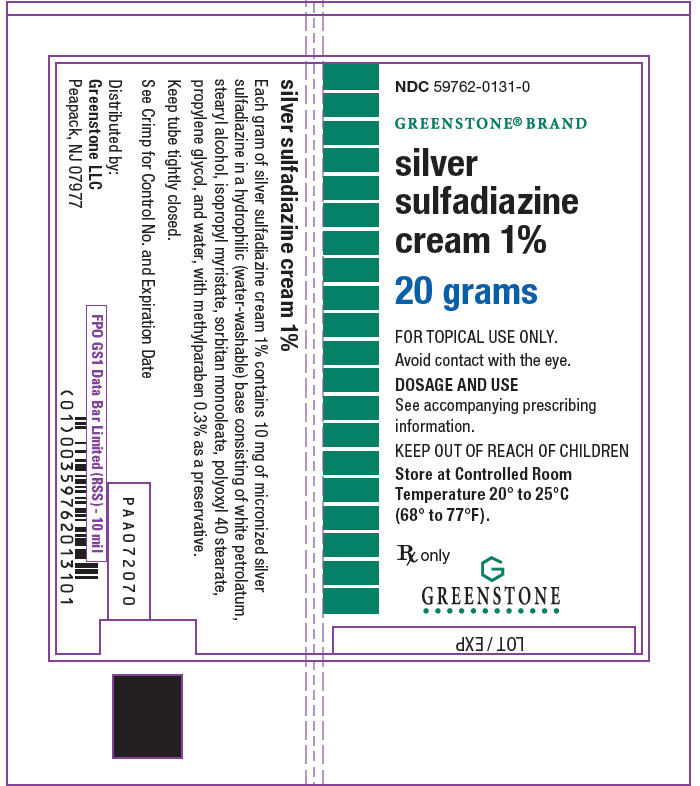
PRINCIPAL DISPLAY PANEL - 20 gram Tube Label NDC 59762-0131-0 GREENSTONE ® BRAND silver sulfadiazine cream 1% 20 grams FOR TOPICAL USE ONLY. Avoid contact with the eye. DOSAGE AND USE See accompanying prescribing information. KEEP OUT OF REACH OF CHILDREN Store at Controlled Room Temperature 20° to 25°C (68° to 77°F). Rx only GREENSTONE LOT / EXP PRINCIPAL DISPLAY PANEL - 20 gram Tube Label
PRINCIPAL DISPLAY PANEL - 20 gram Tube Carton NDC 59762-0131-0 GREENSTONE ® BRAND silver sulfadiazine cream 1% 20 grams Rx only PRINCIPAL DISPLAY PANEL - 20 gram Tube Carton
PRINCIPAL DISPLAY PANEL - 50 gram Jar Label NDC 59762-0131-6 GREENSTONE ® BRAND silver sulfadiazine cream 1% 50 grams Rx only FOR TOPICAL USE ONLY Avoid contact with the eye. PRINCIPAL DISPLAY PANEL - 50 gram Jar Label