
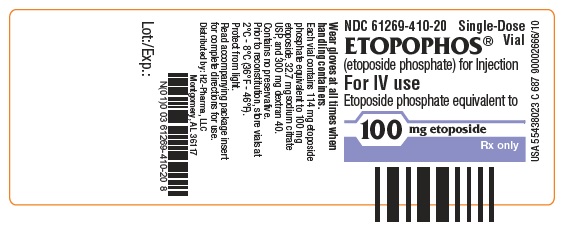
Etopophos etoposide phosphate 100 mg Injection, Powder, Lyophilized, For Solution, 1 vial — NDC 61269-410-20 (Billing 61269-0410-20)
This is a package of 1 vial of Etopophos etoposide phosphate 100 mg Injection, Powder, Lyophilized, For Solution from H2-Pharma, LLC, marketed since Jun 2009 and currently FDA-listed. It is this product's only package size.
NDC database record
One package, one record: these facts belong to NDC 61269-410-20 alone.
- Record
- FDA NDC Directory package listing · Human prescription drug
- Code segments
- 61269 labeler · 410 product · 20 package
- Package marketed since
- Jun 1, 2009
- Sample package
- No — commercial package
- Listing certified through
- Dec 31, 2027
- Billing quantity
- 1 EA per package
- Barcode (UPC-A, from the NDC)
- 3 6126941020 8
- Medicaid fills, this package
- 178 prescriptions in the last four reported quarters
- FDA record last changed
- Sep 17, 2026
Identity & classification
Regulatory identifiers FDA, NLM and CMS codes for this package
Drug-database identifiers Medi-Span GPI and First Databank GCN / HICL / AHFS classification
- GSN (GCN sequence number): 027350
- GCN: 07552
- HICL (First Databank): 011549
- AHFS class code: 10:00.00.00
- RxCUI (RxNorm): 226719
Where does this data come from?
- FDA openFDA NDC Directory · synced Oct 1, 2026
- FDA label on DailyMed · label index refreshed Oct 5, 2026
- RxNorm (NLM RxNav) · catalog refreshed Oct 1, 2026
- Medi-Span GPI (licensed)
- First Databank (licensed) · refreshed Oct 1, 2026
RxNorm drug class
This medicine belongs to the Topoisomerase Inhibitor class.
Where does this data come from?
- RxClass (NLM) · catalog refreshed Oct 1, 2026
Clinical
Etoposide injection is used in combination with other medications to treat cancer of the testicles that has not improved or that has worsened after treatment with other medications or radiation therapy. Etoposide injection is also used in combination with other medications to treat a certain type of lung cancer (small cell lung cancer; SCLC). Etoposide is in a class of medications known as podophyllotoxin derivatives. It works by slowing or stopping the growth of cancer cells in your body.
Read the full MedlinePlus article ↗- It's a chemotherapy medicine used with other cancer drugs. It is used for small cell lung cancer, and the injection forms are also used for refractory testicular cancer, meaning ca...
- It comes as an IV injection given by your healthcare team, slowly over time, or as capsules you take by mouth. It's given in repeated courses, usually every 3 to 4 weeks. Capsules...
- Common ones are low blood counts, nausea and vomiting, poor appetite, diarrhea, mouth sores, and hair loss. Hair loss is usually reversible, and nausea can often be controlled with...
- Call right away for fever, chills, or signs of infection, unusual bleeding or bruising, or trouble breathing. Also report swelling of the face or tongue, a severe rash, or pain and...
Patient education
Supplement & herbal interactions
Where does this data come from?
- MedlinePlus (NLM) · refreshed Oct 1, 2026
- FDA label on DailyMed · label index refreshed Oct 5, 2026
Ask a licensed pharmacist directly — free, answered by our team.
Pricing
A drug doesn't have one price. Each row is a different public payment system, and none is what you'd pay at the counter — that depends on your insurance. The ⓘ on each row explains what it measures.
| Price system | Per mL | Per package |
|---|---|---|
| Retail pharmacies payNADAC · weekly | Not in the retail survey — common for institutional, discontinued, or low-volume packs. | |
| Medicaid paysCMS SDUD · 12 mo | $6.40 | — |
| Medicare drug plans payPart D · quarterly | No Part D plan price is available for this NDC in our data. | |
| Medicare Part B allowsASP · J9181 | $1.018 / J9181 unit | — |
Where does this data come from?
- CMS NADAC weekly file
- CMS ASP pricing files · refreshed Sep 20, 2026
- CMS Medicaid State Drug Utilization Data · through Q4 2025
- CMS Part D plan pricing files · refreshed Sep 24, 2026
- VA National Acquisition Center price file
Billing & reimbursement
Where does this data come from?
- CMS ASP NDC-HCPCS crosswalk · refreshed Sep 22, 2026
- DMEPDAC NDC-HCPCS crosswalk
- openFDA NSDE billing units · refreshed Sep 7, 2026
Packaging — all sizes for this product
| Package NDC | Description | Marketing start | Marketing end | Status |
|---|---|---|---|---|
| 61269-0410-20 You're viewing this Main listing | 1 VIAL, SINGLE-DOSE in 1 CARTON / 1 INJECTION, POWDER, LYOPHILIZED, FOR SOLUTION in 1 VIAL, SINGLE-DOSE | 2009-06-01 | — | Active |
Therapeutic equivalents
| Product | Labeler | Pack | NADAC/unit | TE | Status | Price vs. this |
|---|---|---|---|---|---|---|
| Etopophos 100 mgthis 61269-0410-20 | H2-Pharma, | 1 vial | — | — | FDA listed | — |
Where does this data come from?
- FDA openFDA NDC Directory · synced Oct 1, 2026
- FDA Orange Book · refreshed Oct 3, 2026
- CMS NADAC weekly file
Availability & generic status
We did not find an FDA-approved generic match for this exact strength, form and route.
Where does this data come from?
- FDA Orange Book · refreshed Oct 3, 2026
Inactive Ingredients / Excipients
Inactive ingredients, also called excipients, are components of the drug product other than the active ingredient. They may include fillers, dyes, coatings, preservatives, flavors, or other formulation ingredients.
🧪 Avoiding an ingredient? See Etoposide inactive ingredients by manufacturer: every current product's list side by side, so you can ask your pharmacy for the version that does not list it.
💡 Tap an ingredient (hover on desktop) to see what it is and why it’s used.
-
300 mg
UNII K3R6ZDH4DU
Dextran 40 is a sugar-based polymer derived from bacteria. It acts as a thickener and volume expander in liquid medicines, helping achieve proper consistency and stability.
-
32.7 mg
UNII 1Q73Q2JULR
Sodium citrate is a salt derived from citric acid. It works as a buffer to maintain the medicine's pH level and may also help improve taste or act as a preservative in the formulation.
2 inactive ingredients listed in the exact product block matched to this NDC.
Where does this data come from?
ingredient classCode="IACT" elements from the exact product block matched by this NDC. Label-section narrative from DailyMed / the openFDA label index is shown separately when available.- FDA label on DailyMed · label index refreshed Oct 5, 2026
- FDA openFDA NDC Directory · synced Oct 1, 2026
Inactive ingredient FAQ
Are inactive ingredients the same for every manufacturer?
Why might an inactive ingredient be missing?
Can inactive ingredients matter?
Manufacturer & labeler
More NDCs from H2-Pharma, LLC labeler code 61269
- Pylera Bismuth Subcitrate Potassium, Metronidazole, and Tetracycline Hydrochloride 140 mg; 125 mg; 125 mg Capsule NDC 61269-380-12
- Pylera Bismuth Subcitrate Potassium, Metronidazole, and Tetracycline Hydrochloride 140 mg; 125 mg; 125 mg Capsule NDC 61269-381-12
- Bismuth Subcitrate Potassium, Metronidazole and Tetracycline Hydrochloride 140 mg; 125 mg; 125 mg Capsule NDC 61269-386-12
- Droxia Hydroxyurea 200 mg Capsule NDC 61269-402-60
- Droxia Hydroxyurea 300 mg Capsule NDC 61269-403-60
- Droxia Hydroxyurea 400 mg Capsule NDC 61269-404-60
- Xenical orlistat 120 mg Capsule NDC 61269-460-90
- Xeloda capecitabine 500 mg Tablet, Film Coated NDC 61269-475-12
- Valcyte valganciclovir 450 mg Tablet, Film Coated NDC 61269-480-60
- Valcyte valganciclovir hydrochloride 50 mg/mL Powder, For Solution NDC 61269-485-10
- PULMICORT FLEXHALER Budesonide 90 ug Aerosol, Powder NDC 61269-509-06
- PULMICORT FLEXHALER Budesonide 180 ug Aerosol, Powder NDC 61269-518-12
Where does this data come from?
- FDA openFDA NDC Directory · synced Oct 1, 2026
- Drugs@FDA
Full prescribing information FDA SPL
🎯 Indications and Usage ▾
1 INDICATIONS AND USAGE ETOPOPHOS is a topoisomerase inhibitor indicated for the treatment of patients with: Refractory testicular tumors, in combination with other chemotherapeutic drugs. ( 1.1 ) Small cell lung cancer, in combination with cisplatin, as first-line treatment. ( 1.2 )
1.1Refractory Testicular Tumors ETOPOPHOS is indicated, in combination with other chemotherapeutic drugs, for treatment of patients with refractory testicular tumors.
1.2Small Cell Lung Cancer ETOPOPHOS is indicated, in combination with cisplatin, for first-line treatment of patients with small cell lung cancer.
⏱️ Dosage and Administration ▾
2 DOSAGE AND ADMINISTRATION Refractory testicular tumors: 50 to 100 mg/m 2 per day administered intravenously over 5 minutes to 3.5 hours on days 1 through 5, or 100 mg/m 2 administered intravenously over 5 minutes to 3.5 hours on days 1, 3, and 5. ( 2.1 ) Small cell lung cancer: 35 mg/m 2 per day administered intravenously over 5 minutes to 3.5 hours for 4 days or 50 mg/m 2 per day administered intravenously over 5 minutes to 3.5 hours for 5 days. ( 2.2 ) Do not give by bolus injection.
( 2.4 ) Renal impairment: Reduce the recommended dose to 75% in patients with creatinine clearance 15 to 50 mL/min. ( 2.3 )
2.1Refractory Testicular Tumors The recommended dose of ETOPOPHOS is: 50 to 100 mg/m 2 per day administered intravenously over 5 minutes to 3.5 hours on days 1 through 5 of each 21-day (or 28-day cycle), or 100 mg/m 2 administered intravenously over 5 minutes to 3.5 hours on days 1, 3, and 5 of each 21-day (or 28-day cycle).
2.2Small Cell Lung Cancer The recommended dose of ETOPOPHOS is: • 35 mg/m 2 per day administered intravenously over 5 minutes to 3.5 hours for 4 days, or • 50 mg/m 2 per day administered intravenously over 5 minutes to 3.5 hours for 5 days.
2.3Dosage Modification In patients with a creatinine clearance (CLcr) 15-50 mL/min, administer 75% of the recommended dose. Data are not available in patients with CLcr less than 15 mL/min. Consider further dose reduction in these patients.
2.4Preparation and Administration Preparation Reconstitute with Sterile Water for Injection, USP; 5% Dextrose Injection, USP; 0.9% Sodium Chloride Injection, USP; Bacteriostatic Water for Injection with Benzyl Alcohol; or Bacteriostatic Sodium Chloride for Injection with Benzyl Alcohol, using the quantity of diluent shown below: Vial Strength Volume of Diluent Final Concentration 100 mg 5 mL 20 mg/mL 10 mL 10 mg/mL Following reconstitution, ETOPOPHOS can be further diluted to concentrations as low as 0.1 mg/mL with either 5% Dextrose Injection, USP, or 0.9% Sodium Chloride Injection, USP.
Inspect parenteral drug products visually for particulate matter and discoloration prior to administration whenever solution and container permit. Storage After reconstitution, store under the following conditions: Refrigerated 2° to 8°C (36° to 46°F) for 7 days; Room temperature at 20° to 25°C (68° to 77°F) for 24 hours following reconstitution with Sterile Water for Injection, USP, 5% Dextrose Injection, USP, or 0.9% Sodium Chloride Injection, USP; Room temperature 20° to 25°C (68° to 77°F) for 48 hours following reconstitution with Bacteriostatic Water for Injection with benzyl alcohol or Bacteriostatic Sodium Chloride for Injection with benzyl alcohol.
Reconstituted ETOPOPHOS solutions further diluted as directed can be stored under refrigeration 2° to 8°C (36° to 46°F) or at room temperature 20° to 25°C (68° to 77°F) for 24 hours. Administration DO NOT GIVE ETOPOPHOS BY BOLUS INTRAVENOUS INJECTION. ETOPOPHOS solutions may be administered at infusion rates up to 3.5 hours.
Extravasation of ETOPOPHOS may result in swelling, pain, cellulitis, and necrosis including skin necrosis. ETOPOPHOS is a cytotoxic drug. Follow applicable special handling and disposal procedures.
1 To minimize the risk of dermal exposure, use of gloves is recommended. If dermal contact occurs, immediately and thoroughly wash areas of skin contact with soap and water and flush mucosa with water.
💊 Dosage Forms and Strengths ▾
3 DOSAGE FORMS AND STRENGTHS For injection: 114 mg etoposide phosphate (equivalent to 100 mg etoposide), white to off-white, lyophilized powder in single-dose vial for reconstitution [see Description (11) ] . For injection: 114 mg etoposide phosphate (equivalent to 100 mg etoposide), white to off-white, lyophilized powder in single-dose vial for reconstitution. ( 3 , 11 )
⛔ Contraindications ▾
4 CONTRAINDICATIONS ETOPOPHOS is contraindicated in patients with a history of a severe hypersensitivity reaction to etoposide products [see Warnings and Precautions (5.3) ] . Hypersensitivity to etoposide products. ( 4 , 5.3 )
⚠️ Warnings and Cautions ▾
5 WARNINGS AND PRECAUTIONS Myelosuppression : Obtain complete blood counts prior to each cycle and more frequently as clinically indicated. ( 5.1 ) Secondary leukemias : Can occur with long-term use. ( 5.2 ) Hypersensitivity reactions : Hypersensitivity reactions including anaphylaxis may occur.
( 5.3 ) Embryo-fetal toxicity : ETOPOPHOS can cause fetal harm. Advise females of potential risk to the fetus and to use effective contraception during treatment with ETOPOPHOS and for 6 months after final dose. Advise males to use effective contraception for 4 months, after the last dose of ETOPOPHOS.
( 5.4 , 8.1 , 8.3 )
5.1Myelosuppression ETOPOPHOS causes myelosuppression that results in thrombocytopenia and neutropenia. Fatal infections (including opportunistic infections like Pneumocystis jirovecii pneumonia) and bleeding have occurred. Obtain complete blood counts prior to each cycle of ETOPOPHOS and more frequently as clinically indicated [see Adverse Reactions (6.1)] .
5.2Secondary Leukemias Secondary leukemias have occurred with long term use of ETOPOPHOS.
5.3Hypersensitivity Reactions ETOPOPHOS can cause hypersensitivity reactions, including rash, urticaria, pruritus, and anaphylaxis [see Adverse Reactions (6.1)] . If hypersensitivity reactions occur, immediately interrupt ETOPOPHOS and institute supportive management. Permanently discontinue ETOPOPHOS in patients who experience a severe hypersensitivity reaction.
5.4Embryo-Fetal Toxicity Based on animal studies and its mechanism of action, ETOPOPHOS can cause fetal harm when administered to a pregnant woman. Advise pregnant women of the potential hazard to the fetus [see Use in Specific Populations ( 8.1 )] . Advise females of reproductive potential to use effective contraception during treatment with ETOPOPHOS and for at least 6 months after the final dose.
Advise males with female partners of reproductive potential to use effective contraception for 4 months after the final dose [see Use in Specific Populations ( 8.3 )] .
🤒 Adverse Reactions ▾
6 ADVERSE REACTIONS The following serious adverse reactions are described elsewhere in the labeling: Myelosuppression [see Warnings and Precautions (5.1) ] Secondary leukemias [see Warnings and Precautions (5.2) ] Hypersensitivity reactions [see Warnings and Precautions (5.3) ] Most common adverse reaction is neutropenia. ( 6 ) To report SUSPECTED ADVERSE REACTIONS, contact the Safety Call Center at 1-866-885-0690 or FDA at 1-800-FDA-1088 or www.fda.gov/medwatch .
6.1Clinical Trials Experience Because clinical trials are conducted under widely varying conditions, adverse reaction rates, observed in the clinical trials of a drug, cannot be directly compared to rates in the clinical trials of another drug and may not reflect the rates observed in practice. ETOPOPHOS has been used as a single agent in clinical studies involving 206 patients with a variety of malignancies (including one non-Hodgkin’s lymphoma) and in combination with cisplatin in 60 patients with small cell lung cancer.
The most common adverse reaction was neutropenia. Other Important Adverse Reactions Gastrointestinal Toxicity Nausea and vomiting are the major gastrointestinal toxicities. The severity of nausea and vomiting is generally mild to moderate, with treatment discontinuation required in 1% of patients.
Nausea and vomiting are managed with standard antiemetic therapy. Other Toxicities Other clinically important adverse reactions in clinical trials were: Gastrointestinal: abdominal pain, constipation, dysphagia General: fever Ocular: transient cortical blindness, optic neuritis Respiratory: interstitial pneumonitis/pulmonary fibrosis Skin: pigmentation, radiation recall dermatitis, Stevens-Johnson syndrome, and toxic epidermal necrolysis Neurologic: seizure, aftertaste Hepatobiliary disorder: hepatotoxicity
6.2Postmarketing Experience The following adverse reactions have been identified during postapproval use of ETOPOPHOS. Because these reactions are reported voluntarily from a population of uncertain size, it is not always possible to reliably estimate their frequency or establish a causal relationship to drug exposure. Extravasation Extravasation, resulting in local soft tissue toxicity.
Extravasation of ETOPOPHOS can result in swelling, pain, cellulitis, and necrosis, including skin necrosis. Acute Renal Failure Reversible cases of acute renal failure have been reported with administration of high dose (2220 mg/m 2 ) ETOPOPHOS with total body irradiation used for hematopoietic stem cell transplantation. The ETOPOPHOS formulation contains dextran 40, which has been associated with acute renal failure when administered in high doses.
🔄 Drug Interactions ▾
7 DRUG INTERACTIONS Warfarin: Co-administration of ETOPOPHOS with warfarin can result in elevated international normalized ratio (INR). Measure INR frequently. Warfarin: Co-administration can result in elevated international normalized ratio (INR). Measure INR frequently. ( 7 )
👥 Use in Specific Populations ▾
8 USE IN SPECIFIC POPULATIONS Lactation: Do not breastfeed. ( 8.2 )
8.1Pregnancy Risk Summary Based on animal data and its mechanism of action, ETOPOPHOS can cause fetal harm when administered to a pregnant woman. Etoposide, the active moiety of etoposide phosphate is teratogenic in mice and rats (see Data) . Advise pregnant women of the potential hazard to a fetus.
Advise women of childbearing potential to avoid becoming pregnant. In the U.S. general population, the estimated background risk of major birth defects and miscarriage in clinically recognized pregnancies is 2% to 4% and 15% to 20%, respectively. Data Animal Data In rats, an intravenous etoposide dose of 0.4 mg/kg/day (about 0.05 times of the 50 mg/m 2 human dose based on body surface area [BSA]) during organogenesis caused maternal toxicity, embryotoxicity, and teratogenicity (skeletal abnormalities, exencephaly, encephalocele, and anophthalmia); higher doses of 1.2 and 3.6 mg/kg/day (about 0.14 and 0.5 times the 50 mg/m 2 human dose based on BSA) resulted in 90% and 100% embryonic resorptions.
In mice, a single etoposide dose of 1.0 mg/kg (approximately 0.06 times the 50 mg/m 2 human dose based on BSA) administered intraperitoneally on days 6, 7, or 8 of gestation caused embryotoxicity, cranial abnormalities, and major skeletal malformations. An intraperitoneal dose of 1.5 mg/kg (about 0.1 times the 50 mg/m 2 human based on BSA) on day 7 of gestation caused an increase in the incidence of intrauterine death and fetal malformations and a significant decrease in the average fetal body weight [see Nonclinical Toxicology (13.1) ] .
8.2Lactation There is no information regarding the presence of etoposide in human milk or its effects on breastfed infant milk production. Because of the potential for serious adverse reactions in nursing infants from ETOPOPHOS, advise women not to breastfeed during treatment with ETOPOPHOS.
8.3Females and Males of Reproductive Potential Contraception Females Advise females of reproductive potential to use effective contraception during treatment with ETOPOPHOS and for 6 months after the final dose. Males ETOPOPHOS may damage spermatozoa and testicular tissue, resulting in possible genetic fetal abnormalities. Males with female sexual partners of reproductive potential should use effective contraception during treatment with ETOPOPHOS and for 4 months after the final dose.
Infertility Females In females of reproductive potential, ETOPOPHOS may cause infertility and result in amenorrhea. Premature menopause can occur with ETOPOPHOS. Recovery of menses and ovulation is related to age at treatment.
Males In male patients, ETOPOPHOS may result in oligospermia, azoospermia, and permanent loss of fertility. Sperm counts have been reported to return to normal levels in some men, and in some cases, have occurred several years after the end of therapy [See Nonclinical Toxicology (13.1) ] .
8.4Pediatric Use Safety and effectiveness in pediatric patients have not been established.
8.5Geriatric Use Clinical studies of etoposide did not include sufficient numbers (n=71) of patients aged 65 years and over to determine whether they respond differently from younger patients. Other reported clinical experience has not identified differences in responses between elderly and younger patients.
🆘 Overdosage ▾
10 OVERDOSAGE No antidote has been established for ETOPOPHOS overdosage in humans. Based on animal studies, overdosage may result in neurotoxicity.
🧬 Clinical Pharmacology ▾
12 CLINICAL PHARMACOLOGY
12.1Mechanism of Action Etoposide phosphate is a prodrug that is converted to its active moiety, etoposide, by dephosphorylation. Etoposide causes the induction of DNA strand breaks by an interaction with DNA-topoisomerase II or the formation of free radicals, leading to cell cycle arrest, primarily at the G2 stage of the cell cycle, and cell death.
12.2Pharmacodynamics Following intravenous administration of 90, 100, and 110 mg/m 2 dose of ETOPOPHOS over 60 minutes, mean nadir values (expressed as percent decrease from baseline) for granulocytes, hemoglobin, and thrombocytes were 81.0 ± 16.5%, 21.4 ± 9.9%, and 44.1 ± 20.7%, respectively.
12.3Pharmacokinetics Following intravenous administration of an etoposide formulation, the area under the concentration time curve (AUC) and maximum plasma concentration (C max ) values increased linearly and etoposide did not accumulate in the plasma following daily administration for 4 to 5 days. Distribution Following administration of an injectable etoposide formulation, the mean volume of distribution of etoposide at steady state was 18 to 29 liters. Etoposide enters the CSF poorly.
In vitro, etoposide is 97% bound to human plasma proteins, primarily albumin. Elimination The terminal elimination half-life of etoposide ranges from 4 to 11 hours. Total body clearance values range from 33 to 48 mL/min.
Metabolism Following intravenous administration of ETOPOPHOS, etoposide phosphate is completely converted to etoposide in plasma. Etoposide is metabolized by opening of the lactone ring, O-demethylation, and conjugation (i.e., glucuronidation and sulfation). O-demethylation occurs through the CYP450 3A4 isoenzyme pathway to produce the active catechol metabolite.
Excretion At 120 hours after intravenous administration of radiolabeled etoposide formulation, the mean recovery of radioactivity in the urine was 56% of the dose, 45% of which was excreted as etoposide and 8% or less as metabolites. Fecal recovery of radioactivity was 44% of the dose. Specific Populations Following intravenous administration of etoposide in adults, the total body clearance of etoposide was correlated with creatinine clearance, serum albumin concentration, and non-renal clearance.
No clinically significant differences in the pharmacokinetics of etoposide were observed based on age and sex. Drug Interaction Studies Cisplatin: Co-administration of cisplatin may increase exposure to etoposide. Highly protein-bound drugs: Phenylbutazone, sodium salicylate, and aspirin displaced protein-bound etoposide in vitro.
Select antiepileptic medications: Co-administration with antiepileptic medications including phenytoin, phenobarbital, carbamazepine, and valproic acid may increase etoposide clearance. Etoposide may be a substrate of the P-glycoprotein (P-gp) transporter system based upon in vitro studies.
📦 How Supplied / Storage and Handling ▾
16 HOW SUPPLIED/STORAGE AND HANDLING How Supplied/Storage ETOPOPHOS is supplied as a single-dose vial containing etoposide phosphate equivalent to 100 mg etoposide as a lyophilized powder for reconstitution, individually packaged in a carton: NDC 61269-410-20 Store unopened vials at 2° to 8°C (36°-46°F). Keep vial in outer carton to protect from light. Handling ETOPOPHOS is a cytotoxic drug. Follow applicable special handling and disposal procedures. 1
📋 Description ▾
11 DESCRIPTION ETOPOPHOS (etoposide phosphate) is a topoisomerase inhibitor. The chemical name for etoposide phosphate is: 4'-Demethylepipodophyllotoxin 9-[4,6-O-(R)-ethylidene-β-D-glucopyranoside], 4' (dihydrogen phosphate). Etoposide phosphate has the following structure: Etoposide phosphate is a phosphate ester of etoposide, a semi-synthetic derivative of podophyllotoxin.
ETOPOPHOS is available for intravenous infusion as a sterile lyophilized powder in single-dose vials for reconstitution containing 114 mg etoposide phosphate, equivalent to 100 mg etoposide, 32.7 mg sodium citrate USP, and 300 mg dextran 40. Image Etoposide Phosphate Chemical Structure
💬 Information for Patients ▾
17 PATIENT COUNSELING INFORMATION Myelosuppression Advise patients that periodic monitoring of their blood counts is required. Advise patients to contact their healthcare provider for new onset of bleeding, fever, or symptoms of infection [see Warnings and Precautions (5.1)] . Embryo-Fetal Toxicity Advise females of reproductive potential of the potential risk to a fetus and to inform their healthcare provider of a known or suspected pregnancy [see Warnings and Precautions (5.4) and Use in Specific Populations ( 8.1 , 8.3 )] .
Advise females of reproductive potential to use effective contraception during and 6 months after treatment with ETOPOPHOS [see Warnings and Precautions (5.4) and Use in Specific Populations ( 8.1 , 8.3 )] . Advise males with female sexual partners of reproductive potential to use condoms during treatment with ETOPOPHOS and for at least 4 months after the final dose [see Warnings and Precautions (5.4) and Use in Specific Populations ( 8.3 )] . Licensed by: CHEPLAPHARM Arzneimittel GmbH 17489 Greifswald, Germany Product of Germany Distributed by: H2-Pharma, LLC Montgomery, AL 36117, USA
🔬 Clinical Studies ▾
14 CLINICAL STUDIES Study 1 was a multicenter trial in patients, with previously untreated, small cell lung cancer, randomized (1:1) to receive either etoposide phosphate (80 mg/m 2 /day) plus cisplatin (20 mg/m 2 /day) for 5 days, or etoposide (80 mg/m 2 /day) plus cisplatin (20 mg/m 2 /day). The major efficacy outcome measure was objective response rate (ORR). Among the 121 patients enrolled, the median age was 64 years, 65% of patients were male, 89% were White, and ECOG performance score was 0 to 2.
Study 1 demonstrated an overall response rate of 61% (95% confidence interval [CI] 47, 73) for patients treated with etoposide phosphate plus cisplatin, and 58% (95% CI: 45, 71) for those receiving etoposide plus cisplatin.
🧪 Nonclinical Toxicology ▾
13 NONCLINICAL TOXICOLOGY
13.1Carcinogenesis, Mutagenesis, Impairment of Fertility ETOPOPHOS was non-mutagenic in an in vitro Ames microbial mutagenicity assay; however, ETOPOPHOS is rapidly and completely converted to etoposide in vivo. Therefore, as etoposide is mutagenic in the Ames assay, ETOPOPHOS is considered mutagenic in vivo. In rats, oral dosing of ETOPOPHOS for 5 consecutive days at doses greater than or equal to 86 mg/kg/day (about 10 times the 50 mg/m 2 human dose based on BSA) resulted in irreversible testicular atrophy.
Irreversible testicular atrophy was also present in rats treated with ETOPOPHOS intravenously for 30 days at 5.11 mg/kg/day (about 0.5 times the 50 mg/m 2 human dose based on BSA).
📚 References ▾
15 REFERENCES 1. "OSHA Hazardous Drugs." OSHA . http://www.osha.gov/SLTC/hazardousdrugs/index.html
📄 Recent Major Changes ▾
Warnings and Precautions, Myelosuppression (5.1) 7/2026
📄 Package Label / Principal Display Panel ▾
--------------------------------------------------------------------------------------------------------- ETOPOPHOS 100 mg for Injection Representative Packaging See How Supplied section for a complete list of available packages of ETOPOPHOS. NDC 61269-410-20 Single-Dose Vial ETOPOPHOS ® (etoposide phosphate) for Injection For IV use Etoposide phosphate equivalent to 100 mg etoposide Rx only Image etopophos100mg-lbl
Medicaid utilization & spend
Reported adverse events (FAERS)
Top reported reactions
Age at onset
Reporter sex
Serious outcomes
Where does this data come from?
About this NDC listing & data coverage
What data is (and isn’t) available for this NDC — tap to expand
| NDC identity (package / product / labeler codes) | ✓ Available |
| Labeler | ✓ Available |
| Product & package description | ✓ Available |
| Marketing category & status | ✓ Available |
| Active ingredient / dosage form / route | ✓ Available |
| FDA label (SPL via DailyMed) | ✓ Available |
| Package photos | ✓ Available |
| Inactive ingredients (structured) | ✓ Available |
| NADAC pharmacy acquisition price (CMS) | — Not published for this NDC CMS publishes NADAC only for NDCs reported in its retail-pharmacy survey. |
| Orange Book / therapeutic-equivalence data | — Not published for this NDC Applies only to products approved under an NDA/ANDA; many listings are out of scope. |
| HCPCS J-code billing crosswalk | ✓ Available |
| Medicaid utilization (CMS SDUD) | ✓ Available |