
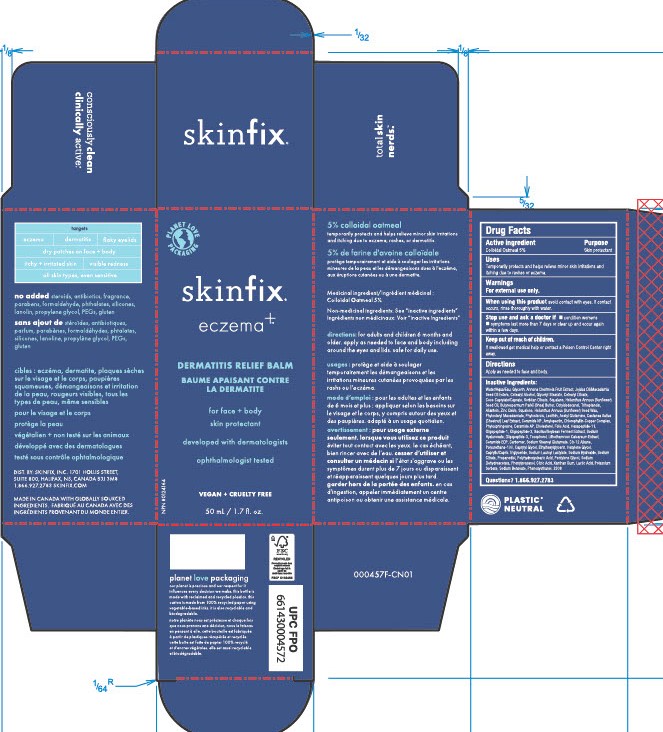
Eczema Dermatitis Relief Balm Colloidal Oatmeal 5 g/100g Cream — NDC 61328-112-30 (Billing 61328-0112-30)
This is a package of Eczema Dermatitis Relief Balm Colloidal Oatmeal 5 g/100g Cream from Skinfix, Inc., marketed since Oct 2023 and currently FDA-listed.
Identity & classification
Regulatory identifiers FDA, NLM and CMS codes for this package
Where does this data come from?
- FDA openFDA NDC Directory · synced Oct 1, 2026
- FDA label on DailyMed · label index refreshed Oct 1, 2026
- RxNorm (NLM RxNav) · catalog refreshed Oct 1, 2026
- Medi-Span GPI (licensed)
- First Databank (licensed) · refreshed Oct 1, 2026
Clinical
This is a topical cream containing colloidal oatmeal, marketed as an over-the-counter monograph product under FDA's established rules for skin-care ingredients. Colloidal oatmeal is commonly used in creams intended for temporary relief of itching and irritation associated with eczema and dermatitis. The cream is applied directly to affected skin areas. This product is sold under a standard FDA monograph rather than as an individually reviewed new drug application.
Patient education
Supplement & herbal interactions
Where does this data come from?
- MedlinePlus (NLM) · refreshed Oct 1, 2026
- FDA label on DailyMed · label index refreshed Oct 1, 2026
Ask a licensed pharmacist directly — free, answered by our team.
Pricing
A drug doesn't have one price. Each row is a different public payment system, and none is what you'd pay at the counter — that depends on your insurance. The ⓘ on each row explains what it measures.
| Price system | Per g | Per package |
|---|---|---|
| Retail pharmacies payNADAC · weekly | Not in the retail survey — common for institutional, discontinued, or low-volume packs. | |
| Medicaid paysCMS SDUD · 12 mo | No recent Medicaid claims on file for this NDC — rare and low-volume NDCs are suppressed in the public data. | |
| Medicare drug plans payPart D · quarterly | No Part D plan price is available for this NDC in our data. | |
Where does this data come from?
- CMS NADAC weekly file
- CMS ASP pricing files · refreshed Sep 20, 2026
- CMS Medicaid State Drug Utilization Data · refreshed Oct 3, 2026
- CMS Part D plan pricing files · refreshed Sep 24, 2026
- VA National Acquisition Center price file
Packaging — all sizes for this product
| Package NDC | Description | Marketing start | Marketing end | Status |
|---|---|---|---|---|
| 61328-0112-20 61328-112-20 Main listing | 50 g in 1 BOTTLE, PUMP | 2023-10-01 | — | Active |
| 61328-0112-30 You're viewing this | 1 TUBE in 1 CARTON / 40 g in 1 TUBE | 2026-09-12 | — | Active |
Pack size FAQ
What quantity is in this package?
What NDC number is used to bill for this package of Eczema Dermatitis Relief Balm Colloidal Oatmeal 5 g/100g Cream?
Therapeutic equivalents
| Product | Labeler | Pack | NADAC/unit | TE | Status | Price vs. this |
|---|---|---|---|---|---|---|
| Flexitol Face and Eyelid Eczema 50 mg/g 43251-4904-01 | LaCorium | 1 tube | — | — | FDA listed | — |
| Eczema Dermatitis Relief Balm 5 g/100gthis 61328-0112-30 | Skinfix, | 1 tube | — | — | FDA listed | — |
| Earth Mama Eczema Cream 50 mg/g 72812-0151-01 | Earth | 85 g | — | — | FDA listed | — |
| Dermatitis Face Balm 5 g/100g 61328-0121-12 | Skinfix, | 13.5 g | — | — | FDA listed | — |
Where does this data come from?
- FDA openFDA NDC Directory · synced Oct 1, 2026
- FDA Orange Book · refreshed Sep 3, 2026
- CMS NADAC weekly file
Availability & generic status
We did not find an FDA-approved generic match for this exact strength, form and route.
Where does this data come from?
- FDA Orange Book · refreshed Sep 3, 2026
What it looks like
Where does this data come from?
- FDA label on DailyMed · label index refreshed Oct 1, 2026
Inactive Ingredients / Excipients
Inactive ingredients, also called excipients, are components of the drug product other than the active ingredient. They may include fillers, dyes, coatings, preservatives, flavors, or other formulation ingredients.
💡 Tap an ingredient (hover on desktop) to see what it is and why it’s used.
-
UNII 01J18G9G97
Acetyl glutamine is an amino acid derivative made by attaching an acetyl group to the amino acid glutamine. It may be used as a buffering agent, pH regulator, or stability enhancer in pharmaceutical formulations.
-
UNII 344S277G0Z
Allantoin is a naturally derived compound that helps soften and soothe skin. In medicines, it works as a skin-conditioning agent and may help support wound healing and reduce irritation in topical formulations.
-
UNII 4XO4QFV777
A branched starch polymer derived from plant sources. It acts as a binder to hold tablet ingredients together and as a filler to add bulk and structure to solid dosage forms.
-
UNII 00YIU5438U
Caprylyl glycol is a clear liquid derived from coconut oil. In medicines, it acts as a humectant to retain moisture, a preservative booster to prevent microbial growth, and a solvent to help dissolve or mix other ingredients.
-
UNII 0A5MM307FC
A synthetic polymer that absorbs water and forms a thick, gel-like substance. In medicines, it works as a thickener and stabilizer to improve texture and help ingredients stay mixed together in creams, gels, and lotions.
-
UNII IV3S2HH53G
A plant extract from chestnut tree leaves used in medicines as a natural ingredient. It may serve as a preservative, antioxidant, or flavor component in the formulation.
-
UNII 5THT33P7X7
A waxy, lipid-like substance derived from animal or plant sources. It helps soften and moisturize the skin by acting as an emollient and skin-conditioning agent in topical medicines and creams.
-
UNII F1X8L2B00J
A naturally derived fatty substance that helps bind and condition the product's texture. It works as an emollient and skin-conditioning agent in topical formulations, helping maintain moisture and smoothness.
-
UNII 4370DF050B
Ceramide NP is a waxy, lipid-based substance that mimics natural skin oils. It's used in topical formulations as an emollient and skin-conditioning agent to help soften, smooth, and protect the skin barrier.
-
UNII 58B69Q84JO
A plant-derived emulsifier made from olive oil and fatty alcohols. It helps blend oil and water ingredients together and stabilizes the product's texture in creams, lotions, and similar formulations.
-
UNII 2DMT128M1S
A waxy solid derived from plant or animal sources. It acts as an emulsifier to blend oil and water components, and also thickens the medicine to give it the right texture and consistency.
-
UNII 33WVT714QS
A natural plant extract from the cherimoya fruit, used as a flavoring agent to add taste to the medicine. It helps mask bitter or unpleasant flavors in oral formulations.
-
UNII 97C5T2UQ7J
Cholesterol is a fatty substance found naturally in animal tissues. In medications, it's used as an ingredient in liposomal formulations and lipid-based drug delivery systems to help encapsulate and stabilize active drugs for better absorption.
-
UNII 2968PHW8QP
A weak organic acid derived from citrus fruits or made through fermentation. It works as a buffer to control pH, a preservative to extend shelf life, and a flavoring agent in medications.
-
UNII 8D9H4QU99H
A synthetic fatty acid ester derived from coconut oil, used as an emulsifier and solubilizer to help mix oil and water-based ingredients and improve how the body absorbs certain drugs.
-
UNII 147D247K3P
Ethylhexylglycerin is a synthetic preservative used to prevent bacteria and mold from growing in medicines and personal care products. It helps keep the product safe and stable throughout its shelf life.
-
UNII 935E97BOY8
Folic acid is a synthetic form of a B vitamin. In medicines, it's added as a nutritional supplement or to help prevent vitamin deficiency, especially in prenatal formulas.
-
UNII PDC6A3C0OX
Glycerin is a clear, thick liquid derived from plant oils or fats. It acts as a humectant to retain moisture, a sweetener, and a solvent in medications.
-
UNII 230OU9XXE4
A waxy substance made from glycerin and stearic acid that acts as an emulsifier to blend oily and watery ingredients together. It also helps thicken and stabilize the medicine's texture.
-
UNII 42DG15CHXV
A natural plant wax derived from sunflower seeds. It serves as a lubricant and glidant to help powders flow smoothly during manufacturing and tablet formation.
-
UNII NCJ63WU6BY
A synthetic peptide made of six amino acids linked together. In medications, it functions as an active cosmetic or skin-conditioning agent rather than a traditional inactive filler or binder.
-
UNII KEH0A3F75J
Hexylene glycol is a clear liquid alcohol used as a solvent and preservative in medicines. It helps dissolve other ingredients and keeps the product stable during storage.
-
UNII YSE9PPT4TH
Hyaluronate sodium is a natural carbohydrate that holds moisture. It's used in medicines as a lubricant, thickener, and moisture-retaining agent to improve texture and delivery of the active ingredient.
-
UNII 33X04XA5AT
Lactic acid is a naturally occurring organic acid derived from milk or plant sources. It lowers and maintains pH in formulations, helps preserve the product, and can enhance ingredient stability and absorption.
-
UNII 1DI56QDM62
A natural fatty substance from soybeans that helps mix oil and water-based ingredients together. It acts as an emulsifier and lubricant in medicines to improve texture and help the product break down properly in your body.
-
UNII C6734SM77O
A plant-based ingredient derived from macadamia oil, used as an emulsifier and skin-conditioning agent in topical formulations. It helps blend oil and water components together and improve texture.
-
UNII C9H2L21V7U
A fat derived from coconut or palm oil containing shorter fatty acid chains. It serves as a solvent and carrier to help dissolve or suspend active ingredients, improving absorption and stability in liquid formulations.
-
UNII 461N1O614Y
A synthetic oily liquid used as an emollient and solvent in medications. It helps dissolve active ingredients and improves how the medicine spreads or absorbs through the skin.
-
UNII 50C1307PZG
Pentylene glycol is a humectant and preservative helper derived from petroleum or plant sources. It draws moisture into the product and helps prevent bacterial growth, keeping medicines stable during storage.
-
UNII HIE492ZZ3T
Phenoxyethanol is a synthetic preservative and antimicrobial agent used to prevent bacterial and fungal growth in medicines and cosmetic products, extending shelf life and maintaining product safety.
-
UNII 0F897O3O4M
A naturally occurring alcohol derived from plants or synthesized chemically. It functions as a preservative and flavoring agent in medicines, helping prevent microbial growth and add pleasant taste to oral products.
-
UNII 6J1M3WA0ZK
A red algae-derived mineral rich in calcium carbonate. Used as a filler and buffer to add bulk to the tablet or capsule and help maintain stable pH levels in the formulation.
-
UNII GIN46U9Q2Q
Phytosphingosine is a naturally derived fatty compound that helps stabilize and thicken skincare and cosmetic formulations. It works as an emollient and conditioning agent to improve texture and skin feel in topical products.
-
UNII 233VSF903M
A plant-derived oil compound used as an emollient and skin-conditioning agent. It helps soften the product texture and improve how the medicine spreads on or absorbs into the skin.
-
UNII YXH47AOU0F
A synthetic fatty acid used as a thickener and stabilizer in medicines. It helps create the right texture and prevents separation of ingredients in liquid or semi-solid formulations.
-
UNII 1VPU26JZZ4
Potassium sorbate is a salt derived from sorbic acid, a naturally occurring preservative. It prevents growth of mold, yeast, and some bacteria, extending the medicine's shelf life.
-
UNII 5965N8W85T
Propanediol is a clear liquid organic compound derived from vegetable sources or synthesized chemically. It acts as a humectant to retain moisture, a solvent to dissolve active ingredients, and a preservative booster in liquid medications and supplements.
-
UNII K49155WL9Y
Shea butter is a fat extracted from shea tree nuts. It's used in medicines as an emollient and lubricant to soften the product, improve texture, and help ingredients blend smoothly together.
-
UNII OJ245FE5EU
Sodium benzoate is a salt derived from benzoic acid, a preservative. It's added to medicines to prevent growth of bacteria, fungi, and other microorganisms that could spoil the product.
-
UNII 45P3261C7T
Sodium carbonate is an alkaline mineral salt commonly used in medications as a buffer to help maintain pH balance and improve stability. It may also function as a disintegrant to help tablets break apart in the digestive system.
-
UNII 451W47IQ8X
Sodium chloride is common table salt. It's used in medicines as a buffer to maintain proper pH, as a filler to add bulk, or to adjust the osmotic balance in liquid formulations.
-
UNII 1Q73Q2JULR
Sodium citrate is a salt derived from citric acid. It works as a buffer to maintain the medicine's pH level and may also help improve taste or act as a preservative in the formulation.
-
UNII 1D276TYV9O
A green compound derived from chlorophyll that acts as a colorant and deodorant in medicines. It helps give products their green tint and may reduce odors in formulations.
-
UNII 8W46YN971G
Sodium dehydroacetate is a salt derived from dehydroacetic acid, a compound used as a preservative. It helps prevent mold, bacteria, and yeast growth in medicines, extending shelf life and maintaining product safety.
-
UNII 55X04QC32I
A strong alkaline chemical used to adjust and maintain the pH balance of liquid medicines. It helps keep the medicine stable and ensures it stays effective during storage.
-
UNII 7243K85WFO
Sodium lauroyl lactylate is a mild surfactant derived from natural fats and lactic acid. It acts as an emulsifier and solubilizer to help blend oil and water-based ingredients and improve how the body absorbs the active drug.
-
UNII 65A9F4P024
A synthetic compound derived from the amino acid glutamate and stearic acid. It acts as an emulsifier and surfactant to help mix oil and water-based ingredients, keeping the medicine uniform throughout.
-
UNII MDL271E3GR
Sorbitan olivate is an emulsifier derived from sorbitol and olive oil. It helps blend water and oil ingredients together to maintain consistent texture and appearance throughout the medicine.
-
UNII GW89575KF9
Squalane is a lightweight oil derived from plant sources or synthesized. It acts as an emollient and lubricant in formulations, helping ingredients blend smoothly and improving product texture and spreadability.
-
UNII 7QWM220FJH
Squalene is a natural oil-like substance found in shark liver and some plants. It's used in medicines as an emulsifier to help mix oil and water-based ingredients together.
-
UNII 3W1JG795YI
Sunflower oil is a natural vegetable oil derived from sunflower seeds. It serves as a solvent, lubricant, and carrier in medicines, helping dissolve active ingredients and improve how the medication flows and absorbs in the body.
-
UNII R0ZB2556P8
Tocopherol is a form of vitamin E derived from plant oils. It acts as an antioxidant in medicines to prevent oils and fats from breaking down and spoiling during storage.
-
UNII 2P6O7CFW5K
Triheptanoin is a synthetic fat made from glycerol and seven-carbon fatty acids. It's used as a caloric supplement and carrier in certain formulations to deliver active ingredients and provide nutritional support.
-
UNII 059QF0KO0R
Water is a liquid solvent that dissolves and mixes ingredients together in liquid medicines, syrups, and injections. It helps distribute the active drug evenly throughout the product.
-
UNII TTV12P4NEE
Xanthan gum is a thickening and stabilizing ingredient made from fermented corn or other sugars. It's added to medicines to improve texture, prevent separation of liquids and solids, and help the product stay consistent.
-
UNII SOI2LOH54Z
Zinc oxide is a white mineral powder used in medicines as a protective barrier agent and color additive. It helps shield skin in topical products and may also serve as a filler or opacifying ingredient.
56 inactive ingredients listed in the exact product block matched to this NDC.
Label-section wording can be broader than the structured product block and may mention additional formulation ingredients.
Where does this data come from?
ingredient classCode="IACT" elements from the exact product block matched by this NDC. Label-section narrative from DailyMed / the openFDA label index is shown separately when available.- FDA label on DailyMed · label index refreshed Oct 1, 2026
- FDA openFDA NDC Directory · synced Oct 1, 2026
Inactive ingredient FAQ
Are inactive ingredients the same for every manufacturer?
Why might an inactive ingredient be missing?
Can inactive ingredients matter?
Manufacturer & labeler
Where does this data come from?
- FDA openFDA NDC Directory · synced Oct 1, 2026
- Drugs@FDA
FDA label — Drug Facts FDA SPL
🎯 Indications and Usage ▾
USES Temporarily protects and helps relieve minor skin irritations and itching due to rashes or eczema.
⏱️ Dosage and Administration ▾
DIRECTIONS Apply as needed to face and body.
⚠️ Warnings ▾
WARNINGS For external use only. When using this product avoid contact with eyes. if contact occurs, rinse thoroughly with water.
🧪 Active Ingredient ▾
ACTIVE INGREDIENT Colloidal Oatmeal 5%
🧪 Inactive Ingredients ▾
INACTIVE INGREDIENTS Water/Aqua/Eau, Glycerin, Annona Cherimola Fruit Extract, Jojoba Oil/Macadamia Seed Oil Esters, Cetearyl Alcohol, Glyceryl Stearate, Cetearyl Olivate, Coco-Caprylate/Caprate, Sorbitan Olivate, Squalane, Helianthus Annuus (Sunflower) Seed Oil, Butyrospermum Parkii (Shea) Butter, Octyldodecanol, Triheptanoin, Allantoin, Zinc Oxide, Squalene, Helianthus Annuus (Sunflower) Seed Wax, Phytosteryl Macadamiate, Phytosterols, Lecithin, Acetyl Glutamine, Castanea Sativa (Chestnut) Leaf Extract, Ceramide NP, Amylopectin, Chlorophyllin-Copper Complex, Phytosphingosine, Ceramide AP, Cholesterol, Folic Acid, Hexapeptide-11, Oligopeptide-1, Oligopeptide-2, Bacillus/Soybean Ferment Extract, Sodium Hyaluronate, Oligopeptide-3, Tocopherol, Lithothamnion Calcareum Extract, Ceramide EOP, Carbomer, Sodium Stearoyl Glutamate, C9-12 Alkane, Polyurethane-100, Caprylyl Glycol, Ethylhexylglycerin, Hexylene Glycol, Caprylic/Capric Triglyceride, Sodium Lauroyl Lactylate, Sodium Hydroxide, Sodium Citrate, Propanediol, Polyhydroxystearic Acid, Pentylene Glycol, Sodium Dehydroacetate, Phenylpropanol, Citric Acid, Xanthan Gum, Lactic Acid, Sodium Carbonate, Sodium Chloride, Potassium Sorbate, Sodium Benzoate, Phenoxyethanol.
🎯 Purpose ▾
PURPOSE Skin protectant
📄 Stop Use and Ask a Doctor If ▾
STOP USE AND ASK A DOCTOR IF condition worsens symptoms last more than 7 days or clear up and occur again within a few days
📄 Keep Out of Reach of Children ▾
KEEP OUT OF REACH OF CHILDREN If swallowed get medical help or contact a poison control center right away.
📄 Questions or Comments ▾
QUESTIONS? 1.866.927.2783
📄 Package Label / Principal Display Panel ▾
package label
Reported adverse events (FAERS)
Top reported reactions
Reporter sex
Serious outcomes
Where does this data come from?
About this NDC listing & data coverage
What data is (and isn’t) available for this NDC — tap to expand
| NDC identity (package / product / labeler codes) | ✓ Available |
| Labeler | ✓ Available |
| Product & package description | ✓ Available |
| Marketing category & status | ✓ Available |
| Active ingredient / dosage form / route | ✓ Available |
| FDA label (SPL via DailyMed) | ✓ Available |
| Package photos | ✓ Available |
| Inactive ingredients (structured) | ✓ Available |
| NADAC pharmacy acquisition price (CMS) | — Not published for this NDC CMS publishes NADAC only for NDCs reported in its retail-pharmacy survey. |
| Orange Book / therapeutic-equivalence data | — Not published for this NDC Applies only to products approved under an NDA/ANDA; many listings are out of scope. |
| HCPCS J-code billing crosswalk | — Not published for this NDC Most self-administered / retail products have no J-code — that is normal. |
| Medicaid utilization (CMS SDUD) | — Not published for this NDC CMS reports utilization only for NDCs with Medicaid claims above its privacy threshold. |