
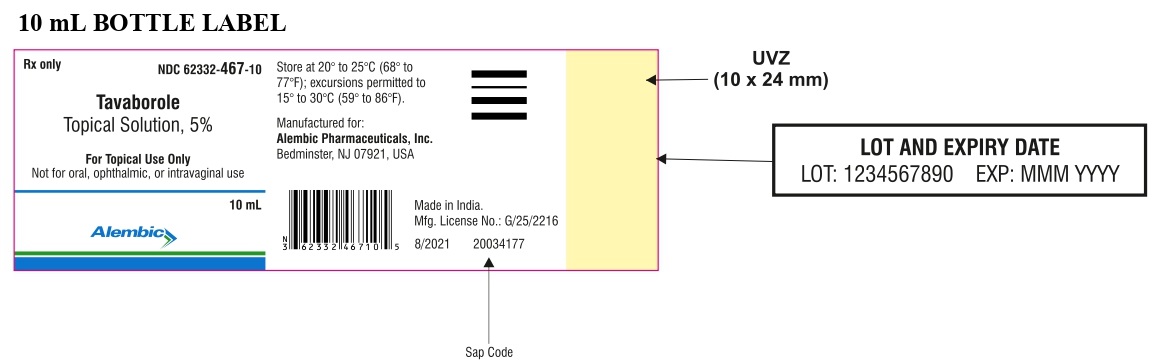
Tavaborole 43.5 mg/mL Solution — NDC 62332-467-10 (Billing 62332-0467-10)
This is a package of Tavaborole 43.5 mg/mL Solution from Alembic Pharmaceuticals Inc., marketed since Oct 2020 and currently FDA-listed; retail pharmacies pay about $3.39 per mL (NADAC). It is the main listing for this product, which comes in 2 package sizes.
NDC database record
One package, one record: these facts belong to NDC 62332-467-10 alone.
- Record
- FDA NDC Directory package listing · Human prescription drug
- Code segments
- 62332 labeler · 467 product · 10 package
- Package marketed since
- Oct 23, 2020
- Sample package
- No — commercial package
- Listing certified through
- Dec 31, 2026
- Barcode (UPC-A, from the NDC)
- 3 6233246710 5
- Medicaid fills, this package
- 1,179 prescriptions in the last four reported quarters
- FDA record last changed
- Jul 24, 2026
Other active recalls for Tavaborole (different manufacturers) — 2 · tap to view
Identity & classification
Regulatory identifiers FDA, NLM and CMS codes for this package
Drug-database identifiers Medi-Span GPI and First Databank GCN / HICL / AHFS classification
- GSN (GCN sequence number): 072716
- GCN: 36997
- GPI-14 (Medi-Span): 90156080002010
- HICL (First Databank): 041353
- AHFS class code: 84:04.08.24
- RxCUI (RxNorm): 1543177
Where does this data come from?
- FDA openFDA NDC Directory · synced Oct 8, 2026
- FDA label on DailyMed · label index refreshed Oct 8, 2026
- RxNorm (NLM RxNav) · catalog refreshed Oct 1, 2026
- Medi-Span GPI (licensed)
- First Databank (licensed) · refreshed Oct 8, 2026
RxNorm drug class
This medicine belongs to the Oxaborole Antifungal class.
Where does this data come from?
- RxClass (NLM) · catalog refreshed Oct 1, 2026
Clinical
Tavaborole topical solution is used to treat fungal toenail infections (infections that may cause nail discoloration, splitting, or pain). Tavaborole topical solution is in a class of medications called antifungals. It works by stopping the growth of nail fungus.
Read the full MedlinePlus article ↗- Tavaborole topical solution treats fungal infection of the toenails, called onychomycosis. It works against the fungi Trichophyton rubrum and Trichophyton mentagrophytes. It is not...
- Apply it once a day to the affected toenails for 48 weeks. Cover the whole nail surface and get some under the tip of each treated nail. It is only for your nails and skin, never f...
- Most are mild and happen where you apply it. You might notice peeling skin, redness, irritation or an ingrown toenail. Call your doctor if you get a rash, itching or swelling, whic...
- There are no human pregnancy data. Animal studies showed harm to the fetus at very high doses. Because some tavaborole is absorbed, tell your doctor if you are pregnant or breastfe...
Patient education
Supplement & herbal interactions
Some supplements/herbs that may interact with Tavaborole — tap one for details:
Where does this data come from?
- MedlinePlus (NLM) · refreshed Oct 8, 2026
- FDA label on DailyMed · label index refreshed Oct 8, 2026
Ask a licensed pharmacist directly — free, answered by our team.
Pricing
A drug doesn't have one price. Each row is a different public payment system, and none is what you'd pay at the counter — that depends on your insurance. The ⓘ on each row explains what it measures.
| Price system | Per mL | Per package |
|---|---|---|
| Retail pharmacies payNADAC · weekly | $3.390 | $33.90 / 10 ml |
| Medicaid paysCMS SDUD · 12 mo | $5.10 | $51.00 / 10 ml |
| Medicare drug plans payPart D · Q2 2026 | $8.79 | $87.95 / 10 ml |
Where does this data come from?
- CMS NADAC weekly file · file of Oct 7, 2026
- CMS ASP pricing files · refreshed Sep 20, 2026
- CMS Medicaid State Drug Utilization Data · through Q1 2026
- CMS Part D plan pricing files · refreshed Sep 24, 2026
- VA National Acquisition Center price file
Packaging — all sizes for this product
| Package NDC | Description | Per unit | Per pack | Marketing start | Marketing end | Status |
|---|---|---|---|---|---|---|
| 62332-0467-04 62332-467-04 | 1 BOTTLE, DROPPER in 1 CARTON / 4 mL in 1 BOTTLE, DROPPER | — | — | 2020-10-23 | — | Active |
| 62332-0467-10 You're viewing this Main listing | 1 BOTTLE, DROPPER in 1 CARTON / 10 mL in 1 BOTTLE, DROPPER | $3.39 / mL | $33.90 | 2020-10-23 | — | Active |
In Medicaid, this is the most-dispensed pack of this product — about 100% of fills over the last four reported quarters. See all packs ↓
Pack size FAQ
What quantity is in this package?
What NDC number is used to bill for this package of Tavaborole 43.5 mg/mL Solution?
Prices are the latest CMS NADAC pharmacy acquisition cost per NDC; per-pack figures are per-unit × pack quantity, shown only when the pack is denominated in the same measure NADAC prices.
Therapeutic equivalents
| Product | Labeler | Pack | NADAC/unit | TE | Status | Price vs. this |
|---|---|---|---|---|---|---|
| Tavaborole 43.5 mg/mL 21922-0020-12 | Encube | 1 bottle | $3.390 | AB | Availability likely | — |
| Tavaborole 43.5 mg/mL 62135-0663-59 | Chartwell | 10 ml | $3.390 | AB | Availability likely | — |
| Tavaborole 43.5 mg/mLthis 62332-0467-10 | Alembic | 1 bottle | $3.390 | AB | Availability likely | — |
| Tavaborole 43.5 mg/mL 72578-0102-04 | Viona | 1 bottle | $3.390 | AB | Availability likely | — |
| tavaborole 43.5 mg/mL 51862-0690-10 | Mayne | 1 bottle | $5.041 | AB | Discontinued | +49% |
| Tavaborole 43.5 mg/mL 46708-0467-04 | Alembic | 1 bottle | — | AB | FDA listed | — |
| Tavaborole 43.5 mg/mL 69097-0686-34 | Cipla | 1 bottle | — | — | Discontinued | — |
| Tavaborole 43.5 mg/mL 69238-1657-04 | Amneal | 1 bottle | — | — | Discontinued | — |
| Tavaborole 43.5 mg/mL 70771-1826-00 | Zydus | 1 bottle | — | AB | FDA listed | — |
Where does this data come from?
- FDA openFDA NDC Directory · synced Oct 8, 2026
- FDA Orange Book · refreshed Oct 3, 2026
- CMS NADAC weekly file · file of Oct 7, 2026
Availability & generic status
This product is an FDA-approved generic. Other versions of the same drug are listed under Therapeutic equivalents, least expensive first.
Where does this data come from?
- FDA Orange Book · refreshed Oct 3, 2026
Inactive Ingredients / Excipients
Inactive ingredients, also called excipients, are components of the drug product other than the active ingredient. They may include fillers, dyes, coatings, preservatives, flavors, or other formulation ingredients.
🧪 Avoiding an ingredient? See Tavaborole Topical inactive ingredients by manufacturer: every current product's list side by side, so you can ask your pharmacy for the version that does not list it.
💡 Tap an ingredient (hover on desktop) to see what it is and why it’s used.
-
UNII 3K9958V90M
A liquid solvent derived from fermentation or chemical synthesis. In medicines, alcohol dissolves active ingredients, helps preserve the product, and improves how the body absorbs certain drugs.
-
UNII 25IH6R4SGF
Edetate calcium disodium is a chelating agent, a chemical that binds to metal ions. It's used in some medications to prevent unwanted metals from interfering with the drug's stability and effectiveness.
-
UNII 6DC9Q167V3
Propylene glycol is a clear liquid derived from petroleum or vegetable sources. It acts as a solvent, humectant, and preservative in medicines, helping dissolve active ingredients and maintain product stability.
3 inactive ingredients listed in the exact product block matched to this NDC.
Where does this data come from?
ingredient classCode="IACT" elements from the exact product block matched by this NDC. Label-section narrative from DailyMed / the openFDA label index is shown separately when available.- FDA label on DailyMed · label index refreshed Oct 8, 2026
- FDA openFDA NDC Directory · synced Oct 8, 2026
Inactive ingredient FAQ
Are inactive ingredients the same for every manufacturer?
Why might an inactive ingredient be missing?
Can inactive ingredients matter?
Manufacturer & labeler
More NDCs from Alembic Pharmaceuticals Inc. labeler code 62332
- Acyclovir 50 mg/g Cream NDC 62332-423-05
- Lidocaine 50 mg/g Ointment NDC 62332-424-30
- CLOBETASOL PROPIONATE .05 g/mL Spray NDC 62332-425-12
- Zolmitriptan 2.5 mg Tablet, Film Coated NDC 62332-462-06
- Zolmitriptan 5 mg Tablet, Film Coated NDC 62332-463-03
- Clobetasol Propionate .5 mg/g Ointment NDC 62332-465-15
- Entacapone 200 mg Tablet, Film Coated NDC 62332-478-31
- Pirfenidone 267 mg Tablet, Coated NDC 62332-479-27
- Pirfenidone 801 mg Tablet, Coated NDC 62332-480-71
- Doxycycline Hyclate 75 mg Tablet, Delayed Release NDC 62332-481-31
- Doxycycline Hyclate 100 mg Tablet, Delayed Release NDC 62332-482-31
- Doxycycline Hyclate 150 mg Tablet, Delayed Release NDC 62332-483-30
Where does this data come from?
- FDA openFDA NDC Directory · synced Oct 8, 2026
- Drugs@FDA
Full prescribing information FDA SPL
🎯 Indications and Usage ▾
1 INDICATIONS AND USAGE Tavaborole topical solution, 5% is an oxaborole antifungal indicated for the treatment of onychomycosis of the toenails due to Trichophyton rubrum or Trichophyton mentagrophytes . Tavaborole topical solution is an oxaborole antifungal indicated for the topical treatment of onychomycosis of the toenails due to Trichophyton rubrum or Trichophyton mentagrophytes .
⏱️ Dosage and Administration ▾
2 DOSAGE AND ADMINISTRATION Apply tavaborole topical solution to affected toenails once daily for 48 weeks. Tavaborole topical solution should be applied to the entire toenail surface and under the tip of each toenail being treated. Tavaborole topical solution is for topical use only and not for oral, ophthalmic, or intravaginal use.
Apply tavaborole topical solution to affected toenails once daily for 48 weeks. ( 2 ) Tavaborole topical solution should be applied to the entire toenail surface and under the tip of each toenail being treated. ( 2 ) For topical use only.
( 2 ) Not for oral, ophthalmic, or intravaginal use. ( 2 )
💊 Dosage Forms and Strengths ▾
3 DOSAGE FORMS AND STRENGTHS Tavaborole topical solution, 5% is a clear, colorless alcohol-based solution. Each milliliter of solution contains 43.5 mg (5% w/w) of tavaborole. Solution, 5%.
⛔ Contraindications ▾
4 CONTRAINDICATIONS None. None.
🤒 Adverse Reactions ▾
6 ADVERSE REACTIONS Common adverse reactions occurring in ≥1% in subjects treated with tavaborole topical solution included application site exfoliation, ingrown toenail, application site erythema, and application site dermatitis. ( 6.1 ) To report SUSPECTED ADVERSE REACTIONS, contact Alembic Pharmaceuticals, Inc. at 1-866-210-9797 or FDA at 1-800-FDA-1088 or www.fda.gov/medwatch.
6.1Clinical Trials Experience Because clinical trials are conducted under widely varying conditions, adverse reaction rates observed in the clinical trials of a drug cannot be directly compared to rates in the clinical trials of another drug and may not reflect the rates observed in practice. In two clinical trials, 791 subjects were treated with tavaborole topical solution. The most commonly reported adverse reactions are listed below (Table 1).
Table 1: Adverse Reactions Occurring in ≥1% of Tavaborole Topical Solution, 5%-Treated Subjects and at a Greater Frequency than Observed with Vehicle Preferred Term Tavaborole Topical Solution N=791 n(%) Vehicle N=395 n(%) Application site exfoliation 21 (2.7%) 1 (0.3%) Ingrown toenail 20 (2.5%) 1 (0.3%) Application site erythema 13 (1.6%) 0 (0%) Application site dermatitis 10 (1.3%) 0 (0%)
6.2Postmarketing Experience The following adverse reactions have been identified during postmarketing use of tavaborole topical solution. Because these reactions are reported voluntarily from a population of uncertain size, it is not always possible to reliably estimate their frequency or establish a causal relationship to drug product exposure: Hypersensitivity; contact allergy
👥 Use in Specific Populations ▾
8 USE IN SPECIFIC POPULATIONS
8.1Pregnancy Risk Summary There are no available data on tavaborole topical solution use in pregnant women to inform a drug associated risk for major birth defects, miscarriage or adverse maternal or fetal outcomes. In oral animal reproductive studies, administration of tavaborole during the period of organogenesis resulted in embryofetal toxicity and malformations at 570 times the Maximum Recommended Human Dose (MRHD) based on Area Under the Curve (AUC) comparisons in rats and embryofetal toxicity at 155 times the MRHD based on AUC comparisons in rabbits.
Embryofetal toxicity was noted following dermal administration in rabbits up to 36 times the MRHD based on AUC comparisons [ see Data ]. The background risk of major birth defects and miscarriage for the indicated population is unknown. All pregnancies carry some risk of birth defect, loss, or other adverse outcomes.
The background risk of major birth defects in the U.S. general population is 2% to 4% and of miscarriage is 15% to 20% of clinically recognized pregnancies. Data Animal Data Oral administration: In an oral embryofetal development study in rats, oral doses of 30, 100, and 300 mg/kg/day tavaborole were administered during the period of organogenesis (gestational days 6 to 19) to pregnant female rats. In the presence of maternal toxicity, embryofetal toxicity (increased embryofetal resorption and/or deaths) and drug-related skeletal malformations and variations suggestive of delayed development (i.e., a delay in ossification) were noted in fetuses at 300 mg/kg/day tavaborole [570 times the MRHD based on AUC comparisons].
No developmental toxicity was noted in rats at 100 mg/kg/day tavaborole (26 times the MRHD based on AUC comparisons). In an oral embryofetal development study in rabbits, oral doses of 15, 50, and 150 mg/kg/day tavaborole were administered during the period of organogenesis (gestational days 7 to 19) to pregnant female rabbits. In the presence of maternal toxicity, excessive embryofetal mortality due to post-implantation loss was noted at 150 mg/kg/day tavaborole.
No drug related malformations were noted in rabbits at 150 mg/kg/day tavaborole (155 times the MRHD based on AUC comparisons). No embryofetal mortality was noted in rabbits at 50 mg/kg/day tavaborole (16 times the MRHD based on AUC comparisons). In an oral prenatal and postnatal development study in rats, oral doses of 15, 60, and 100 mg/kg/day tavaborole were administered from the beginning of organogenesis (gestation day 6) through the end of lactation (lactation day 20).
In the presence of minimal maternal toxicity, no embryofetal toxicity or effects on postnatal development were noted at 100 mg/kg/day (29 times the MRHD based on AUC comparisons). Topical administration: In a dermal embryofetal development study in rabbits, topical doses of 1%, 5%, and 10% tavaborole solution were administered during the period of organogenesis (gestational days 6 to 28) to pregnant female rabbits. A dose dependent increase in dermal irritation at the treatment site was noted at 5% and 10% tavaborole solution.
A decrease in fetal bodyweight was noted at 10% tavaborole solution. No drug related malformations were noted in rabbits at 10% tavaborole solution (36 times the MRHD based on AUC comparisons). No embryofetal toxicity was noted in rabbits at 5% tavaborole solution (26 times the MRHD based on AUC comparisons).
8.2Lactation Risk Summary There is no information available on the presence of tavaborole topical solution in human milk, the effects of the drug on the breastfed infant or the effects of the drug on milk production after topical application of tavaborole topical solution to women who are breastfeeding. Tavaborole topical solution is systemically absorbed. The lack of clinical data during lactation precludes a clear determination of the risk of tavaborole topical solution to a breastfed infant.
Therefore, the developmental and health benefits of breastfeeding… [Excerpted — this section continues on DailyMed.]
🤰 Pregnancy ▾
8.1Pregnancy Risk Summary There are no available data on tavaborole topical solution use in pregnant women to inform a drug associated risk for major birth defects, miscarriage or adverse maternal or fetal outcomes. In oral animal reproductive studies, administration of tavaborole during the period of organogenesis resulted in embryofetal toxicity and malformations at 570 times the Maximum Recommended Human Dose (MRHD) based on Area Under the Curve (AUC) comparisons in rats and embryofetal toxicity at 155 times the MRHD based on AUC comparisons in rabbits.
Embryofetal toxicity was noted following dermal administration in rabbits up to 36 times the MRHD based on AUC comparisons [ see Data ]. The background risk of major birth defects and miscarriage for the indicated population is unknown. All pregnancies carry some risk of birth defect, loss, or other adverse outcomes.
The background risk of major birth defects in the U.S. general population is 2% to 4% and of miscarriage is 15% to 20% of clinically recognized pregnancies. Data Animal Data Oral administration: In an oral embryofetal development study in rats, oral doses of 30, 100, and 300 mg/kg/day tavaborole were administered during the period of organogenesis (gestational days 6 to 19) to pregnant female rats. In the presence of maternal toxicity, embryofetal toxicity (increased embryofetal resorption and/or deaths) and drug-related skeletal malformations and variations suggestive of delayed development (i.e., a delay in ossification) were noted in fetuses at 300 mg/kg/day tavaborole [570 times the MRHD based on AUC comparisons].
No developmental toxicity was noted in rats at 100 mg/kg/day tavaborole (26 times the MRHD based on AUC comparisons). In an oral embryofetal development study in rabbits, oral doses of 15, 50, and 150 mg/kg/day tavaborole were administered during the period of organogenesis (gestational days 7 to 19) to pregnant female rabbits. In the presence of maternal toxicity, excessive embryofetal mortality due to post-implantation loss was noted at 150 mg/kg/day tavaborole.
No drug related malformations were noted in rabbits at 150 mg/kg/day tavaborole (155 times the MRHD based on AUC comparisons). No embryofetal mortality was noted in rabbits at 50 mg/kg/day tavaborole (16 times the MRHD based on AUC comparisons). In an oral prenatal and postnatal development study in rats, oral doses of 15, 60, and 100 mg/kg/day tavaborole were administered from the beginning of organogenesis (gestation day 6) through the end of lactation (lactation day 20).
In the presence of minimal maternal toxicity, no embryofetal toxicity or effects on postnatal development were noted at 100 mg/kg/day (29 times the MRHD based on AUC comparisons). Topical administration: In a dermal embryofetal development study in rabbits, topical doses of 1%, 5%, and 10% tavaborole solution were administered during the period of organogenesis (gestational days 6 to 28) to pregnant female rabbits. A dose dependent increase in dermal irritation at the treatment site was noted at 5% and 10% tavaborole solution.
A decrease in fetal bodyweight was noted at 10% tavaborole solution. No drug related malformations were noted in rabbits at 10% tavaborole solution (36 times the MRHD based on AUC comparisons). No embryofetal toxicity was noted in rabbits at 5% tavaborole solution (26 times the MRHD based on AUC comparisons).
🧒 Pediatric Use ▾
8.4Pediatric Use The safety and efficacy of tavaborole topical solution were established in patients 6 years of age and older. Use of tavaborole topical solution in these age groups is supported by evidence from adequate and well-controlled studies of tavaborole topical solution in adults with additional data from an open-label pharmacokinetics study of tavaborole in subjects 12 years to less than 17 years old [ see Clinical Pharmacology ( 12.3 )].
🧓 Geriatric Use ▾
8.5Geriatric Use In clinical trials of 791 subjects who were exposed to tavaborole topical solution, 19% were 65 years of age and over, while 4% were 75 years of age and over. No overall differences in safety or effectiveness were observed between these subjects and younger subjects, but greater sensitivity of some older individuals cannot be ruled out.
🧬 Clinical Pharmacology ▾
12 CLINICAL PHARMACOLOGY
12.1Mechanism of Action Tavaborole topical solution is an oxaborole antifungal [see Clinical Pharmacology ( 12.4 ) ].
12.2Pharmacodynamics At therapeutic doses, tavaborole topical solution is not expected to prolong QTc to any clinically relevant extent.
12.3Pharmacokinetics Tavaborole undergoes extensive metabolism. Renal excretion is the major route of elimination of the metabolites. In a clinical pharmacology trial of six healthy adult male volunteers who received a single topical application of 5% 14 C-tavaborole solution, tavaborole conjugates and metabolites were shown to be excreted primarily in the urine.
The pharmacokinetics (PK) of tavaborole was investigated in 24 adult subjects with distal subungual onychomycosis involving at least 4 toenails (including at least 1 great toenail) following a single dose and a 2-week daily topical application of 200 μL of a 5% solution of tavaborole to all ten toenails and 2 mm of skin surrounding each toenail. Steady state was achieved after 14 days of dosing. After a single dose, the mean (± standard deviation) peak concentration (C max ) of tavaborole was 3.5 ± 2.3 ng/mL (n=21 with measurable concentrations, range 0.618 to 10.2 ng/mL, LLOQ=0.5 ng/mL), and the mean AUC last ± SD was 44.4 ± 25.5 ng*hr/mL (n=21).
After 2 weeks of daily dosing, the mean C max ± SD was 5.2 ± 3.5 ng/mL (n=24, range 1.5 to 12.8 ng/mL), and the mean AUC τ ± SD was 75.8 ± 44.5 ng*hr/mL. In another study PK of tavaborole was investigated in 22 subjects aged 12 years to less than 17 years with distal subungual onychomycosis involving at least 4 toenails (including at least 1 great toenail with at least 20% involvement) following once daily application of 5% solution of tavaborole to all ten toenails and 2 mm of skin surrounding each toenail for 29 days.
On Day 29, the mean ± SD C max was 5.9 ± 4.9 ng/mL (n=21 with measurable concentrations, range 1.0 to 16.4 ng/mL, LLOQ=0.5 ng/mL), and the mean ± SD AUC 0-24 was 76.0 ± 62.5 ng*hr/mL. Drug Interaction Studies In Vitro Studies In vitro studies have shown that tavaborole, at therapeutic concentrations, neither inhibits nor induces cytochrome P450 (CYP450) enzymes.
12.4Microbiology Mechanism of Action The mechanism of action of tavaborole is inhibition of fungal protein synthesis. Tavaborole inhibits protein synthesis by inhibition of an aminoacyl-transfer ribonucleic acid (tRNA) synthetase (AARS). Activity in vitro and in clinical infections Tavaborole has been shown to be active against most strains of the following microorganisms, both in vitro and in clinical infections [see Indications and Usage ( 1 ) ]: Trichophyton rubrum Trichophyton mentagrophytes Mechanism of Resistance Trichophyton mentagrophytes and Trichophyton rubrum strains from isolates collected in the clinical trials have not demonstrated resistance following repeated exposure to tavaborole.
🧬 Mechanism of Action ▾
12.1Mechanism of Action Tavaborole topical solution is an oxaborole antifungal [see Clinical Pharmacology ( 12.4 ) ].
📦 How Supplied / Storage and Handling ▾
16 HOW SUPPLIED/STORAGE AND HANDLING
16.1How Supplied Tavaborole topical solution, 5% is a clear, colorless solution supplied in an amber glass bottle with a screw cap. At initial use, the screw cap is replaced with the dropper assembly. Tavaborole topical solution, 5% is supplied in the following presentations: NDC 62332-467-10: One bottle containing 10 mL of solution with one glass pointed-tip dropper.
NDC 62332-467-04: One bottle containing 4 mL of solution with one glass pointed-tip dropper.
16.2Storage and Handling Store at 20° to 25°C (68° to 77°F); excursions permitted to 15° to 30°C (59° to 86°F) [see USP Controlled Room Temperature]. CAUTION: Flammable. Keep away from heat and flame. Discard product within 3 months after insertion of the dropper. Keep bottle tightly closed. Keep out of reach of children. The Packaging of This Product Contains Dry Natural Rubber .
16.1How Supplied Tavaborole topical solution, 5% is a clear, colorless solution supplied in an amber glass bottle with a screw cap. At initial use, the screw cap is replaced with the dropper assembly. Tavaborole topical solution, 5% is supplied in the following presentations: NDC 62332-467-10: One bottle containing 10 mL of solution with one glass pointed-tip dropper.
NDC 62332-467-04: One bottle containing 4 mL of solution with one glass pointed-tip dropper.
📦 Storage and Handling ▾
16.2Storage and Handling Store at 20° to 25°C (68° to 77°F); excursions permitted to 15° to 30°C (59° to 86°F) [see USP Controlled Room Temperature]. CAUTION: Flammable. Keep away from heat and flame. Discard product within 3 months after insertion of the dropper. Keep bottle tightly closed. Keep out of reach of children. The Packaging of This Product Contains Dry Natural Rubber .
📋 Description ▾
11 DESCRIPTION Tavaborole topical solution, 5% contains tavaborole, 5% (w/w) in a clear, colorless alcohol-based solution for topical use. The active ingredient, tavaborole, is an oxaborole antifungal with the chemical name of 5-fluoro-1,3-dihydro-1-hydroxy-2,1-benzoxaborole. The chemical formula is C 7 H 6 BFO 2 , the molecular weight is 151.93 and the structural formula is: Tavaborole is a white to off-white powder.
It is slightly soluble in water and freely soluble in ethanol and propylene glycol. Each mL of tavaborole topical solution contains 43.5 mg of tavaborole. Inactive ingredients include alcohol (73.11% v/v), edetate calcium disodium, and propylene glycol.
Image
💬 Information for Patients ▾
17 PATIENT COUNSELING INFORMATION See FDA-approved patient labeling (Patient Information and Instructions for Use) The patient should be told the following: The impact of nail polish or other cosmetic nail products on the efficacy of tavaborole topical solution has not been evaluated. Inform a health care professional if the area of application shows signs of persistent irritation (for example, redness, itching, swelling). Product is flammable.
Avoid use near heat or open flame. Manufactured for: Alembic Pharmaceuticals, Inc. Bedminster, NJ 07921, USA Manufactured by: Alembic Pharmaceuticals Limited (Derma Division), Karakhadi, Vadodara 391450, India.
Mfg. License No.: G/25/2216 PATIENT INFORMATION Tavaborole (ta'' va bor' ole) topical solution, 5% Important information: Tavaborole topical solution is for use on toenails only. Do not use tavaborole topical solution in your mouth, eyes, or vagina.
What is tavaborole topical solution? Tavaborole topical solution is a prescription medicine used to treat fungal infections of the toenails. It is not known if tavaborole topical solution is safe and effective in children less than 6 years age.
Before using tavaborole topical solution, tell your healthcare provider about all of your medical conditions, including if you: • are pregnant or plan to become pregnant. It is not known if tavaborole topical solution can harm your unborn baby. • are breastfeeding or plan to breastfeed. It is not known if tavaborole topical solution passes into your breast milk.
Talk to your healthcare provider about the best way to feed your baby during your treatment with tavaborole topical solution. Tell your healthcare provider about all the medicines you take, including prescription and over-the- counter medicines, vitamins, and herbal supplements. How should I use tavaborole topical solution?
See the "Instructions for Use" at the end of this Patient Information for detailed information about the right way to use tavaborole topical solution. • Use tavaborole topical solution exactly as your healthcare provider tells you to use it. • Apply tavaborole topical solution to your affected toenails 1 time each day. • Tavaborole topical solution is used for 48 weeks. • It is not known if the use of nail polish or other cosmetic nail products (such as gel nails or acrylic nails) will affect how tavaborole topical solution works.
What should I avoid while using tavaborole topical solution? • Tavaborole topical solution is flammable. Avoid heat and flame while applying tavaborole topical solution to your toenail. What are the possible side effects of tavaborole topical solution?
The most common side effects of tavaborole topical solution include: skin peeling, ingrown toenail, redness, itching, and swelling. Tavaborole topical solution may cause irritation at or near the application site. Tell your healthcare provider if you develop irritation at the application site that does not go away.
These are not all of the possible side effects of tavaborole topical solution. Call your doctor for medical advice about side effects. You may report side effects to FDA at 1-800-FDA-1088.
How should I store tavaborole topical solution? • Store tavaborole topical solution at room temperature, between 68°F to 77°F (20°C to 25°C) • Tavaborole topical solution is flammable. Keep away from heat and flame. • Keep the bottle tightly closed. • Safely throw away tavaborole topical solution after 3 months of inserting the dropper. Keep tavaborole topical solution and all medicines out of the reach of children.
General information about the safe and effective use of tavaborole topical solution Medicines are sometimes prescribed for purposes other than those listed in a Patient Information leaflet. Do not use tavaborole topical solution for a condition for which it was not prescribed. Do not give tavaborole topical solution to other people, even if they have the same symptoms that you have.
It may harm them. You can ask your pharmacist or hea… [Excerpted — this section continues on DailyMed.]
🧬 Pharmacokinetics ▾
12.3Pharmacokinetics Tavaborole undergoes extensive metabolism. Renal excretion is the major route of elimination of the metabolites. In a clinical pharmacology trial of six healthy adult male volunteers who received a single topical application of 5% 14 C-tavaborole solution, tavaborole conjugates and metabolites were shown to be excreted primarily in the urine.
The pharmacokinetics (PK) of tavaborole was investigated in 24 adult subjects with distal subungual onychomycosis involving at least 4 toenails (including at least 1 great toenail) following a single dose and a 2-week daily topical application of 200 μL of a 5% solution of tavaborole to all ten toenails and 2 mm of skin surrounding each toenail. Steady state was achieved after 14 days of dosing. After a single dose, the mean (± standard deviation) peak concentration (C max ) of tavaborole was 3.5 ± 2.3 ng/mL (n=21 with measurable concentrations, range 0.618 to 10.2 ng/mL, LLOQ=0.5 ng/mL), and the mean AUC last ± SD was 44.4 ± 25.5 ng*hr/mL (n=21).
After 2 weeks of daily dosing, the mean C max ± SD was 5.2 ± 3.5 ng/mL (n=24, range 1.5 to 12.8 ng/mL), and the mean AUC τ ± SD was 75.8 ± 44.5 ng*hr/mL. In another study PK of tavaborole was investigated in 22 subjects aged 12 years to less than 17 years with distal subungual onychomycosis involving at least 4 toenails (including at least 1 great toenail with at least 20% involvement) following once daily application of 5% solution of tavaborole to all ten toenails and 2 mm of skin surrounding each toenail for 29 days.
On Day 29, the mean ± SD C max was 5.9 ± 4.9 ng/mL (n=21 with measurable concentrations, range 1.0 to 16.4 ng/mL, LLOQ=0.5 ng/mL), and the mean ± SD AUC 0-24 was 76.0 ± 62.5 ng*hr/mL. Drug Interaction Studies In Vitro Studies In vitro studies have shown that tavaborole, at therapeutic concentrations, neither inhibits nor induces cytochrome P450 (CYP450) enzymes.
🧬 Pharmacodynamics ▾
12.2Pharmacodynamics At therapeutic doses, tavaborole topical solution is not expected to prolong QTc to any clinically relevant extent.
🔬 Clinical Studies ▾
14 CLINICAL STUDIES The efficacy and safety of tavaborole topical solution was evaluated in two multicenter, double-blind, randomized, vehicle-controlled trials. Tavaborole topical solution or vehicle was applied once daily for 48 weeks in subjects with 20% to 60% clinical involvement of the target toenail, without dermatophytomas or lunula (matrix) involvement. A total of 1194 subjects (795 tavaborole topical solution, 399 Vehicle) 18 to 88 years of age, 82% male, 84% white, participated in these two trials.
Efficacy assessments were made at 52 weeks following a 48-week treatment period. The Complete Cure efficacy endpoint included negative mycology (negative KOH wet mount and negative fungal culture) and Completely Clear Nail (no clinical evidence of onychomycosis as evidenced by a normal toenail plate, no onycholysis, and no subungual hyperkeratosis). Efficacy results from the two trials are summarized in Table 2.
Table 2: Efficacy Outcomes a. Complete cure defined as 0% clinical involvement of the target toenail plus negative KOH and negative culture. b. Complete or almost complete cure defined as ≤10% affected target toenail area involved and negative KOH and culture. c.
Mycologic cure defined as negative KOH and negative culture. Efficacy Variable Trial 1 Trial 2 Tavaborole Topical Solution N=399 n (%) Vehicle N=194 n (%) Tavaborole Topical Solution N=396 n (%) Vehicle N=205 n (%) Complete Cure a 26 (6.5%) 1 (0.5%) 36 (9.1%) 3 (1.5%) Complete or Almost Complete Cure b 61 (15.3%) 3 (1.5%) 71 (17.9%) 8 (3.9%) Mycologic Cure c 124 (31.1%) 14 (7.2%) 142 (35.9%) 25 (12.2%)
🧪 Nonclinical Toxicology ▾
13 NONCLINICAL TOXICOLOGY
13.1Carcinogenesis , Mutagenesis , Impairment of Fertility In an oral carcinogenicity study in Sprague-Dawley rats, oral doses of 12.5, 25, and 50 mg/kg/day tavaborole were administered to rats once daily for 104 weeks. No drug related neoplastic findings were noted at oral doses up to 50 mg/kg/day tavaborole (14 times the MRHD based on AUC comparisons). In a dermal carcinogenicity study in CD-1 mice, topical doses of 5%, 10%, and 15% tavaborole solution were administered to mice once daily for 104 weeks.
No drug related neoplastic findings were noted at topical doses up to 15% tavaborole solution (89 times the MRHD based on AUC comparisons). Tavaborole revealed no evidence of mutagenic or clastogenic potential based on the results of two in vitro genotoxicity tests (Ames assay and Human lymphocyte chromosomal aberration assay) and one in vivo genotoxicity test (rat micronucleus assay). No effects on fertility were observed in male and female rats that were administered oral doses up to 300 mg/kg/day tavaborole (107 times the MRHD based on AUC comparisons) prior to and during early pregnancy.
📄 Carcinogenesis, Mutagenesis, Impairment of Fertility ▾
13.1Carcinogenesis , Mutagenesis , Impairment of Fertility In an oral carcinogenicity study in Sprague-Dawley rats, oral doses of 12.5, 25, and 50 mg/kg/day tavaborole were administered to rats once daily for 104 weeks. No drug related neoplastic findings were noted at oral doses up to 50 mg/kg/day tavaborole (14 times the MRHD based on AUC comparisons). In a dermal carcinogenicity study in CD-1 mice, topical doses of 5%, 10%, and 15% tavaborole solution were administered to mice once daily for 104 weeks.
No drug related neoplastic findings were noted at topical doses up to 15% tavaborole solution (89 times the MRHD based on AUC comparisons). Tavaborole revealed no evidence of mutagenic or clastogenic potential based on the results of two in vitro genotoxicity tests (Ames assay and Human lymphocyte chromosomal aberration assay) and one in vivo genotoxicity test (rat micronucleus assay). No effects on fertility were observed in male and female rats that were administered oral doses up to 300 mg/kg/day tavaborole (107 times the MRHD based on AUC comparisons) prior to and during early pregnancy.
📄 Patient Package Insert ▾
Fig ure E Figure F Step 8: Repeat Steps 3 to 7 to apply tavaborole topical solution to each affected toenail. Step 9: Let the tavaborole topical solution dry completely. This may take a couple of minutes.
Avoid getting tavaborole topical solution on skin that is not surrounding the treated toenail(s). If tavaborole topical solution comes in contact with surrounding skin, use a tissue to wipe any excess solution from the surrounding skin. Do not wipe tavaborole topical solution off of your toenails.
Step 10 : After applying tavaborole topical solution to your toenails, insert the dropper back into the bottle and screw it on tightly. Step 11: Wash your hands with soap and water after applying tavaborole topical solution. This Patient Information and Instructions for Use has been approved by the U.S.
Food and Drug Administration. Manufactured for: Alembic Pharmaceuticals, Inc. Bedminster, NJ 07921, USA Manufactured by: Alembic Pharmaceuticals Limited (Derma Division), Karakhadi, Vadodara 391450, India.
Revised: 12/2023 Image
📄 Package Label / Principal Display Panel ▾
PACKAGE LABEL.PRINCIPAL DISPLAY PANEL NDC 62332-467-10 Tavaborole Topical Solution, 5% For Topical Use Only Not for oral, ophthalmic, or intravaginal use 10 mL Rx only 10 mL Bottle label 10 mL carton