
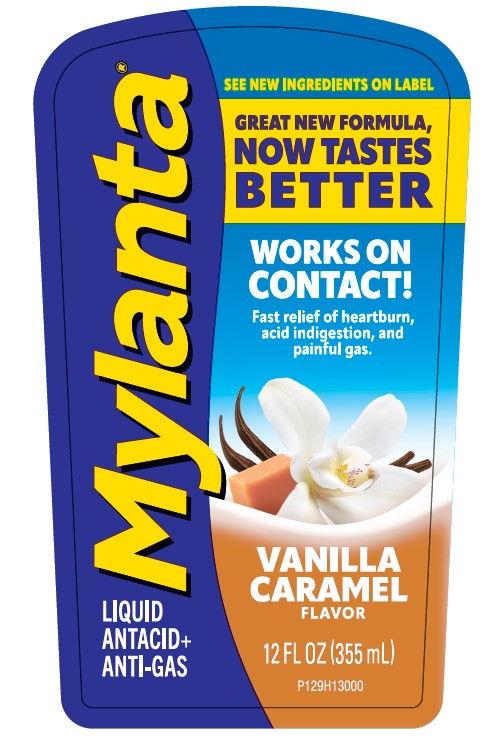
Mylanta Vanilla Caramel Calcium carbonate, magnesium hydroxide, simethicone 800 mg/10mL; 80 mg/10mL; 270 mg/10mL Liquid, 355 mL — NDC 62372-541-12 (Billing 62372-0541-12)
This is a package of 355 mL of Mylanta Vanilla Caramel Calcium carbonate, magnesium hydroxide, simethicone 800 mg/10mL; 80 mg/10mL; 270 mg/10mL Liquid from Infirst Healthcare Inc., marketed since Jan 2024 and currently FDA-listed. It is this product's only package size.
NDC database record
One package, one record: these facts belong to NDC 62372-541-12 alone.
- Record
- FDA NDC Directory package listing · Human OTC drug
- Code segments
- 62372 labeler · 541 product · 12 package
- Package marketed since
- Jan 31, 2024
- Sample package
- No — commercial package
- Listing certified through
- Dec 31, 2026
- Barcode (UPC-A, from the NDC)
- 3 6237254112 4
- FDA record last changed
- Oct 8, 2026
Identity & classification
Regulatory identifiers FDA, NLM and CMS codes for this package
- RxCUI (RxNorm): 1788932
Where does this data come from?
- FDA openFDA NDC Directory · synced Oct 8, 2026
- FDA label on DailyMed · label index refreshed Oct 8, 2026
- RxNorm (NLM RxNav) · catalog refreshed Oct 1, 2026
- Medi-Span GPI (licensed)
- First Databank (licensed) · refreshed Oct 8, 2026
RxNorm drug class
This medicine belongs to the Calcium compounds class.
Where does this data come from?
- RxClass (NLM) · catalog refreshed Oct 1, 2026
Clinical
Mylanta Vanilla Caramel is an oral liquid antacid sold as an over-the-counter monograph drug. It contains calcium carbonate and magnesium hydroxide, which are bases that typically neutralize stomach acid, and simethicone (also called dimethicone), an anti-gas agent commonly used to reduce bloating and gas discomfort. This combination is typically used as a short-term remedy for heartburn, indigestion, and upset stomach.
Patient education
Supplement & herbal interactions
Where does this data come from?
- MedlinePlus (NLM) · refreshed Oct 8, 2026
- FDA label on DailyMed · label index refreshed Oct 8, 2026
Ask a licensed pharmacist directly — free, answered by our team.
Pricing
A drug doesn't have one price. Each row is a different public payment system, and none is what you'd pay at the counter — that depends on your insurance. The ⓘ on each row explains what it measures.
| Price system | Per mL | Per package |
|---|---|---|
| Retail pharmacies payNADAC · weekly | Not in the retail survey — common for institutional, discontinued, or low-volume packs. | |
| Medicaid paysCMS SDUD · 12 mo | No recent Medicaid claims on file for this NDC — rare and low-volume NDCs are suppressed in the public data. | |
| Medicare drug plans payPart D · quarterly | No Part D plan price is available for this NDC in our data. | |
Where does this data come from?
- CMS NADAC weekly file
- CMS ASP pricing files · refreshed Sep 20, 2026
- CMS Medicaid State Drug Utilization Data · refreshed Oct 8, 2026
- CMS Part D plan pricing files · refreshed Sep 24, 2026
- VA National Acquisition Center price file
Packaging — all sizes for this product
| Package NDC | Description | Marketing start | Marketing end | Status |
|---|---|---|---|---|
| 62372-0541-12 You're viewing this Main listing | 355 mL in 1 BOTTLE | 2024-01-31 | — | Active |
Therapeutic equivalents
Where does this data come from?
- FDA openFDA NDC Directory · synced Oct 8, 2026
- FDA Orange Book · refreshed Oct 3, 2026
- CMS NADAC weekly file
Availability & generic status
We did not find an FDA-approved generic match for this exact strength, form and route.
Where does this data come from?
- FDA Orange Book · refreshed Oct 3, 2026
Inactive Ingredients / Excipients
Inactive ingredients, also called excipients, are components of the drug product other than the active ingredient. They may include fillers, dyes, coatings, preservatives, flavors, or other formulation ingredients.
💡 Tap an ingredient (hover on desktop) to see what it is and why it’s used.
-
UNII 8SKN0B0MIM
Benzoic acid is a naturally occurring organic acid used as a preservative in medicines and foods. It helps prevent bacterial and fungal growth to extend shelf life and maintain product stability.
-
UNII LKG8494WBH
Benzyl alcohol is a clear liquid used as a preservative and solvent in medicines. It helps prevent bacterial and fungal growth and dissolves other ingredients to create uniform liquid formulations.
-
UNII 7FLD91C86K
Edetate disodium is a chemical compound that binds and removes certain metal ions. In medicines, it acts as a preservative and stabilizer by preventing metals like calcium from interfering with the product's shelf life and consistency.
-
UNII PDC6A3C0OX
Glycerin is a clear, thick liquid derived from plant oils or fats. It acts as a humectant to retain moisture, a sweetener, and a solvent in medications.
-
UNII 230OU9XXE4
A waxy substance made from glycerin and stearic acid that acts as an emulsifier to blend oily and watery ingredients together. It also helps thicken and stabilize the medicine's texture.
-
UNII Z944H5SN0H
A plant-based thickening agent derived from cellulose. It acts as a binder to hold tablet ingredients together and as a thickener in liquid formulations to achieve the right consistency.
-
UNII OP1R32D61U
Microcrystalline cellulose is a purified form of cellulose, a natural fiber from plant sources. It acts as a binder and filler in tablets and capsules, helping hold ingredients together and give the medicine its shape and size.
-
UNII 2P9L47VI5E
A waxy compound made by combining polyethylene glycol with stearic acid. It acts as an emulsifier and thickener, helping blend oil and water-based ingredients and giving the medicine a smooth, stable consistency.
-
UNII 14BGY2Y3MJ
Polysorbate 65 is a synthetic emulsifier derived from sorbitol and fatty acids. It helps mix oil and water in medications, keeping ingredients evenly distributed throughout the product.
-
UNII OJ245FE5EU
Sodium benzoate is a salt derived from benzoic acid, a preservative. It's added to medicines to prevent growth of bacteria, fungi, and other microorganisms that could spoil the product.
-
UNII X045WJ989B
Sorbic acid is a preservative derived from berries that prevents mold, yeast, and bacterial growth in medicines. It keeps the product stable and safe during storage.
-
UNII 96K6UQ3ZD4
Sucralose is a synthetic sweetener made from sugar. It's added to medicines to improve taste without adding calories, helping make bitter or unpleasant-tasting drugs easier to take.
-
UNII 059QF0KO0R
Water is a liquid solvent that dissolves and mixes ingredients together in liquid medicines, syrups, and injections. It helps distribute the active drug evenly throughout the product.
-
UNII TTV12P4NEE
Xanthan gum is a thickening and stabilizing ingredient made from fermented corn or other sugars. It's added to medicines to improve texture, prevent separation of liquids and solids, and help the product stay consistent.
14 inactive ingredients listed in the exact product block matched to this NDC.
Label-section wording can be broader than the structured product block and may mention additional formulation ingredients.
Where does this data come from?
ingredient classCode="IACT" elements from the exact product block matched by this NDC. Label-section narrative from DailyMed / the openFDA label index is shown separately when available.- FDA label on DailyMed · label index refreshed Oct 8, 2026
- FDA openFDA NDC Directory · synced Oct 8, 2026
Inactive ingredient FAQ
Are inactive ingredients the same for every manufacturer?
Why might an inactive ingredient be missing?
Can inactive ingredients matter?
Manufacturer & labeler
More NDCs from Infirst Healthcare Inc. labeler code 62372
- Childrens Mylicon All in One Tummy Relief for Kids Antacid and Antigas 400 mg/5mL; 40 mg/5mL Liquid NDC 62372-410-04
- Mylanta Maximum Strength Classic Flavor Antacid and Anti Gas Aluminum hydroxide Magnesium hydroxide and Simethicone 800 mg/10mL; 800 mg/10mL; 80 mg/10mL Suspension NDC 62372-500-10
- Mylanta Classic Calcium carbonate, magnesium hydroxide, simethicone 800 mg/10mL; 80 mg/10mL; 270 mg/10mL Liquid NDC 62372-501-12
- Mylanta Maximum Strength Vanilla Caramel Flavor Antacid and Anti Gas Aluminum hydroxide Magnesium hydroxide and Simethicone 800 mg/10mL; 800 mg/10mL; 80 mg/10mL Suspension NDC 62372-504-12
- Mylanta New Tonight Soothing Honey Chamomile Calcium Carbonate,Magnesium hydroxide and Simethicone 800 mg/10mL; 270 mg/10mL; 80 mg/10mL Suspension NDC 62372-510-10
- Mylanta All-Family Multi Symptom Stomach Remedy calcium carbonate, simethicone 800 mg/10mL; 80 mg/10mL Liquid NDC 62372-520-16
- Mylanta Fall Harvest Collection Pumpkin Spice Calcium Carbonate,Magnesium hydroxide and Simethicone 800 mg/10mL; 270 mg/10mL; 80 mg/10mL Suspension NDC 62372-542-12
- Mylanta Fall Harvest Collection Spiced Apple Cider Calcium Carbonate,Magnesium hydroxide and Simethicone 800 mg/10mL; 270 mg/10mL; 80 mg/10mL Suspension NDC 62372-543-12
- Mylanta One Antacid/Anti-Gas Calcium carbonate, Magnesium hydroxide, Dimethicone 1000 mg; 270 mg; 80 mg Tablet, Chewable NDC 62372-551-50
- Mylanta One Antacid/Anti-Gas Calcium carbonate, Magnesium hydroxide, Dimethicone 1000 mg; 270 mg; 80 mg Tablet, Chewable NDC 62372-552-50
- mylanta gas Simethicone 125 mg Capsule, Liquid Filled NDC 62372-554-31
- Mylicon Infants Gas Relief Original Simethicone 20 mg/.3mL Emulsion NDC 62372-630-15
Where does this data come from?
- FDA openFDA NDC Directory · synced Oct 8, 2026
- Drugs@FDA
FDA label — Drug Facts FDA SPL
🎯 Indications and Usage ▾
Uses relieves: • heartburn • acid indigestion • sour stomach • upset stomach due to these symptoms • pressure and bloating commonly referred to as gas • overindulgence in food and drink
⏱️ Dosage and Administration ▾
Directions • shake well before use • measure with dosing cup provided • adults and children 12 years and over: 10 mL-20 mL (1-2 doses) as needed, between meals, at bedtime or as directed by a doctor • do not take more than 60 mL (6 doses) in any 24-hour period • do not use the maximum dosage for more than 2 weeks • children under 12 years : ask a doctor • mL=milliliter
⚠️ Warnings ▾
Warnings Ask a doctor before use if you have • kidney disease • a magnesium restricted diet Ask a doctor or pharmacist before use if you are presently taking a prescription drug. Antacids may interact with certain prescription drugs. Keep out of reach of children. In case of overdose, get medical help or contact a poison control center right away at 1-800-222-1222.
🧪 Active Ingredient ▾
Active ingredients Calcium carbonate 800 mg Magnesium hydroxide 270 mg Simethicone 80 mg
🧪 Inactive Ingredients ▾
Inactive ingredients benzoic acid, benzyl alcohol, edetate disodium, flavor, glycerin, glyceryl monostearate, methylcellulose, microcrystalline cellulose, peg-8 stearate, polysorbate 65, purified water, sodium benzoate, sorbic acid, sucralose, xanthan gum
🎯 Purpose ▾
Purposes Antacid Antacid Anti-gas
📄 Ask a Doctor Before Use If ▾
Ask a doctor before use if you have • kidney disease • a magnesium restricted diet
📄 Ask a Doctor or Pharmacist Before Use If ▾
Ask a doctor or pharmacist before use if you are presently taking a prescription drug. Antacids may interact with certain prescription drugs.
📄 Keep Out of Reach of Children ▾
Keep out of reach of children. In case of overdose, get medical help or contact a poison control center right away at 1-800-222-1222.
📄 Questions or Comments ▾
Questions or comments? call 1-844-695-6624 toll free (English and Spanish)
📄 Package Label / Principal Display Panel ▾
Mylanta ® LIQUID ANTACID+ANTI-GAS WORKS ON CONTACT! Fast relief of heartburn, acid indigestion, and painful gas. VANILLA CARAMEL FLAVOR 12 FL OZ (355 mL) label
About this NDC listing & data coverage
What data is (and isn’t) available for this NDC — tap to expand
| NDC identity (package / product / labeler codes) | ✓ Available |
| Labeler | ✓ Available |
| Product & package description | ✓ Available |
| Marketing category & status | ✓ Available |
| Active ingredient / dosage form / route | ✓ Available |
| FDA label (SPL via DailyMed) | ✓ Available |
| Package photos | ✓ Available |
| Inactive ingredients (structured) | ✓ Available |
| NADAC pharmacy acquisition price (CMS) | — Not published for this NDC CMS publishes NADAC only for NDCs reported in its retail-pharmacy survey. |
| Orange Book / therapeutic-equivalence data | — Not published for this NDC Applies only to products approved under an NDA/ANDA; many listings are out of scope. |
| HCPCS J-code billing crosswalk | — Not published for this NDC Most self-administered / retail products have no J-code — that is normal. |
| Medicaid utilization (CMS SDUD) | — Not published for this NDC CMS reports utilization only for NDCs with Medicaid claims above its privacy threshold. |