
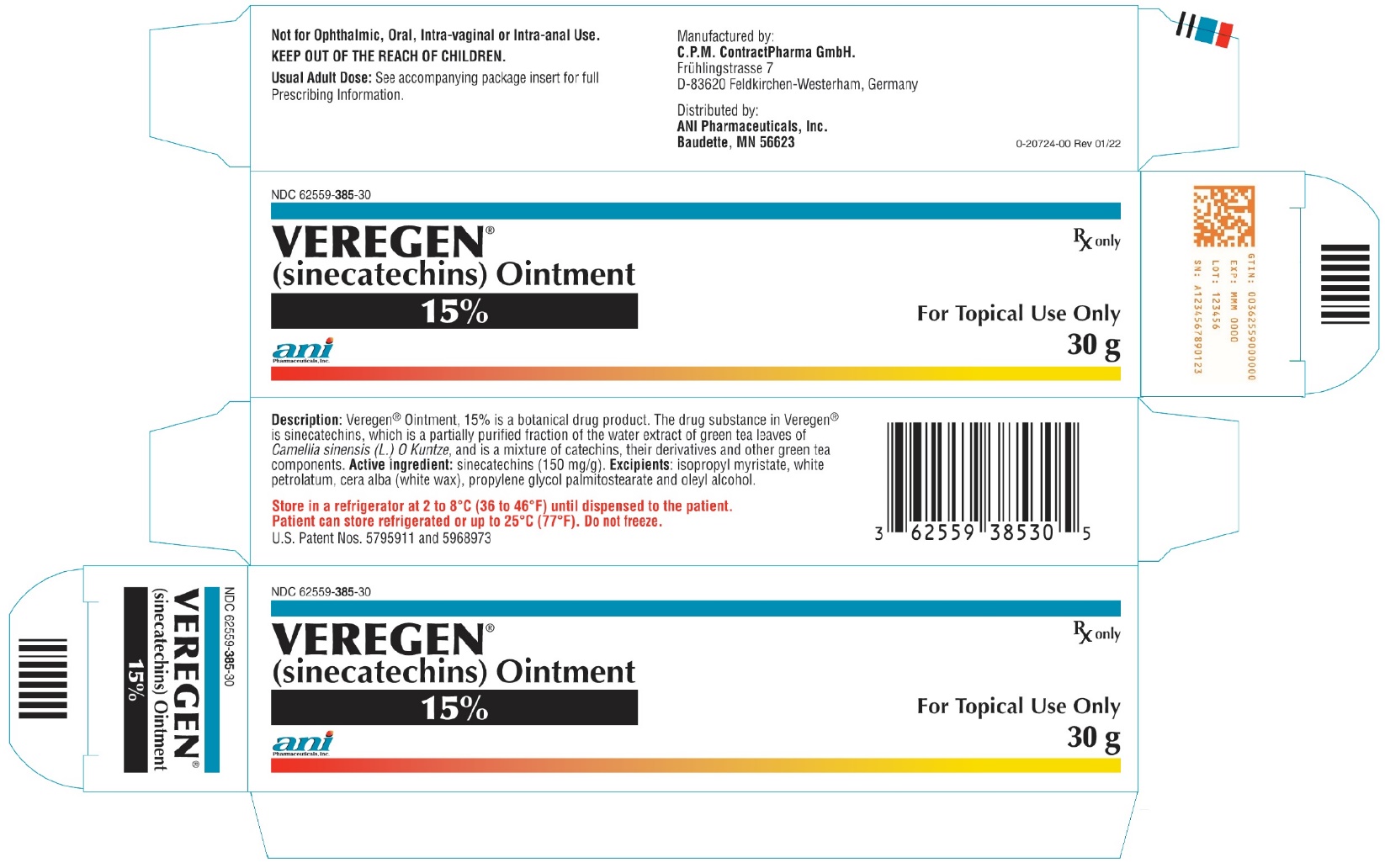
Veregen sinecatechins 150 mg/g Ointment — NDC 62559-385-30 (Billing 62559-0385-30)
This is a package of Veregen sinecatechins 150 mg/g Ointment from ANI Pharmaceuticals, Inc., marketed since Nov 2022 and currently FDA-listed; retail pharmacies pay about $50.96 per g (NADAC). It is the main listing for this product, which comes in 2 package sizes.
NDC database record
One package, one record: these facts belong to NDC 62559-385-30 alone.
- Record
- FDA NDC Directory package listing · Human prescription drug
- Code segments
- 62559 labeler · 385 product · 30 package
- Package marketed since
- Nov 10, 2022
- Sample package
- No — commercial package
- Listing certified through
- Dec 31, 2026
- Barcode (UPC)
- 0362559385305
- Medicaid fills, this package
- 96 prescriptions in the last four reported quarters
- FDA record last changed
- Jul 24, 2026
Identity & classification
Regulatory identifiers FDA, NLM and CMS codes for this package
Drug-database identifiers Medi-Span GPI and First Databank GCN / HICL / AHFS classification
- GSN (GCN sequence number): 063500
- GCN: 99226
- GPI-14 (Medi-Span): 90760070004220
- HICL (First Databank): 035277
- AHFS class code: 84:28.00.00
- RxCUI (RxNorm): 753350
Where does this data come from?
- FDA openFDA NDC Directory · synced Oct 8, 2026
- FDA label on DailyMed · label index refreshed Oct 8, 2026
- RxNorm (NLM RxNav) · catalog refreshed Oct 8, 2026
- Medi-Span GPI (licensed)
- First Databank (licensed) · refreshed Oct 8, 2026
RxNorm drug class
This medicine belongs to the Antivirals class.
Where does this data come from?
- RxClass (NLM) · catalog refreshed Oct 8, 2026
Clinical
Patient education
Supplement & herbal interactions
Where does this data come from?
- MedlinePlus (NLM) · refreshed Oct 8, 2026
- FDA label on DailyMed · label index refreshed Oct 8, 2026
Ask a licensed pharmacist directly — free, answered by our team.
Pricing
A drug doesn't have one price. Each row is a different public payment system, and none is what you'd pay at the counter — that depends on your insurance. The ⓘ on each row explains what it measures.
| Price system | Per g | Per package |
|---|---|---|
| Retail pharmacies payNADAC · weekly | $50.958 | $1,528.73 / 30 g |
| Medicaid paysCMS SDUD · 12 mo | $51.80 | $1,554.02 / 30 g |
| Medicare drug plans payPart D · Q2 2026 | $50.69 | $1,520.76 / 30 g |
Where does this data come from?
- CMS NADAC weekly file · file of Oct 7, 2026
- CMS ASP pricing files · refreshed Sep 20, 2026
- CMS Medicaid State Drug Utilization Data · through Q1 2026
- CMS Part D plan pricing files · refreshed Sep 24, 2026
- VA National Acquisition Center price file
Packaging — all sizes for this product
| Package NDC | Description | Per unit | Per pack | Marketing start | Marketing end | Status |
|---|---|---|---|---|---|---|
| 62559-0385-26 62559-385-26 | 6 CARTON in 1 CARTON / 1 TUBE in 1 CARTON / 2 g in 1 TUBE Sample | — | — | 2022-11-10 | — | Active |
| 62559-0385-30 You're viewing this Main listing | 1 TUBE in 1 CARTON / 30 g in 1 TUBE | $50.96 / g | $1,528.73 | 2022-11-10 | — | Active |
Pack size FAQ
What quantity is in this package?
What NDC number is used to bill for this package of Veregen sinecatechins 150 mg/g Ointment?
Prices are the latest CMS NADAC pharmacy acquisition cost per NDC; per-pack figures are per-unit × pack quantity, shown only when the pack is denominated in the same measure NADAC prices.
Therapeutic equivalents
| Product | Labeler | Pack | NADAC/unit | TE | Status | Price vs. this |
|---|---|---|---|---|---|---|
| Veregen 150 mg/gthis 62559-0385-30 | ANI | 1 tube | $50.958 | — | Availability likely | — |
Where does this data come from?
- FDA openFDA NDC Directory · synced Oct 8, 2026
- FDA Orange Book · refreshed Oct 3, 2026
- CMS NADAC weekly file · file of Oct 7, 2026
Availability & generic status
We did not find an FDA-approved generic match for this exact strength, form and route. Patent/protection dates below may affect future generic timing.
Why the date isn’t exact: Generic timing can change because patents may be challenged, settled, licensed, added, removed, or worked around with a narrower label — and FDA approval does not always mean a pharmacy can get the generic today.
🛈 What do these terms mean?
- Patent
- Legal protection listed in the Orange Book that may delay generic approval or launch. Issued by the U.S. Patent & Trademark Office.
- Substance patent
- Covers the active drug molecule itself — the hardest to design around. A generic generally can’t launch until it expires.
- Formulation (product) patent
- Covers a specific formulation or dosage form. A generic can sometimes work around it with a different formulation.
- Method-of-use patent
- A patent covering one specific approved use of the drug — not necessarily the whole molecule. A generic can sometimes launch with a “skinny label” that carves out the protected use and keeps the others.
- Skinny label
- A generic label that omits a still-patented use when the FDA allows it — letting a generic reach the market for the unprotected uses.
- Exclusivity
- FDA-granted marketing protection, separate from patents — e.g. 5-yr new chemical entity, 7-yr orphan drug, or a +6-month pediatric extension.
- Paragraph IV
- A generic applicant’s formal challenge to a listed patent. It can potentially lead to earlier generic entry, but often involves litigation or a settlement.
- RLD / RS
- Reference Listed Drug — the brand product the FDA uses as the reference for generic applications. Reference Standard — the product the FDA expects generics to compare against in bioequivalence testing.
- TE / AB rating
- FDA therapeutic-equivalence rating. An AB rating generally means the FDA considers a generic therapeutically equivalent to — and substitutable for — the brand.
- LOE (loss of exclusivity)
- The latest patent or exclusivity currently listed — the loss-of-exclusivity / latest-listed-protection date shown on this page. Paragraph-IV challenges and settlements can move the real date earlier; FDA approval and a manufacturer’s decision to market can move it later.
Built from the FDA Orange Book. The bars above are scaled to each protection’s expiry; the red LOE marker is the last one to lapse.
| Patent | Type | Use code | Expires |
|---|---|---|---|
| US 7858662 ↗ | Method of use | U-172 | Oct 2, 2026 |
Is there a generic version of VEREGEN 15% OINTMENT?
The FDA approved a generic — why can’t I get it at my pharmacy yet?
Why do different websites show different generic release dates?
What does “FDA listed” mean?
What does a patent or protection date mean here?
What does “current Orange Book estimate” mean?
Can a generic come out before the last patent expires?
Can a generic come out after the listed dates?
What is the difference between patents and exclusivity?
Why are there multiple patent dates?
Where does this data come from?
- FDA Orange Book · refreshed Oct 3, 2026
What it looks like
Where does this data come from?
- FDA label on DailyMed · label index refreshed Oct 8, 2026
Inactive Ingredients / Excipients
Inactive ingredients, also called excipients, are components of the drug product other than the active ingredient. They may include fillers, dyes, coatings, preservatives, flavors, or other formulation ingredients.
💡 Tap an ingredient (hover on desktop) to see what it is and why it’s used.
-
UNII 0RE8K4LNJS
Isopropyl myristate is an oily liquid made from coconut or palm oil. It's used in medicines as an emollient and penetration enhancer to help the medicine absorb through skin or improve spreadability in topical products.
-
UNII 172F2WN8DV
A fatty alcohol derived from animal or plant oils. It acts as an emollient and helps stabilize emulsions, allowing oil and water to mix evenly in the medication.
-
UNII 4T6H12BN9U
Petrolatum is a purified mineral oil-based jelly derived from petroleum. In medicines, it acts as an emollient, lubricant, and moisture barrier to soften skin, reduce friction, and help prevent water loss from formulations.
-
UNII F76354LMGR
A synthetic fatty acid compound derived from propylene glycol and palm oil. It works as an emulsifier to blend oil and water-based ingredients, and as a thickener to improve texture and stability in the medicine.
-
UNII 7G1J5DA97F
White wax is a refined, bleached plant-based or mineral wax that serves as a coating and hardening agent in medicines. It helps control how fast the drug dissolves and improves the product's texture and appearance.
5 inactive ingredients listed in the exact product block matched to this NDC.
Where does this data come from?
ingredient classCode="IACT" elements from the exact product block matched by this NDC. Label-section narrative from DailyMed / the openFDA label index is shown separately when available.- FDA label on DailyMed · label index refreshed Oct 8, 2026
- FDA openFDA NDC Directory · synced Oct 8, 2026
Inactive ingredient FAQ
Are inactive ingredients the same for every manufacturer?
Why might an inactive ingredient be missing?
Can inactive ingredients matter?
Manufacturer & labeler
More NDCs from ANI Pharmaceuticals, Inc. labeler code 62559
- Glipizide 5 mg Tablet NDC 62559-315-10
- Glipizide 10 mg Tablet NDC 62559-316-10
- Kionex Sodium Polystyrene Sulfonate 15 g/60mL Suspension NDC 62559-356-01
- Flecainide Acetate 50 mg Tablet NDC 62559-380-01
- Flecainide Acetate 100 mg Tablet NDC 62559-381-01
- Flecainide Acetate 150 mg Tablet NDC 62559-382-01
- vancomycin hydrochloride 125 mg Capsule NDC 62559-390-20
- vancomycin hydrochloride 250 mg Capsule NDC 62559-391-20
- Colestipol Hydrochloride 1 g Tablet, Film Coated NDC 62559-395-12
- Benazepril Hydrochloride and Hydrochlorothiazide 5 mg; 6.25 mg Tablet NDC 62559-414-01
- Benazepril Hydrochloride and Hydrochlorothiazide 10 mg; 12.5 mg Tablet NDC 62559-415-01
- Benazepril Hydrochloride and Hydrochlorothiazide 20 mg; 12.5 mg Tablet NDC 62559-416-01
Where does this data come from?
- FDA openFDA NDC Directory · synced Oct 8, 2026
- Drugs@FDA
Full prescribing information FDA SPL
🎯 Indications and Usage ▾
1 INDICATIONS AND USAGE Veregen is a topical ointment indicated for the treatment of external genital and perianal warts (Condylomata acuminata) in immunocompetent patients 18 years and older (1.1) . Limitations of Use Safety and effectiveness of Veregen have not been established in immunosuppressed patients, in treatment of external genital and perianal warts beyond 16-weeks, or for multiple treatment courses (1.2) .
1.1Indication Veregen is indicated for the topical treatment of external genital and perianal warts (Condylomata acuminata) in immunocompetent patients 18 years and older.
1.2Limitations of Use The safety and effectiveness of Veregen have not been established for treatment beyond 16-weeks or for multiple treatment courses. The safety and effectiveness of Veregen in immunosuppressed patients have not been established.
⏱️ Dosage and Administration ▾
2 DOSAGE AND ADMINISTRATION • Veregen is to be applied three times per day to all external genital and perianal warts (2.1) . • Apply about an 0.5 cm strand of ointment to each wart using the finger(s), dabbing it on to ensure complete coverage and leaving a thin layer of the ointment on the warts (2.1) . • Veregen is not for ophthalmic, oral, intravaginal, or intra-anal use (2.1) .
2.1General Dosing Information Veregen is to be applied three times per day to all external genital and perianal warts. Apply about an 0.5 cm strand of the Veregen to each wart using the finger(s), dabbing it on to ensure complete coverage and leaving a thin layer of the ointment on the warts. Patients should wash their hands before and after application of Veregen.
It is not necessary to wash off the ointment from the treated area prior to the next application. Veregen ® is not for ophthalmic, oral, intravaginal, or intra-anal use.
2.2Treatment Period Treatment with Veregen should be continued until complete clearance of all warts, however no longer than 16 weeks. Local skin reactions (e.g. erythema) at the treatment site are frequent. Nevertheless, treatment should be continued when the severity of the local skin reaction is acceptable.
💊 Dosage Forms and Strengths ▾
3 DOSAGE FORMS AND STRENGTHS Ointment, 15% w/w. Each gram of Veregen Ointment, 15% contains 150 mg of sinecatechins in a brown ointment base. Ointment, 15% (3)
⛔ Contraindications ▾
4 CONTRAINDICATIONS None None (4)
⚠️ Warnings and Cautions ▾
5 WARNINGS AND PRECAUTIONS Veregen has not been evaluated for the treatment of urethral, intra-vaginal, cervical, rectal, or intra-anal human papilloma viral disease and should not be used for the treatment of these conditions. Use of Veregen on open wounds should be avoided. Patients should be advised to avoid exposure of the genital and perianal area to sun/UV-light as Veregen has not been tested under these circumstances. • Veregen should not be used to treat urethral, intra-vaginal, cervical, rectal, or intra-anal human papilloma viral disease (5) . • Use of Veregen on open wounds should be avoided (5) . • Avoid exposure of Veregen treated areas to sun/UV-light as Veregen has not been tested under these circumstances (5) .
🤒 Adverse Reactions ▾
6 ADVERSE REACTIONS Because clinical trials are conducted under widely varying conditions, adverse reaction rates observed in the clinical trials of a drug cannot be directly compared to rates in the clinical trials of another drug and may not reflect the rates observed in practice. In Phase 3 clinical trials, a total of 397 subjects received Veregen three times per day topical application for the treatment of external genital and perianal warts for up to 16 weeks. Serious local adverse events of pain and inflammation were reported in two subjects (0.5%), both women.
In clinical trials, the incidence of patients with local adverse events leading to discontinuation or dose interruption (reduction) was 5% (19/397). These included the following events: application site reactions (local pain, erythema, vesicles, skin erosion/ulceration), phimosis, inguinal lymphadenitis, urethral meatal stenosis, dysuria, genital herpes simplex, vulvitis, hypersensitivity, pruritus, pyodermitis, skin ulcer, erosions in the urethral meatus, and superinfection of warts and ulcers. Local and regional reactions (including adenopathy) occurring at >1% in the treated groups are presented in Table 1.
Table 1: Local and Regional Adverse Reactions During Treatment (% Subjects) Veregen ® (N = 397) Vehicle (N = 207) Erythema 70 32 Pruritus 69 45 Burning 67 31 Pain/discomfort 56 14 Erosion/Ulceration 49 10 Edema 45 11 Induration 35 11 Rash vesicular 20 6 Regional Lymphadenitis 3 1 Desquamation 5 <1 Discharge 3 <1 Bleeding 2 <1 Reaction 2 0 Scar 1 0 Irritation 1 0 Rash 1 0 A total of 266/397 (67%) of subjects in the Veregen group had either a moderate or a severe reaction that was considered probably related to the drug, of which 120 (30%) subjects had a severe reaction.
Severe reactions occurred in 37% (71/192) of women and in 24% (49/205) of men. The percentage of subjects with at least one severe, related adverse event was 26% (86/328) for subjects with genital warts only, 42% (19/45) in subjects with both genital and perianal warts and 48% (11/23) of subjects with perianal warts only. Phimosis occurred in 3% of uncircumcised male subjects (5/174) treated with Veregen and in 1% (1/99) in vehicle.
The maximum mean severity of erythema, erosion, edema, and induration was observed by week 2 of treatment. Less common local adverse events included urethritis, perianal infection, pigmentation changes, dryness, eczema, hyperesthesia, necrosis, papules, and discoloration. Other less common adverse events included cervical dysplasia, pelvic pain, cutaneous facial rash, and staphylococcemia.
In a dermal sensitization study of Veregen in healthy volunteers, hypersensitivity (type IV) was observed in 5 out of 209 subjects (2.4%) under occlusive conditions. Most common adverse reactions are local skin and application site reactions including (incidence ≥ 20%) erythema, pruritus, burning, pain/discomfort, erosion/ulceration, edema, induration, and rash vesicular (6) . To report SUSPECTED ADVERSE REACTIONS, ANI Pharmaceuticals, Inc. at 1-800-308-6755 or FDA at 1-800-FDA-1088 or www.fda.gov/medwatch.
👥 Use in Specific Populations ▾
8 USE IN SPECIFIC POPULATIONS
8.1Pregnancy Risk Summary There are no available data on Veregen use in pregnant women to evaluate for a drug-associated risk of major birth defects, miscarriage, or adverse maternal or fetal outcomes. In animal reproduction studies, sinecatechins did not cause malformations, but did affect the developing fetus in the presence of maternal toxicity when given to pregnant rabbits and rats by intravaginal or systemic routes of administration during the period of organogenesis ( see Data ). The available data do not allow the calculation of relevant comparisons between the systemic exposure of sinecatechins observed in the animal studies to the systemic exposure that would be expected in humans after topical use of Veregen.
Data Embryo-fetal development studies were conducted in rats and rabbits using intravaginal and systemic routes of administration, respectively. Oral administration of sinecatechins during the period of organogenesis (gestational Days 6 to 15 in rats or 6 to 18 in rabbits) did not cause treatment-related malformations or effects on embryo-fetal development at doses of up to 1,000 mg/kg/day. In the presence of maternal toxicity (characterized by marked local irritation at the administration sites and decreased body weight and food consumption) in pregnant female rabbits, subcutaneous doses of 12 and 36 mg/kg/day of sinecatechins during the period of organogenesis (gestational Days 6 to 19) resulted in corresponding influences on fetal development including reduced fetal body weights and delays in skeletal ossification.
No treatment-related effects on embryo-fetal development were noted at 4 mg/kg/day. No malformations were noted at any of the doses evaluated in this study. A combined fertility and embryo-fetal development study using daily vaginal administration of Veregen to rats from Day 4 before mating and throughout mating until Day 17 of gestation did not show treatment-related effects on fertility, malformations, or embryo-fetal development at doses up to 0.15 mL/rat/day.
This dose corresponds to approximately 150 mg/rat/day. A pre- and post-natal development study was conducted in rats using vaginal administration of Veregen at doses of 0.05, 0.10 and 0.15 mL/rat/day from Day 6 of gestation through parturition and lactation. The high and intermediate dose levels of 0.15 and 0.10 mL/rat/day resulted in an increased mortality of the F 0 dams, associated with indications of parturition complications.
The high dose level of 0.15 mL/rat/day also resulted in an increased incidence of stillbirths. There were no other treatment-related effects on pre- and post-natal development, growth, reproduction and fertility at any dose tested.
8.2Lactation Risk Summary There are no data on the presence of sinecatechins in human or animal milk, the effects on the breastfed child, or the effects on milk production. After topical application, Veregen concentrations in plasma are low and therefore concentrations in human breast milk are likely to be low [see Clinical Pharmacology ( 12.3 )]. The developmental and health benefits of breastfeeding should be considered along with the mother’s clinical need for Veregen and any potential adverse effects on the breast-fed child from Veregen or from the underlying maternal condition.
8.4Pediatric Use Safety and effectiveness in pediatric patients have not been established.
8.5Geriatric Use Seven patients (1.4%), older than 65 years of age were treated with Veregen in clinical studies. This, however, is an insufficient number of subjects to determine whether they respond differently from younger subjects.
🤰 Pregnancy ▾
8.1Pregnancy Risk Summary There are no available data on Veregen use in pregnant women to evaluate for a drug-associated risk of major birth defects, miscarriage, or adverse maternal or fetal outcomes. In animal reproduction studies, sinecatechins did not cause malformations, but did affect the developing fetus in the presence of maternal toxicity when given to pregnant rabbits and rats by intravaginal or systemic routes of administration during the period of organogenesis ( see Data ). The available data do not allow the calculation of relevant comparisons between the systemic exposure of sinecatechins observed in the animal studies to the systemic exposure that would be expected in humans after topical use of Veregen.
Data Embryo-fetal development studies were conducted in rats and rabbits using intravaginal and systemic routes of administration, respectively. Oral administration of sinecatechins during the period of organogenesis (gestational Days 6 to 15 in rats or 6 to 18 in rabbits) did not cause treatment-related malformations or effects on embryo-fetal development at doses of up to 1,000 mg/kg/day. In the presence of maternal toxicity (characterized by marked local irritation at the administration sites and decreased body weight and food consumption) in pregnant female rabbits, subcutaneous doses of 12 and 36 mg/kg/day of sinecatechins during the period of organogenesis (gestational Days 6 to 19) resulted in corresponding influences on fetal development including reduced fetal body weights and delays in skeletal ossification.
No treatment-related effects on embryo-fetal development were noted at 4 mg/kg/day. No malformations were noted at any of the doses evaluated in this study. A combined fertility and embryo-fetal development study using daily vaginal administration of Veregen to rats from Day 4 before mating and throughout mating until Day 17 of gestation did not show treatment-related effects on fertility, malformations, or embryo-fetal development at doses up to 0.15 mL/rat/day.
This dose corresponds to approximately 150 mg/rat/day. A pre- and post-natal development study was conducted in rats using vaginal administration of Veregen at doses of 0.05, 0.10 and 0.15 mL/rat/day from Day 6 of gestation through parturition and lactation. The high and intermediate dose levels of 0.15 and 0.10 mL/rat/day resulted in an increased mortality of the F 0 dams, associated with indications of parturition complications.
The high dose level of 0.15 mL/rat/day also resulted in an increased incidence of stillbirths. There were no other treatment-related effects on pre- and post-natal development, growth, reproduction and fertility at any dose tested.
🧒 Pediatric Use ▾
8.4Pediatric Use Safety and effectiveness in pediatric patients have not been established.
🧓 Geriatric Use ▾
8.5Geriatric Use Seven patients (1.4%), older than 65 years of age were treated with Veregen in clinical studies. This, however, is an insufficient number of subjects to determine whether they respond differently from younger subjects.
🧬 Clinical Pharmacology ▾
12 CLINICAL PHARMACOLOGY
12.1Mechanism of Action The mode of action of Veregen involved in the clearance of genital and perianal warts is unknown. In vitro, sinecatechins had anti-oxidative activity; the clinical significance of this finding is unknown.
12.2Pharmacodynamics The pharmacodynamics of Veregen is unknown.
12.3Pharmacokinetics Systemic exposure to EGCg, EGC, ECg, and EC were evaluated following either topical application of Veregen to subjects with external genital and perianal warts (250 mg applied 3 times a day for 7 days) or following oral ingestion of green tea beverage (500 mL ingested 3 times a day for 7 days). Following topical application of Veregen, plasma concentration of all 4 catechins were below the limit of quantification (<5 ng/mL) on Day 1. After application of Veregen for 7 days, plasma EGC, ECg, and EC concentrations were below the limit of quantification while plasma concentration of EGCg were measurable in 2 out of 20 subjects.
The mean maximal plasma concentration (C max ) of EGCg was 10.1 ng/mL and the mean area under the concentration versus time curve (AUC) of EGCg was 52.2 ng*h/mL in these 2 subjects. Oral ingestion of green tea beverage resulted in measurable concentration of EGCg in all subjects on both Day 1 and Day 7, with mean (SD) C max of 23.0 (12.0) ng/mL and AUC of 104.6 (39.0) ng*h/mL on Day 7.
🧬 Mechanism of Action ▾
12.1Mechanism of Action The mode of action of Veregen involved in the clearance of genital and perianal warts is unknown. In vitro, sinecatechins had anti-oxidative activity; the clinical significance of this finding is unknown.
📦 How Supplied / Storage and Handling ▾
16 HOW SUPPLIED/STORAGE AND HANDLING Veregen is a brown ointment and is supplied in an aluminum tube containing 30 grams (NDC 62559-385-30) of ointment per tube. Prior to dispensing to the patient, store refrigerated 2°C to 8°C (36°F to 46°F). After dispensing, store refrigerated or up to 25°C (77°F). Do not freeze. KEEP OUT OF THE REACH OF CHILDREN.
📦 Storage and Handling ▾
Prior to dispensing to the patient, store refrigerated 2°C to 8°C (36°F to 46°F). After dispensing, store refrigerated or up to 25°C (77°F). Do not freeze. KEEP OUT OF THE REACH OF CHILDREN.
📋 Description ▾
11 DESCRIPTION Veregen (sinecatechins) Ointment, 15% is a botanical drug product for topical use. The drug substance in Veregen is sinecatechins, which is a partially purified fraction of the water extract of green tea leaves from Camellia sinensis (L.) O Kuntze , and is a mixture of catechins and other green tea components. Catechins constitute 85 to 95% (by weight) of the total drug substance which includes more than 55% of Epigallocatechin gallate (EGCg), other catechin derivatives such as Epicatechin (EC), Epigallocatechin (EGC), Epicatechin gallate (ECg), and some additional minor catechin derivatives i.e.
Gallocatechin gallate (GCg), Gallocatechin (GC), Catechin gallate (Cg), and Catechin (C). In addition to the known catechin components, it also contains gallic acid, caffeine, and theobromine which together constitute about 2.5% of the drug substance. The remaining amount of the drug substance contains undefined botanical constituents derived from green tea leaves.
The structural formulae of catechins are shown below. General Structure of Catechins Each gram of the ointment contains 150 mg of sinecatechins in a water free ointment base consisting of isopropyl myristate, white petrolatum, cera alba (white wax), propylene glycol palmitostearate, and oleyl alcohol. Structure
💬 Information for Patients ▾
17 PATIENT COUNSELING INFORMATION See FDA-approved patient labeling (Patient Information) Patients using Veregen should receive the following information and instructions: • This medication is only to be used as directed by a physician. It is for external use only. Eye contact should be avoided as well as application into the vagina or anus. • It is not necessary to wash off Veregen prior to the next application.
When the treatment area is washed or a bath is taken, the ointment should be applied afterwards. • It is common for patients to experience local skin reactions such as erythema, erosion, edema, itching, and burning at the site of application. Severe skin reactions can occur and should be promptly reported to the healthcare provider. Should severe local skin reaction occur, the ointment should be removed by washing the treatment area with mild soap and water, and further doses withheld. • Sexual (genital, anal or oral) contact should be avoided while the ointment is on the skin, or the ointment should be washed off prior to these activities.
Veregen may weaken condoms and vaginal diaphragms. Therefore, the use in combination with Veregen is not recommended. • Female patients using tampons should insert the tampon before applying the ointment. If the tampon is changed while the ointment is on the skin, accidental application of the ointment into the vagina must be avoided. • Veregen may stain clothing and bedding. • Veregen is not a cure and new warts might develop during or after a course of therapy.
If new warts develop during the 16-week treatment period, these should also be treated with Veregen. • The effect of Veregen on the transmission of genital/perianal warts is unknown. • Patients should be advised to avoid exposure of the genital and perianal area to sun/UV light as Veregen has not been tested under these circumstances. • The treatment area should not be bandaged or otherwise covered or wrapped as to be occlusive. • Uncircumcised males treating warts under the foreskin should retract the foreskin and clean the area daily.
🧬 Pharmacokinetics ▾
12.3Pharmacokinetics Systemic exposure to EGCg, EGC, ECg, and EC were evaluated following either topical application of Veregen to subjects with external genital and perianal warts (250 mg applied 3 times a day for 7 days) or following oral ingestion of green tea beverage (500 mL ingested 3 times a day for 7 days). Following topical application of Veregen, plasma concentration of all 4 catechins were below the limit of quantification (<5 ng/mL) on Day 1. After application of Veregen for 7 days, plasma EGC, ECg, and EC concentrations were below the limit of quantification while plasma concentration of EGCg were measurable in 2 out of 20 subjects.
The mean maximal plasma concentration (C max ) of EGCg was 10.1 ng/mL and the mean area under the concentration versus time curve (AUC) of EGCg was 52.2 ng*h/mL in these 2 subjects. Oral ingestion of green tea beverage resulted in measurable concentration of EGCg in all subjects on both Day 1 and Day 7, with mean (SD) C max of 23.0 (12.0) ng/mL and AUC of 104.6 (39.0) ng*h/mL on Day 7.
🧬 Pharmacodynamics ▾
12.2Pharmacodynamics The pharmacodynamics of Veregen is unknown.
🔬 Clinical Studies ▾
14 CLINICAL STUDIES Two randomized, double-blind, vehicle-controlled trials were performed to investigate the safety and efficacy of Veregen in the treatment of immunocompetent subjects 18 years of age and older with external genital and perianal warts. The subjects applied the ointment 3 times daily for up to 16 weeks or until complete clearance of all warts (baseline and new warts occurring during treatment). Over both trials the median baseline wart area was 51 mm 2 (range 12 to 585 mm 2 ), and the median baseline number of warts was 6 (range 2 to 30).
The primary efficacy outcome measure was the response rate defined as the proportion of subjects with complete clinical (visual) clearance of all external genital and perianal warts (baseline and new) by week 16, presented in Tables 2 and 3 for all randomized subjects dispensed medication. Table 2: Efficacy by Region Complete Clearance All Countries (includes the United States) Veregen ® 15% ( N = 397) 213 (53.6%) Vehicle ( N = 207) 73 (35.3%) United States Veregen ® 15% ( N = 21) 5 (23.8%) Vehicle ( N = 9) 0 (0.0%) Table 3: Efficacy by Gender Complete Clearance Males Veregen ® 15% ( N = 205) 97 (47.3%) Vehicle ( N = 118) 34 (28.8%) Females Veregen ® 15% ( N = 192) 116 (60.4%) Vehicle ( N = 89) 39 (43.8%) Median time to complete wart clearance was 16 weeks and 10 weeks, respectively, in the two phase 3 clinical trials.
The rate of recurrence of external genital and perianal warts 12 weeks after completion of treatment in subjects with complete clearance is 6.8% (14/206) for those treated with Veregen and 5.8% (4/69) for those treated with vehicle.
🧪 Nonclinical Toxicology ▾
13 NONCLINICAL TOXICOLOGY
13.1Carcinogenesis, Mutagenesis, Impairment of Fertility In an oral (gavage) carcinogenicity study, sinecatechins was administered daily for 26 weeks to p53 transgenic mice at doses up to 500 mg/kg/day. Treatment with sinecatechins was not associated with an increased incidence of either neoplastic or non-neoplastic lesions in the organs and tissues examined. Veregen has not been evaluated in a dermal carcinogenicity study.
Sinecatechins was negative in the Ames test, in vivo rat micronucleus assay, UDS test, and transgenic mouse mutation assay, but positive in the mouse lymphoma mutation assay. Daily vaginal administration of Veregen to rats from Day 4 before mating and throughout mating until Day 17 of gestation did not cause adverse effects on mating performance and fertility at doses up to 0.15 mL/rat/day.
📄 Carcinogenesis, Mutagenesis, Impairment of Fertility ▾
13.1Carcinogenesis, Mutagenesis, Impairment of Fertility In an oral (gavage) carcinogenicity study, sinecatechins was administered daily for 26 weeks to p53 transgenic mice at doses up to 500 mg/kg/day. Treatment with sinecatechins was not associated with an increased incidence of either neoplastic or non-neoplastic lesions in the organs and tissues examined. Veregen has not been evaluated in a dermal carcinogenicity study.
Sinecatechins was negative in the Ames test, in vivo rat micronucleus assay, UDS test, and transgenic mouse mutation assay, but positive in the mouse lymphoma mutation assay. Daily vaginal administration of Veregen to rats from Day 4 before mating and throughout mating until Day 17 of gestation did not cause adverse effects on mating performance and fertility at doses up to 0.15 mL/rat/day.
📄 Patient Package Insert ▾
Patient Package Insert PATIENT INFORMATION V eregen ® (sinecatechins) Ointment, 15% Read this leaflet carefully before you start using Veregen Ointment and each time you refill your prescription. There may be new information. This information does not take the place of your doctor’s advice.
If you have any questions about Veregen Ointment or your condition ask your doctor or pharmacist. Only your doctor can prescribe Veregen and determine if it is right for you. What is Veregen Ointment?
Veregen Ointment is a medicine for skin use only (topical) for the treatment of warts on the outside of the genitals and around the outside of the anus. It is not a treatment for warts in the vagina, cervix, or inside the anus. Your doctor may recommend examination and screening tests (such as a Pap smear) to evaluate these areas.
Who should not use Veregen Ointment? Do not use Veregen Ointment if you are allergic to an ingredient in Veregen Ointment. The list of ingredients is at the end of this leaflet.
What should I tell my doctor before using Veregen Ointment? Tell your doctor about all your health conditions and all the medicines you take including prescription, over-the-counter medicine, vitamins, supplements, and herbals. Be sure to tell your doctor if you are: • pregnant or planning to become pregnant , as it is not known if Veregen Ointment can harm your unborn baby.
Your doctor will determine whether the benefit outweighs the risk. • breastfeeding , as it is not known if Veregen Ointment can pass into your milk and if it can harm your baby. • using any other type of skin product or have open wounds on the area to be treated . Veregen Ointment should not be used until your skin has healed from other treatments applied to the same area. • immunocompromised . This means that your immune system cannot fight infections as well as it should.
How should I use Veregen Ointment? • Use Veregen Ointment only on the area affected exactly as prescribed by your doctor. • Wash your hands before and after application of Veregen Ointment. A small amount of the ointment should be applied to all warts using your finger(s), dabbing it on to ensure complete coverage and leaving a thin layer of the ointment on the warts as directed by your doctor. • Apply Veregen Ointment three times per day — in the morning, at noontime and in the evening. Do not wash off the ointment from the treated area before the next application.
When you wash the treatment area or bathe, apply the ointment afterwards. • Treatment with Veregen Ointment should be continued until complete clearance of all warts, however no longer than 16 weeks. If your warts do not go away, or if they come back after treatment call your doctor. • Veregen Ointment is not a cure for warts on your genitals or around your anus with certainty. New warts may develop during or after treatment, and may need treatment.
What should I avoid while using Veregen Ointment? • Do not apply Veregen Ointment on open wounds or into the vagina or into the anus. • Genital warts are a sexually transmitted disease, and you may infect your partner. • Avoid sexual contact (genital, anal or oral) when Veregen Ointment is on your genital or perianal skin. If you do choose to have sexual contact, you must wash off the ointment carefully before having protected sexual contact as the ointment may weaken condoms and vaginal diaphragms. Talk to your doctor about safe sex practices. • Avoid contact with your eyes, nostrils and mouth while ointment is on your finger(s). • Women using tampons: insert the tampon before applying the ointment.
If you need to change your tampon while the ointment is on your skin, avoid getting the ointment into the vagina. • Uncircumcised men treating warts under the foreskin should retract the foreskin and clean the area daily. • Do not expose the genital area treated with Veregen Ointment to sunlight, sunlamps or tanning beds. • Do not cover the treated area. Loose-fitting undergarments can be worn after… [Excerpted — this section continues on DailyMed.]
📄 Package Label / Principal Display Panel ▾
VEREGEN ® (sinecatechins) Ointment 15 % For Topical Use Only 30g 30g-carton