
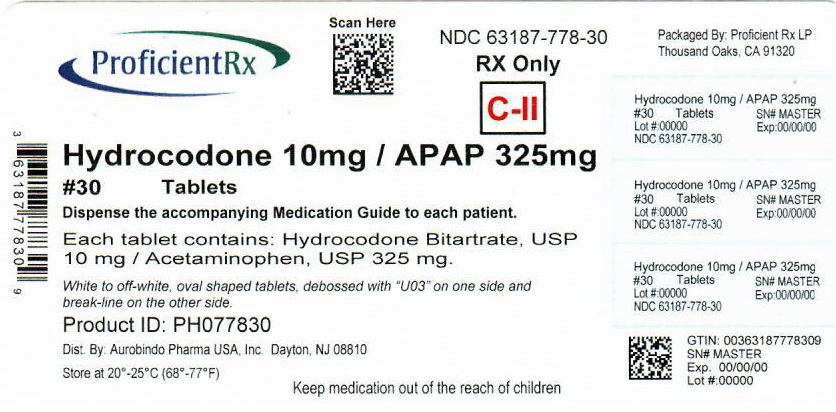
Hydrocodone Bitartrate and Acetaminophen 10 mg; 325 mg Tablet, 12-count — NDC 63187-778-12 (Billing 63187-0778-12)
This is a package of 12 tablets of Hydrocodone Bitartrate and Acetaminophen 10 mg; 325 mg Tablet from Proficient Rx LP, marketed since Apr 2012 and currently FDA-listed. It is the main listing for this product, which comes in 6 package sizes.
NDC database record
One package, one record: these facts belong to NDC 63187-778-12 alone.
- Record
- FDA NDC Directory package listing · Human prescription drug
- Code segments
- 63187 labeler · 778 product · 12 package
- Package marketed since
- Nov 1, 2016
- Sample package
- No — commercial package
- Listing certified through
- Dec 31, 2026
- Billing quantity
- 12 EA per package
- Barcode (UPC)
- 0363187778309
- FDA record last changed
- Aug 27, 2026
Identity & classification
Regulatory identifiers FDA, NLM and CMS codes for this package
Drug-database identifiers Medi-Span GPI and First Databank GCN / HICL / AHFS classification
- GSN (GCN sequence number): 030623
- GCN: 70330
- GPI-14 (Medi-Span): 65991702100305
- HICL (First Databank): 001730
- AHFS class code: 28:08.08.00
- RxCUI (RxNorm): 856999
Where does this data come from?
- FDA openFDA NDC Directory · synced Oct 1, 2026
- FDA label on DailyMed · label index refreshed Oct 5, 2026
- RxNorm (NLM RxNav) · catalog refreshed Oct 1, 2026
- Medi-Span GPI (licensed)
- First Databank (licensed) · refreshed Oct 1, 2026
RxNorm drug class
This medicine belongs to the Anilides class.
Where does this data come from?
- RxClass (NLM) · catalog refreshed Oct 1, 2026
Clinical
Acetaminophen is used to relieve mild to moderate pain and to reduce fever. Acetaminophen is in a class of medications called analgesics (pain relievers) and antipyretics (fever reducers). It works by changing the way the body senses pain and by cooling the body.
Read the full MedlinePlus article ↗Patient education
Supplement & herbal interactions
Where does this data come from?
- MedlinePlus (NLM) · refreshed Oct 1, 2026
- FDA label on DailyMed · label index refreshed Oct 5, 2026
Ask a licensed pharmacist directly — free, answered by our team.
Pricing
A drug doesn't have one price. Each row is a different public payment system, and none is what you'd pay at the counter — that depends on your insurance. The ⓘ on each row explains what it measures.
| Price system | Per each | Per package |
|---|---|---|
| Retail pharmacies payNADAC · weekly | Not in the retail survey — common for institutional, discontinued, or low-volume packs. | |
| Medicaid paysCMS SDUD · 12 mo | No recent Medicaid claims on file for this NDC — rare and low-volume NDCs are suppressed in the public data. | |
| Medicare drug plans payPart D · Q2 2026 | $0.2311 | $2.77 / 12 tablets |
Where does this data come from?
- CMS NADAC weekly file
- CMS ASP pricing files · refreshed Sep 20, 2026
- CMS Medicaid State Drug Utilization Data · refreshed Oct 5, 2026
- CMS Part D plan pricing files · refreshed Sep 24, 2026
- VA National Acquisition Center price file
Packaging — all sizes for this product
| Package NDC | Description | Marketing start | Marketing end | Status |
|---|---|---|---|---|
| 63187-0778-12 You're viewing this Main listing | 12 TABLET in 1 BOTTLE | 2016-11-01 | — | Active |
| 63187-0778-15 63187-778-15 | 15 TABLET in 1 BOTTLE | 2017-02-01 | — | Active |
| 63187-0778-20 63187-778-20 | 20 TABLET in 1 BOTTLE | 2016-11-01 | — | Active |
| 63187-0778-30 63187-778-30 | 30 TABLET in 1 BOTTLE | 2016-11-01 | — | Active |
| 63187-0778-60 63187-778-60 | 60 TABLET in 1 BOTTLE | 2016-11-01 | — | Active |
| 63187-0778-90 63187-778-90 | 90 TABLET in 1 BOTTLE | 2017-02-01 | — | Active |
You're viewing the smallest of 6 pack sizes for this product.
Pack size FAQ
What quantity is in this package?
How does this package differ from NDC 63187-0778-15?
What NDC number is used to bill for this package of Hydrocodone Bitartrate and Acetaminophen 10 mg; 325 mg Tablet?
Therapeutic equivalents
| Product | Labeler | Pack | NADAC/unit | TE | Status | Price vs. this |
|---|---|---|---|---|---|---|
| Hydrocodone Bitartrate and Acetaminophen 325 mg/1; 10 mg 42806-0113-01 | Epic | 100 tablets | $0.135 | AA | FDA listed | — |
| Hydrocodone Bitartrate And Acetaminophen 10 mg/1; 325 mg 00406-0125-01 | SpecGx | 100 tablets | $0.152 | AA | Availability likely | — |
| Hydrocodone Bitartrate and Acetaminophen 10 mg/1; 325 mg 10702-0191-01 | KVK-Tech, | 100 tablets | $0.152 | AA | Availability likely | — |
| Hydrocodone Bitartrate and Acetaminophen 10 mg/1; 325 mg 13107-0021-01 | Aurolife | 100 tablets | $0.152 | AA | Availability likely | — |
| Hydrocodone Bitartrate and Acetaminophen 10 mg/1; 325 mg 27808-0037-01 | Cranbury | 100 tablets | $0.152 | AA | Availability likely | — |
| Hydrocodone Bitartrate and Acetaminophen 10 mg/1; 325 mg 31722-0997-01 | Camber | 100 tablets | $0.152 | AA | Discontinued | — |
| Hydrocodone Bitartrate and Acetaminophen 10 mg/1; 325 mg 42858-0203-01 | Rhodes | 100 tablets | $0.152 | AA | Availability likely | — |
| Hydrocodone Bitartrate and Acetaminophen 10 mg/1; 325 mg 50268-0402-15 | AvPAK | 50 tablets | $0.152 | AA | Availability likely | — |
| Hydrocodone Bitartrate and Acetaminophen 10 mg/1; 325 mg 53746-0110-01 | Amneal | 100 tablets | $0.152 | AA | Availability likely | — |
| Hydrocodone Bitartrate and Acetaminophen 10 mg/1; 325 mg 60687-0418-01 | American | 100 tablets | $0.152 | AA | Availability likely | — |
| hydrocodone bitartrate and acetaminophen 10 mg/1; 325 mg 64380-0442-01 | Strides | 100 tablets | $0.152 | AA | Availability likely | — |
| Hydrocodone Bitartrate and Acetaminophen 10 mg/1; 325 mg 64850-0633-01 | Elite | 100 tablets | $0.152 | AA | Availability likely | — |
| Hydrocodone Bitartrate and Acetaminophen 10 mg/1; 325 mg 71930-0021-12 | Eywa | 100 tablets | $0.152 | AA | Availability likely | — |
| Hydrocodone Bitartrate and Acetaminophen 10 mg/1; 325 mg 43386-0358-01 | Lupin | 100 tablets | $0.153 | — | Availability likely | — |
| Hydrocodone Bitartrate and Acetaminophen 10 mg/1; 325 mg 00245-0412-01 | Upsher-Smith | 100 tablets | — | — | FDA listed | — |
| Hydrocodone Bitartrate And Acetaminophen 10 mg/1; 325 mg 55700-0991-30 | Quality | 30 tablets | — | AA | FDA listed | — |
| Hydrocodone Bitartrate And Acetaminophen 10 mg/1; 325 mg 60429-0592-01 | Golden | 100 tablets | — | AA | Discontinued | — |
| Hydrocodone Bitartrate And Acetaminophen 10 mg/1; 325 mg 60760-0871-30 | ST. | 30 tablets | — | AA | FDA listed | — |
| Hydrocodone Bitartrate and Acetaminophen 325 mg/1; 10 mg 60760-0872-30 | St. | 30 tablets | — | AA | FDA listed | — |
| Hydrocodone Bitartrate and Acetaminophen 10 mg/1; 325 mg 63187-0120-20 | Proficient | 20 tablets | — | AA | FDA listed | — |
| Hydrocodone Bitartrate and Acetaminophen 10 mg/1; 325 mgthis 63187-0778-12 | Proficient | 12 tablets | — | AA | FDA listed | — |
| Hydrocodone Bitartrate and Acetaminophen 325 mg/1; 10 mg 63304-0497-01 | Sun | 100 tablets | — | — | FDA listed | — |
| Hydrocodone Bitartrate and Acetaminophen 10 mg/1; 325 mg 63629-1938-01 | Bryant | 100 tablets | — | AA | FDA listed | — |
| Hydrocodone Bitartrate and Acetaminophen 10 mg/1; 325 mg 63629-2298-01 | Bryant | 100 tablets | — | AA | FDA listed | — |
| Hydrocodone Bitartrate and Acetaminophen 10 mg/1; 325 mg 63629-2299-01 | Bryant | 500 tablets | — | AA | FDA listed | — |
| Hydrocodone Bitartrate and Acetaminophen 10 mg/1; 325 mg 63629-2300-01 | Bryant | 1000 tablets | — | AA | FDA listed | — |
| Hydrocodone Bitartrate and Acetaminophen 10 mg/1; 325 mg 63629-2470-01 | Bryant | 500 tablets | — | AA | FDA listed | — |
| Hydrocodone Bitartrate and Acetaminophen 10 mg/1; 325 mg 63629-2471-01 | Bryant | 100 tablets | — | AA | FDA listed | — |
| Hydrocodone Bitartrate and Acetaminophen 10 mg/1; 325 mg 63629-8886-01 | Bryant | 30 tablets | — | AA | FDA listed | — |
| Hydrocodone Bitartrate and Acetaminophen 10 mg/1; 325 mg 66267-0319-30 | NuCare | 30 tablets | — | AA | FDA listed | — |
| Hydrocodone Bitartrate and Acetaminophen 10 mg/1; 325 mg 68071-4941-06 | NuCare | 6 tablets | — | AA | FDA listed | — |
| Hydrocodone Bitartrate and Acetaminophen 10 mg/1; 325 mg 70010-0674-01 | Granules | 100 tablets | — | AA | FDA listed | — |
| Hydrocodone Bitartrate and Acetaminophen 10 mg/1; 325 mg 71205-0660-30 | Proficient | 30 tablets | — | AA | FDA listed | — |
| Hydrocodone Bitartrate and Acetaminophen 10 mg/1; 325 mg 71335-1271-00 | Bryant | 120 tablets | — | AA | Discontinued | — |
| Hydrocodone Bitartrate and Acetaminophen 10 mg/1; 325 mg 71335-1339-01 | Bryant | 21 tablets | — | AA | FDA listed | — |
| Hydrocodone Bitartrate and Acetaminophen 10 mg/1; 325 mg 71335-1418-00 | Bryant | 120 tablets | — | AA | Discontinued | — |
| Hydrocodone Bitartrate and Acetaminophen 10 mg/1; 325 mg 71335-1444-01 | Bryant | 21 tablets | — | AA | Discontinued | — |
| Hydrocodone Bitartrate and Acetaminophen 10 mg/1; 325 mg 71335-2105-01 | Bryant | 30 tablets | — | AA | FDA listed | — |
| Hydrocodone Bitartrate and Acetaminophen 10 mg/1; 325 mg 71335-2118-00 | Bryant | 120 tablets | — | AA | FDA listed | — |
| Hydrocodone Bitartrate and Acetaminophen 10 mg/1; 325 mg 71335-2740-01 | Bryant | 1000 tablets | — | AA | FDA listed | — |
| Hydrocodone Bitartrate and Acetaminophen 10 mg/1; 325 mg 71335-9602-01 | Bryant | 21 tablets | — | AA | FDA listed | — |
| Hydrocodone Bitartrate and Acetaminophen 10 mg/1; 325 mg 71335-9735-00 | Bryant | 120 tablets | — | AA | FDA listed | — |
| Hydrocodone Bitartrate and Acetaminophen 10 mg/1; 325 mg 72162-1281-00 | Bryant | 1000 tablets | — | AA | FDA listed | — |
| Hydrocodone Bitartrate and Acetaminophen 10 mg/1; 325 mg 72162-1991-01 | Bryant | 100 tablets | — | AA | FDA listed | — |
| Hydrocodone Bitartrate and Acetaminophen 10 mg/1; 325 mg 72162-2271-01 | Bryant | 100 tablets | — | AA | FDA listed | — |
| Hydrocodone Bitartrate And Acetaminophen 325 mg/1; 10 mg 72189-0348-30 | DirectRx | 30 tablets | — | AA | FDA listed | — |
| Norco 10 mg/1; 325 mg 72189-0399-30 | Direct_Rx | 30 tablets | — | AA | FDA listed | — |
| Hydrocodone/APAP 10 mg/1; 325 mg 72189-0650-30 | Direct_Rx | 30 tablets | — | AA | FDA listed | — |
| Hydrocodone Bitartrate and Acetaminophen 10 mg/1; 325 mg 72865-0112-01 | XLCare | 100 tablets | — | AA | FDA listed | — |
| Hydrocodone Bitartrate and Acetaminophen 10 mg/1; 325 mg 72865-0204-01 | XLCare | 100 tablets | — | AA | FDA listed | — |
| Hydrocodone Bitartrate and Acetaminophen 10 mg/1; 325 mg 76420-0215-01 | Asclemed | 100 tablets | — | AA | FDA listed | — |
| Hydrocodone Bitartrate and Acetaminophen 10 mg/1; 325 mg 76420-0877-00 | Asclemed | 1000 tablets | — | AA | FDA listed | — |
| Hydrocodone Bitartrate And Acetaminophen 10 mg/1; 325 mg 82804-0003-30 | Proficient | 30 tablets | — | AA | FDA listed | — |
| Hydrocodone Bitartrate and Acetaminophen 10 mg/1; 325 mg 87063-0051-01 | Asclemed | 100 tablets | — | AA | FDA listed | — |
Where does this data come from?
- FDA openFDA NDC Directory · synced Oct 1, 2026
- FDA Orange Book · refreshed Oct 3, 2026
- CMS NADAC weekly file
Availability & generic status
This product is an FDA-approved generic. Other versions of the same drug are listed under Therapeutic equivalents, least expensive first.
Where does this data come from?
- FDA Orange Book · refreshed Oct 3, 2026
What it looks like
Where does this data come from?
- FDA label on DailyMed · label index refreshed Oct 5, 2026
Inactive Ingredients / Excipients
Inactive ingredients, also called excipients, are components of the drug product other than the active ingredient. They may include fillers, dyes, coatings, preservatives, flavors, or other formulation ingredients.
💡 Tap an ingredient (hover on desktop) to see what it is and why it’s used.
-
UNII M28OL1HH48
Croscarmellose sodium is a plant-based substance derived from cellulose. It acts as a disintegrant, helping tablets and capsules break down quickly in the digestive system so the medicine can be absorbed.
-
UNII 68401960MK
Crospovidone is a synthetic polymer made from polyvinylpyrrolidone. It acts as a disintegrant, helping tablets break apart quickly in the stomach so the medicine dissolves and absorbs into the body.
-
UNII 70097M6I30
Magnesium stearate is a salt made from magnesium and stearic acid, a fatty substance. It's used in tablets and capsules as a lubricant and glidant to help ingredients flow smoothly during manufacturing and prevent sticking.
-
UNII OP1R32D61U
Microcrystalline cellulose is a purified form of cellulose, a natural fiber from plant sources. It acts as a binder and filler in tablets and capsules, helping hold ingredients together and give the medicine its shape and size.
-
UNII U725QWY32X
Povidone K30 is a synthetic polymer made from petroleum. It acts as a binder to hold tablet ingredients together and as a disintegrant to help the tablet break apart in the stomach so the medicine can be absorbed.
-
UNII ETJ7Z6XBU4
Silicon dioxide is a naturally occurring mineral used as a glidant and anti-caking agent. It helps powder ingredients flow smoothly and prevents clumping during manufacturing and storage.
-
UNII O8232NY3SJ
A plant-based carbohydrate derived from corn kernels. It acts as a filler to add bulk, a binder to hold ingredients together, and a disintegrant to help the tablet break apart in your stomach for absorption.
-
UNII 4ELV7Z65AP
Stearic acid is a fatty acid derived from plant or animal sources. It acts as a binder and lubricant in tablets and capsules, helping them hold together and flow smoothly during manufacturing.
8 inactive ingredients listed in the exact product block matched to this NDC.
Where does this data come from?
ingredient classCode="IACT" elements from the exact product block matched by this NDC. Label-section narrative from DailyMed / the openFDA label index is shown separately when available.- FDA label on DailyMed · label index refreshed Oct 5, 2026
- FDA openFDA NDC Directory · synced Oct 1, 2026
Inactive ingredient FAQ
Are inactive ingredients the same for every manufacturer?
Why might an inactive ingredient be missing?
Can inactive ingredients matter?
Manufacturer & labeler
More NDCs from Proficient Rx LP labeler code 63187
- Gemfibrozil 600 mg Tablet NDC 63187-772-30
- Topiramate 25 mg Tablet NDC 63187-773-30
- Ketoconazole 20 mg/g Cream NDC 63187-774-15
- Lisinopril 20 mg Tablet NDC 63187-775-00
- Valacyclovir Hydrochloride 1 g Tablet, Film Coated NDC 63187-776-04
- Ketorolac Tromethamine 5 mg/mL Solution/ Drops NDC 63187-777-05
- Metformin hydrochloride 500 mg Tablet, Extended Release NDC 63187-779-00
- Lisinopril 2.5 mg Tablet NDC 63187-780-30
- Montelukast Sodium 10 mg Tablet, Film Coated NDC 63187-781-14
- Sulfamethoxazole and Trimethoprim 800 mg; 160 mg Tablet NDC 63187-782-06
- Amlodipine Besylate 2.5 mg Tablet NDC 63187-783-10
- Dicyclomine Hydrochloride 20 mg Tablet NDC 63187-784-15
Where does this data come from?
- FDA openFDA NDC Directory · synced Oct 1, 2026
- Drugs@FDA
Full prescribing information FDA SPL
🚨 Boxed Warning ▾
WARNING WARNING:ADDICTION, ABUSE, AND MISUSE; LIFE-THREATENING RESPIRATORY DEPRESSION;ACCIDENTAL INGESTION; NEONATAL OPIOID; WITHDRAWAL SYNDROME; and HEPATOTOXICITY Addiction, Abuse, and Misuse Hydrocodone bitartrate and acetaminophen tablets exposes patients and other users to the risks of opioid addiction, abuse, and misuse, which can lead to overdose and death. Assess each patient’srisk prior to prescribing hydrocodone bitartrate and acetaminophen tablets, andmonitor all patients regularly for the development of these behaviors orconditions [see WARNINGS ].
Life-ThreateningRespiratory Depression Serious, life-threatening, or fatal respiratory depression may occur with use of hydrocodone bitartrate and acetaminophen tablets. Monitor for respiratory depression, especially during initiation of hydrocodone bitartrate and acetaminophen tablets or following adose increase [see WARNINGS ]. Accidental Ingestion Accidental ingestion of even one dose of hydrocodone bitartrate and acetaminophen tablets, especially by children, can result in a fatal overdose of Hydrocodone bitartrate and acetaminophen tablets[see WARNINGS ].
Neonatal Opioid Withdrawal Syndrome Prolonged use of hydrocodone bitartrate and acetaminophen tablets during pregnancy can result in neonatal opioid withdrawal syndrome, which may be life-threatening if not recognized andtreated, and requires management according to protocols developed by neonatology experts. If opioid use is required for a prolonged period in apregnant woman, advise the patient of the risk of neonatal opioid withdrawal syndrome and ensure that appropriate treatment will be available [see WARNINGS ].
Hepatotoxicity Acetaminophenhas been associated with cases of acute liver failure, at times resulting inliver transplant and death. Most of the cases of liver injury are associatedwith the use of acetaminophen at doses that exceed 4,000 milligrams per day,and often involve more than one acetaminophen-containing product (see WARNINGS ). Risks from concomitant use with Benzodiazepines or other CNS Depressants Concomitant use of opiods with benzodiazepines or other central nervous system (CNS) depressants including alcohol, may result in profound sedation, respiratory depression, coma, and death. [see WARNINGS , PRECAUTIONS ; Drug interactions] • Reserve concomitant prescribing of Hydrocodone bitartrate and acetaminophen tablets and benzodiazepines or other CNS depressants for use in patients for whom alternative treatment options are inadequate. • Limit dosages and durations to the minimum required. • Follow patients for signs and symptoms of respiratory depression and sedation.
🎯 Indications and Usage ▾
INDICATIONS AND USAGE Hydrocodone bitartrate and acetaminophentablets are indicated for the management of relief of moderate to moderatelysevere pain, pain severe enough to require an opioid analgesic and for whichalternative treatments are inadequate. Limitations of Use Because of the risks of addiction, abuse, andmisuse, with opioids, even at recommended doses [see WARNINGS ], reserve hydrocodonebitartrate and acetaminophen tablets for use in patients for whom alternativetreatment options [e.g., non-opioid analgesics] • Have not been tolerated, or are not expected to be tolerated, • Have not provided adequate analgesia, or are not expected to provide adequate analgesia
⏱️ Dosage and Administration ▾
DOSAGE AND ADMINISTRATION Important Dosage and Administration Instructions Initiate thedosing regimen for each patient individually, taking into account the patient'sseverity of pain, patient response, prior analgesic treatment experience, andrisk factors for addiction, abuse, and misuse [see WARNINGS ]. Monitorpatients closely for respiratory depression, especially within the first 24 to 72hours of initiating therapy and following dosage increases with hydrocodonebitartrate and acetaminophen tablets and adjust the dosage accordingly [see WARNINGS ].
Dosage should be adjusted according tothe severity of the pain and the response of the patient. However, it should bekept in mind that tolerance to hydrocodone can develop with continued use andthat the incidence of untoward effects is dose related. Initial Dosage Treatment with Hydrocodone Bitartrate and Acetaminophen Tablets The usual adult dosageis one tablet every four to six hours as needed for pain.
The total dailydosage should not exceed 6 tablets. 5 mg/325 mg The usual adult dosage is one or two tablets every four to six hours as needed for pain. 7.5 mg/325 mg The usual adult dosage is one tablet every four to six hours as needed for pain.
The total daily dosage should not exceed 6 tablets. 10 mg/325 mg The usual adult dosage is one tablet every four to six hours as needed for pain. The total daily dosage should not exceed 6 tablets.
Titrationand Maintenance of Therapy Individually titrate hydrocodonebitartrate and acetaminophen tablets to a dose that provides adequate analgesiaand minimizes adverse reactions. Continually reevaluate patients receiving hydrocodonebitartrate and acetaminophen tablets to assess the maintenance of pain controland the relative incidence of adverse reactions, as well as monitoring for thedevelopment of addiction, abuse, or misuse [see WARNINGS ]. Frequentcommunication is important among the prescriber, other members of thehealthcare team, the patient, and the caregiver/family during periods ofchanging analgesic requirements, including initial titration.
If the levelof pain increases after dosage stabilization, attempt to identify the source ofincreased pain before increasing the hydrocodone bitartrate and acetaminophentablets dosage. If unacceptable opioid-related adverse reactions are observed,consider reducing the dosage. Adjust the dosage to obtain an appropriatebalance between management of pain and opioid-related adverse reactions.
Discontinuation of Hydrocodone Bitartrate and Acetaminophen Tablets When apatient who has been taking hydrocodone bitartrate and acetaminophen tabletsregularly and may be physically dependent no longer requires therapy with hydrocodonebitartrate and acetaminophen tablets, use a gradual downward titration of thedosage to prevent signs and symptoms of withdrawal. Do not stop hydrocodonebitartrate and acetaminophen tablets abruptly [see WARNINGS , DRUG ABUSE ANDDEPENDENCE ].
⛔ Contraindications ▾
CONTRAINDICATIONS Hydrocodonebitartrate and acetaminophen tablets are contraindicated in patients with: • Significant respiratory depression [see WARNINGS ] • Acute or severe bronchial asthma in an unmonitored setting or in the absence of resuscitative equipment [see WARNINGS] • Hypersensitivity to hydrocodone or acetaminophen • Hypersensitive to other opioids which may exhibit cross-sensitivity to hydrocodone
⚠️ Warnings ▾
WARNINGS Addiction, Abuse, and Misuse Hydrocodone bitartrate and acetaminophen tablet contains hydrocodone and acetaminophen a Schedule CII controlled substance. As an opioid, hydrocodone bitartrate andacetaminophen tablets exposes users to the risks of addiction, abuse, andmisuse [see DRUG ABUSE AND DEPENDENCE ]. Although therisk of addiction in any individual is unknown, it can occur in patients appropriately prescribed hydrocodone bitartrate and acetaminophen tablets.Addiction can occur at recommended dosages and if the drug is misused orabused.
Assess eachpatient’s risk for opioid addiction, abuse, or misuse prior to prescribing hydrocodone bitartrate and acetaminophen tablets, and monitor all patients receiving hydrocodone bitartrate and acetaminophen tablets for the development of these behaviors or conditions. Risks are increased in patients with a personal or family historyof substance abuse (including drug or alcohol abuse or addiction) or mental illness (e.g., major depression). The potential for these risks should not, however, prevent the proper management of pain in any given patient.
Patients at increased risk may be prescribed opioids such as hydrocodone bitartrate and acetaminophen tablets, but use in such patients necessitates intensive counseling about the risks andproperuse of hydrocodone bitartrate and acetaminophen tablets along with intensive monitoring for signs of addiction, abuse, and misuse. Opioids are sought by drug abusers and people with addiction disorders and are subject to criminal diversion. Consider these risks when prescribing or dispensing hydrocodone bitartrate and acetaminophen tablets.
Strategies to reduce these risks includeprescribing the drug in the smallest appropriate quantity and advising thepatient on the proper disposal of unused drug [see PRECAUTIONS ; Information for Patients]. Contact local state professional licensing board or statecontrolled substances authority for information on how to prevent and detectabuse or diversion of this product. Hepatotoxicity Acetaminophenhas been associated with cases of acute liver failure, at times resulting inliver transplant and death.
Most of the cases of liver injury are associated withthe use of acetaminophen at doses that exceed 4,000 milligrams per day, andoften involve more than one acetaminophen-containing product. The excessiveintake of acetaminophen may be intentional to cause self-harm or unintentionalas patients attempt to obtain more pain relief or unknowingly take otheracetaminophen-containing products. The riskof acute liver failure is higher in individuals who ingest alcohol while taking acetaminophen.
Instruct patients to look for acetaminophen or APAP on package labels and not to use more than one product that contains acetaminophen. Instruct patients to seek medical attention immediately upon ingestion of more than 4,000 milligrams of acetaminophen per day, even if they feel well. Life-Threatening Respiratory Depression Serious, life-threatening, or fatal respiratory depression has been reported with theuse of opioids, even when used as recommended.
Respiratory depression, if notimmediately recognized and treated, may lead to respiratory arrest and death.Management of respiratory depression may include close observation, supportive measures, and use of opioid antagonists, depending on the patient’s clinical status [see OVERDOSAGE ]. Carbon dioxide (CO 2 ) retention from opioid-induced respiratory depression can exacerbate the sedating effects ofopioids. While serious, life-threatening, or fatal respiratory depression can occur at anytime during the use of hydrocodone bitartrate and acetaminophen tablets, therisk is greatest during the initiation of therapy or following a dosageincrease.
Monitor patients closely for respiratory depression, especiallywithin the first 24 to 72 hours of initiating therapy with and following dosage increases of hydrocodone bitartrate and acetaminophen tablets. To reduce therisk of respiratory d… [Excerpted — this section continues on DailyMed.]
🤒 Adverse Reactions ▾
ADVERSE REACTIONS The most frequently reported adverse reactions include: lightheadedness, dizziness, sedation, nausea and vomiting. These effects seem to be more prominent in ambulatory than in nonambulatory patients and some of these adverse reactions may be alleviated if the patient lies down. Other adverse reactions include Central Nervous System Drowsiness, mental clouding, lethargy, impairment of mental and physical performance, anxiety, fear, dysphoria, psychic dependence, mood changes.
Gastrointestinal System Prolonged administration of hydrocodone bitartrate and acetaminophen tablets may produce constipation. Genitourinary System Ureteral spasm, spasm of vesical sphincters and urinary retention have been reported with opiates. Respiratory Depression Hydrocodone bitartrate may produce dose-related respiratory depression by acting directly on the brain stem respiratory center.
(see OVERDOSAGE ). Special Senses Cases of hearing impairment or permanent loss have been reported predominantly in patients with chronic overdose. Dermatological Skin rash, pruritus.
The following adverse drug events may be borne in mind as potential effects of acetaminophen: allergic reactions, rash, thrombocytopenia, agranulocytosis. Potential effects of high dosage are listed in the OVERDOSAGE section. Postmarketing Experience • serotonin syndrome • adrenal insufficiency Androgen Deficiency Chronic useof opioids may influence the hypothalamic-pituitary-gonadal axis, leading toandrogen deficiency that may manifest as symptoms of hypogonadism, such asimpotence, erectile dysfunction, or amenorrhea.
The causal role of opioids inthe syndrome of hypogonadism is unknown because the various medical, physical, lifestyle, and psychological stressors that may influence gonadal hormone levels have not been adequately controlled for in studies conducted to date. Patients presenting with symptoms of androgen deficiency should undergo laboratory evaluation.
🔄 Drug Interactions ▾
Drug Interactions Patients receiving other narcotic analgesics, antihistamines, antipsychotics, antianxiety agents, or other CNS depressants (including alcohol) concomitantlywith hydrocodone bitartrate and acetaminophen tablets may exhibit an additiveCNS depression. When combined therapy is contemplated, the dose of one or bothagents should be reduced. The use of MAO inhibitors or tricyclic antidepressants with hydrocodone preparations may increase the effect of either the antidepressant or hydrocodone.
Hydrocodone bitartrate and acetaminophen tablets contains hydrocodone and acetaminophen, asubstance with a high potential for abuse similar to other opioids including withdrawal also may be precipitated through the administration of drugs with opioid antagonist activity (e.g., naloxone, nalmefene), mixedagonist/antagonist analgesics (pentazocine, butorphanol, nalbuphine), orpartial agonists (buprenorphine). Physical dependence may not occur to aclinically significant degree until after several days to weeks of continuedopioid usage.
Hydrocodone bitartrate and acetaminophen tablets can be abusedand is subject to misuse, addiction, and criminal diversion [see WARNINGS ]. Benzodiazepines and other Central Nervous System (CNS) Depressants Due to additive pharmacologic effect, the concomitant use of benzodiazepines or other CNS depressants such as alcohol, other sedatives/hypnotics, anxiolytics, tranquilizers, muscle relaxants, general anesthetics, antipsychotics, and other opioids, can increases the risk of respiratory depression, profound sedation, coma, and death.
Reserve concomitant prescribing of these drugs for use in patients for whom alternative treatment options are inadequate. Limit dosages and durations to the minimum required. Follow patients closely for signs of respiratory depression and sedation [see WARNINGS ].
Serotonergic Drugs The concomitantuse of opioids with other drugs that affect the serotonergic neurotransmitter system, such as selective serotonin reuptake inhibitors (SSRIs), serotonin andnorepinephrine reuptake inhibitors (SNRIs), tricyclic antidepressants (TCAs),triptans, 5-HT 3 receptor antagonists, drugs that effect theserotonin neurotransmitter system (e.g., mirtazapine, trazodone, tramadol), andmonoamine oxidase (MAO) inhibitors (those intended to treat psychiatricdisorders and also others, such as linezolid and intravenous methylene blue),has resulted in serotonin syndrome [see PRECAUTIONS ; Information for Patients/Caregivers].
If concomitant use is warranted, carefully observe the patient, particularly during treatment initiation and dose adjustment. Discontinue hydrocodone bitartrateand acetaminophen tablets if serotonin syndrome is suspected.
🤰 Pregnancy ▾
Pregnancy Neonatal Opioid Withdrawal Syndrome Inform patients that prolonged use of hydrocodone bitartrate and acetaminophen tablets during pregnancy can result in neonatal opioid withdrawal syndrome, which maybe life-threatening if not recognized and treated [see WARNINGS , PRECAUTIONS ; Error! Hyperlink reference not valid. ] Embryo-Fetal Toxicity Inform female patients of reproductive potential that hydrocodone bitartrate andacetaminophen can cause fetal harm and to inform the prescriber of a known orsuspected pregnancy [see PRECAUTIONS ; Error!
Hyperlink reference not valid. ]. Lactation Advise nursing mothers to monitor infants for increased sleepiness (more than usual), breathing difficulties, or limpness. Instruct nursing mothers to seek immediate medical care if they notice these signs [see PRECAUTIONS ; Error!
Hyperlink reference not valid. ]. Disposal of Unused Hydrocodone Bitartrate and Acetaminophen Tablets Advise patients on the proper disposal of unused drug [see PRECAUTIONS ; Information for Patients/Caregivers] by contacting local state professional licensing board orstate controlled substances authority for information on how to prevent anddetect abuse or diversion of this product. Teratogenic Effects
🧓 Geriatric Use ▾
Geriatric Use Elderly patients (aged 65 years or older) may have increased sensitivity to hydrocodone bitartrate and acetaminophen tablets. In general, use caution when selecting adosage for an elderly patient, usually starting at the low end of the dosing range, reflecting the greater frequency of decreased hepatic, renal, or cardiac function and of concomitant disease or other drug therapy. Respiratory depression is the chief risk for elderly patients treated with opioids, and hasoccurred after large initial doses were administered to patients who were not opioid-tolerant or when opioids were co-administered with other agents that depress respiration.
Titrate the dosage of hydrocodone bitartrate andacetaminophen tablets slowly in geriatric patients [see WARNINGS ].
🆘 Overdosage ▾
OVERDOSAGE Clinical Presentation Acuteoverdose with hydrocodone bitartrate and acetaminophen tablets can bemanifested by respiratory depression, somnolence progressing to stupor or coma,skeletal muscle flaccidity, cold and clammy skin, constricted pupils, and, insome cases, pulmonary edema, bradycardia, hypotension, partial or completeairway obstruction, atypical snoring, and death. Marked mydriasis rather thanmiosis may be seen with hypoxia in overdose situations. Treatment of Overdose In case ofoverdose, priorities are the reestablishment of a patent and protected airwayand institution of assisted or controlled ventilation, if needed.
Employ othersupportive measures (including oxygen and vasopressors) in the management ofcirculatory shock and pulmonary edema as indicated. Cardiac arrest orarrhythmias will require advanced life-support techniques. The opioidantagonists, naloxone or nalmefene, are specific antidotes to respiratorydepression resulting from opioid overdose.
For clinically significantrespiratory or circulatory depression secondary to hydrocodone bitartrate andacetaminophen tablets overdose, administer an opioid antagonist. Opioidantagonists should not be administered in the absence of clinically significantrespiratory or circulatory depression secondary to hydrocodone bitartrate andacetaminophen tablets overdose. Because theduration of opioid reversal is expected to be less than the duration of actionof hydrocodone bitartrate and acetaminophen tablets in hydrocodone bitartrateand acetaminophen tablets, carefully monitor the patient until spontaneousrespiration is reliably re-established.
If the response to an opioid antagonistis suboptimal or only brief in nature, administer additional antagonist asdirected by the product’s prescribing information. In anindividual physically dependent on opioids, administration of the recommendedusual dosage of the antagonist will precipitate an acute withdrawal syndrome.The severity of the withdrawal symptoms experienced will depend on the degreeof physical dependence and the dose of the antagonist administered. If adecision is made to treat serious respiratory depression in the physicallydependent patient, administration of the antagonist should be begun with careand by titration with smaller than usual doses of the antagonist.
🧬 Clinical Pharmacology ▾
CLINICAL PHARMACOLOGY Hydrocodone is a semisynthetic narcotic analgesic and antitussive with multiple actions qualitatively similar to those of codeine. Most of these involve the central nervous system and smooth muscle. The precise mechanism of action of hydrocodone and other opiates is not known, although it is believed to relate to the existence of opiate receptors in the central nervous system.
In addition to analgesia, narcotics may produce drowsiness, changes in mood and mental clouding. The analgesic action of acetaminophen involves peripheral influences, but the specific mechanism is as yet undetermined. Antipyretic activity is mediated through hypothalamic heat regulating centers.
Acetaminophen inhibits prostaglandin synthetase. Therapeutic doses of acetaminophen have negligible effects on the cardiovascular or respiratory systems; however, toxic doses may cause circulatory failure and rapid, shallow breathing. Pharmacokinetics The behavior of the individual components is described below.
Hydrocodone Following a 10 mg oral dose of hydrocodone administered to five adult male subjects, the mean peak concentration was 23.6 ± 5.2 ng/mL. Maximum serum levels were achieved at 1.3 ± 0.3 hours and the half-life was determined to be 3.8 ± 0.3 hours. Hydrocodone exhibits a complex pattern of metabolism including O-demethylation, N-demethylation and 6-keto reduction to the corresponding 6-α- and 6-β-hydroxy-metabolites.
See OVERDOSAGE for toxicity information. Acetaminophen Acetaminophen is rapidly absorbed from the gastrointestinal tract and is distributed throughout most body tissues. The plasma half-life is 1.25 to 3 hours, but may be increased by liver damage and following overdosage.
Elimination of acetaminophen is principally by liver metabolism (conjugation) and subsequent renal excretion of metabolites. Approximately 85% of an oral dose appears in the urine within 24 hours of administration, most as the glucuronide conjugate, with small amounts of other conjugates and unchanged drug. See OVERDOSAGE for toxicity information.
📦 How Supplied / Storage and Handling ▾
HOW SUPPLIED Hydrocodone Bitartrate and Acetaminophen Tablets USP are available in the following strengths: Hydrocodone Bitartrate and Acetaminophen Tablet USP, 10 mg/325 mg is available as white to off-white, oval shaped tablets, debossed with “U03” on one side and break-line on the other side. Each tablet contains 10 mg hydrocodone bitartrate and 325 mg acetaminophen. Bottles of 12 NDC 63187-778-12 Bottles of 15 NDC 63187-778-15 Bottles of 20 NDC 63187-778-20 Bottles of 30 NDC 63187-778-30 Bottles of 60 NDC 63187-778-60 Bottles of 90 NDC 63187-778-90 Storage: Store at 20° to 25°C (68° to 77°F). [See USP Controlled Room Temperature.] Dispense in a tight, light-resistant container as defined in the USP with a child-resistant closure.
Keep this and all medication out of the reach of children. A Schedule C-II controlled drug substance. Dispense with Medication Guide available at www.aurobindousa.com/product-medication-guides Manufactured by: Aurolife Pharma LLC Dayton, NJ 08810 Manufactured for: Aurobindo Pharma USA, Inc.
Dayton, NJ 08810 Repackaged by: Proficient Rx LP. Thousand Oaks, CA 91320 Revised: 09/2016
📋 Description ▾
DESCRIPTION Hydrocodone bitartrate and acetaminophen is supplied in tablet form for oral administration. Hydrocodone bitartrate is an opioid analgesic and antitussive and occurs as fine, white crystals or as a crystalline powder. It is affected by light.
The chemical name is: 4,5α-epoxy-3-methoxy-17-methylmorphinan-6-one tartrate (1:1) hydrate (2:5). It has the following structural formula: Acetaminophen, 4’-hydroxyacetanilide, a slightly bitter, white, odorless, crystalline powder, is a non-opiate, non-salicylate analgesic and antipyretic. It has the following structural formula: Hydrocodone bitartrate and acetaminophen tablets USP, for oral administration, are available in a variety of strengths as described in the following table.
Each hydrocodone bitartrate and acetaminophen tablet contains: Strength Hydrocodone Bitartrate Acetaminophen 5 mg/325 mg 7.5 mg/325 mg 10 mg/325 mg 5 mg 7.5 mg 10 mg 325 mg 325 mg 325 mg In addition each tablet contains the following inactive ingredients: colloidal silicon dioxide, croscarmellose sodium, crospovidone, magnesium stearate, microcrystalline cellulose, povidone, pregelatinized starch and stearic acid. Meets USP Dissolution Test 1. chemical structure Chemical Structure
💬 Information for Patients ▾
Information for Patients/Caregivers Addiction, Abuse, and Misuse Informpatients that the use of hydrocodone bitartrate and acetaminophen tablets, even when taken as recommended, can result in addiction, abuse, and misuse, which can lead to overdose and death [see WARNINGS ]. Instruct patients not to share hydrocodone bitartrate and acetaminophen tablets with others and to take steps to protect hydrocodone bitartrate and acetaminophen tablets from theft ormisuse. Life-Threatening Respiratory Depression Informpatients of the risk of life-threatening respiratory depression, including information that the risk is greatest when starting hydrocodone bitartrate andacetaminophen tablets or when the dosage is increased, and that it can occureven at recommended dosages [see WARNINGS ].
Advise patients how to recognize respiratory depression and to seek medical attention if breathing difficulties develop. Accidental Ingestion Inform patients that accidental ingestion, especially by children, may result inrespiratory depression or death [see WARNINGS ]. Instruct patients totake steps to store hydrocodone bitartrate and acetaminophen tablets securely.Opioids are sought by drug abusers and people with addiction disorders and aresubject to criminal diversion.
Consider these risks when prescribing ordispensing hydrocodone bitartrate and acetaminophen tablets. Strategies toreduce these risks include prescribing the drug in the smallest appropriatequantity and advising the patient on the proper disposal of unused drug [see PRECAUTIONS ; Information for Patients ]. Contact local state professional licensing boardor state controlled substances authority for information on how to prevent anddetect abuse or diversion of this product.
Interactions with Benzodiazepines and Other CNS Depressants Inform patients and caregivers that potentially fatal additive effects may occur if Hydrocodone bitartrate and acetaminophen tablets is used with benzodiazepines or other CNS depressants, including alcohol, and not to use these concomitantly unless supervised by a health care provider [see WARNINGS and PRECAUTIONS ; Drug Interactions]. Serotonin Syndrome Inform patients that hydrocodone bitartrate and acetaminophen tablets could cause a rare but potentially life-threatening condition resulting from concomitant administration of serotonergic drugs.
Warn patients of the symptoms ofserotonin syndrome and to seek medical attention right away if symptoms develop. Instruct patients to inform their physicians if they are taking, orplan to take serotonergic medications [see PRECAUTIONS ; Error! Hyperlink reference not valid. ].
Adrenal Insufficiency Inform patients that hydrocodone bitartrate and acetaminophen tablets could cause adrenal insufficiency, a potentially life-threatening condition. Adrenal insufficiency may present with non-specific symptoms and signs such as nausea,vomiting, anorexia, fatigue, weakness, dizziness, and low blood pressure.Advise patients to seek medical attention if they experience a constellation ofthese symptoms [see WARNINGS ].
💬 Medication Guide ▾
MEDICATION GUIDE Hydrocodone Bitartrate and Acetaminophen Tablets, USP CII HIGH-droe-KOE-dohnby-TAR-trate/ass-eet-ah-MEE-noe-fen Hydrocodone Bitartrate and Acetaminophen Tablets are: • A strong prescription pain medicine that contains an opioid (narcotic) that is used for the management of relief of moderate to moderately severe pain, pain severe enough to require an opioid analgesic and for which alternative treatments are inadequate or when non-opioid pain medicines do not treat your pain well enough or you cannot tolerate them. • An opioid pain medicine that can put you at risk for overdose and death.
Even if you take your dose correctly as prescribed you are at risk for opioid addiction, abuse, and misuse that can lead to death. Important information about Hydrocodone Bitartrate and Acetaminophen Tablets: • Get emergency help right away if you take too much hydrocodone bitartrate and acetaminophen tablets (overdose). When you first start taking hydrocodone bitartrate and acetaminophen tablets, when your dose is changed, or if you take too much (overdose), serious or life-threatening breathing problems that can lead to death may occur. • Taking hydrocodone bitartrate and acetaminophen tablets with other opioid medicines,benzodiazepines, alcohol, or other central nervous system depressants (including street drugs) can cause severe drowsiness, decreased awareness, breathing problems, coma and death. • Never give anyone else your hydrocodone bitartrate and acetaminophen tablets.
They could die from taking it. Store hydrocodone bitartrate and acetaminophen tablets away from children and in a safe place to prevent stealing or abuse. Selling or giving away hydrocodone bitartrate and acetaminophen tablets is against the law.
Do not take Hydrocodone Bitartrate and Acetaminophen Tablets if you have: • acute or severe bronchial asthma, trouble breathing, or other lung problems. • a bowel blockage or have narrowing of the stomach or intestines. • significant respiratory depression • severe impairment of hepatic or renal function, hypothyroidism, Addison’s disease, prostatic hypertrophy or urethral stricture Before taking Hydrocodone Bitartrate and Acetaminophen Tablets, tell your healthcareprovider if you have a history of: • head injury, seizures • liver, kidney, thyroid problems • problems urinating • pancreas or gallbladder problems • abuse of street or prescription drugs, alcohol addiction, or mental health problems.
Tell your healthcare provider if you are: • pregnant or planning to become pregnant. Prolonged use of hydrocodone bitartrate and acetaminophen tablets during pregnancy can cause withdrawal symptoms in your newborn baby that could be life-threatening if not recognized and treated. • breastfeeding. Hydrocodone bitartrate and acetaminophen tablets passes into breast milk and may harm your baby. • taking prescription or over-the-counter medicines, vitamins, or herbal supplements.
Taking hydrocodone bitartrate and acetaminophen tablets with certain other medicines can cause serious side effects that could lead to death. Whentaking Hydrocodone Bitartrate and Acetaminophen Tablets: • Do not change your dose. Take hydrocodone bitartrate and acetaminophen tablets exactly as prescribed by your healthcare provider. • The usual adult dosage is one tablet every four to six hours as needed for pain.
The total daily dosage should not exceed 6 tablets. Do not take more than your prescribed dose. If you miss a dose, take your next dose at your usual time. • Call your healthcare provider if the dose you are taking does not control your pain. • If you have been taking hydrocodone bitartrate and acetaminophen tablets regularly, do not stop taking hydrocodone bitartrate and acetaminophen tablets without talking to your healthcare provider. • After you stop taking hydrocodone bitartrate and acetaminophen tablets, contact local state professional licensing board or state controlled substances authority for information on how to prevent and… [Excerpted — this section continues on DailyMed.]
⚠️ Precautions ▾
PRECAUTIONS General Special Risk Patients As with any narcotic analgesic agent, hydrocodonebitartrate and acetaminophen tablets should be used with caution in elderly ordebilitated patients and those with severe impairment of hepatic or renalfunction, hypothyroidism, Addison’s disease, prostatic hypertrophy or urethralstricture. The usual precautions should be observed and the possibility of respiratorydepression should be kept in mind. Cough Reflex Hydrocodone suppresses the cough reflex;as with all narcotics, caution should be exercised when hydrocodone bitartrateand acetaminophen tablets are used postoperatively and in patients with pulmonarydisease.
Information for Patients/Caregivers Addiction, Abuse, and Misuse Informpatients that the use of hydrocodone bitartrate and acetaminophen tablets, even when taken as recommended, can result in addiction, abuse, and misuse, which can lead to overdose and death [see WARNINGS ]. Instruct patients not to share hydrocodone bitartrate and acetaminophen tablets with others and to take steps to protect hydrocodone bitartrate and acetaminophen tablets from theft ormisuse. Life-Threatening Respiratory Depression Informpatients of the risk of life-threatening respiratory depression, including information that the risk is greatest when starting hydrocodone bitartrate andacetaminophen tablets or when the dosage is increased, and that it can occureven at recommended dosages [see WARNINGS ].
Advise patients how to recognize respiratory depression and to seek medical attention if breathing difficulties develop. Accidental Ingestion Inform patients that accidental ingestion, especially by children, may result inrespiratory depression or death [see WARNINGS ]. Instruct patients totake steps to store hydrocodone bitartrate and acetaminophen tablets securely.Opioids are sought by drug abusers and people with addiction disorders and aresubject to criminal diversion.
Consider these risks when prescribing ordispensing hydrocodone bitartrate and acetaminophen tablets. Strategies toreduce these risks include prescribing the drug in the smallest appropriatequantity and advising the patient on the proper disposal of unused drug [see PRECAUTIONS ; Information for Patients ]. Contact local state professional licensing boardor state controlled substances authority for information on how to prevent anddetect abuse or diversion of this product.
Interactions with Benzodiazepines and Other CNS Depressants Inform patients and caregivers that potentially fatal additive effects may occur if Hydrocodone bitartrate and acetaminophen tablets is used with benzodiazepines or other CNS depressants, including alcohol, and not to use these concomitantly unless supervised by a health care provider [see WARNINGS and PRECAUTIONS ; Drug Interactions]. Serotonin Syndrome Inform patients that hydrocodone bitartrate and acetaminophen tablets could cause a rare but potentially life-threatening condition resulting from concomitant administration of serotonergic drugs.
Warn patients of the symptoms ofserotonin syndrome and to seek medical attention right away if symptoms develop. Instruct patients to inform their physicians if they are taking, orplan to take serotonergic medications [see PRECAUTIONS ; Error! Hyperlink reference not valid. ].
Adrenal Insufficiency Inform patients that hydrocodone bitartrate and acetaminophen tablets could cause adrenal insufficiency, a potentially life-threatening condition. Adrenal insufficiency may present with non-specific symptoms and signs such as nausea,vomiting, anorexia, fatigue, weakness, dizziness, and low blood pressure.Advise patients to seek medical attention if they experience a constellation ofthese symptoms [see WARNINGS ]. Pregnancy Neonatal Opioid Withdrawal Syndrome Inform patients that prolonged use of hydrocodone bitartrate and acetaminophen tablets during pregnancy can result in neonatal opioid withdrawal syndrome, which maybe life-threatening if not recognized and treated [see… [Excerpted — this section continues on DailyMed.]
🍼 Nursing Mothers ▾
Nursing Mothers The developmental and health benefits of breastfeeding should be considered alongwith the mother’s clinical need for hydrocodone bitartrate and acetaminophen and any potential adverse effects on the breastfed infant from hydrocodone bitartrate and acetaminophen tablets or from the underlying maternal condition.Infants exposed to hydrocodone bitartrate and acetaminophen through breast milkshould be monitored for excess sedation and respiratory depression. Withdrawal symptoms can occur in breastfed infants when maternal administration of anopioid analgesic is stopped, or when breast-feeding is stopped.
🔒 Drug Abuse and Dependence ▾
DRUG ABUSE AND DEPENDENCE Controlled Substance Hydrocodone bitartrate and acetaminophen tablets contains hydrocodone and acetaminophen, aSchedule CII controlled substance. Abuse Hydrocodone bitartrate and acetaminophen tablets contains hydrocodone and acetaminophen, asubstance with a high potential for abuse similar to other opioids including withdrawal also may be precipitated through the administration of drugs withopioid antagonist activity (e.g., naloxone, nalmefene), mixedagonist/antagonist analgesics (pentazocine, butorphanol, nalbuphine), orpartial agonists (buprenorphine).
Physical dependence may not occur to aclinically significant degree until after several days to weeks of continuedopioid usage. Hydrocodone bitartrate and acetaminophen tablets can be abusedand is subject to misuse, addiction, and criminal diversion [see WARNINGS ]. All patients treated with opioids require careful monitoring for signs of abuse and addiction, since use of opioid analgesic products carries the risk of addiction even under appropriate medical use.
Prescription drug abuse is the intentional non-therapeutic use of a prescription drug, evenonce, for its rewarding psychological or physiological effects. Drug addiction is a cluster of behavioral, cognitive, and physiological phenomenathat develop after repeated substance use and includes: a strong desire to take the drug, difficulties in controlling its use, persisting in its use despite harmful consequences, a higher priority given to drug use than to other activities and obligations, increased tolerance, and sometimes a physical withdrawal. “Drug-seeking”behavior is very common in persons with substance use disorders.
Drug-seeking tactics include emergency calls or visits near the end of office hours, refusal to undergo appropriate examination, testing, or referral, repeated “loss” of prescriptions, tampering with prescriptions and reluctance to provide priormedical records or contact information for other treating health careprovider(s). “Doctor shopping” (visiting multiple prescribers) to obtainadditional prescriptions is common among drug abusers and people suffering from untreated addiction. Preoccupation with achieving adequate pain relief can beappropriate behavior in a patient with poor pain control.
Abuse and addiction are separate and distinct from physical dependence and tolerance.Health care providers should be aware that addiction may not be accompanied by concurrent tolerance and symptoms of physical dependence in all addicts. Inaddition, abuse of opioids can occur in the absence of true addiction. Hydrocodone bitartrate and acetaminophen tablets, like other opioids, can be diverted fornon-medical use into illicit channels of distribution.
Careful record-keepingof prescribing information, including quantity, frequency, and renewalrequests, as required by state and federal law, is strongly advised. Properassessment of the patient, proper prescribing practices, periodic re-evaluationof therapy, and proper dispensing and storage are appropriate measures thathelp to limit abuse of opioid drugs. Risks Specific to Abuse of Hydrocodone Bitartrate and Acetaminophen Tablets Hydrocodone Serious overdose with hydrocodone is characterized by respiratory depression (adecrease in respiratory rate and/or tidal volume, Cheyne-Stokes respiration,cyanosis), extreme somnolence progressing to stupor or coma, skeletal muscleflaccidity, cold and clammy skin, and sometimes bradycardia and hypotension.
Insevere overdosage, apnea, circulatory collapse, cardiac arrest and death mayoccur. Acetaminophen In acetaminophen overdosage: dose-dependent, potentially fatal hepatic necrosis isthe most serious adverse effect. Renal tubular necrosis, hypoglycemic coma, andcoagulation defects may also occur.
Early symptoms following a potentially hepatotoxic overdose may include: nausea,vomiting, diaphoresis and general malaise. Clinical and laboratory evidence ofhepatic toxicity may not be apparent until 48 to 72… [Excerpted — this section continues on DailyMed.]
📄 Carcinogenesis, Mutagenesis, Impairment of Fertility ▾
Carcinogenesis, Mutagenesis, Impairment of Fertility Infertility Chronic useof opioids may cause reduced fertility in females and males of reproductivepotential. It is not known whether these effects on fertility are reversible[see ADVERSE REACTIONS ]. Pregnancy Fetal/Neonatal Adverse Reactions Prolonged useof opioid analgesics during pregnancy for medical or nonmedical purposes canresult in physical dependence in the neonate and neonatal opioid withdrawalsyndrome shortly after birth.
Neonatal opioid withdrawal syndrome presents as irritability, hyperactivity and abnormalsleep pattern, high pitched cry, tremor, vomiting, diarrhea and failure to gainweight. The onset, duration, and severity of neonatal opioid withdrawalsyndrome vary based on the specific opioid used, duration of use, timing andamount of last maternal use, and rate of elimination of the drug by thenewborn. Observe newborns for symptoms of neonatal opioid withdrawal syndromeand manage accordingly [see WARNINGS ].
Labor or Delivery Opioids cross the placenta and may produce respiratory depression and psycho-physiologic effects in neonates. An opioid antagonist, such as naloxone, must be availablefor reversal of opioid-induced respiratory depression in the neonate. Hydrocodone bitartrate and acetaminophen tablets is not recommended for use inpregnant women during or immediately prior to labor, when other analgesic techniques are more appropriate.
Opioid analgesics, including hydrocodonebitartrate and acetaminophen, can prolong labor through actions which temporarily reduce the strength, duration, and frequency of uterine contractions. However, this effect is not consistent and may be offset by anincreased rate of cervical dilation, which tends to shorten labor. Monitorneonates exposed to opioid analgesics during labor for signs of excess sedationand respiratory depression.
📄 Package Label / Principal Display Panel ▾
PACKAGE LABEL-PRINCIPAL DISPLAY PANEL - 10 mg/325 mg (30 Tablet Bottle) NDC 63187-778-30 Hydrocodone Bitartrate and Acetaminophen Tablets, USP CII 10 mg/325 mg Rx only 30 Tablets 63187-778-30
About this NDC listing & data coverage
What data is (and isn’t) available for this NDC — tap to expand
| NDC identity (package / product / labeler codes) | ✓ Available |
| Labeler | ✓ Available |
| Product & package description | ✓ Available |
| Marketing category & status | ✓ Available |
| Active ingredient / dosage form / route | ✓ Available |
| FDA label (SPL via DailyMed) | ✓ Available |
| Package photos | ✓ Available |
| Inactive ingredients (structured) | ✓ Available |
| NADAC pharmacy acquisition price (CMS) | — Not published for this NDC CMS publishes NADAC only for NDCs reported in its retail-pharmacy survey. |
| Orange Book / therapeutic-equivalence data | ✓ Available |
| HCPCS J-code billing crosswalk | — Not published for this NDC Most self-administered / retail products have no J-code — that is normal. |
| Medicaid utilization (CMS SDUD) | — Not published for this NDC CMS reports utilization only for NDCs with Medicaid claims above its privacy threshold. |