
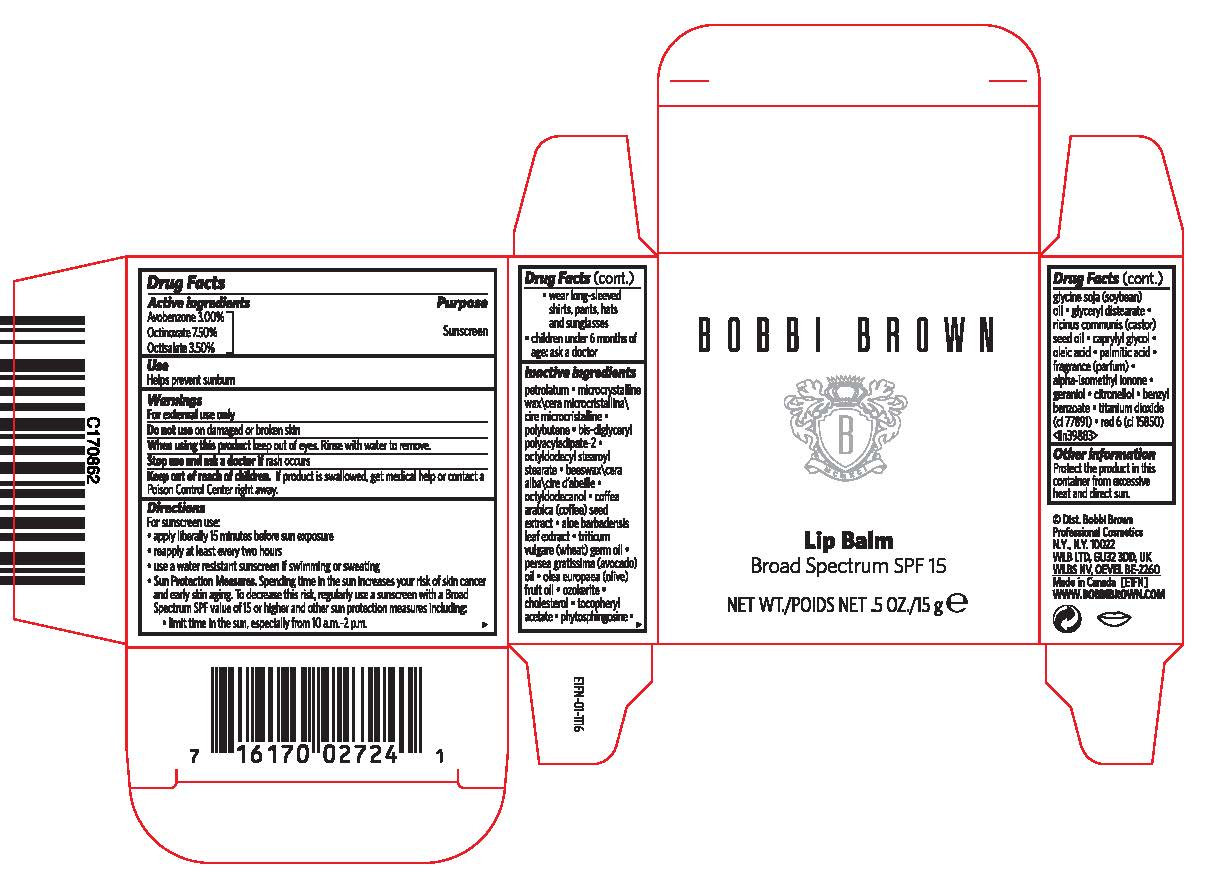
BOBBI BROWN LIP BALM BROAD SPECTRUM SPF 15 AVOBENZONE, OCTINOXATE, and OCTISALATE 3 g/100g; 7.5 g/100g; 3.5 g/100g Lipstick
🆔 Identity & classification
Where does this data come from?
🏭 Manufacturer & labeler
Where does this data come from?
🩺 Clinical
This is an over-the-counter lip balm sold as a lipstick formulation for topical application to the lips. It contains three sunscreen active ingredients (avobenzone, octinoxate, and octisalate) that are typically used to filter ultraviolet radiation and provide broad-spectrum sun protection. The product is marketed under the FDA's OTC monograph rules for sunscreen products rather than as an individually reviewed drug application. Lip balms with these ingredients are commonly used to help protect lip skin from sun exposure.
Patient education
Supplement & herbal interactions
Where does this data come from?
Ask a licensed pharmacist directly — free, answered by our team.
🧪 Inactive Ingredients / Excipients
Inactive ingredients, also called excipients, are components of the drug product other than the active ingredient. They may include fillers, dyes, coatings, preservatives, flavors, or other formulation ingredients.
💡 Tap an ingredient (hover on desktop) to see what it is and why it’s used.
-
UNII 9E8X80D2L0
A synthetic form of vitamin E used as an antioxidant and preservative in medications. It helps prevent the active ingredients from degrading when exposed to oxygen or light.
-
UNII P01OUT964K
A fragrant plant-derived alcohol used as a flavoring agent and fragrance component in medicines. It provides taste and aroma to make the product more pleasant to use.
-
UNII ZY81Z83H0X
Aloe vera leaf is a plant extract derived from the aloe plant. It is used in medicines as a natural moisturizer and skin-soothing agent in topical formulations.
-
UNII 3SW678MX72
A natural flavoring derived from roasted arabica coffee beans. It adds coffee taste and aroma to the medicine, making it more palatable for patients who need to swallow or chew the product.
-
UNII 6VNO72PFC1
A natural oil extracted from avocado fruit. It's used in medicines as an emollient and carrier to help dissolve or deliver active ingredients and improve how the product feels on skin or mucous membranes.
-
UNII N863NB338G
Benzyl benzoate is a liquid organic compound used as a solvent and preservative in medicines. It helps dissolve active ingredients and can extend shelf life by preventing microbial growth in liquid formulations.
-
UNII 00YIU5438U
Caprylyl glycol is a clear liquid derived from coconut oil. In medicines, it acts as a humectant to retain moisture, a preservative booster to prevent microbial growth, and a solvent to help dissolve or mix other ingredients.
-
UNII D5340Y2I9G
Castor oil is a natural plant-based oil used in medicines as a lubricant, laxative agent, and solvent. It helps medicine ingredients dissolve or flow smoothly and can aid bowel movement in formulations designed for that purpose.
-
UNII 97C5T2UQ7J
Cholesterol is a fatty substance found naturally in animal tissues. In medications, it's used as an ingredient in liposomal formulations and lipid-based drug delivery systems to help encapsulate and stabilize active drugs for better absorption.
-
UNII 481744AI4O
A synthetic red dye used to color medicines and products. It helps make tablets, capsules, and liquids visually distinct so patients can easily identify their medication.
-
UNII L837108USY
Geraniol is a natural fragrant compound found in plants like roses and lemons. It's used in medicines as a flavoring agent and to improve the taste or aroma of the product.
-
UNII 73071MW2KM
A waxy substance derived from glycerin and stearic acid that acts as a binder, emulsifier, and thickener in medicines. It helps hold solid formulations together and gives creams and lotions a smooth, stable texture.
-
UNII 9XP4LC555B
A fragrance compound derived from natural plant sources or made synthetically. It's added to medicines as a flavoring agent to mask bitter tastes and improve how the medicine smells and tastes.
-
UNII XOF597Q3KY
A refined form of wax made from petroleum, microcrystalline wax is used in medicines as a coating agent, binder, and hardening ingredient. It helps give tablets and capsules their shape and protective outer layer.
-
UNII 461N1O614Y
A synthetic oily liquid used as an emollient and solvent in medications. It helps dissolve active ingredients and improves how the medicine spreads or absorbs through the skin.
-
UNII 3D47Q6D93C
A synthetic ester derived from fatty acids, used as an emollient and lubricant in topical formulations. It helps soften the skin and improves the texture and spreadability of creams and ointments.
-
UNII 2UMI9U37CP
Oleic acid is a naturally occurring fatty acid derived from plant or animal oils. It functions as an emulsifier and solvent in medicines, helping blend water and oil-based ingredients together and dissolving other components.
-
UNII 6UYK2W1W1E
A natural oil extracted from olives. It acts as an emollient and lubricant in formulations, helping to soften ingredients and improve how the medicine spreads or flows.
-
UNII 2V16EO95H1
Palmitic acid is a saturated fatty acid derived from plant and animal sources. It serves as an emulsifier and lubricant in medicines, helping ingredients mix smoothly and preventing sticking during manufacturing.
-
UNII 4T6H12BN9U
Petrolatum is a purified mineral oil-based jelly derived from petroleum. In medicines, it acts as an emollient, lubricant, and moisture barrier to soften skin, reduce friction, and help prevent water loss from formulations.
-
UNII GIN46U9Q2Q
Phytosphingosine is a naturally derived fatty compound that helps stabilize and thicken skincare and cosmetic formulations. It works as an emollient and conditioning agent to improve texture and skin feel in topical products.
-
UNII 241ATL177A
Soybean oil is a natural plant oil derived from soybean seeds. It's used in medicines as a solvent and carrier to help dissolve or suspend active ingredients and improve how the body absorbs them.
-
UNII 15FIX9V2JP
Titanium dioxide is a bright white mineral powder commonly used as a colorant and opacifying agent. It makes pills and tablets white or lighter in color and helps make coatings non-transparent.
-
UNII 14C97E680P
Wheat germ oil is an oil extracted from wheat kernels. It's used in medicines as an emollient and lubricant to improve texture and help ingredients blend smoothly.
-
UNII 2ZA36H0S2V
Beeswax is a natural wax produced by honeybees. In medicines, it works as a coating agent and thickener to control how fast the drug dissolves and improve the product's texture and appearance.
25 inactive ingredients listed in the exact product block matched to this NDC.
Label-section wording can be broader than the structured product block and may mention additional formulation ingredients.
Where does this data come from?
ingredient classCode="IACT" elements from the exact product block matched by this NDC. Label-section narrative from DailyMed / the openFDA label index is shown separately when available.Inactive ingredient FAQ
Are inactive ingredients the same for every manufacturer?
Why might an inactive ingredient be missing?
Can inactive ingredients matter?
💲 Pricing
A drug doesn't have one price. Each row is a different public payment system, and none is what you'd pay at the counter — that depends on your insurance. The ⓘ on each row explains what it measures.
| Price system | Per each | Per package |
|---|---|---|
| Retail pharmacies payNADAC · weekly | Not in the retail survey — common for institutional, discontinued, or low-volume packs. | |
| Medicaid paysCMS SDUD · 12 mo | No recent Medicaid claims on file for this NDC — rare and low-volume NDCs are suppressed in the public data. | |
| Medicare drug plans payPart D · quarterly | No Part D plan price is available for this NDC in our data. | |
Where does this data come from?
🔁 Therapeutic equivalents
| Product | Labeler | Pack | NADAC/unit | TE | Status | Price vs. this |
|---|---|---|---|---|---|---|
| Bobbi Brown Lip Balm Broad Spectrum Spf 15 3 g/100g; 7.5 g/100g; 3.5 g/100gthis 64141-0019-01 | Bobbi | 1 jar | — | — | FDA listed | — |
Where does this data come from?
⏳ Availability & generic status
We did not find an FDA-approved generic match for this exact strength, form and route.
Where does this data come from?
🔬 Reported adverse events (FAERS)
Top reported reactions
Reporter sex
Where does this data come from?
📦 Packaging — all sizes for this product
| Package NDC | Description | Marketing start | Status |
|---|---|---|---|
| 64141-0019-01 You're viewing this | 1 JAR in 1 CARTON (64141-019-01) / 15 g in 1 JAR | 2002-02-01 | Active |
🧭 About this NDC listing & data coverage
What data is (and isn’t) available for this NDC — tap to expand
| NDC identity (package / product / labeler codes) | ✓ Available |
| Labeler | ✓ Available |
| Product & package description | ✓ Available |
| Marketing category & status | ✓ Available |
| Active ingredient / dosage form / route | ✓ Available |
| FDA label (SPL via DailyMed) | ✓ Available |
| Package photos | ✓ Available |
| Inactive ingredients (structured) | ✓ Available |
| NADAC pharmacy acquisition price (CMS) | — Not published for this NDC CMS publishes NADAC only for NDCs reported in its retail-pharmacy survey. |
| Orange Book / therapeutic-equivalence data | — Not published for this NDC Applies only to products approved under an NDA/ANDA; many listings are out of scope. |
| HCPCS J-code billing crosswalk | — Not published for this NDC Most self-administered / retail products have no J-code — that is normal. |
| Medicaid utilization (CMS SDUD) | — Not published for this NDC CMS reports utilization only for NDCs with Medicaid claims above its privacy threshold. |
Questions about this listing
Is this NDC FDA-approved?
Why is there no price listed?
Is the NDC printed on the package the same as the 11-digit billing NDC?
What do the three segments of this NDC mean?
Is this package still being marketed?
Who lists this product with the FDA?
Do I need a prescription for this product?
Where does this data come from?
📄 FDA label — Drug Facts FDA SPL
🎯 Indications and Usage ▾
Use Helps prevent sunburn
⏱️ Dosage and Administration ▾
Directions For sunscreen use: apply liberally 15 minutes before sun exposure reapply at least every two hours use a water resistant sunscreen if swimming or sweating Sun Protection Measures. Spending time in the sun increases your risk of skin cancer and early skin aging. To decrease this risk, regularly use a sunscreen with a Broad Spectrum SPF value of 15 or higher and other sun protection measures including: limit time in the sun, especially from 10 a.m.–2 p.m. wear long-sleeved shirts, pants, hats and sunglasses children under 6 months of age: ask a doctor
⚠️ Warnings ▾
Warnings For external use only Do not use on damaged or broken skin When using this product keep out of eyes. Rinse with water to remove. Stop use and ask a doctor if rash occurs Keep out of reach of children. If product is swallowed, get medical help or contact a Poison Control Center right away.
📦 Storage and Handling ▾
Other information Protect the product in this container from excessive heat and direct sun.
🧪 Active Ingredient ▾
Active Ingredients Avobenzone 3.00% Octinoxate 7.50% Octisalate 3.50%
🧪 Inactive Ingredients ▾
Inactive ingredients petrolatum ■ microcrystalline wax\cera microcristallina\cire microcristalline ■ polybutene ■ bis-diglyceryl polyacyladipate-2 ■ octyldodecyl stearoyl stearate ■ beeswax\cera alba\cire d abeille ■ octyldodecanol ■ coffea arabica (coffee) seed extract ■ aloe barbadensis leaf extract ■ triticum vulgare (wheat) germ oil ■ persea gratissima (avocado) oil ■ olea europaea (olive) fruit oil ■ ozokerite ■ cholesterol ■ tocopheryl acetate ■ phytosphingosine ■ glycine soja (soybean) oil ■ glyceryl distearate ■ ricinus communis (castor) seed oil ■ caprylyl glycol ■ oleic acid ■ palmitic acid ■ fragrance (parfum) ■ alpha-isomethyl ionone ■ geraniol ■ citronellol ■ benzyl benzoate ■ titanium dioxide (ci 77891) ■ red 6 (ci 15850) <iln39883>
🎯 Purpose ▾
Purpose Sunscreen