
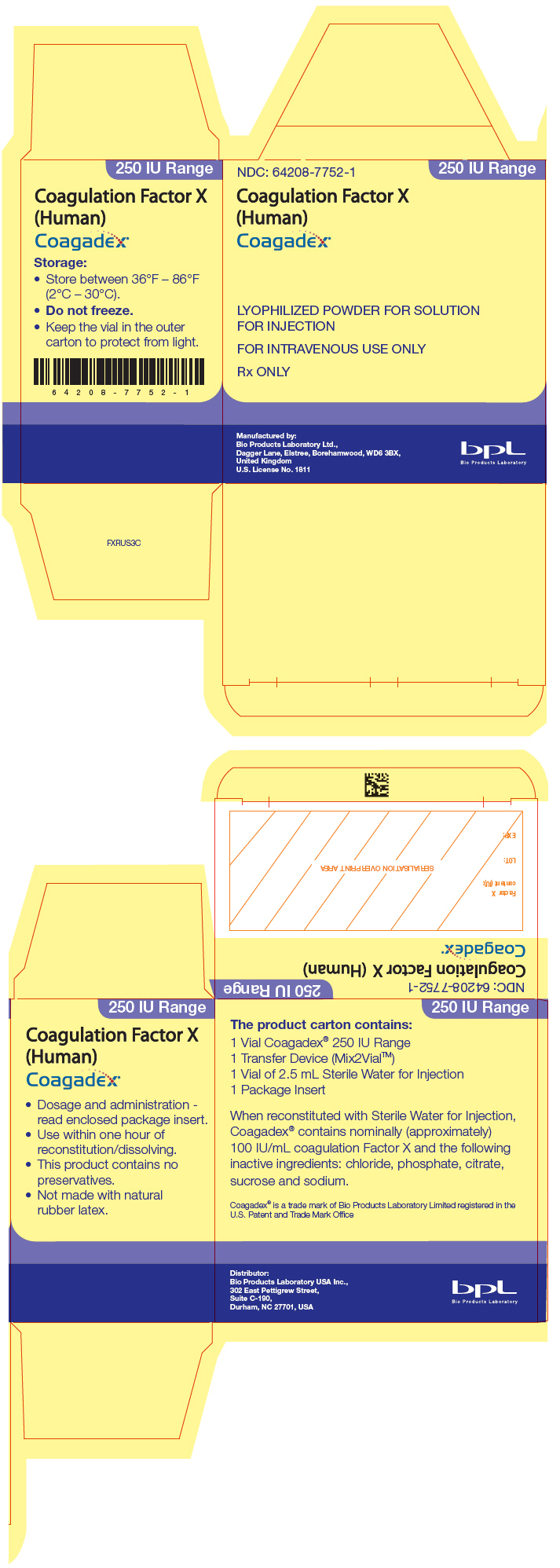
Coagadex Coagulation Factor X Human Kit — NDC 64208-7752-1 (Billing 64208-7752-01)
This is a package of Coagadex Coagulation Factor X Human Kit from Bio Products Laboratory Ltd, marketed since Oct 2015 and currently FDA-listed. It is this product's only package size.
NDC database record
One package, one record: these facts belong to NDC 64208-7752-1 alone.
- Record
- FDA NDC Directory package listing · Human prescription drug
- Code segments
- 64208 labeler · 7752 product · 1 package
- Package marketed since
- Oct 21, 2015
- Sample package
- No — commercial package
- Listing certified through
- Dec 31, 2027
- Barcode (UPC-A, from the NDC)
- 3 6420877521 5
- FDA record last changed
- Jul 24, 2026
Identity & classification
Regulatory identifiers FDA, NLM and CMS codes for this package
Drug-database identifiers Medi-Span GPI and First Databank GCN / HICL / AHFS classification
- GSN (GCN sequence number): 075044
- GCN: 39952
- GPI-14 (Medi-Span): 85100031002120
- HICL (First Databank): 042733
- AHFS class code: 20:28.16.00
- RxCUI (RxNorm): 1719235
Where does this data come from?
- FDA openFDA NDC Directory · synced Oct 8, 2026
- FDA label on DailyMed · label index refreshed Oct 8, 2026
- RxNorm (NLM RxNav) · catalog refreshed Oct 1, 2026
- Medi-Span GPI (licensed)
- First Databank (licensed) · refreshed Oct 8, 2026
RxNorm drug class
This medicine belongs to the Human Blood Coagulation Factor class.
Where does this data come from?
- RxClass (NLM) · catalog refreshed Oct 1, 2026
Clinical
Patient education
Supplement & herbal interactions
Where does this data come from?
- MedlinePlus (NLM) · refreshed Oct 8, 2026
- FDA label on DailyMed · label index refreshed Oct 8, 2026
Ask a licensed pharmacist directly — free, answered by our team.
Pricing
A drug doesn't have one price. Each row is a different public payment system, and none is what you'd pay at the counter — that depends on your insurance. The ⓘ on each row explains what it measures.
| Price system | Per each | Per package |
|---|---|---|
| Retail pharmacies payNADAC · weekly | Not in the retail survey — common for institutional, discontinued, or low-volume packs. | |
| Medicaid paysCMS SDUD · 12 mo | No recent Medicaid claims on file for this NDC — rare and low-volume NDCs are suppressed in the public data. | |
| Medicare drug plans payPart D · quarterly | No Part D plan price is available for this NDC in our data. | |
| Medicare Part B allowsASP · J7175 | $9.953 / J7175 unit | — |
Where does this data come from?
- CMS NADAC weekly file
- CMS ASP pricing files · refreshed Sep 20, 2026
- CMS Medicaid State Drug Utilization Data · refreshed Oct 8, 2026
- CMS Part D plan pricing files · refreshed Sep 24, 2026
- VA National Acquisition Center price file
Billing & reimbursement
Where does this data come from?
- CMS ASP NDC-HCPCS crosswalk · refreshed Sep 22, 2026
- DMEPDAC NDC-HCPCS crosswalk
- openFDA NSDE billing units · refreshed Oct 7, 2026
Packaging — all sizes for this product
| Package NDC | Description | Marketing start | Marketing end | Status |
|---|---|---|---|---|
| 64208-7752-01 You're viewing this Main listing | 1 KIT in 1 CARTON * 10 mL in 1 VIAL, GLASS * 2.5 mL in 1 VIAL, GLASS | 2015-10-21 | — | Active |
Therapeutic equivalents
| Product | Labeler | Pack | NADAC/unit | TE | Status | Price vs. this |
|---|---|---|---|---|---|---|
| Coagadexthis 64208-7752-01 | Bio | 1 kit | — | — | FDA listed | — |
| Coagadex 64208-7753-01 | Bio | 1 kit | — | — | FDA listed | — |
Where does this data come from?
- FDA openFDA NDC Directory · synced Oct 8, 2026
- FDA Purple Book · refreshed Oct 5, 2026
- CMS NADAC weekly file
Availability & biosimilar status
Biologics have no small-molecule generics; biosimilar competition is tracked in the FDA Purple Book.
Why the date isn’t exact: Biosimilar timing can change because patents may be challenged, settled, licensed, added or removed, and litigation can move the real date earlier or later.
🛈 What do these terms mean?
- Biologic patent
- A patent the reference product’s maker has publicly listed. A biosimilar generally can’t launch until these expire — unless they’re invalidated or resolved in a settlement.
- Reference-product exclusivity
- A flat 12 years of FDA market protection from the biologic’s first licensure (the BPCIA). No biosimilar can be licensed before it ends, regardless of patents.
- Interchangeable exclusivity
- The first interchangeable biosimilar can earn a period as the only interchangeable version (pharmacists can substitute it without the prescriber).
- Earliest biosimilar (LOE)
- The latest of all the dates above — the soonest a biosimilar can realistically reach the market. Litigation and settlements can move it earlier.
Biologics have no small-molecule “generics” — competition comes from FDA-licensed biosimilars, tracked in the FDA Purple Book.
| Code | What it grants | Expires |
|---|---|---|
| RefProduct | Reference-product exclusivity (12-year, BPCIA) — no biosimilar can be licensed before this date | Oct 20, 2027 |
Is there a biosimilar for COAGADEX 250 UNIT VIAL?
Why do different websites show different biosimilar dates?
Can a biosimilar launch before the last patent expires?
What does “current Purple Book estimate” mean?
What does “FDA listed” mean?
What does a patent or protection date mean here?
Where does this data come from?
- FDA Purple Book · refreshed Oct 5, 2026
Inactive Ingredients / Excipients
Inactive ingredients, also called excipients, are components of the drug product other than the active ingredient. They may include fillers, dyes, coatings, preservatives, flavors, or other formulation ingredients.
Where does this data come from?
IACT rows and label-wide narrative are kept separate; availability and product-level specificity depend on the submitted label.- FDA label on DailyMed · label index refreshed Oct 8, 2026
- FDA openFDA NDC Directory · synced Oct 8, 2026
Inactive ingredient FAQ
Are inactive ingredients the same for every manufacturer?
Why might an inactive ingredient be missing?
Can inactive ingredients matter?
Manufacturer & labeler
More NDCs from Bio Products Laboratory Ltd labeler code 64208
- ALBUMINEX Albumin Human .05 g/mL Solution NDC 64208-2510-1
- ALBUMINEX Albumin Human .25 g/mL Solution NDC 64208-2512-3
- Coagadex Coagulation Factor X Human Kit NDC 64208-7753-1
- Gammaplex HUMAN IMMUNOGLOBULIN G 5 g/100mL Solution NDC 64208-8234-6
- Gammaplex HUMAN IMMUNOGLOBULIN G 5 g/50mL Solution NDC 64208-8235-5
Where does this data come from?
- FDA openFDA NDC Directory · synced Oct 8, 2026
- Drugs@FDA
Full prescribing information FDA SPL
🎯 Indications and Usage ▾
1 INDICATIONS AND USAGE COAGADEX, Coagulation Factor X (Human), is a plasma-derived human blood coagulation Factor indicated in adults and children with hereditary Factor X deficiency for: Routine prophylaxis to reduce the frequency of bleeding episodes On-demand treatment and control of bleeding episodes Perioperative management of bleeding in patients with mild, moderate, and severe hereditary Factor X deficiency COAGADEX, Coagulation Factor X (Human), is a plasma-derived human blood coagulation factor indicated in adults and children with hereditary Factor X deficiency for: Routine prophylaxis to reduce the frequency of bleeding episodes ( 1 ) On-demand treatment and control of bleeding episodes ( 1 ) Perioperative management of bleeding in patients with mild, moderate and severe hereditary Factor X deficiency ( 1 )
⏱️ Dosage and Administration ▾
2 DOSAGE AND ADMINISTRATION For intravenous use after reconstitution only For intravenous use only after reconstitution. Each vial of COAGADEX contains the labeled amount of Factor X in international units (IU) ( 2 ) The dosage and duration of treatment depend on the severity of the Factor X deficiency, the location and extent of the bleeding and the patient's clinical condition ( 2.1 ) For prophylaxis of bleeding episodes ( 2.1 ): Age Initial dose Further management Children: Less than 12 years of age 40 IU/kg twice weekly Monitor trough blood levels of Factor X targeting ≥5 IU/dL and adjust dosage to clinical response and trough levels.
Do not exceed a peak level of 120 IU/dL. Adults and adolescents: 12 years of age or older 25 IU/kg twice weekly For treatment of bleeding episodes ( 2.1 ): Age Initial dose Further management Children: Less than 12 years of age 30 IU/kg Infuse at first sign of bleeding. Repeat at intervals of 24 hours until the bleed stops.
Adults and adolescents: 12 years of age or older 25 IU/kg For perioperative management ( 2.1 ): Age Initial dose Further management Children: Less than 12 years of age Use a factor of 0.6 to calculate the required dose Pre-surgery: raise plasma Factor X levels to 70-90 IU/dL. Post-surgery: maintain plasma Factor X levels at ≥50 IU/dL until the patient is no longer at risk of bleeding due to surgery. Dose (IU) = body weight (kg) × desired factor X rise † (IU/dL or % of normal) ×
0.6Adults and adolescents: 12 years of age or older Use a factor of 0.5 to calculate the required dose Dose (IU) = body weight (kg) × desired factor X rise ‡ (IU/dL or % of normal) × 0.5
2.1Dose Dose and duration of the treatment depend on the severity of the Factor X deficiency, location and extent of the bleeding, the patient's age (<12 years or >12 years) and the patient's clinical condition. Base the dose and frequency on the individual clinical response. Do not administer more than 60 IU/kg daily.
Each vial of COAGADEX is labeled with the actual Factor X potency/content in International Units (IU). Prophylaxis of bleeding episodes Age Initial dose Further management Children: Less than 12 years of age 40 IU/kg twice weekly Due to inter-and intra-patient variability, it is recommended that trough blood levels of Factor X should be monitored at intervals, especially in the first weeks of therapy or after dosages changes. Adjust dosage regimen to clinical response and trough levels of Factor X of at least 5 IU/dL.
Do not exceed a peak level of 120 IU/dL. [For more detailed calculations of dose, see Detailed Dose Calculation (2.1) ] . Adults and adolescents: 12 years of age or older 25 IU/kg twice weekly On–demand treatment and control of bleeding episodes Age Initial dose Further management Children: Less than 12 years of age 30 IU/kg Infuse COAGADEX when the first sign of bleeding occurs [see Clinical Trial Experience (6.1) ] . Repeat at intervals of 24 hours until the bleed stops. [For more detailed calculations of dose, see Detailed Dose Calculation (2.1) ] .
Adults and adolescents: 12 years of age or older 25 IU/kg Perioperative management of bleeding Age Initial dose Further management Children: Less than 12 years of age Use a factor of 0.6 to calculate the required dose Measure post-infusion plasma Factor X levels for each patient before and after surgery to ensure that hemostatic levels are obtained and maintained. Pre-surgery : calculate the dose of COAGADEX to raise plasma Factor X levels to 70-90 IU/dL Post-surgery : Repeat dose as necessary to maintain plasma Factor X levels at a minimum of 50 IU/dL until the patient is no longer at risk of bleeding due to surgery Dose (IU) = body weight (kg) × desired factor X rise † (IU/dL or % of normal) ×
0.6Adults and adolescents: 12 years of age or older Use a factor of 0.5 to calculate the required dose Dose (IU) = body weight (kg) × desired factor X rise ‡ (IU/dL or % of normal) ×
0.5Detailed Dose Calculation For young children (less than 12… [Excerpted — this section continues on DailyMed.]
💊 Dosage Forms and Strengths ▾
3 DOSAGE FORMS AND STRENGTHS COAGADEX is available as a white or off-white lyophilized powder for reconstitution in single-dose vials containing nominally (approximately) 250 IU or 500 IU of Factor X activity. The exact potency/content is listed on the vial label. When reconstituted using the Sterile Water for Injection supplied with the kit, the final concentration is approximately 100 IU/mL.
Factor X activity in COAGADEX is defined in IU and determined using an in vitro chromogenic assay and a Factor X concentrate reference standard calibrated against the current World Health Organization (WHO) International Standard for Blood Coagulation Factors II and X, Concentrate. COAGADEX is available as a lyophilized powder for reconstitution in single-dose vials containing nominally (approximately) 250 IU or 500 IU of Factor X activity. When reconstituted using the Sterile Water for Injection supplied with the kit, the final concentration is approximately 100 IU/mL ( 3 ).
⛔ Contraindications ▾
4 CONTRAINDICATIONS COAGADEX is contraindicated in patients who have had life-threatening hypersensitivity reactions to COAGADEX [ see Description (11) ]. Do not use in patients who have had life-threatening hypersensitivity reactions to COAGADEX ( 4 ).
⚠️ Warnings and Cautions ▾
5 WARNINGS AND PRECAUTIONS Hypersensitivity reactions, including anaphylaxis, are possible. Should symptoms occur, discontinue COAGADEX and administer appropriate treatment ( 5.1 ). Development of neutralizing antibodies (inhibitors) may occur.
If expected plasma Factor X activity levels are not attained, or if bleeding is not controlled with an appropriate dose, perform an assay that measures Factor X inhibitor concentration ( 5.2 ). COAGADEX is made from human blood and therefore carries a risk of transmitting infectious agents, e.g. viruses, the variant Creutzfeldt-Jakob disease (vCJD) agent and, theoretically, the Creutzfeldt-Jakob disease (CJD) agent ( 5.4 ).
5.1Hypersensitivity Reactions Allergic type hypersensitivity reactions, including anaphylaxis, are possible. Early signs of hypersensitivity reactions including angioedema, infusion site inflammation (e.g. burning, stinging, erythema), chills, cough, dizziness, fever, flushing, generalized urticaria, headache, hives, hypotension, lethargy, musculoskeletal pains, nausea, pruritus, rash, restlessness, tachycardia, tightness of the chest, tingling, vomiting, wheezing. If hypersensitivity symptoms occur, discontinue use of the product immediately and administer appropriate emergency treatment.
COAGADEX contains traces of human proteins other than Factor X.
5.2Neutralizing Antibodies The formation of neutralizing antibodies (inhibitors) to Factor X may occur. Monitor all patients treated with COAGADEX for the development of inhibitors by appropriate clinical observations and laboratory tests. If expected Factor X activity levels are not attained, or if bleeding is not controlled with an expected dose, perform an assay that measures Factor X inhibitor concentration.
5.3Transmissible Infectious Agents As COAGADEX is made from human blood, it may carry a risk of transmitting infectious agents, e.g. viruses, the variant Creutzfeldt-Jakob disease (vCJD) agent and, theoretically, the Creutzfeldt-Jakob disease (CJD) agent. There is also the possibility that unknown infectious agents may be present in the product. The risk that the product will transmit viruses has been reduced by screening plasma donors for prior exposure to certain viruses, by testing for the presence of certain current virus infections, and by inactivating and removing certain viruses during manufacture.
Despite these measures, this product may still potentially transmit diseases. All infections suspected by a physician possibly to have been transmitted by this product should be reported by the physician or other healthcare providers to Kedrion Biopharma, Inc. at 1-855-3KDRION (1-855-353-7466) or [email protected]
5.4Monitoring and Laboratory Tests Monitor plasma Factor X activity by performing a validated test (e.g. one-stage clotting assay), to confirm that adequate Factor X levels have been achieved and maintained [ see Dosage and Administration (2) ]. Monitor for the development of Factor X inhibitors. Perform a Nijmegen-Bethesda inhibitor assay if expected Factor X plasma levels are not attained, or if bleeding is not controlled with the expected dose of COAGADEX.
Use Nijmegen-Bethesda Units (BU) to report inhibitor levels.
🤒 Adverse Reactions ▾
6 ADVERSE REACTIONS The most common adverse drug reactions (frequency ≥ 5% of subjects) observed in clinical trials were infusion site erythema, infusion site pain, fatigue, and back pain. The most common adverse drug reactions (frequency ≥ 5% of subjects) observed in clinical trials were infusion site erythema, infusion site pain, fatigue and back pain ( 6 ). To report SUSPECTED ADVERSE REACTIONS, contact Kedrion Biopharma, Inc. at 1-855-3KDRION (1-855-353-7466) or the FDA at 1-800-FDA-1088 or www.fda.gov/medwatch
6.1Clinical Trials Experience As clinical trials are conducted under widely varying conditions, adverse reaction rates observed in the clinical trials of a drug cannot be directly compared to rates in the clinical trial of another drug and may not reflect the rates observed in clinical practice. During the clinical development of COAGADEX involving three multicenter, open-label, non-randomized clinical studies, 27 individual subjects with hereditary Factor X deficiency received at least one dose of COAGADEX. Sixteen subjects aged 12 to 58 years with moderate to severe hereditary Factor X deficiency (basal FX:C < 5 IU/dL) received doses of COAGADEX for pharmacokinetic evaluation, on-demand treatment for control of bleeding episodes, and/or perioperative management of minor surgical or dental procedures.
A total of 468 infusions were administered, including 242 for on-demand treatment and control of bleeding episodes, 6 for perioperative management and 31 for PK assessments. Spontaneous, traumatic and menorrhagic bleeding episodes were treated with an on-demand dose of 25 IU/kg for up to 2 years. Two subjects aged 55 and 59 years with mild hereditary Factor X deficiency (basal FX:C 6 IU/dL and 8 IU/dL) received COAGADEX for perioperative management of four major surgical procedures.
There were 40 exposure days to COAGADEX. Six adverse reactions were reported in 2 of the 18 subjects. These were infusion site erythema (2 reports in 1 subject [5.6%]), fatigue (2 reports in 1 subject [5.6%]), back pain (1 report [5.6%]) and infusion site pain (1 report [5.6%]).
In a separate study, nine children (aged 2 to 11 years), of whom four were less than 6 years of age, received 537 (mean 59.7) doses of COAGADEX as routine prophylaxis of bleeding episodes during a period of at least 6 months. In addition, 22 infusions were given to treat a bleed, equivalent to 2.1 bleeds per subject per year. There were no adverse drug reactions in this study.
6.2Immunogenicity Immunogenicity was evaluated in three studies and all subjects (adults and children) underwent Factor X inhibitor testing (inhibitor screen and Nijmegen-Bethesda assay) at baseline, end of study and at 3-monthly intervals in between. For subjects who underwent surgery, inhibitor testing was done pre-surgery and on discharge. All inhibitor tests were negative.
Additionally, comparison of pharmacokinetic (PK) parameters at the repeat PK assessment with those at first dose did not suggest development of any inhibitors to Factor X. The detection of antibody formation is highly dependent on the sensitivity and specificity of the assay. Additionally, the observed incidence of antibody (including neutralizing antibody) positivity in an assay may be influenced by several factors including assay methodology, sample handling, timing of sample collection, concomitant medications, and underlying disease.
For these reasons, it may be misleading to compare the incidence of antibodies to COAGADEX in the studies described above with the incidence of antibodies in other studies or to other products.
🔄 Drug Interactions ▾
7 DRUG INTERACTIONS Drug interaction studies have not been performed. Use with caution in patients who are receiving other plasma products that may contain Factor X (e.g. fresh frozen plasma, prothrombin complex concentrates). Based on the mechanism of action, COAGADEX is likely to be counteracted by direct and indirect Factor Xa inhibitors [ see Clinical Pharmacology (12.1) ].
👥 Use in Specific Populations ▾
8 USE IN SPECIFIC POPULATIONS
8.1Pregnancy Risk Summary There is limited data with COAGADEX in pregnant women to inform on drug-associated risk. Animal reproduction studies have not been conducted using COAGADEX. It is not known whether COAGADEX can cause fetal harm when administered to a pregnant woman or can affect reproduction capacity.
In the U.S. general population, the estimated background risk of major birth defects and miscarriage in clinically recognized pregnancies is 2-4% and 15-20%, respectively.
8.2Lactation Risk Summary There is no information regarding the presence of COAGADEX in human milk, the effects on the breast-fed infant, or the effects on milk production. The developmental and health benefits of breast-feeding should be considered along with the mother's clinical need for COAGADEX and any potential adverse effects on the breast-fed infant from COAGADEX or from the underlying maternal condition.
8.4Pediatric Use A prospective, open-label, multicenter study was conducted in nine pediatric patients (0-5 years, n=4; 6-11 years, n=5) with severe (n=8) or moderate (n=1) hereditary factor X deficiency, to assess safety, efficacy, and pharmacokinetics of COAGADEX used prophylactically and on-demand. Patients had baseline FX levels < 5 IU/dL, and were dosed to achieve post-treatment levels of at least 5 IU/dL. After ≥26 weeks and ≥50 exposure days, investigators rated pdFX efficacy for preventing/decreasing bleeds.
At end of study, investigators rated pdFX efficacy excellent for all subjects. Ten bleeds occurred (n = 3 subjects; 6 major, 3 minor, 1 unassessed for severity). Trough FX:C levels remained >5 IU/dL for all subjects after achievement of steady state.
All AEs were unrelated to treatment; no inhibitor development or clinically significant changes in laboratory parameters were observed. Six additional pediatric subjects aged 12 to 17 years were included in a prospective, open-label, multicenter study of COAGADEX to treat spontaneous, traumatic and menorrhagic bleeding episodes. Overall efficacy and safety outcomes were comparable to those in the younger age groups. [ See Clinical Trial Experience (6.1) , Pharmacokinetics (12.3) and Clinical Studies (14) ].
8.5Geriatric Use Clinical studies of COAGADEX did not include sufficient numbers of subjects aged 65 and over to determine whether they respond differently from younger subjects. Other reported clinical experience has not identified differences in responses between the elderly and younger patients. In general, dose selection for an elderly patient should be cautious, usually starting at the low end of the dosing range, reflecting the greater frequency of decreased hepatic, renal, or cardiac function, and of concomitant disease or other drug therapy.
🤰 Pregnancy ▾
8.1Pregnancy Risk Summary There is limited data with COAGADEX in pregnant women to inform on drug-associated risk. Animal reproduction studies have not been conducted using COAGADEX. It is not known whether COAGADEX can cause fetal harm when administered to a pregnant woman or can affect reproduction capacity.
In the U.S. general population, the estimated background risk of major birth defects and miscarriage in clinically recognized pregnancies is 2-4% and 15-20%, respectively.
🧒 Pediatric Use ▾
8.4Pediatric Use A prospective, open-label, multicenter study was conducted in nine pediatric patients (0-5 years, n=4; 6-11 years, n=5) with severe (n=8) or moderate (n=1) hereditary factor X deficiency, to assess safety, efficacy, and pharmacokinetics of COAGADEX used prophylactically and on-demand. Patients had baseline FX levels < 5 IU/dL, and were dosed to achieve post-treatment levels of at least 5 IU/dL. After ≥26 weeks and ≥50 exposure days, investigators rated pdFX efficacy for preventing/decreasing bleeds.
At end of study, investigators rated pdFX efficacy excellent for all subjects. Ten bleeds occurred (n = 3 subjects; 6 major, 3 minor, 1 unassessed for severity). Trough FX:C levels remained >5 IU/dL for all subjects after achievement of steady state.
All AEs were unrelated to treatment; no inhibitor development or clinically significant changes in laboratory parameters were observed. Six additional pediatric subjects aged 12 to 17 years were included in a prospective, open-label, multicenter study of COAGADEX to treat spontaneous, traumatic and menorrhagic bleeding episodes. Overall efficacy and safety outcomes were comparable to those in the younger age groups. [ See Clinical Trial Experience (6.1) , Pharmacokinetics (12.3) and Clinical Studies (14) ].
🧓 Geriatric Use ▾
8.5Geriatric Use Clinical studies of COAGADEX did not include sufficient numbers of subjects aged 65 and over to determine whether they respond differently from younger subjects. Other reported clinical experience has not identified differences in responses between the elderly and younger patients. In general, dose selection for an elderly patient should be cautious, usually starting at the low end of the dosing range, reflecting the greater frequency of decreased hepatic, renal, or cardiac function, and of concomitant disease or other drug therapy.
🆘 Overdosage ▾
10 OVERDOSAGE One case of accidental overdosage was reported in the clinical trials, in which a subject received approximately 80 IU/kg Factor X to treat a bleed. No adverse events were reported relating to this overdose.
🧬 Clinical Pharmacology ▾
12 CLINICAL PHARMACOLOGY
12.1Mechanism of Action COAGADEX temporarily replaces the missing Factor X needed for effective hemostasis. Factor X is an inactive zymogen, which can be activated by Factor IXa (via the intrinsic pathway) or by Factor VIIa (via the extrinsic pathway). Factor X is converted from its inactive form to the active form (Factor Xa) by the cleavage of a 52-residue peptide from the heavy chain.
Factor Xa associates with Factor Va on a phospholipid surface to form the prothrombinase complex, which activates prothrombin to thrombin in the presence of calcium ions. Thrombin then acts upon soluble fibrinogen and Factor XIII to generate a cross-linked fibrin clot.
12.2Pharmacodynamics The administration of COAGADEX increases plasma levels of Factor X and can temporarily correct the coagulation defect in these patients, as reflected by decrease in the aPTT and PT.
12.3Pharmacokinetics In a clinical study of COAGADEX in subjects with severe or moderate Factor X deficiency (basal FX:C < 5 IU/dL), the pharmacokinetics of COAGADEX were assessed after intravenous infusion (mean [range] infusion rate 5.9 [1.3-17.1] mL/min) of 25 IU/kg COAGADEX. Pharmacokinetic (PK) parameters were calculated from plasma Factor X:C activity measurements after subtraction of the pre-dose value. The PK assessment was repeated at least 6 months after the first dose.
The PK parameters following a single dose are summarized in Table 3. The pharmacokinetics of COAGADEX were similar following the single and repeat dosing. Table 3 Mean PK Parameters of COAGADEX Following a Single 25 IU/kg Dose to Subjects 12 years of Age and Older First Dose Mean (CV%) (n=16) CV: Coefficient of variation C max (IU/mL) 0.504 (17.2) Half-life (hr) 30.3 (22.8) AUC 0-144h (IU.hr/mL) 17.1 (21.0) AUC( 0-∞ ) (IU.hr/mL) 18.0 (20.9) V ss (mL/kg) 56.3 (24.0) CL (mL/kg/hr) 1.35 (21.7) MRT (hr) 41.8 (21.7) Incremental recovery (IU/dL per IU/kg) Using peak increment within 30 minutes post-dose 2.04 (19.5) Incremental recovery in children <12 years of age was assessed at baseline and 6 months after the first dose.
Values are summarized in Table 4. Table 4 Incremental Recovery (IU/mL per IU/kg) in Young Children Under 12 Years of Age Pediatric age group Visit 1 First dose of COAGADEX; Mean (Min-Max) End of Study After at least 6 months; Mean (Min-Max) Aged 6-11 years (n = 5) 1.83 (1.6–2.2) 1.99 (1.8–2.2) Aged 0-5 years (n = 4) 1.45 (1.3–1.6) 1.62 (1.3–1.8) Studies were not conducted to evaluate the impact of gender or renal/hepatic function on the pharmacokinetics of COAGADEX.
🧬 Mechanism of Action ▾
12.1Mechanism of Action COAGADEX temporarily replaces the missing Factor X needed for effective hemostasis. Factor X is an inactive zymogen, which can be activated by Factor IXa (via the intrinsic pathway) or by Factor VIIa (via the extrinsic pathway). Factor X is converted from its inactive form to the active form (Factor Xa) by the cleavage of a 52-residue peptide from the heavy chain.
Factor Xa associates with Factor Va on a phospholipid surface to form the prothrombinase complex, which activates prothrombin to thrombin in the presence of calcium ions. Thrombin then acts upon soluble fibrinogen and Factor XIII to generate a cross-linked fibrin clot.
📦 How Supplied / Storage and Handling ▾
16 HOW SUPPLIED/STORAGE AND HANDLING How Supplied COAGADEX is supplied in single-dose glass vials containing a nominal (approximate) 250 IU or 500 IU (approximately 100 IU/mL after reconstitution) of Factor X activity, packaged with 2.5 mL or 5 mL of Sterile Water for Injection, respectively, and a Mix2Vial transfer device. The vials are closed with a synthetic rubber stopper. The stopper is not made with natural rubber latex.
The stopper is secured with an aluminum overseal with a flip-off polypropylene cap. Strength Kit NDC Number 250 IU Range 64208-7752-1 500 IU Range 64208-7753-1 Storage and Handling Store COAGADEX in its original package to protect it from light. Store the COAGADEX package in a refrigerator or at room temperature at 36°F to 86°F (2°C to 30°C).
Do not freeze. Do not use COAGADEX or the Sterile Water for Injection after the expiration date printed on the vial and carton labels. Use reconstituted COAGADEX within one hour of reconstitution.
Do not use COAGADEX if the reconstituted solution is cloudy or contains any particles.
📦 Storage and Handling ▾
Storage and Handling Store COAGADEX in its original package to protect it from light. Store the COAGADEX package in a refrigerator or at room temperature at 36°F to 86°F (2°C to 30°C). Do not freeze.
Do not use COAGADEX or the Sterile Water for Injection after the expiration date printed on the vial and carton labels. Use reconstituted COAGADEX within one hour of reconstitution. Do not use COAGADEX if the reconstituted solution is cloudy or contains any particles.
📋 Description ▾
11 DESCRIPTION COAGADEX is a plasma-derived, sterile, purified concentrate of human coagulation Factor X that contains sucrose as a stabilizer. It is formulated as a lyophilized powder for solution for intravenous administration. When reconstituted with Sterile Water for Injection it forms a colorless, clear or slightly pearl-like solution.
COAGADEX contains nominally (approximately) 100 IU/mL of coagulation Factor X and the following inactive ingredients: chloride, phosphate, citrate, sucrose and sodium. Each vial of COAGADEX is labeled with the actual Factor X activity/content expressed in IU per vial. Factor X activity in IU is determined using an in vitro chromogenic assay and a Factor X concentrate reference standard calibrated against the current WHO International Standard for Blood Coagulation Factors II and X Concentrate.
COAGADEX contains no added biological components such as heparin, albumin or anti-thrombin. The content of Factor II and Factor IX are ≤ 1 IU/mL of the reconstituted product. Factor Xa and Factor IIa were not detectable by Non-activated Partial Thromboplastin Time (NaPTT) or Fibrinogen Clotting Time (FCT) tests for potential thrombogenicity, and comprised < 10 parts per million by weight when tested by more sensitive analytical methods.
The specific activity of COAGADEX is typically 80-137 IU per mg protein. The product contains no preservatives. COAGADEX is manufactured from plasma, obtained from healthy US donors, who have passed viral screening tests.
All donors are subjected to medical examinations, laboratory tests, and a review of their medical history before being allowed to donate blood or plasma. All plasma donations are screened for antibody to human immunodeficiency virus (HIV)-1/2, hepatitis C virus (HCV), and hepatitis B surface antigen (HBsAg). Additional testing of donations is carried out in plasma mini-pools (512 donations per pool) with nucleic acid amplification testing (NAT) for HIV, hepatitis B virus (HBV), hepatitis C virus (HCV), hepatitis A virus (HAV) and human parvovirus B19.
Furthermore, each manufacturing pool is tested to be negative for HBsAg and anti-HIV-1/2 antibodies. Also, manufacturing pools are non-reactive by nucleic acid test for HAV, HBV, HCV, and HIV-1. The limit for human parvovirus B19 in the manufacturing pools is set not to exceed 10 4 IU/mL.
Three processing steps specifically designed to remove or inactivate viruses are: 1) Solvent/detergent treatment targeted to inactivate enveloped viruses 2) A 15-nm filtration step designed to remove small viruses including non-enveloped viruses 3) Terminal dry-heat treatment at 80°C for 72 hours in the final container to inactivate enveloped and non-enveloped viruses The capacity of the manufacturing process to remove and/or inactivate enveloped and non-enveloped viruses has been validated by laboratory spiking studies on a scaled-down process model.
Overall virus reduction was calculated only from steps that were mechanistically independent from each other. Table 2 presents the contribution of each process step to virus reduction and the overall process reduction. Table 2 Viral Reduction by Process Step Process Log 10 Reduction of Virus (LRV) over manufacturing step Virus Type (Envelope/Genome) Size (nm) Solvent/detergent 15-nm filtration Terminal dry-heat treatment Total LRV HIV: Human immunodeficiency virus SIN: Sindbis virus, model for HCV WNV: West Nile Virus BVDV: Bovine viral diarrhea virus, model for HCV IBR: Infectious bovine rhinotracheitis, bovine herpes virus model for enveloped DNA viruses including HBV HAV: Hepatitis A virus HSV: Herpes simplex virus CPV: Canine parvovirus, model for human parvovirus B19 NA: Not applicable, solvent/detergent treatment step is limited to the inactivation of enveloped viruses NT: Not tested HIV Env/RNA 80-100 > 4.6 > 6.8 5.5 >
16.9 SIN Env/RNA 60-70
6.0 NT NT
6.0BVDV Env/RNA 50-70 > 5.1 > 4.5 > 5.2 >
14.8HSV Env/DNA 120-200 > 5.4 5.8 3.5 >
14.7 IBR Env/DNA 120-200 >
5.3N… [Excerpted — this section continues on DailyMed.]
💬 Information for Patients ▾
17 PATIENT COUNSELING INFORMATION Advise the patients to read the FDA-approved patient labeling (Patient Information and Instructions for Use). Inform patients to immediately report the following early signs and symptoms of hypersensitivity reactions to their healthcare professional: angioedema, infusion site inflammation (e.g. burning, stinging, erythema), chills, cough, dizziness, fever, flushing, generalized urticaria, headache, hives, hypotension, lethargy, musculoskeletal pains, nausea, pruritus, rash, restlessness, tachycardia, tightness of the chest, tingling, vomiting, wheezing [ see Warnings and Precautions (5.1) ].
Inform patients that the development of inhibitors to Factor X is a possible complication of treatment with COAGADEX. Advise the patients to contact their healthcare provider for further treatment and/or assessment if they experience a lack of clinical response to COAGADEX because this may be a manifestation of an inhibitor [ see Warnings and Precautions (5.2) ]. Inform patients that COAGADEX is made from human plasma and may contain infectious agents that can cause diseases.
While the risk that COAGADEX can transmit an infection has been reduced by screening plasma donors for prior exposure, testing donated plasma, and inactivating or removing certain viruses during manufacturing, patients should report any symptoms that concern them [ see Warnings and Precautions (5.3) ].
🧬 Pharmacokinetics ▾
12.3Pharmacokinetics In a clinical study of COAGADEX in subjects with severe or moderate Factor X deficiency (basal FX:C < 5 IU/dL), the pharmacokinetics of COAGADEX were assessed after intravenous infusion (mean [range] infusion rate 5.9 [1.3-17.1] mL/min) of 25 IU/kg COAGADEX. Pharmacokinetic (PK) parameters were calculated from plasma Factor X:C activity measurements after subtraction of the pre-dose value. The PK assessment was repeated at least 6 months after the first dose.
The PK parameters following a single dose are summarized in Table 3. The pharmacokinetics of COAGADEX were similar following the single and repeat dosing. Table 3 Mean PK Parameters of COAGADEX Following a Single 25 IU/kg Dose to Subjects 12 years of Age and Older First Dose Mean (CV%) (n=16) CV: Coefficient of variation C max (IU/mL) 0.504 (17.2) Half-life (hr) 30.3 (22.8) AUC 0-144h (IU.hr/mL) 17.1 (21.0) AUC( 0-∞ ) (IU.hr/mL) 18.0 (20.9) V ss (mL/kg) 56.3 (24.0) CL (mL/kg/hr) 1.35 (21.7) MRT (hr) 41.8 (21.7) Incremental recovery (IU/dL per IU/kg) Using peak increment within 30 minutes post-dose 2.04 (19.5) Incremental recovery in children <12 years of age was assessed at baseline and 6 months after the first dose.
Values are summarized in Table 4. Table 4 Incremental Recovery (IU/mL per IU/kg) in Young Children Under 12 Years of Age Pediatric age group Visit 1 First dose of COAGADEX; Mean (Min-Max) End of Study After at least 6 months; Mean (Min-Max) Aged 6-11 years (n = 5) 1.83 (1.6–2.2) 1.99 (1.8–2.2) Aged 0-5 years (n = 4) 1.45 (1.3–1.6) 1.62 (1.3–1.8) Studies were not conducted to evaluate the impact of gender or renal/hepatic function on the pharmacokinetics of COAGADEX.
🧬 Pharmacodynamics ▾
12.2Pharmacodynamics The administration of COAGADEX increases plasma levels of Factor X and can temporarily correct the coagulation defect in these patients, as reflected by decrease in the aPTT and PT.
🔬 Clinical Studies ▾
14 CLINICAL STUDIES Prophylaxis of Bleeding Episodes In a multicenter, open-label, non-randomized clinical trial, the use of COAGADEX in routine prophylaxis of bleeding episodes was evaluated in nine children aged less than 12 years of age. The mean age was 7.3 (range 2.6 to 11.9) years. Eight subjects had severe FX deficiency and the other had moderate deficiency.
Four subjects were between 0 and 5 years of age and five were between 6 and 11 years of age inclusive. The majority of subjects were Asian (7; 77.8%) and the remainder were Caucasian/White (2; 22.2%). After the first dose of COAGADEX 50 IU/kg, given at a rate not exceeding 3 mL/minute, all subjects underwent a 30-minute post-dose incremental recovery assessment.
Routine prophylaxis was started on Day 2 or 3 with unit doses of 40-50 IU/kg and during the first 6 weeks trough levels of Factor X were measured to adjust the dosage regimen to maintain a trough level of at least 5 IU/dL. At the end of the study (at least 6 months and at least 50 exposure days) a repeat 30-minute incremental recovery was performed. A total of 537 (mean 59.7 per subject) prophylactic infusions were administered.
The median prophylactic dose per infusion per subject was
39.60 IU/kg (mean
38.76IU/kg), and ranged from 18.0 to
47.3IU/kg. Median and mean doses per infusion in the four children less than 6 years of age were both
40.1IU/kg (95% CI 30.70, 49.57) and in the five children 6 to 11 years of age inclusive, median dose was
39.6 IU/kg and mean dose was
37.7IU/kg (95% CI: 23.42, 51.91). The median dosing interval for all of the nine children was 3 days (range 2 to 8 days). Investigators' assessment following 6 months of routine prophylaxis was rated excellent in all 9 subjects; excellent was defined as 'no minor or major bleeds occurred during the study period' or 'lower frequency of bleeds than expected, given subject's medical/treatment history'.
In addition, 22 infusions were given to treat a bleed, equivalent to 2.1 bleeds per subject per year. One subject had three episodes of epistaxis and the other bleeds were due to trauma or menorrhagia. All bleeds were treated with a single infusion; the median and mean doses per subject were both
31.7IU/kg (range 24.6 to
38.8IU/kg) and all recorded efficacy ratings were categorized as 'excellent' i.e. Overt bleed: bleeding stopped within 12 hours with a single dose; Menorrhagic bleed: no additional doses required; Covert bleeds: there were none in this study. On-demand Treatment and Control of Bleeding Episodes In a multicenter, open-label, non-randomized clinical trial to evaluate the pharmacokinetics, safety and efficacy of COAGADEX, 16 subjects with moderate to severe hereditary Factor X deficiency (FX:C < 5 IU/dL) received a dose of 25 IU/kg COAGADEX to treat spontaneous, traumatic and menorrhagic bleeding episodes.
If hemostasis was not achieved with a single dose of COAGADEX, additional doses could be given until the bleed stopped. Subjects could also continue with treatment after the bleed had stopped to reduce the risk of recurrence of a given bleed. Subjects were aged 12 to 58 years, including 6 pediatric subjects aged 12 to 17 years.
Six subjects were male, 10 were female, and 12 were Caucasian. The efficacy of COAGADEX in treating bleeding episodes was assessed by the subject and/or investigator for each new bleeding episode, using a bleed-specific ordinal rating scale of excellent, good, poor and unassessable for each type of bleed (overt, covert or menorrhagic). Overt bleed: 'excellent' if bleeding stopped within 12 hours with a single dose; 'good' if within 24 hours with ≤2 doses.
Covert bleed: 'excellent' if bleeding stopped within 48 hours with 1 or 2 doses; 'good' if within 48 hours with ≤3 doses. Menorrhagic bleed: 'excellent' if ≤2 doses within 48 hours; 'good' if 2 doses over >48 hours. Each bleed was reviewed by a Data Review Committee for its suitability for the efficacy evaluation.
Of the 208 bleeding episodes treated… [Excerpted — this section continues on DailyMed.]
🧪 Nonclinical Toxicology ▾
13 NONCLINICAL TOXICOLOGY
13.1Carcinogenesis, Mutagenesis, Impairment of Fertility Nonclinical studies evaluating the carcinogenic or mutagenic potential of COAGADEX have not been conducted. No animal studies regarding impairment of fertility following COAGADEX dosing were conducted; however, no macroscopic or microscopic pathologies in reproductive organs were observed in rats dosed every other day with 6 times the maximum recommended clinical dose of 60 IU/kg COAGADEX for 28 days.
📄 Carcinogenesis, Mutagenesis, Impairment of Fertility ▾
13.1Carcinogenesis, Mutagenesis, Impairment of Fertility Nonclinical studies evaluating the carcinogenic or mutagenic potential of COAGADEX have not been conducted. No animal studies regarding impairment of fertility following COAGADEX dosing were conducted; however, no macroscopic or microscopic pathologies in reproductive organs were observed in rats dosed every other day with 6 times the maximum recommended clinical dose of 60 IU/kg COAGADEX for 28 days.
📄 Patient Package Insert ▾
Patient Information COAGADEX ® (co-ag-a-dex) Coagulation Factor X (Human) This Patient Information leaflet summarizes important information about COAGADEX. Please read it carefully before using COAGADEX and each time you get a refill, as there may be new information. This Patient Information does not take the place of talking with your healthcare provider about your medical condition or treatment, and it does not include all of the important information about COAGADEX.
If you have any questions about COAGADEX after reading this information, ask your healthcare provider. What is the most important information I need to know about COAGADEX? Do not attempt to do an infusion yourself unless you have been taught how by your healthcare provider or hemophilia center.
You must carefully follow your healthcare provider's instructions regarding the dose and schedule for infusing COAGADEX so that your treatment will work best for you. What is COAGADEX? COAGADEX is a medicine given as an infusion into the vein to replace the clotting factor that is missing in people with Factor X deficiency.
Factor X deficiency is an inherited bleeding disorder that prevents blood from clotting normally. COAGADEX is used to treat, control or reduce bleeding in patients with hereditary Factor X deficiency. Your healthcare provider may give you COAGADEX when you have surgery.
Who should not use COAGADEX? You should not use COAGADEX if you are allergic (hypersensitive) to any of the ingredients in COAGADEX. Tell your healthcare provider if you are pregnant or breast-feeding because COAGADEX may not be right for you.
What should I tell my healthcare provider before I use COAGADEX? You should tell your healthcare provider if you: Have or have had any medical problems Have any allergies Take any prescription and non-prescription medicines, including over-the-counter medicines, supplements or herbal medicines Are breast-feeding. It is not known if COAGADEX passes into your milk and if it can harm your baby Are pregnant or planning to become pregnant.
It is not known if COAGADEX may harm your unborn baby Have been told you have inhibitors to Factor X How should I use COAGADEX? You get COAGADEX as an infusion into your vein. You may infuse COAGADEX at a hemophilia treatment center, at your healthcare provider's office or in your home.
You should be trained on how to do infusions by your healthcare provider or hemophilia treatment center. Many people with coagulation factor deficiencies learn to infuse their treatment by themselves or with the help of a family member or caregiver. Your healthcare provider will tell you how much COAGADEX to use based on your weight, the severity of your Factor X deficiency, and where you are bleeding from.
You may need blood tests done after using COAGADEX to be sure that the level of Factor X in your blood is high enough to clot your blood. Call your healthcare provider right away if your bleeding does not stop after using COAGADEX. What are the possible side-effects of COAGADEX?
You can have an allergic reaction to COAGADEX. Stop treatment and call your healthcare provider right away if you have any of the following symptoms: difficulty breathing, chest tightness, swelling of the face, rash or hives. Common side effects of COAGADEX are infusion site redness, infusion site pain, tiredness, and back pain.
Your body can also make antibodies, called "inhibitors," against COAGADEX, which may stop COAGADEX from working properly. Your healthcare provider may give you blood tests to check for inhibitors. These are not all of the possible side effects of COAGADEX.
Tell your healthcare provider about any side effects that bother you or do not go away. What are the COAGADEX dosage strengths? COAGADEX is packaged with a suitable volume (2.5 mL or 5 mL) of Sterile Water for Injection, and one Mix2Vial transfer device.
COAGADEX comes in two different dosage strengths: Approximately 250 International Units (IU) – to be reconstituted with 2.5 mL… [Excerpted — this section continues on DailyMed.]
📖 Instructions for Use ▾
Instructions for Use COAGADEX ® (co-ag-a-dex) Coagulation Factor X (Human) Important: Do not attempt to give an infusion to yourself unless you have been taught how to by your healthcare provider or hemophilia center. Always follow the specific instructions given by your healthcare provider. The steps listed below are general guidelines for using COAGADEX.
If you are unsure of the procedures, please call your healthcare provider before using. Your healthcare provider will prescribe the dose and when to use COAGADEX. Contact your healthcare provider right away if you accidentally take more than the prescribed dose.
Your healthcare provider may need to take blood tests from time to time. Talk to your healthcare provider before traveling. Plan to take enough COAGADEX for your treatment during this time.
Dispose of all materials, including any leftover reconstituted COAGADEX product, in an appropriate container. How should I dissolve COAGADEX before use? COAGADEX must be dissolved in the sterile water provided with the product using the provided transfer device called Mix2Vial™.
See below for step-by-step instructions for reconstituting COAGADEX. Step 1 Bring the vials of COAGADEX and sterile water to room temperature before mixing. Remove the cap from the vial of COAGADEX and clean the top of the stopper with an alcohol swab.
Repeat this step with the vial of sterile water. Step 2 Peel back the top of the Mix2Vial package but leave the device in the package. Step 5 The sterile water will be pulled into the vial of COAGADEX by the vacuum contained within it.
Gently swirl the vial to make sure the powder is thoroughly mixed. Do not shake the vial. A clear or slightly pearl-like solution should be obtained, usually in less than 1 minute (5 minutes maximum).
Note: If the water is not pulled into the vial of COAGADEX. This indicates a loss of vacuum in the vial. Do not use the product.
Step 3 Place the blue end of the Mix2Vial on the sterile water vial and push straight down until the spike penetrates the rubber stopper and snaps into place. Remove the plastic outer packaging from the Mix2Vial and discard it. Do not touch the exposed end of the device.
Step 6 Separate the empty sterile water vial and blue part from the clear part by unscrewing counter-clockwise. Step 7 Draw air into the syringe by pulling the plunger to the required volume of sterile water added. Connect the syringe to the clear part of the Mix2Vial.
Push the air in the syringe into the vial. Step 4 Turn the sterile water vial upside down with the device still attached. Place the clear end of the Mix2Vial on the product vial and push straight down until the spike penetrates the rubber stopper and snaps into place.
Step 8 Immediately invert the COAGADEX vial. The solution will be drawn into the syringe. Disconnect the filled syringe from the device.
Use the product immediately or within one hour of reconstitution. Do not store the reconstituted product. Note: If there are any particles in the syringe, or if the solution is cloudy, or if a gel or clot forms, contact the manufacturer to report the batch number printed on the vial.
If you have to use more than one vial of COAGADEX to make up your dose, repeat steps 1 to 5 to reconstitute each vial and draw up all of the solution into one syringe for your infusion. You must use a new Mix2Vial to draw the contents of each vial up into the plastic syringe. How do I infuse COAGADEX?
Inspect the solution before infusion. Do not use if there are any particles in the syringe, or if the solution is cloudy, or if a gel or clot forms. Do not add the solution to any other fluids and do not mix it together with any other medicine.
To infuse the medicine: Attach a suitable needle to the syringe containing COAGADEX solution. Inject the dose at a suggested rate of 10 mL/min, but no more than 20 mL/min into your vein. After infusing the medicine: After infusion, safely dispose of the needle, tubing, syringe, any unused COAGADEX and other… [Excerpted — this section continues on DailyMed.]
📄 Recent Major Changes ▾
INDICATIONS AND USAGE ( 1 ) 4/2023 DOSAGE AND ADMINISTRATION ( 2 , 2.1 , 2.3 ) 4/2023
📄 Package Label / Principal Display Panel ▾
PRINCIPAL DISPLAY PANEL - 250 IU Kit Carton NDC: 64208-7752-1 250 IU Range Coagulation Factor X (Human) Coagadex ® LYOPHILIZED POWDER FOR SOLUTION FOR INJECTION FOR INTRAVENOUS USE ONLY Rx ONLY Manufactured by: Bio Products Laboratory Ltd., Dagger Lane, Elstree, Borehamwood, WD6 3BX, United Kingdom U.S. License No. 1811 Bio Products Laboratory PRINCIPAL DISPLAY PANEL - 250 IU Kit Carton
PRINCIPAL DISPLAY PANEL - 250 IU Vial Label Coagulation Factor X (Human) Coagadex ® 250 IU Range FOR INTRAVENOUS USE ONLY. Read enclosed package insert before use. Rx only. Store between 36°F – 86°F (2°C – 30°C). DO NOT FREEZE. NDC: 64208-7754-1 FXRUS4L PRINCIPAL DISPLAY PANEL - 250 IU Vial Label
PRINCIPAL DISPLAY PANEL - 2.5 mL Vial Label Sterile Water for Injection 2.5 mL Store between 36°F – 86°F (2°C – 30°C). Do not freeze. Do not use unless clear. NDC: 64208-7755-1 Bio Products Laboratory Ltd., Elstree, Borehamwood, WD6 3BX, United Kingdom PRINCIPAL DISPLAY PANEL - 2.5 mL Vial Label
PRINCIPAL DISPLAY PANEL - 500 IU Kit Carton NDC: 64208-7753-1 500 IU Range Coagulation Factor X (Human) Coagadex ® LYOPHILIZED POWDER FOR SOLUTION FOR INJECTION FOR INTRAVENOUS USE ONLY Rx ONLY Manufactured by: Bio Products Laboratory Ltd., Dagger Lane, Elstree, Borehamwood, WD6 3BX, United Kingdom U.S. License No. 1811 Bio Products Laboratory PRINCIPAL DISPLAY PANEL - 500 IU Kit Carton
PRINCIPAL DISPLAY PANEL - 500 IU Vial Label Coagulation Factor X (Human) Coagadex ® 500 IU Range FOR INTRAVENOUS USE ONLY. Read enclosed package insert before use. Rx only. Store between 36°F – 86°F (2°C – 30°C). DO NOT FREEZE. NDC: 64208-7756-1 FXSUS4L PRINCIPAL DISPLAY PANEL - 500 IU Vial Label
PRINCIPAL DISPLAY PANEL - 5 mL Vial Label Sterile Water for Injection 5 mL Store between 36°F – 86°F (2°C – 30°C). Do not freeze. Do not use unless clear. NDC: 64208-7755-2 Bio Products Laboratory Ltd., Elstree, Borehamwood, WD6 3BX, United Kingdom PRINCIPAL DISPLAY PANEL - 5 mL Vial Label
About this NDC listing & data coverage
Kit / multi-component package
This NDC identifies a kit — a package containing more than one component. Structured data (pricing, ingredients, equivalents) is often reported per component rather than for the kit NDC itself, which can make this page look thinner than the components' own pages.
What data is (and isn’t) available for this NDC — tap to expand
| NDC identity (package / product / labeler codes) | ✓ Available |
| Labeler | ✓ Available |
| Product & package description | ✓ Available |
| Marketing category & status | ✓ Available |
| Active ingredient / dosage form / route | ✓ Available |
| FDA label (SPL via DailyMed) | ✓ Available |
| Package photos | ✓ Available |
| Inactive ingredients (structured) | — Not published for this NDC The labeler did not submit a structured excipient list, or no SPL is available. |
| NADAC pharmacy acquisition price (CMS) | — Not published for this NDC CMS publishes NADAC only for NDCs reported in its retail-pharmacy survey. |
| Orange Book / therapeutic-equivalence data | ✓ Available |
| HCPCS J-code billing crosswalk | ✓ Available |
| Medicaid utilization (CMS SDUD) | — Not published for this NDC CMS reports utilization only for NDCs with Medicaid claims above its privacy threshold. |