
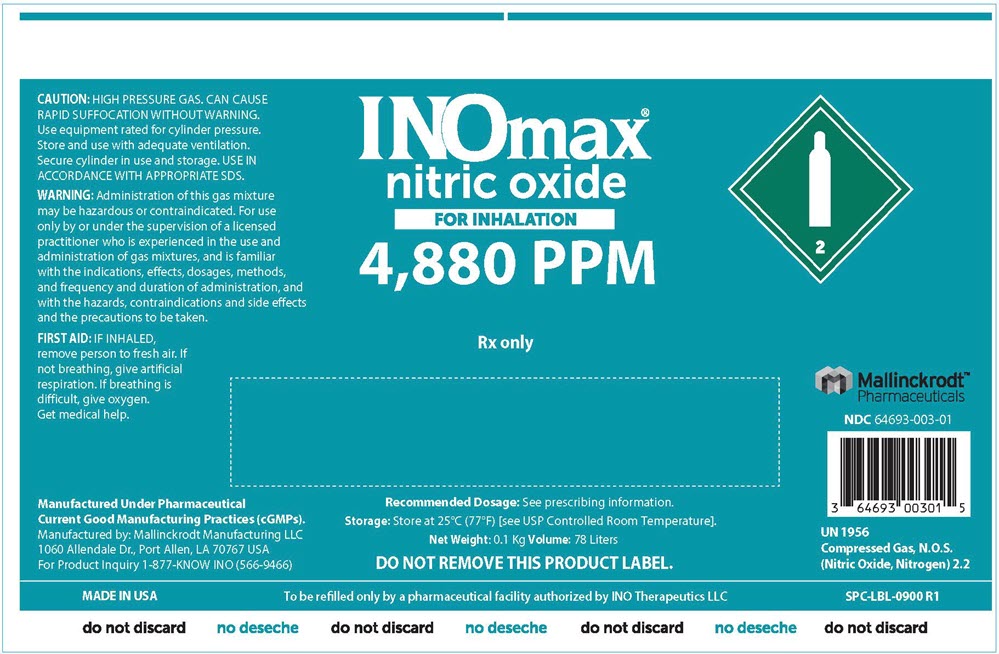
INOMAX nitric oxide 6 mg/L Gas, 78 l — NDC 64693-003-01 (Billing 64693-0003-01)
This is a package of 78 l of INOMAX nitric oxide 6 mg/L Gas from INO Therapeutics LLC, marketed since Jan 2023 and currently FDA-listed. It is this product's only package size.
Identity & classification
Regulatory identifiers FDA, NLM and CMS codes for this package
- RxCUI (RxNorm): 582608
Where does this data come from?
- FDA openFDA NDC Directory · synced Oct 1, 2026
- FDA label on DailyMed · label index refreshed Oct 1, 2026
- RxNorm (NLM RxNav) · catalog refreshed Oct 1, 2026
- Medi-Span GPI (licensed)
- First Databank (licensed) · refreshed Oct 1, 2026
RxNorm drug class
This medicine belongs to the Vasodilator class.
Where does this data come from?
- RxClass (NLM) · catalog refreshed Oct 1, 2026
Clinical
Patient education
Supplement & herbal interactions
Where does this data come from?
- MedlinePlus (NLM) · refreshed Oct 1, 2026
- FDA label on DailyMed · label index refreshed Oct 1, 2026
Ask a licensed pharmacist directly — free, answered by our team.
Pricing
A drug doesn't have one price. Each row is a different public payment system, and none is what you'd pay at the counter — that depends on your insurance. The ⓘ on each row explains what it measures.
| Price system | Per each | Per package |
|---|---|---|
| Retail pharmacies payNADAC · weekly | Not in the retail survey — common for institutional, discontinued, or low-volume packs. | |
| Medicaid paysCMS SDUD · 12 mo | No recent Medicaid claims on file for this NDC — rare and low-volume NDCs are suppressed in the public data. | |
| Medicare drug plans payPart D · quarterly | No Part D plan price is available for this NDC in our data. | |
Where does this data come from?
- CMS NADAC weekly file
- CMS ASP pricing files · refreshed Sep 20, 2026
- CMS Medicaid State Drug Utilization Data · refreshed Oct 2, 2026
- CMS Part D plan pricing files · refreshed Sep 24, 2026
- VA National Acquisition Center price file
Packaging — all sizes for this product
| Package NDC | Description | Marketing start | Marketing end | Status |
|---|---|---|---|---|
| 64693-0003-01 You're viewing this Main listing | 78 L in 1 CYLINDER | 2023-01-17 | — | Active |
Therapeutic equivalents
| Product | Labeler | Pack | NADAC/unit | TE | Status | Price vs. this |
|---|---|---|---|---|---|---|
| Inomax 6 mg/Lthis 64693-0003-01 | INO | 78 l | — | — | FDA listed | — |
Where does this data come from?
- FDA openFDA NDC Directory · synced Oct 1, 2026
- FDA Orange Book · refreshed Sep 3, 2026
- CMS NADAC weekly file
Availability & generic status
The FDA lists approved generic versions of this medicine, but that does not always mean a pharmacy can get one today. Patent rules, launch agreements, supply and pricing can affect when generics actually arrive.
Why the date isn’t exact: Generic timing can change because patents may be challenged, settled, licensed, added, removed, or worked around with a narrower label — and FDA approval does not always mean a pharmacy can get the generic today.
🛈 What do these terms mean?
- Patent
- Legal protection listed in the Orange Book that may delay generic approval or launch. Issued by the U.S. Patent & Trademark Office.
- Substance patent
- Covers the active drug molecule itself — the hardest to design around. A generic generally can’t launch until it expires.
- Formulation (product) patent
- Covers a specific formulation or dosage form. A generic can sometimes work around it with a different formulation.
- Method-of-use patent
- A patent covering one specific approved use of the drug — not necessarily the whole molecule. A generic can sometimes launch with a “skinny label” that carves out the protected use and keeps the others.
- Skinny label
- A generic label that omits a still-patented use when the FDA allows it — letting a generic reach the market for the unprotected uses.
- Exclusivity
- FDA-granted marketing protection, separate from patents — e.g. 5-yr new chemical entity, 7-yr orphan drug, or a +6-month pediatric extension.
- Paragraph IV
- A generic applicant’s formal challenge to a listed patent. It can potentially lead to earlier generic entry, but often involves litigation or a settlement.
- RLD / RS
- Reference Listed Drug — the brand product the FDA uses as the reference for generic applications. Reference Standard — the product the FDA expects generics to compare against in bioequivalence testing.
- TE / AB rating
- FDA therapeutic-equivalence rating. An AB rating generally means the FDA considers a generic therapeutically equivalent to — and substitutable for — the brand.
- LOE (loss of exclusivity)
- The latest patent or exclusivity currently listed — the loss-of-exclusivity / latest-listed-protection date shown on this page. Paragraph-IV challenges and settlements can move the real date earlier; FDA approval and a manufacturer’s decision to market can move it later.
Built from the FDA Orange Book. The bars above are scaled to each protection’s expiry; the red LOE marker is the last one to lapse.
| Patent | Type | Use code | Expires |
|---|---|---|---|
| US 8431163 ↗ | Method of use | U-1286 | Jun 30, 2029 |
| US 8282966 ↗ | Method of use | U-1286 | Jun 30, 2029 |
| US 8293284 ↗ | Method of use | U-1286 | Jun 30, 2029 |
| US 8776795 ↗ | Method of use | U-1226 | Jan 6, 2031 |
| US 8795741 ↗ | Method of use | U-1286 | Jun 30, 2029 |
| US 8846112 ↗ | Method of use | U-1286 | Jun 30, 2029 |
| US 9408993 ↗ | Method of use | U-1824 | Jan 6, 2031 |
| US 9265911 ↗ | Method of use | U-1824 | Jan 6, 2031 |
| US 9295802 ↗ | Method of use | U-1226 | Jan 6, 2031 |
| US 8282966 ↗ | Method of use | U-1286 | Jun 30, 2029 |
| US 8293284 ↗ | Method of use | U-1286 | Jun 30, 2029 |
| US 8291904 ↗ | Method of use | U-1226 | Jan 6, 2031 |
| US 8846112 ↗ | Method of use | U-1286 | Jun 30, 2029 |
| US 8776794 ↗ | Method of use | U-1226 | Jan 6, 2031 |
| US 8776795 ↗ | Method of use | U-1226 | Jan 6, 2031 |
| US 8573210 ↗ | Method of use | U-1453 | Jan 6, 2031 |
| US 8795741 ↗ | Method of use | U-1286 | Jun 30, 2029 |
| US 8291904 ↗ | Method of use | U-1226 | Jan 6, 2031 |
| US 8431163 ↗ | Method of use | U-1286 | Jun 30, 2029 |
| US 9279794 ↗ | Method of use | U-1823 | Feb 19, 2035 |
| US 11931377 ↗ | Drug substance | U-3903 | Jun 30, 2029 |
| US 11931377 ↗ | Drug substance | U-3903 | Jun 30, 2029 |
| US 9770570 ↗ | Method of use | U-2148 | May 3, 2036 |
| US 8776794 ↗ | Method of use | U-1226 | Jan 6, 2031 |
| US 8573210 ↗ | Method of use | U-1453 | Jan 6, 2031 |
| US 8573209 ↗ | Drug product | — | Jan 6, 2031 |
| US 8573209 ↗ | Drug product | — | Jan 6, 2031 |
| US 8282966*PED ↗ | Drug product | — | Dec 30, 2029 |
| US 8291904*PED ↗ | Drug product | — | Jul 6, 2031 |
| US 8293284*PED ↗ | Drug product | — | Dec 30, 2029 |
| US 8431163*PED ↗ | Drug product | — | Dec 30, 2029 |
| US 8282966*PED ↗ | Drug product | — | Dec 30, 2029 |
| US 8291904*PED ↗ | Drug product | — | Jul 6, 2031 |
| US 8293284*PED ↗ | Drug product | — | Dec 30, 2029 |
| US 8431163*PED ↗ | Drug product | — | Dec 30, 2029 |
| US 8776795*PED ↗ | Drug product | — | Jul 6, 2031 |
| US 8776794*PED ↗ | Drug product | — | Jul 6, 2031 |
| US 8776795*PED ↗ | Drug product | — | Jul 6, 2031 |
| US 8776794*PED ↗ | Drug product | — | Jul 6, 2031 |
| US 8795741*PED ↗ | Drug product | — | Dec 30, 2029 |
| US 8795741*PED ↗ | Drug product | — | Dec 30, 2029 |
| US 8573209*PED ↗ | Drug product | — | Jul 6, 2031 |
| US 8573209*PED ↗ | Drug product | — | Jul 6, 2031 |
| US 8846112*PED ↗ | Drug product | — | Dec 30, 2029 |
| US 8846112*PED ↗ | Drug product | — | Dec 30, 2029 |
| US 8573210*PED ↗ | Drug product | — | Jul 6, 2031 |
| US 8573210*PED ↗ | Drug product | — | Jul 6, 2031 |
| US 9295802*PED ↗ | Drug product | — | Jul 6, 2031 |
| US 9408993*PED ↗ | Drug product | — | Jul 6, 2031 |
| US 9265911*PED ↗ | Drug product | — | Jul 6, 2031 |
| US 9279794*PED ↗ | Drug product | — | Aug 19, 2035 |
| US 9770570*PED ↗ | Drug product | — | Nov 3, 2036 |
| US 11931377*PED ↗ | Drug product | — | Dec 30, 2029 |
Is there a generic version of this drug?
The FDA approved a generic — why can’t I get it at my pharmacy yet?
Why do different websites show different generic release dates?
What does “FDA listed” mean?
What does a patent or protection date mean here?
What does “current Orange Book estimate” mean?
Can a generic come out before the last patent expires?
Can a generic come out after the listed dates?
What is the difference between patents and exclusivity?
Why are there multiple patent dates?
Where does this data come from?
- FDA Orange Book · refreshed Sep 3, 2026
Inactive Ingredients / Excipients
Inactive ingredients, also called excipients, are components of the drug product other than the active ingredient. They may include fillers, dyes, coatings, preservatives, flavors, or other formulation ingredients.
Where does this data come from?
IACT rows and label-wide narrative are kept separate; availability and product-level specificity depend on the submitted label.- FDA label on DailyMed · label index refreshed Oct 1, 2026
- FDA openFDA NDC Directory · synced Oct 1, 2026
Inactive ingredient FAQ
Are inactive ingredients the same for every manufacturer?
Why might an inactive ingredient be missing?
Can inactive ingredients matter?
Manufacturer & labeler
Where does this data come from?
- FDA openFDA NDC Directory · synced Oct 1, 2026
- Drugs@FDA
Full prescribing information FDA SPL
🎯 Indications and Usage ▾
1 INDICATIONS AND USAGE INOmax ® is indicated to improve oxygenation and reduce the need for extracorporeal membrane oxygenation in term and near-term (>34 weeks gestation) neonates with hypoxic respiratory failure associated with clinical or echocardiographic evidence of pulmonary hypertension in conjunction with ventilatory support and other appropriate agents. INOmax is a vasodilator indicated to improve oxygenation and reduce the need for extracorporeal membrane oxygenation in term and near-term (>34 weeks gestation) neonates with hypoxic respiratory failure associated with clinical or echocardiographic evidence of pulmonary hypertension in conjunction with ventilatory support and other appropriate agents.
⏱️ Dosage and Administration ▾
2 DOSAGE AND ADMINISTRATION The recommended dose is 20 ppm, maintained for up to 14 days or until the underlying oxygen desaturation has resolved ( 2.1 ). Doses greater than 20 ppm are not recommended ( 2.1 , 5.2 ) Administration: Avoid abrupt discontinuation ( 2.2 , 5.1 ).
2.1Dosage Term and near-term neonates with hypoxic respiratory failure The recommended dose of INOmax is 20 ppm. Maintain treatment up to 14 days or until the underlying oxygen desaturation has resolved and the neonate is ready to be weaned from INOmax therapy. Doses greater than 20 ppm are not recommended [see Warnings and Precautions (5.2) ] .
2.2Administration Nitric Oxide Delivery Systems INOmax must be administered using a calibrated, FDA-cleared Nitric Oxide Delivery System (NODS). There are various FDA-cleared NODS; refer to the NODS labeling to determine which NODS to use with this drug product and for needed information on training and technical support for users of this drug product with the NODS. When utilizing a nitric oxide delivery system specifically cleared for use in the MRI suite (e.g., the INOmax DSIR ® Plus MRI) only use INOmax MR conditional cylinders at 100 gauss or less [see How Supplied/Storage and Handling (16) ].
Keep available a backup battery power supply and an independent reserve nitric oxide delivery system to address power and system failures . Monitoring Measure methemoglobin within 4-8 hours after initiation of treatment with INOmax and periodically throughout treatment [see Warnings and Precautions (5.2) ] . Monitor for PaO 2 and inspired NO 2 during INOmax administration [see Warnings and Precautions (5.3) ] .
Weaning and Discontinuation Avoid abrupt discontinuation of INOmax [see Warnings and Precautions (5.1) ]. To wean INOmax, downtitrate in several steps, pausing several hours at each step to monitor for hypoxemia.
💊 Dosage Forms and Strengths ▾
3 DOSAGE FORMS AND STRENGTHS INOmax (nitric oxide) gas is available in 800 and 4,880 ppm concentrations. INOmax (nitric oxide) is a gas available in 800 and 4,880 ppm concentrations ( 3 ).
⛔ Contraindications ▾
4 CONTRAINDICATIONS INOmax is contraindicated in neonates dependent on right-to-left shunting of blood. Neonates dependent on right-to-left shunting of blood ( 4 ).
⚠️ Warnings and Cautions ▾
5 WARNINGS AND PRECAUTIONS Rebound: Abrupt discontinuation of INOmax may lead to worsening oxygenation and increasing pulmonary artery pressure ( 5.1 ). Methemoglobinemia: Methemoglobin increases with the dose of nitric oxide; following discontinuation or reduction of nitric oxide, methemoglobin levels return to baseline over a period of hours ( 5.2 ). Elevated NO 2 Levels: Monitor NO 2 levels ( 5.3 ).
Heart Failure: In patients with pre-existing left ventricular dysfunction, INOmax may increase pulmonary capillary wedge pressure leading to pulmonary edema ( 5.4 ).
5.1Rebound Pulmonary Hypertension Syndrome following Abrupt Discontinuation Wean from INOmax [see Dosage and Administration (2.2) ]. Abrupt discontinuation of INOmax may lead to worsening oxygenation and increasing pulmonary artery pressure, i.e., Rebound Pulmonary Hypertension Syndrome. Signs and symptoms of Rebound Pulmonary Hypertension Syndrome include hypoxemia, systemic hypotension, bradycardia, and decreased cardiac output.
If Rebound Pulmonary Hypertension occurs, reinstate INOmax therapy immediately.
5.2Hypoxemia from Methemoglobinemia Nitric oxide combines with hemoglobin to form methemoglobin, which does not transport oxygen. Methemoglobin levels increase with the dose of INOmax; it can take 8 hours or more before steady-state methemoglobin levels are attained. Monitor methemoglobin and adjust the dose of INOmax to optimize oxygenation.
If methemoglobin levels do not resolve with decrease in dose or discontinuation of INOmax, additional therapy may be warranted to treat methemoglobinemia [see Overdosage (10) ].
5.3Airway Injury from Nitrogen Dioxide Nitrogen dioxide (NO 2 ) forms in gas mixtures containing NO and O 2 . Nitrogen dioxide may cause airway inflammation and damage to lung tissues. If there is an unexpected change in NO 2 concentration, or if the NO 2 concentration reaches 3 ppm when measured in the breathing circuit, then the delivery system should be assessed in accordance with the Nitric Oxide Delivery System O&M Manual troubleshooting section, and the NO 2 analyzer should be recalibrated.
The dose of INOmax and/or FiO 2 should be adjusted as appropriate.
5.4Worsening Heart Failure Patients with left ventricular dysfunction treated with INOmax may experience pulmonary edema, increased pulmonary capillary wedge pressure, worsening of left ventricular dysfunction, systemic hypotension, bradycardia and cardiac arrest. Discontinue INOmax while providing symptomatic care.
🤒 Adverse Reactions ▾
6 ADVERSE REACTIONS The following adverse reactions are discussed elsewhere in the label; Hypoxemia [see Warnings and Precautions (5.2) ] Worsening Heart Failure [see Warnings and Precautions (5.4) ] The most common adverse reaction is hypotension. ( 6 ). To report SUSPECTED ADVERSE REACTIONS, contact INO Therapeutics at 1-877-566-9466 and http://www.inomax.com/ or FDA at 1-800-FDA-1088 or www.fda.gov/medwatch.
6.1Clinical Trials Experience Because clinical trials are conducted under widely varying conditions, adverse reaction rates observed in the clinical trials of a drug cannot be directly compared to rates in the clinical trials of another drug and may not reflect the rates observed in practice. The adverse reaction information from the clinical studies does, however, provide a basis for identifying the adverse events that appear to be related to drug use and for approximating rates. Controlled studies have included 325 patients on INOmax doses of 5 to 80 ppm and 251 patients on placebo.
Total mortality in the pooled trials was 11% on placebo and 9% on INOmax, a result adequate to exclude INOmax mortality being more than 40% worse than placebo. In both the NINOS and CINRGI studies, the duration of hospitalization was similar in INOmax and placebo-treated groups. From all controlled studies, at least 6 months of follow-up is available for 278 patients who received INOmax and 212 patients who received placebo.
Among these patients, there was no evidence of an adverse effect of treatment on the need for rehospitalization, special medical services, pulmonary disease, or neurological sequelae. In the NINOS study, treatment groups were similar with respect to the incidence and severity of intracranial hemorrhage, Grade IV hemorrhage, periventricular leukomalacia, cerebral infarction, seizures requiring anticonvulsant therapy, pulmonary hemorrhage, or gastrointestinal hemorrhage. In CINRGI, the only adverse reaction (>2% higher incidence on INOmax than on placebo) was hypotension (14% vs.
11%).
6.2Post-Marketing Experience Post marketing reports of accidental exposure to nitric oxide for inhalation in hospital staff has been associated with chest discomfort, dizziness, dry throat, dyspnea, and headache.
🔄 Drug Interactions ▾
7 DRUG INTERACTIONS Nitric oxide donor compounds may increase the risk of developing methemoglobinemia ( 7 ).
7.1Nitric Oxide Donor Agents Nitric oxide donor agents such as prilocaine, sodium nitroprusside and nitroglycerine may increase the risk of developing methemoglobinemia.
👥 Use in Specific Populations ▾
8 USE IN SPECIFIC POPULATIONS
8.4Pediatric Use The safety and efficacy of nitric oxide for inhalation has been demonstrated in term and near-term neonates with hypoxic respiratory failure associated with evidence of pulmonary hypertension [see Clinical Studies (14.1) ]. Additional studies conducted in premature neonates for the prevention of bronchopulmonary dysplasia have not demonstrated substantial evidence of efficacy [see Clinical Studies (14.3) ]. No information about its effectiveness in other age populations is available.
8.5Geriatric Use Nitric oxide is not indicated for use in the adult population.
🧒 Pediatric Use ▾
8.4Pediatric Use The safety and efficacy of nitric oxide for inhalation has been demonstrated in term and near-term neonates with hypoxic respiratory failure associated with evidence of pulmonary hypertension [see Clinical Studies (14.1) ]. Additional studies conducted in premature neonates for the prevention of bronchopulmonary dysplasia have not demonstrated substantial evidence of efficacy [see Clinical Studies (14.3) ]. No information about its effectiveness in other age populations is available.
🧓 Geriatric Use ▾
8.5Geriatric Use Nitric oxide is not indicated for use in the adult population.
🆘 Overdosage ▾
10 OVERDOSAGE Overdosage with INOmax is manifest by elevations in methemoglobin and pulmonary toxicities associated with inspired NO 2 . Elevated NO 2 may cause acute lung injury. Elevations in methemoglobin reduce the oxygen delivery capacity of the circulation.
In clinical studies, NO 2 levels >3 ppm or methemoglobin levels >7% were treated by reducing the dose of, or discontinuing, INOmax. Methemoglobinemia that does not resolve after reduction or discontinuation of therapy can be treated with intravenous vitamin C, intravenous methylene blue, or blood transfusion, based upon the clinical situation.
🧬 Clinical Pharmacology ▾
12 CLINICAL PHARMACOLOGY
12.1Mechanism of Action Nitric oxide relaxes vascular smooth muscle by binding to the heme moiety of cytosolic guanylate cyclase, activating guanylate cyclase and increasing intracellular levels of cyclic guanosine 3',5'-monophosphate, which then leads to vasodilation. When inhaled, nitric oxide selectively dilates the pulmonary vasculature, and because of efficient scavenging by hemoglobin, has minimal effect on the systemic vasculature. INOmax appears to increase the partial pressure of arterial oxygen (PaO 2 ) by dilating pulmonary vessels in better ventilated areas of the lung, redistributing pulmonary blood flow away from lung regions with low ventilation/perfusion (V/Q) ratios toward regions with normal ratios.
12.2Pharmacodynamics Effects on Pulmonary Vascular Tone in PPHN Persistent pulmonary hypertension of the newborn (PPHN) occurs as a primary developmental defect or as a condition secondary to other diseases such as meconium aspiration syndrome (MAS), pneumonia, sepsis, hyaline membrane disease, congenital diaphragmatic hernia (CDH), and pulmonary hypoplasia. In these states, pulmonary vascular resistance (PVR) is high, which results in hypoxemia secondary to right-to-left shunting of blood through the patent ductus arteriosus and foramen ovale.
In neonates with PPHN, INOmax improves oxygenation (as indicated by significant increases in PaO 2 ).
12.3Pharmacokinetics The pharmacokinetics of nitric oxide has been studied in adults. Absorption and Distribution Nitric oxide is absorbed systemically after inhalation. Most of it traverses the pulmonary capillary bed where it combines with hemoglobin that is 60% to 100% oxygen-saturated.
At this level of oxygen saturation, nitric oxide combines predominantly with oxyhemoglobin to produce methemoglobin and nitrate. At low oxygen saturation, nitric oxide can combine with deoxyhemoglobin to transiently form nitrosylhemoglobin, which is converted to nitrogen oxides and methemoglobin upon exposure to oxygen. Within the pulmonary system, nitric oxide can combine with oxygen and water to produce nitrogen dioxide and nitrite, respectively, which interact with oxyhemoglobin to produce methemoglobin and nitrate.
Thus, the end products of nitric oxide that enter the systemic circulation are predominantly methemoglobin and nitrate. Metabolism Methemoglobin disposition has been investigated as a function of time and nitric oxide exposure concentration in neonates with respiratory failure. The methemoglobin (MetHb) concentration-time profiles during the first 12 hours of exposure to 0, 5, 20, and 80 ppm INOmax are shown in Figure 1.
Figure 1: Methemoglobin Concentration-Time Profiles Neonates Inhaling 0, 5, 20 or 80 ppm INOmax Methemoglobin concentrations increased during the first 8 hours of nitric oxide exposure. The mean methemoglobin level remained below 1% in the placebo group and in the 5 ppm and 20 ppm INOmax groups but reached approximately 5% in the 80 ppm INOmax group. Methemoglobin levels >7% were attained only in patients receiving 80 ppm, where they comprised 35% of the group.
The average time to reach peak methemoglobin was 10 ± 9 (SD) hours (median, 8 hours) in these 13 patients, but one patient did not exceed 7% until 40 hours. Figure 1 Elimination Nitrate has been identified as the predominant nitric oxide metabolite excreted in the urine, accounting for >70% of the nitric oxide dose inhaled. Nitrate is cleared from the plasma by the kidney at rates approaching the rate of glomerular filtration.
🧬 Mechanism of Action ▾
12.1Mechanism of Action Nitric oxide relaxes vascular smooth muscle by binding to the heme moiety of cytosolic guanylate cyclase, activating guanylate cyclase and increasing intracellular levels of cyclic guanosine 3',5'-monophosphate, which then leads to vasodilation. When inhaled, nitric oxide selectively dilates the pulmonary vasculature, and because of efficient scavenging by hemoglobin, has minimal effect on the systemic vasculature. INOmax appears to increase the partial pressure of arterial oxygen (PaO 2 ) by dilating pulmonary vessels in better ventilated areas of the lung, redistributing pulmonary blood flow away from lung regions with low ventilation/perfusion (V/Q) ratios toward regions with normal ratios.
📦 How Supplied / Storage and Handling ▾
16 HOW SUPPLIED/STORAGE AND HANDLING INOmax (nitric oxide) is available in the following sizes: Size D Portable aluminum cylinders containing 353 liters at STP of nitric oxide gas in 800 ppm concentration in nitrogen (delivered volume 344 liters) (NDC 64693-002-01) Size 88 Aluminum cylinders containing 1963 liters at STP of nitric oxide gas in 800 ppm concentration in nitrogen (delivered volume 1918 liters) (NDC 64693-002-02) 0.4 liter Portable aluminum cylinders containing 78 liters at STP of nitric oxide gas in 4,880 ppm concentration in nitrogen (delivered volume 70 liters) (NDC 64693-003-01) Store at 25°C (77°F) with excursions permitted between 15° to 30°C (59° to 86°F) [see USP Controlled Room Temperature].
All regulations concerning handling of pressure vessels must be followed. Protect the cylinders from shocks, falls, oxidizing and flammable materials, moisture, and sources of heat or ignition. INOmax MR conditional labeled cylinders (i.e., size 88 aluminum cylinder) may be used at 100 gauss or less.
Use of any other cylinders (e.g., size D or 0.4 liter aluminum cylinder) may create a projectile hazard. Occupational Exposure The exposure limit set by the Occupational Safety and Health Administration (OSHA) for nitric oxide is 25 ppm, and for NO 2 the limit is 5 ppm. For a list of patents, see https://www.mallinckrodt.com/patents/
📦 Storage and Handling ▾
Store at 25°C (77°F) with excursions permitted between 15° to 30°C (59° to 86°F) [see USP Controlled Room Temperature]. All regulations concerning handling of pressure vessels must be followed. Protect the cylinders from shocks, falls, oxidizing and flammable materials, moisture, and sources of heat or ignition.
INOmax MR conditional labeled cylinders (i.e., size 88 aluminum cylinder) may be used at 100 gauss or less. Use of any other cylinders (e.g., size D or 0.4 liter aluminum cylinder) may create a projectile hazard.
📋 Description ▾
11 DESCRIPTION INOmax (nitric oxide gas) is a drug administered by inhalation. Nitric oxide, the active substance in INOmax, is a pulmonary vasodilator. INOmax 800 ppm is a gaseous blend of nitric oxide (0.08%) and nitrogen (99.92%).
INOmax 4,880™ ppm is a gaseous blend of nitric oxide (0.488%) and nitrogen (99.51%). INOmax 800 ppm is supplied in aluminum cylinders as a compressed gas under high pressure (2,000 pounds per square inch [psi]). INOmax 4,880 ppm is supplied in aluminum cylinders as a compressed gas under high pressure (3,000 psi).
The structural formula of nitric oxide (NO) is shown below: Chemical Structure
🧬 Pharmacokinetics ▾
12.3Pharmacokinetics The pharmacokinetics of nitric oxide has been studied in adults.
🧬 Pharmacodynamics ▾
12.2Pharmacodynamics Effects on Pulmonary Vascular Tone in PPHN Persistent pulmonary hypertension of the newborn (PPHN) occurs as a primary developmental defect or as a condition secondary to other diseases such as meconium aspiration syndrome (MAS), pneumonia, sepsis, hyaline membrane disease, congenital diaphragmatic hernia (CDH), and pulmonary hypoplasia. In these states, pulmonary vascular resistance (PVR) is high, which results in hypoxemia secondary to right-to-left shunting of blood through the patent ductus arteriosus and foramen ovale.
In neonates with PPHN, INOmax improves oxygenation (as indicated by significant increases in PaO 2 ).
🔬 Clinical Studies ▾
14 CLINICAL STUDIES
14.1Treatment of Hypoxic Respiratory Failure (HRF) The efficacy of INOmax has been investigated in term and near-term newborns with hypoxic respiratory failure resulting from a variety of etiologies. Inhalation of INOmax reduces the oxygenation index (OI= mean airway pressure in cm H 2 O × fraction of inspired oxygen concentration [FiO 2 ]× 100 divided by systemic arterial concentration in mm Hg [PaO 2 ]) and increases PaO 2 [see Clinical Pharmacology (12.1) ] . NINOS Study The Neonatal Inhaled Nitric Oxide Study (NINOS) was a double-blind, randomized, placebo-controlled, multicenter trial in 235 neonates with hypoxic respiratory failure.
The objective of the study was to determine whether inhaled nitric oxide would reduce the occurrence of death and/or initiation of extracorporeal membrane oxygenation (ECMO) in a prospectively defined cohort of term or near-term neonates with hypoxic respiratory failure unresponsive to conventional therapy. Hypoxic respiratory failure was caused by meconium aspiration syndrome (MAS; 49%), pneumonia/sepsis (21%), idiopathic primary pulmonary hypertension of the newborn (PPHN; 17%), or respiratory distress syndrome (RDS; 11%).
Infants ≤14 days of age (mean, 1.7 days) with a mean PaO 2 of 46 mm Hg and a mean oxygenation index (OI) of 43 cm H 2 O / mm Hg were initially randomized to receive 100% O 2 with (n=114) or without (n=121) 20 ppm nitric oxide for up to 14 days. Response to study drug was defined as a change from baseline in PaO 2 30 minutes after starting treatment (full response = >20 mm Hg, partial = 10–20 mm Hg, no response = <10 mm Hg). Neonates with a less than full response were evaluated for a response to 80 ppm nitric oxide or control gas.
The primary results from the NINOS study are presented in Table 1. Table 1: Summary of Clinical Results from NINOS Study Control (n=121) NO (n=114) P value Death or ECMO Extracorporeal membrane oxygenation , Death or need for ECMO was the study's primary end point 77 (64%) 52 (46%) 0.006 Death 20 (17%) 16 (14%)
0.60ECMO 66 (55%) 44 (39%) 0.014 Although the incidence of death by 120 days of age was similar in both groups (NO, 14%; control, 17%), significantly fewer infants in the nitric oxide group required ECMO compared with controls (39% vs. 55%, p = 0.014). The combined incidence of death and/or initiation of ECMO showed a significant advantage for the nitric oxide treated group (46% vs.
64%, p = 0.006). The nitric oxide group also had significantly greater increases in PaO 2 and greater decreases in the OI and the alveolar-arterial oxygen gradient than the control group (p<0.001 for all parameters). Significantly more patients had at least a partial response to the initial administration of study drug in the nitric oxide group (66%) than the control group (26%, p<0.001).
Of the 125 infants who did not respond to 20 ppm nitric oxide or control, similar percentages of NO-treated (18%) and control (20%) patients had at least a partial response to 80 ppm nitric oxide for inhalation or control drug, suggesting a lack of additional benefit for the higher dose of nitric oxide. No infant had study drug discontinued for toxicity. Inhaled nitric oxide had no detectable effect on mortality.
The adverse events collected in the NINOS trial occurred at similar incidence rates in both treatment groups [see Adverse Reactions (6.1) ]. Follow-up exams were performed at 18–24 months for the infants enrolled in this trial. In the infants with available follow-up, the two treatment groups were similar with respect to their mental, motor, audiologic, or neurologic evaluations.
CINRGI Study This study was a double-blind, randomized, placebo-controlled, multicenter trial of 186 term and near-term neonates with pulmonary hypertension and hypoxic respiratory failure. The primary objective of the study was to determine whether INOmax would reduce the receipt of ECMO in these patients. Hypoxic respiratory failure was caused by MAS (35%), idiopathic… [Excerpted — this section continues on DailyMed.]
🧪 Nonclinical Toxicology ▾
13 NONCLINICAL TOXICOLOGY
13.1Carcinogenesis, Mutagenesis, Impairment of Fertility No evidence of a carcinogenic effect was apparent, at inhalation exposures up to the recommended dose (20 ppm), in rats for 20 hr/day for up to two years. Higher exposures have not been investigated. Nitric oxide has demonstrated genotoxicity in Salmonella (Ames Test), human lymphocytes, and after in vivo exposure in rats.
There are no animal or human studies to evaluate nitric oxide for effects on fertility.
📄 Carcinogenesis, Mutagenesis, Impairment of Fertility ▾
13.1Carcinogenesis, Mutagenesis, Impairment of Fertility No evidence of a carcinogenic effect was apparent, at inhalation exposures up to the recommended dose (20 ppm), in rats for 20 hr/day for up to two years. Higher exposures have not been investigated. Nitric oxide has demonstrated genotoxicity in Salmonella (Ames Test), human lymphocytes, and after in vivo exposure in rats.
There are no animal or human studies to evaluate nitric oxide for effects on fertility.
📄 Package Label / Principal Display Panel ▾
PRINCIPAL DISPLAY PANEL - 1963 Liter Cylinder Label Rx only INOmax ® nitric oxide FOR INHALATION 800 PPM CAUTION: HIGH PRESSURE GAS. CAN CAUSE RAPID SUFFOCATION WITHOUT WARNING. Use equipment rated for cylinder pressure.
Store and use with adequate ventilation. Secure cylinder in use and storage. Close valve after each use and when empty.
USE IN ACCORDANCE WITH APPROPRIATE SDS. WARNING: Administration of this gas mixture may be hazardous or contraindicated. For use only by or under the supervision of a licensed practitioner who is experienced in the use and administration of gas mixtures, and is familiar with the indications, effects, dosages, methods, and frequency and duration of administration, and with the hazards, contraindications and side effects and the precautions to be taken.
FIRST AID: IF INHALED, remove person to fresh air. If not breathing, give artificial respiration. If breathing is difficult, give oxygen.
Get medical help. RETURN WITH 25 PSIG. TO BE REFILLED ONLY BY A PHARMACEUTICAL FACILITY AUTHORIZED BY INO Therapeutics LLC Manufactured Under Pharmaceutical Current Good Manufacturing Practices (cGMPs).
DO NOT REMOVE THIS PRODUCT LABEL. Store at 25°C (77°F) [see USP Controlled Room Temperature]. Volume 1963 Liters Mallinckrodt™ Pharmaceuticals Manufactured by: Mallinckrodt Manufacturing LLC 1060 Allendale Dr.
Port Allen, LA 70767 USA For Product Inquiry 1-877-KNOW INO (566-9466) UN 1956 Compressed Gas, N.O.S. (Nitric Oxide, Nitrogen)
2.2 Net Weight:
2.5Kg NDC 64693-002-02 MADE IN USA Label No. SPC-LBL-0060 R8 PRINCIPAL DISPLAY PANEL - 1963 Liter Cylinder Label
PRINCIPAL DISPLAY PANEL - 78 Liter Cylinder Label INOmax ® nitric oxide FOR INHALATION 4,880 PPM 2 Rx only CAUTION: HIGH PRESSURE GAS. CAN CAUSE RAPID SUFFOCATION WITHOUT WARNING. Use equipment rated for cylinder pressure.
Store and use with adequate ventilation. Secure cylinder in use and storage. USE IN ACCORDANCE WITH APPROPRIATE SDS.
WARNING: Administration of this gas mixture may be hazardous or contraindicated. For use only by or under the supervision of a licensed practitioner who is experienced in the use and administration of gas mixtures, and is familiar with the indications, effects, dosages, methods, and frequency and duration of administration, and with the hazards, contraindications and side effects and the precautions to be taken. FIRST AID: IF INHALED, remove person to fresh air.
If not breathing, give artificial respiration. If breathing is difficult, give oxygen. Get medical help.
Manufactured Under Pharmaceutical Current Good Manufacturing Practices (cGMPs). Manufactured by: Mallinckrodt Manufacturing LLC 1060 Allendale Dr., Port Allen, LA 70767 USA For Product Inquiry 1-877-KNOW INO (566-9466) Recommended Dosage: See prescribing information. Storage: Store at 25°C (77°F) [see USP Controlled Room Temperature].
Net Weight:
0.1Kg Volume: 78 Liters DO NOT REMOVE THIS PRODUCT LABEL. Mallinckrodt™ Pharmaceuticals NDC 64693-003-01 UN 1956 Compressed Gas, N.O.S. (Nitric Oxide, Nitrogen)
2.2MADE IN USA To be refilled only by a pharmaceutical facility authorized by INO Therapeutics LLC SPC-LBL-0900 R1 do not discard PRINCIPAL DISPLAY PANEL - 78 Liter Cylinder Label
About this NDC listing & data coverage
What data is (and isn’t) available for this NDC — tap to expand
| NDC identity (package / product / labeler codes) | ✓ Available |
| Labeler | ✓ Available |
| Product & package description | ✓ Available |
| Marketing category & status | ✓ Available |
| Active ingredient / dosage form / route | ✓ Available |
| FDA label (SPL via DailyMed) | ✓ Available |
| Package photos | ✓ Available |
| Inactive ingredients (structured) | — Not published for this NDC The labeler did not submit a structured excipient list, or no SPL is available. |
| NADAC pharmacy acquisition price (CMS) | — Not published for this NDC CMS publishes NADAC only for NDCs reported in its retail-pharmacy survey. |
| Orange Book / therapeutic-equivalence data | ✓ Available |
| HCPCS J-code billing crosswalk | — Not published for this NDC Most self-administered / retail products have no J-code — that is normal. |
| Medicaid utilization (CMS SDUD) | — Not published for this NDC CMS reports utilization only for NDCs with Medicaid claims above its privacy threshold. |