
Clemastine Fumarate 2.68 mg Tablet, 30-count — NDC 64950-268-03 (Billing 64950-0268-03)
This is a package of 30 tablets of Clemastine Fumarate 2.68 mg Tablet from Genus Lifesciences, marketed since Nov 2024 and currently FDA-listed.
NDC database record
One package, one record: these facts belong to NDC 64950-268-03 alone.
- Record
- FDA NDC Directory package listing · Human prescription drug
- Code segments
- 64950 labeler · 268 product · 03 package
- Package marketed since
- Nov 20, 2024
- Sample package
- No — commercial package
- Listing certified through
- Dec 31, 2026
- Barcode (UPC-A, from the NDC)
- 3 6495026803 4
- FDA record last changed
- Jul 24, 2026
Identity & classification
Regulatory identifiers FDA, NLM and CMS codes for this package
Drug-database identifiers Medi-Span GPI and First Databank GCN / HICL / AHFS classification
- GSN (GCN sequence number): 011656
- GCN: 46691
- GPI-14 (Medi-Span): 41200020400310
- HICL (First Databank): 004512
- AHFS class code: 04:04.00.00
- RxCUI (RxNorm): 857461
Where does this data come from?
- FDA openFDA NDC Directory · synced Oct 1, 2026
- FDA label on DailyMed · label index refreshed Oct 5, 2026
- RxNorm (NLM RxNav) · catalog refreshed Oct 1, 2026
- Medi-Span GPI (licensed)
- First Databank (licensed) · refreshed Oct 1, 2026
RxNorm drug class
This medicine belongs to the Antihistamines for topical use class.
Where does this data come from?
- RxClass (NLM) · catalog refreshed Oct 1, 2026
Clinical
Clemastine is used to treat allergy symptoms: runny nose sneezing itching of the nose or throat red, itchy, or watery eyes Clemastine is also used to relieve the itching and swelling of hives. Clemastine is in a class of medications called antihistamines. It works by blocking the action of histamine, a substance in the body that causes allergic symptoms.
Read the full MedlinePlus article ↗- It relieves allergy symptoms like sneezing, runny nose, itching and watery eyes. It is also used for mild allergic skin reactions such as hives and angioedema, at the higher dosage...
- Quite possibly. Drowsiness is the most common side effect. Wait to see how it affects you before driving or using machinery, and avoid alcohol and other sedating medicines because...
- You take it by mouth, as a syrup or tablet. The syrup is generally taken twice daily, and the tablets up to three times daily at most. Your prescriber will tailor the dose, so foll...
- If you are breastfeeding, no. The label says antihistamines are contraindicated for nursing mothers because of higher risk to infants. For pregnancy, there is not enough experience...
Patient education
Supplement & herbal interactions
Where does this data come from?
- MedlinePlus (NLM) · refreshed Oct 1, 2026
- FDA label on DailyMed · label index refreshed Oct 5, 2026
Ask a licensed pharmacist directly — free, answered by our team.
Pricing
A drug doesn't have one price. Each row is a different public payment system, and none is what you'd pay at the counter — that depends on your insurance. The ⓘ on each row explains what it measures.
| Price system | Per each | Per package |
|---|---|---|
| Retail pharmacies payNADAC · weekly | Not in the retail survey — common for institutional, discontinued, or low-volume packs. | |
| Medicaid paysCMS SDUD · 12 mo | No recent Medicaid claims on file for this NDC — rare and low-volume NDCs are suppressed in the public data. | |
| Medicare drug plans payPart D · Q2 2026 | $3.32 | $99.63 / 30 tablets |
Where does this data come from?
- CMS NADAC weekly file
- CMS ASP pricing files · refreshed Sep 20, 2026
- CMS Medicaid State Drug Utilization Data · refreshed Oct 5, 2026
- CMS Part D plan pricing files · refreshed Sep 24, 2026
- VA National Acquisition Center price file
Packaging — all sizes for this product
| Package NDC | Description | Per unit | Per pack | Marketing start | Marketing end | Status |
|---|---|---|---|---|---|---|
| 64950-0268-03 You're viewing this | 30 TABLET in 1 BOTTLE | — | — | 2024-11-20 | — | Active |
| 64950-0268-10 64950-268-10 Main listing | 100 TABLET in 1 BOTTLE | $3.18 / ea | $317.75 | 2024-11-20 | — | Active |
You're viewing the smallest of 2 pack sizes for this product.
This pack shows little to no recent Medicaid volume — the 100 tablets pack carries most fills. See all packs ↓
Pack size FAQ
What quantity is in this package?
How does this package differ from NDC 64950-0268-10?
What NDC number is used to bill for this package of Clemastine Fumarate 2.68 mg Tablet?
Prices are the latest CMS NADAC pharmacy acquisition cost per NDC; per-pack figures are per-unit × pack quantity, shown only when the pack is denominated in the same measure NADAC prices.
Therapeutic equivalents
| Product | Labeler | Pack | NADAC/unit | TE | Status | Price vs. this |
|---|---|---|---|---|---|---|
| Clemsza 2.68 mg 71085-0081-30 | IPG | 30 tablets | $3.178 | — | Availability likely | — |
| Clemastine Fumarate 2.68 mgthis 64950-0268-03 | Genus | 30 tablets | — | — | FDA listed | — |
Where does this data come from?
- FDA openFDA NDC Directory · synced Oct 1, 2026
- FDA Orange Book · refreshed Oct 3, 2026
- CMS NADAC weekly file
Availability & generic status
This product is an FDA-approved generic. Other versions of the same drug are listed under Therapeutic equivalents, least expensive first.
Where does this data come from?
- FDA Orange Book · refreshed Oct 3, 2026
What it looks like
Where does this data come from?
- FDA label on DailyMed · label index refreshed Oct 5, 2026
Inactive Ingredients / Excipients
Inactive ingredients, also called excipients, are components of the drug product other than the active ingredient. They may include fillers, dyes, coatings, preservatives, flavors, or other formulation ingredients.
🧪 Avoiding an ingredient? See Clemastine inactive ingredients by manufacturer: every current product's list side by side, so you can ask your pharmacy for the version that does not list it.
💡 Tap an ingredient (hover on desktop) to see what it is and why it’s used.
-
UNII J2B2A4N98G
Lactose is a natural sugar derived from milk. In medications, it serves as a filler and binder to add bulk and help hold tablet or capsule ingredients together during manufacturing.
-
UNII U725QWY32X
Povidone K30 is a synthetic polymer made from petroleum. It acts as a binder to hold tablet ingredients together and as a disintegrant to help the tablet break apart in the stomach so the medicine can be absorbed.
-
UNII ETJ7Z6XBU4
Silicon dioxide is a naturally occurring mineral used as a glidant and anti-caking agent. It helps powder ingredients flow smoothly and prevents clumping during manufacturing and storage.
-
UNII O8232NY3SJ
A plant-based carbohydrate derived from corn kernels. It acts as a filler to add bulk, a binder to hold ingredients together, and a disintegrant to help the tablet break apart in your stomach for absorption.
-
UNII 4ELV7Z65AP
Stearic acid is a fatty acid derived from plant or animal sources. It acts as a binder and lubricant in tablets and capsules, helping them hold together and flow smoothly during manufacturing.
5 inactive ingredients listed in the exact product block matched to this NDC.
Where does this data come from?
ingredient classCode="IACT" elements from the exact product block matched by this NDC. Label-section narrative from DailyMed / the openFDA label index is shown separately when available.- FDA label on DailyMed · label index refreshed Oct 5, 2026
- FDA openFDA NDC Directory · synced Oct 1, 2026
Inactive ingredient FAQ
Are inactive ingredients the same for every manufacturer?
Why might an inactive ingredient be missing?
Can inactive ingredients matter?
Manufacturer & labeler
More NDCs from Genus Lifesciences labeler code 64950
- Isoniazid 300 mg Tablet NDC 64950-217-03
- Flurbiprofen 100 mg Tablet NDC 64950-218-10
- Carbinoxamine Maleate 4 mg/5mL Solution NDC 64950-243-04
- Isosorbide Mononitrate 10 mg Tablet NDC 64950-250-01
- Isosorbide Mononitrate 20 mg Tablet NDC 64950-251-01
- Opium morphine 1 g/100mL Tincture NDC 64950-258-11
- Butalbital, Acetaminophen and Caffeine 50 mg/15mL; 325 mg/15mL; 40 mg/15mL Solution NDC 64950-290-16
- Potassium Chloride 20 meq/15mL Solution NDC 64950-320-47
- Potassium Chloride 1.5 g/1.58g Powder, For Solution NDC 64950-321-01
- Clemastine Fumarate .67 mg/5mL Syrup NDC 64950-324-12
- Hydrocodone Bitartrate and Acetaminophen 7.5 mg/15mL; 325 mg/15mL Solution NDC 64950-343-11
- Metoclopramide 5 mg/5mL Solution NDC 64950-344-16
Where does this data come from?
- FDA openFDA NDC Directory · synced Oct 1, 2026
- Drugs@FDA
Full prescribing information FDA SPL
🎯 Indications and Usage ▾
INDICATIONS AND USAGE Clemastine Fumarate Tablets USP, 2.68 mg are indicated for the relief of symptoms associated with allergic rhinitis such as sneezing, rhinorrhea, pruritus, and lacrimation. Clemastine Fumarate Tablets USP, 2.68 mg are also indicated for the relief of mild, uncomplicated allergic skin manifestations of urticaria and angioedema. It should be noted that clemastine fumarate is indicated for the dermatologic indications at the 2.68 mg dosage level only.
⏱️ Dosage and Administration ▾
DOSAGE AND ADMINISTRATION DOSAGE SHOULD BE INDIVIDUALIZED ACCORDING TO THE NEEDS AND RESPONSE OF THE PATIENT. Clemastine Fumarate Tablets 2.68 mg The maximum recommended dosage is one tablet three times daily. Many patients respond favorably to a single dose which may be repeated as required, but not to exceed three tablets daily.
⛔ Contraindications ▾
CONTRAINDICATIONS Usage in Nursing Mothers Because of the higher risk of antihistamines for infants generally and for newborns and prematures in particular, antihistamine therapy is contraindicated in nursing mothers. Usage in Lower Respiratory Disease Antihistamines should not be used to treat lower respiratory tract symptoms including asthma. Antihistamines are also contraindicated in the following conditions: Hypersensitivity to clemastine fumarate or other antihistamines of similar chemical structure.
Monoamine oxidase inhibitor therapy (see Drug Interactions section).
⚠️ Warnings ▾
WARNINGS Antihistamines should be used with considerable caution in patients with: narrow angle glaucoma, stenosing peptic ulcer, pyloroduodenal obstruction, symptomatic prostatic hypertrophy, and bladder neck obstruction. Usage in Children Safety and efficacy of clemastine fumarate have not been established in children under the age of 12 years. Usage in Pregnancy Experience with this drug in pregnant women is inadequate to determine whether there is exists a potential for harm to the developing fetus.
Usage with CNS Depressants Clemastine has additive effects with alcohol and other CNS depressants (hypnotics, sedatives, tranquilizers, etc.). Usage in Activities Requiring Mental Alertness Patients should be warned about engaging in activities requiring mental alertness such as driving a car or operating appliances, machinery, etc. Usage in the Elderly (approximately 60 years or older) Antihistamines are more likely to cause dizziness, sedation, and hypotension in elderly patients.
🤒 Adverse Reactions ▾
ADVERSE REACTIONS Transient drowsiness, the most common adverse reaction associated with clemastine fumarate, occurs relatively frequently and may require discontinuation of therapy in some instances. Antihistaminic Compounds It should be noted that the following reactions have occurred with one or more antihistamines and, therefore, should be kept in mind when prescribing drugs belonging to this class, including clemastine. The most frequent adverse reactions are italicized.
General: Urticaria, drug rash, anaphylactic shock, photosensitivity, excessive perspiration, chills, dryness of the mouth, nose, and throat. Cardiovascular System: Hypotension, headache, palpitations, tachycardia, extrasystoles. Hematologic System: Hemolytic anemia, thrombocytopenia, agranulocytosis.
Nervous System: Sedation, sleepiness, dizziness, disturbed coordination , fatigue, confusion, restlessness, excitation, nervousness, tremor, irritability, insomnia, euphoria, paresthesias, blurred vision, diplopia, vertigo, tinnitus, acute labyrinthitis, hysteria, neuritis, convulsions. GI System: Epigastric distress, anorexia, nausea, vomiting, diarrhea, constipation. GU System: Urinary frequency, difficult urination, urinary retention, early menses.
Respiratory System: Thickening of bronchial secretions, tightness of chest and wheezing, nasal stuffiness.
🔄 Drug Interactions ▾
Drug Interactions MAO inhibitors prolong and intensify the anticholinergic (drying) effects of antihistamines.
🆘 Overdosage ▾
OVERDOSAGE Antihistamine overdosage reactions may vary from central nervous system depression to stimulation. Stimulation is particularly likely in children. Atropine-like signs and symptoms: dry mouth; fixed, dilated pupils; flushing; and gastrointestinal symptoms may also occur.
If vomiting has not occurred spontaneously the conscious patient should be induced to vomit. This is best done by having him drink a glass of water or milk after which he should be made to gag. Precautions against aspiration must be taken, especially in infants and children.
If vomiting is unsuccessful gastric lavage is indicated within 3 hours after ingestion and even later if large amounts of milk or cream were given beforehand. Isotonic and 1/2 isotonic saline is the lavage solution of choice. Saline cathartics , such as milk of magnesia, by osmosis draw water into the bowel and therefore, are valuable for their action in rapid dilution of bowel content.
Stimulants should not be used. Vasopressors may be used to treat hypotension.
🧬 Clinical Pharmacology ▾
CLINICAL PHARMACOLOGY Clemastine fumarate is an antihistamine with anticholinergic (drying) and sedative side effects. Antihistamines appear to compete with histamine for cell receptor sites on effector cells. The inherently long duration of antihistaminic effects of clemastine fumarate has been demonstrated in wheal and flare studies.
In normal human subjects who received histamine injections over a 24-hour period, the antihistaminic activity of clemastine reached a peak at 5 to 7 hours, persisted for 10 to 12 hours and, in some cases, for as long as 24 hours. Pharmacokinetic studies in man utilizing 3 H and 14 C labeled compound demonstrates that: clemastine is rapidly and nearly completely absorbed from the gastrointestinal tract, peak plasma concentrations are attained in 2 to 4 hours, and urinary excretion is the major mode of elimination.
📦 How Supplied / Storage and Handling ▾
HOW SUPPLIED Clemastine Fumarate Tablets USP, 2.68 mg are white, round, scored tablets debossed with "NH" and "268". Tablets are packaged in bottles of 30 (NDC 64950-268-03) and 100 (NDC 64950-268-10) Store at 20° to 25°C (68° to 77°F) [See USP Controlled Room Temperature]. Dispense in a tight, light-resistant container as defined in the USP, with a child-resistant closure (as required).
📦 Storage and Handling ▾
Store at 20° to 25°C (68° to 77°F) [See USP Controlled Room Temperature]. Dispense in a tight, light-resistant container as defined in the USP, with a child-resistant closure (as required).
📋 Description ▾
DESCRIPTION Clemastine belongs to the benzhydryl ether group of antihistaminic compounds. The chemical name is (+)-(2 R )-2-[2-[[( R )- p -Chloro-α-methyl-α-phenylbenzyl]-oxy]ethyl]-1-methylpyrrolidine fumarate (1:1). C 21 H 26 C1NO∙C 4 H 4 O 4 M.W.
459.97 Each tablet for oral administration contains 2.68 mg of clemastine fumarate, USP. Inactive ingredients: colloidal silicon dioxide, corn starch, lactose monohydrate, povidone, pregelatinized starch and stearic acid. Chemical Structure
⚠️ Precautions ▾
PRECAUTIONS Clemastine fumarate should be used with caution in patients with: history of bronchial asthma, increased intraocular pressure, hyperthyroidism, cardiovascular disease, and hypotension. Drug Interactions MAO inhibitors prolong and intensify the anticholinergic (drying) effects of antihistamines.
📄 Package Label / Principal Display Panel ▾
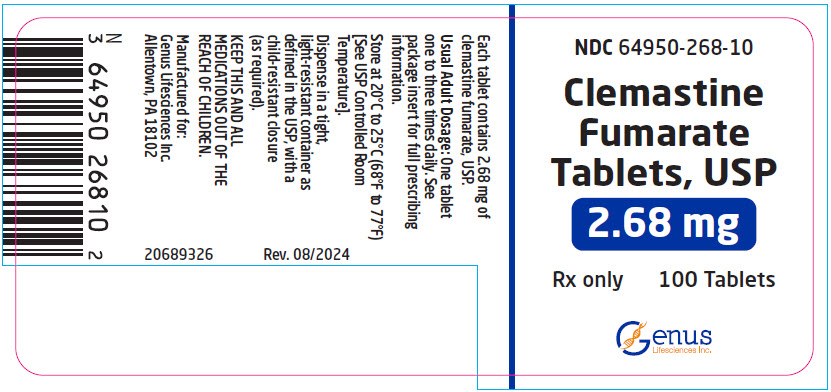
PRINCIPAL DISPLAY PANEL - 2.68 mg Tablet Bottle Label NDC 64950-268-10 Clemastine Fumarate Tablets, USP 2.68 mg Rx only 100 Tablets Genus Lifesciences Inc. PRINCIPAL DISPLAY PANEL - 2.68 mg Tablet Bottle Label
Medicaid utilization by pack size
Medicare Part D spend CMS · PART D · 2026 (Q1)
About this NDC listing & data coverage
What data is (and isn’t) available for this NDC — tap to expand
| NDC identity (package / product / labeler codes) | ✓ Available |
| Labeler | ✓ Available |
| Product & package description | ✓ Available |
| Marketing category & status | ✓ Available |
| Active ingredient / dosage form / route | ✓ Available |
| FDA label (SPL via DailyMed) | ✓ Available |
| Package photos | ✓ Available |
| Inactive ingredients (structured) | ✓ Available |
| NADAC pharmacy acquisition price (CMS) | — Not published for this NDC CMS publishes NADAC only for NDCs reported in its retail-pharmacy survey. |
| Orange Book / therapeutic-equivalence data | — Not published for this NDC Applies only to products approved under an NDA/ANDA; many listings are out of scope. |
| HCPCS J-code billing crosswalk | — Not published for this NDC Most self-administered / retail products have no J-code — that is normal. |
| Medicaid utilization (CMS SDUD) | — Not published for this NDC CMS reports utilization only for NDCs with Medicaid claims above its privacy threshold. |