
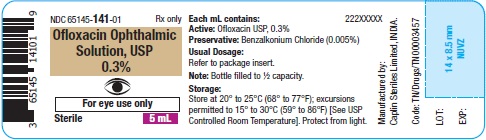
Ofloxacin 3 mg/mL Solution/ Drops, 5 mL — NDC 65145-141-01 (Billing 65145-0141-01)
This is a package of 5 mL of Ofloxacin 3 mg/mL Solution/ Drops from Caplin Steriles Limited, marketed since Feb 2025 and currently FDA-listed; retail pharmacies pay about $1.24 per mL (NADAC). It is this product's only package size.
Identity & classification
Regulatory identifiers FDA, NLM and CMS codes for this package
Drug-database identifiers Medi-Span GPI and First Databank GCN / HICL / AHFS classification
- GSN (GCN sequence number): 019734
- GCN: 36600
- GPI-14 (Medi-Span): 86101047002020
- HICL (First Databank): 006035
- AHFS class code: 08:12.18.00
- RxCUI (RxNorm): 312075
Where does this data come from?
- FDA openFDA NDC Directory · synced Oct 1, 2026
- FDA label on DailyMed · label index refreshed Oct 1, 2026
- RxNorm (NLM RxNav) · catalog refreshed Oct 1, 2026
- Medi-Span GPI (licensed)
- First Databank (licensed) · refreshed Oct 1, 2026
RxNorm drug class
This medicine belongs to the Quinolone Antimicrobial class.
Where does this data come from?
- RxClass (NLM) · catalog refreshed Oct 1, 2026
Clinical
- It is an antibiotic for certain bacterial infections. Tablets treat things like pneumonia, skin infections, and some urethral and cervical infections. Eye drops treat bacterial con...
- Follow the schedule on your label. Tablets are usually taken about every 12 hours. Keep antacids, iron, and zinc multivitamins at least two hours before or after. For ear drops, wa...
- With the tablets, the most common are nausea, headache, trouble sleeping, dizziness, and diarrhea. Women may also notice vaginal itching. These are often mild, but tell me if they...
- Stop the medicine and call if you have tendon pain or swelling, tingling or numbness, confusion, hallucinations, or a rash or swelling. Also call for severe diarrhea or sudden seve...
Patient education
Supplement & herbal interactions
Where does this data come from?
- MedlinePlus (NLM) · refreshed Oct 1, 2026
- FDA label on DailyMed · label index refreshed Oct 1, 2026
Ask a licensed pharmacist directly — free, answered by our team.
Pricing
A drug doesn't have one price. Each row is a different public payment system, and none is what you'd pay at the counter — that depends on your insurance. The ⓘ on each row explains what it measures.
| Price system | Per mL | Per package |
|---|---|---|
| Retail pharmacies payNADAC · weekly | $1.241 | $6.21 / 5 ml |
| Medicaid paysCMS SDUD · 12 mo | $3.13 | $15.66 / 5 ml |
| Medicare drug plans payPart D · Q2 2026 | $1.98 | $9.88 / 5 ml |
Where does this data come from?
- CMS NADAC weekly file · file of Sep 30, 2026
- CMS ASP pricing files · refreshed Sep 20, 2026
- CMS Medicaid State Drug Utilization Data · through Q1 2026
- CMS Part D plan pricing files · refreshed Sep 24, 2026
- VA National Acquisition Center price file
Packaging — all sizes for this product
| Package NDC | Description | Marketing start | Marketing end | Status |
|---|---|---|---|---|
| 65145-0141-01 You're viewing this Main listing | 5 mL in 1 BOTTLE, DROPPER | 2025-02-05 | — | Active |
Therapeutic equivalents
| Product | Labeler | Pack | NADAC/unit | TE | Status | Price vs. this |
|---|---|---|---|---|---|---|
| Ofloxacin 3 mg/mL 64980-0515-01 | Rising | 1 bottle | $1.114 | AT | Availability likely | save 10% |
| Ofloxacin 3 mg/mL 65145-0142-01 | Caplin | 10 ml | $1.114 | AT | Availability likely | save 10% |
| ofloxacin 3 mg/mL 70756-0650-30 | Lifestar | 1 bottle | $1.114 | AT | Availability likely | save 10% |
| ofloxacin 3 mg/mL 00904-7434-05 | Major | 1 bottle | $1.241 | AT | Availability likely | — |
| Ofloxacin 3 mg/mL 24208-0434-05 | Bausch | 1 bottle | $1.241 | AT | Availability likely | — |
| Ofloxacin 3 mg/mL 60505-0560-00 | Apotex | 1 bottle | $1.241 | AT | Availability likely | — |
| Ofloxacin 3 mg/mLthis 65145-0141-01 | Caplin | 5 ml | $1.241 | AT | Availability likely | — |
| Ofloxacin 3 mg/mL 69315-0327-05 | Leading | 5 ml | $1.241 | AT | Availability likely | — |
| Ofloxacin 3 mg/mL 70069-0411-01 | Somerset | 1 bottle | $1.241 | AT | Availability likely | — |
| Ofloxacin 3 mg/mL 70512-0793-05 | SOLA | 1 bottle | $1.241 | AT | Availability likely | — |
| ofloxacin 3 mg/mL 70756-0607-30 | Lifestar | 1 bottle | $1.241 | AT | Availability likely | — |
| Ofloxacin 3 mg/mL 72485-0613-10 | ARMAS | 1 bottle | $1.241 | AT | Availability likely | — |
| ofloxacin 3 mg/mL 72603-0192-01 | NorthStar | 5 ml | $1.241 | AT | Availability likely | — |
| Ocuflox 3 mg/mL 11980-0779-05 | Allergan, | 1 bottle | — | AT | FDA listed | — |
| Ofloxacin 3 mg/mL 50090-1744-00 | A-S | 1 bottle | — | AT | FDA listed | — |
| Ofloxacin 3 mg/mL 50090-5186-00 | A-S | 1 bottle | — | AT | FDA listed | — |
| Ofloxacin 3 mg/mL 50090-5209-00 | A-S | 1 bottle | — | AT | FDA listed | — |
| Ofloxacin 3 mg/mL 50090-5425-00 | A-S | 1 bottle | — | AT | FDA listed | — |
| ofloxacin 3 mg/mL 50090-6794-00 | A-S | 1 bottle | — | AT | FDA listed | — |
| Ofloxacin 3 mg/mL 50090-7264-00 | A-S | 1 bottle | — | AT | FDA listed | — |
| ofloxacin 3 mg/mL 50090-7761-00 | A-S | 5 ml | — | AT | FDA listed | — |
| Ofloxacin ophthalmic 3 mg/mL 59390-0140-05 | Altaire | 5 ml | — | AT | FDA listed | — |
| Ofloxacin 3 mg/mL 60760-0917-05 | St. | 1 bottle | — | AT | FDA listed | — |
| Ofloxacin 3 mg/mL 60760-0970-05 | ST. | 1 bottle | — | AT | FDA listed | — |
| Ofloxacin 3 mg/mL 63187-0268-05 | Proficient | 1 bottle | — | AT | FDA listed | — |
| Ofloxacin 3 mg/mL 63187-0662-05 | Proficient | 1 bottle | — | AT | FDA listed | — |
| Ofloxacin 3 mg/mL 63187-0734-05 | Proficient | 1 bottle | — | AT | FDA listed | — |
| Ofloxacin 3 mg/mL 68071-1607-05 | NuCare | 5 ml | — | AT | FDA listed | — |
| Ofloxacin 3 mg/mL 68071-2254-05 | NuCare | 1 bottle | — | AT | FDA listed | — |
| Ofloxacin 3 mg/mL 68071-2265-01 | NuCare | 1 bottle | — | AT | FDA listed | — |
| ofloxacin 3 mg/mL 68071-3448-05 | NuCare | 1 bottle | — | AT | FDA listed | — |
| Ofloxacin 3 mg/mL 68071-3566-01 | NuCare | 1 bottle | — | AT | FDA listed | — |
| ofloxacin 3 mg/mL 68071-3919-05 | NuCare | 5 ml | — | AT | FDA listed | — |
| Ofloxacin 3 mg/mL 68788-7693-05 | Preferred | 1 bottle | — | AT | FDA listed | — |
| ofloxacin 3 mg/mL 68788-8449-05 | Preferred | 1 bottle | — | AT | FDA listed | — |
| Ofloxacin 3 mg/mL 68788-8761-05 | Preferred | 1 bottle | — | AT | FDA listed | — |
| ofloxacin 3 mg/mL 70518-3710-00 | REMEDYREPACK | 1 bottle | — | AT | FDA listed | — |
| Ofloxacin 3 mg/mL 71205-0420-05 | Proficient | 1 bottle | — | AT | FDA listed | — |
| Ofloxacin Ophth Soln 3 mg/mL 72189-0472-05 | Direct_Rx | 5 ml | — | AT | FDA listed | — |
| ofloxacin 3 mg/mL 82804-0101-05 | Proficient | 1 bottle | — | AT | FDA listed | — |
Where does this data come from?
- FDA openFDA NDC Directory · synced Oct 1, 2026
- FDA Orange Book · refreshed Sep 3, 2026
- CMS NADAC weekly file · file of Sep 30, 2026
Availability & generic status
This product is an FDA-approved generic. Other versions of the same drug are listed under Therapeutic equivalents, least expensive first.
Where does this data come from?
- FDA Orange Book · refreshed Sep 3, 2026
Inactive Ingredients / Excipients
Inactive ingredients, also called excipients, are components of the drug product other than the active ingredient. They may include fillers, dyes, coatings, preservatives, flavors, or other formulation ingredients.
💡 Tap an ingredient (hover on desktop) to see what it is and why it’s used.
-
UNII QTT17582CB
A strong acid used to adjust and maintain the proper pH level in liquid medicines, ensuring stability and preventing breakdown of active ingredients.
-
UNII 451W47IQ8X
Sodium chloride is common table salt. It's used in medicines as a buffer to maintain proper pH, as a filler to add bulk, or to adjust the osmotic balance in liquid formulations.
-
UNII 55X04QC32I
A strong alkaline chemical used to adjust and maintain the pH balance of liquid medicines. It helps keep the medicine stable and ensures it stays effective during storage.
-
UNII 059QF0KO0R
Water is a liquid solvent that dissolves and mixes ingredients together in liquid medicines, syrups, and injections. It helps distribute the active drug evenly throughout the product.
4 inactive ingredients listed in the exact product block matched to this NDC.
Where does this data come from?
ingredient classCode="IACT" elements from the exact product block matched by this NDC. Label-section narrative from DailyMed / the openFDA label index is shown separately when available.- FDA label on DailyMed · label index refreshed Oct 1, 2026
- FDA openFDA NDC Directory · synced Oct 1, 2026
Inactive ingredient FAQ
Are inactive ingredients the same for every manufacturer?
Why might an inactive ingredient be missing?
Can inactive ingredients matter?
Manufacturer & labeler
Where does this data come from?
- FDA openFDA NDC Directory · synced Oct 1, 2026
- Drugs@FDA
Full prescribing information FDA SPL
🎯 Indications and Usage ▾
INDICATIONS & USAGE Ofloxacin ophthalmic solution is indicated for the treatment of infections caused by susceptible strains of the following bacteria in the conditions listed below: CONJUNCTIVITIS: Gram-positive bacteria: Gram-negative bacteria: Staphylococcus aureus Enterobacter cloacae Staphylococcus epidermidis Haemophilus influenzae Streptococcus pneumoniae Proteus mirabilis Pseudomonas aeruginosa CORNEAL ULCERS: Gram-positive bacteria: Gram-negative bacteria: Staphylococcus aureus Pseudomonas aeruginosa Staphylococcus epidermidis Serratia marcescens* Streptococcus pneumoniae Anaerobic species: Propionibacterium acnes *Efficacy for this organism was studied in fewer than 10 infections
⏱️ Dosage and Administration ▾
DOSAGE & ADMINISTRATION The recommended dosage regimen for the treatment of bacterial conjunctivitis is: Days 1 and 2 Instill one to two drops every two to four hours in the affected eye(s). Days 3 through 7 Instill one to two drops four times daily. The recommended dosage regimen for the treatment of bacterial corneal ulcer is: Days 1 and 2 Instill one to two drops into the affected eye every 30 minutes, while awake.
Awaken at approximately four and six hours after retiring and instill one to two drops. Days 3 through 7 to 9 Instill one to two drops hourly, while awake. Days 7 to 9 through treatment completion Instill one to two drops, four times daily.
⛔ Contraindications ▾
CONTRAINDICATIONS Ofloxacin ophthalmic solution is contraindicated in patients with a history of hypersensitivity to ofloxacin, to other quinolones, or to any of the components in this medication ( see Warnings ).
⚠️ Warnings ▾
WARNINGS NOT FOR INJECTION. Ofloxacin ophthalmic solution should not be injected subconjunctivally, nor should it be introduced directly into the anterior chamber of the eye. There are rare reports of anaphylactic reaction/shock and fatal hypersensitivity reactions in patients receiving systemic quinolones, some following the first dose, including ofloxacin.
Some reactions were accompanied by cardiovascular collapse, loss of consciousness, angioedema (including laryngeal, pharyngeal or facial edema), airway obstruction, dyspnea, urticaria, and itching. A rare occurrence of Stevens-Johnson syndrome, which progressed to toxic epidermal necrolysis, has been reported in a patient who was receiving topical ophthalmic ofloxacin. If an allergic reaction to ofloxacin occurs, discontinue the drug.
Serious acute hypersensitivity reactions may require immediate emergency treatment. Oxygen and airway management, including intubation should be administered as clinically indicated.
🤒 Adverse Reactions ▾
ADVERSE REACTIONS Ophthalmic Use The most frequently reported drug-related adverse reaction was transient ocular burning or discomfort. Other reported reactions include stinging, redness, itching, chemical conjunctivitis/keratitis, ocular/periocular/facial edema, foreign body sensation, photophobia, blurred vision, tearing, dryness, and eye pain. Rare reports of dizziness and nausea have been received.
Refer to Warnings for additional adverse reactions. To report SUSPECTED ADVERSE REACTIONS, contact Caplin Steriles Limited at 1-866-978-6111 or FDA at 1-800-FDA-1088 or www.fda.gov/medwatch .
🔄 Drug Interactions ▾
Drug Interactions Specific drug interaction studies have not been conducted with ofloxacin ophthalmic solution. However, the systemic administration of some quinolones has been shown to elevate plasma concentrations of theophylline, interfere with the metabolism of caffeine, and enhance the effects of the oral anticoagulant warfarin and its derivatives, and has been associated with transient elevations in serum creatinine in patients receiving cyclosporine concomitantly.
🤰 Pregnancy ▾
Pregnancy Teratogenic Effects Ofloxacin has been shown to have an embryocidal effect in rats and in rabbits when given in doses of 810 mg/kg/day (equivalent to 9000 times the maximum recommended daily ophthalmic dose) and 160 mg/kg/day (equivalent to 1800 times the maximum recommended daily ophthalmic dose). These dosages resulted in decreased fetal body weight and increased fetal mortality in rats and rabbits, respectively. Minor fetal skeletal variations were reported in rats receiving doses of 810 mg/kg/day.
Ofloxacin has not been shown to be teratogenic at doses as high as 810 mg/kg/day and 160 mg/kg/day when administered to pregnant rats and rabbits, respectively. Nonteratogenic Effects Additional studies in rats with doses up to 360 mg/kg/day during late gestation showed no adverse effect on late fetal development, labor, delivery, lactation, neonatal viability, or growth of the newborn. There are, however, no adequate and well-controlled studies in pregnant women.
Ofloxacin ophthalmic solution should be used during pregnancy only if the potential benefit justifies the potential risk to the fetus.
🧒 Pediatric Use ▾
Pediatric Use Safety and effectiveness in infants below the age of one year have not been established. Quinolones, including ofloxacin, have been shown to cause arthropathy in immature animals after oral administration; however, topical ocular administration of ofloxacin to immature animals has not shown any arthropathy. There is no evidence that the ophthalmic dosage form of ofloxacin has any effect on weight bearing joints.
🧓 Geriatric Use ▾
Geriatric Use No overall differences in safety or effectiveness have been observed between elderly and younger patients.
🧬 Clinical Pharmacology ▾
CLINICAL PHARMACOLOGY Pharmacokinetics Serum, urine and tear concentrations of ofloxacin were measured in 30 healthy women at various time points during a ten-day course of treatment with ofloxacin ophthalmic solution. The mean serum ofloxacin concentration ranged from 0.4 ng/mL to 1.9 ng/mL. Maximum ofloxacin concentration increased from 1.1 ng/mL on day one to 1.9 ng/mL on day 11 after QID dosing for 10 1/2 days.
Maximum serum ofloxacin concentrations after ten days of topical ophthalmic dosing were more than 1000 times lower than those reported after standard oral doses of ofloxacin. Tear ofloxacin concentrations ranged from 5.7 to 31 mcg/g during the 40 minute period following the last dose on day 11. Mean tear concentration measured four hours after topical ophthalmic dosing was 9.2 mcg/g.
Corneal tissue concentrations of 4.4 mcg/mL were observed four hours after beginning topical ocular application of two drops of ofloxacin ophthalmic solution every 30 minutes. Ofloxacin was excreted in the urine primarily unmodified. Microbiology Ofloxacin has in vitro activity against a broad range of gram-positive and gram-negative aerobic and anaerobic bacteria.
Ofloxacin is bactericidal at concentrations equal to or slightly greater than inhibitory concentrations. Ofloxacin is thought to exert a bactericidal effect on susceptible bacterial cells by inhibiting DNA gyrase, an essential bacterial enzyme which is a critical catalyst in the duplication, transcription, and repair of bacterial DNA. Cross-resistance has been observed between ofloxacin and other fluoroquinolones.
There is generally no cross-resistance between ofloxacin and other classes of antibacterial agents such as beta-lactams or aminoglycosides. Ofloxacin has been shown to be active against most strains of the following organisms both in vitro and clinically, in conjunctival and/or corneal ulcer infections ( see Indications and Usage ). AEROBES, GRAM-POSITIVE: AEROBES, GRAM-NEGATIVE: Staphylococcus aureus Enterobacter cloacae Staphylococcus epidermidis Haemophilus influenzae Streptococcus pneumoniae Proteus mirabilis ANAEROBIC SPECIES: Propionibacterium acnes Pseudomonas aeruginosa Serratia marcescens* *Efficacy for this organism was studied in fewer than 10 infections The safety and effectiveness of ofloxacin ophthalmic solution in treating ophthalmologic infections due to the following organisms have not been established in adequate and well-controlled clinical trials.
Ofloxacin ophthalmic solution has been shown to be active in vitro against most strains of these organisms but the clinical significance in ophthalmologic infections is unknown. AEROBES, GRAM-POSITIVE: Enterococcus faecalis Staphylococcus hominus Listeria monocytogenes Staphylococcus simulans Staphylococcus capitis Streptococcus pyogenes AEROBES, GRAM-NEGATIVE: Acinetobacter calcoaceticus var. anitratus Klebsiella pneumoniae Acinetobacter calcoaceticus var. lwoffii Moraxella (Branhamella) catarrhalis Citrobacter diversus Moraxella lacunata Citrobacter freundii Morganella morganii Enterobacter aerogenes Neisseria gonorrhoeae Enterobacter agglomerans Pseudomonas acidovorans Escherichia coli Pseudomonas fluorescens Haemophilus parainfluenzae Shigella sonnei Klebsiella oxytoca OTHER: Chlamydia trachomatis Clinical Studies Conjunctivitis In a randomized, double-masked, multicenter clinical trial, ofloxacin ophthalmic solution was superior to its vehicle after 2 days of treatment in patients with conjunctivitis and positive conjunctival cultures.
Clinical outcomes for the trial demonstrated a clinical improvement rate of 86% (54/63) for the ofloxacin treated group versus 72% (48/67) for the placebo treated group after 2 days of therapy. Microbiological outcomes for the same clinical trial demonstrated an eradication rate for causative pathogens of 65% (41/63) for the ofloxacin treated group versus 25% (17/67) for the vehicle treated group after 2 days of therapy. Please note that microbiologic eradication doe… [Excerpted — this section continues on DailyMed.]
📦 How Supplied / Storage and Handling ▾
HOW SUPPLIED Ofloxacin ophthalmic solution, USP 0.3% is supplied sterile in opaque white LDPE plastic bottles and white dropper tips with tan high density polyethylene (HDPE) caps as follows: 5 mL in 10 mL bottle – NDC 65145- 141 -01 10 mL in 10 mL bottle – NDC 65145- 142 -01 STORAGE: Store at 20° to 25°C (68° to 77°F); excursions permitted to 15° to 30°C (59° to 86°F) [See USP Controlled Room Temperature]. Protect from light. Rx only Made in India Distributed by: Caplin Steriles USA Inc, Hamilton, NJ 08619.
Code: TN/Drugs/TN00003457 Revised: 08/2024 22200946 Ofloxacin-oph-caplin-logo
📋 Description ▾
DESCRIPTION Ofloxacin Ophthalmic Solution USP 0.3% is a sterile ophthalmic solution. It is a fluorinated carboxyquinolone anti-infective for topical ophthalmic use. Chemical Name (±)-9-Fluoro-2,3-dihydro-3-methyl-10-(4-methyl-1-piperazinyl)-7-oxo-7 H -pyrido[1,2,3- de ]-1,4-benzoxazine-6-carboxylic acid.
Contains: Active: ofloxacin 0.3% (3 mg/mL). Preservative: benzalkonium chloride (0.005%). Inactives: sodium chloride and water for injection.
May also contain hydrochloric acid and/or sodium hydroxide to adjust pH. Ofloxacin Ophthalmic Solution USP, 0.3% is unbuffered and formulated with a pH of 6.4 (range - 6.0 to 6.8). It has an osmolality of 300 mOsm/kg.
Ofloxacin is a fluorinated 4-quinolone which differs from other fluorinated 4-quinolones in that there is a six member (pyridobenzoxazine) ring from positions 1 to 8 of the basic ring structure. Ofloxacin-structure
💬 Information for Patients ▾
Information for Patients Avoid contaminating the applicator tip with material from the eye, fingers or other source. Systemic quinolones, including ofloxacin, have been associated with hypersensitivity reactions, even following a single dose. Discontinue use immediately and contact your physician at the first sign of a rash or allergic reaction.
⚠️ Precautions ▾
PRECAUTIONS General As with other anti-infectives, prolonged use may result in overgrowth of nonsusceptible organisms, including fungi. If superinfection occurs discontinue use and institute alternative therapy. Whenever clinical judgment dictates, the patient should be examined with the aid of magnification, such as slit lamp biomicroscopy and, where appropriate, fluorescein staining.
Ofloxacin should be discontinued at the first appearance of a skin rash or any other sign of hypersensitivity reaction. The systemic administration of quinolones, including ofloxacin, has led to lesions or erosions of the cartilage in weight-bearing joints and other signs of arthropathy in immature animals of various species. Ofloxacin, administered systemically at 10 mg/kg/day in young dogs (equivalent to 110 times the maximum recommended daily adult ophthalmic dose) has been associated with these types of effects.
Information for Patients Avoid contaminating the applicator tip with material from the eye, fingers or other source. Systemic quinolones, including ofloxacin, have been associated with hypersensitivity reactions, even following a single dose. Discontinue use immediately and contact your physician at the first sign of a rash or allergic reaction.
Drug Interactions Specific drug interaction studies have not been conducted with ofloxacin ophthalmic solution. However, the systemic administration of some quinolones has been shown to elevate plasma concentrations of theophylline, interfere with the metabolism of caffeine, and enhance the effects of the oral anticoagulant warfarin and its derivatives, and has been associated with transient elevations in serum creatinine in patients receiving cyclosporine concomitantly. Carcinogenesis, Mutagenesis, Impairment of Fertility Long term studies to determine the carcinogenic potential of ofloxacin have not been conducted.
Ofloxacin was not mutagenic in the Ames test, in vitro and in vivo cytogenic assay, sister chromatid exchange assay (Chinese hamster and human cell lines), unscheduled DNA synthesis (UDS) assay using human fibroblasts, the dominant lethal assay, or mouse micronucleus assay. Ofloxacin was positive in the UDS test using rat hepatocyte, and in the mouse lymphoma assay. In fertility studies in rats, ofloxacin did not affect male or female fertility or morphological or reproductive performance at oral dosing up to 360 mg/kg/day (equivalent to 4000 times the maximum recommended daily ophthalmic dose).
Pregnancy Teratogenic Effects Ofloxacin has been shown to have an embryocidal effect in rats and in rabbits when given in doses of 810 mg/kg/day (equivalent to 9000 times the maximum recommended daily ophthalmic dose) and 160 mg/kg/day (equivalent to 1800 times the maximum recommended daily ophthalmic dose). These dosages resulted in decreased fetal body weight and increased fetal mortality in rats and rabbits, respectively. Minor fetal skeletal variations were reported in rats receiving doses of 810 mg/kg/day.
Ofloxacin has not been shown to be teratogenic at doses as high as 810 mg/kg/day and 160 mg/kg/day when administered to pregnant rats and rabbits, respectively. Nonteratogenic Effects Additional studies in rats with doses up to 360 mg/kg/day during late gestation showed no adverse effect on late fetal development, labor, delivery, lactation, neonatal viability, or growth of the newborn. There are, however, no adequate and well-controlled studies in pregnant women.
Ofloxacin ophthalmic solution should be used during pregnancy only if the potential benefit justifies the potential risk to the fetus. Nursing Mothers In nursing women a single 200 mg oral dose resulted in concentrations of ofloxacin in milk which were similar to those found in plasma. It is not known whether ofloxacin is excreted in human milk following topical ophthalmic administration.
Because of the potential for serious adverse reactions from ofloxacin in nursing infants, a decision should be made whether to disconti… [Excerpted — this section continues on DailyMed.]
🍼 Nursing Mothers ▾
Nursing Mothers In nursing women a single 200 mg oral dose resulted in concentrations of ofloxacin in milk which were similar to those found in plasma. It is not known whether ofloxacin is excreted in human milk following topical ophthalmic administration. Because of the potential for serious adverse reactions from ofloxacin in nursing infants, a decision should be made whether to discontinue nursing or to discontinue the drug, taking into account the importance of the drug to the mother.
📄 Carcinogenesis, Mutagenesis, Impairment of Fertility ▾
Carcinogenesis, Mutagenesis, Impairment of Fertility Long term studies to determine the carcinogenic potential of ofloxacin have not been conducted. Ofloxacin was not mutagenic in the Ames test, in vitro and in vivo cytogenic assay, sister chromatid exchange assay (Chinese hamster and human cell lines), unscheduled DNA synthesis (UDS) assay using human fibroblasts, the dominant lethal assay, or mouse micronucleus assay. Ofloxacin was positive in the UDS test using rat hepatocyte, and in the mouse lymphoma assay.
In fertility studies in rats, ofloxacin did not affect male or female fertility or morphological or reproductive performance at oral dosing up to 360 mg/kg/day (equivalent to 4000 times the maximum recommended daily ophthalmic dose).
📄 Package Label / Principal Display Panel ▾
PACKAGE LABEL.PRINCIPAL DISPLAY PANEL Container Label - 5 mL NDC 65145- 141 -01 Rx only Ofloxacin Ophthalmic Solution, USP 0.3% For eye use only Sterile 5 mL Carton Label - 5 mL Rx only 5 mL NDC 65145- 141 -01 Ofloxacin Ophthalmic Solution, USP 0.3% For eye use only Sterile Container Label - 10 mL NDC 65145- 142 -01 Rx only Ofloxacin Ophthalmic Solution, USP 0.3% For eye use only Sterile 10 mL Carton Label - 10 mL Rx only 10 mL NDC 65145- 142 -01 Ofloxacin Ophthalmic Solution, USP 0.3% For eye use only Sterile ofloxacin-ophthalmic-5ml-container ofloxacin-ophthalmic-5ml-carton ofloxacin-ophthalmic-10ml-container ofloxacin-ophthalmic-10ml-carton