
Home › NDC Lookup › Ingredients › Lactulose › 66220-0719-30
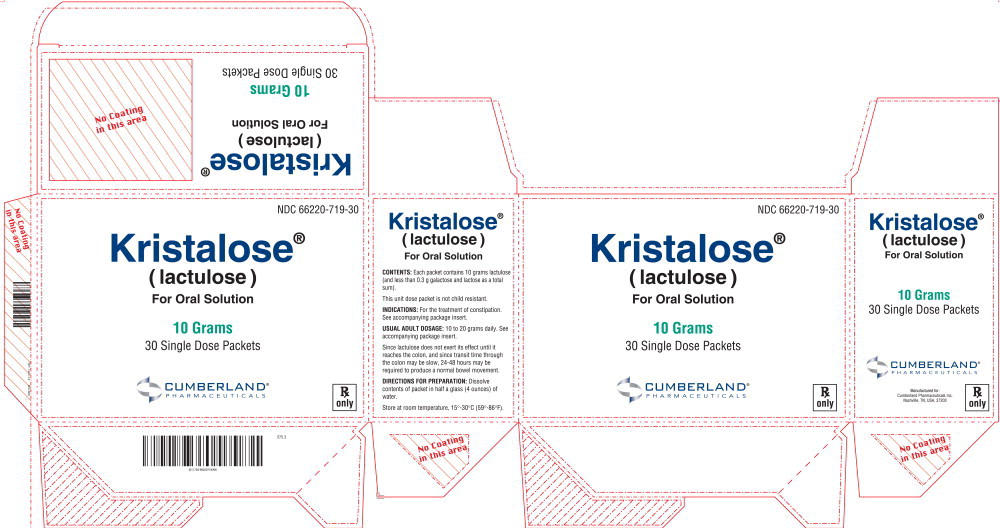
KRISTALOSE lactulose 10 g/10g Powder, For Solution — NDC 66220-0719-30 package photo

KRISTALOSE lactulose 10 g/10g Powder, For Solution

by Cumberland Pharmaceuticals Inc. · 30 POUCH in 1 CARTON (66220-719-30) / 10 g in 1 POUCH (66220-719-01)
NDC 66220-0719-30
🏷️ FDA NDC (as labeled) 66220-719-30 billing pads the product segment with a zero
Rx only Generic On market Non-controlled
🗂️ Data synced Jul 24, 2026 · sources: openFDA · FDA label (DailyMed) · FDA Orange & Purple Book · First Databank · CMS NADAC, ASP, Medicare & Medicaid · RxNorm
📋 All sources & update times →

🆔 Identity & classification

FDA NDC (as labeled) 66220-719-30
Product NDC 66220-719
11-digit billing NDC 66220071930
NCPDP billing unit EA — each (per item)
UNII 9U7D5QH5AE
UPC 0366220729016, 0366220719017
Application # ANDA074712
SPL Set ID 535dd1ea-b567-49f7-9a84-8ea91e78c466
Established class (EPC) Osmotic Laxative
Mechanism of action Osmotic Activity; Acidifying Activity
Physiologic effect Stimulation Large Intestine Fluid/Electrolyte Secretion
DEA schedule Non-controlled
Marketing category ANDA
Marketing status On market
FDA listing status Listed (active directory)
Marketing start 2012-01-20
Route ORAL
Dosage form POWDER, FOR SOLUTION
Substance LACTULOSE
GPI-14 46600020003010
GPI class Kristalose
GCN Seq No 023508
GCN 10162
HICL code 001396
Ingredient (HICL) Lactulose
HIC1 code D
Therapeutic class — broad (HIC1) Biliary System/Gastro-Intestinal System
HIC2 code D6
Therapeutic class — intermediate (HIC2) Drugs Acting Principally On The Colon
HIC3 code D6S
Therapeutic class — specific (HIC3) Laxatives And Cathartics
AHFS code 40:10.00.00
AHFS class Ammonia Detoxicants
FDB label name KRISTALOSE 10 GM PACKET
FDB brand name Kristalose
Legend status F — Federal legend — prescription drug or device
TE code (Orange Book) AA · RLD · RS
Why two NDCs? The FDA registers this code as 66220-719-30 — a 5-3-2 layout, and that's what's printed on the package and shown on DailyMed. For insurance claims, every NDC is standardized to a uniform 11-digit 5-4-2 format by adding a zero to the product segment → 66220-0719-30. Same drug, same package — only the format differs.
Where does this data come from?
Identifiers from the FDA openFDA NDC Directory and Structured Product Labeling; RxCUI from RxNorm (NLM); GPI from Medi-Span; GCN / HIC / AHFS / legend from First Databank.

🏷️ RxNorm drug class

This medicine belongs to the Osmotic Laxative class.

Pharmacologic class Osmotic Laxative
Drug family (ATC) Osmotically acting laxatives
How it works Osmotic Activity, Acidifying Activity
Where does this data come from?
Therapeutic classes from RxNorm RxClass (U.S. National Library of Medicine) — Established Pharmacologic Class (FDA), ATC drug family (WHO) and mechanism of action, matched by this product’s RxCUI.

🏭 Manufacturer & labeler

LabelerCumberland Pharmaceuticals Inc.
Application holderAPOTEX INC
FDA applicationANDA074712 (ANDA)
Labeler code66220
First marketedJan 2012
Product typeHuman Prescription Drug
Portfolio7 products on file
The labeler markets the product; the application holder owns the FDA approval. They’re often the same company but can differ (e.g. a repackager or an authorized generic). A mailing address / phone appears here when the manufacturer includes it in the product’s FDA label (not all do).
Where does this data come from?
Labeler, application holder and registered establishment from the FDA openFDA NDC Directory and Drugs@FDA; address/contact from the product’s FDA label.

🩺 Clinical

Label name KRISTALOSE 10 GM PACKET Ingredient Lactulose
📖 What it is MedlinePlus · NLM

Lactulose is a synthetic sugar used to treat constipation. It is broken down in the colon into products that pull water out from the body and into the colon. This water softens stools. Lactulose is also used to reduce the amount of ammonia in the blood of patients with liver disease. It works by drawing ammonia from the blood into the colon where it is removed from the body. This medication is sometimes prescribed for other uses; ask your doctor or pharmacist for more information.

Read the full MedlinePlus article ↗
📗 Our plain-language guide HelloPharmacist
  • Lactulose has two main uses. Some products — like Constulose and Kristalose — are prescribed specifically for constipation. Other products, like Enulose and Generlac, are used for...
  • For constipation, it usually takes 24 to 48 hours to produce a bowel movement, so don't be worried if nothing happens right away. For portal-systemic encephalopathy, improvement ma...
  • How long does it take lactulose to work?
  • The most common side effects are digestive — gas, bloating, belching, and mild stomach cramping. These are pretty typical, especially when you first start. The one to watch for is...
📖 Read our full Lactulose guide →
Where does this data come from?
Plain-language summary from MedlinePlus (U.S. National Library of Medicine); supplement & herbal interactions and nutrient depletion data from the Natural Medicines database; our full guide is HelloPharmacist editorial content.

🧪 Inactive Ingredients / Excipients

Inactive ingredients, also called excipients, are components of the drug product other than the active ingredient. They may include fillers, dyes, coatings, preservatives, flavors, or other formulation ingredients.

A current SPL was checked, but it does not contain a structured or narrative inactive-ingredient list for this product. This does not mean the product has no inactive ingredients.
Where does this data come from?
Source: official FDA Structured Product Labeling (SPL) via DailyMed and the openFDA label index. Structured IACT rows and label-wide narrative are kept separate; availability and product-level specificity depend on the submitted label.

Inactive ingredient FAQ

Are inactive ingredients the same for every manufacturer?
No. Inactive ingredients can differ by manufacturer, dosage form, strength, and package / product version.
Why might an inactive ingredient be missing?
Some SPLs do not provide a complete structured inactive-ingredient list, and older or unusual labels may only include the information in narrative text.
Can inactive ingredients matter?
Yes. They can matter for allergies, intolerances, dyes, gluten / lactose concerns, preservatives, and formulation differences — but confirm with a pharmacist or the manufacturer when it’s clinically important.

💲 Pricing

A drug doesn't have one price. Each row is a different public payment system, and none is what you'd pay at the counter — that depends on your insurance. The ⓘ on each row explains what it measures.

Price systemPer eaPer package
Retail pharmacies payNADAC · weekly $9.591 $287.73 / 30 pouches
Medicaid paysCMS SDUD · 12 mo $0.8888 $26.66 / 30 pouches
Medicare drug plans payPart D · Q2 2026 $8.45 $253.43 / 30 pouches
NADAC price history (per ea) — tap or hover for the price & month
Oct 2021 Jan 2024 May 2026 Sep 2026 $9.630 $8.053
▲ Up 19% over the last 11 months.
Where does this data come from?
NADAC (National Average Drug Acquisition Cost) is the CMS weekly pharmacy-acquisition-cost survey — what pharmacies pay. ASP (Average Sales Price) is the CMS Medicare Part B drug-payment file, published quarterly. Medicaid pays is computed by us from CMS State Drug Utilization Data (total reimbursed ÷ units, trailing 12 months) — gross of rebates and inclusive of dispensing fees, so it reflects what Medicaid paid, not an acquisition cost. Medicare drug plans pay is the median negotiated point-of-sale unit cost across plans listing this NDC in the CMS quarterly Prescription Drug Plan pricing files, before rebates. The VA pays is the federal contract price (FSS, and the statutory Big 4 ceiling where listed) from the VA National Acquisition Center pharmaceutical price file. All are free public government data; each measures a different payer, so the figures are not directly comparable.

🔁 Therapeutic equivalents

ProductLabelerPackNADAC/unitTEStatusPrice vs. this
Lactulose 10 g/10g 00121-0965-30 PAI 30 pouches $8.220 AA Availability likely save 14%
Lactulose 10 g/10g 73352-0900-15 Trifluent 15 pouches $8.220 AA Availability likely save 14%
LACTULOSE Crystalline 10 g/10g 85592-0819-30 Cumberland 30 pouches $8.220 AA Availability likely save 14%
Kristalose 10 g/10gthis 66220-0719-30 Cumberland 30 pouches $9.591 AA Availability likely —
Lactulose 10 g/10g 69067-0010-15 Foxland 15 pouches — AA FDA listed —
About this product: this is a generic version of the medicine. FDA equivalence ratings are shown when available, and other versions are listed above, least expensive first.
Where does this data come from?
Equivalents are other NDCs of the same ingredient, form and route from the openFDA NDC Directory, ranked least-expensive-first by NADAC. Therapeutic-equivalence (AB) ratings come from the FDA Orange Book; biologics use the FDA Purple Book for biosimilar & interchangeable status.

⏳ Availability & generic status

🏛️
2012
On the market since
Jan 2012
📍
2026
Currently FDA-listed
14 years listed
🔓
·
Generic on the market
this product is a generic
✅This is a generic drug

This product is an FDA-approved generic. Other versions of the same drug are listed under Therapeutic equivalents, least expensive first.

Where does this data come from?
Patents and exclusivity from the FDA Orange Book (small-molecule drugs), refreshed from public FDA data. Generic launch timing is an estimate, not a guarantee.

🗺️ Medicaid utilization & spend

📍 This exact package only: Medicaid data is reported per full 11-digit NDC — labeler, product and pack size — so every number here is for 66220-0719-30, not the drug overall. Other pack sizes report separately.
💊 Pharmacy benefit only: These are Medicaid outpatient pharmacy claims, billed by NDC. They exclude the medical benefit — clinic- or hospital-administered drugs billed under HCPCS J-codes — so drugs used mostly that way (e.g. Avastin, Lucentis, Keytruda) can look low or missing here. That’s expected, not an error.
📅 Q1 2025 – Q1 2026 · 5 quarters of data
ⓘ The newest quarter is usually incomplete when first published; states restate recent quarters in later CMS releases, so the latest figures typically revise upward. State coverage-policy changes can also shift quarter-to-quarter totals.
Prescriptions last 4 qtrs
13.2K
Units reimbursed last 4 qtrs
4M
Gross reimbursed last 4 qtrs
$3.54M
Avg / prescription
$267.04
Avg / unit
$0.8888
Latest quarter Q1 2026
2.8KRx
Medicaid pays / ea
$0.8888
gross reimbursed
vs
NADAC / ea
$9.5911
acquisition cost
=
Spread
−$8.7023
-91% vs cost
What Medicaid paid per ea (before rebates; includes the pharmacy’s dispensing fee) compared with NADAC — the average price pharmacies pay to buy the drug. A positive spread means Medicaid reimbursed more than the purchase price, before manufacturer rebates.
Fee-for-service vs managed care ⓘ
15% FFS 85% MCO
Fee-for-service · 2,003 Rx Managed care · 11,237 Rx
State Medicaid map
Alaska: no data reported AK Maine: no data reported ME Washington: no data reported WA Idaho: no data reported ID Montana: no data reported MT North Dakota: no data reported ND Minnesota: no data reported MN Wisconsin: 9,600 units · 162 per 100k residents WI Michigan: no data reported MI New York: 299,910 units · 1,532 per 100k residents NY Vermont: no data reported VT New Hampshire: no data reported NH Oregon: no data reported OR Nevada: no data reported NV Wyoming: no data reported WY South Dakota: no data reported SD Iowa: no data reported IA Illinois: no data reported IL Indiana: no data reported IN Ohio: 8,840 units · 75.0 per 100k residents OH Pennsylvania: no data reported PA New Jersey: no data reported NJ Massachusetts: no data reported MA California: 90,270 units · 232 per 100k residents CA Utah: no data reported UT Colorado: 5,800 units · 98.7 per 100k residents CO Nebraska: no data reported NE Missouri: 35,190 units · 568 per 100k residents MO Kentucky: no data reported KY West Virginia: 5,480 units · 310 per 100k residents WV Virginia: no data reported VA Maryland: no data reported MD Connecticut: 26,960 units · 745 per 100k residents CT Rhode Island: no data reported RI Arizona: no data reported AZ New Mexico: no data reported NM Kansas: no data reported KS Arkansas: 53,290 units · 1,738 per 100k residents AR Tennessee: no data reported TN North Carolina: 30,720 units · 284 per 100k residents NC South Carolina: no data reported SC Delaware: no data reported DE Oklahoma: no data reported OK Louisiana: 225,620 units · 4,933 per 100k residents LA Mississippi: no data reported MS Alabama: 133,910 units · 2,622 per 100k residents AL Georgia: no data reported GA D.C.: no data reported DC Hawaii: no data reported HI Texas: 3,052,120 units · 10,006 per 100k residents TX Florida: no data reported FL
Units reimbursed · per 100k residents
75.010,006
gray = no data reported ⓘ
Colors are per 100,000 residents, so big states don’t automatically dominate. Tap or hover a state for its actual totals.
Tap or hover a state
…for its Medicaid breakdown
🏆 Top states by units · per 100k residents
1 Texas 10,006 /100k
2 Louisiana 4,933 /100k
3 Alabama 2,622 /100k
4 Arkansas 1,738 /100k
5 New York 1,532 /100k
6 Connecticut 745 /100k
7 Missouri 568 /100k
8 West Virginia 310 /100k
National units — by quarter
💵 About the dollar figures: “reimbursed” is what Medicaid paid pharmacies before confidential manufacturer rebates, so the program’s real net cost is lower than these numbers. Fee-for-service and managed-care claims are combined unless split above. Source: CMS State Drug Utilization Data; per-100k rates use 2023 Census population estimates.

📊 Medicare Part D spend CMS · PART D · 2026 (Q1)

Medicare Part D (outpatient prescription) spending for Kristalose — the program that covers self-administered drugs. 1 manufacturer.
⚠️ Drug-level data: CMS publishes Part D spending by drug, not by NDC — these figures combine every manufacturer, strength and package size sold under the name Kristalose. That’s a different level of aggregation than the Medicaid card above, which is specific to this exact 11-digit NDC (pack size included), so the two aren’t directly comparable.
Period
Total Part D spend
$407.3K
Claims incl. refills
793
Beneficiaries
550
Spend / beneficiary
$740.57
Spend / claim
$513.64
Trend by period
💵 About the dollar figures: spending is what Part D plans paid before confidential manufacturer rebates, so the program’s real net cost is lower. A blank patient count means fewer than 11 people — CMS hides counts that small to protect privacy. Source: CMS Medicare Quarterly Part D Spending by Drug (data.cms.gov), updated quarterly.

🔬 Reported adverse events (FAERS)

Read carefully: FAERS reports are voluntary and unverified. Counts are not incidence, do not establish causation, are subject to reporting bias, and cannot be used to compare one drug to another. Shown for signal context only. Reports for KRISTALOSE (this brand).

Top reported reactions

Nausea2,520
Constipation2,487
Fall2,222
Vomiting2,081
Fatigue2,000
Death1,916
Diarrhoea1,893

Age at onset

Neonate27
Infant34
Child109
Adolescent57
Adult2,677
Elderly2,899

Reporter sex

36,876 reports
Male · 48%
Female · 52%
Unknown · 0%

Serious outcomes

Hospitalization20,397
Death6,477
Life-threatening2,943
Disabling1,214
Reports over time (by year) — tap or hover for the count & year
2019 2021 2023 2026 2,974 0
Most recent year is provisional (FAERS lags ~3 months).
Where does this data come from?
Adverse-event reports from the FDA Adverse Event Reporting System (FAERS) via openFDA. FAERS reports are voluntary and unverified — counts are not incidence and don’t establish causation.

📦 Packaging — all sizes for this product

Package NDCDescription Marketing startStatus
66220-0719-30 You're viewing this 30 POUCH in 1 CARTON (66220-719-30) / 10 g in 1 POUCH (66220-719-01) 2012-01-20 Active

📄 Full prescribing information FDA SPL

The complete FDA label for this product — the official prescribing information, verbatim, section by section. Jump with a chip, search within the label, or expand everything.
🎯 Indications and Usage 44 words ▾

INDICATIONS AND USAGE KRISTALOSE ® (LACTULOSE) For Oral Solution is indicated for the treatment of constipation. In patients with a history of chronic constipation, lactulose therapy increases the number of bowel movements per day and the number of days on which bowel movements occur.

⏱️ Dosage and Administration 40 words ▾

DOSAGE AND ADMINISTRATION The usual adult dosage is 10 g to 20 g of lactulose daily. The dose may be increased to 40 g daily if necessary. Twenty-four to 48 hours may be required to produce a normal bowel movement.

⛔ Contraindications 32 words ▾

CONTRAINDICATIONS Since KRISTALOSE ® (LACTULOSE) For Oral Solution contains galactose (less than 0.3 g/10 g as a total sum with lactose), it is contraindicated in patients who require a low galactose diet.

⚠️ Warnings 90 words ▾

WARNINGS A theoretical hazard may exist for patients being treated with lactulose who may be required to undergo electrocautery procedures during proctoscopy or colonoscopy. Accumulation of H 2 gas in significant concentration in the presence of an electrical spark may result in an explosive reaction. Although this complication has not been reported with lactulose, patients on lactulose therapy undergoing such procedures should have a thorough bowel cleansing with a non-fermentable solution.

Insufflation of CO 2 as an additional safeguard may be pursued but is considered to be a redundant measure.

🤒 Adverse Reactions 43 words ▾

ADVERSE REACTIONS Precise frequency data are not available. Initial dosing may produce flatulence and intestinal cramps, which are usually transient. Excessive dosage can lead to diarrhea with potential complications such as loss of fluids, hypokalemia, and hypernatremia. Nausea and vomiting have been reported.

🔄 Drug Interactions 49 words ▾

Drug Interactions Results of preliminary studies in humans and rats suggest that nonabsorbable antacids given concurrently with lactulose may inhibit the desired lactulose-induced drop in colonic pH. Therefore, a possible lack of desired effect of treatment should be taken into consideration before such drugs are given concomitantly with lactulose.

🤰 Pregnancy 75 words ▾

Pregnancy Teratogenic Effects Reproduction studies have been performed in mice, rats, and rabbits at doses up to 3 or 6 times the usual human oral dose and have revealed no evidence of impaired fertility or harm to the fetus due to lactulose. There are, however, no adequate and well-controlled studies in pregnant women. Because animal reproduction studies are not always predictive of human response, this drug should be used during pregnancy only if clearly needed.

🧒 Pediatric Use 12 words ▾

Pediatric Use Safety and effectiveness in pediatric patients have not been established.

🆘 Overdosage 78 words ▾

OVERDOSAGE Signs and Symptoms There have been no reports of accidental overdosage. In the event of overdosage, it is expected that diarrhea and abdominal cramps would be the major symptoms. Medication should be terminated.

Oral LD 50 The acute oral LD 50 of the drug is 48.8 mL/kg in mice and greater than 30 mL/kg in rats. Dialysis Dialysis data are not available for lactulose. Its molecular similarity to sucrose, however, would suggest that it should be dialyzable.

🧬 Clinical Pharmacology 162 words ▾

CLINICAL PHARMACOLOGY KRISTALOSE ® (LACTULOSE) is poorly absorbed from the gastrointestinal tract and no enzyme capable of hydrolysis of this disaccharide is present in human gastrointestinal tissue. As a result, oral doses of lactulose reach the colon virtually unchanged. In the colon, lactulose is broken down primarily to lactic acid, and also to small amounts of formic and acetic acids, by the action of colonic bacteria, which results in an increase in osmotic pressure and slight acidification of the colonic contents.

This in turn causes an increase in stool water content and softens the stool. Since lactulose does not exert its effect until it reaches the colon, and since transit time through the colon may be slow, 24 to 48 hours may be required to produce desired bowel movement. Lactulose given orally to man and experimental animals resulted in only small amounts reaching the blood.

Urinary excretion has been determined to be 3% or less and is essentially complete within 24 hours.

📦 How Supplied / Storage and Handling 93 words ▾

HOW SUPPLIED KRISTALOSE ® (LACTULOSE) For Oral Solution is available in single dose packets of 10 g (NDC 66220-719-01) and single dose packets of 20 g (NDC 66220-729-01). The packets are supplied as follows: NDC 66220-719-30 (Carton of thirty 10 g packets) NDC 66220-729-30 (Carton of thirty 20 g packets) STORE AT ROOM TEMPERATURE, 15°-30°C (59°-86°F). To report SUSPECTED ADVERSE REACTIONS, contact Cumberland Pharmaceuticals Inc. at 1-877-484-2700 or FDA at 1-800-FDA-1088 or www.fda.gov/medwatch.

Manufactured for: CUMBERLAND PHARMACEUTICALS INC. Nashville, TN 37203 KRISTALOSE is a registered trademark of Cumberland Pharmaceuticals Inc. Issued: July 2018

📋 Description 89 words ▾

DESCRIPTION KRISTALOSE (lactulose) is a synthetic disaccharide in the form of crystals for reconstitution prior to use for oral administration Each 10 g of lactulose contains less than 0.3 g galactose and lactose as a total sum. The pH range is 3.0 to 7.0. Lactulose is a colonic acidifier which promotes laxation.

The chemical name for lactulose is 4-O-β-D-Galactopyranosyl-D-fructofuranose. It has the following structural formula: The molecular formula is C 12 H 22 O 11 . The molecular weight is 342.30.

It is freely soluble in water. Structural Formula

💬 Information for Patients 15 words ▾

Information for Patients In the event that an unusual diarrheal condition occurs, contact your physician.

Source: FDA Structured Product Labeling, mirrored from DailyMed / openFDA. Prefer the government’s original formatting? View this label on DailyMed ↗
For educational and professional reference only — not medical advice. Pricing reflects published NADAC and CMS ASP (free public data) and may differ from your acquisition cost; always verify before billing or dispensing.