
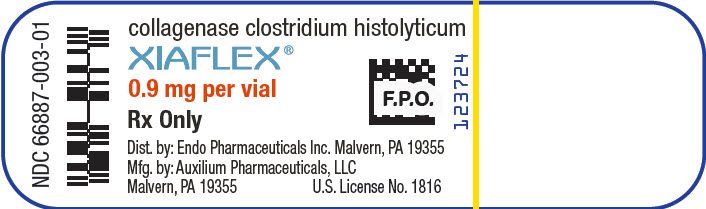
XIAFLEX collagenase clostridium histolyticum Kit
🆔 Identity & classification
Where does this data come from?
🏷️ RxNorm drug class
This medicine belongs to the Collagen-specific Enzyme class.
Where does this data come from?
🏭 Manufacturer & labeler
Where does this data come from?
🩺 Clinical
Collagenase Clostridium histolyticum injection (Xiaflex) is used to treat Dupuytren's contracture (a painless thickening and tightening of tissue [cord] beneath the skin in the palm of the hand, which may make it difficult to straighten one or more fingers) when a cord of tissue can be felt upon examination. Collagenase Clostridium histolyticum injection (Xiaflex) is also used to treat Peyronie's disease (a thickening of tissue [plaque] inside the penis that causes the penis to curve). Collagenase Clostridium histolyticum injection (QWO) is also used to treat cellulite (fat deposit beneath th...
Read the full MedlinePlus article ↗Patient education
Supplement & herbal interactions
Where does this data come from?
Ask a licensed pharmacist directly — free, answered by our team.
🧪 Inactive Ingredients / Excipients
Inactive ingredients, also called excipients, are components of the drug product other than the active ingredient. They may include fillers, dyes, coatings, preservatives, flavors, or other formulation ingredients.
Where does this data come from?
IACT rows and label-wide narrative are kept separate; availability and product-level specificity depend on the submitted label.Inactive ingredient FAQ
Are inactive ingredients the same for every manufacturer?
Why might an inactive ingredient be missing?
Can inactive ingredients matter?
💲 Pricing
A drug doesn't have one price. Each row is a different public payment system, and none is what you'd pay at the counter — that depends on your insurance. The ⓘ on each row explains what it measures.
| Price system | Per each | Per package |
|---|---|---|
| Retail pharmacies payNADAC · weekly | Not in the retail survey — common for institutional, discontinued, or low-volume packs. | |
| Medicaid paysCMS SDUD · 12 mo | $6,303.96 | — |
| Medicare drug plans payPart D · quarterly | No Part D plan price is available for this NDC in our data. | |
| Medicare Part B allowsASP · J0775 | $78.299 / J0775 unit | — |
Where does this data come from?
🧾 Billing & reimbursement
Where does this data come from?
🔁 Therapeutic equivalents
| Product | Labeler | Pack | NADAC/unit | TE | Status | Price vs. this |
|---|---|---|---|---|---|---|
| Xiaflexthis 66887-0003-01 | Endo | 1 kit | — | — | FDA listed | — |
Where does this data come from?
⏳ Availability & biosimilar status
Biologics have no small-molecule generics; biosimilar competition is tracked in the FDA Purple Book.
Where does this data come from?
🗺️ Medicaid utilization & spend
💊 Medicaid utilization by pack size
📊 Medicare Part D spend CMS · PART D · 2026 (Q1)
🔬 Reported adverse events (FAERS)
Top reported reactions
Age at onset
Reporter sex
Serious outcomes
Where does this data come from?
📦 Packaging — all sizes for this product
| Package NDC | Description | Marketing start | Status |
|---|---|---|---|
| 66887-0003-01 You're viewing this | 1 KIT in 1 CARTON (66887-003-01) * 1 INJECTION, POWDER, LYOPHILIZED, FOR SOLUTION in 1 VIAL * 3 mL in 1 VIAL | 2010-02-22 | Active |
| 66887-0003-02 | 2 CARTON in 1 CARTON (66887-003-02) / 1 KIT in 1 CARTON * 1 INJECTION, POWDER, LYOPHILIZED, FOR SOLUTION in 1 VIAL * 3 mL in 1 VIAL | 2010-02-22 | Active |
In Medicaid, this is the most-dispensed pack of this product — about 100% of fills over the last four reported quarters. See all packs ↓
Pack size FAQ
What quantity is in NDC 66887-0003-01?
What NDC number is used to bill for this package of XIAFLEX collagenase clostridium histolyticum Kit?
🧭 About this NDC listing & data coverage
Kit / multi-component package
This NDC identifies a kit — a package containing more than one component. Structured data (pricing, ingredients, equivalents) is often reported per component rather than for the kit NDC itself, which can make this page look thinner than the components' own pages.
What data is (and isn’t) available for this NDC — tap to expand
| NDC identity (package / product / labeler codes) | ✓ Available |
| Labeler | ✓ Available |
| Product & package description | ✓ Available |
| Marketing category & status | ✓ Available |
| Active ingredient / dosage form / route | ✓ Available |
| FDA label (SPL via DailyMed) | ✓ Available |
| Package photos | ✓ Available |
| Inactive ingredients (structured) | — Not published for this NDC The labeler did not submit a structured excipient list, or no SPL is available. |
| NADAC pharmacy acquisition price (CMS) | — Not published for this NDC CMS publishes NADAC only for NDCs reported in its retail-pharmacy survey. |
| Orange Book / therapeutic-equivalence data | — Not published for this NDC Applies only to products approved under an NDA/ANDA; many listings are out of scope. |
| HCPCS J-code billing crosswalk | ✓ Available |
| Medicaid utilization (CMS SDUD) | ✓ Available |
Questions about this listing
Why is there no price listed?
Is the NDC printed on the package the same as the 11-digit billing NDC?
What do the three segments of this NDC mean?
Is this package still being marketed?
Does this product come in other package sizes?
Who lists this product with the FDA?
Do I need a prescription for this product?
Does this product have a billing J-code?
Where does this data come from?
📄 Full prescribing information FDA SPL
🚨 Boxed Warning ▾
WARNING: CORPORAL RUPTURE (PENILE FRACTURE) OR OTHER SERIOUS PENILE INJURY IN THE TREATMENT OF PEYRONIE’S DISEASE Corporal rupture (penile fracture) was reported as an adverse reaction in 5 of 1044 (0.5%) XIAFLEX-treated patients in clinical studies. In other XIAFLEX-treated patients (9 of 1044; 0.9%), a combination of penile ecchymoses or hematoma, sudden penile detumescence, and/or a penile “popping” sound or sensation was reported, and in these cases, a diagnosis of corporal rupture cannot be excluded. Severe penile hematoma was also reported as an adverse reaction in 39 of 1044 (3.7%) XIAFLEX-treated patients [see Warnings and Precautions (5.2)] .
Signs or symptoms that may reflect serious penile injury should be promptly evaluated to assess for corporal rupture or severe penile hematoma which may require surgical intervention [see Warnings and Precautions (5.2)] . Because of the risks of corporal rupture or other serious penile injury, XIAFLEX is available for the treatment of Peyronie’s disease only through a restricted program under a Risk Evaluation and Mitigation Strategy (REMS) called the XIAFLEX REMS Program [see Warnings and Precautions (5.3)] . WARNING: CORPORAL RUPTURE (PENILE FRACTURE) OR OTHER SERIOUS PENILE INJURY IN THE TREATMENT OF PEYRONIE’S DISEASE See full prescribing information for complete boxed warning Corporal rupture (penile fracture) was reported as an adverse reaction in 5 of 1044 (0.5%) XIAFLEX-treated patients in clinical studies.
In other XIAFLEX-treated patients (9 of 1044; 0.9%), a diagnosis of corporal rupture cannot be excluded. Severe penile hematoma was also reported as an adverse reaction in 39 of 1044 (3.7%) XIAFLEX-treated patients. ( 5.2 ) XIAFLEX is available for the treatment of Peyronie’s disease only through a restricted program called the XIAFLEX REMS Program.
( 5.3 )
🎯 Indications and Usage ▾
1 INDICATIONS AND USAGE XIAFLEX is indicated for the treatment of adult patients with Dupuytren’s contracture with a palpable cord. XIAFLEX is indicated for the treatment of adult men with Peyronie’s disease with a palpable plaque and curvature deformity of at least 30 degrees at the start of therapy. XIAFLEX is a combination of bacterial collagenases indicated for: The treatment of adult patients with Dupuytren’s contracture with a palpable cord ( 1 ) The treatment of adult men with Peyronie’s disease with a palpable plaque and curvature deformity of at least 30 degrees at the start of therapy ( 1 )
⏱️ Dosage and Administration ▾
2 DOSAGE AND ADMINISTRATION Dupuytren’s Contracture ( 2.1 ) XIAFLEX should be administered by a healthcare provider experienced in injection procedures of the hand and in the treatment of Dupuytren’s contracture. Reconstitute XIAFLEX lyophilized powder with only the supplied diluent prior to use. Inject 0.58 mg of XIAFLEX into each palpable Dupuytren’s cord with a contracture of a metacarpophalangeal (MP) joint or a proximal interphalangeal (PIP) joint according to the injection procedure.
Up to two joints in the same hand may be treated during a treatment visit. ( 2.1 ) Approximately 24 to 72 hours following an injection, perform a finger extension procedure if a contracture persists. Injections and finger extension procedures may be administered up to 3 times per cord at approximately 4-week intervals.
Inject up to two cords in the same hand at a treatment visit. If a patient has other cords with contractures, inject those cords at another treatment visit. Peyronie’s Disease ( 2.2 ) XIAFLEX should be administered by a healthcare provider experienced in the treatment of male urological diseases.
Reconstitute XIAFLEX lyophilized powder with only the supplied diluent prior to use. A treatment cycle consists of two XIAFLEX injection procedures and a penile modeling procedure. Induce a penile erection.
A single intracavernosal injection of 10 or 20 mcg of alprostadil may be used for this purpose. With the penis in the erect state, identify and mark the target area in the Peyronie’s plaque to be injected. The penis should be in a flaccid state before injecting XIAFLEX.
Inject 0.58 mg XIAFLEX into the target plaque once on each of 2 days, 1 to 3 days apart, according to the injection procedure. Perform a penile modeling procedure 1 to 3 days after the second injection of each treatment cycle. For each plaque causing the curvature deformity, up to 4 treatment cycles may be administered.
Each treatment cycle may be repeated at approximately 6-week intervals. If the curvature deformity is less than 15 degrees after the first, second or third treatment cycle, or if further treatment is not clinically indicated, then subsequent treatment cycles should not be administered.
2.1Dosage and Administration for Dupuytren’s Contracture Dosing Overview for Dupuytren’s Contracture XIAFLEX should be administered by a healthcare provider experienced in injection procedures of the hand and in the treatment of patients with Dupuytren’s contracture. XIAFLEX, supplied as a lyophilized powder, must be reconstituted with the provided diluent prior to use [see Dosage and Administration (2.1)] . The dose of XIAFLEX is 0.58 mg per injection into a palpable cord with a contracture of a metacarpophalangeal (MP) joint or a proximal interphalangeal (PIP) joint [see Dosage and Administration (2.1)] .
Each vial of XIAFLEX and sterile diluent should only be used for a single injection. If two joints on the same hand are to be treated during a treatment visit, separate vials and syringes should be used for each reconstitution and injection. Table 1 displays an overview of the volumes of sterile diluent for reconstitution and the reconstituted XIAFLEX solution to be used in the intralesional injection [see Dosage and Administration (2.1)] .
Approximately 24 to 72 hours after injection, perform a finger extension procedure if a contracture persists to facilitate cord disruption [see Dosage and Administration (2.1)] . Table 1. Volumes Needed for Reconstitution and Administration for Dupuytren’s Contracture For cords affecting MP joints For cords affecting PIP joints 1 The reconstituted XIAFLEX solution to be used in the intralesional injection contains 0.58 mg of XIAFLEX.
Note: The entire reconstituted XIAFLEX solution contains 0.9 mg of XIAFLEX. Reconstituted XIAFLEX solution remaining in the vial after the injection should be discarded. Sterile Diluent for Reconstitution Volume 0.39 mL 0.31 mL Reconstituted XIAFLEX Solution to be Injected 1 Volume 0.25 mL 0.20 mL F…
💊 Dosage Forms and Strengths ▾
3 DOSAGE FORMS AND STRENGTHS XIAFLEX is supplied in single-use glass vials containing 0.9 mg of collagenase clostridium histolyticum as a sterile, lyophilized powder for reconstitution. Sterile diluent for reconstitution is provided in the package in a single-use glass vial containing 3 mL of 0.3 mg/mL calcium chloride dihydrate in 0.9% sodium chloride. Single-use glass vials containing 0.9 mg of collagenase clostridium histolyticum as a sterile, lyophilized powder for reconstitution.
Sterile diluent for reconstitution is also provided in a single-use glass vial. ( 3 )
⛔ Contraindications ▾
4 CONTRAINDICATIONS XIAFLEX is contraindicated in: the treatment of Peyronie’s plaques that involve the penile urethra due to potential risk to this structure. patients with a history of hypersensitivity to XIAFLEX or to collagenase used in any other therapeutic application or application method [see Warnings and Precautions (5.4)] . Peyronie’s plaques that involve the penile urethra ( 4 ) History of hypersensitivity to XIAFLEX or to collagenase used in other therapeutic applications ( 4 )
⚠️ Warnings and Cautions ▾
5 WARNINGS AND PRECAUTIONS Tendon rupture or serious injury to the injected finger/hand: Avoid injecting XIAFLEX into tendons, nerves, blood vessels, or other collagen-containing structure of the hand. Injection into these structures may result in possible permanent injury, such as tendon rupture, ligament damage, or skin laceration. ( 5.1 ) Corporal rupture (penile fracture) or other serious injury to the penis: Avoid injecting into the urethra, nerves, blood vessels, corpora cavernosa or other collagen-containing structures of the penis.
Injection into these structures may result in possible permanent injury such as corporal rupture (penile fracture). ( 5.2 ) Hypersensitivity reactions, including anaphylaxis: Healthcare providers should be prepared to address hypersensitivity reactions, including anaphylaxis, following XIAFLEX injections. ( 5.4 ) Patients with abnormal coagulation: Use with caution, including in patients who have received anticoagulant medications other than low-dose aspirin within 7 days of the injection.
( 5.5 ) Acute post-injection back pain reactions: Observe patients and provide palliative support as needed. Administer the smallest number of treatment cycles necessary to treat the patient’s curvature deformity ( 5.6 , 6.4 ) Syncope and presyncope: Make patients aware that post-injection pain can trigger syncope and presyncope. If presyncope occurs, patients should remain recumbent until symptoms resolve.
( 5.7 , 6.4 )
5.1Tendon Rupture or Other Serious Injury to the Injected Finger/Hand in the Treatment of Dupuytren’s Contracture In the controlled and uncontrolled portions of clinical trials in Dupuytren’s contracture, flexor tendon ruptures occurred after XIAFLEX injection [see Adverse Reactions (6.1)] . Injection of XIAFLEX into collagen-containing structures such as tendons or ligaments of the hand may result in damage to those structures and possible permanent injury such as tendon rupture or ligament damage. Therefore, XIAFLEX should be injected only into the collagen cord with a MP or PIP joint contracture, and care should be taken to avoid injecting into tendons, nerves, blood vessels, or other collagen-containing structures of the hand.
When injecting a cord affecting a PIP joint of the fifth finger, the needle insertion should not be more than 2 to 3 mm in depth and avoid injecting more than 4 mm distal to the palmar digital crease [see Dosage and Administration (2.1)] . Other XIAFLEX-associated serious local adverse reactions included pulley rupture, ligament injury, complex regional pain syndrome (CRPS), sensory abnormality of the hand, and skin laceration (tear). In a historically controlled post-marketing trial, the incidence of skin laceration (22%) was higher for subjects treated with two concurrent injections of XIAFLEX compared with subjects treated with up to three single injections in the placebo-controlled premarketing trials (9%).
Postmarketing cases of skin laceration requiring skin graft after finger extension procedures and local skin and soft-tissue necrosis, some requiring skin grafting or, other surgical interventions including finger amputation have been reported. Signs or symptoms that may reflect serious injury to the injected finger/hand should be promptly evaluated because surgical intervention may be required.
5.2Corporal Rupture (Penile Fracture) or Other Serious Injury to the Penis in the Treatment of Peyronie’s Disease Corporal rupture was reported as an adverse reaction after XIAFLEX injections in 5 of 1044 (0.5%) XIAFLEX-treated patients in the controlled and uncontrolled clinical trials in Peyronie’s disease. In other XIAFLEX-treated patients (9 of 1044; 0.9%), a combination of penile ecchymoses or hematoma, sudden penile detumescence, and/or a penile “popping” sound or sensation was reported, and in these cases, a diagnosis of corporal rupture cannot be excluded.
These patients were managed without surgical intervention, but the long-term consequences are unknow…
🤒 Adverse Reactions ▾
6 ADVERSE REACTIONS The following serious adverse reactions in patients with Dupuytren’s contracture are discussed in greater detail elsewhere in the labeling: Tendon ruptures or other serious injury to the injected extremity [see Warnings and Precautions (5.1)] The following serious adverse reactions in patients with Peyronie’s disease are discussed in greater detail elsewhere in the labeling: Corporal rupture (penile fracture) and severe penile hematoma [see Warnings and Precautions (5.2)] In other XIAFLEX-treated patients, a combination of penile ecchymoses or hematoma, sudden penile detumescence, and/or a penile “popping” sound or sensation was reported, and in these cases, a diagnosis of corporal rupture cannot be excluded [see Warnings and Precautions (5.2)] Dupuytren’s Contracture ( 6.1 ) The most common adverse reactions reported in ≥ 25% of patients treated with XIAFLEX and at an incidence greater than placebo were edema peripheral (e.g., swelling of the injected hand), contusion, injection site hemorrhage, injection site reaction, and pain in the injected extremity.
Peyronie’s Disease ( 6.2 ) The most frequently reported adverse drug reactions reported with ≥ 25% of patients treated with XIAFLEX and at an incidence greater than placebo were penile hematoma, penile swelling and penile pain. To report SUSPECTED ADVERSE REACTIONS, contact Endo at 1-800-462-3636 or FDA at 1-800-FDA-1088 or www.fda.gov/medwatch.
6.1Clinical Studies Experience in Patients with Dupuytren’s Contracture Because clinical studies are conducted under widely varying conditions, adverse reaction rates observed in the clinical studies of a drug cannot be directly compared to rates in the clinical studies of another drug and may not reflect the rates observed in practice. Out of 1082 patients who received 0.58 mg of XIAFLEX in the controlled and uncontrolled portions of the XIAFLEX studies (2630 XIAFLEX injections), 3 (0.3%) patients had a flexor tendon rupture of the treated finger within 7 days of the injection.
The data described below are based on two pooled randomized, double-blind, placebo-controlled trials through Day 90 in patients with Dupuytren’s contracture (Studies 1 and 2). In these trials, patients were treated with up to 3 injections of 0.58 mg of XIAFLEX or placebo with approximately 4-week intervals between injections and the patients had finger extension procedures the day after injection, if needed, to facilitate disruption of the cord [see Clinical Studies (14)] . These trials were comprised of 374 patients of whom 249 and 125 received 0.58 mg of XIAFLEX and placebo, respectively.
The mean age was 63 years, 80% were male and 20% were female, and 100% were white. In the placebo-controlled portions of Studies 1 and 2 through Day 90, 98% and 51% of XIAFLEX-treated and placebo-treated patients had an adverse reaction after up to 3 injections, respectively. Over 95% of XIAFLEX-treated patients had an adverse reaction of the injected extremity after up to 3 injections.
Approximately 81% of these local reactions resolved without intervention within 4 weeks of XIAFLEX injections. The adverse reaction profile was similar for each injection, regardless of the number of injections administered. However, the incidence of pruritus increased with more injections [see Warnings and Precautions (5.4)].
The most frequently reported adverse drug reactions (≥ 25%) in the XIAFLEX clinical trials in patients with Dupuytren’s contracture included edema peripheral (mostly swelling of the injected hand), contusion, injection site hemorrhage, injection site reaction, and pain in the treated extremity. Table 3 shows the incidence of adverse reactions that were reported in greater than or equal to 5% of XIAFLEX-treated patients and at a frequency greater than placebo-treated patients after up to 3 injections in the pooled placebo-controlled trials through Day 90 (Studies 1 and 2).
Table 3. Adverse Reactions Occurring in ≥ 5% of XIAFLEX-Treated Patients wit…
🔄 Drug Interactions ▾
7 DRUG INTERACTIONS Anticoagulant drugs: XIAFLEX should be used with caution in patients receiving concomitant anticoagulants (except for low-dose aspirin) [see Warnings and Precautions (5.5)] .
👥 Use in Specific Populations ▾
8 USE IN SPECIFIC POPULATIONS
8.1Pregnancy Pregnancy Category B There are no adequate and well-controlled studies of XIAFLEX in pregnant women. Because animal reproduction studies are not always predictive of human response, XIAFLEX should be used during pregnancy only if clearly needed. Risk Summary Based on animal data, XIAFLEX is not predicted to increase the risk for major developmental abnormalities in humans.
Human Data Human pharmacokinetic studies showed that XIAFLEX levels were not quantifiable in the systemic circulation following injection into a Dupuytren’s cord. Low levels of XIAFLEX were quantifiable in the plasma of evaluable male subjects for up to 30 minutes following administration of XIAFLEX into the penile plaque of subjects with Peyronie’s disease [see Clinical Pharmacology (12.3)]. Almost all patients develop anti-product antibodies (anti-AUX-I and anti-AUX-II) after treatment with XIAFLEX, and the clinical significance of anti-product antibody formation on a developing fetus is not known [see Adverse Reactions (6)].
Animal Data Reproduction studies have been performed in rats with intravenous exposures up to approximately 11 times the maximum recommended human dose (MRHD) of XIAFLEX on a mg/m 2 basis, and have revealed no evidence of impaired fertility or harm to the fetus due to collagenase clostridium histolyticum.
8.3Nursing Mothers It is not known whether collagenase clostridium histolyticum is excreted in human milk. Because many drugs are excreted in human milk, caution should be exercised when XIAFLEX is administered to a nursing woman.
8.4Pediatric Use The safety and effectiveness of XIAFLEX in pediatric patients less than 18 years old have not been established.
8.5Geriatric Use Of the 249 XIAFLEX-treated patients in the double-blind, placebo-controlled, clinical trials in Dupuytren’s contracture (Studies 1 and 2), 104 (42%) were 65 years of age or older and 9% were 75 years of age or older. Of the 551 XIAFLEX-treated patients in the double-blind, placebo-controlled, clinical trials in Peyronie’s disease (Studies 1 and 2), 100 (18%) were 65 years of age or older and 5 (0.9 %) were 75 years of age or older. No overall differences in safety or effectiveness of XIAFLEX were observed between these patients and younger patients.
🤰 Pregnancy ▾
8.1Pregnancy Pregnancy Category B There are no adequate and well-controlled studies of XIAFLEX in pregnant women. Because animal reproduction studies are not always predictive of human response, XIAFLEX should be used during pregnancy only if clearly needed. Risk Summary Based on animal data, XIAFLEX is not predicted to increase the risk for major developmental abnormalities in humans.
Human Data Human pharmacokinetic studies showed that XIAFLEX levels were not quantifiable in the systemic circulation following injection into a Dupuytren’s cord. Low levels of XIAFLEX were quantifiable in the plasma of evaluable male subjects for up to 30 minutes following administration of XIAFLEX into the penile plaque of subjects with Peyronie’s disease [see Clinical Pharmacology (12.3)]. Almost all patients develop anti-product antibodies (anti-AUX-I and anti-AUX-II) after treatment with XIAFLEX, and the clinical significance of anti-product antibody formation on a developing fetus is not known [see Adverse Reactions (6)].
Animal Data Reproduction studies have been performed in rats with intravenous exposures up to approximately 11 times the maximum recommended human dose (MRHD) of XIAFLEX on a mg/m 2 basis, and have revealed no evidence of impaired fertility or harm to the fetus due to collagenase clostridium histolyticum.
🧒 Pediatric Use ▾
8.4Pediatric Use The safety and effectiveness of XIAFLEX in pediatric patients less than 18 years old have not been established.
🧓 Geriatric Use ▾
8.5Geriatric Use Of the 249 XIAFLEX-treated patients in the double-blind, placebo-controlled, clinical trials in Dupuytren’s contracture (Studies 1 and 2), 104 (42%) were 65 years of age or older and 9% were 75 years of age or older. Of the 551 XIAFLEX-treated patients in the double-blind, placebo-controlled, clinical trials in Peyronie’s disease (Studies 1 and 2), 100 (18%) were 65 years of age or older and 5 (0.9 %) were 75 years of age or older. No overall differences in safety or effectiveness of XIAFLEX were observed between these patients and younger patients.
🆘 Overdosage ▾
10 OVERDOSAGE The effects of overdose of XIAFLEX are unknown. It is possible that multiple simultaneous or excessive doses of XIAFLEX may cause more severe local effects than the recommended doses including serious adverse reactions in the injected area (e.g., tendon ruptures or corporal ruptures dependent on the injection site). Supportive care and symptomatic treatment are recommended in these circumstances.
🧬 Clinical Pharmacology ▾
12 CLINICAL PHARMACOLOGY
12.1Mechanism of Action Collagenases are proteinases that hydrolyze collagen in its native triple helical conformation under physiological conditions, resulting in lysis of collagen deposits. Injection of XIAFLEX into a Dupuytren’s cord, which is comprised mostly of collagen, may result in enzymatic disruption of the cord. The signs and symptoms of Peyronie’s disease are caused by a collagen plaque.
Injection of XIAFLEX into a Peyronie’s plaque, which is comprised mostly of collagen, may result in enzymatic disruption of the plaque. Following this disruption of the plaque, penile curvature deformity and patient bother caused by Peyronie’s disease are reduced [see Clinical Studies (14.2)]. Results of in vitro studies, including those of explant tissues containing Peyronie’s plaques, suggest that XIAFLEX disrupts the predominant collagen found in plaques (Types I and III).
At higher doses and longer incubation times, non-fibrillar Type IV collagen was affected causing collagen lysis in small veins, but did not cause structural damage to arteries, nerves or large veins which contain Type IV collagen in in vitro or in vivo studies. Results of in vitro studies suggest that the collagenases (AUX-I and AUX-II) worked synergistically to provide hydrolyzing activity towards collagen. However, there are no clinical data regarding the relative contributions of the individual collagenases (AUX-I or AUX-II) to the efficacy of XIAFLEX in the treatment of Dupuytren’s contracture or Peyronie’s disease.
Collagen fragments generated from clostridial collagenase have been shown to generate increased vascular permeability, inflammatory responses, and regenerative changes. However, the effects of the formation of the collagen fragments derived from the collagen plaque are unknown.
12.3Pharmacokinetics Following administration of either a single injection of XIAFLEX 0.58 mg into a Dupuytren’s cord in 20 patients or two concurrent injections of XIAFLEX 0.58 mg into Dupuytren’s cords of 12 patients, no quantifiable levels of XIAFLEX (AUX-I or AUX-II) were detected in plasma up to 30 days post injection. Following each of two intralesional administrations, separated by 24 hours, of XIAFLEX 0.58 mg into the penile plaque of 19 subjects with Peyronie’s disease, plasma levels of AUX-I and AUX-II in subjects with quantifiable levels (79% and 40% for AUX-I and AUX-II, respectively) were minimal and short-lived.
The maximal plasma concentrations of AUX-I and AUX-II were <29 ng/mL and <71 ng/mL, respectively, and were observed approximately within 10 minutes after injection. All plasma levels were below the limits of quantification within 30 minutes following dosing. There was no evidence of accumulation following two sequential injections of XIAFLEX administered 24 hours apart.
No subject had quantifiable plasma levels 15 minutes after modeling of plaque on Day 3 (i.e., 24 hours after Injection 2 on Day 2).
🧬 Mechanism of Action ▾
12.1Mechanism of Action Collagenases are proteinases that hydrolyze collagen in its native triple helical conformation under physiological conditions, resulting in lysis of collagen deposits. Injection of XIAFLEX into a Dupuytren’s cord, which is comprised mostly of collagen, may result in enzymatic disruption of the cord. The signs and symptoms of Peyronie’s disease are caused by a collagen plaque.
Injection of XIAFLEX into a Peyronie’s plaque, which is comprised mostly of collagen, may result in enzymatic disruption of the plaque. Following this disruption of the plaque, penile curvature deformity and patient bother caused by Peyronie’s disease are reduced [see Clinical Studies (14.2)]. Results of in vitro studies, including those of explant tissues containing Peyronie’s plaques, suggest that XIAFLEX disrupts the predominant collagen found in plaques (Types I and III).
At higher doses and longer incubation times, non-fibrillar Type IV collagen was affected causing collagen lysis in small veins, but did not cause structural damage to arteries, nerves or large veins which contain Type IV collagen in in vitro or in vivo studies. Results of in vitro studies suggest that the collagenases (AUX-I and AUX-II) worked synergistically to provide hydrolyzing activity towards collagen. However, there are no clinical data regarding the relative contributions of the individual collagenases (AUX-I or AUX-II) to the efficacy of XIAFLEX in the treatment of Dupuytren’s contracture or Peyronie’s disease.
Collagen fragments generated from clostridial collagenase have been shown to generate increased vascular permeability, inflammatory responses, and regenerative changes. However, the effects of the formation of the collagen fragments derived from the collagen plaque are unknown.
📦 How Supplied / Storage and Handling ▾
16 HOW SUPPLIED/STORAGE AND HANDLING XIAFLEX is available in single-use, glass vials containing 0.9 mg of collagenase clostridium histolyticum as a sterile, lyophilized powder. Sterile diluent for reconstitution is available in single-use, glass vials containing 3 mL of 0.3 mg/mL calcium chloride dihydrate in 0.9% sodium chloride. NDC Number Package Size 66887-003-01 Single-use package: 1 carton containing a single-use vial of XIAFLEX and a single-use vial of sterile diluent 66887-003-02 Dual-Pack (2 single-use packages): 1 box containing 2 cartons, each containing a single-use vial of XIAFLEX and a single-use vial of sterile diluent Storage and Stability Prior to reconstitution, the vials of XIAFLEX and diluent should be stored in a refrigerator at 2°C to 8°C (36°F to 46°F). [ see Dosage and Administration (2.1 , 2.2 )] .
Do not freeze. The reconstituted XIAFLEX solution can be kept at room temperature (20°C to 25°C/68°F to 77°F) for up to 1 hour or refrigerated at 2°C to 8°C (36°F to 46°F) for up to 4 hours prior to administration [ see Dosage and Administration (2.1 , 2.2 )] .
📦 Storage and Handling ▾
Storage and Stability Prior to reconstitution, the vials of XIAFLEX and diluent should be stored in a refrigerator at 2°C to 8°C (36°F to 46°F). [ see Dosage and Administration (2.1 , 2.2 )] . Do not freeze. The reconstituted XIAFLEX solution can be kept at room temperature (20°C to 25°C/68°F to 77°F) for up to 1 hour or refrigerated at 2°C to 8°C (36°F to 46°F) for up to 4 hours prior to administration [ see Dosage and Administration (2.1 , 2.2 )] .
📋 Description ▾
11 DESCRIPTION XIAFLEX contains purified collagenase clostridium histolyticum, consisting of two microbial collagenases in a defined mass ratio, Collagenase AUX-I and Collagenase AUX-II, which are isolated and purified from the fermentation of Clostridium histolyticum bacteria. Collagenase AUX-I is a single polypeptide chain consisting of approximately 1000 amino acids of known sequence. It has an observed molecular weight of 114 kiloDaltons (kDa).
It belongs to the class I Clostridium histolyticum collagenases. Collagenase AUX-II is a single polypeptide chain consisting of approximately 1000 amino acids of deduced sequence. It has an observed molecular weight of 113 kDa.
It belongs to the class II Clostridium histolyticum collagenases. XIAFLEX is supplied as a sterile lyophilized powder (white cake) intended for reconstitution with the supplied sterile diluent (0.3 mg/mL calcium chloride dihydrate in 0.9% sodium chloride) prior to intralesional injection into a Dupuytren’s cord or a Peyronie’s plaque. XIAFLEX is available in single-use, glass vials containing 0.9 mg of collagenase clostridium histolyticum.
Each vial also contains 0.5 mg of hydrochloric acid, 18.5 mg of sucrose, and 1.1 mg of tromethamine.
💬 Information for Patients ▾
17 PATIENT COUNSELING INFORMATION See FDA-approved patient labeling ( Medication Guide ).
17.1Patient Counseling for Dupuytren’s Contracture Advise patients of the following: Serious complications of XIAFLEX injection include tendon rupture, serious ligament damage, or skin laceration that may result in the inability to fully bend the finger and may require surgery to correct the complication. XIAFLEX injection is likely to result in swelling, bruising, bleeding, and/or pain of the injected site and surrounding tissue. After the XIAFLEX injections, instruct patients: Not to flex or extend the fingers of the injected hand to reduce extravasation of XIAFLEX out of the cord(s).
Not to attempt to disrupt the injected cord(s) by self-manipulation. To elevate the injected hand until bedtime. To promptly contact their physician if there is evidence of infection (e.g., fever, chills, increasing redness or edema), sensory changes in the treated finger(s), trouble bending the finger(s) after the swelling goes down (symptoms of tendon rupture), or skin laceration.
To return to their healthcare provider’s office 1 to 3 days after the injection visit for an examination of the injected hand and for possible finger extension procedure(s) to disrupt the cord. Following the finger extension procedure(s) and fitting patient with a splint, instruct patients: Not to perform strenuous activity with the injected hand until advised to do so. To wear the splint at bedtime for up to 4 months.
To perform a series of finger flexion and extension exercises each day.
17.2Patient Counseling for Peyronie’s Disease Advise patients of the following: Serious complications of XIAFLEX injection include corporal rupture, penile hematoma and skin and soft tissue necrosis related to penile hematoma, and these events may require surgery to correct the complication. Acute post-injection back pain reactions have been reported in patients treated with XIAFLEX. Back pain may be mild to severe and may radiate to the legs, chest and arms, may include spasms, and may make walking difficult.
Events typically resolve within 15 minutes but may last longer. Patients should report post-injection back pain reactions to their healthcare provider. After the XIAFLEX injections, instruct the patient: That their penis may appear bruised and/or swollen That they may have mild-to-moderate penile pain that can be relieved by taking over-the-counter pain medications To promptly contact their physician if, at any time, they have severe pain or severe swelling of the penis, severe purple bruising and swelling of the penis, difficulty urinating or blood in the urine, or sudden loss of the ability to maintain an erection.
These symptoms may be accompanied by a popping or cracking sound from the penis To return to their healthcare provider’s office when directed for further injection(s) and/or penile modeling procedure(s) To not have sex between the first and second injections of a treatment cycle To wait 4 weeks after the second injection of a treatment cycle before resuming sexual activity, provided pain and swelling have subsided To perform gentle, at home modeling activities, as recommended by their physician To refrain from using a vacuum erection device during treatment with XIAFLEX To avoid abdominal straining associated with situations, such as straining during bowel movements Provide the patient instructions on the appropriate technique to perform penile modeling activities at home, as described in “What You Need to Know About XIAFLEX Treatment for Peyronie's Disease: A Patient Guide” , and give the patient a copy.
Manufactured by: Endo Biologics Limited Dublin, Ireland D15 TX2V US License No. 1816 US Patent Nos. 7,811,560; RE39,941; and 6,022,539 © 2026 Keenova Therapeutics, plc or one of its affiliates.
💬 Medication Guide ▾
Medication Guide XIAFLEX ® (Zī a flex) (collagenase clostridium histolyticum) For injection, for intralesional use XIAFLEX is approved for two uses: Dupuytren's contracture and Peyronie's disease. Information is provided separately for each use. Use for treating Dupuytren's contracture is described first, followed by use for treating Peyronie's disease.
Read this Medication Guide before you receive XIAFLEX for the treatment of Dupuytren’s contracture and each time you get an injection. There may be new information. This Medication Guide does not take the place of talking with your healthcare provider about your medical condition or treatment.
What is the most important information I should know about XIAFLEX for the treatment of Dupuytren’s contracture? XIAFLEX may cause serious side effects, including: Tendon rupture or ligament damage. Receiving an injection of XIAFLEX may cause damage to a tendon or ligament in your hand and cause it to break or weaken.
This could require surgery to fix the damaged tendon or ligament. Call your healthcare provider right away if you have trouble bending your injected finger (towards the wrist) after the swelling goes down or you have problems using your treated hand after your follow-up visit. Nerve injury or other serious injury of the hand.
After finger procedures, some people developed tears in the skin (lacerations), and local skin and soft-tissue necrosis (death of skin cells). Some lacerations and necrosis required skin grafting, or other surgery including amputation. Call your healthcare provider right away if you get numbness, tingling, increased pain, or tears in the skin (laceration) in your treated finger or hand after your injection or after your follow-up visit.
Hypersensitivity reactions, including anaphylaxis. Severe allergic reactions can happen in people who receive XIAFLEX, because it contains foreign proteins. Call your healthcare provider right away if you have any of these symptoms of an allergic reaction after an injection of XIAFLEX: hives chest pain swollen face low blood pressure breathing trouble dizziness or fainting 4.
Fainting: Fainting or near fainting can happen in people who receive XIAFLEX, especially following finger procedures. If you have dizziness or feel faint after receiving XIAFLEX, lie down until the symptoms go away. What is XIAFLEX?
XIAFLEX is a prescription medicine used to treat adults with Dupuytren’s contracture when a “cord” can be felt. It is not known if XIAFLEX is safe and effective in children under the age of 18. Who should not receive XIAFLEX?
Do not receive XIAFLEX if you: are allergic to collagenase clostridium histolyticum, or any of the ingredients in XIAFLEX, or to any other collagenase product. See the end of this Medication Guide for a complete list of ingredients in XIAFLEX. Talk to your healthcare provider before receiving this medicine if you have any of these conditions.
What should I tell my healthcare provider before receiving XIAFLEX? Before receiving XIAFLEX, tell your healthcare provider if you: have had an allergic reaction to a XIAFLEX injection in the past have a bleeding problem have received XIAFLEX to treat another condition have any other medical conditions are pregnant or plan to become pregnant. It is not known if XIAFLEX will harm your unborn baby. are breastfeeding or plan to breastfeed.
It is not known if XIAFLEX passes into your breast milk. Talk to your healthcare provider about the best way to feed your baby if you receive XIAFLEX. Tell your healthcare provider about all the medicines you take, including prescription and over-the-counter medicines, vitamins, and herbal supplements.
Using XIAFLEX with certain other medicines can cause serious side effects. Especially tell your healthcare provider if you take: medicines to thin your blood (anticoagulants). If you are told to stop taking a blood thinner before your XIAFLEX injection, your healthcare provider should tell you when to restart the blood thinner.
As…