
Levulan Kerastick aminolevulinic acid hydrochloride Kit — NDC 67308-101-06 (Billing 67308-0101-06)
This is a package of Levulan Kerastick aminolevulinic acid hydrochloride Kit from Sun Pharmaceutical Industries, Inc, marketed since Sep 2000 and currently FDA-listed.
NDC database record
One package, one record: these facts belong to NDC 67308-101-06 alone.
- Record
- FDA NDC Directory package listing · Human prescription drug
- Code segments
- 67308 labeler · 101 product · 06 package
- Package marketed since
- Sep 24, 2000
- Sample package
- No — commercial package
- Listing certified through
- Dec 31, 2026
- Barcode (UPC-A, from the NDC)
- 3 6730810106 9
- Medicaid fills, this package
- 495 prescriptions in the last four reported quarters
- FDA record last changed
- Jul 24, 2026
Identity & classification
Regulatory identifiers FDA, NLM and CMS codes for this package
Drug-database identifiers Medi-Span GPI and First Databank GCN / HICL / AHFS classification
- GSN (GCN sequence number): 047723
- GCN: 12698
- GPI-14 (Medi-Span): 90375015102120
- HICL (First Databank): 021920
- AHFS class code: 84:18.00.00
- RxCUI (RxNorm): 762672
Where does this data come from?
- FDA openFDA NDC Directory · synced Oct 8, 2026
- FDA label on DailyMed · label index refreshed Oct 8, 2026
- RxNorm (NLM RxNav) · catalog refreshed Oct 1, 2026
- Medi-Span GPI (licensed)
- First Databank (licensed) · refreshed Oct 8, 2026
Clinical
Aminolevulinic acid is used with light therapy to treat actinic keratoses (small crusty or scaly patches of skin formed by exposure to sunlight; can turn into cancer if not treated) of the face,scalp, or upper arms. Aminolevulinic acid is in a class of medications called photosensitizing agents. Photosensitizing agents combined with light therapy is called phytodynamic therapy (PDT). The light activates the drug which then kills abnormal cells.
Read the full MedlinePlus article ↗Patient education
Supplement & herbal interactions
Some supplements/herbs that may interact with Aminolevulinic Acid Hydrochloride — tap one for details:
Where does this data come from?
- MedlinePlus (NLM) · refreshed Oct 8, 2026
- FDA label on DailyMed · label index refreshed Oct 8, 2026
Ask a licensed pharmacist directly — free, answered by our team.
Pricing
A drug doesn't have one price. Each row is a different public payment system, and none is what you'd pay at the counter — that depends on your insurance. The ⓘ on each row explains what it measures.
| Price system | Per each | Per package |
|---|---|---|
| Retail pharmacies payNADAC · weekly | Not in the retail survey — common for institutional, discontinued, or low-volume packs. | |
| Medicaid paysCMS SDUD · 12 mo | $312.05 | — |
| Medicare drug plans payPart D · quarterly | No Part D plan price is available for this NDC in our data. | |
| Medicare Part B allowsASP · J7308 | $389.280 / J7308 unit | — |
Where does this data come from?
- CMS NADAC weekly file
- CMS ASP pricing files · refreshed Sep 20, 2026
- CMS Medicaid State Drug Utilization Data · through Q1 2026
- CMS Part D plan pricing files · refreshed Sep 24, 2026
- VA National Acquisition Center price file
Billing & reimbursement
Where does this data come from?
- CMS ASP NDC-HCPCS crosswalk · refreshed Sep 22, 2026
- DMEPDAC NDC-HCPCS crosswalk
- openFDA NSDE billing units · refreshed Oct 7, 2026
Packaging — all sizes for this product
| Package NDC | Description | Marketing start | Marketing end | Status |
|---|---|---|---|---|
| 67308-0101-01 67308-101-01 Main listing | 1 KIT in 1 APPLICATOR * 1.5 mL in 1 AMPULE * 1.5 mL in 1 AMPULE | 2000-09-04 | — | Active |
| 67308-0101-02 67308-101-02 | 2 APPLICATOR in 1 CARTON / 1 KIT in 1 APPLICATOR * 1.5 mL in 1 AMPULE * 1.5 mL in 1 AMPULE | 2000-12-20 | — | Active |
| 67308-0101-06 You're viewing this | 6 APPLICATOR in 1 CARTON / 1 KIT in 1 APPLICATOR * 1.5 mL in 1 AMPULE * 1.5 mL in 1 AMPULE | 2000-09-24 | — | Active |
This pack accounts for about 46% of this product's recent Medicaid fills; most go to a different pack size. See all packs ↓
Pack size FAQ
What quantity is in this package?
What NDC number is used to bill for this package of Levulan Kerastick aminolevulinic acid hydrochloride Kit?
Therapeutic equivalents
| Product | Labeler | Pack | NADAC/unit | TE | Status | Price vs. this |
|---|---|---|---|---|---|---|
| Levulan Kerastickthis 67308-0101-06 | Sun | 6 applicators | — | — | FDA listed | — |
Where does this data come from?
- FDA openFDA NDC Directory · synced Oct 8, 2026
- FDA Orange Book · refreshed Oct 3, 2026
- CMS NADAC weekly file
Availability & generic status
We did not find an FDA-approved generic match for this exact strength, form and route. Patent/protection dates below may affect future generic timing.
Why the date isn’t exact: Generic timing can change because patents may be challenged, settled, licensed, added, removed, or worked around with a narrower label — and FDA approval does not always mean a pharmacy can get the generic today.
🛈 What do these terms mean?
- Patent
- Legal protection listed in the Orange Book that may delay generic approval or launch. Issued by the U.S. Patent & Trademark Office.
- Substance patent
- Covers the active drug molecule itself — the hardest to design around. A generic generally can’t launch until it expires.
- Formulation (product) patent
- Covers a specific formulation or dosage form. A generic can sometimes work around it with a different formulation.
- Method-of-use patent
- A patent covering one specific approved use of the drug — not necessarily the whole molecule. A generic can sometimes launch with a “skinny label” that carves out the protected use and keeps the others.
- Skinny label
- A generic label that omits a still-patented use when the FDA allows it — letting a generic reach the market for the unprotected uses.
- Exclusivity
- FDA-granted marketing protection, separate from patents — e.g. 5-yr new chemical entity, 7-yr orphan drug, or a +6-month pediatric extension.
- Paragraph IV
- A generic applicant’s formal challenge to a listed patent. It can potentially lead to earlier generic entry, but often involves litigation or a settlement.
- RLD / RS
- Reference Listed Drug — the brand product the FDA uses as the reference for generic applications. Reference Standard — the product the FDA expects generics to compare against in bioequivalence testing.
- TE / AB rating
- FDA therapeutic-equivalence rating. An AB rating generally means the FDA considers a generic therapeutically equivalent to — and substitutable for — the brand.
- LOE (loss of exclusivity)
- The latest patent or exclusivity currently listed — the loss-of-exclusivity / latest-listed-protection date shown on this page. Paragraph-IV challenges and settlements can move the real date earlier; FDA approval and a manufacturer’s decision to market can move it later.
Built from the FDA Orange Book. The bars above are scaled to each protection’s expiry; the red LOE marker is the last one to lapse.
| Patent | Type | Use code | Expires |
|---|---|---|---|
| US 11690914 ↗ | Method of use | U-3163 | Jan 12, 2038 |
| US 11077192 ↗ | Method of use | U-3163 | Jan 12, 2038 |
| US 12290700 ↗ | Method of use | U-804 | Oct 13, 2036 |
| US 11697028 ↗ | Method of use | U-804 | Oct 13, 2036 |
| US 11446512 ↗ | Method of use | U-804 | Jan 17, 2037 |
| US 11179574 ↗ | Method of use | U-804 | Oct 13, 2036 |
| US 12296011 ↗ | Method of use | U-3163 | Jan 12, 2038 |
| US 10357567 ↗ | Method of use | U-3163 | Jan 12, 2038 |
| US 11571478 ↗ | Method of use | U-3163 | Jan 12, 2038 |
| US 11135293 ↗ | Method of use | U-3163 | Jan 12, 2038 |
Is there a generic version of LEVULAN KERASTICK 20%?
The FDA approved a generic — why can’t I get it at my pharmacy yet?
Why do different websites show different generic release dates?
What does “FDA listed” mean?
What does a patent or protection date mean here?
What does “current Orange Book estimate” mean?
Can a generic come out before the last patent expires?
Can a generic come out after the listed dates?
What is the difference between patents and exclusivity?
Why are there multiple patent dates?
Where does this data come from?
- FDA Orange Book · refreshed Oct 3, 2026
Inactive Ingredients / Excipients
Inactive ingredients, also called excipients, are components of the drug product other than the active ingredient. They may include fillers, dyes, coatings, preservatives, flavors, or other formulation ingredients.
Where does this data come from?
IACT rows and label-wide narrative are kept separate; availability and product-level specificity depend on the submitted label.- FDA label on DailyMed · label index refreshed Oct 8, 2026
- FDA openFDA NDC Directory · synced Oct 8, 2026
Inactive ingredient FAQ
Are inactive ingredients the same for every manufacturer?
Why might an inactive ingredient be missing?
Can inactive ingredients matter?
Manufacturer & labeler
Where does this data come from?
- FDA openFDA NDC Directory · synced Oct 8, 2026
- Drugs@FDA
Full prescribing information FDA SPL
🎯 Indications and Usage ▾
1 INDICATIONS AND USAGE The LEVULAN KERASTICK for topical solution plus blue light illumination using the BLU-U Blue Light Photodynamic Therapy Illuminator is indicated for the treatment of minimally to moderately thick actinic keratoses of the face, scalp, or upper extremities. LEVULAN KERASTICK for topical solution, a porphyrin precursor, plus blue light illumination using the BLU-U Blue Light Photodynamic Therapy Illuminator is indicated for photodynamic therapy (treatment) of minimally to moderately thick actinic keratoses of the face or scalp, or actinic keratoses of the upper extremities.
( 1 )
⏱️ Dosage and Administration ▾
2 DOSAGE AND ADMINISTRATION LEVULAN KERASTICK photodynamic therapy is a two-stage process for administration by a health care provider.( 2.1 ) Apply the drug product to the target lesions. ( 2.1 ) Illuminate with blue light using the BLU-U ® Blue Light Photodynamic Therapy Illuminator after the incubation time of( 2.2 ): 14 to 18 hours for scalp or face 3 hours for upper extremities, with occlusion LEVULAN KERASTICK photodynamic therapy may be repeated a second time for lesions that have not completely resolved after 8 weeks ( 2.1 ) For topical use only.
( 2.1) See full prescribing information for complete dosage and administration instruction. ( 2 ) See BLU-U user manual for detailed lamp safety and operating instructions. ( 2.2 )
2.1Preparation and Administration Overview After mixing, the LEVULAN KERASTICK topical solution 20% is intended for direct application to individual lesions diagnosed as actinic keratoses and not to perilesional skin. This product is not intended for application by patients or unqualified medical personnel. Application should involve lesions on the scalp, face or upper extremities; multiple lesions can be treated within a treatment region, but multiple treatment regions should not be treated simultaneously.
The recommended treatment frequency is: one application of the LEVULAN KERASTICK topical solution and one dose of illumination per treatment region per 8-week treatment session. Each individual LEVULAN KERASTICK applicator should be used for only one patient. LEVULAN KERASTICK photodynamic therapy for actinic keratoses is a two-stage process involving application of the LEVULAN KERASTICK topical solution to the target lesions and then illumination with blue light using the BLU-U Blue Light Photodynamic Therapy Illuminator after 3 hours for upper extremity lesions or after 14-18 hours for face or scalp lesions.
TABLE 1 Schedule for LEVULAN KERASTICK Photodynamic Therapy 1 The incubation time is 14-18 hours for actinic keratosis lesions on the face or scalp. 2 The incubation time is 3 hours for actinic keratosis lesions on the upper extremities. LEVULAN KERASTICK topical solution application Time window 1 for Blue Light Illumination for face or scalp Time window 2 for Blue Light Illumination for upper extremities 6 am 8 pm to Midnight 9 am 7 am 9 pm to 1 am 10 am 8 am 10 pm to 2 am 11 am 9 am 11 pm to 3 am 12 Noon 10 am Midnight to 4 am 1 pm 11 am 1 am to 5 am 2 pm 12 pm 2 am to 6 am 3 pm 1 pm 3 am to 7 am 4 pm 2 pm 4 am to 8 am 5 pm 3 pm 5 am to 9 am 6 pm 4 pm 6 am to 10 am 7 pm 5 pm 7 am to 11 am 8 pm 6 pm 8 am to Noon 9 pm 7 pm 9 am to 1 pm 10 pm 8 pm 10 am to 2 pm 11 pm 9 pm 11 am to 3 pm 12 Midnight 10 pm Noon to 4 pm 1 am If for any reason the patient cannot be given BLU-U Blue Light Photodynamic Therapy Illuminator treatment during the prescribed time after applying LEVULAN KERASTICK topical solution, he or she may nonetheless experience sensations of stinging and/or burning if the photosensitized actinic keratoses are exposed to sunlight or prolonged or intense light at that time.
Advise the patient to wear appropriate protective apparel (e.g., wide-brimmed hat, long sleeve shirt, gloves) to shade the treated actinic keratoses from sunlight or other bright light sources until at least 40 hours after the application of LEVULAN KERASTICK topical solution. Advise the patient to reduce light exposure if the sensations of stinging and/or burning are experienced. LEVULAN KERASTICK photodynamic therapy may be repeated a second time for lesions that have not completely resolved 8 weeks after the initial treatment.
2.2Dosage and Administration Instructions Step A - Treatment of Actinic Keratoses with LEVULAN KERASTICK Topical Solution Preparation of Lesions Actinic keratoses targeted for treatment should be clean and dry prior to application of LEVULAN KERASTICK Topical Solution. Preparation of LEVULAN KERASTICK topical solution The LEVULAN KERASTICK applicator consists of a plastic tube containin… [Excerpted — this section continues on DailyMed.]
💊 Dosage Forms and Strengths ▾
3 DOSAGE FORMS AND STRENGTHS For topical solution: 354 mg of aminolevulinic acid hydrochloride as a powder in a plastic applicator device. Upon mixture, LEVULAN KERASTICK is a topical solution containing 20% aminolevulinic acid hydrochloride (ALA HCl) by weight. After mixture, topical solution contains 20% aminolevulinic acid hydrochloride (ALA HCl) by weight in a plastic applicator device. ( 3 )
⛔ Contraindications ▾
4 CONTRAINDICATIONS The LEVULAN KERASTICK for topical solution plus blue light illumination using the BLU-U Blue Light Photodynamic Therapy Illuminator is contraindicated in patients with: Cutaneous photosensitivity at wavelengths of 400-450 nm [see Warnings and Precautions (5.2) ] Porphyria or known allergies to porphyrins [see Warnings and Precautions (5.2) ] Known sensitivity to any of the components of the LEVULAN KERASTICK. Cutaneous photosensitivity at wavelengths of 400-450 nm. ( 4 ) Porphyria or known allergies to porphyrins.
( 4 ) Sensitivity to any of the components of the LEVULAN KERASTICK. ( 4 )
⚠️ Warnings and Cautions ▾
5 WARNINGS AND PRECAUTIONS Transient amnestic episodes have been reported during postmarketing use of LEVULAN KERASTICK in combination with BLU-U Blue Light Photodynamic Therapy Illuminator. Inform patients and their caregivers that LEVULAN KERASTICK in combination with PDT may cause transient amnestic episodes. Advise them to contact the healthcare provider if the patient develops amnesia after treatment.
( 5.1 ) Avoid exposure of the photosensitive actinic keratoses to sunlight or bright indoor light prior to blue light treatment. Protect treated lesions from sunlight exposure. Sunscreens will not protect the patient against photosensitivity reactions.
( 5.2 ) The LEVULAN KERASTICK for topical solution should be used by a qualified health professional. To avoid unintended photosensitivity, LEVULAN KERASTICK topical solution should be applied to no more than 5 mm of perilesional skin surrounding each target actinic keratosis lesion. ( 5.2 ) Irritation may be experienced if this product is applied to eyes or mucous membranes.
Do not apply to the eyes or to mucous membranes. Excessive irritation may be experienced if this product is applied under occlusion longer than 3 hours. ( 5.3 )
5.1Transient Amnestic Episodes Transient amnestic episodes have been reported during postmarketing use of LEVULAN KERASTICK in combination with BLU-U Blue Light Photodynamic Therapy Illuminator. Inform patients and their caregivers that LEVULAN KERASTICK in combination with PDT may cause transient amnestic episodes. Advise them to contact the healthcare provider if the patient develops amnesia after treatment.
5.2Photosensitivity After LEVULAN KERASTICK topical solution has been applied, the treatment site will become photosensitive and patients should avoid exposure of the photosensitive treatment sites to sunlight or bright indoor light (e.g., examination lamps, operating room lamps, tanning beds, or lights at close proximity) for 40 hours. Exposure may result in a stinging and/or burning sensation and may cause erythema and/or edema of the lesions. Therefore, before exposure to sunlight, patients should protect treated lesions from the sun by wearing a wide-brimmed hat or similar head covering of light-opaque material, and/or a long-sleeved shirt and/or gloves.
Sunscreens will not protect against photosensitivity reactions caused by visible light. It has not been determined if perspiration can spread the LEVULAN KERASTICK topical solution outside the treatment site to the eye or surrounding skin. Application of LEVULAN KERASTICK topical solution to perilesional areas of photodamaged skin of the face, scalp or upper extremities may result in photosensitization.
Upon exposure to activating light from the BLU-U, such photosensitized skin may produce a stinging and/or burning sensation and may become erythematous and/or edematous in a manner similar to that of actinic keratoses treated with LEVULAN KERASTICK Photodynamic Therapy. Because of the potential for skin to become photosensitized, the LEVULAN KERASTICK topical solution should be used by a qualified health professional to apply drug to no more than 5mm of perilesional skin surrounding the target actinic keratosis lesions.
If for any reason the patient cannot return for blue light treatment during the prescribed period after applying LEVULAN KERASTICK topical solution, the patient should call the doctor. The patient should also continue to avoid exposure of the photosensitized lesions to sunlight or prolonged or intense light for at least 40 hours. If stinging and/or burning is noted, exposure to light should be reduced.
5.3Irritation The LEVULAN KERASTICK topical solution contains alcohol and is intended for topical use only. Irritation may be experienced if this product is applied to eyes or mucous membranes. Do not apply to the eyes or to mucous membranes. Excessive irritation may be experienced if this product is applied under occlusion longer than 3 hours.
5.4Coagulation Defects The… [Excerpted — this section continues on DailyMed.]
🤒 Adverse Reactions ▾
6 ADVERSE REACTIONS The following adverse reactions are discussed in greater detail in the other sections of the labeling: Transient Amnestic Episodes [see Warnings and Precautions (5.1) ] Increased Photosensitivity [see Warnings and Precautions (5.2) ] Irritation [see Warnings and Precautions (5.3) ] Coagulation defects [see Warnings and Precautions (5.4) ] The most common local adverse reactions (incidence ≥ 10%) were erythema, edema, stinging/burning, scaling/crusting, itching, erosion, hypo/hyperpigmentation, oozing/vesiculation/crusting, scaling and dryness.
( 6.1 ) To report SUSPECTED ADVERSE REACTIONS, contact Sun Dermatology at 877-533-3872 or FDA at 1-800-FDA-1088 or www.fda.gov/medwatch.
6.1Clinical Trial Experience Because clinical trials are conducted under widely varying conditions, adverse reaction rate observed in the clinical trials of a drug cannot be directly compared to rates in the clinical trials of another drug and may not reflect the rates observed in practice. In clinical trials, no non-cutaneous adverse events were found to be consistently associated with LEVULAN KERASTICK photodynamic therapy. Photodynamic Therapy Response: The constellation of transient local symptoms of stinging and/or burning, itching, erythema and edema as a result of LEVULAN KERASTICK photodynamic therapy (PDT) was observed in all clinical trials for actinic keratoses treatment.
Stinging and/or burning subsided between 1 minute and 24 hours after the BLU-U Blue Light Photodynamic Therapy Illuminator was turned off, and appeared qualitatively similar to that perceived by patients with erythropoietic protoporphyria upon exposure to sunlight. There was no clear drug dose or light dose dependent change in the incidence or severity of stinging and/or burning. Local skin reactions at the application site were observed in 99% of subjects treated with LEVULAN KERASTICK topical solution and BLU-U Blue Light Photodynamic Therapy Illuminator.
The most common local adverse reactions (incidence ≥ 10%) were application site stinging/burning, erythema, edema, scaling/crusting, hypo/hyperpigmentation, itching, erosion, oozing/vesiculation/crusting, dryness. In the trials for face and scalp lesions, severe stinging and/or burning at one or more lesions during light treatment was reported by at least 50% of subjects. Severe stinging and/or burning also occurred during light treatment in 9% of subjects receiving treatment for upper extremity lesions.
The majority of subjects reported that all lesions treated exhibited at least slight stinging and/or burning. In trials of the face and scalp, the sensation of stinging/burning appeared to reach a plateau at 6 minutes into the treatment. Less than 3% of subjects receiving treatment for face or scalp lesions discontinued light treatment because of stinging/burning.
No subjects discontinued light treatment in the trial for upper extremity lesions. In trials for the face or scalp lesions, 99% of the active treatment group and 79% of the vehicle group experienced erythema shortly after treatment. In the trial for the upper extremity lesions, 99% of LEVULAN KERASTICK topical solution treatment group and 52% of the vehicle group experienced erythema on visit Days 2-3.
Approximately 35% of LEVULAN KERASTICK topical solution group had edema, while edema occurred in < 1% of the vehicle group. Both erythema and edema resolved to baseline or improved by 4 weeks after therapy for face or scalp. Edema resolved by 4 weeks and erythema resolved to baseline by 8 weeks for upper extremities.
The application of LEVULAN KERASTICK topical solution to perilesional skin resulted in stinging, burning, erythema and edema similar to treated actinic keratoses [see Warnings and Precautions (5.2) ] . Other Localized Cutaneous Adverse Experiences: Table 2 depicts the incidence and severity of cutaneous adverse events in trials for the face and scalp. TABLE 2 Post-PDT Cutaneous Adverse Events – ALA-018/ALA-019 For the Face and Sca… [Excerpted — this section continues on DailyMed.]
🔄 Drug Interactions ▾
7 DRUG INTERACTIONS There have been no formal studies of the interaction of LEVULAN KERASTICK topical solution with any other drugs, and no drug-specific interactions were noted during any of the controlled clinical trials. It is, however, possible that concomitant use of other known photosensitizing agents such as St. John’s wort, griseofulvin, thiazide diuretics, sulfonylureas, phenothiazines, sulfonamides and tetracyclines might increase the photosensitivity reaction of actinic keratoses treated with LEVULAN KERASTICK topical solution [see Warnings and Precautions (5.2) ] .
Concomitant use of other known photosensitizing agents such as St. John’s wort, griseofulvin, thiazide diuretics, sulfonylureas, phenothiazines, sulfonamides and tetracyclines might increase the photosensitivity reaction. ( 7 )
👥 Use in Specific Populations ▾
8 USE IN SPECIFIC POPULATIONS
8.1Pregnancy Risk Summary Limited available data with LEVULAN KERASTICK topical solution use in pregnant women are insufficient to inform a drug associated risk of adverse developmental outcomes. Animal developmental toxicology studies were not conducted with aminolevulinic acid. LEVULAN KERASTICK solution has low systemic absorption following topical administration, and the risk of maternal use resulting in fetal exposure to the drug is unknown [see Clinical Pharmacology (12.3) ].
The estimated background risk of major birth defects and miscarriage for the indicated population are unknown. All pregnancies have a background risk of birth defect, loss, or other adverse outcomes. In the U.S. general population, the estimated background risk of major birth defects and miscarriage in clinically recognized pregnancies is 2% to 4% and 15% to 20%, respectively.
8.2Lactation Risk Summary There are no data on the presence of LEVULAN KERASTICK topical solution in either human or animal milk, the effects on the breastfed infant or on milk production. The developmental and health benefits of breastfeeding should be considered along with the mother’s clinical need for LEVULAN KERASTICK topical solution and any potential adverse effects on the breastfeeding child from LEVULAN KERASTICK topical solution or from the underlying maternal condition.
8.4Pediatric Use The safety and effectiveness in pediatric patients below the age of 18 have not been established. Actinic keratosis is not a disease generally seen in the pediatric population.
8.5Geriatric Use Of the 512 subjects in Phase 3 clinical trials of LEVULAN KERASTICK topical solution, 63% (321/512) were 65 years old and over, while 24% (123/512) were 75 years old and over. No overall differences in safety or substantial differences in effectiveness were observed between these subjects and younger subjects, but greater sensitivity of some older individuals cannot be ruled out.
🤰 Pregnancy ▾
8.1Pregnancy Risk Summary Limited available data with LEVULAN KERASTICK topical solution use in pregnant women are insufficient to inform a drug associated risk of adverse developmental outcomes. Animal developmental toxicology studies were not conducted with aminolevulinic acid. LEVULAN KERASTICK solution has low systemic absorption following topical administration, and the risk of maternal use resulting in fetal exposure to the drug is unknown [see Clinical Pharmacology (12.3) ].
The estimated background risk of major birth defects and miscarriage for the indicated population are unknown. All pregnancies have a background risk of birth defect, loss, or other adverse outcomes. In the U.S. general population, the estimated background risk of major birth defects and miscarriage in clinically recognized pregnancies is 2% to 4% and 15% to 20%, respectively.
🧒 Pediatric Use ▾
8.4Pediatric Use The safety and effectiveness in pediatric patients below the age of 18 have not been established. Actinic keratosis is not a disease generally seen in the pediatric population.
🧓 Geriatric Use ▾
8.5Geriatric Use Of the 512 subjects in Phase 3 clinical trials of LEVULAN KERASTICK topical solution, 63% (321/512) were 65 years old and over, while 24% (123/512) were 75 years old and over. No overall differences in safety or substantial differences in effectiveness were observed between these subjects and younger subjects, but greater sensitivity of some older individuals cannot be ruled out.
🆘 Overdosage ▾
10 OVERDOSAGE
10.1LEVULAN KERASTICK Topical Solution Overdose In the event that the drug is ingested, monitoring and supportive care are recommended. The patient should be advised to avoid incidental exposure to intense light sources for at least 40 hours after ingestion. The consequences of exceeding the recommended topical dosage are unknown.
10.2BLU-U Light Overdose There is no information on overdose of blue light from the BLU-U Blue Light Photodynamic Therapy Illuminator following LEVULAN KERASTICK topical solution application.
🧬 Clinical Pharmacology ▾
12 CLINICAL PHARMACOLOGY
12.1Mechanism of Action Following the application of LEVULAN KERASTICK topical solution, photosensitization occurs through the metabolic conversion of aminolevulinic acid to protoporphyrin IX (PpIX), a photosensitizer, which accumulates in the skin. When exposed to light of appropriate wavelength and energy, the accumulated photoactive porphyrins produce a photodynamic reaction, resulting in a cytotoxic process dependent upon the simultaneous presence of oxygen. The absorption of light results in an excited state of porphyrin molecules, and subsequent spin transfer from photoreactive porphyrins to molecular oxygen generates singlet oxygen, which can further react to form superoxide and hydroxyl radicals.
LEVULAN KERASTICK Photodynamic Therapy of actinic keratoses is the combination of photosensitization by application of the LEVULAN KERASTICK topical solution to the lesions and subsequent illumination with BLU-U Blue Light Photodynamic Therapy Illuminator.
12.2Pharmacodynamics ALA does not exhibit fluorescence, while PpIX has a high fluorescence yield. Time-dependent changes in surface fluorescence have been used to determine PpIX accumulation and clearance in actinic keratoses and perilesional skin after application of the LEVULAN KERASTICK topical solution in 12 subjects. Peak fluorescence intensity was reached in 11 ± 1 hr in actinic keratoses and 12 ± 1 hr in perilesional skin.
The mean clearance half-life of fluorescence for lesions was 30 ± 10 hr and 28 ± 6 hr for perilesional skin. The fluorescence in perilesional skin was similar to that in actinic keratoses. Therefore, the LEVULAN KERASTICK topical solution should only be applied to the affected skin.
12.3Pharmacokinetics Two human pharmacokinetic (PK) studies were conducted in subjects with minimally to moderately thick actinic keratoses on the upper extremities, having at least 6 lesions on one upper extremity and at least 12 lesions on the other upper extremity. A single dose comprising of two topical applications of LEVULAN KERASTICK topical solution (each containing 354 mg ALA HCl) were directly applied to the lesions and occluded for 3 hours prior to light treatment. The first PK study was conducted in 29 subjects and PK parameters of ALA were assessed.
The baseline-corrected mean ± SD of the maximum concentration (C max ) of ALA was 249.9 ± 694.5 ng/mL and the median time to reach C max (T max ) was 2 hr post dose. The mean ± SD exposure to ALA, as expressed by area under the concentration time curve (AUC t ) was 669.9 ± 1610 ng∙hr/mL. The mean ± SD elimination half-life (T 1/2 ) of ALA was 5.7 ± 3.9 hr.
A second PK study was conducted in 14 subjects and PK parameters of ALA and PpIX were measured. The baseline-corrected PpIX concentrations were negative in at least 50% of samples in 50% (7/14) subjects and AUC could not be estimated reliably. The baseline-corrected mean ± SD of C max for ALA and PpIX was 95.6 ± 120.6 ng/mL and 0.95 ± 0.71 ng/mL, respectively.
The median T max of ALA and PpIX was 2 hr post dose and 12 hr post dose, respectively. The mean AUC t of ALA was 261.1 ± 229.3 ng∙hr/mL. The mean ± SD T 1/2 of ALA was 8.5 ± 6.7 hr.
🧬 Mechanism of Action ▾
12.1Mechanism of Action Following the application of LEVULAN KERASTICK topical solution, photosensitization occurs through the metabolic conversion of aminolevulinic acid to protoporphyrin IX (PpIX), a photosensitizer, which accumulates in the skin. When exposed to light of appropriate wavelength and energy, the accumulated photoactive porphyrins produce a photodynamic reaction, resulting in a cytotoxic process dependent upon the simultaneous presence of oxygen. The absorption of light results in an excited state of porphyrin molecules, and subsequent spin transfer from photoreactive porphyrins to molecular oxygen generates singlet oxygen, which can further react to form superoxide and hydroxyl radicals.
LEVULAN KERASTICK Photodynamic Therapy of actinic keratoses is the combination of photosensitization by application of the LEVULAN KERASTICK topical solution to the lesions and subsequent illumination with BLU-U Blue Light Photodynamic Therapy Illuminator.
📦 How Supplied / Storage and Handling ▾
16 HOW SUPPLIED/STORAGE AND HANDLING
16.1How Supplied The LEVULAN KERASTICK for topical solution, 20%, is supplied in packs of 6 applicators. Each LEVULAN KERASTICK applicator is for single use and consists of a plastic tube containing two sealed glass ampules and an applicator tip. One ampule contains 1.5 mL of solution vehicle. The other ampule contains 354 mg of aminolevulinic acid HCl. The applicator is covered with a protective cardboard sleeve and cap.
16.2Product Package - NDC Number Carton of 6 LEVULAN KERASTICK for topical solution, 20% applicators 67308-101-06
16.3Storage Store between 20° - 25 °C (68° - 77 °F); excursions permitted to 15°- 30 °C (59° - 86 °F) [See USP Controlled Room Temperature]. The LEVULAN KERASTICK topical solution should be used immediately following preparation (dissolution). Solution application must be completed within 2 hours of preparation. An applicator that has been prepared must be discarded 2 hours after mixing (dissolving) and a new LEVULAN KERASTICK applicator used, if needed.
📋 Description ▾
11 DESCRIPTION LEVULAN KERASTICK (aminolevulinic acid HCl) for topical solution, 20%, a porphyrin precursor, contains the hydrochloride salt of aminolevulinic acid (ALA), an endogenous 5-carbon aminoketone. ALA HCl is a white to off-white, odorless crystalline solid that is very soluble in water, slightly soluble in methanol and ethanol, and practically insoluble in chloroform, hexane and mineral oil. The chemical name for ALA HCl is 5-amino-4-oxopentanoic acid hydrochloride (MW = 167.59).
The structural formula is represented below: The LEVULAN KERASTICK for topical solution applicator is a two-component system consisting of a plastic tube containing two sealed glass ampules and an applicator tip. One ampule contains 1.5 mL of solution vehicle comprising alcohol USP (ethanol content = 48% v/v), water, laureth-4, isopropyl alcohol, and polyethylene glycol. The other ampule contains 354 mg of aminolevulinic acid HCl as a dry solid.
The applicator tube is enclosed in a protective cardboard sleeve and cap. The 20% topical solution is prepared just prior to the time of use by breaking the ampules and mixing the contents by shaking the LEVULAN KERASTICK applicator. “LEVULAN KERASTICK for topical solution” refers to the drug product in its unmixed state, “LEVULAN KERASTICK topical solution” refers to the mixed drug product (in the applicator tube or after application), and “LEVULAN KERASTICK” refers to the applicator only. Levulan-04
💬 Information for Patients ▾
17 PATIENT COUNSELING INFORMATION Advise the patient to read the FDA-approved patient labeling (Patient Information and Instructions for Use). Transient Amnestic Episodes Transient episodes of amnesia have been reported with LEVULAN KERASTICK in combination with BLU-U Blue Light Photodynamic Therapy Illuminator. Advise patients and their families or caregivers to contact their healthcare provider if memory impairment, confusion, or disorientation is observed [see Warnings and Precautions (5.1) ].
Photosensitivity Transient episodes of amnesia have been reported with LEVULAN KERASTICK in combination with BLU-U Blue Light Photodynamic Therapy Illuminator. Advise patients and their families or caregivers to contact their healthcare provider if memory impairment, confusion, or disorientation is observed [see Warnings and Precautions (5.2) ]. Advise patients that after LEVULAN KERASTICK topical solution has been applied, the treatment site will become photosensitive and that they should avoid exposure of the photosensitive treatment sites to sunlight or bright indoor light (e.g., examination lamps, operating room lamps, tanning beds, or lights at close proximity) for 40 hours.
Exposure may result in a stinging and/or burning sensation and may cause erythema and/or edema of the lesions [see Warnings and Precautions (5.2) ]. Advise patients to protect treated lesions from the sun by wearing a wide-brimmed hat or similar head covering of light-opaque material, and/or a long-sleeved shirt and/or gloves. Advise patients sunscreens will not protect against photosensitivity reactions caused by visible light.
It has not been determined if perspiration can spread the LEVULAN KERASTICK topical solution outside the treatment site to the eye or surrounding skin [see Warnings and Precautions (5.2) ]. If for any reason the patient cannot return for blue light treatment during the prescribed period after applying LEVULAN KERASTICK topical solution, advise patients to call the doctor. Advise patient to continue to avoid exposure of the photosensitized lesions to sunlight or prolonged or intense light for at least 40 hours.
If stinging and/or burning is noted, exposure to light should be reduced [see Warnings and Precautions (5.2) ]. Advise patients to avoid certain medications that may enhance the phototoxic reaction to PDT [see Drug Interactions (7) ] . Common Adverse Reactions Inform patients that treatment with LEVULAN KERASTICK topical solution plus BLU-U Blue Light Photodynamic Therapy Illuminator may result in sensitivity to light, skin irritation and local skin reactions including erythema, edema, stinging/burning, scaling, crusting, oozing, vesiculation, wheal, scabbing, pustules, ulceration, itching, erosion, hypo/hyperpigmentation, bleeding, tenderness, dysesthesia, and dryness.
LEVULAN, KERASTICK, KERASTICK KRUSHER, BLU-U, and DUSA are registered trademarks of DUSA Pharmaceuticals, Inc., a Sun Pharma company © 2020 Sun Pharmaceutical Industries, Inc. All rights reserved. Manufactured by: Sun Pharmaceutical Industries, Inc.
Billerica, MA, 01821 LAB-0530AW, Revision: F Sun Pharmaceutical Industries, Inc. Princeton, NJ 1-877-533-3872 Levulan-09
🧬 Pharmacokinetics ▾
12.3Pharmacokinetics Two human pharmacokinetic (PK) studies were conducted in subjects with minimally to moderately thick actinic keratoses on the upper extremities, having at least 6 lesions on one upper extremity and at least 12 lesions on the other upper extremity. A single dose comprising of two topical applications of LEVULAN KERASTICK topical solution (each containing 354 mg ALA HCl) were directly applied to the lesions and occluded for 3 hours prior to light treatment. The first PK study was conducted in 29 subjects and PK parameters of ALA were assessed.
The baseline-corrected mean ± SD of the maximum concentration (C max ) of ALA was 249.9 ± 694.5 ng/mL and the median time to reach C max (T max ) was 2 hr post dose. The mean ± SD exposure to ALA, as expressed by area under the concentration time curve (AUC t ) was 669.9 ± 1610 ng∙hr/mL. The mean ± SD elimination half-life (T 1/2 ) of ALA was 5.7 ± 3.9 hr.
A second PK study was conducted in 14 subjects and PK parameters of ALA and PpIX were measured. The baseline-corrected PpIX concentrations were negative in at least 50% of samples in 50% (7/14) subjects and AUC could not be estimated reliably. The baseline-corrected mean ± SD of C max for ALA and PpIX was 95.6 ± 120.6 ng/mL and 0.95 ± 0.71 ng/mL, respectively.
The median T max of ALA and PpIX was 2 hr post dose and 12 hr post dose, respectively. The mean AUC t of ALA was 261.1 ± 229.3 ng∙hr/mL. The mean ± SD T 1/2 of ALA was 8.5 ± 6.7 hr.
🧬 Pharmacodynamics ▾
12.2Pharmacodynamics ALA does not exhibit fluorescence, while PpIX has a high fluorescence yield. Time-dependent changes in surface fluorescence have been used to determine PpIX accumulation and clearance in actinic keratoses and perilesional skin after application of the LEVULAN KERASTICK topical solution in 12 subjects. Peak fluorescence intensity was reached in 11 ± 1 hr in actinic keratoses and 12 ± 1 hr in perilesional skin.
The mean clearance half-life of fluorescence for lesions was 30 ± 10 hr and 28 ± 6 hr for perilesional skin. The fluorescence in perilesional skin was similar to that in actinic keratoses. Therefore, the LEVULAN KERASTICK topical solution should only be applied to the affected skin.
🔬 Clinical Studies ▾
14 CLINICAL STUDIES
14.1Actinic Keratoses of the Face or Scalp LEVULAN KERASTICK for topical solution plus blue light at 6-10.9 J/cm 2 , has been used to treat actinic keratoses of the face or scalp in 342 subjects in seven clinical trials. Phase 3 trials ALA-018 and ALA-019 were two, identically designed, multicenter, two-arm trials using LEVULAN KERASTICK topical solution plus illumination from the BLU-U Blue Light Photodynamic Therapy Illuminator for 1000 seconds (16 minutes and 40 seconds) for a nominal exposure of 10 J/cm 2 . Subjects were excluded from these trials who had a history of cutaneous photosensitization, porphyria, hypersensitivity to porphyrins, photodermatosis, or inherited or acquired coagulation defects.
A minimum of 4 and a maximum of 15 clinically typical, discrete, Grade 1 (slightly palpable actinic keratoses: better felt than seen), or Grade 2 (moderately thick actinic keratoses: easily seen and felt) target actinic keratoses were identified (see Table 5 for definitions). Target lesions on the face or on the scalp, but not on both locations in the same subject, received treatment. The subjects were randomized to receive treatment either with the LEVULAN KERASTICK topical solution plus BLU-U Blue Light Photodynamic Therapy Illuminator or vehicle plus BLU-U Blue Light Photodynamic Therapy Illuminator.
Subjects were randomized at a 3 to 1 LEVULAN KERASTICK topical solution to vehicle ratio. A total of 243 subjects were enrolled in two Phase 3 trials (ALA-018, ALA-019). Lesions were designated as cleared (complete response) if the lesion had completely cleared and adherent scaling plaques of actinic keratoses were no longer evident on the surface of the treated skin when palpated.
The percentage of subjects in whom 75% or more of treated lesions were cleared, and the percentage of subjects in whom 100% of treated lesions were cleared (Complete Responders), for each trial 8 weeks after treatment are shown in Table 4 . TABLE 4 - Subject Responses at Week 8 ALA-018 ALA-019 LEVULAN KERASTICK Topical Solution + PDT Vehicle + PDT LEVULAN KERASTICK Topical Solution + PDT Vehicle + PDT Subjects with > 75% of AK Lesions Cleared Total No. Subjects 68/87 (78%) 6/29 (21%) 71/93 (76%) 8/32 (25%) Subjects with Face Lesions 57/71 (80%) 2/21 (10%) 57/67 (85%) 7/19 (37%) Patients with Scalp Lesions 11/16 (69%) 4/8 (50%) 14/26 (54%) 1/13 (8%) Complete Responders Total No.
Subjects 60/87 (69%) 4/29 (14%) 59/93 (63%) 4/32 (13%) Subjects with Face Lesions 49/71 (69%) 2/21 (10%) 47/67 (70%) 4/19 (21%) Subjects with Scalp Lesions 11/16 (69%) 2/8 (25%) 12/26 (46%) 0/13 (0%) Because ALA-018 and ALA-019 had identical protocols, the combined results from the two trials are shown in the following tables. For actinic keratoses with a variety of thicknesses (excluding very thick, Grade 3 actinic keratoses which were not studied in the Phase 3 trials), LEVULAN KERASTICK topical solution plus BLU-U Blue Light Photodynamic Therapy Illuminator is more effective than vehicle plus BLU-U Blue Light Photodynamic Therapy Illuminator, but as shown in Table 5 , the percentage of lesions with complete responses at 8 weeks after treatment with LEVULAN KERASTICK topical solution plus blue light illumination was lower for those lesions that were thicker at baseline.
Efficacy of LEVULAN KERASTICK topical solution plus BLU-U Blue Light Photodynamic Therapy Illuminator on higher grade lesions was not studied in the Phase 3 clinical efficacy trials. TABLE 5 Lesions Complete Responses at Week 8 for Different Lesion Grades Lesion Grade LEVULAN KERASTICK Topical Solution + PDT Vehicle + PDT Grade 1 (slightly palpable actinic keratoses: better felt than seen) 666/756 (88%) 122/302 (40%) Grade 2 (moderately thick actinic keratoses: easily seen and felt) 495/632 (78%) 52/199 (26%) Grade 3 (very thick and/or hyperkeratotic actinic keratoses) 0 0 Those subjects who were not Complete Responders at Week 8 had retreatment of the persistent target lesions at Week 8… [Excerpted — this section continues on DailyMed.]
🧪 Nonclinical Toxicology ▾
13 NONCLINICAL TOXICOLOGY
13.1Carcinogenesis, Mutagenesis, Impairment of Fertility No carcinogenicity testing has been carried out using ALA. No evidence of mutagenic effects was seen in four studies conducted with ALA to evaluate this potential. In the Salmonella-Escherichia coli /mammalian microsome reverse mutation assay (Ames mutagenicity assay), no increases in the number of revertants were observed with any of the tester strains.
In the Salmonella-Escherichia coli /mammalian microsome reverse mutation assay in the presence of solar light radiation (Ames mutagenicity assay with light), ALA did not cause an increase in the number of revertants per plate of any of the tester strains in the presence or absence of simulated solar light. In the L5178Y TK± mouse lymphoma forward mutation assay, ALA was evaluated as negative with and without metabolic activation under the study conditions. PpIX formation was not demonstrated in any of these in vitro studies.
In the in vivo mouse micronucleus assay, ALA was considered negative under the study exposure conditions. In contrast, at least one report in the literature has noted genotoxic effects in cultured rat hepatocytes after ALA exposure with PpIX formation. Other studies have documented oxidative DNA damage in vivo and in vitro as a result of ALA exposure.
No assessment of effects of ALA HCl on fertility has been performed in laboratory animals. It is unknown what effects systemic exposure to ALA HCl might have on fertility or reproductive function.
📄 Carcinogenesis, Mutagenesis, Impairment of Fertility ▾
13.1Carcinogenesis, Mutagenesis, Impairment of Fertility No carcinogenicity testing has been carried out using ALA. No evidence of mutagenic effects was seen in four studies conducted with ALA to evaluate this potential. In the Salmonella-Escherichia coli /mammalian microsome reverse mutation assay (Ames mutagenicity assay), no increases in the number of revertants were observed with any of the tester strains.
In the Salmonella-Escherichia coli /mammalian microsome reverse mutation assay in the presence of solar light radiation (Ames mutagenicity assay with light), ALA did not cause an increase in the number of revertants per plate of any of the tester strains in the presence or absence of simulated solar light. In the L5178Y TK± mouse lymphoma forward mutation assay, ALA was evaluated as negative with and without metabolic activation under the study conditions. PpIX formation was not demonstrated in any of these in vitro studies.
In the in vivo mouse micronucleus assay, ALA was considered negative under the study exposure conditions. In contrast, at least one report in the literature has noted genotoxic effects in cultured rat hepatocytes after ALA exposure with PpIX formation. Other studies have documented oxidative DNA damage in vivo and in vitro as a result of ALA exposure.
No assessment of effects of ALA HCl on fertility has been performed in laboratory animals. It is unknown what effects systemic exposure to ALA HCl might have on fertility or reproductive function.
📄 Recent Major Changes ▾
Indications and Usage ( 1 ) 03/2018 Dosage and Administration ( 2 ) 03/2018 Warning and Precautions, Irritation ( 5.2 , 5.3 ) 03/2018 Warning and Precautions ( 5.1 ) 04/2018
📄 Package Label / Principal Display Panel ▾
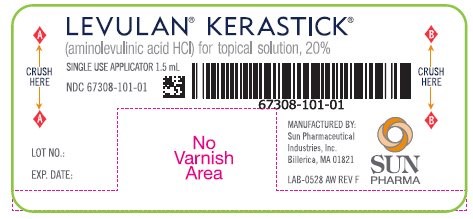
PACKAGE LABEL LEVULAN ® KERASTICK ® (aminolevulinic acid HCl) for Topical Solution, 20% SINGLE USE APPLICATOR 1.5 mL NDC 67308-101-01 A ↑ CRUSH HERE ↓ A LOT NO.: EXP. DATE: B ↑ CRUSH HERE ↓ B MANUFACTURED BY: Sun Pharmaceutical Industries, Inc. Billerica, MA 01821 LAB-0528 AW REV F NDC 67308-101-06 LEVULAN ® KERASTICK ® (aminolevulinic acid HCl) for Topical Solution, 20% 6 SINGLE USE APPLICATORS/1.5 ML EACH FOR TOPICAL USE ONLY NOT FOR USE IN EYES FOR ADMINISTRATION BY HEALTH PROFESSIONAL ONLY RX Only Each applicator contains: Active Ingredient: 354mg aminolevulinic acid HCl Inactive Ingredients: Alcohol, USP (ethanol content=48%v/v), Water, laureth-4, isopropyl alcohol and polyethylene glycol.
Usual Dose: For indications, dosage, precautions, etc., see enclosed package insert. Store between 20°– 25°C (68°-77°F), excursions permitted to 15°– 30°C (59° – 86°F). [See USP Controlled Room Temperature] Use and discard within two hours after activation. Sun Pharmaceutical Industries, Inc.
Billerica, MA 01821 1-877-533-3872 or 1-978-657-7500 LAB-1451 AW Rev F 6 SINGLE USE APPLICATORS,
1.5ML EACH Carefully follow the step by step directions provided in the package insert to prepare Levulan ® Kerastick ® for application. Please note the locations of the crush points “A” and “B” which are indicated by the red diamonds “♦” on each Kerastick ® . NDC 67308-101-01 Levulan ® Kerastick ® (aminolevulinic acid HCl) for Topical Solution, 20% SINGLE USE APPLICATOR
1.5ML LOT NO.: EXP. DATE: SAMPLE: NOT FOR SALE Manufactured By: Sun Pharmaceutical Industries, Inc. Billerica, MA 01821 LAB-1411 REV.: C NDC 67308-101-02 Levulan® Kerastick ® (aminolevulinic acid HCl) for Topical Solution, 20% 2 SINGLE USE APPLICATORS, 1.5 mL EACH SAMPLE NOT FOR SALE For Topical Use Only Not For Use in Eyes FOR ADMINISTRATION BY HEALTH PROFESSIONAL ONLY Rx only Carefully follow the step by step directions provided in the package to prepare Levulan ® Kerastick ® for application.
Please note the locations of the crush points "A" and "B" which are indicated by the red diamonds "♦" on each Kerastick ® . CAT. NO.: LOT NO.: EXP.
DATE: Sun Pharmaceutical Industries, Inc. Billerica, MA 01821 1-877-533-3872 LAB-1462AW REV. C Each applicator contains: Active Ingredient: 354mg aminolevulinic acid HCl Inactive Ingredients: Alcohol, USP (ethanol content-48% v/v), water, laureth-4, isopropyl alcohol, and polyethylene glycol.
Usual Dose: For indications, dosage, precautions, etc., see enclosed package insert. Store between 20°25°C (68°-77°F); excursions permitted to 15°-30°C (59°-86°F) [See USP Controlled Room Temperature] Use and discard within two hours after activation. Levulan-11 Levulan-12 Levulan-13 Levulan-14 Levulan-15
Medicaid utilization & spend
Medicaid utilization by pack size
About this NDC listing & data coverage
Kit / multi-component package
This NDC identifies a kit — a package containing more than one component. Structured data (pricing, ingredients, equivalents) is often reported per component rather than for the kit NDC itself, which can make this page look thinner than the components' own pages.
What data is (and isn’t) available for this NDC — tap to expand
| NDC identity (package / product / labeler codes) | ✓ Available |
| Labeler | ✓ Available |
| Product & package description | ✓ Available |
| Marketing category & status | ✓ Available |
| Active ingredient / dosage form / route | ✓ Available |
| FDA label (SPL via DailyMed) | ✓ Available |
| Package photos | ✓ Available |
| Inactive ingredients (structured) | — Not published for this NDC The labeler did not submit a structured excipient list, or no SPL is available. |
| NADAC pharmacy acquisition price (CMS) | — Not published for this NDC CMS publishes NADAC only for NDCs reported in its retail-pharmacy survey. |
| Orange Book / therapeutic-equivalence data | ✓ Available |
| HCPCS J-code billing crosswalk | ✓ Available |
| Medicaid utilization (CMS SDUD) | ✓ Available |