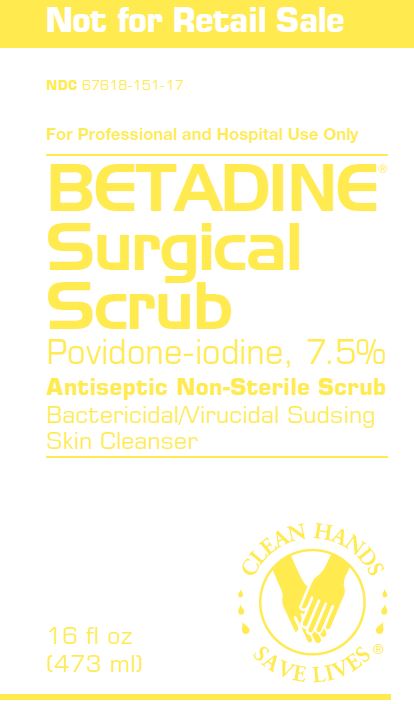
by Atlantis Consumer Healthcare, Inc. · 118 mL in 1 BOTTLE
This is a package of 118 mL of Betadine Surgical Scrub POVIDONE-IODINE .075 mg/mL Solution from Atlantis Consumer Healthcare, Inc., marketed since Jul 1996 and currently FDA-listed. It is the main listing for this product, which comes in 5 package sizes.
NDC 67618-0151-04
🏷️ FDA NDC (as labeled)67618-151-04billing pads the product segment with a zero
This package
Contains118 mLMedicaid pays$53.02 / unit · 12 moPer package$6,256.89 / 118 ml · MedicaidPack sizes5 compare ↓
🗂️ FDA directory synced Oct 1, 2026 · this listing last changed Jul 24, 2026 · sources: openFDA · FDA label (DailyMed) · FDA Orange & Purple Book · First Databank · CMS NADAC, ASP, Medicare & Medicaid · RxNorm
Compiled from public FDA, CMS, DailyMed, NADAC, and related drug data sources. Editorial policy
⚠️
Other active recalls for Povidone-iodine (different manufacturers) — 2 · tap to view
These affect other manufacturers’ products for the same ingredient — not necessarily the exact NDC on this page.
Class III · Aug 19, 2025 — Subpotent drug (Medline Industries, LP)· FDA recall D-0674-2025
Class II · Sep 11, 2024 — Incorrect/Undeclared Excipients: The inactive ingredients labeled on the product boxes and tubes are listed as "mineral oil , petrolatum ". The inactive ingredients in the actual product are polyethylene glycol 400 , polyethylene glycol 4000. (Zhejiang Jingwei Pharmaceutical Co., Ltd.)· FDA recall D-0013-2025
Each entry is an official FDA enforcement report — look up any recall number in the FDA recall database ↗
Identity & classification
Regulatory identifiers FDA, NLM and CMS codes for this package
Drug-database identifiers Medi-Span GPI and First Databank GCN / HICL / AHFS classification
GPI-1492200040002010
GPI classBetadine Surgical Scrub
GCN Seq No016884
GCN29731
HICL code004265
Ingredient (HICL)Povidone-Iodine
HIC1 codeQ
Therapeutic class — broad (HIC1)Ear/Eye/Nose/Rectum/Topical/Vagina/Other
HIC2 codeQ5
Therapeutic class — intermediate (HIC2)Agents Acting Principally On The Skin
HIC3 codeQ5B
Therapeutic class — specific (HIC3)Topical Preparations,Antibacterials
AHFS code84:04.92.00
AHFS classLocal Anti-Infectives, Miscellaneous
FDB label nameBETADINE SURGICAL SCRUB
FDB brand nameBetadine
Legend statusO — Over-the-counter (OTC) drug or device
Quick answers
GSN (GCN sequence number):016884
GCN:29731
GPI-14 (Medi-Span):92200040002010
HICL (First Databank):004265
AHFS class code:84:04.92.00
RxCUI (RxNorm):211747
Why two NDCs?
The FDA registers this code as 67618-151-04 — a 5-3-2 layout, and that's what's printed on the package and shown on DailyMed. For insurance claims, every NDC is standardized to a uniform 11-digit 5-4-2 format by adding a zero to the product segment → 67618-0151-04. Same drug, same package — only the format differs.
Where does this data come from?
Identifiers from the FDA openFDA NDC Directory and Structured Product Labeling; RxCUI from RxNorm (NLM); GPI from Medi-Span; GCN / HIC / AHFS / legend from First Databank.
Drug family (ATC)Iodine products, Medicated dressings with antiinfectives, Medicated shampoos
Where does this data come from?
Therapeutic classes from RxNorm RxClass (U.S. National Library of Medicine) — Established Pharmacologic Class (FDA), ATC drug family (WHO) and mechanism of action, matched by this product’s RxCUI.
Label name BETADINE SURGICAL SCRUBIngredient Povidone-Iodine
📗 Our plain-language guide HelloPharmacist
It's an antiseptic that lowers germs on the skin. Depending on the product, it's used to prep skin before surgery, as a hand scrub or hand wash, or as first aid for minor cuts, scr...
It goes on the skin, not in your mouth. Swabs are wiped on and thrown away after one use, and scrubs are lathered and rinsed. Follow the directions on your specific product, and do...
If it gets in your eyes, ears or mouth, rinse with cold water right away and contact a doctor. It can cause serious or permanent injury. If it's swallowed, get medical help or call...
Plain-language summary from MedlinePlus (U.S. National Library of Medicine); supplement & herbal interactions and nutrient depletion data from the Natural Medicines database; our full guide is HelloPharmacist editorial content.
A drug doesn't have one price. Each row is a different public payment system, and none is what you'd pay at the counter — that depends on your insurance. The ⓘ on each row explains what it measures.
Price system
Per mL
Per package
Retail pharmacies payNADAC · weekly
Not in the retail survey — common for institutional, discontinued, or low-volume packs.
Medicaid paysCMS SDUD · 12 mo
$53.02
$6,256.89 / 118 ml
Medicare drug plans payPart D · quarterly
No Part D plan price is available for this NDC in our data.
Where does this data come from?
NADAC (National Average Drug Acquisition Cost) is the CMS weekly pharmacy-acquisition-cost survey — what pharmacies pay. ASP (Average Sales Price) is the CMS Medicare Part B drug-payment file, published quarterly. Medicaid pays is computed by us from CMS State Drug Utilization Data (total reimbursed ÷ units, trailing 12 months) — gross of rebates and inclusive of dispensing fees, so it reflects what Medicaid paid, not an acquisition cost. Medicare drug plans pay is the median negotiated point-of-sale unit cost across plans listing this NDC in the CMS quarterly Prescription Drug Plan pricing files, before rebates. The VA pays is the federal contract price (FSS, and the statutory Big 4 ceiling where listed) from the VA National Acquisition Center pharmaceutical price file. All are free public government data; each measures a different payer, so the figures are not directly comparable.
In Medicaid, this is the most-dispensed pack of this product — about 100% of fills over the last four reported quarters. See all packs ↓
Pack size FAQ
What quantity is in this package?
This package contains 118 mL — 118 ml in 1 bottle.
How does this package differ from NDC 67618-0151-16?
Both are Betadine Surgical Scrub POVIDONE-IODINE .075 mg/mL Solution — the drug itself is identical. This page's package is the 118 mL one, while NDC 67618-0151-16 is the 473 ml package.
What NDC number is used to bill for this package of Betadine Surgical Scrub POVIDONE-IODINE .075 mg/mL Solution?
Use the 11-digit billing form listed in the identifiers section of this page. Pharmacy and medical claims use the 11-digit form; the FDA label may print a shorter form of the same code.
About this product: other versions of the same ingredient, strength and form are listed above, least expensive first, with FDA equivalence ratings where available.
Where does this data come from?
Equivalents are other NDCs of the same ingredient, form and route from the openFDA NDC Directory, ranked least-expensive-first by NADAC. Therapeutic-equivalence (AB) ratings come from the FDA Orange Book; biologics use the FDA Purple Book for biosimilar & interchangeable status.
We did not find an FDA-approved generic match for this exact strength, form and route.
Where does this data come from?
Patents and exclusivity from the FDA Orange Book (small-molecule drugs), refreshed from public FDA data. Generic launch timing is an estimate, not a guarantee.
Inactive ingredients, also called excipients, are components of the drug product
other than the active ingredient. They may include fillers, dyes, coatings, preservatives, flavors,
or other formulation ingredients.
💡 Tap an ingredient (hover on desktop) to see what it is and why it’s used.
UNII 9HIA70O4J0
A synthetic surfactant derived from nonylphenol ethoxylate. It acts as an emulsifier and solubilizer, helping blend oil and water-based ingredients together in formulations.
UNII 48Q180SH9T
Nonoxynol-9 is a surfactant, a chemical that reduces surface tension. In medicines, it acts as an emulsifier or solubilizer, helping mix ingredients that normally don't combine well, and may also serve as a preservative or antimicrobial agent.
UNII 55X04QC32I
A strong alkaline chemical used to adjust and maintain the pH balance of liquid medicines. It helps keep the medicine stable and ensures it stays effective during storage.
UNII 059QF0KO0R
Water is a liquid solvent that dissolves and mixes ingredients together in liquid medicines, syrups, and injections. It helps distribute the active drug evenly throughout the product.
4 inactive ingredients listed in the exact product block matched to this NDC.
The official label also statesInactive ingredients ammonium nonoxynol-4sulfate, nonoxynol-9, purified water, sodium hydroxide
Label-section wording can be broader than the structured product block and may mention additional formulation ingredients.
Where does this data come from?
Data sourced from official FDA Structured Product Labeling (SPL) via DailyMed — ingredient classCode="IACT" elements from the exact product block matched by this NDC. Label-section narrative from DailyMed / the openFDA label index is shown separately when available.
Are inactive ingredients the same for every manufacturer?
No. Inactive ingredients can differ by manufacturer, dosage form, strength, and package / product version.
Why might an inactive ingredient be missing?
Some SPLs do not provide a complete structured inactive-ingredient list, and older or unusual labels may only include the information in narrative text.
Can inactive ingredients matter?
Yes. They can matter for allergies, intolerances, dyes, gluten / lactose concerns, preservatives, and formulation differences — but confirm with a pharmacist or the manufacturer when it’s clinically important.
The labeler markets the product; the application holder owns the FDA approval. They’re often the same company but can differ (e.g. a repackager or an authorized generic). A mailing address / phone appears here when the manufacturer includes it in the product’s FDA label (not all do).
Where does this data come from?
Labeler, application holder and registered establishment from the FDA openFDA NDC Directory and Drugs@FDA; address/contact from the product’s FDA label.
The complete FDA label for this product — the official Drug Facts labeling, verbatim, section by section. Jump with a chip, search within the label, or expand everything.
Uses helps to reduce bacteria that potentially can cause skininfection for handwashing to reduce bacteria on the skin significantly reduces the number of microorganisms on thehands and forearms prior to surgery or patient care
⏱️Dosage and Administration96 words▾
Directions Surgical hand scrub: wet hands with water spread about 5 cc (1 teaspoonful) of Scrub over both handsand forearms without adding more water, scrub thoroughly for 2 1/2 to3 minutes use a sponge if desired. Clean thoroughly under fingernails. add a little water and develop copious suds. Rinse thoroughlyunder running water. repeat the entire procedure using another 5 cc of Scrub Antiseptic hand wash: wet hands with water and pour about 5 cc of Scrub on hands rub hands vigorously together for at least 15 seconds, coveringall surfaces rinse and dry with a disposable towel
⚠️Warnings68 words▾
Warnings For external use only Do not use this product in the eyes When using this product prolonged exposure to wet solution may cause irritation or, rarely, severe skin reactions Stop use and ask a doctor if irritation and redness develop in rare instances of local irritation or sensitivity Keep out of reach of children. If swallowed, get medical help or contact a Poison Control Center right away.
📦Storage and Handling14 words▾
Other information store at 25°C (77°F); excursions permitted between 15°-30°C(59°-86°F) store in original container
🧪Active Ingredient8 words▾
Drug Facts Active ingredient Povidone-iodine, 7.5%(0.75% available iodine)
Purpose Antiseptic Uses helps to reduce bacteria that potentially can cause skininfection for handwashing to reduce bacteria on the skin significantly reduces the number of microorganisms on thehands and forearms prior to surgery or patient care
📄Do Not Use8 words▾
Do not use this product in the eyes
📄Ask a Doctor Before Use If19 words▾
Stop use and ask a doctor if irritation and redness develop in rare instances of local irritation or sensitivity
📄When Using This Product17 words▾
When using this product prolonged exposure to wet solution may cause irritation or, rarely, severe skin reactions
📄Keep Out of Reach of Children19 words▾
Keep out of reach of children. If swallowed, get medical help or contact a Poison Control Center right away.
No label section mentions that — try another word, or open the full label on DailyMed below.
Glossary — plain-language definitions of medical terms used in this label:
Active ingredient: The part of a medicine that produces its intended effect on the body.
Drug Facts: The standardized information panel on over-the-counter medicines that lists ingredients, uses, warnings, and directions.
NDC: A unique number that identifies a specific medicine, its maker, strength, and package size.
Source: FDA Structured Product Labeling, mirrored from DailyMed / openFDA.
Prefer the government’s original formatting? View this label on DailyMed ↗
Medicaid utilization & spend
📍 This exact package only: Medicaid data is reported per full 11-digit NDC — labeler, product and pack size — so every number here is for this package alone, not the drug overall. Other pack sizes report separately.
💊 Pharmacy benefit only: These are Medicaid outpatient pharmacy claims, billed by NDC. They exclude the medical benefit — clinic- or hospital-administered drugs billed under HCPCS J-codes — so drugs used mostly that way (e.g. Avastin, Lucentis, Keytruda) can look low or missing here. That’s expected, not an error.
📅 Q1 2025 – Q1 2026 · 5 quarters of data
ⓘ The newest quarter is usually incomplete when first published; states restate recent quarters in later CMS releases, so the latest figures typically revise upward. State coverage-policy changes can also shift quarter-to-quarter totals.
Prescriptions last 4 qtrs
182
Units reimbursed last 4 qtrs
144
Gross reimbursed last 4 qtrs
$7.6K
Avg / prescription
$41.95
Avg / unit
$53.0245
Latest quarter Q1 2026
28Rx
Fee-for-service vs managed care ⓘ
100% MCO
Fee-for-service · 0 Rx Managed care · 182 Rx
State Medicaid map
Units reimbursed · per 100k residents
3.23.2
gray = no data reported ⓘ
Colors are per 100,000 residents, so big states don’t automatically dominate. Tap or hover a state for its actual totals.
Tap or hover a state
…for its Medicaid breakdown
Prescriptions—
Units—
Reimbursed—
🏆 Top states by units · per 100k residents
1Kentucky3.2 /100k
National units — by quarter
💵 About the dollar figures: “reimbursed” is what Medicaid paid pharmacies before confidential manufacturer rebates, so the program’s real net cost is lower than these numbers. Fee-for-service and managed-care claims are combined unless split above. Source: CMS State Drug Utilization Data; per-100k rates use 2023 Census population estimates.
Medicaid utilization by pack size
Medicaid (SDUD) totals over the four most recent reported quarters for every package size of this drug — handy when a specific package (e.g. a starter/titration pack) carries little or no Medicaid volume on its own.
Drug total (last 4 qtrs): 182 Rx · 144 units · $7,636 gross reimbursed
Tap a pack size to open its page. Source: CMS State Drug Utilization Data, last 4 quarters.
Medicare Part D spend CMS · PART D · 2025 (Q1-Q4)
Medicare Part D (outpatient prescription) spending for Betadine (matched by generic name) — the program that covers self-administered drugs. 1 manufacturer.
⚠️ Drug-level data: CMS publishes Part D spending by drug, not by NDC — these figures combine every manufacturer, strength and package size sold under the name Betadine. That’s a different level of aggregation than the Medicaid card above, which is specific to this exact 11-digit NDC (pack size included), so the two aren’t directly comparable.
Total Part D spend
$874.18
Claims incl. refills
38
Beneficiaries
28
Spend / beneficiary
$31.22
Spend / claim
$23.00
💵 About the dollar figures: spending is what Part D plans paid before confidential manufacturer rebates, so the program’s real net cost is lower. A blank patient count means fewer than 11 people — CMS hides counts that small to protect privacy. Source: CMS Medicare Quarterly Part D Spending by Drug (data.cms.gov), updated quarterly.
About this NDC listing & data coverage
Over-the-counter (OTC) product
What data is (and isn’t) available for this NDC — tap to expand
NDC identity (package / product / labeler codes)
✓ Available
Labeler
✓ Available
Product & package description
✓ Available
Marketing category & status
✓ Available
Active ingredient / dosage form / route
✓ Available
FDA label (SPL via DailyMed)
✓ Available
Package photos
✓ Available
Inactive ingredients (structured)
✓ Available
NADAC pharmacy acquisition price (CMS)
— Not published for this NDCCMS publishes NADAC only for NDCs reported in its retail-pharmacy survey.
Orange Book / therapeutic-equivalence data
— Not published for this NDCApplies only to products approved under an NDA/ANDA; many listings are out of scope.
HCPCS J-code billing crosswalk
— Not published for this NDCMost self-administered / retail products have no J-code — that is normal.
Medicaid utilization (CMS SDUD)
✓ Available
“Not published” reflects what the public FDA / CMS / NLM sources provide for this exact package code — it is a property of the data feeds, not a judgment about the product.
Questions about this listing
Is this NDC FDA-approved?
An NDC listing does not by itself establish FDA approval — the NDC Directory records that a product is listed with FDA, not that it was reviewed and approved. This listing's marketing category is "Otc Monograph Drug". Products approved under an application carry an NDA, ANDA, or BLA number.
Why is there no price listed?
The pricing shown on our NDC pages comes from CMS NADAC, a voluntary survey of retail community pharmacy invoices. CMS does not publish a NADAC for every NDC — packages outside the retail survey (institutional and hospital products, bulk packages, discontinued items, and many OTC items) may never receive one. A missing price reflects the survey's scope, not this product's actual cost, and does not mean the product is free or unavailable.
Is the NDC printed on the package the same as the 11-digit billing NDC?
Yes, they identify this exact package in different formats. The form printed on the packaging and shown on DailyMed is the one the FDA registered. Insurance claims use a fixed 11-digit 5-4-2 format, so the short segment is padded with a leading zero and the dashes are dropped. The Identity section at the top of this page lists each form of this code.
Is this package still being marketed?
Yes, per the latest FDA NDC Directory data on this page: this package is listed as actively marketed, with no marketing end date reported by Atlantis Consumer Healthcare, Inc.. Listing status can change — the directory data on this page refreshes weekly.
Does this product come in other package sizes?
Yes — the FDA directory lists 4 other package presentations of this same product, including 1 bottle (67618-0151-17), 473 ml (67618-0151-16), 946 ml (67618-0151-32). Each has its own NDC and its own page — see the package list near the top of this page.
Who lists this product with the FDA?
Atlantis Consumer Healthcare, Inc. is the labeler of record for this NDC — the company under whose FDA-assigned code the package is listed. The labeler may be the manufacturer itself or a distributor marketing the product under its own code.
Do I need a prescription for this product?
This NDC is listed with FDA as an over-the-counter product, so it does not require a prescription. Follow the package directions, and ask your pharmacist if you are unsure whether it is right for you.
This page identifies an FDA-listed package (the NDC) and reports public regulatory and pricing data about the listing. It is reference information, not a medical recommendation — talk to your pharmacist or prescriber about your own medication.
Where does this data come from?
Listing facts (marketing category, packager status, marketing dates) from the FDA openFDA NDC Directory; label availability from DailyMed; pricing coverage from CMS NADAC; equivalence scope from the FDA Orange Book.
For educational and professional reference only — not medical advice. Pricing reflects published
NADAC and CMS ASP (free public data) and may differ from your acquisition cost; always verify before billing or dispensing.