
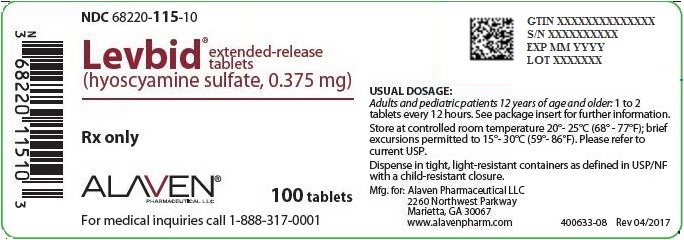
Levbid hyoscyamine sulfate .375 mg Tablet, Extended Release, 1 tablet — NDC 68220-115-10 (Billing 68220-0115-10)
This is a package of 1 tablet of Levbid hyoscyamine sulfate .375 mg Tablet, Extended Release from Viatris Specialty LLC, marketed since Dec 2008 and currently FDA-listed. It is this product's only package size.
NDC database record
One package, one record: these facts belong to NDC 68220-115-10 alone.
- Record
- FDA NDC Directory package listing · Human prescription drug
- Code segments
- 68220 labeler · 115 product · 10 package
- Package marketed since
- Dec 1, 2008
- Sample package
- No — commercial package
- Listing certified through
- Dec 31, 2027
- Billing quantity
- 1 EA per package
- Barcode (UPC)
- 0368220115103
- FDA record last changed
- Jul 24, 2026
Identity & classification
Regulatory identifiers FDA, NLM and CMS codes for this package
Drug-database identifiers Medi-Span GPI and First Databank GCN / HICL / AHFS classification
- GSN (GCN sequence number): 023715
- GCN: 18960
- GPI-14 (Medi-Span): 49101030107420
- HICL (First Databank): 002017
- AHFS class code: 12:08.08.00
- RxCUI (RxNorm): 1046770
Where does this data come from?
- FDA openFDA NDC Directory · synced Oct 8, 2026
- FDA label on DailyMed · label index refreshed Oct 8, 2026
- RxNorm (NLM RxNav) · catalog refreshed Oct 1, 2026
- Medi-Span GPI (licensed)
- First Databank (licensed) · refreshed Oct 8, 2026
RxNorm drug class
This medicine belongs to the Belladonna alkaloids, tertiary amines class.
Where does this data come from?
- RxClass (NLM) · catalog refreshed Oct 1, 2026
Clinical
Hyoscyamine is used to control symptoms associated with disorders of the gastrointestinal (GI) tract. It works by decreasing the motion of the stomach and intestines and the secretion of stomach fluids, including acid. Hyoscyamine is also used in the treatment of bladder spasms, peptic ulcer disease, diverticulitis, colic, irritable bowel syndrome, cystitis, and pancreatitis. Hyoscyamine may also be used to treat certain heart conditions, to control the symptoms of Parkinson's disease and rhinitis (runny nose), and to reduce excess saliva production.
Read the full MedlinePlus article ↗- Hyoscyamine calms spasms and slows secretions in the stomach, bowel and bladder. It is often an add-on for peptic ulcer or irritable bowel syndrome. Some products have additional u...
- Many tablets are taken 30 to 60 minutes before meals and at bedtime, and some are taken as needed. Follow your label, since dissolving, under-the-tongue and extended-release forms...
- Dry mouth, blurred vision, drowsiness, dizziness and constipation are common. Use caution driving until you know how it affects you. Call your doctor if you cannot urinate or feel...
- Be careful. Hyoscyamine reduces sweating, so you can overheat and even get heat stroke. Stay cool and get help for fever or heat illness.
Patient education
Supplement & herbal interactions
Where does this data come from?
- MedlinePlus (NLM) · refreshed Oct 8, 2026
- FDA label on DailyMed · label index refreshed Oct 8, 2026
Ask a licensed pharmacist directly — free, answered by our team.
Pricing
A drug doesn't have one price. Each row is a different public payment system, and none is what you'd pay at the counter — that depends on your insurance. The ⓘ on each row explains what it measures.
| Price system | Per each | Per package |
|---|---|---|
| Retail pharmacies payNADAC · weekly | Not in the retail survey — common for institutional, discontinued, or low-volume packs. | |
| Medicaid paysCMS SDUD · 12 mo | No recent Medicaid claims on file for this NDC — rare and low-volume NDCs are suppressed in the public data. | |
| Medicare drug plans payPart D · quarterly | No Part D plan price is available for this NDC in our data. | |
Where does this data come from?
- CMS NADAC weekly file
- CMS ASP pricing files · refreshed Sep 20, 2026
- CMS Medicaid State Drug Utilization Data · refreshed Oct 8, 2026
- CMS Part D plan pricing files · refreshed Sep 24, 2026
- VA National Acquisition Center price file
Packaging — all sizes for this product
| Package NDC | Description | Marketing start | Marketing end | Status |
|---|---|---|---|---|
| 68220-0115-10 You're viewing this Main listing | 1 TABLET, EXTENDED RELEASE in 1 BOTTLE | 2008-12-01 | — | Active |
Therapeutic equivalents
| Product | Labeler | Pack | NADAC/unit | TE | Status | Price vs. this |
|---|---|---|---|---|---|---|
| Hyoscyamine Sulfate .375 mg 62559-0423-01 | ANI | 100 tablets | $0.536 | — | Availability likely | — |
| Hyoscyamine Sulfate .375 mg 16477-0738-01 | Laser | 100 tablets | — | — | FDA listed | — |
| Hyoscyamine Sulfate .375 mg 39328-0052-10 | Patrin | 100 tablets | — | — | FDA listed | — |
| Hyoscyamine ER .375 mg 51525-0115-01 | Mylan | 100 tablets | — | — | FDA listed | — |
| Hyoscyamine sulfate .375 mg 62135-0860-60 | Chartwell | 60 tablets | — | — | FDA listed | — |
| Levbid .375 mgthis 68220-0115-10 | Viatris | 1 tablet | — | — | FDA listed | — |
| Hyoscyamine ER .375 mg 75929-0057-10 | Pharma | 100 tablets | — | — | Discontinued | — |
Where does this data come from?
- FDA openFDA NDC Directory · synced Oct 8, 2026
- FDA Orange Book · refreshed Oct 3, 2026
- CMS NADAC weekly file
Availability & generic status
We did not find an FDA-approved generic match for this exact strength, form and route.
Where does this data come from?
- FDA Orange Book · refreshed Oct 3, 2026
What it looks like
Where does this data come from?
- FDA label on DailyMed · label index refreshed Oct 8, 2026
Inactive Ingredients / Excipients
Inactive ingredients, also called excipients, are components of the drug product other than the active ingredient. They may include fillers, dyes, coatings, preservatives, flavors, or other formulation ingredients.
🧪 Avoiding an ingredient? See Hyoscyamine inactive ingredients by manufacturer: every current product's list side by side, so you can ask your pharmacy for the version that does not list it.
💡 Tap an ingredient (hover on desktop) to see what it is and why it’s used.
-
UNII L11K75P92J
A mineral salt made from calcium and phosphate. It acts as a filler and binder in tablets to add bulk and help hold the medicine together in solid form.
-
UNII 7Z8S9VYZ4B
Ethylcellulose is a plant-derived thickener and film-former made by chemically modifying cellulose. It's used as a binder to hold tablet ingredients together, a coating to control how quickly medicine is released, or a thickener in liquid formulations.
-
UNII EWQ57Q8I5X
Lactose monohydrate is a natural sugar derived from milk. It serves as a filler and binder in tablets and capsules, helping create the proper size, texture, and consistency of the medicine.
-
UNII 70097M6I30
Magnesium stearate is a salt made from magnesium and stearic acid, a fatty substance. It's used in tablets and capsules as a lubricant and glidant to help ingredients flow smoothly during manufacturing and prevent sticking.
-
UNII OP1R32D61U
Microcrystalline cellulose is a purified form of cellulose, a natural fiber from plant sources. It acts as a binder and filler in tablets and capsules, helping hold ingredients together and give the medicine its shape and size.
-
UNII 4ELV7Z65AP
Stearic acid is a fatty acid derived from plant or animal sources. It acts as a binder and lubricant in tablets and capsules, helping them hold together and flow smoothly during manufacturing.
6 inactive ingredients listed in the exact product block matched to this NDC.
Where does this data come from?
ingredient classCode="IACT" elements from the exact product block matched by this NDC. Label-section narrative from DailyMed / the openFDA label index is shown separately when available.- FDA label on DailyMed · label index refreshed Oct 8, 2026
- FDA openFDA NDC Directory · synced Oct 8, 2026
Inactive ingredient FAQ
Are inactive ingredients the same for every manufacturer?
Why might an inactive ingredient be missing?
Can inactive ingredients matter?
Manufacturer & labeler
More NDCs from Viatris Specialty LLC labeler code 68220
Where does this data come from?
- FDA openFDA NDC Directory · synced Oct 8, 2026
- Drugs@FDA
Full prescribing information FDA SPL
🎯 Indications and Usage ▾
INDICATIONS AND USAGE Levbid ® is effective as adjunctive therapy in the treatment of peptic ulcer. It can also be used to control gastric secretion, visceral spasm and hypermotility in spastic colitis, spastic bladder, cystitis, pylorospasm, and associated abdominal cramps. May be used in functional intestinal disorders to reduce symptoms such as those seen in mild dysenteries, diverticulitis, and acute enterocolitis.
For use as adjunctive therapy in the treatment of irritable bowel syndrome (irritable colon, spastic colon, mucous colitis) and functional gastrointestinal disorders. Also used as adjunctive therapy in the treatment of neurogenic bladder and neurogenic bowel disturbances (including the splenic flexure syndrome and neurogenic colon). Levbid ® is indicated along with morphine or other narcotics in symptomatic relief of biliary and renal colic; as a “drying agent” in the relief of symptoms of acute rhinitis; in the therapy of Parkinsonism to reduce rigidity and tremors and to control associated sialorrhea and hyperhidrosis.
May be used in the therapy of poisoning by anticholinesterase agents.
⏱️ Dosage and Administration ▾
DOSAGE AND ADMINISTRATION Dosage may be adjusted according to the conditions and severity of symptoms. Adults and pediatric patients 12 years of age and older: 1 to 2 tablets every 12 hours. Do not crush or chew tablets. Do not exceed 4 tablets in 24 hours.
⛔ Contraindications ▾
CONTRAINDICATIONS Glaucoma; obstructive uropathy (for example, bladder neck obstruction due to prostatic hypertrophy); obstructive disease of the gastrointestinal tract (as in achalasia, pyloroduodenal stenosis); paralytic ileus, intestinal atony of elderly or debilitated patients; unstable cardiovascular status in acute hemorrhage; severe ulcerative colitis; toxic megacolon complicating ulcerative colitis; myasthenia gravis.
⚠️ Warnings ▾
WARNINGS In the presence of high environmental temperature, heat prostration can occur with drug use (fever and heat stroke due to decreased sweating). Diarrhea may be an early symptom of incomplete intestinal obstruction, especially in patients with ileostomy or colostomy. In this instance, treatment with this drug would be inappropriate and possibly harmful.
Like other anticholinergic agents, Levbid ® may produce drowsiness, dizziness or blurred vision. In this event, the patient should be warned not to engage in activities requiring mental alertness such as operating a motor vehicle or other machinery or to perform hazardous work while taking this drug. Psychosis has been reported in sensitive individuals given anticholinergic drugs including hyoscyamine sulfate.
CNS signs and symptoms include confusion, disorientation, short-term memory loss, hallucinations, dysarthria, ataxia, euphoria, anxiety, fatigue, insomnia, agitation and mannerisms, and inappropriate affect. These CNS signs and symptoms usually resolve within 12 to 48 hours after discontinuation of the drug.
🤒 Adverse Reactions ▾
ADVERSE REACTIONS All of the following adverse reactions have been reported with hyoscyamine sulfate. Adverse reactions may include dryness of the mouth; urinary hesitancy and retention; blurred vision; tachycardia; palpitations; mydriasis; increased ocular tension; loss of taste; headache; nervousness; drowsiness; weakness; fatigue; dizziness; insomnia; nausea; vomiting; impotence; constipation; bloated feeling; abdominal pain; diarrhea; allergic reactions or drug idiosyncrasies; urticaria and other dermal manifestations; ataxia; speech disturbance; some degree of mental confusion and/or excitement (especially in elderly persons); short-term memory loss; hallucinations; and decreased sweating.
🔄 Drug Interactions ▾
Drug Interactions Additive adverse effects resulting from cholinergic blockade may occur when Levbid ® is administered concomitantly with other antimuscarinics, amantadine, haloperidol, phenothiazines, monoamine oxidase (MAO) inhibitors, tricyclic antidepressants or some antihistamines. Antacids may interfere with the absorption of Levbid ® .
🤰 Pregnancy ▾
Pregnancy Animal reproduction studies have not been conducted with Levbid®. It is also not known whether Levbid ® can cause fetal harm when administered to a pregnant woman or can affect reproduction capacity. Levbid ® should be given to a pregnant woman only if clearly needed.
🧓 Geriatric Use ▾
Geriatric Use Reported clinical experience has not identified differences in safety between patients aged 65 and over and younger patients. In general, dose selection for an elderly patient should be cautious, usually starting at the low end of the dosing range, reflecting the greater frequency of decreased hepatic, renal, or cardiac function, and of concomitant disease or other drug therapy. This drug is known to be substantially excreted by the kidney, and the risk of toxic reactions to this drug may be greater in patients with impaired renal function.
Because elderly patients are more likely to have decreased renal function, care should be taken in dose selection, and it may be useful to monitor renal function.
🆘 Overdosage ▾
OVERDOSAGE The signs and symptoms of overdose are headache, nausea, vomiting, blurred vision, dilated pupils, hot dry skin, dizziness, dryness of the mouth, difficulty in swallowing, and CNS stimulation. Measures to be taken are immediate lavage of the stomach and injection of physostigmine 0.5 to 2 mg intravenously and repeated as necessary up to a total of 5 mg. Fever may be treated symptomatically (tepid water sponge baths, hypothermic blanket).
Excitement to a degree which demands attention may be managed with sodium thiopental 2% solution given slowly intravenously or chloral hydrate (100-200 mL of a 2% solution) by rectal infusion. In the event of progression of the curare-like effect to paralysis of the respiratory muscles, artificial respiration should be instituted and maintained until effective respiratory action returns. In rats, the LD 50 for hyoscyamine is 375 mg/kg.
Levbid ® is dialyzable.
🧬 Clinical Pharmacology ▾
CLINICAL PHARMACOLOGY Levbid ® inhibits specifically the actions of acetylcholine on structures innervated by postganglionic cholinergic nerves and on smooth muscles that respond to acetylcholine but lack cholinergic innervation. These peripheral cholinergic receptors are present in the autonomic effector cells of the smooth muscle, the cardiac muscle, the sinoatrial node, the atrioventricular node, and the exocrine glands. At therapeutic doses, it is completely devoid of any action on autonomic ganglia.
Levbid ® inhibits gastrointestinal propulsive motility and decreases gastric acid secretion. Levbid ® also controls excessive pharyngeal, tracheal, and bronchial secretions. Hyoscyamine sulfate is absorbed totally and completely by oral administration.
Once absorbed, it disappears rapidly from the blood and is distributed throughout the entire body: the half-life is 2 to 3 ½ hours. Hyoscyamine sulfate is partly hydrolyzed to tropic acid and tropine but the majority of the drug is excreted in the urine unchanged within the first 12 hours. Only traces of this drug are found in breast milk.
Hyoscyamine sulfate passes the blood brain barrier and the placental barrier. Levbid ® releases 0.375 mg hyoscyamine sulfate at a controlled and predictable rate for 12 hours. The mean peak plasma concentration occurred at 4.20 hours.
The mean (±SEM) apparent plasma elimination half-life is 7.47 hours (± 0.60). Tablets may not completely disintegrate and may be excreted by some patients.
📦 How Supplied / Storage and Handling ▾
HOW SUPPLIED Levbid ® (hyoscyamine sulfate 0.375 mg) extended-release tablets are white, capsule-shaped tablets. They are coded AP on one side and 115 on the other. Bottles of 100 NDC 68220-115-10 Store at controlled room temperature 20°-25°C (68°- 77°F); brief excursions permitted to 15°-30°C (59°- 86°F).
Please refer to current USP. Dispense in tight, light-resistant containers as defined in USP/NF with a child-resistant closure. KEEP OUT OF REACH OF CHILDREN Also available as: Levsin ® dosage strength package size NDC Sublingual Tablets 0.125 mg 100’s 68220-113-10 Tablets 0.125 mg 100’s 68220-112-10 For more information, call Viatris at 1-877-446-3679 (1-877-4-INFO-RX).
LEVBID is a registered trademark of Alaven Pharmaceutical LLC, a Viatris Company. © 2025 Viatris Inc. Distributed by: Viatris Specialty LLC Morgantown, WV 26505 U.S.A. 201090-01 115 Rev.
07/2025 VS:SOV:LVBDER:R1
📋 Description ▾
DESCRIPTION Levbid ® extended-release tablets contain 0.375 mg of hyoscyamine sulfate in a formulation designed for oral b.i.d. dosage. Hyoscyamine sulfate is one of the principal anticholinergic/antispasmodic components of belladonna alkaloids. The empirical formula is (C 17 H 23 NO 3 )2•H 2 SO 4 •2H 2 O and the molecular weight is 712.85.
Chemically, it is benzeneacetic acid, α-(hydroxymethyl)-,8-methyl-8-azabicyclo [3.2.1.] oct-3-yl ester, [3(S)-endo]-, sulfate (2:1), dihydrate with the following structure: Each Levbid ® extended-release tablet also contains as inactive ingredients: calcium phosphate dibasic, ethylcellulose, lactose monohydrate, magnesium stearate, microcrystalline cellulose and stearic acid. chemical structure
💬 Information for Patients ▾
Information for Patients Like other anticholinergic agents, Levbid ® may produce drowsiness, dizziness, or blurred vision. In this event, the patient should be warned not to engage in activities requiring mental alertness such as operating a motor vehicle or other machinery or to perform hazardous work while taking this drug. Use of Levbid ® may decrease sweating resulting in heat prostration, fever or heat stroke; febrile patients or those who may be exposed to elevated environmental temperatures should use caution.
Tablets may not completely disintegrate and may be excreted by some patients.
⚠️ Precautions ▾
PRECAUTIONS General Use with caution in patients with: autonomic neuropathy, hyperthyroidism, coronary heart disease, congestive heart failure, cardiac arrhythmias, hypertension, and renal disease. Investigate any tachycardia before giving any anticholinergic drugs since they may increase the heart rate. Use with caution in patients with hiatal hernia associated with reflux esophagitis.
Information for Patients Like other anticholinergic agents, Levbid ® may produce drowsiness, dizziness, or blurred vision. In this event, the patient should be warned not to engage in activities requiring mental alertness such as operating a motor vehicle or other machinery or to perform hazardous work while taking this drug. Use of Levbid ® may decrease sweating resulting in heat prostration, fever or heat stroke; febrile patients or those who may be exposed to elevated environmental temperatures should use caution.
Tablets may not completely disintegrate and may be excreted by some patients. Drug Interactions Additive adverse effects resulting from cholinergic blockade may occur when Levbid ® is administered concomitantly with other antimuscarinics, amantadine, haloperidol, phenothiazines, monoamine oxidase (MAO) inhibitors, tricyclic antidepressants or some antihistamines. Antacids may interfere with the absorption of Levbid ® .
Carcinogenesis, Mutagenesis, Impairment of Fertility No long-term studies in animals have been performed to determine the carcinogenic, mutagenic or impairment of fertility potential of Levbid ® ; however, 40 years of marketing experience with hyoscyamine sulfate shows no demonstrable evidence of a problem. Pregnancy Animal reproduction studies have not been conducted with Levbid®. It is also not known whether Levbid ® can cause fetal harm when administered to a pregnant woman or can affect reproduction capacity.
Levbid ® should be given to a pregnant woman only if clearly needed. Nursing Mothers Levbid ® is excreted in human milk. Caution should be exercised when Levbid ® is administered to a nursing woman.
Geriatric Use Reported clinical experience has not identified differences in safety between patients aged 65 and over and younger patients. In general, dose selection for an elderly patient should be cautious, usually starting at the low end of the dosing range, reflecting the greater frequency of decreased hepatic, renal, or cardiac function, and of concomitant disease or other drug therapy. This drug is known to be substantially excreted by the kidney, and the risk of toxic reactions to this drug may be greater in patients with impaired renal function.
Because elderly patients are more likely to have decreased renal function, care should be taken in dose selection, and it may be useful to monitor renal function.
🍼 Nursing Mothers ▾
Nursing Mothers Levbid ® is excreted in human milk. Caution should be exercised when Levbid ® is administered to a nursing woman.
📄 Carcinogenesis, Mutagenesis, Impairment of Fertility ▾
Carcinogenesis, Mutagenesis, Impairment of Fertility No long-term studies in animals have been performed to determine the carcinogenic, mutagenic or impairment of fertility potential of Levbid ® ; however, 40 years of marketing experience with hyoscyamine sulfate shows no demonstrable evidence of a problem.
📄 Package Label / Principal Display Panel ▾
PRINCIPAL DISPLAY PANEL – 0.375 MG NDC 68220- 115 -10 Levbid ® extended-release tablets (hyoscyamine sulfate, 0.375 mg) Rx only 100 tablets USUAL DOSAGE: Adults and pediatric patients 12 years of age and older: 1 to 2 tablets every 12 hours. See package insert for further information. Store at controlled room temperature 20°- 25°C (68° - 77°F); brief excursions permitted to 15°- 30°C (59°- 86°F).
Please refer to current USP. Dispense in tight, light-resistant containers as defined in USP/NF with a child-resistant closure. Distributed by: Viatris Specialty LLC Morgantown, WV 26505 U.S.A.
LEVBID is a registered trademark of Alaven Pharmaceutical LLC, a Viatris Company. © 2025 Viatris Inc. VSSOV115A1 200950-01 Rev 06/2025 Levbid Extended-Release Tablets 0.375 mg Bottle Label
Medicare Part D spend CMS · PART D · 2026 (Q1)
Reported adverse events (FAERS)
Top reported reactions
Age at onset
Reporter sex
Where does this data come from?
About this NDC listing & data coverage
Listed without an FDA application
This product's marketing category indicates it is marketed without an approved FDA application (no NDA, ANDA, or BLA on file). Having an NDC does not by itself establish FDA approval — the NDC Directory is a listing system, not an approval decision. Approval-linked data such as Orange Book therapeutic-equivalence ratings therefore does not apply.
What data is (and isn’t) available for this NDC — tap to expand
| NDC identity (package / product / labeler codes) | ✓ Available |
| Labeler | ✓ Available |
| Product & package description | ✓ Available |
| Marketing category & status | ✓ Available |
| Active ingredient / dosage form / route | ✓ Available |
| FDA label (SPL via DailyMed) | ✓ Available |
| Package photos | ✓ Available |
| Inactive ingredients (structured) | ✓ Available |
| NADAC pharmacy acquisition price (CMS) | — Not published for this NDC CMS publishes NADAC only for NDCs reported in its retail-pharmacy survey. |
| Orange Book / therapeutic-equivalence data | — Not published for this NDC Applies only to products approved under an NDA/ANDA; many listings are out of scope. |
| HCPCS J-code billing crosswalk | — Not published for this NDC Most self-administered / retail products have no J-code — that is normal. |
| Medicaid utilization (CMS SDUD) | — Not published for this NDC CMS reports utilization only for NDCs with Medicaid claims above its privacy threshold. |