
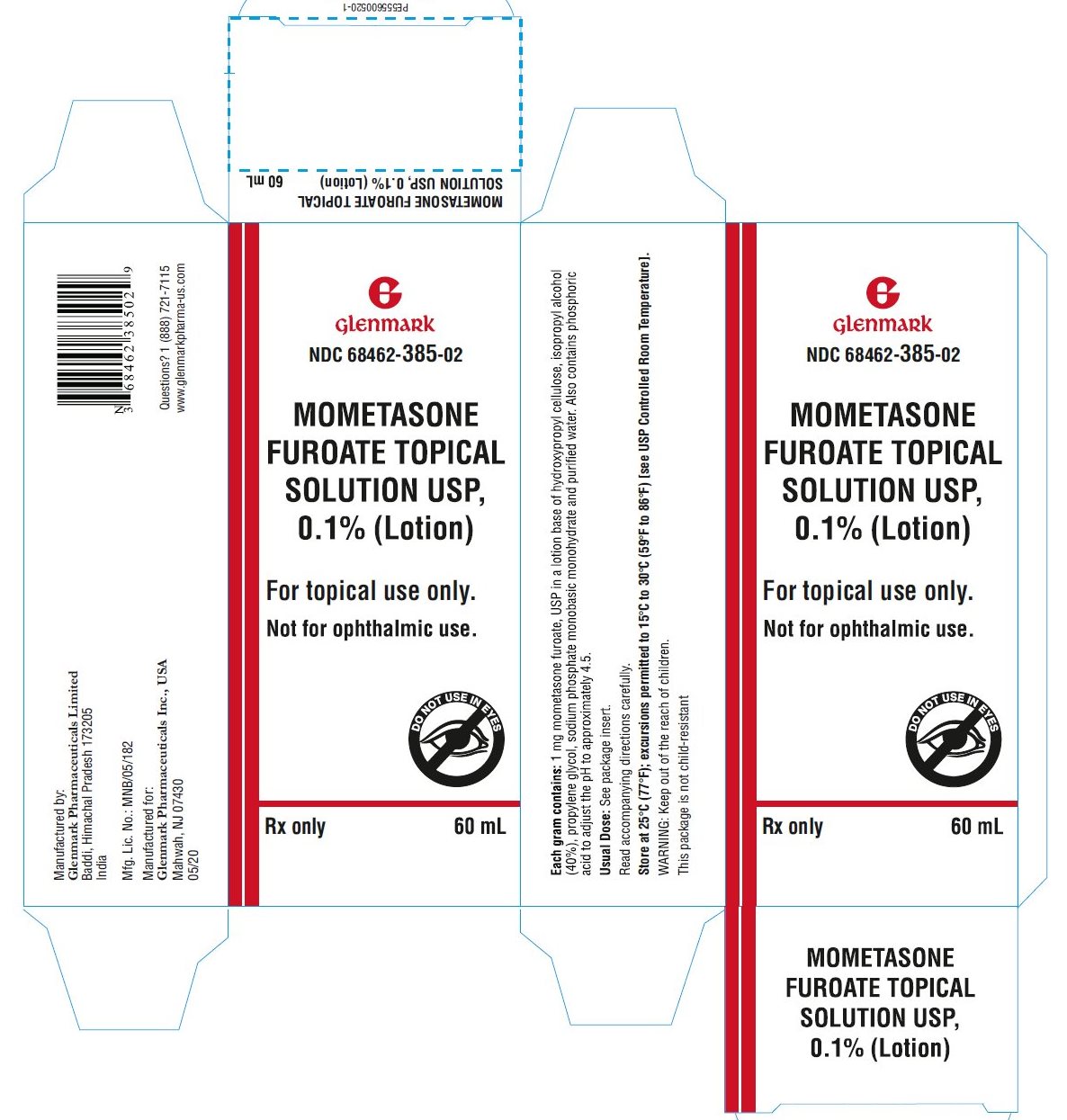
Mometasone Furoate 1 mg/mL Lotion — NDC 68462-385-02 (Billing 68462-0385-02)
This is a package of Mometasone Furoate 1 mg/mL Lotion from Glenmark Pharmaceuticals Inc., USA, marketed since Jun 2020 and currently FDA-listed; retail pharmacies pay about $0.3689 per mL (NADAC). It is the main listing for this product, which comes in 2 package sizes.
NDC database record
One package, one record: these facts belong to NDC 68462-385-02 alone.
- Record
- FDA NDC Directory package listing · Human prescription drug
- Code segments
- 68462 labeler · 385 product · 02 package
- Package marketed since
- Jun 1, 2020
- Sample package
- No — commercial package
- Listing certified through
- Dec 31, 2026
- Barcode (UPC)
- 0368462385371
- FDA record last changed
- Jul 24, 2026
Other active recalls for Mometasone Furoate (different manufacturers) — 2 · tap to view
Past resolved recalls for this product (1)
Identity & classification
Regulatory identifiers FDA, NLM and CMS codes for this package
Drug-database identifiers Medi-Span GPI and First Databank GCN / HICL / AHFS classification
- GSN (GCN sequence number): 035527
- GCN: 06034
- GPI-14 (Medi-Span): 90550082102010
- HICL (First Databank): 003329
- AHFS class code: 48:10.08.00
- RxCUI (RxNorm): 151030
Where does this data come from?
- FDA openFDA NDC Directory · synced Oct 1, 2026
- FDA label on DailyMed · label index refreshed Oct 5, 2026
- RxNorm (NLM RxNav) · catalog refreshed Oct 1, 2026
- Medi-Span GPI (licensed)
- First Databank (licensed) · refreshed Oct 1, 2026
RxNorm drug class
This medicine belongs to the Corticosteroid class.
Where does this data come from?
- RxClass (NLM) · catalog refreshed Oct 1, 2026
Clinical
Mometasone topical is used to relieve the redness, swelling, itching, inflammation, and discomfort of skin due to various skin conditions. Mometasone is in a class of medications called corticosteroids. It works by activating natural substances in the skin to reduce swelling, redness, and itching.
Read the full MedlinePlus article ↗- It depends on the product. The nasal spray treats hay fever symptoms and nasal polyps, Asmanex inhalers treat asthma long term, Sinuva treats nasal polyps after sinus surgery, and...
- No. Asmanex is for daily control, not quick relief. Use your fast-acting rescue inhaler, and call your doctor if your asthma isn't responding.
- Can I use my Asmanex inhaler during an asthma attack?
- Inhaled steroids can cause thrush, a yeast infection in the mouth and throat. Rinse with water and spit it out, without swallowing, after every dose.
Patient education
Supplement & herbal interactions
Some supplements/herbs that may interact with Mometasone Furoate — tap one for details:
Where does this data come from?
- MedlinePlus (NLM) · refreshed Oct 1, 2026
- FDA label on DailyMed · label index refreshed Oct 5, 2026
Ask a licensed pharmacist directly — free, answered by our team.
Pricing
A drug doesn't have one price. Each row is a different public payment system, and none is what you'd pay at the counter — that depends on your insurance. The ⓘ on each row explains what it measures.
| Price system | Per mL | Per package |
|---|---|---|
| Retail pharmacies payNADAC · weekly | $0.369 | $22.13 / 60 ml |
| Medicaid paysCMS SDUD · 12 mo | No recent Medicaid claims on file for this NDC — rare and low-volume NDCs are suppressed in the public data. | |
| Medicare drug plans payPart D · Q2 2026 | $0.4768 | $28.61 / 60 ml |
Where does this data come from?
- CMS NADAC weekly file · file of Feb 21, 2024
- CMS ASP pricing files · refreshed Sep 20, 2026
- CMS Medicaid State Drug Utilization Data · refreshed Oct 5, 2026
- CMS Part D plan pricing files · refreshed Sep 24, 2026
- VA National Acquisition Center price file
Packaging — all sizes for this product
| Package NDC | Description | Per unit | Per pack | Marketing start | Marketing end | Status |
|---|---|---|---|---|---|---|
| 68462-0385-02 You're viewing this Main listing | 1 BOTTLE in 1 CARTON / 60 mL in 1 BOTTLE | $0.3689 / mL | $22.14 | 2020-06-01 | — | Active |
| 68462-0385-37 68462-385-37 | 1 BOTTLE in 1 CARTON / 30 mL in 1 BOTTLE | $0.3925 / mL | $11.78 | 2020-06-01 | — | Active |
This pack has the lowest per-mL cost of the 2 priced pack sizes ($0.3689 NADAC).
Pack size FAQ
What quantity is in this package?
What NDC number is used to bill for this package of Mometasone Furoate 1 mg/mL Lotion?
Prices are the latest CMS NADAC pharmacy acquisition cost per NDC; per-pack figures are per-unit × pack quantity, shown only when the pack is denominated in the same measure NADAC prices.
Therapeutic equivalents
| Product | Labeler | Pack | NADAC/unit | TE | Status | Price vs. this |
|---|---|---|---|---|---|---|
| Mometasone Furoate 1 mg/mLthis 68462-0385-02 | Glenmark | 1 bottle | $0.369 | — | FDA listed | — |
| Mometasone Furoate 1 mg/mL 21922-0072-01 | Encube | 1 bottle | $0.478 | AB | Availability likely | +29% |
| Mometasone Furoate 1 mg/mL 45802-0118-46 | Padagis | 1 bottle | $0.478 | AB | Availability likely | +29% |
| Mometasone Furoate 1 mg/mL 51672-1305-03 | Sun | 1 bottle | — | — | Discontinued | — |
| Mometasone Furoate 1 mg/mL 63629-8685-01 | Bryant | 1 bottle | — | AB | FDA listed | — |
| Mometasone Furoate 1 mg/mL 72162-1392-03 | Bryant | 1 bottle | — | AB | FDA listed | — |
Where does this data come from?
- FDA openFDA NDC Directory · synced Oct 1, 2026
- FDA Orange Book · refreshed Oct 3, 2026
- CMS NADAC weekly file · file of Feb 21, 2024
Availability & generic status
This product is an FDA-approved generic. Other versions of the same drug are listed under Therapeutic equivalents, least expensive first.
Where does this data come from?
- FDA Orange Book · refreshed Oct 3, 2026
Inactive Ingredients / Excipients
Inactive ingredients, also called excipients, are components of the drug product other than the active ingredient. They may include fillers, dyes, coatings, preservatives, flavors, or other formulation ingredients.
💡 Tap an ingredient (hover on desktop) to see what it is and why it’s used.
-
UNII RFW2ET671P
Hydroxypropyl cellulose is a plant-derived thickening agent made from cellulose. It acts as a binder to hold tablet ingredients together and as a film-former to coat tablets or control how fast the medicine releases.
-
UNII ND2M416302
Isopropyl alcohol is a clear liquid solvent derived from petroleum. In medicines, it dissolves active ingredients and other components, helps the product flow smoothly, and aids in sterilization during manufacturing.
-
UNII E4GA8884NN
Phosphoric acid is a weak mineral acid used in medicines as a buffer and pH adjuster. It helps stabilize the product and control its acidity level.
-
UNII 6DC9Q167V3
Propylene glycol is a clear liquid derived from petroleum or vegetable sources. It acts as a solvent, humectant, and preservative in medicines, helping dissolve active ingredients and maintain product stability.
-
UNII 593YOG76RN
A salt made from sodium and phosphate that helps regulate acidity and maintain proper pH balance in the medicine. It also acts as a buffer to keep the product stable.
-
UNII 059QF0KO0R
Water is a liquid solvent that dissolves and mixes ingredients together in liquid medicines, syrups, and injections. It helps distribute the active drug evenly throughout the product.
6 inactive ingredients listed in the exact product block matched to this NDC.
Where does this data come from?
ingredient classCode="IACT" elements from the exact product block matched by this NDC. Label-section narrative from DailyMed / the openFDA label index is shown separately when available.- FDA label on DailyMed · label index refreshed Oct 5, 2026
- FDA openFDA NDC Directory · synced Oct 1, 2026
Inactive ingredient FAQ
Are inactive ingredients the same for every manufacturer?
Why might an inactive ingredient be missing?
Can inactive ingredients matter?
Manufacturer & labeler
More NDCs from Glenmark Pharmaceuticals Inc., USA labeler code 68462
- norethindrone acetate and ethinyl estradiol and ferrous fumarate Kit NDC 68462-376-29
- Theophylline 400 mg Tablet, Extended Release NDC 68462-380-01
- riluzole 50 mg Tablet, Film Coated NDC 68462-381-10
- Eszopiclone 1 mg Tablet, Film Coated NDC 68462-382-01
- Eszopiclone 2 mg Tablet, Film Coated NDC 68462-383-01
- Eszopiclone 3 mg Tablet, Film Coated NDC 68462-384-01
- solifenacin succinate 5 mg Tablet, Film Coated NDC 68462-386-14
- solifenacin succinate 10 mg Tablet, Film Coated, Extended Release NDC 68462-387-14
- MARLISSA Levonorgestrel and Ethinyl Estradiol Kit NDC 68462-388-29
- Esomeprazole Magnesium 20 mg Capsule, Delayed Release Pellets NDC 68462-390-10
- Esomeprazole Magnesium 40 mg Capsule, Delayed Release Pellets NDC 68462-391-10
- raloxifene hydrochloride 60 mg Tablet, Film Coated NDC 68462-393-01
Where does this data come from?
- FDA openFDA NDC Directory · synced Oct 1, 2026
- Drugs@FDA
Full prescribing information FDA SPL
🎯 Indications and Usage ▾
1 INDICATIONS AND USAGE Mometasone furoate topical solution, 0.1% (lotion) is a corticosteroid indicated for the relief of the inflammatory and pruritic manifestations of corticosteroid-responsive dermatoses in patients 12 years of age or older. Mometasone furoate topical solution (lotion) is a corticosteroid indicated for the relief of the inflammatory and pruritic manifestations of corticosteroid-responsive dermatoses in patients ≥12 years of age. ( 1 )
⏱️ Dosage and Administration ▾
2 DOSAGE AND ADMINISTRATION Apply a few drops of mometasone furoate topical solution to the affected skin areas once daily and massage lightly until it disappears. Therapy should be discontinued when control is achieved. If no improvement is seen within 2 weeks, reassessment of diagnosis may be necessary [see Warnings and Precautions ( 5.1 ) and Use in Specific Populations ( 8.4 )] .
Do not use mometasone furoate topical solution with occlusive dressings unless directed by a physician. Do not apply mometasone furoate topical solution in the diaper area if the patient requires diapers or plastic pants, as these garments constitute occlusive dressing. Mometasone furoate topical solution is for topical use only.
It is not for oral, ophthalmic, or intravaginal use. Avoid use on the face, groin, or axillae. Avoid contact with eyes.
Wash hands after each application. • Apply a few drops to the affected skin areas once daily and massage lightly until it disappears. ( 2 ) • Discontinue therapy when control is achieved. ( 2 ) • If no improvement is seen within 2 weeks, reassess diagnosis.
( 2 ) • Do not use with occlusive dressings unless directed by a physician. ( 2 )
💊 Dosage Forms and Strengths ▾
3 DOSAGE FORMS AND STRENGTHS Lotion, 0.1%. Each gram of Mometasone Furoate Topical Solution USP, 0.1% (Lotion) contains 1 mg of mometasone furoate, USP in a clear transparent slightly viscous solution. • Lotion, 0.1%. ( 3 )
⛔ Contraindications ▾
4 CONTRAINDICATIONS Mometasone furoate topical solution is contraindicated in those patients with a history of hypersensitivity to any of the components in the preparation. • Mometasone furoate topical solution is contraindicated in those patients with a history of hypersensitivity to any of the components in the preparation. ( 4 )
⚠️ Warnings and Cautions ▾
5 WARNINGS AND PRECAUTIONS • Reversible HPA axis suppression with the potential for glucocorticosteroid insufficiency after withdrawal of treatment, Cushing’s syndrome, and hyperglycemia may occur due to systemic absorption. Patients applying a topical steroid to a large surface area or to areas under occlusion should be evaluated periodically for evidence of HPA axis suppression. Modify use should HPA axis suppression develop.
( 5.1 , 8.4 ) • Pediatric patients may be more susceptible to systemic toxicity. ( 5.1 , 8.4 ) • May increase the risk of cataracts and glaucoma. If visual symptoms occur, consider referral to an ophthalmologist.
( Error! Hyperlink reference not valid. )
5.1Effects on Endocrine System Systemic absorption of topical corticosteroids can produce reversible hypothalamic-pituitary-adrenal (HPA) axis suppression with the potential for glucocorticosteroid insufficiency. This may occur during treatment or after withdrawal of treatment. Manifestations of Cushing’s syndrome, hyperglycemia, and glucosuria can also be produced in some patients by systemic absorption of topical corticosteroids while on treatment.
Factors that predispose a patient using a topical corticosteroid to HPA axis suppression include the use of high-potency steroids, large treatment surface areas, prolonged use, use of occlusive dressing, altered skin barrier, liver failure, and young age. Because of the potential for systemic absorption, use of topical corticosteroids may require that patients be periodically evaluated for HPA axis suppression. This may be done by using the adrenocorticotropic hormone (ACTH) stimulation test.
In a study evaluating the effects of mometasone furoate topical solution on the HPA axis, 15 mL were applied without occlusion twice daily (30 mL per day) for 7 days to 4 adult subjects with scalp and body psoriasis. At the end of treatment, the plasma cortisol levels for each of the 4 subjects remained within the normal range and changed little from baseline. If HPA axis suppression is documented, an attempt should be made to gradually withdraw the drug, to reduce the frequency of application, or to substitute a less potent corticosteroid.
Recovery of HPA axis function is generally prompt upon discontinuation of topical corticosteroids. Infrequently, signs and symptoms of glucocorticosteroid insufficiency may occur, requiring supplemental systemic corticosteroids. Pediatric patients may be more susceptible to systemic toxicity from equivalent doses due to their larger skin surface to body mass ratios [ see Use in Specific Populations ( 8.4 )] .
5.2Ophthalmic Adverse Reactions Use of topical corticosteroids may increase the risk of posterior subcapsular cataracts and glaucoma. Cataracts and glaucoma have been reported in postmarketing experience with the use of topical corticosteroid products, including the topical mometasone products [ see Adverse Reactions ( Error! Hyperlink reference not valid. ) ].
Avoid contact of mometasone furoate topical solution with eyes. Advise patients to report any visual symptoms and consider referral to an ophthalmologist for evaluation.
5.3Allergic Contact Dermatitis If irritation develops, mometasone furoate topical solution should be discontinued and appropriate therapy instituted. Allergic contact dermatitis with corticosteroids is usually diagnosed by observing failure to heal rather than noting a clinical exacerbation. Such an observation should be corroborated with appropriate diagnostic patch testing.
5.4Concomitant Skin Infections If concomitant skin infections are present or develop, an appropriate antifungal or antibacterial agent should be used. If a favorable response does not occur promptly, use of mometasone furoate topical solution should be discontinued until the infection has been adequately controlled.
🤒 Adverse Reactions ▾
6 ADVERSE REACTIONS Most common adverse reactions included are acneiform reaction, burning, itching and folliculitis. ( 6 ) To report SUSPECTED ADVERSE REACTIONS, contact Glenmark Pharmaceuticals Inc., USA at 1 (888) 721-7115 or FDA at 1-800-FDA-1088 or www.fda.gov/medwatch
6.1Clinical Trials Experience Because clinical trials are conducted under widely varying conditions, adverse reaction rates observed in the clinical trials of a drug cannot be directly compared to rates in the clinical trials of another drug and may not reflect the rates observed in clinical practice. In clinical trials involving 209 subjects, the incidence of adverse reactions associated with the use of mometasone furoate topical solution was 3%. Reported reactions included acneiform reaction, 2; burning, 4; and itching, 1.
In an irritation/sensitization study involving 156 normal subjects, the incidence of folliculitis was 3% (4 subjects). The following adverse reactions were reported to be possibly or probably related to treatment with mometasone furoate topical solution during a clinical trial in 14% of 65 pediatric subjects 6 months to 2 years of age: decreased glucocorticoid levels, 4; paresthesia, 2; dry mouth,1; an unspecified endocrine disorder, 1; pruritus, 1; and an unspecified skin disorder, 1. The following signs of skin atrophy were also observed among 65 subjects treated with mometasone furoate topical solution in a clinical trial: shininess, 4; telangiectasia, 2; loss of elasticity, 2; and loss of normal skin markings, 3.
6.2Postmarketing Experience Because adverse reactions are reported voluntarily from a population of uncertain size, it is not always possible to reliably estimate their frequency or establish a causal relationship to drug exposure. Postmarketing reports for local adverse reactions to topical corticosteroids include irritation, dryness, folliculitis, hypertrichosis, acneiform eruptions, hypopigmentation, perioral dermatitis, allergic contact dermatitis, secondary infection, skin atrophy, striae, and miliaria. These adverse reactions may occur more frequently with the use of occlusive dressings.
Postmarketing reports for ophthalmic adverse reactions to topical corticosteroids include blurred vision, cataracts, glaucoma, increased intraocular pressure, and central serous chorioretinopathy.
🔄 Drug Interactions ▾
7 DRUG INTERACTIONS No drug-drug interaction studies have been conducted with mometasone furoate topical solution.
👥 Use in Specific Populations ▾
8 USE IN SPECIFIC POPULATIONS
8.1Pregnancy There are no adequate and well-controlled studies in pregnant women. Therefore, mometasone furoate topical solution should be used during pregnancy only if the potential benefit justifies the potential risk to the fetus. Corticosteroids have been shown to be teratogenic in laboratory animals when administered systemically at relatively low dosage levels.
Some corticosteroids have been shown to be teratogenic after dermal application in laboratory animals. When administered to pregnant rats, rabbits, and mice, mometasone furoate increased fetal malformations. The doses that produced malformations also decreased fetal growth, as measured by lower fetal weights and/or delayed ossification.
Mometasone furoate also caused dystocia and related complications when administered to rats during the end of pregnancy. In mice, mometasone furoate caused cleft palate at subcutaneous doses of 60 mcg/kg and above. Fetal survival was reduced at 180 mcg/kg.
No toxicity was observed at 20 mcg/kg (Doses of 20, 60, and 180 mcg/kg in the mouse are approximately 0.01, 0.02, and 0.05 times the estimated maximum clinical topical dose from mometasone furoate topical solution on a mcg/m 2 basis). In rats, mometasone furoate produced umbilical hernias at topical doses of 600 mcg/kg and above. A dose of 300 mcg/kg produced delays in ossification, but no malformations (Doses of 300 and 600 mcg/kg in the rat are approximately 0.2 and 0.4 times the estimated maximum clinical topical dose from mometasone furoate topical solution on a mcg/m 2 basis).
In rabbits, mometasone furoate caused multiple malformations (e.g., flexed front paws, gallbladder agenesis, umbilical hernia, hydrocephaly) at topical doses of 150 mcg/kg and above (approximately 0.2 times the estimated maximum clinical topical dose from mometasone furoate topical solution on a mcg/m 2 basis). In an oral study, mometasone furoate increased resorptions and caused cleft palate and/or head malformations (hydrocephaly and domed head) at 700 mcg/kg. At 2800 mcg/kg most litters were aborted or resorbed.
No toxicity was observed at 140 mcg/kg (Doses at 140, 700, and 2800 mcg/kg in the rabbit are approximately 0.2, 0.9, and 3.6 times the estimated maximum clinical topical dose from mometasone furoate topical solution on a mcg/m 2 basis). When rats received subcutaneous doses of mometasone furoate throughout pregnancy or during the later stages of pregnancy, 15 mcg/kg caused prolonged and difficult labor and reduced the number of live births, birth weight, and early pup survival. Similar effects were not observed at 7.5 mcg/kg (Doses of 7.5 and 15 mcg/kg in the rat are approximately 0.005 and 0.01 times the estimated maximum clinical topical dose from mometasone furoate topical solution on a mcg/m 2 basis).
8.3Nursing Mothers Systemically administered corticosteroids appear in human milk and could suppress growth, interfere with endogenous corticosteroid production, or cause other untoward effects. It is not known whether topical administration of corticosteroids could result in sufficient systemic absorption to produce detectable quantities in human milk. Because many drugs are excreted in human milk, caution should be exercised when mometasone furoate topical solution is administered to a nursing woman.
8.4Pediatric Use Since safety and efficacy of mometasone furoate topical solution have not been established in pediatric patients below 12 years of age, its use in this age group is not recommended. Mometasone furoate topical solution caused HPA axis suppression in approximately 29% of pediatric subjects ages 6 to 23 months, who showed normal adrenal function by Cortrosyn test before starting treatment, and were treated for approximately 3 weeks over a mean body surface area of 40% (range 16% to 90%). The criteria for suppression were: basal cortisol level of ≤5 mcg/dL, 30-minute post-stimulation level of ≤18 mcg/dL, or an increase of <7 mcg/dL.
Follow-up test… [Excerpted — this section continues on DailyMed.]
🤰 Pregnancy ▾
8.1Pregnancy There are no adequate and well-controlled studies in pregnant women. Therefore, mometasone furoate topical solution should be used during pregnancy only if the potential benefit justifies the potential risk to the fetus. Corticosteroids have been shown to be teratogenic in laboratory animals when administered systemically at relatively low dosage levels.
Some corticosteroids have been shown to be teratogenic after dermal application in laboratory animals. When administered to pregnant rats, rabbits, and mice, mometasone furoate increased fetal malformations. The doses that produced malformations also decreased fetal growth, as measured by lower fetal weights and/or delayed ossification.
Mometasone furoate also caused dystocia and related complications when administered to rats during the end of pregnancy. In mice, mometasone furoate caused cleft palate at subcutaneous doses of 60 mcg/kg and above. Fetal survival was reduced at 180 mcg/kg.
No toxicity was observed at 20 mcg/kg (Doses of 20, 60, and 180 mcg/kg in the mouse are approximately 0.01, 0.02, and 0.05 times the estimated maximum clinical topical dose from mometasone furoate topical solution on a mcg/m 2 basis). In rats, mometasone furoate produced umbilical hernias at topical doses of 600 mcg/kg and above. A dose of 300 mcg/kg produced delays in ossification, but no malformations (Doses of 300 and 600 mcg/kg in the rat are approximately 0.2 and 0.4 times the estimated maximum clinical topical dose from mometasone furoate topical solution on a mcg/m 2 basis).
In rabbits, mometasone furoate caused multiple malformations (e.g., flexed front paws, gallbladder agenesis, umbilical hernia, hydrocephaly) at topical doses of 150 mcg/kg and above (approximately 0.2 times the estimated maximum clinical topical dose from mometasone furoate topical solution on a mcg/m 2 basis). In an oral study, mometasone furoate increased resorptions and caused cleft palate and/or head malformations (hydrocephaly and domed head) at 700 mcg/kg. At 2800 mcg/kg most litters were aborted or resorbed.
No toxicity was observed at 140 mcg/kg (Doses at 140, 700, and 2800 mcg/kg in the rabbit are approximately 0.2, 0.9, and 3.6 times the estimated maximum clinical topical dose from mometasone furoate topical solution on a mcg/m 2 basis). When rats received subcutaneous doses of mometasone furoate throughout pregnancy or during the later stages of pregnancy, 15 mcg/kg caused prolonged and difficult labor and reduced the number of live births, birth weight, and early pup survival. Similar effects were not observed at 7.5 mcg/kg (Doses of 7.5 and 15 mcg/kg in the rat are approximately 0.005 and 0.01 times the estimated maximum clinical topical dose from mometasone furoate topical solution on a mcg/m 2 basis).
🧒 Pediatric Use ▾
8.4Pediatric Use Since safety and efficacy of mometasone furoate topical solution have not been established in pediatric patients below 12 years of age, its use in this age group is not recommended. Mometasone furoate topical solution caused HPA axis suppression in approximately 29% of pediatric subjects ages 6 to 23 months, who showed normal adrenal function by Cortrosyn test before starting treatment, and were treated for approximately 3 weeks over a mean body surface area of 40% (range 16% to 90%). The criteria for suppression were: basal cortisol level of ≤5 mcg/dL, 30-minute post-stimulation level of ≤18 mcg/dL, or an increase of <7 mcg/dL.
Follow-up testing 2 to 4 weeks after stopping treatment, available for 8 of the subjects, demonstrated suppressed HPA axis function in 1 subject, using these same criteria. Long-term use of topical corticosteroids has not been studied in this population [see Clinical Pharmacology ( Error! Hyperlink reference not valid. )] .
Because of a higher ratio of skin surface area to body mass, pediatric patients are at a greater risk than adults of HPA axis suppression and Cushing’s syndrome when they are treated with topical corticosteroids. They are, therefore, also at greater risk of adrenal insufficiency during and/or after withdrawal of treatment. Pediatric patients may be more susceptible than adults to skin atrophy, including striae, when they are treated with topical corticosteroids.
Pediatric patients applying topical corticosteroids to greater than 20% of body surface are at higher risk of HPA axis suppression. HPA axis suppression, Cushing’s syndrome, linear growth retardation, delayed weight gain, and intracranial hypertension have been reported in pediatric patients receiving topical corticosteroids. Manifestations of adrenal suppression in children include low plasma cortisol levels and absence of response to ACTH stimulation.
Manifestations of intracranial hypertension include bulging fontanelles, headaches, and bilateral papilledema. Mometasone furoate topical solution should not be used in the treatment of diaper dermatitis.
🧓 Geriatric Use ▾
8.5Geriatric Use Clinical trials of mometasone furoate topical solution did not include sufficient numbers of subjects aged 65 and over to determine whether they respond differently from younger subjects. Other reported clinical experience has not identified differences in responses between the elderly and younger patients. In general, dose selection for an elderly patient should be cautious usually starting at the low end of the dosing range.
🆘 Overdosage ▾
10 OVERDOSAGE Topically applied mometasone furoate topical solution can be absorbed in sufficient amounts to produce systemic effects [see Warnings and Precautions ( 5.1 )].
🧬 Clinical Pharmacology ▾
12 CLINICAL PHARMACOLOGY
12.1Mechanism of Action Like other topical corticosteroids, mometasone furoate has anti-inflammatory, antipruritic, and vasoconstrictive properties. The mechanism of the anti-inflammatory activity of the topical steroids, in general, is unclear. However, corticosteroids are thought to act by the induction of phospholipase A 2 inhibitory proteins, collectively called lipocortins.
It is postulated that these proteins control the biosynthesis of potent mediators of inflammation such as prostaglandins and leukotrienes by inhibiting the release of their common precursor arachidonic acid. Arachidonic acid is released from membrane phospholipids by phospholipase A 2.
12.2Pharmacodynamics Studies performed with mometasone furoate topical solution indicate that it is in the medium range of potency as compared with other topical corticosteroids. In a study evaluating the effects of mometasone furoate topical solution on the HPA axis, 15 mL were applied without occlusion twice daily (30 mL per day) for 7 days to 4 adult subjects with scalp and body psoriasis. At the end of treatment, the plasma cortisol levels for each of the 4 subjects remained within the normal range and changed little from baseline [see Warnings and Precautions ( 5.1 )] .
Sixty-five pediatric subjects ages 6 to 23 months, with atopic dermatitis, were enrolled in an open-label, HPA axis safety trial. Mometasone furoate topical solution was applied once daily for approximately 3 weeks over a mean body surface area of 40% (range 16%-90%). In approximately 29% of subjects who showed normal adrenal function by Cortrosyn test before starting treatment, adrenal suppression was observed at the end of treatment with mometasone furoate topical solution.
The criteria for suppression were: basal cortisol level of ≤5 mcg/dL, 30-minute post-stimulation level of ≤18 mcg/dL, or an increase of <7 mcg/dL. Follow-up testing 2 to 4 weeks after stopping treatment, available for 8 of the subjects, demonstrated suppressed HPA axis function in 1 subject, using these same criteria [see Use in Specific Populations ( 8.4 )] .
12.3Pharmacokinetics The extent of percutaneous absorption of topical corticosteroids is determined by many factors including the vehicle and the integrity of the epidermal barrier. Studies in humans indicate that approximately 0.7% of the applied dose of mometasone furoate ointment enters the circulation after 8 hours of contact on normal skin without occlusion. A similar minimal degree of absorption of the corticosteroid from the lotion formulation would be anticipated.
Inflammation and/or other disease processes in the skin may increase percutaneous absorption.
🧬 Mechanism of Action ▾
12.1Mechanism of Action Like other topical corticosteroids, mometasone furoate has anti-inflammatory, antipruritic, and vasoconstrictive properties. The mechanism of the anti-inflammatory activity of the topical steroids, in general, is unclear. However, corticosteroids are thought to act by the induction of phospholipase A 2 inhibitory proteins, collectively called lipocortins.
It is postulated that these proteins control the biosynthesis of potent mediators of inflammation such as prostaglandins and leukotrienes by inhibiting the release of their common precursor arachidonic acid. Arachidonic acid is released from membrane phospholipids by phospholipase A 2.
📦 How Supplied / Storage and Handling ▾
16 HOW SUPPLIED/STORAGE AND HANDLING Mometasone Furoate Topical Solution USP, 0.1% (Lotion) is clear transparent slightly viscous solution and supplied in 30 mL (NDC 68462-385-37) and 60 mL (NDC 68462-385-02) bottles. Store Mometasone Furoate Topical Solution USP, 0.1% (Lotion) at 25°C (77°F); excursions permitted to 15°C to 30°C (59°F to 86°F) [see USP Controlled Room Temperature].
📋 Description ▾
11 DESCRIPTION Mometasone Furoate Topical Solution USP, 0.1% (Lotion) contains mometasone furoate, USP for topical use. Mometasone furoate, USP is a synthetic corticosteroid with anti-inflammatory activity. Chemically, mometasone furoate, USP is 9α, 21-dichloro-11β,17-dihydroxy-16α-methylpregna-1,4-diene-3,20-dione 17-(2-furoate), with the empirical formula C 27 H 30 Cl 2 O 6 , a molecular weight of 521.43 g/mol and the following structural formula: Mometasone furoate, USP is a white to off-white powder soluble in acetone and methylene chloride.
Each gram of Mometasone Furoate Topical Solution USP, 0.1% (Lotion) contains: 1 mg mometasone furoate, USP in a lotion base of hydroxypropyl cellulose, isopropyl alcohol (40%), propylene glycol, sodium phosphate monobasic monohydrate and purified water. Also contains phosphoric acid used to adjust the pH to approximately 4.5. chemical-structure
💬 Information for Patients ▾
17 PATIENT COUNSELING INFORMATION Advise the patient to read the FDA-approved patient labeling (Patient Information). Inform patients of the following: • Use mometasone furoate topical solution as directed by the physician. It is for external use only. • Avoid contact with the eyes. • Advise patients to report any visual symptoms to their healthcare providers. • Do not use mometasone furoate topical solution on the face, underarms, or groin areas. • Do not use mometasone furoate topical solution for any disorder other than that for which it was prescribed. • Do not bandage or otherwise cover or wrap the treated skin area so as to be occlusive, unless directed by the physician. • Report any signs of local adverse reactions to the physician. • Advise patients not to use mometasone furoate topical solution in the treatment of diaper dermatitis.
Do not apply mometasone furoate topical solution in the diaper area, as diapers or plastic pants may constitute occlusive dressing. • Discontinue therapy when control is achieved. If no improvement is seen within 2 weeks, contact the physician. • Do not use other corticosteroid-containing products with mometasone furoate topical solution without first consulting with the physician. Manufactured by: Glenmark Pharmaceuticals Limited Baddi, Himachal Pradesh 173205, India Manufactured for: Glenmark Pharmaceuticals Inc., USA Mahwah, NJ 07430 Questions?
1 (888) 721-7115 www.glenmarkpharma-us.com May 2020 logo
🍼 Nursing Mothers ▾
8.3Nursing Mothers Systemically administered corticosteroids appear in human milk and could suppress growth, interfere with endogenous corticosteroid production, or cause other untoward effects. It is not known whether topical administration of corticosteroids could result in sufficient systemic absorption to produce detectable quantities in human milk. Because many drugs are excreted in human milk, caution should be exercised when mometasone furoate topical solution is administered to a nursing woman.
🧬 Pharmacokinetics ▾
12.3Pharmacokinetics The extent of percutaneous absorption of topical corticosteroids is determined by many factors including the vehicle and the integrity of the epidermal barrier. Studies in humans indicate that approximately 0.7% of the applied dose of mometasone furoate ointment enters the circulation after 8 hours of contact on normal skin without occlusion. A similar minimal degree of absorption of the corticosteroid from the lotion formulation would be anticipated.
Inflammation and/or other disease processes in the skin may increase percutaneous absorption.
🧬 Pharmacodynamics ▾
12.2Pharmacodynamics Studies performed with mometasone furoate topical solution indicate that it is in the medium range of potency as compared with other topical corticosteroids. In a study evaluating the effects of mometasone furoate topical solution on the HPA axis, 15 mL were applied without occlusion twice daily (30 mL per day) for 7 days to 4 adult subjects with scalp and body psoriasis. At the end of treatment, the plasma cortisol levels for each of the 4 subjects remained within the normal range and changed little from baseline [see Warnings and Precautions ( 5.1 )] .
Sixty-five pediatric subjects ages 6 to 23 months, with atopic dermatitis, were enrolled in an open-label, HPA axis safety trial. Mometasone furoate topical solution was applied once daily for approximately 3 weeks over a mean body surface area of 40% (range 16%-90%). In approximately 29% of subjects who showed normal adrenal function by Cortrosyn test before starting treatment, adrenal suppression was observed at the end of treatment with mometasone furoate topical solution.
The criteria for suppression were: basal cortisol level of ≤5 mcg/dL, 30-minute post-stimulation level of ≤18 mcg/dL, or an increase of <7 mcg/dL. Follow-up testing 2 to 4 weeks after stopping treatment, available for 8 of the subjects, demonstrated suppressed HPA axis function in 1 subject, using these same criteria [see Use in Specific Populations ( 8.4 )] .
🔬 Clinical Studies ▾
14 CLINICAL STUDIES The safety and efficacy of mometasone furoate topical solution, 0.1% for the treatment of corticosteroid-responsive dermatoses was demonstrated in two vehicle-controlled trials, one in scalp psoriasis and one in seborrheic dermatitis. A total of 405 subjects (age range: 12 to 95 years) received mometasone furoate topical solution (205 subjects) or the vehicle lotion applied once daily for 21 days.
🧪 Nonclinical Toxicology ▾
13 NONCLINICAL TOXICOLOGY
13.1Carcinogenesis, Mutagenesis, Impairment of Fertility Long-term animal studies have not been performed to evaluate the carcinogenic potential of mometasone furoate topical solution. Long-term carcinogenicity studies of mometasone furoate were conducted by the inhalation route in rats and mice. In a 2-year carcinogenicity study in Sprague Dawley rats, mometasone furoate demonstrated no statistically significant increase of tumors at inhalation doses up to 67 mcg/kg (approximately 0.04 times the estimated maximum clinical topical dose from mometasone furoate topical solution on a mcg/m 2 basis).
In a 19-month carcinogenicity study in Swiss CD-1 mice, mometasone furoate demonstrated no statistically significant increase in the incidence of tumors at inhalation doses up to 160 mcg/kg (approximately 0.05 times the estimated maximum clinical topical dose from mometasone furoate topical solution on a mcg/m 2 basis). Mometasone furoate increased chromosomal aberrations in an in vitro Chinese hamster ovary cell assay, but did not increase chromosomal aberrations in an in vitro Chinese hamster lung cell assay. Mometasone furoate was not mutagenic in the Ames test or mouse lymphoma assay, and was not clastogenic in an in vivo mouse micronucleus assay, a rat bone marrow chromosomal aberration assay, or a mouse male germ-cell chromosomal aberration assay.
Mometasone furoate also did not induce unscheduled DNA synthesis in vivo in rat hepatocytes. In reproductive studies in rats, impairment of fertility was not produced in male or female rats by subcutaneous doses up to 15 mcg/kg (approximately 0.01 times the estimated maximum clinical topical dose from mometasone furoate topical solution on a mcg/m 2 basis).
📄 Carcinogenesis, Mutagenesis, Impairment of Fertility ▾
13.1Carcinogenesis, Mutagenesis, Impairment of Fertility Long-term animal studies have not been performed to evaluate the carcinogenic potential of mometasone furoate topical solution. Long-term carcinogenicity studies of mometasone furoate were conducted by the inhalation route in rats and mice. In a 2-year carcinogenicity study in Sprague Dawley rats, mometasone furoate demonstrated no statistically significant increase of tumors at inhalation doses up to 67 mcg/kg (approximately 0.04 times the estimated maximum clinical topical dose from mometasone furoate topical solution on a mcg/m 2 basis).
In a 19-month carcinogenicity study in Swiss CD-1 mice, mometasone furoate demonstrated no statistically significant increase in the incidence of tumors at inhalation doses up to 160 mcg/kg (approximately 0.05 times the estimated maximum clinical topical dose from mometasone furoate topical solution on a mcg/m 2 basis). Mometasone furoate increased chromosomal aberrations in an in vitro Chinese hamster ovary cell assay, but did not increase chromosomal aberrations in an in vitro Chinese hamster lung cell assay. Mometasone furoate was not mutagenic in the Ames test or mouse lymphoma assay, and was not clastogenic in an in vivo mouse micronucleus assay, a rat bone marrow chromosomal aberration assay, or a mouse male germ-cell chromosomal aberration assay.
Mometasone furoate also did not induce unscheduled DNA synthesis in vivo in rat hepatocytes. In reproductive studies in rats, impairment of fertility was not produced in male or female rats by subcutaneous doses up to 15 mcg/kg (approximately 0.01 times the estimated maximum clinical topical dose from mometasone furoate topical solution on a mcg/m 2 basis).
📄 Patient Package Insert ▾
Patient Information Mometasone Furoate (moe-MET-a-sone-FYOOR-oh-ate) Topical Solution (Lotion), 0.1% Important information: Mometasone furoate topical solution is for use on skin only . Do not use mometasone furoate topical solution in your eyes, mouth, or vagina. What is Mometasone furoate topical solution? • Mometasone furoate topical solution is a prescription medicine used on the skin (topical) for the relief of redness, swelling, heat, pain (inflammation) and itching, caused by certain skin problems in people 12 years of age and older. • It is not known if mometasone furoate topical solution is safe and effective for use in children under 12 years of age. • Mometasone furoate topical solution should not be used in children under 12 years of age.
Do not use mometasone furoate topical solution if you are allergic to mometasone furoate or any of the ingredients in mometasone furoate topical solution. See the end of this leaflet for a complete list of ingredients in mometasone furoate topical solution. Before using mometasone furoate topical solution, tell your healthcare provider about all your medical conditions, including if you: • have a skin infection at the site to be treated.
You may also need medicine to treat the skin infection. • are pregnant or plan to become pregnant. It is not known if mometasone furoate topical solution will harm your unborn baby. • are breastfeeding or plan to breastfeed. It is not known if mometasone furoate topical solution passes into your breast milk.
Tell your healthcare provider about all the medicines you take , including prescription and over-the-counter medicines, vitamins, and herbal supplements. Especially tell your healthcare provider if you take other corticosteroid medicines by mouth or use other products on your skin or scalp that contain corticosteroids. How should I use mometasone furoate topical solution? • Use mometasone furoate topical solution exactly as your healthcare provider tells you to use it. • Apply a few drops of mometasone furoate topical solution to the affected skin area 1 time each day and rub it in lightly until it disappears. • Use mometasone furoate topical solution until the affected skin area is improved.
Tell your healthcare provider if the treated skin area does not get better after 2 weeks of treatment. • Do not bandage, cover, or wrap the treated skin area unless your healthcare provider tells you to. • Mometasone furoate topical solution should not be used to treat diaper rash or redness. Avoid using mometasone furoate topical solution in the diaper area if wearing diapers or plastic pants. • Avoid using mometasone furoate topical solution on the face, groin, or underarms (armpits). • Wash your hands after applying mometasone furoate topical solution .
What are the possible side effects of mometasone furoate topical solution ? Mometasone furoate topical solution may cause serious side effects, including: • Mometasone furoate topical solution can pass through your skin . Too much mometasone furoate topical solution passing through your skin can cause your adrenal glands to stop working properly.
Your healthcare provider may do blood tests to check for adrenal gland problems. • Vision problems . Topical corticosteroids may increase your chance of developing vision problems such as cataract and glaucoma. Tell your healthcare provider if you develop blurred vision or other vision problems during treatment with mometasone furoate topical solution. • Skin problems .
Skin problems may happen during treatment with mometasone furoate topical solution, including allergic reactions (contact dermatitis) and skin infections at the treatment site. Stop using mometasone furoate topical solution and tell your healthcare provider if you develop any skin reactions such as pain, tenderness, swelling, or problems healing during treatment with mometasone furoate topical solution. The most common side effects of mometasone furoate topical solution include burning, itching,… [Excerpted — this section continues on DailyMed.]
📄 Package Label / Principal Display Panel ▾
PACKAGE/LABEL PRINCIPAL DISPLAY PANEL-30 ML NDC 68462-385-37 Mometasone Furoate Topical Solution, USP 0.1% (Lotion) 30 ml- Carton carton-30-ml
PACKAGE/LABEL PRINCIPAL DISPLAY PANEL-60 ML NDC 68462-385-02 Mometasone Furoate Topical Solution, USP 0.1% (Lotion) 60 ml- Carton 60-ml-carton