
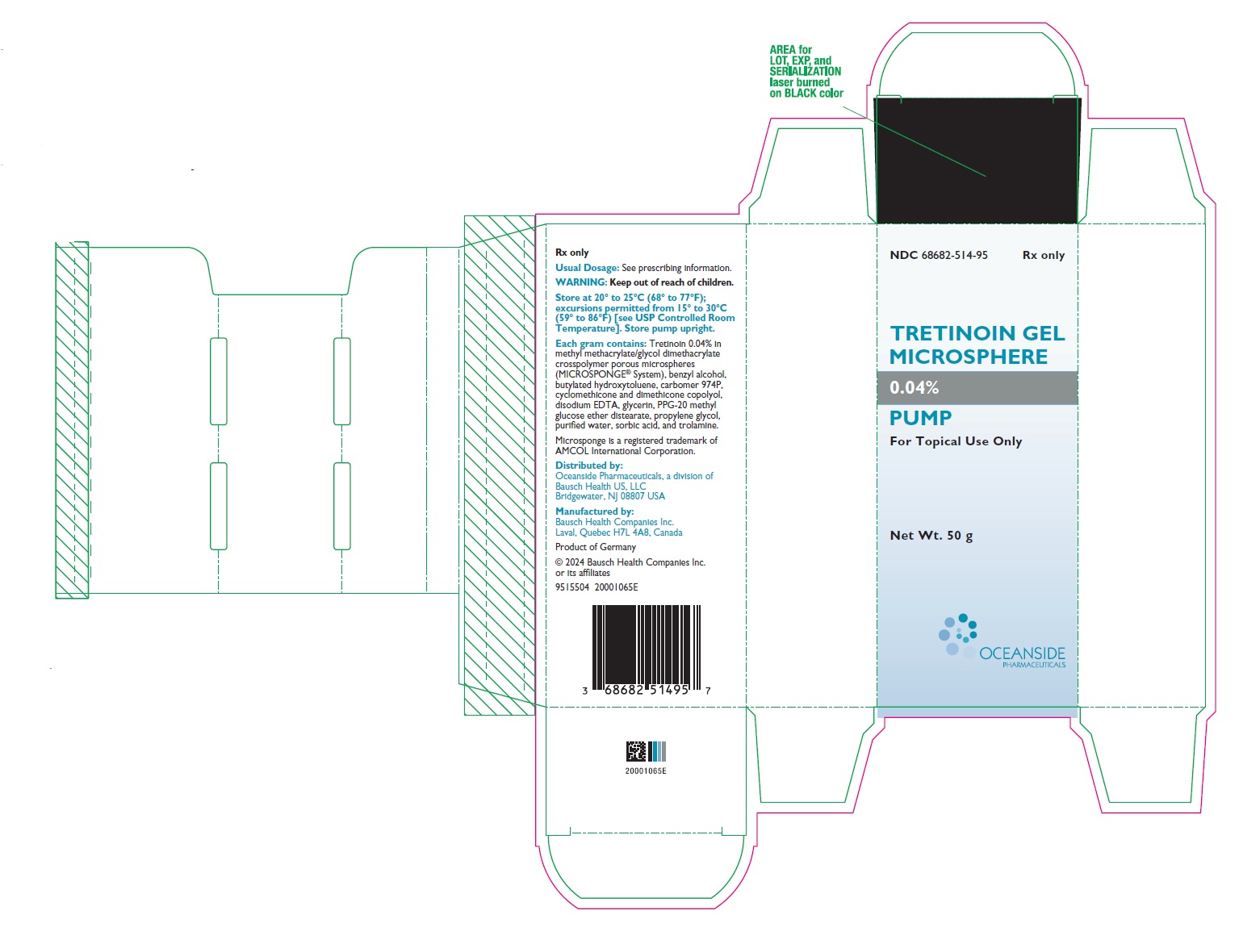
Tretinoin .4 mg/g Gel — NDC 68682-514-95 (Billing 68682-0514-95)
This is a package of Tretinoin .4 mg/g Gel from Oceanside Pharmaceuticals, marketed since Mar 2013 and currently FDA-listed.
Identity & classification
Regulatory identifiers FDA, NLM and CMS codes for this package
Drug-database identifiers Medi-Span GPI and First Databank GCN / HICL / AHFS classification
- GSN (GCN sequence number): 068881
- GCN: 31776
- GPI-14 (Medi-Span): 90050030204015
- HICL (First Databank): 032888
- AHFS class code: 10:00.00.00
- RxCUI (RxNorm): 313453
Where does this data come from?
- FDA openFDA NDC Directory · synced Oct 1, 2026
- FDA label on DailyMed · label index refreshed Oct 1, 2026
- RxNorm (NLM RxNav) · catalog refreshed Oct 1, 2026
- Medi-Span GPI (licensed)
- First Databank (licensed) · refreshed Oct 1, 2026
RxNorm drug class
This medicine belongs to the Retinoid class.
Where does this data come from?
- RxClass (NLM) · catalog refreshed Oct 1, 2026
Clinical
Tretinoin is used to treat acne. Tretinoin is also used to reduce fine wrinkles. Tretinoin is in a class of medications called retinoids. It works by increasing production of new skin cells and unclogging pores.
Read the full MedlinePlus article ↗- It depends on the product. Tretinoin gel (microsphere) treats acne vulgaris. Renova cream eases fine facial wrinkles when used with sun protection. Renova doesn’t erase wrinkles or...
- For the gel, wash and dry the area, then apply a thin layer once a day in the evening to where acne appears. Keep it away from your eyes, mouth, nose creases, and mucous membranes....
- That’s common, especially in the first two weeks. A gentle, mild soap and a moisturizer help. Avoid scrubbing and harsh products. Call your doctor if it’s severe, blistering, or ju...
- Acne can flare in the early weeks. If you can tolerate it, don’t quit just for that. Real benefit usually takes more than seven weeks, so give it time.
Patient education
Supplement & herbal interactions
Some supplements/herbs that may interact with Tretinoin — tap one for details:
Tretinoin may be associated with lower levels of 1 nutrient — worth a chat with your pharmacist, not a cause for alarm.
Where does this data come from?
- MedlinePlus (NLM) · refreshed Oct 1, 2026
- FDA label on DailyMed · label index refreshed Oct 1, 2026
Ask a licensed pharmacist directly — free, answered by our team.
Pricing
A drug doesn't have one price. Each row is a different public payment system, and none is what you'd pay at the counter — that depends on your insurance. The ⓘ on each row explains what it measures.
| Price system | Per g | Per package |
|---|---|---|
| Retail pharmacies payNADAC · weekly | Not in the retail survey — common for institutional, discontinued, or low-volume packs. | |
| Medicaid paysCMS SDUD · 12 mo | $7.74 | $387.23 / 50 g |
| Medicare drug plans payPart D · Q2 2026 | $8.96 | $447.96 / 50 g |
Where does this data come from?
- CMS NADAC weekly file
- CMS ASP pricing files · refreshed Sep 20, 2026
- CMS Medicaid State Drug Utilization Data · through Q3 2025
- CMS Part D plan pricing files · refreshed Sep 24, 2026
- VA National Acquisition Center price file
Packaging — all sizes for this product
| Package NDC | Description | Per unit | Per pack | Marketing start | Marketing end | Status |
|---|---|---|---|---|---|---|
| 68682-0514-92 68682-514-92 Main listing | 1 TUBE in 1 CARTON / 20 g in 1 TUBE | $11.45 / g | $229.05 | 2013-03-14 | — | Active |
| 68682-0514-94 68682-514-94 | 1 TUBE in 1 CARTON / 45 g in 1 TUBE | — | — | 2013-03-14 | — | Active |
| 68682-0514-95 You're viewing this | 1 BOTTLE, PUMP in 1 CARTON / 50 g in 1 BOTTLE, PUMP | — | — | 2013-03-14 | — | Active |
In Medicaid, this is the most-dispensed pack of this product — about 71% of fills over the last four reported quarters. See all packs ↓
Pack size FAQ
What quantity is in this package?
What NDC number is used to bill for this package of Tretinoin .4 mg/g Gel?
Prices are the latest CMS NADAC pharmacy acquisition cost per NDC; per-pack figures are per-unit × pack quantity, shown only when the pack is denominated in the same measure NADAC prices.
Therapeutic equivalents
| Product | Labeler | Pack | NADAC/unit | TE | Status | Price vs. this |
|---|---|---|---|---|---|---|
| Tretinoin .4 mg/gthis 68682-0514-95 | Oceanside | 1 bottle | — | — | FDA listed | — |
| Retin-A MICRO .4 mg/g 00187-5144-20 | Bausch | 1 tube | — | — | Discontinued | — |
Where does this data come from?
- FDA openFDA NDC Directory · synced Oct 1, 2026
- FDA Orange Book · refreshed Sep 3, 2026
- CMS NADAC weekly file
Availability & generic status
FDA-approved generic versions are listed, and recent pricing/market data suggests they may be available — see Therapeutic equivalents.
Where does this data come from?
- FDA Orange Book · refreshed Sep 3, 2026
Inactive Ingredients / Excipients
Inactive ingredients, also called excipients, are components of the drug product other than the active ingredient. They may include fillers, dyes, coatings, preservatives, flavors, or other formulation ingredients.
💡 Tap an ingredient (hover on desktop) to see what it is and why it’s used.
-
UNII LKG8494WBH
Benzyl alcohol is a clear liquid used as a preservative and solvent in medicines. It helps prevent bacterial and fungal growth and dissolves other ingredients to create uniform liquid formulations.
-
UNII 1P9D0Z171K
BHT is a synthetic antioxidant that prevents fats and oils in medicines from breaking down and becoming rancid. It helps keep the product stable and effective during storage.
-
UNII HHT01ZNK31
Carbomer Homopolymer Type B is a synthetic polymer made from acrylic acid. It absorbs water and forms a gel, so it's used in medicines as a thickener, suspending agent, and to help create a smooth texture in creams, gels, and lotions.
-
UNII NMQ347994Z
Cyclomethicone is a silicone-based fluid that acts as a lubricant and solvent in medicines. It helps products flow smoothly, reduces friction between particles, and aids in even distribution of active ingredients.
-
UNII 7FLD91C86K
Edetate disodium is a chemical compound that binds and removes certain metal ions. In medicines, it acts as a preservative and stabilizer by preventing metals like calcium from interfering with the product's shelf life and consistency.
-
UNII PDC6A3C0OX
Glycerin is a clear, thick liquid derived from plant oils or fats. It acts as a humectant to retain moisture, a sweetener, and a solvent in medications.
-
UNII 0057334FAB
A synthetic compound derived from glucose that combines water-repelling and water-attracting properties. It works as an emulsifier to help blend oil and water-based ingredients, and may also function as a thickener in creams and lotions.
-
UNII 6DC9Q167V3
Propylene glycol is a clear liquid derived from petroleum or vegetable sources. It acts as a solvent, humectant, and preservative in medicines, helping dissolve active ingredients and maintain product stability.
-
UNII X045WJ989B
Sorbic acid is a preservative derived from berries that prevents mold, yeast, and bacterial growth in medicines. It keeps the product stable and safe during storage.
-
UNII 9O3K93S3TK
Trolamine is an alkaline compound used as a pH buffer and emulsifier in medicines. It helps neutralize acids, stabilize formulations, and enable mixing of oil and water-based ingredients.
-
UNII 059QF0KO0R
Water is a liquid solvent that dissolves and mixes ingredients together in liquid medicines, syrups, and injections. It helps distribute the active drug evenly throughout the product.
11 inactive ingredients listed in the exact product block matched to this NDC.
Where does this data come from?
ingredient classCode="IACT" elements from the exact product block matched by this NDC. Label-section narrative from DailyMed / the openFDA label index is shown separately when available.- FDA label on DailyMed · label index refreshed Oct 1, 2026
- FDA openFDA NDC Directory · synced Oct 1, 2026
Inactive ingredient FAQ
Are inactive ingredients the same for every manufacturer?
Why might an inactive ingredient be missing?
Can inactive ingredients matter?
Manufacturer & labeler
Where does this data come from?
- FDA openFDA NDC Directory · synced Oct 1, 2026
- Drugs@FDA
Full prescribing information FDA SPL
🎯 Indications and Usage ▾
1 INDICATIONS AND USAGE Tretinoin Gel Microsphere is indicated for the topical treatment of acne vulgaris in adults and pediatric patients 12 years of age and older. Tretinoin Gel Microsphere is a retinoid indicated for the topical treatment of acne vulgaris in adults and pediatric patients 12 years of age and older. ( 1 )
⏱️ Dosage and Administration ▾
2 DOSAGE AND ADMINISTRATION For topical use only. Not for oral, ophthalmic, or intravaginal use. • Prior to Tretinoin Gel Microsphere use, thoroughly cleanse area(s) with a mild, non-medicated cleanser then pat the skin dry. • When applying Tretinoin Gel Microsphere, keep away from the eyes, the mouth, paranasal creases of the nose, and mucous membranes. • Apply a thin layer of Tretinoin Gel Microsphere (0.04%, 0.08%, or 0.1%) to skin where acne lesions appear (cover the entire affected area), once daily in the evening.
Do not apply more than a thin layer [see Warning and Precautions (5.1) ] . Improvements in acne lesions may be noticed after two weeks of Tretinoin Gel Microsphere therapy, but more than seven weeks of therapy may be needed for sustained benefit. If Tretinoin Gel Microsphere was temporarily discontinued due to local adverse reactions, Tretinoin Gel Microsphere therapy may be resumed upon resolution of local adverse reactions. • For topical use only.
Not for oral, ophthalmic, or intravaginal use. ( 2 ) • Keep away from eyes, mouth, paranasal creases of the nose, and mucous membranes. ( 2 ) • Apply a thin layer of Tretinoin Gel Microsphere to skin where acne lesions appear (cover the entire affected area) (0.04%, 0.08%, or 0.1%) once daily in the evening.
(2)
💊 Dosage Forms and Strengths ▾
3 DOSAGE FORMS AND STRENGTHS Gel (white to very pale yellow and opaque): • 0.04% (0.4 mg of tretinoin per gram) • 0.08% (0.8 mg of tretinoin per gram) • 0.1% (1 mg of tretinoin per gram). Gel: 0.04%, 0.08%, and 0.1% ( 3 )
⛔ Contraindications ▾
4 CONTRAINDICATIONS None. None. (4 )
⚠️ Warnings and Cautions ▾
5 WARNINGS AND PRECAUTIONS • Local Skin Irritation : Tretinoin Gel Microsphere can cause local skin irritation, including excessive dryness, redness, swelling, peeling, itching, blistering, burning, or stinging. ( 5.1 ) o Avoid use on eczematous skin or during weather extremes, such as severe wind or cold. o To reduce the risk of local skin irritation, wash the treated skin gently, using a mild, non-medicated soap, avoid washing the treated skin too often or scrubbing it hard when washing, and apply a topical moisturizer. o If severe local skin irritation occurs, discontinue use temporarily or permanently. • Initial Worsening of Inflammatory Acne Vulgaris : During the early weeks of Tretinoin Gel Microsphere treatment, an apparent exacerbation of inflammatory lesions may occur.
If Tretinoin Gel Microsphere is tolerated, this should not be considered a reason to discontinue therapy. ( 5.2 ) • Photosensitivity : Tretinoin Gel Microsphere can cause photosensitivity. Advise patients to avoid or minimize unnecessary exposure to UV light, including sunlight and sunlamps.
Advise patients to use sunscreen (SPF ≥15) and sun-protective clothing if UV light exposure cannot be avoided. Avoid use on sunburn skin. ( 5.3 )
5.1Local Skin Irritation Tretinoin Gel Microsphere can cause local skin irritation, including excessive dryness, redness, swelling, peeling, itching, blistering, burning, or stinging [see Adverse Reactions (6.1)] . Use of Tretinoin Gel Microsphere in greater than the recommended dosage (more frequent than once daily application or excessive application) will not result in more rapid or improved acne results and may result in marked redness, peeling, or discomfort. Tretinoin has been reported to cause severe local skin irritation on eczematous skin.
Weather extremes, such as severe wind or cold, may increase the risk of skin irritation in patients using Tretinoin Gel Microsphere. To reduce the risk of local skin irritation, instruct Tretinoin Gel Microsphere-treated patients to: • Avoid use of Tretinoin Gel Microsphere in areas affected by eczema. • Minimize or avoid use of Tretinoin Gel Microsphere with weather extremes. • Wash the treated skin gently, using a mild, non-medicated soap, pat it dry, and avoid washing the treated skin too often or scrubbing it hard when washing.
Tretinoin Gel Microsphere is not recommended with concomitant use of medicated or abrasive soaps and cleansers, products that have a strong drying effect, products with high concentrations of alcohol, astringents, spices, or lime peels. • Apply a topical moisturizer. Advise patients that concomitant use of topical over the counter (OTC) acne products containing benzoyl peroxide, sulfur, resorcinol, or salicylic acid with Tretinoin Gel Microsphere may increase the risk for local skin irritation including dryness, erythema, and peeling.
Consider withholding the use of topical OTC acne products if signs of skin irritation develop. Advise patients to allow the skin irritation effects of the topical OTC acne products to subside before initiation of Tretinoin Gel Microsphere treatment. If severe local skin irritation occurs, discontinue Tretinoin Gel Microsphere use temporarily or permanently.
Efficacy of Tretinoin Gel Microsphere at reduced frequencies of application has not been established.
5.2Initial Worsening of Inflammatory Acne Vulgaris During the early weeks of Tretinoin Gel Microsphere treatment, an apparent exacerbation of inflammatory acne vulgaris lesions may occur. If Tretinoin Gel Microsphere is tolerated, initial worsening of inflammatory acne vulgaris lesions should not be considered a reason to discontinue therapy.
5.3Photosensitivity Tretinoin Gel Microsphere can cause photosensitivity. Advise patients to avoid or minimize unnecessary exposure to ultraviolet (UV) light, including sunlight and sunlamps, while using Tretinoin Gel Microsphere. Advise patients with sunburn to not use Tretinoin Gel Microsphere until the sunburn fully recover… [Excerpted — this section continues on DailyMed.]
🤒 Adverse Reactions ▾
6 ADVERSE REACTIONS Most common adverse reactions were skin irritation, skin burning, erythema, peeling, dryness, itching, and dermatitis. (6.1) To report SUSPECTED ADVERSE REACTIONS, contact Oceanside Pharmaceuticals at 1-800-321-4576 or FDA at 1-800-FDA-1088 or www.fda.gov/medwatch.
6.1Clinical Trials Experience Because clinical trials are conducted under widely varying conditions, adverse reaction rates observed in the clinical trials of a drug cannot be directly compared to rates in the clinical trials of another drug and may not reflect the rates observed in practice. Tretinoin Gel Microsphere, 0.1% The safety of Tretinoin Gel Microsphere, 0.1% for the treatment of acne vulgaris was evaluated in two multicenter, double-blind, randomized, vehicle-controlled clinical trials (Studies 1 and 2).
A total of 347 subjects with acne vulgaris were treated in Studies 1 and 2 in which 172 subjects received Tretinoin Gel Microsphere, 0.1% and 175 subjects received vehicle, applied topically once daily in the evening, for 12 weeks. Mean age was 19 years (range 11-40) and 55% were female [see Clinical Studies (14.1) ] . Tretinoin Gel Microsphere is not approved for use in pediatric patients younger than 12 years of age [see Indications and Usage (1) ] .
In Studies 1 and 2, subjects treated with Tretinoin Gel Microsphere, 0.1% had increased cutaneous irritation scores for erythema, peeling, dryness, burning/stinging, or itching that peaked during the initial two weeks of therapy and decreased thereafter, compared to those treated with vehicle [see Warnings and Precautions (5.1) ] . During the 12-week treatment period, no more than 3% of Tretinoin Gel Microsphere, 0.1%-treated subjects had cutaneous irritation scores indicative of severe cutaneous irritation and 6% (14/224) of Tretinoin Gel Microsphere 0.1%-treated subjects discontinued treatment due to cutaneous irritation.
Of these 14 subjects, four had severe cutaneous irritation after 3 to 5 days of treatment, with blistering in one subject. Tretinoin Gel Microsphere, 0.04% The safety of Tretinoin Gel Microsphere, 0.04% for the treatment of acne vulgaris was evaluated in two multicenter, double-blind, randomized, vehicle-controlled clinical trials (Studies 3 and 4). A total of 451 subjects with acne vulgaris were treated in Studies 3 and 4 in which 225 subjects received Tretinoin Gel Microsphere, 0.04% and 226 subjects received vehicle, applied once daily in the evening, for 12 weeks.
Mean age was 19 years (range 11-49) and 57% were female [see Clinical Studies (14.2) ] . Tretinoin Gel Microsphere is not approved for use in pediatric patients younger than 12 years of age [see Indications and Usage (1) ] . In Studies 3 and 4, subjects treated with Tretinoin Gel Microsphere, 0.04% had increased cutaneous irritation scores for erythema, peeling, dryness, burning/stinging, or itching that peaked during the initial two weeks of therapy and decreased thereafter, compared to those treated with vehicle [see Warnings and Precautions (5.1) ] .
Approximately half of the 225 subjects in the Tretinoin Gel Microsphere, 0.04%-treated group had cutaneous irritation at Week 2. Of the subjects who experienced cutaneous irritation, most had signs or symptoms that were mild in severity (severity was ranked on a 4-point ordinal scale: 0=none, 1=mild, 2=moderate, and 3=severe). Less than 10% of Tretinoin Gel Microsphere, 0.04%-treated subjects experienced moderate cutaneous irritation, and none had severe cutaneous irritation at Week 2.
In Studies 3 and 4, during the 12-week treatment period, the majority of Tretinoin Gel Microsphere, 0.04%-treated subjects experienced cutaneous irritation (mild, moderate, or severe), of which, 1% (2/225) of subjects had cutaneous irritation scores indicative of a severe irritation and 1.3% (3/225) of subjects discontinued treatment due to cutaneous irritation, which included dryness in one subject and peeling and urticaria in another. Tretinoin Gel Microsphere, 0.04% and… [Excerpted — this section continues on DailyMed.]
👥 Use in Specific Populations ▾
8 USE IN SPECIFIC POPULATIONS
8.1Pregnancy Risk Summary Available data from published prospective observational studies and retrospective cohort studies over decades of use of topical tretinoin in pregnant women have not established a drug-associated risk of major birth defects, miscarriage, or adverse maternal or fetal outcomes (see Data) . In animal reproduction studies with pregnant rats, alterations in the vertebrae and ribs of offspring were observed with daily topical dosing of 0.1% Tretinoin Gel (microsponge) during organogenesis at 5 to 10 times the maximum recommended human dose (MRHD).
In animal reproduction studies with pregnant rabbits, fetal malformations, such as domed head and hydrocephaly, were observed in the offspring with daily topical dosing of 0.1% Tretinoin Gel (microsponge) during organogenesis at 10 to 19 times the MRHD [ see Data ]. The background risk of major birth defects and miscarriage for the indicated population is unknown. All pregnancies have a background risk of birth defect, loss, or other adverse outcomes.
In the US general population, the estimated background risk of major birth defects and miscarriage in clinically recognized pregnancies is 2% to 4%, and 15% to 20%, respectively. Data Human Data: Published data from prospective observational studies and retrospective cohort studies on the use of topical tretinoin products during pregnancy have not identified an association with topical tretinoin and major birth defects or miscarriage. The available studies have methodologic limitations, including potential misclassification of exposure, small sample size and in some cases, lack of physical exam by an expert in birth defects.
Animal Data: For purposes of comparison of the animal exposure to systemic human exposure, the MRHD applied topically is defined as 1 gram of Tretinoin Gel Microsphere, 0.1%, applied daily to a 60 kg person (0.017 mg tretinoin/kg body weight). Pregnant rats were treated with 0.1% Tretinoin Gel (microsponge) at daily dermal doses of 0.2, 0.5, and 1 mg/kg/day tretinoin on gestation days 6-15. Alterations were seen in the vertebrae and ribs of the affected offsprings at 0.5 mg/kg/day tretinoin, 5 to 10 times the MRHD based on body surface area (BSA) comparison.
Pregnant rabbits were treated with 0.1% Tretinoin Gel (microsponge) at daily dermal doses of 0.2, 0.5, and 1 mg/kg/day tretinoin on gestation days 7-19. Doses were administered topically for 24 hours a day while wearing Elizabethan collars to prevent ingestion of the drug. Increased incidences of certain alterations, including domed head and hydrocephaly, typical of retinoid-induced fetal malformations in this species were observed at doses of 0.5 and 1 mg/kg/day.
Similar malformations were not observed in the offspring at 0.2 mg/kg/day, 4 times the MRHD based on BSA comparison. In a second rabbit study, pregnant rabbits were treated with 0.1% Tretinoin Gel (microsponge) at daily dermal doses of 0.5 or 1 mg/kg/day tretinoin on gestation days 7-19. Doses were administered topically for six hours per day while pregnant rabbits were restrained in stocks to prevent ingestion.
The offspring of pregnant rabbits exposed to 0.5 or 1 mg/kg/day tretinoin did not show any malformations at doses up to 19 times (1.0 mg/kg/day) the MRHD based on BSA comparison, but fetal resorptions were increased at 0.5 mg/kg (10 times the MRHD based on BSA comparison). Malformations (shortened or kinked tail) were observed in the offspring of pregnant rats treated with topical tretinoin at doses greater than 1 mg/kg/day during the period of organogenesis (10 times the MRHD based on BSA comparison). Anomalies (humerus: short 13%, bent 6%, os parietal incompletely ossified 14%) have also been reported in offspring when 10 mg/kg/day was topically applied to pregnant rats during the period of organogenesis.
Supernumerary ribs have been a consistent finding in newborn rats when dams were treated topically or orally with retinoids. Oral administra… [Excerpted — this section continues on DailyMed.]
🤰 Pregnancy ▾
8.1Pregnancy Risk Summary Available data from published prospective observational studies and retrospective cohort studies over decades of use of topical tretinoin in pregnant women have not established a drug-associated risk of major birth defects, miscarriage, or adverse maternal or fetal outcomes (see Data) . In animal reproduction studies with pregnant rats, alterations in the vertebrae and ribs of offspring were observed with daily topical dosing of 0.1% Tretinoin Gel (microsponge) during organogenesis at 5 to 10 times the maximum recommended human dose (MRHD).
In animal reproduction studies with pregnant rabbits, fetal malformations, such as domed head and hydrocephaly, were observed in the offspring with daily topical dosing of 0.1% Tretinoin Gel (microsponge) during organogenesis at 10 to 19 times the MRHD [ see Data ]. The background risk of major birth defects and miscarriage for the indicated population is unknown. All pregnancies have a background risk of birth defect, loss, or other adverse outcomes.
In the US general population, the estimated background risk of major birth defects and miscarriage in clinically recognized pregnancies is 2% to 4%, and 15% to 20%, respectively. Data Human Data: Published data from prospective observational studies and retrospective cohort studies on the use of topical tretinoin products during pregnancy have not identified an association with topical tretinoin and major birth defects or miscarriage. The available studies have methodologic limitations, including potential misclassification of exposure, small sample size and in some cases, lack of physical exam by an expert in birth defects.
Animal Data: For purposes of comparison of the animal exposure to systemic human exposure, the MRHD applied topically is defined as 1 gram of Tretinoin Gel Microsphere, 0.1%, applied daily to a 60 kg person (0.017 mg tretinoin/kg body weight). Pregnant rats were treated with 0.1% Tretinoin Gel (microsponge) at daily dermal doses of 0.2, 0.5, and 1 mg/kg/day tretinoin on gestation days 6-15. Alterations were seen in the vertebrae and ribs of the affected offsprings at 0.5 mg/kg/day tretinoin, 5 to 10 times the MRHD based on body surface area (BSA) comparison.
Pregnant rabbits were treated with 0.1% Tretinoin Gel (microsponge) at daily dermal doses of 0.2, 0.5, and 1 mg/kg/day tretinoin on gestation days 7-19. Doses were administered topically for 24 hours a day while wearing Elizabethan collars to prevent ingestion of the drug. Increased incidences of certain alterations, including domed head and hydrocephaly, typical of retinoid-induced fetal malformations in this species were observed at doses of 0.5 and 1 mg/kg/day.
Similar malformations were not observed in the offspring at 0.2 mg/kg/day, 4 times the MRHD based on BSA comparison. In a second rabbit study, pregnant rabbits were treated with 0.1% Tretinoin Gel (microsponge) at daily dermal doses of 0.5 or 1 mg/kg/day tretinoin on gestation days 7-19. Doses were administered topically for six hours per day while pregnant rabbits were restrained in stocks to prevent ingestion.
The offspring of pregnant rabbits exposed to 0.5 or 1 mg/kg/day tretinoin did not show any malformations at doses up to 19 times (1.0 mg/kg/day) the MRHD based on BSA comparison, but fetal resorptions were increased at 0.5 mg/kg (10 times the MRHD based on BSA comparison). Malformations (shortened or kinked tail) were observed in the offspring of pregnant rats treated with topical tretinoin at doses greater than 1 mg/kg/day during the period of organogenesis (10 times the MRHD based on BSA comparison). Anomalies (humerus: short 13%, bent 6%, os parietal incompletely ossified 14%) have also been reported in offspring when 10 mg/kg/day was topically applied to pregnant rats during the period of organogenesis.
Supernumerary ribs have been a consistent finding in newborn rats when dams were treated topically or orally with retinoids. Oral administration of tretinoin during organ… [Excerpted — this section continues on DailyMed.]
🧒 Pediatric Use ▾
8.4Pediatric Use The safety and effectiveness of Tretinoin Gel Microsphere for topical application for the treatment of acne vulgaris have been established in pediatric patients aged 12 years and older [see Clinical Studies (14) ] . The safety and effectiveness of Tretinoin Gel Microsphere have not been established in pediatric patients younger than 12 years of age.
🧓 Geriatric Use ▾
8.5Geriatric Use Clinical trials of Tretinoin Gel Microsphere did not include sufficient numbers of subjects aged 65 and over to determine whether they responded differently from younger adult subjects. Acne vulgaris is largely a disease of pediatric and young adult patients. Clinical studies of Tretinoin Gel Microsphere did not include patients 65 years of age and older.
🆘 Overdosage ▾
10 OVERDOSAGE Oral ingestion of large amounts of Tretinoin Gel Microsphere may lead to the same adverse reactions as those associated with excessive oral intake of Vitamin A. Consider contacting the Poison Help Line (1-800-222-1222) or a medical toxicologist for overdose recommendations.
🧬 Clinical Pharmacology ▾
12 CLINICAL PHARMACOLOGY
12.1Mechanism of Action Although tretinoin activates three members of the retinoic acid (RAR) nuclear receptors (RARα, RARβ, and RARγ) which may act to modify gene expression, subsequent protein synthesis, and epithelial cell growth and differentiation, it has not been established whether the clinical effects of tretinoin are mediated through activation of retinoic acid receptors and/or other mechanisms. The exact mechanism of action of topical tretinoin for treatment of acne vulgaris is unknown. Current evidence suggests that topical tretinoin decreases cohesiveness of follicular epithelial cells with decreased microcomedone formation.
Additionally, tretinoin stimulates mitotic activity and increased turnover of follicular epithelial cells causing extrusion of the comedones.
12.3Pharmacokinetics Absorption Tretinoin is a metabolite of Vitamin A. Percutaneous absorption, as determined by the cumulative excretion of radiolabeled drug into urine and feces, was assessed in 44 healthy males and females after single and repeated daily tretinoin applications up to 28 days of 500 mg of a 0.1% tretinoin gel product. In this assessment, estimates of in vivo bioavailability, mean (SD) were 0.82 (0.11)% and 1.41 (0.54)%, for single and multiple daily topical applications, respectively.
The plasma concentrations of tretinoin and its metabolites, 13- cis -retinoic acid, all- trans -4-oxo-retinoic acid, and 13- cis -4-oxo-retinoic acid, generally ranged from 1 to 3 ng/mL and were essentially unaltered after either single or multiple daily applications of Tretinoin Gel Microsphere, 0.1%, relative to baseline levels. Clinical pharmacokinetic studies have not been performed with Tretinoin Gel Microsphere, 0.08%, and 0.04%.
🧬 Mechanism of Action ▾
12.1Mechanism of Action Although tretinoin activates three members of the retinoic acid (RAR) nuclear receptors (RARα, RARβ, and RARγ) which may act to modify gene expression, subsequent protein synthesis, and epithelial cell growth and differentiation, it has not been established whether the clinical effects of tretinoin are mediated through activation of retinoic acid receptors and/or other mechanisms. The exact mechanism of action of topical tretinoin for treatment of acne vulgaris is unknown. Current evidence suggests that topical tretinoin decreases cohesiveness of follicular epithelial cells with decreased microcomedone formation.
Additionally, tretinoin stimulates mitotic activity and increased turnover of follicular epithelial cells causing extrusion of the comedones.
📦 How Supplied / Storage and Handling ▾
16 HOW SUPPLIED/STORAGE AND HANDLING How Supplied Tretinoin Gel Microsphere (tretinoin) is opaque and white to very pale yellow in color and is supplied as follows: Strength Amount of Tretinoin in One Gram of Gel Quantity/Package Type NDC 0.04% 0.4 mg 20 gram tube 68682-514-92 45 gram tube 68682-514-94 50 gram pump 68682-514-95 0.08% 0.8 mg 50 gram pump 68682-515-95 0.1% 1 mg 20 gram tube 68682-513-82 45 gram tube 68682-513-84 50 gram pump 68682-513-85 Storage and Handling Store at 20° to 25°C (68° to 77°F); excursions permitted from 15° to 30°C (59° to 86°F) [see USP Controlled Room Temperature].
Store pump upright.
📋 Description ▾
11 DESCRIPTION Chemically, tretinoin is all-trans-retinoic acid, also known as (all-E)-3,7-dimethyl-9-(2,6,6-trimethyl-1-cyclohexen-1-yl)-2,4,6,8-nonatetraenoic acid. Tretinoin is a retinoid and a metabolite of naturally occurring Vitamin A. Tretinoin has a molecular weight of 300.44, a molecular formula of C 20 H 28 O 2 and the following chemical structure: Tretinoin Gel Microsphere (tretinoin) gel is for topical use.
Each gram of Tretinoin Gel Microsphere gel: • 0.04%, contains 0.4 mg of tretinoin • 0.08%, contains 0.8 mg of tretinoin • 0.1%, contains 1 mg of tretinoin The formulation contains methyl methacrylate/glycol dimethacrylate crosspolymer (MICROSPONGE ® System), propylene glycol dicaprylate/dicaprate and butylated hydroxytoluene. Other components consist of benzyl alcohol, butylated hydroxytoluene, carbomer 974P, cyclomethicone and dimethicone copolyol, disodium EDTA, glycerin, PPG-20 methyl glucose ether distearate, propylene glycol, purified water, sorbic acid, and trolamine.
A structure of a chemical formula AI-generated content may be incorrect.
💬 Information for Patients ▾
17 PATIENT COUNSELING INFORMATION Advise the patient to read the FDA-approved patient labeling (Patient Information). Administration Instruct the patient to [see Dosage and Administration (2) ] : • Thoroughly cleanse treatment area(s) with a mild, non-medicated cleanser then pat the skin dry prior to application of Tretinoin Gel Microsphere. • Avoid contact with eyes, mouth, paranal creases of nose, and mucous membranes when applying Tretinoin Gel Microsphere. • Apply a thin layer of Tretinoin Gel Microsphere to cover the affected area(s).
Local Skin Irritation: Advise the patient that use of Tretinoin Gel Microsphere greater than the recommended dosage will not result in more rapid of improved acne results and may result in marked redness, peeling or discomfort [see Warnings and Precautions (5.1) ] . To reduce the risk of local skin irritation, advise the patient to: • Minimize or avoid use of Tretinoin Gel Microsphere during weather extremes, such as severe wind or cold. • Wash the treated skin gently, using a mild, non-medicated soap, and pat it dry, and avoid washing the treated skin too often or scrubbing it hard when washing. • Not use medicated or abrasive soaps and cleansers, products that have a strong drying effect, products with high concentrations of alcohol, astringents, spices, and lime peels while using Tretinoin Gel Microsphere. • Apply a topical moisturizer when using Tretinoin Gel Microsphere.
Advise the patient that concomitant use of topical OTC acne products containing benzoyl peroxide, sulfur, resorcinol, or salicylic acid with Tretinoin Gel Microsphere may increase the risk of local skin irritation. Advise the patient to withhold the use of topical OTC acne products if signs of skin irritation develop. Advise the patient to allow the skin irritation effects of the topical OTC acne products to subside before initiation of Tretinoin Gel Microsphere [see Warning and Precautions (5.1) ] .
Photosensitivity Advise the patient to avoid or minimize unnecessary exposure to ultraviolet (UV) light, including sunlight and sunlamps, while using Tretinoin Gel Microsphere. Advise the patient to not use Tretinoin Gel Microsphere on sunburn skin. Advise the patient to use sun protection in the form of sunscreen (SPF ≥15) and sun-protective clothing if UV exposure cannot be avoided [see Warnings and Precautions (5.3) ] .
Lactation Advise the female patient to use Tretinoin Gel Microsphere on the smallest area of skin with acne vulgaris and for the shortest duration possible while breastfeeding. To avoid direct infant exposure, instruct the patient who is breastfeeding not to apply Tretinoin Gel Microsphere directly to the nipple and areola [see Use in Specific Populations (8.2) ] . Distributed by: Oceanside Pharmaceuticals, a division of Bausch Health US, LLC Bridgewater, NJ 08807 USA Manufactured by: Bausch Health Companies Inc.
Laval, Quebec H7L 4A8, Canada MICROSPONGE is a registered trademark of AMCOL International Corporation. All other products/brand names and/or logos are trademarks of the respective owners. © 2025 Bausch Health Companies Inc. or its affiliates 9515306
🧬 Pharmacokinetics ▾
12.3Pharmacokinetics Absorption Tretinoin is a metabolite of Vitamin A. Percutaneous absorption, as determined by the cumulative excretion of radiolabeled drug into urine and feces, was assessed in 44 healthy males and females after single and repeated daily tretinoin applications up to 28 days of 500 mg of a 0.1% tretinoin gel product. In this assessment, estimates of in vivo bioavailability, mean (SD) were 0.82 (0.11)% and 1.41 (0.54)%, for single and multiple daily topical applications, respectively.
The plasma concentrations of tretinoin and its metabolites, 13- cis -retinoic acid, all- trans -4-oxo-retinoic acid, and 13- cis -4-oxo-retinoic acid, generally ranged from 1 to 3 ng/mL and were essentially unaltered after either single or multiple daily applications of Tretinoin Gel Microsphere, 0.1%, relative to baseline levels. Clinical pharmacokinetic studies have not been performed with Tretinoin Gel Microsphere, 0.08%, and 0.04%.
🔬 Clinical Studies ▾
14 CLINICAL STUDIES
14.1Clinical Studies with Tretinoin Gel Microsphere, 0.1% The efficacy of Tretinoin Gel Microsphere, 0.1 was evaluated in two double-blind, randomized, vehicle-controlled trials in adult and pediatric subjects 11 years of age and older with acne vulgaris (Studies 1 and 2). Tretinoin Gel Microsphere is not approved for use in pediatric patients younger than 12 years of age [see Indications and Usage (1) ] . Tretinoin Gel Microsphere, 0.1%, applied topically once daily in the evening, was superior to vehicle gel, applied topically once daily, in reducing the acne lesion counts.
The mean reduction in lesion counts from baseline after treatment for 12 weeks are shown in Table 1: Table 1: Mean Percent Reduction in Lesion Counts in Subjects with Acne Vulgaris at Week 12 in Studies 1 and 2 Study 1 Study 2 Tretinoin Gel Microsphere, 0.1% (n=72) Vehicle Gel (n=71) Tretinoin Gel Microsphere, 0.1% (n=72) Vehicle Gel (n=67) Non-inflammatory lesion counts 49% 22% 32% 3% Inflammatory lesion counts 37% 18% 29% 24% Total lesion counts 45% 23% 32% 16% Efficacy was also assessed by the investigator’s global evaluation, which included categories of “excellent”, “good”, “fair”, “no change”, and “poor”.
Tretinoin Gel Microsphere, 0.1%, was significantly superior (p<0.001) to the vehicle in the investigator’s global evaluation of the clinical response: • In Study #1, 35% of Tretinoin Gel Microsphere, 0.1% -treated subjects achieved an “excellent” result, as compared to 11% of vehicle-treated subjects. • In Study #2, 28% of Tretinoin Gel Microsphere, 0.1%-treated subjects achieved an “excellent” result, as compared to 9% of vehicle-treated subjects.
14.2Clinical Studies with Tretinoin Gel Microsphere, 0.04% In two vehicle-controlled clinical trials in adult and pediatric subjects 11 years of age and older with acne vulgaris (Studies 3 and 4). Tretinoin Gel Microsphere is not approved for use in pediatric patients younger than 12 years of age [see Indications and Usage (1) ] . Tretinoin Gel Microsphere, 0.04%, applied topically once daily in the evening, was more effective (p<0.05) than vehicle gel, applied topically once daily, in reducing the acne lesion counts.
The mean reduction in lesion counts from baseline after treatment for 12 weeks are shown in Table 2: Table 2: Mean Percent Reduction in Lesion Counts in Subjects with Acne Vulgaris at Week 12 in Studies 3 and 4 Study 3 Study 4 Tretinoin Gel Microsphere, 0.04% (n=108) Vehicle Gel (n=111) Tretinoin Gel Microsphere, 0.04% (n=110) Vehicle Gel (n=103) Non-inflammatory lesion counts 37% -2% -2% represents a mean percent increase of 2% 29% 14% Inflammatory lesion counts 44% 13% 41% 30% Total lesion counts 40% 8% 35% 20% Efficacy was also assessed by the investigator’s global evaluation, which included categories of “excellent”, “good”, “fair”, “no change”, and “poor”.
Tretinoin Gel Microsphere, 0.04% was superior (p<0.05) to the vehicle in the investigator's global evaluation of the clinical response: • In Study #3, 14% of Tretinoin Gel Microsphere, 0.04%-treated subjects achieved an “excellent” result, as compared to 5% of vehicle-treated subjects. • In Study #4, 19% of Tretinoin Gel Microsphere, 0.04%-treated subjects achieved an “excellent” result, as compared to 9% of vehicle-treated subjects.
🧪 Nonclinical Toxicology ▾
13 NONCLINICAL TOXICOLOGY
13.1Carcinogenesis, Mutagenesis, Impairment of Fertility Dermal carcinogenicity testing has not been performed with Tretinoin Gel Microsphere, 0.04%, 0.08%, or 0.1%. In a 91-week dermal study in which CD-1 mice were administered 0.017% and 0.035% formulations of tretinoin, cutaneous squamous cell carcinomas and papillomas in the treatment area were observed in some female mice. These concentrations are near the tretinoin concentration of the 0.04% and 0.1% clinical formulations.
A dose-dependent incidence of liver tumors in male mice was observed at those same doses. The maximum systemic doses associated with the administered 0.017% and 0.035% formulations are 0.5 and 1 mg/kg/day tretinoin, respectively. These doses are two and four times the MRHD based on BSA comparison.
The biological significance of these findings is not clear because they occurred at doses that exceeded the dermal maximally tolerated dose of tretinoin and because they were within the background natural occurrence rate for these tumors in this strain of mice. There was no evidence of carcinogenic potential when 0.025 mg/kg/day of tretinoin was administered topically to mice (0.1 times the MRHD based on BSA comparison). Studies in hairless albino mice suggest that concurrent exposure to tretinoin may enhance the tumorigenic potential of carcinogenic doses of UVB and UVA light from a solar simulator.
This effect has been confirmed in a later study in pigmented mice, and dark pigmentation did not overcome the enhancement of photocarcinogenesis by 0.05% tretinoin. Although the significance of these studies to humans is not clear, patients should minimize exposure to sunlight or artificial ultraviolet irradiation sources [see Warnings and Precautions (5.3) ] . The genotoxic potential of tretinoin was evaluated in the Ames assay and an in vivo mouse micronucleus assay.
Both tests were negative. The components of the microspheres have shown potential for genetic toxicity and fetal malformation. EGDMA, a component of the excipient acrylates copolymer, was positive for induction of structural chromosomal aberrations in an in vitro chromosomal aberration assay in mammalian cells in the absence of metabolic activation, and negative for genetic toxicity in the Ames assay, and an in vivo mouse micronucleus assay.
In fertility studies in rats with oral tretinoin, the no-observable effect level was 2 mg/kg/day (19 times the MRHD based on BSA comparison).
📄 Carcinogenesis, Mutagenesis, Impairment of Fertility ▾
13.1Carcinogenesis, Mutagenesis, Impairment of Fertility Dermal carcinogenicity testing has not been performed with Tretinoin Gel Microsphere, 0.04%, 0.08%, or 0.1%. In a 91-week dermal study in which CD-1 mice were administered 0.017% and 0.035% formulations of tretinoin, cutaneous squamous cell carcinomas and papillomas in the treatment area were observed in some female mice. These concentrations are near the tretinoin concentration of the 0.04% and 0.1% clinical formulations.
A dose-dependent incidence of liver tumors in male mice was observed at those same doses. The maximum systemic doses associated with the administered 0.017% and 0.035% formulations are 0.5 and 1 mg/kg/day tretinoin, respectively. These doses are two and four times the MRHD based on BSA comparison.
The biological significance of these findings is not clear because they occurred at doses that exceeded the dermal maximally tolerated dose of tretinoin and because they were within the background natural occurrence rate for these tumors in this strain of mice. There was no evidence of carcinogenic potential when 0.025 mg/kg/day of tretinoin was administered topically to mice (0.1 times the MRHD based on BSA comparison). Studies in hairless albino mice suggest that concurrent exposure to tretinoin may enhance the tumorigenic potential of carcinogenic doses of UVB and UVA light from a solar simulator.
This effect has been confirmed in a later study in pigmented mice, and dark pigmentation did not overcome the enhancement of photocarcinogenesis by 0.05% tretinoin. Although the significance of these studies to humans is not clear, patients should minimize exposure to sunlight or artificial ultraviolet irradiation sources [see Warnings and Precautions (5.3) ] . The genotoxic potential of tretinoin was evaluated in the Ames assay and an in vivo mouse micronucleus assay.
Both tests were negative. The components of the microspheres have shown potential for genetic toxicity and fetal malformation. EGDMA, a component of the excipient acrylates copolymer, was positive for induction of structural chromosomal aberrations in an in vitro chromosomal aberration assay in mammalian cells in the absence of metabolic activation, and negative for genetic toxicity in the Ames assay, and an in vivo mouse micronucleus assay.
In fertility studies in rats with oral tretinoin, the no-observable effect level was 2 mg/kg/day (19 times the MRHD based on BSA comparison).
📄 Patient Package Insert ▾
Patient Information Tretinoin Gel Microsphere, 0.1%, 0.08% and 0.04% for topical use Important information: Tretinoin Gel Microsphere is for use on skin (topical use) only. Keep Tretinoin Gel Microsphere away from your eyes, mouth, vagina, or the corners of your nose. What is Tretinoin Gel Microsphere?
Tretinoin Gel Microsphere is a prescription medicine used on the skin (topical) to treat acne in adults and children 12 years of age and older. Acne is a condition in which the skin has blackheads, whiteheads, and other pimples. It is not known if Tretinoin Gel Microsphere is safe and effective in children under 12 years of age.
Before using Tretinoin Gel Microsphere, tell your healthcare provider about all of your medical conditions, including if you: • have a skin condition called eczema. • have a sunburn. You should not use Tretinoin Gel Microsphere until your skin has healed. • are pregnant or plan to become pregnant. It is not known if Tretinoin Gel Microsphere will harm your unborn baby. • are breastfeeding or plan to breastfeed.
It is not known if Tretinoin Gel Microsphere passes into your breast milk. If you breastfeed during treatment with Tretinoin Gel Microsphere, use Tretinoin Gel Microsphere on the smallest area of the skin with acne and for the shortest time possible. Do not apply Tretinoin Gel Microsphere directly to the nipple and areola to avoid contact with your baby.
Tell your healthcare provider about all of the medicines you take, including prescription and over-the-counter medicines, vitamins, and herbal supplements. Especially tell your healthcare provider if you use any skin products that contain benzoyl peroxide, sulfur, resorcinol, or salicylic acid. Using these topical skin products may increase the irritation of your skin when used with Tretinoin Gel Microsphere.
How should I use Tretinoin Gel Microsphere? • Use Tretinoin Gel Microsphere exactly as your healthcare provider tells you to use it. • Before you apply Tretinoin Gel Microsphere, gently wash the affected skin area with a mild, non-medicated soap. Rinse and pat your skin dry. • Apply a thin layer of Tretinoin Gel Microsphere to the affected area 1 time a day in the evening. • Do not use more Tretinoin Gel Microsphere than you need to cover the affected area and do not apply Tretinoin Gel Microsphere more than 1 time a day.
Using too much Tretinoin Gel Microsphere or using it too often will not give you faster or better results, and you may get skin redness, peeling, or discomfort. • You may use moisturizers after applying Tretinoin Gel Microsphere. • Early in your treatment, you may get new pimples. At this stage, it is important to continue using Tretinoin Gel Microsphere. • Your acne may not get better right away. Improvement in your acne may be noticed after 2 weeks of Tretinoin Gel Microsphere treatment, but more than 7 weeks of treatment may be needed before you get the full benefit.
Wash your hands after applying Tretinoin Gel Microsphere. • Tretinoin Gel Microsphere taken by mouth in large amounts may lead to the same side effects as those seen with large amounts of Vitamin A taken by mouth. Call the Poison Help line at 1-800-222-1222 if Tretinoin Gel Microsphere is taken by mouth. What should I avoid while using Tretinoin Gel Microsphere? • You should avoid sunlamps, tanning beds, and ultraviolet light during treatment with Tretinoin Gel Microsphere. • Minimize exposure to sunlight. • If you have to be in the sunlight, are sensitive to sunlight, or are using medicine that cause sensitive to sunlight, use a sunscreen with sun protection factor (SPF) of 15 or more.
Wear a wide-brimmed hat or other protective clothing to cover the treated areas, even on days when it is not sunny, or you are inside. • Do not use Tretinoin Gel Microsphere on sunburn skin until your skin has healed. What are the possible side effects of Tretinoin Gel Microsphere? Tretinoin Gel Microsphere can cause serious side effects, including: • Skin irritation.
Tretinoi… [Excerpted — this section continues on DailyMed.]
📄 Package Label / Principal Display Panel ▾
Package/Label Display Panel NDC 68682-513-85 Rx only TRETINOIN GEL (MICROSPHERE) 0.1% PUMP For Topical Use Only Net Wt. 50 g OCEANSIDE PHARMACEUTICALS 9515706 20001068G carton
0.1
Package/Label Display Panel NDC 68682-514-95 Rx only TRETINOIN GEL (MICROSPHERE) 0.04% PUMP For Topical Use Only Net Wt. 50 g OCEANSIDE PHARMACEUTICALS 9515506 20001065G carton
0.04
Package/Label Display Panel NDC 68682-515-95 TRETINOIN GEL (MICROSPHERE) 0.08% PUMP For Topical Use Only Net Wt. 50 g OCEANSIDE PHARMACEUTICALS 9551805 20001069F carton 0.08
Medicaid utilization & spend
Medicaid utilization by pack size
Medicare Part D spend CMS · PART D · 2026 (Q1)
About this NDC listing & data coverage
What data is (and isn’t) available for this NDC — tap to expand
| NDC identity (package / product / labeler codes) | ✓ Available |
| Labeler | ✓ Available |
| Product & package description | ✓ Available |
| Marketing category & status | ✓ Available |
| Active ingredient / dosage form / route | ✓ Available |
| FDA label (SPL via DailyMed) | ✓ Available |
| Package photos | ✓ Available |
| Inactive ingredients (structured) | ✓ Available |
| NADAC pharmacy acquisition price (CMS) | — Not published for this NDC CMS publishes NADAC only for NDCs reported in its retail-pharmacy survey. |
| Orange Book / therapeutic-equivalence data | — Not published for this NDC Applies only to products approved under an NDA/ANDA; many listings are out of scope. |
| HCPCS J-code billing crosswalk | — Not published for this NDC Most self-administered / retail products have no J-code — that is normal. |
| Medicaid utilization (CMS SDUD) | ✓ Available |