
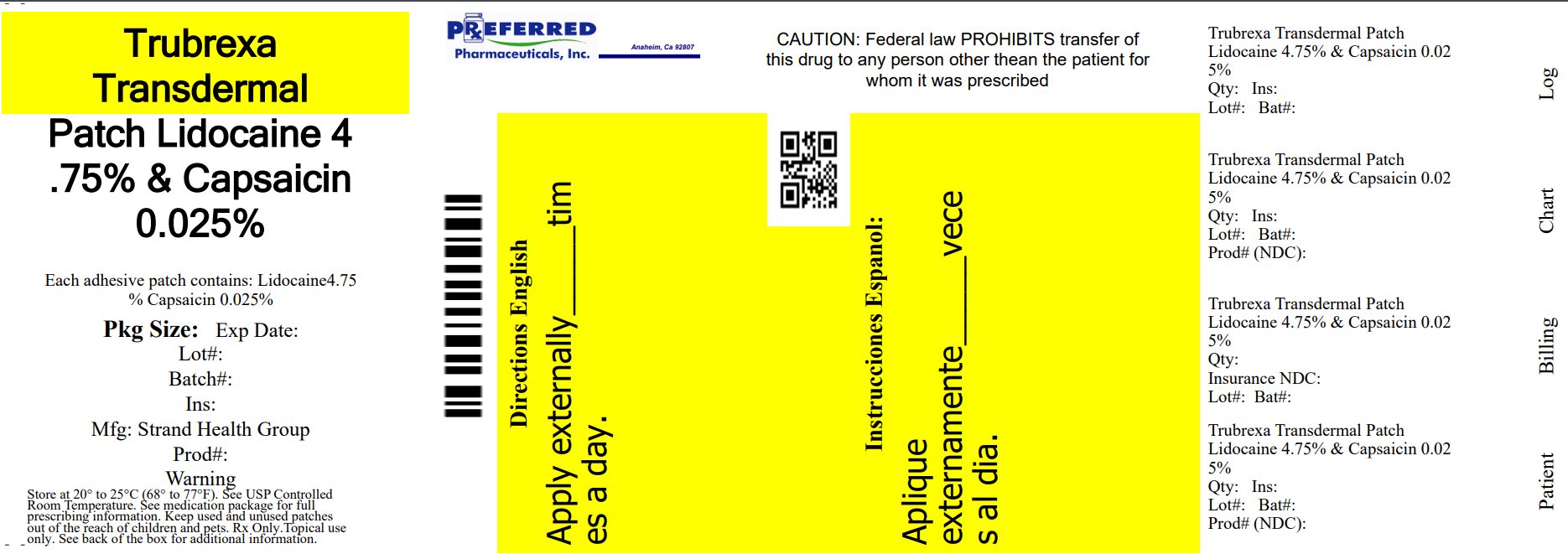
Trubrexa lidocaine and capsaicin .00025 g/g; .0475 g/g Patch, 32 patches — NDC 68788-8599-3 (Billing 68788-8599-03)
This is a package of 32 patches of Trubrexa lidocaine and capsaicin .00025 g/g; .0475 g/g Patch from Preferred Pharmaceuticals Inc., marketed since Mar 2024 and currently FDA-listed. It is this product's only package size.
NDC database record
One package, one record: these facts belong to NDC 68788-8599-3 alone.
- Record
- FDA NDC Directory package listing · Human prescription drug
- Code segments
- 68788 labeler · 8599 product · 3 package
- Package marketed since
- Mar 15, 2024
- Sample package
- No — commercial package
- Listing certified through
- Dec 31, 2026
- Billing quantity
- 32 EA per package
- Barcode (UPC-A, from the NDC)
- 3 6878885993 8
- FDA record last changed
- Jul 24, 2026
Identity & classification
Regulatory identifiers FDA, NLM and CMS codes for this package
- RxCUI (RxNorm): 2667457
Where does this data come from?
- FDA openFDA NDC Directory · synced Oct 1, 2026
- FDA label on DailyMed · label index refreshed Oct 5, 2026
- RxNorm (NLM RxNav) · catalog refreshed Oct 1, 2026
- Medi-Span GPI (licensed)
- First Databank (licensed) · refreshed Oct 1, 2026
RxNorm drug class
This medicine belongs to the Capsaicin and similar agents class.
Where does this data come from?
- RxClass (NLM) · catalog refreshed Oct 1, 2026
Clinical
Capsaicin transdermal patch are used to relieve minor pain in muscles and joints caused by arthritis, backaches, muscle strains, bruises, cramps, and sprains. Capsaicin is a substance that is found in chili peppers. It works by affecting nerve cells in the skin that are associated with pain, which results in decreased activity of these nerve cells and a reduced sense of pain.
Read the full MedlinePlus article ↗Trubrexa is a transdermal patch containing two active ingredients: lidocaine, a local anesthetic, and capsaicin, a compound derived from hot peppers. These ingredients are typically used together in topical products intended to numb and soothe localized areas of discomfort. This is an unapproved prescription drug product, meaning it has not received FDA approval through the standard application process.
Patient education
Supplement & herbal interactions
Where does this data come from?
- MedlinePlus (NLM) · refreshed Oct 1, 2026
- FDA label on DailyMed · label index refreshed Oct 5, 2026
Ask a licensed pharmacist directly — free, answered by our team.
Pricing
A drug doesn't have one price. Each row is a different public payment system, and none is what you'd pay at the counter — that depends on your insurance. The ⓘ on each row explains what it measures.
| Price system | Per each | Per package |
|---|---|---|
| Retail pharmacies payNADAC · weekly | Not in the retail survey — common for institutional, discontinued, or low-volume packs. | |
| Medicaid paysCMS SDUD · 12 mo | No recent Medicaid claims on file for this NDC — rare and low-volume NDCs are suppressed in the public data. | |
| Medicare drug plans payPart D · quarterly | No Part D plan price is available for this NDC in our data. | |
Where does this data come from?
- CMS NADAC weekly file
- CMS ASP pricing files · refreshed Sep 20, 2026
- CMS Medicaid State Drug Utilization Data · refreshed Oct 5, 2026
- CMS Part D plan pricing files · refreshed Sep 24, 2026
- VA National Acquisition Center price file
Packaging — all sizes for this product
| Package NDC | Description | Marketing start | Marketing end | Status |
|---|---|---|---|---|
| 68788-8599-03 You're viewing this Main listing | 8 POUCH in 1 BOX / 4 PATCH in 1 POUCH / 2.7 g in 1 PATCH | 2024-03-15 | — | Active |
Therapeutic equivalents
| Product | Labeler | Pack | NADAC/unit | TE | Status | Price vs. this |
|---|---|---|---|---|---|---|
| Trubrexa .00025 g/g; .0475 g/gthis 68788-8599-03 | Preferred | 32 patches | — | — | FDA listed | — |
| Trubrexa Patch ER .00025 g/g; .0475 g/g 72189-0541-11 | Direct_Rx | 1 patch | — | — | FDA listed | — |
| Trubrexa .00025 g/g; .0475 g/g 76420-0644-32 | Asclemed | 32 patches | — | — | FDA listed | — |
| Trubrexa .00025 g/g; .0475 g/g 80425-0367-01 | Advanced | 32 patches | — | — | FDA listed | — |
| Trubrexa .00025 g/g; .0475 g/g 83295-4000-01 | Strand | 32 patches | — | — | FDA listed | — |
| Trubrexa .00025 g/g; .0475 g/g 85509-4000-03 | PHOENIX | 32 patches | — | — | FDA listed | — |
Where does this data come from?
- FDA openFDA NDC Directory · synced Oct 1, 2026
- FDA Orange Book · refreshed Oct 3, 2026
- CMS NADAC weekly file
Availability & generic status
We did not find an FDA-approved generic match for this exact strength, form and route.
Where does this data come from?
- FDA Orange Book · refreshed Oct 3, 2026
Inactive Ingredients / Excipients
Inactive ingredients, also called excipients, are components of the drug product other than the active ingredient. They may include fillers, dyes, coatings, preservatives, flavors, or other formulation ingredients.
💡 Tap an ingredient (hover on desktop) to see what it is and why it’s used.
-
UNII OZ0E5Y15PZ
A plant extract from arnica flowers, used as a flavoring agent or fragrance component in medicines. It may also provide mild soothing properties to certain topical formulations.
-
UNII PDC6A3C0OX
Glycerin is a clear, thick liquid derived from plant oils or fats. It acts as a humectant to retain moisture, a sweetener, and a solvent in medications.
-
UNII I38ZP9992A
Magnesium is a mineral element used in medications as a binder and filler to help hold tablet ingredients together and add bulk to the formulation.
-
UNII 9G2MAD7J6W
Polyacrylic acid is a synthetic polymer used as a binder and thickening agent in medicines. It helps hold tablet ingredients together and can increase the viscosity of liquid or semi-solid formulations.
-
UNII 059QF0KO0R
Water is a liquid solvent that dissolves and mixes ingredients together in liquid medicines, syrups, and injections. It helps distribute the active drug evenly throughout the product.
5 inactive ingredients listed in the exact product block matched to this NDC.
Where does this data come from?
ingredient classCode="IACT" elements from the exact product block matched by this NDC. Label-section narrative from DailyMed / the openFDA label index is shown separately when available.- FDA label on DailyMed · label index refreshed Oct 5, 2026
- FDA openFDA NDC Directory · synced Oct 1, 2026
Inactive ingredient FAQ
Are inactive ingredients the same for every manufacturer?
Why might an inactive ingredient be missing?
Can inactive ingredients matter?
Manufacturer & labeler
More NDCs from Preferred Pharmaceuticals Inc. labeler code 68788
- good sense ibuprofen 200 mg Tablet, Film Coated NDC 68788-8590-1
- Gentamicin Sulfate 3 mg/mL Solution/ Drops NDC 68788-8592-5
- Fluocinonide .5 mg/g Cream NDC 68788-8593-6
- LidoPro Patch Lidocaine, Menthol, and Methyl Salicylate 4 mg/100mg; .5 mg/100mg; .1 mg/100mg Patch NDC 68788-8594-3
- Propranolol Hydrochloride 20 mg Tablet NDC 68788-8595-3
- Aspirin 81 mg Tablet, Delayed Release NDC 68788-8598-8
- Metformin Hydrochloride 1000 mg Tablet, Film Coated NDC 68788-8600-1
- Polyethylene Glycol 3350 3350 17 g/17g Powder, For Solution NDC 68788-8601-2
- Naproxen 500 mg Tablet NDC 68788-8602-1
- Metformin Hydrochloride 850 mg Tablet NDC 68788-8603-1
- Propranolol Hydrochloride 10 mg Tablet NDC 68788-8604-3
- Loratadine 10 mg Tablet NDC 68788-8605-0
Where does this data come from?
- FDA openFDA NDC Directory · synced Oct 1, 2026
- Drugs@FDA
Full prescribing information FDA SPL
🎯 Indications and Usage ▾
1. INDICATIONS & USAGE Trubrexa TM Transdermal Patch is indicated in adults over the age of 12 years old for the treatment of acute and chronic pain in muscles and joints associated with muscle soreness, strains, sprains, arthritis, simple backache, muscle stiffness, and more.
💊 Dosage Forms and Strengths ▾
2. DOSAGE & ADMINISTRATION
2.1Important Dosage and Administration Instructions • Unintended exposure to capsaicin can cause severe irritation of the eyes, mucous membranes, respiratory tract, and skin in healthcare providers and others. • Because unintended exposure to capsaicin can cause severe irritation of eyes, mucous membranes, respiratory tract, and skin, when administering Trubrexa TM Transdermal Patch it is important to follow these procedures: o Keep Trubrexa TM Transdermal Patch in the sealed pouch until immediately before use. o Use Trubrexa TM Transdermal Patch only on dry, intact (unbroken) skin. o During administration, avoid unnecessary contact with any items in the room, including items that the patient may later have contact with, such as horizontal surfaces and bedsheets. o Immediately after use, clean all areas of skin that had contact with Trubrexa TM Transdermal Patch. o Ensure all used and unused pieces Trubrexa TM Transdermal Patch are properly disposed of.
2.2Dosing and Instructions for Use • Tear open pouch bag and remove one patch. Place remaining patches back in pouch bag and seal the pouch bag closed. • Peel the clear plastic film away and apply Trubrexa TM Transdermal Patch to intact skin to cover the most painful area. Apply one patch per day for up to 12 hours within a 24 hour period (12 on, 12 off).
One single Trubrexa TM Transdermal Patch may be used twice per day. To re-use after first application, place the clear plastic film back on to medicated hydrogel pad. • Clothing may be worn over the area of application. • Wash hands with soap and water after handling the patch. • If irritation or a burning sensation occurs during application, remove the patch and do not reapply until the irritation subsides. • When Trubrexa TM Transdermal Patch is used concomitantly with other products containing local anesthetic agents, the amount absorbed from all formulations must be considered.
3. DOSAGE FORMS & STRENGTHS Trubrexa TM Transdermal Patch contains 4.75% lidocaine and 0.025% capsaicin. Each patch is 2 in x 2 in (5.08 cm x 5.08 cm) and consists of an adhesive side containing the active/inactive ingredients and an outer surface backing layer. The adhesive side is covered with a removable, clear, unprinted, plastic film. The outer surface of the backing layer is imprinted with the Trubrexa TM Transdermal Patch logo.
⛔ Contraindications ▾
4. CONTRAINDICATIONS Trubrexa TM Transdermal Patch is contraindicated in patients with a known history of sensitivity to local anesthetics of the amide type, or to any other component of the product.
⚠️ Warnings and Cautions ▾
5. WARNINGS, PRECAUTIONS & ADVERSE REACTIONS
5.1Risk of Methemoglobinemia Inform patients that use of local anesthetics may cause methemoglobinemia, a serious condition that must be treated promptly. Advise patients or caregivers to stop use and seek immediate medical attention if they or someone in their care experience the following signs or symptoms: pale, gray, or blue colored skin (cyanosis); headache; rapid heart rate; shortness of breath; fatigue; or lightheadedness. Cases of methemoglobinemia have been reported in association with local anesthetic use.
Although all patients are at risk for methemoglobinemia, patients with glucose-6-phosphate dehydrogenase deficiency, congenital or idiopathic methemoglobinemia, cardiac or pulmonary compromise, infants under 6 months of age, and concurrent exposure to oxidizing agents or their metabolites are more susceptible to developing clinical manifestations of the condition. If local anesthetics must be used in these patients, close monitoring for symptoms and signs of methemoglobinemia is recommended. Signs of methemoglobinemia may occur immediately or may be delayed some hours after exposure and are characterized by cyanotic skin discoloration and/or abnormal coloration of the blood.
Methemoglobin levels may continue to rise; therefore, immediate treatment is required to avert more serious central nervous system and cardiovascular adverse effects, including seizures, coma, arrhythmias, and death. Discontinue Trubrexa TM Transdermal Patch and any other oxidizing agents. Depending on the severity of the signs and symptoms, patients may respond to supportive care, i.e., oxygen therapy, hydration, etc.
A more severe clinical presentation may require treatment with methylene blue, exchange transfusion, or hyperbaric oxygen.
5.2Excessive Dosing Excessive dosing by applying Trubrexa TM Transdermal Patch to larger areas or for longer than the recommended wearing time could result in increased absorption of lidocaine and capsaicin and high blood concentrations. Lidocaine toxicity could b e expected at lidocaine blood concentrations above 5 mcg/mL. The blood concentration of lidocaine is determined by the rate of systemic absorption and elimination.
Longer duration of application, application of more than the recommended number of patches, smaller patients, or impaired elimination may all contribute to increasing the blood concentration of lidocaine and capsaicin.
5.3Severe Irritation with Unintended Capsaicin Exposure Unintended exposure to capsaicin can cause severe irritation of eyes, mucous membranes, respiratory tract, and skin. Eye and Mucous Membrane Exposure • Do not apply Trubrexa TM Transdermal Patch to the face, eyes, mouth, nose, or scalp to avoid risk of exposure to eyes or mucous membranes. • Accidental exposure to the eyes and mucous membranes can occur from touching Trubrexa TM Transdermal Patch or items exposed to capsaicin, then touching the eyes and mucous membranes. • If irritation of eyes or mucous membranes occurs, remove the affected individual from the vicinity of Trubrexa TM Transdermal Patch and flush eyes and mucous membranes with cool water.
Respiratory Tract Exposure • Inhalation of airborne capsaicin can result in coughing or sneezing. If irritation of airways occurs, remove the affected individual from the vicinity of Trubrexa TM Transdermal Patch. Provide supportive medical care if shortness of breath develops.
Skin Exposure • Thoroughly clean all areas that had contact with Trubrexa TM Transdermal Patch and properly dispose of all patch components.
5.4Application-Associated Pain During or immediately after treatment with Trubrexa TM Transdermal Patch, the skin at the site of application may develop blisters, bruising, burning sensation, depigmentation, dermatitis, discoloration, edema, erythema, exfoliation, irritation, papules, petechia, pruritus, vesicles, or may be the locus of abnormal sensation. These reactions are generally mild and transient, res… [Excerpted — this section continues on DailyMed.]
🔄 Drug Interactions ▾
6. DRUG INTERACTIONS Antiarrhythmic Drugs Trubrexa TM Transdermal Patch should be used with caution in patients receiving Class I antiarrhythmic drugs (such as tocainide and mexiletine) since the toxic effects are additive and potentially synergistic. Local Anesthetics When Trubrexa TM Transdermal Patch is used concomitantly with other products containing local anesthetic agents, the amount absorbed from all formulations must be considered.
Drugs That May Cause Methemoglobinemia Patients who are administered local anesthetics are at increased risk of developing methemoglobinemia when concurrently exposed to the following drugs, which could include other local anesthetics: Nitrates/Nitrites (nitric oxide, nitroglycerin, nitroprusside, nitrous oxide) Local anesthetics (benzocaine, bupivacaine, lidocaine, prilocaine, procaine, tetracaine) Antineoplastic Agents (cyclophosphamide, flutamide, hydroxyurea, ifosfamide, rasburicase) Antibiotics (dapsone, nitrofurantoin, para-aminosalicylic acid, sulfonamides) Antimalarials (chloroquine, primaquine) Anticonvulsants (Phenobarbital, phenytoin, sodium valproate) Other Drugs (acetaminophen, metoclopramide, quinine, sulfasalazine)
👥 Use in Specific Populations ▾
7. USE IN SPECIFIC POPULATIONS
7.1Pregnancy Trubrexa TM Transdermal Patch has not been studied in pregnancy. Maternal use is not expected to result in fetal exposure. Animal studies have shown no adverse effects when lidocaine and capsaicin are administered and absorbed.
There are, however, no adequate and well-controlled studies in pregnant women. Because animal reproduction studies are not always predictive of human response, Trubrexa TM Transdermal Patch should only be used during pregnancy if clearly needed or advised by a healthcare professional. All pregnancies have a background risk of birth defect, loss, or other adverse outcomes.
7.2Lactation Trubrexa TM Transdermal Patch has not been studied in nursing mothers. Lidocaine is excreted in human milk, and the milk:plasma ration of lidocaine is 0.4. Capsaicin is negligibly absorbed systemically by the mother following topical administration of Trubrexa TM Transdermal Patch.
Caution should be exercised when Trubrexa TM Transdermal Patch is administered to a nursing woman. The developmental and health benefits of breastfeeding should be considered along with the mother’s clinical need for Trubrexa TM Transdermal Patch and any potential adverse effects on the breastfed infant.
7.3Pediatric Use Safety and effectiveness in pediatric patients under the age of 12 have not been studied or established.
7.4Geriatric Use Safety and effectiveness are similar in geriatric patients and younger patients. No dose adjustments are required in geriatric patients.
🆘 Overdosage ▾
8. OVERDOSAGE Lidocaine overdose from cutaneous absorption is rare but could occur. If there is any suspicion of lidocaine overdose, drug blood concentration should be checked.
The management of overdose includes close monitoring, supportive care, and symptomatic treatment. Dialysis is of negligible value in the treatment of acute overdose with lidocaine. In the absence of massive topical overdose or oral ingestion, evaluation of symptoms of toxicity should include consideration of other etiologies for the clinical effects, or overdosage from other sources of lidocaine or other local anesthetics.
There is no specific antidote for overdose with capsaicin. In case of suspected overdose, remove Trubrexa TM Transdermal Patch and gently wash the area with soap and water. Use supportive measures and treat symptoms as clinically warranted.
🧬 Clinical Pharmacology ▾
10. CLINICAL PHARMACOLOGY
10.1Pharmacodynamics Lidocaine is chemically designated as acetamide, 2-(diethylamino)-N-(2,6-dimethylphenyl), has an octanol:water partition ratio of 43 at pH 7.4. Capsaicin is soluble in alcohol, acetone, and ethyl acetate and very slightly soluble in water. Lidocaine is an amide-type local anesthetic agent and is suggested to stabilize neuronal membranes by inhibiting the ionic fluxes required for the initiation and conduction of impulses.
The penetration of lidocaine into intact skin after application of Trubrexa TM Transdermal Patch is sufficient to produce an analgesic effect, but less than the amount necessary to produce a complete sensory block. Capsaicin is an agonist for the transient receptor potential vanilloid 1 receptor (TRPV1), which is an ion channel-receptor complex expressed on nociceptive nerve fibers in the skin. Topical administration of capsaicin causes an initial enhanced stimulation of the TRPV1-expressing cutaneous nociceptors that may be associated with painful sensations.
This is followed by pain relief thought to be mediated by a reduction in TRPV1-expressing nociceptive nerve endings.
10.2Pharmacokinetics The amount of lidocaine and capsaicin systemically absorbed from Trubrexa TM Transdermal Patch is directly related to both the duration of application and the surface area over which it is applied. Systemic exposure decreases upon removal of Trubrexa TM Transdermal Patch. Lidocaine crosses the placental and blood brain barriers, presumably by passive diffusion.
It is not known if lidocaine is metabolized in the skin. Lidocaine is metabolized rapidly by the liver to a number of metabolites, including monoethylglycinexylidide (MEGX) and glycinexylidide (GX), both of which have pharmacologic activity similar to, but less potent than that of lidocaine. Lidocaine and its metabolites are excreted by the kidneys.
📦 How Supplied / Storage and Handling ▾
12. HOW SUPPLIED / STORAGE & HANDLING
12.1How Supplied Trubrexa TM Transdermal Patch comes in a sealed pouch bag. Each patch is 2 in x 2 in (5.08 cm x 5.08 cm) and consists of an adhesive side containing the active/inactive ingredients and an outer surface backing layer. The adhesive side is covered with a removable, clear, unprinted, plastic film.
The outer surface of the backing layer is imprinted with the Trubrexa TM Transdermal Patch logo. Trubrexa TM Transdermal Patch is available as a unit box containing 32 patches (8 pouch bags). NDC 68788-8599-3
12.2Storage Store unit box between 68 o -77 o F (20 o -25 o C). Excursions between 15 o -30 o C (59 o -86 o F) are allowed. Keep Trubrexa TM Transdermal Patch in the sealed pouch bags until immediately before use.
12.3Handling and Disposal Unintended exposure to capsaicin can cause severe irritation of eyes, skin, respiratory tract, and mucous membranes. Avoid contact with your eyes, nose, or mouth. Keep used and unused patches out of the reach of children and pets.
Pouch bags are not child resistant. Wash hands with soap and water after handling the patch. If irritation or a burning sensation occurs during application, remove the patch and do not reapply until the irritation subsides.
After use, fold patches so that the adhesive side sticks to itself, then safely discard used patches where children and pets cannot get to them.
📋 Description ▾
9. DESCRIPTION Trubrexa TM Transdermal Patch is comprised of an adhesive material containing 4.75% lidocaine and 0.025% capsaicin. Each patch is 2 in x 2 in (5.08 cm x 5.08 cm) and consists of an adhesive side containing the active/inactive ingredients and an outer surface backing layer with breathable fabric.
The adhesive side is covered with a removable, clear, unprinted, plastic film. The outer surface of the backing layer is imprinted with the Trubrexa TM Transdermal Patch logo. 4 patches are included in each pouch bag.
The inactive ingredients include: Arnica, Magnesium, Polyacrylate, Vegan Glycerol, and Water. Trubrexa TM Transdermal Patch is Latex Free, Paraben Free, and Vegan.
🧪 Nonclinical Toxicology ▾
11. NONCLINICAL TOXICOLOGY
11.1Carcinogenesis, Mutagenesis, Impairment of Fertility Carcinogenesis A minor metabolite, 2,6-xylidine, has been found to be carcinogenic in rats. The blood concentration of this metabolite is negligible following application of Trubrexa TM Transdermal Patch. Mutagenesis Lidocaine HCl is not mutagenic in Salmonella/mammalian microsome test nor clastogenic in chromosome aberration assay with human lymphocytes and mouse micronucleus test.
Impairment of Fertility The effect of Trubrexa TM Transdermal Patch on fertility has not been studied.
📄 Package Label / Principal Display Panel ▾
A close-up of a document AI-generated content may be incorrect.Trubrexa Transdermal Patch Lidocaine 4.75% Capsaicin 0.025%
About this NDC listing & data coverage
Listed without an FDA application
This product's marketing category indicates it is marketed without an approved FDA application (no NDA, ANDA, or BLA on file). Having an NDC does not by itself establish FDA approval — the NDC Directory is a listing system, not an approval decision. Approval-linked data such as Orange Book therapeutic-equivalence ratings therefore does not apply.
What data is (and isn’t) available for this NDC — tap to expand
| NDC identity (package / product / labeler codes) | ✓ Available |
| Labeler | ✓ Available |
| Product & package description | ✓ Available |
| Marketing category & status | ✓ Available |
| Active ingredient / dosage form / route | ✓ Available |
| FDA label (SPL via DailyMed) | ✓ Available |
| Package photos | ✓ Available |
| Inactive ingredients (structured) | ✓ Available |
| NADAC pharmacy acquisition price (CMS) | — Not published for this NDC CMS publishes NADAC only for NDCs reported in its retail-pharmacy survey. |
| Orange Book / therapeutic-equivalence data | — Not published for this NDC Applies only to products approved under an NDA/ANDA; many listings are out of scope. |
| HCPCS J-code billing crosswalk | — Not published for this NDC Most self-administered / retail products have no J-code — that is normal. |
| Medicaid utilization (CMS SDUD) | — Not published for this NDC CMS reports utilization only for NDCs with Medicaid claims above its privacy threshold. |