
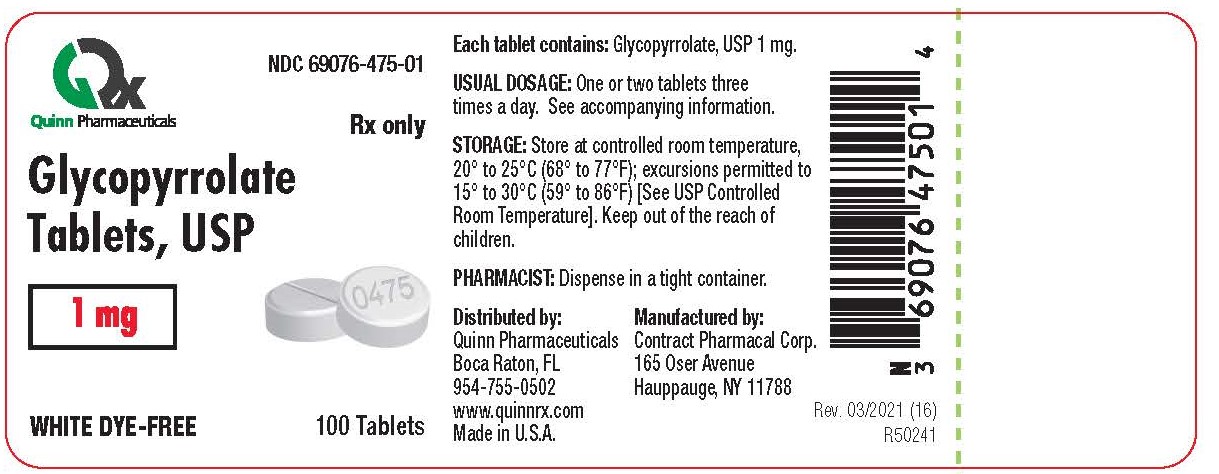
Glycopyrrolate 1 mg Tablet, 100-count — NDC 69076-475-01 (Billing 69076-0475-01)
This is a package of 100 tablets of Glycopyrrolate 1 mg Tablet from Quinn Pharmaceuticals, marketed since May 2021 and currently FDA-listed; retail pharmacies pay about $0.0997 per tablet (NADAC). It is this product's only package size.
NDC database record
One package, one record: these facts belong to NDC 69076-475-01 alone.
- Record
- FDA NDC Directory package listing · Human prescription drug
- Code segments
- 69076 labeler · 475 product · 01 package
- Package marketed since
- May 1, 2021
- Sample package
- No — commercial package
- Listing certified through
- Dec 31, 2026
- Billing quantity
- 100 EA per package
- Barcode (UPC)
- 0369076475014, 0369076476011
- Medicaid fills, this package
- 667 prescriptions in the last four reported quarters
- FDA record last changed
- Jul 24, 2026
Other active recalls for Glycopyrrolate (different manufacturers) — 4 · tap to view
Identity & classification
Regulatory identifiers FDA, NLM and CMS codes for this package
Drug-database identifiers Medi-Span GPI and First Databank GCN / HICL / AHFS classification
- GSN (GCN sequence number): 004887
- GCN: 19130
- GPI-14 (Medi-Span): 49102030000310
- HICL (First Databank): 002028
- AHFS class code: 12:08.08.00
- RxCUI (RxNorm): 197738
Where does this data come from?
- FDA openFDA NDC Directory · synced Oct 1, 2026
- FDA label on DailyMed · label index refreshed Oct 5, 2026
- RxNorm (NLM RxNav) · catalog refreshed Oct 1, 2026
- Medi-Span GPI (licensed)
- First Databank (licensed) · refreshed Oct 1, 2026
RxNorm drug class
This medicine belongs to the Anticholinergic class.
Where does this data come from?
- RxClass (NLM) · catalog refreshed Oct 1, 2026
Clinical
Glycopyrrolate is used in combination with other medications to treat ulcers in adults and children 12 years of age and older. Glycopyrrolate (Cuvposa) is used to reduce saliva and drooling in children between 3 and16 years of age that have certain medical conditions that cause drooling. Glycopyrrolate is in a class of medications called anticholinergics. It decreases stomach acid and saliva production by blocking the activity of a certain natural substance in the body.
Read the full MedlinePlus article ↗Patient education
Supplement & herbal interactions
Some supplements/herbs that may interact with Glycopyrrolate — tap one for details:
Where does this data come from?
- MedlinePlus (NLM) · refreshed Oct 1, 2026
- FDA label on DailyMed · label index refreshed Oct 5, 2026
Ask a licensed pharmacist directly — free, answered by our team.
Pricing
A drug doesn't have one price. Each row is a different public payment system, and none is what you'd pay at the counter — that depends on your insurance. The ⓘ on each row explains what it measures.
| Price system | Per ea | Per package |
|---|---|---|
| Retail pharmacies payNADAC · weekly | $0.100 | $9.97 / 100 tablets |
| Medicaid paysCMS SDUD · 12 mo | $0.2305 | $23.05 / 100 tablets |
| Medicare drug plans payPart D · Q2 2026 | $0.1993 | $19.93 / 100 tablets |
Where does this data come from?
- CMS NADAC weekly file · file of Sep 30, 2026
- CMS ASP pricing files · refreshed Sep 20, 2026
- CMS Medicaid State Drug Utilization Data · through Q1 2026
- CMS Part D plan pricing files · refreshed Sep 24, 2026
- VA National Acquisition Center price file
Packaging — all sizes for this product
| Package NDC | Description | Marketing start | Marketing end | Status |
|---|---|---|---|---|
| 69076-0475-01 You're viewing this Main listing | 100 TABLET in 1 BOTTLE | 2021-05-01 | — | Active |
Therapeutic equivalents
| Product | Labeler | Pack | NADAC/unit | TE | Status | Price vs. this |
|---|---|---|---|---|---|---|
| Glycopyrrolate 1 mg 00904-6709-61 | Major | 100 tablets | $0.100 | AA | Availability likely | — |
| Glycopyrrolate 1 mg 13107-0014-01 | Aurolife | 100 tablets | $0.100 | AA | Availability likely | — |
| Glycopyrrolate 1 mg 23155-0606-01 | Heritage | 100 tablets | $0.100 | AA | Availability likely | — |
| Glycopyrrolate 1 mg 49884-0065-01 | Par | 100 tablets | $0.100 | AA | Availability likely | — |
| Glycopyrrolate 1 mg 50268-0363-15 | AvPAK | 50 tablets | $0.100 | AA | Availability likely | — |
| Glycopyrrolate 1 mg 60687-0458-01 | American | 100 tablets | $0.100 | AA | Availability likely | — |
| Glycopyrrolate 1 mg 62135-0734-60 | Chartwell | 60 tablets | $0.100 | AA | Availability likely | — |
| Glycopyrrolate 1 mgthis 69076-0475-01 | Quinn | 100 tablets | $0.100 | AA | Availability likely | — |
| Glycopyrrolate 1 mg 69315-0139-01 | Leading | 100 tablets | $0.100 | AA | Availability likely | — |
| Glycopyrrolate 1 mg 70752-0108-10 | QUAGEN | 100 tablets | $0.100 | AA | Availability likely | — |
| Glycopyrrolate 1 mg 00615-8617-39 | NCS | 30 tablets | — | AA | FDA listed | — |
| Glycopyrrolate 1 mg 15955-0305-01 | Alembic | 100 tablets | — | AA | FDA listed | — |
| Glycopyrrolate 1 mg 16571-0743-03 | Rising | 30 tablets | — | AA | FDA listed | — |
| Glycopyrrolate 1 mg 55111-0648-01 | Dr. | 100 tablets | — | AA | FDA listed | — |
| Glycopyrrolate 1 mg 63629-2206-01 | Bryant | 100 tablets | — | AA | FDA listed | — |
| Glycopyrrolate 1 mg 63629-7207-01 | Bryant | 30 tablets | — | AA | FDA listed | — |
| Glycopyrrolate 1 mg 63629-9287-01 | Bryant | 100 tablets | — | AA | FDA listed | — |
| Glycopyrrolate 1 mg 70518-4597-00 | REMEDYREPACK | 100 tablets | — | AA | FDA listed | — |
| Glycopyrrolate 1 mg 71335-2075-01 | Bryant | 30 tablets | — | AA | FDA listed | — |
| Glycopyrrolate 1 mg 71335-3090-01 | Bryant | 30 tablets | — | AA | FDA listed | — |
| Glycopyrrolate 1 mg 71335-9652-01 | Bryant | 30 tablets | — | AA | FDA listed | — |
| Glycopyrrolate 1 mg 71921-0110-01 | Florida | 100 tablets | — | AA | FDA listed | — |
| Glycopyrrolate 1 mg 72162-1477-01 | Bryant | 100 tablets | — | AA | FDA listed | — |
| Glycopyrrolate 1 mg 72162-2597-01 | Bryant | 100 tablets | — | AA | FDA listed | — |
| Glycopyrrolate 1 mg 55111-0649-01 | Dr. | 100 tablets | — | AA | FDA listed | — |
Where does this data come from?
- FDA openFDA NDC Directory · synced Oct 1, 2026
- FDA Orange Book · refreshed Oct 3, 2026
- CMS NADAC weekly file · file of Sep 30, 2026
Availability & generic status
This product is an FDA-approved generic. Other versions of the same drug are listed under Therapeutic equivalents, least expensive first.
Where does this data come from?
- FDA Orange Book · refreshed Oct 3, 2026
What it looks like
Where does this data come from?
- FDA label on DailyMed · label index refreshed Oct 5, 2026
Inactive Ingredients / Excipients
Inactive ingredients, also called excipients, are components of the drug product other than the active ingredient. They may include fillers, dyes, coatings, preservatives, flavors, or other formulation ingredients.
💡 Tap an ingredient (hover on desktop) to see what it is and why it’s used.
-
UNII OP1R32D61U
Microcrystalline cellulose is a purified form of cellulose, a natural fiber from plant sources. It acts as a binder and filler in tablets and capsules, helping hold ingredients together and give the medicine its shape and size.
-
UNII EWQ57Q8I5X
Lactose monohydrate is a natural sugar derived from milk. It serves as a filler and binder in tablets and capsules, helping create the proper size, texture, and consistency of the medicine.
-
UNII 70097M6I30
Magnesium stearate is a salt made from magnesium and stearic acid, a fatty substance. It's used in tablets and capsules as a lubricant and glidant to help ingredients flow smoothly during manufacturing and prevent sticking.
-
UNII O8232NY3SJ
A plant-based carbohydrate derived from corn kernels. It acts as a filler to add bulk, a binder to hold ingredients together, and a disintegrant to help the tablet break apart in your stomach for absorption.
4 inactive ingredients listed in the exact product block matched to this NDC.
Where does this data come from?
ingredient classCode="IACT" elements from the exact product block matched by this NDC. Label-section narrative from DailyMed / the openFDA label index is shown separately when available.- FDA label on DailyMed · label index refreshed Oct 5, 2026
- FDA openFDA NDC Directory · synced Oct 1, 2026
Inactive ingredient FAQ
Are inactive ingredients the same for every manufacturer?
Why might an inactive ingredient be missing?
Can inactive ingredients matter?
Manufacturer & labeler
More NDCs from Quinn Pharmaceuticals labeler code 69076
Where does this data come from?
- FDA openFDA NDC Directory · synced Oct 1, 2026
- Drugs@FDA
Full prescribing information FDA SPL
🎯 Indications and Usage ▾
INDICATIONS AND USAGE For use as adjunctive therapy in the treatment of peptic ulcer.
⏱️ Dosage and Administration ▾
DOSAGE AND ADMINISTRATION The dosage of Glycopyrrolate Tablets, USP 1 mg and 2 mg should be adjusted to the needs of the individual patient to assure symptomatic control with a minimum of adverse reactions. The presently recommended maximum daily dosage of glycopyrrolate is 8 mg. Glycopyrrolate Tablets, USP 1 mg The recommended initial dosage of Glycopyrrolate Tablets, USP 1 mg for adults is one tablet three times daily (in the morning, early afternoon, and at bedtime).
Some patients may require two tablets at bedtime to assure overnight control of symptoms. For maintenance, a dosage of one tablet twice a day is frequently adequate. Glycopyrrolate Tablets, USP 2 mg The recommended dosage of Glycopyrrolate Tablets, USP 2 mg for adults is one tablet two or three times daily at equally spaced intervals.
Glycopyrrolate tablets are not recommended for use in pediatric patients under the age of 12 years.
⛔ Contraindications ▾
CONTRAINDICATIONS Glaucoma; obstructive uropathy (for example, bladder neck obstruction due to prostatic hypertrophy); obstructive disease of the gastrointestinal tract (as in achalasia, pyloroduodenal stenosis, etc.); paralytic ileus; intestinal atony of the elderly or debilitated patient; unstable cardiovascular status in acute hemorrhage; severe ulcerative colitis; toxic megacolon complicating ulcerative colitis; myasthenia gravis. Glycopyrrolate Tablets, USP are contraindicated in those patients with a hypersensitivity to glycopyrrolate.
⚠️ Warnings ▾
WARNINGS In the presence of a high environmental temperature, heat prostration (fever and heat stroke due to decreased sweating) can occur with the use of Glycopyrrolate. Diarrhea may be an early symptom of incomplete intestinal obstruction, especially in patients with ileostomy or colostomy. In this instance treatment with this drug would be inappropriate and possibly harmful.
Glycopyrrolate may produce drowsiness or blurred vision. In this event, the patient should be warned not to engage in activities requiring mental alertness such as operating a motor vehicle or other machinery, or performing hazardous work while taking this drug. Theoretically, with overdosage, a curare-like action may occur, i.e., neuro-muscular blockade leading to muscular weakness and possible paralysis.
Pregnancy The safety of this drug during pregnancy has not been established. The use of any drug during pregnancy requires that the potential benefits of the drug be weighed against possible hazards to mother and child. Reproduction studies in rats revealed no teratogenic effects from glycopyrrolate; however, the potent anticholinergic action of this agent resulted in diminished rates of conception and of survival at weaning, in a dose-related manner.
Other studies in dogs suggest that this may be due to diminished seminal secretion which is evident at high doses of glycopyrrolate. Information on possible adverse effects in the pregnant female is limited to uncontrolled data derived from marketing experience. Such experience has revealed no reports of teratogenic or other fetus-damaging potential.
No controlled studies to establish the safety of the drug in pregnancy have been performed. Nursing Mothers It is not known whether this drug is excreted in human milk. As a general rule, nursing should not be undertaken while a patient is on a drug since many drugs are excreted in human milk.
Pediatric Use Since there is no adequate experience in pediatric patients who have received this drug, safety and efficacy in pediatric patients have not been established.
🤒 Adverse Reactions ▾
ADVERSE REACTIONS Anticholinergics produce certain effects, most of which are extensions of their fundamental pharmacological actions. Adverse reactions to anticholinergics in general may include xerostomia; decreased sweating; urinary hesitancy and retention; blurred vision; tachycardia; palpitations; dilatation of the pupil; cycloplegia; increased ocular tension; loss of taste; headaches; nervousness; mental confusion; drowsiness; weakness; dizziness; insomnia; nausea; vomiting; constipation; bloated feeling; impotence; suppression of lactation; severe allergic reaction or drug idiosyncrasies including anaphylaxis, urticaria and other dermal manifestations.
🔄 Drug Interactions ▾
DRUG INTERACTIONS There are no known drug interactions.
🤰 Pregnancy ▾
Pregnancy The safety of this drug during pregnancy has not been established. The use of any drug during pregnancy requires that the potential benefits of the drug be weighed against possible hazards to mother and child. Reproduction studies in rats revealed no teratogenic effects from glycopyrrolate; however, the potent anticholinergic action of this agent resulted in diminished rates of conception and of survival at weaning, in a dose-related manner.
Other studies in dogs suggest that this may be due to diminished seminal secretion which is evident at high doses of glycopyrrolate. Information on possible adverse effects in the pregnant female is limited to uncontrolled data derived from marketing experience. Such experience has revealed no reports of teratogenic or other fetus-damaging potential.
No controlled studies to establish the safety of the drug in pregnancy have been performed.
🧒 Pediatric Use ▾
Pediatric Use Since there is no adequate experience in pediatric patients who have received this drug, safety and efficacy in pediatric patients have not been established.
🆘 Overdosage ▾
OVERDOSAGE The symptoms of overdosage of glycopyrrolate are peripheral in nature rather than central. To guard against further absorption of the drug-use gastric avage, cathartics and/or enemas. To combat peripheral anticholinergic effects (residual mydriasis, dry mouth, etc.)-utilize a quaternary ammonium anticholinesterase, such as neostigmine methylsulfate.
To combat hypotension-use pressor amines (norepinephrine, metaraminol) i.v.; and supportive care. To combat respiratory depression-administer oxygen; utilize a respiratory stimulant such as Dopram ® i.v.; artificial respiration.
🧬 Clinical Pharmacology ▾
CLINICAL PHARMACOLOGY Glycopyrrolate, like other anticholinergic (antimuscarinic) agents, inhibits the action of acetylcholine on structures innervated by postganglionic cholinergic nerves and on smooth muscles that respond to acetylcholine but lack cholinergic innervation. These peripheral cholinergic receptors are present in the autonomic effector cells of smooth muscle, cardiac muscle, the sino-atrial node, the atrioventricular node, exocrine glands, and, to a limited degree, in the autonomic ganglia. Thus, it diminishes the volume and free acidity of gastric secretions and controls excessive pharyngeal, tracheal, and bronchial secretions.
Glycopyrrolate antagonizes muscarinic symptoms (e.g., bronchorrhea, bronchospasm, bradycardia, and intestinal hypermotility) induced by cholinergic drugs such as the anticholinesterases. The highly polar quaternary ammonium group of glycopyrrolate limits its passage across lipid membranes, such as the blood-brain barrier, in contrast to atropine sulfate and scopolamine hydrobromide, which are non-polar tertiary amines which penetrate lipid barriers easily.
📦 How Supplied / Storage and Handling ▾
HOW SUPPLIED Glycopyrrolate Tablets, USP 1 mg are uncoated, round, flat face white tablets with beveled edge and debossed with “0475” on one side and bisected on the other. Glycopyrrolate Tablets, USP 1 mg in bottles of 100 (NDC 69076-475-01). Glycopyrrolate Tablets, USP 2 mg are uncoated, round, flat face white tablets with beveled edges and debossed with “0476” on one side and bisected on the other.
Glycopyrrolate Tablets, USP 2 mg in bottles of 100 (NDC 69076-476-01). Store at controlled room temperature, 20°C to 25°C (68°F to 77°F); excursions permitted to 15°C-30°C (59°F-86°F) [See USP Controlled Room Temperature]. Keep out of reach of children.
Dispense in tight container. Rx only Manufactured by: Contract Pharmacal Corp. 165 Oser Avenue Hauppauge, NY 11788 Distributed by: Quinn Pharmaceuticals 954-755-0502 www.quinnrx.com Made in USA Rev: 03/2021 (4) R50242
📋 Description ▾
Description Glycopyrrolate tablets contain the synthetic anticholinergic, glycopyrrolate. Glycopyrrolate is a quaternary ammonium compound with the following chemical name: 3-[(cyclopentylhydroxyphenylacetyl)oxy]-1, 1-dimethylpyrrolidinium bromide. Each glycopyrrolate tablet USP, intended for oral administration, contains glycopyrrolate equivalent to 1 mg or 2 mg.
In addition, it also contains the following inactive ingredients: lactose monohydrate, dibasic calcium phosphate anhydrous, povidone, sodium starch glycolate and magnesium stearate. The structural formula of glycopyrrolate is represented below: Molecular Formula: C 19 H 28 BrNO 3 Molecular Weight: 398.33 Each tablet contains 1 mg or 2 mg of Glycopyrrolate, USP. Inactive Ingredients: Microcrystalline cellulose, lactose monohydrate, pregelatinized starch, magnesium stearate Chemical Structure
⚠️ Precautions ▾
PRECAUTIONS Use glycopyrrolate with caution in the elderly and in all patients with: Autonomic neuropathy. Hepatic or renal disease. Ulcerative colitis-large doses may suppress intestinal motility to the point of producing a paralytic ileus and for this reason may precipitate or aggravate “toxic megacolon,” a serious complication of the disease.
Hyperthyroidism, coronary heart disease, congestive heart failure, cardiac tachyarrhythmias, tachycardia, hypertension and prostatic hypertrophy. Hiatal hernia associated with reflux esophagitis, since anticholinergic drugs may aggravate this condition.
🍼 Nursing Mothers ▾
Nursing Mothers It is not known whether this drug is excreted in human milk. As a general rule, nursing should not be undertaken while a patient is on a drug since many drugs are excreted in human milk.
📄 Package Label / Principal Display Panel ▾
Quinn Pharmaceuticals NDC 69076-475-01 Rx only Glycopyrrolate Tablets, USP 1 mg WHITE DYE-FREE 100 Tablets Glycopyrrolate tablet - 1 mg Label
Quinn Pharmaceuticals NDC 69076-476-01 Rx only Glycopyrrolate Tablets, USP 2 mg WHITE DYE-FREE 100 Tablets Glycopyrrolate Tablet - 2 mg Label