
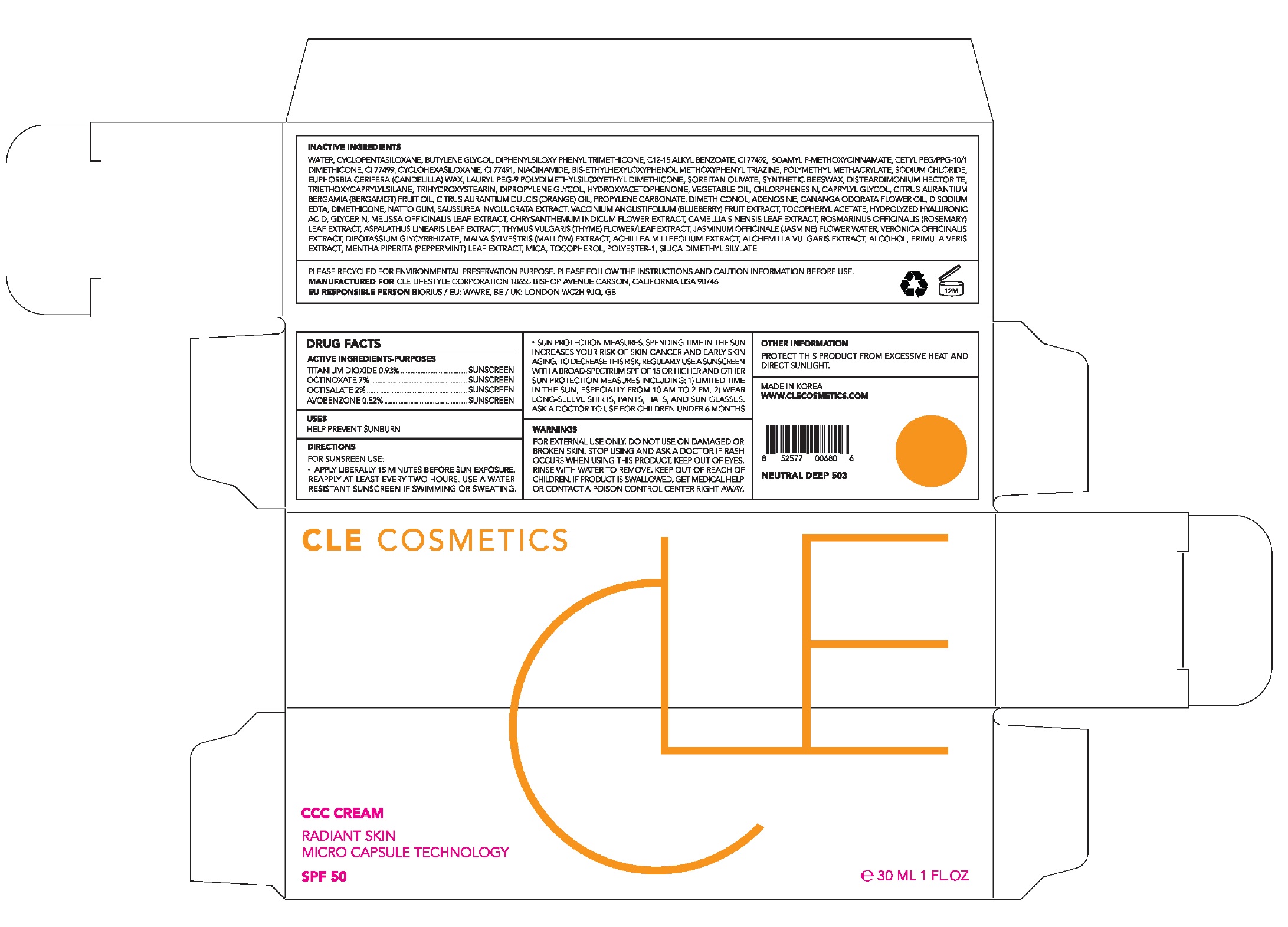
CLE CCC Neutral Deep Titanium Dioxide, Octinoxate, Octisalate, Avobenzone 2.1 mg/30mL; .6 mg/30mL; .279 mg/30mL; .156 mg/30mL Cream, 30 mL
🆔 Identity & classification
Where does this data come from?
🏭 Manufacturer & labeler
Where does this data come from?
🩺 Clinical
This is a topical cream sunscreen product marketed as an over-the-counter monograph drug. It contains four active ingredients that work together to protect skin from ultraviolet (UV) radiation: titanium dioxide and octinoxate are mineral and chemical UV filters respectively, octisalate is a chemical UV absorber, and avobenzone provides broad-spectrum UV protection. The cream is applied to the skin to help prevent sunburn and reduce UV exposure.
Patient education
Supplement & herbal interactions
Where does this data come from?
Ask a licensed pharmacist directly — free, answered by our team.
🧪 Inactive Ingredients / Excipients
Inactive ingredients, also called excipients, are components of the drug product other than the active ingredient. They may include fillers, dyes, coatings, preservatives, flavors, or other formulation ingredients.
💡 Tap an ingredient (hover on desktop) to see what it is and why it’s used.
-
UNII 9E8X80D2L0
A synthetic form of vitamin E used as an antioxidant and preservative in medications. It helps prevent the active ingredients from degrading when exposed to oxygen or light.
-
UNII 2FXJ6SW4PK
A plant extract from yarrow, used in some formulations as a natural flavoring agent or botanical ingredient to add taste or aroma to the medicine.
-
UNII K72T3FS567
Adenosine is a naturally occurring nucleoside compound. In medicines, it functions as an active pharmaceutical ingredient in some formulations, though when listed as an excipient it may serve as a buffering or stabilizing agent to maintain product stability and pH.
-
UNII 9M289NKI69
Alchemilla xanthochlora flowering top is a plant-derived ingredient used as a traditional botanical additive. It may serve as a flavoring, coloring, or general botanical component in herbal formulations.
-
UNII 3K9958V90M
A liquid solvent derived from fermentation or chemical synthesis. In medicines, alcohol dissolves active ingredients, helps preserve the product, and improves how the body absorbs certain drugs.
-
UNII A9EJ3J61HQ
A synthetic liquid derived from benzoic acid and long-chain alcohols. It functions as a solvent and penetration enhancer in topical formulations, helping active ingredients dissolve and absorb into the skin.
-
UNII 376KTP06K8
Amiloxate is a synthetic compound used as an ultraviolet light absorber in topical formulations. It helps protect the medicine from degradation caused by sunlight exposure during storage and use.
-
UNII H7UGK1GJCU
Aspalathus linearis leaf is a plant extract from rooibos tea. It's used in medicines as a natural flavor and color agent, and may help preserve the product's stability.
-
UNII PWZ1720CBH
A chemical compound used as an ultraviolet light filter in topical formulations. It helps protect the medicine or product from degradation caused by sun exposure during storage and use.
-
UNII 39W1PKE3JI
Bergamot oil is a citrus extract from bergamot orange peel. It's used as a flavoring and fragrance agent to improve taste and aroma in medicines.
-
UNII 3XUS85K0RA
Butylene glycol is a clear liquid derived from petroleum or plants that acts as a humectant, solvent, and preservative booster in medicines. It helps keep formulations stable, dissolve active ingredients, and maintain moisture in topical products.
-
UNII WL0328HX19
A natural plant-based wax derived from candelilla shrub leaves. It acts as a coating agent, hardener, and texture modifier to control how quickly the medicine releases and to improve the tablet or capsule's appearance and stability.
-
UNII 00YIU5438U
Caprylyl glycol is a clear liquid derived from coconut oil. In medicines, it acts as a humectant to retain moisture, a preservative booster to prevent microbial growth, and a solvent to help dissolve or mix other ingredients.
-
UNII V2W71V8T0X
A silicone-based compound that mixes oil and water together. Used in formulations as an emulsifier to help blend ingredients and improve texture and stability of creams, lotions, and other topical products.
-
UNII I670DAL4SZ
A preservative that fights bacteria and fungi. It keeps medicines and topical products stable and safe from microbial contamination during storage and use.
-
UNII I6OER6U04L
A plant extract from chrysanthemum flowers used as a natural colorant and flavoring agent in medicines. It may contribute mild taste or visual appeal to the final product.
-
UNII 8470G57WFM
Corn oil is a vegetable oil extracted from corn kernels. It's used in medicines as a solvent to dissolve active ingredients and help the body absorb them, and sometimes as a lubricant in capsules.
-
UNII 0THT5PCI0R
A silicone-based liquid that helps distribute active ingredients evenly throughout topical products. It acts as a solvent and emollient, allowing medicines to spread smoothly on skin while improving texture and absorption.
-
UNII XHK3U310BA
Cyclohexasiloxane is a silicon-based liquid that acts as a solvent and conditioning agent in medicines. It helps dissolve or carry other ingredients and improves how the product spreads or feels on the skin.
-
UNII 92RU3N3Y1O
Dimethicone is a silicone-based oil that acts as an anti-foaming agent and lubricant in medicines. It reduces gas bubbles in liquid formulations and helps coat and protect the stomach lining when ingested.
-
UNII T74O12AN6Y
A silicone oil that reduces foam and prevents clumping. It's used as an anti-foaming agent and lubricant in tablets and capsules to improve how the medicine flows during manufacturing.
-
UNII I445L28B12
A silicone-based compound that acts as a lubricant and glidant in tablet and capsule formulations. It reduces friction between particles and on equipment surfaces, helping medicines flow smoothly during manufacturing and tablet compression.
-
UNII E107L85C40
Dipropylene glycol is a clear liquid made from propylene glycol. It acts as a solvent and humectant in medicines, helping dissolve active ingredients and retain moisture in the formulation.
-
UNII X687XDK09L
A clay mineral processed to carry positive charges, used as a thickener and suspending agent in liquid medicines. It helps keep solid particles evenly distributed throughout the product.
-
UNII 8NLQ36F6MM
Edetate disodium anhydrous is a chemical compound that binds to metal ions in a medicine. It's used as a stabilizer to prevent unwanted chemical reactions and help keep the drug product effective during storage.
-
UNII 1K09F3G675
Ferric oxide red is an inorganic iron compound used as a colorant in medicines. It gives tablets, capsules, or other dosage forms a red or reddish tint for identification and appearance.
-
UNII EX438O2MRT
Ferric oxide yellow is a naturally occurring iron compound used as a colorant in medications. It gives tablets, capsules, and other forms a yellow or golden hue for identification and appearance.
-
UNII XM0M87F357
A dark iron oxide compound that gives medicines their black or dark color. It's used as a colorant in tablets and capsules to help identify the product and make it visually distinctive.
-
UNII PDC6A3C0OX
Glycerin is a clear, thick liquid derived from plant oils or fats. It acts as a humectant to retain moisture, a sweetener, and a solvent in medications.
-
UNII CA2Y0FE3FX
A salt derived from licorice root extract, used as a flavoring agent and sweetener. It may also help soothe and protect mucous membranes in throat lozenges and cough products.
-
UNII W2ZU1RY8B0
A plant extract from green tea leaves. It's used as an antioxidant ingredient to help preserve the medicine and maintain its stability during storage.
-
UNII G1L3HT4CMH
A synthetic compound used in medicines as a preservative and antimicrobial agent. It helps prevent bacterial and fungal growth, extending the product's shelf life.
-
UNII 0Q8K841432
A plant extract from jasmine flowers used as a fragrance and flavoring agent in medicines. It adds pleasant scent and taste to make the medication more appealing to take.
-
UNII 25G622K2RA
A silicone-based surfactant that helps blend oil and water in cosmetic or topical formulations. It reduces surface tension to improve product spreadability and texture.
-
UNII G90PX41VP0
A plant-derived ingredient made from blueberry fruit. It's used as a natural flavor and colorant to make the medicine taste and look more appealing.
-
UNII X1U1U0N90J
A plant extract from common mallow flowers used in some formulations as a natural flavoring agent and to add color. It may also help soothe irritation in throat lozenges or similar products.
-
UNII 50D2ZE9219
A plant extract from lemon balm leaves, used as a flavoring and aromatic ingredient to improve the taste and smell of the medicine.
-
UNII A389O33LX6
A plant extract from peppermint leaves used as a flavoring agent to improve taste. It may also provide a cooling or soothing sensory effect in the medicine.
-
UNII V8A1AW0880
Mica is a naturally occurring mineral that's ground into fine powder. It's used in medicines as a colorant and anti-caking agent to improve appearance and prevent clumping in tablets or powders.
-
UNII 25X51I8RD4
Niacinamide is a form of vitamin B3, a water-soluble nutrient. In medicines, it may be added as a nutritional supplement or to support skin health, though its primary role here is as an active ingredient rather than a traditional inactive filler.
-
UNII AKN3KSD11B
Orange oil obtained by cold pressing orange peel. It serves as a flavoring agent and fragrance in medicines to improve taste and aroma.
-
UNII Z47NNT4J11
A synthetic plastic polymer used as a film-coating material on tablets and capsules. It helps protect the medicine, control how fast it dissolves, and improve appearance by creating a smooth, glossy outer layer.
-
UNII 212N9O2MMZ
A synthetic polymer used as a film-coating agent and emulsifier. It helps form a smooth protective layer around tablets or capsules and improves how oil and water-based ingredients mix together in the formulation.
-
UNII W6LFQ57E4M
Primula veris is a plant extract from cowslip flowers. It's used in medicines as a flavoring agent and to add color or improve taste.
-
UNII 8D08K3S51E
Propylene carbonate is a clear liquid solvent derived from propylene. It helps dissolve or suspend active ingredients in liquid medicines and can improve how well the product flows and mixes.
-
UNII IJ67X351P9
A natural plant extract from rosemary leaves used as a preservative to help prevent oils and fats in the medicine from spoiling or becoming rancid during storage.
-
UNII EU2PSP0G0W
Silica dimethyl silylate is a silicon-based powder that acts as a glidant and anti-caking agent. It reduces friction between particles and helps powders flow smoothly during manufacturing and tablet compression.
-
UNII 451W47IQ8X
Sodium chloride is common table salt. It's used in medicines as a buffer to maintain proper pH, as a filler to add bulk, or to adjust the osmotic balance in liquid formulations.
-
UNII MDL271E3GR
Sorbitan olivate is an emulsifier derived from sorbitol and olive oil. It helps blend water and oil ingredients together to maintain consistent texture and appearance throughout the medicine.
-
UNII 08MNR5YE2R
A wax made in a laboratory to mimic natural beeswax. It's used as a coating, binder, and thickener to give medicines a smooth texture and protect them from moisture.
-
UNII CW657OBU4N
A plant extract from thyme used as a flavoring agent and preservative in medicines. It adds taste and aroma while helping protect the product from spoilage.
-
UNII R0ZB2556P8
Tocopherol is a form of vitamin E derived from plant oils. It acts as an antioxidant in medicines to prevent oils and fats from breaking down and spoiling during storage.
-
UNII LDC331P08E
A silicone-based compound that acts as a glidant and flow agent in solid medications. It reduces friction between powder particles, helping the medicine flow smoothly during manufacturing and tablet compression.
-
UNII 06YD7896S3
A waxy, fatty substance derived from stearic acid. It acts as a thickener and texture modifier in medicines, helping control how quickly the drug dissolves and improving the product's firmness and consistency.
-
UNII 059QF0KO0R
Water is a liquid solvent that dissolves and mixes ingredients together in liquid medicines, syrups, and injections. It helps distribute the active drug evenly throughout the product.
-
UNII 8YOY78GNNX
A fragrant essential oil derived from ylang-ylang tree flowers. It's used as a flavoring and fragrance agent to improve the taste or scent of medicines.
56 inactive ingredients listed in the exact product block matched to this NDC.
Label-section wording can be broader than the structured product block and may mention additional formulation ingredients.
Where does this data come from?
ingredient classCode="IACT" elements from the exact product block matched by this NDC. Label-section narrative from DailyMed / the openFDA label index is shown separately when available.Inactive ingredient FAQ
Are inactive ingredients the same for every manufacturer?
Why might an inactive ingredient be missing?
Can inactive ingredients matter?
💲 Pricing
A drug doesn't have one price. Each row is a different public payment system, and none is what you'd pay at the counter — that depends on your insurance. The ⓘ on each row explains what it measures.
| Price system | Per g | Per package |
|---|---|---|
| Retail pharmacies payNADAC · weekly | Not in the retail survey — common for institutional, discontinued, or low-volume packs. | |
| Medicaid paysCMS SDUD · 12 mo | No recent Medicaid claims on file for this NDC — rare and low-volume NDCs are suppressed in the public data. | |
| Medicare drug plans payPart D · quarterly | No Part D plan price is available for this NDC in our data. | |
Where does this data come from?
🔁 Therapeutic equivalents
| Product | Labeler | Pack | NADAC/unit | TE | Status | Price vs. this |
|---|---|---|---|---|---|---|
| CLE CCC Neutral Deep 2.1 mg/30mL; .6 mg/30mL; .279 mg/30mL; .156 mg/30mLthis 69231-0036-02 | KW | 30 ml | — | — | FDA listed | — |
Where does this data come from?
⏳ Availability & generic status
We did not find an FDA-approved generic match for this exact strength, form and route.
Where does this data come from?
📦 Packaging — all sizes for this product
| Package NDC | Description | Marketing start | Status |
|---|---|---|---|
| 69231-0036-02 You're viewing this | 1 CONTAINER in 1 PACKAGE (69231-036-02) / 30 mL in 1 CONTAINER (69231-036-01) | 2022-11-09 | Active |
🧭 About this NDC listing & data coverage
What data is (and isn’t) available for this NDC — tap to expand
| NDC identity (package / product / labeler codes) | ✓ Available |
| Labeler | ✓ Available |
| Product & package description | ✓ Available |
| Marketing category & status | ✓ Available |
| Active ingredient / dosage form / route | ✓ Available |
| FDA label (SPL via DailyMed) | ✓ Available |
| Package photos | ✓ Available |
| Inactive ingredients (structured) | ✓ Available |
| NADAC pharmacy acquisition price (CMS) | — Not published for this NDC CMS publishes NADAC only for NDCs reported in its retail-pharmacy survey. |
| Orange Book / therapeutic-equivalence data | — Not published for this NDC Applies only to products approved under an NDA/ANDA; many listings are out of scope. |
| HCPCS J-code billing crosswalk | — Not published for this NDC Most self-administered / retail products have no J-code — that is normal. |
| Medicaid utilization (CMS SDUD) | — Not published for this NDC CMS reports utilization only for NDCs with Medicaid claims above its privacy threshold. |
Questions about this listing
Is this NDC FDA-approved?
Why is there no price listed?
Is the NDC printed on the package the same as the 11-digit billing NDC?
What do the three segments of this NDC mean?
Is this package still being marketed?
Who lists this product with the FDA?
Do I need a prescription for this product?
Where does this data come from?
📄 FDA label — Drug Facts FDA SPL
🎯 Indications and Usage ▾
Helps prevent sunburn
⏱️ Dosage and Administration ▾
Apply liberally 15 minutes before sun exposure. Reapply at least every two hours Sun protection measures. Spending time in the sun increases your risk of skin cancer and early skin aging.
To decrease this risk, regularly use a sunscreen with a broad spectrum SPF of 15 of higher and other sun protection measures including: 1) Limited time in the sun, especially from 10 am to 2 pm. 2) Wear long-sleeve shirts, pants, hats, and sunglasses Ask a doctor to use for children under 6 months
⚠️ Warnings ▾
For external use only. Do not use on damaged or broken skin. When using this product, keep out of eyes. Rinse with water to remove. Stop using and ask a doctor if rash occurs.
🧪 Active Ingredient ▾
Titanium Dioxide 0.93% Ethylhexyl Methoxycinnamate 7.00% Ethylhexyl Salicylate 2.00% Avobenzone 0.52%
🧪 Inactive Ingredients ▾
Water, Cyclopentasiloxane, Butylene Glycol, Diphenylsiloxy Phenyl Trimethicone, C12-15 Alkyl Benzoate, CI 77492, Isoamyl p-Methoxycinnamate, Cetyl PEG/PPG-10/1 Dimethicone, CI 77499, Cyclohexasiloxane, CI 77491, Niacinamide, Bis-Ethylhexyloxyphenol Methoxyphenyl Triazine, Polymethyl Methacrylate, Sodium Chloride, Euphorbia Cerifera (Candelilla) Wax, Lauryl PEG-9 Polydimethylsiloxyethyl Dimethicone, Sorbitan Olivate, Synthetic Beeswax, Disteardimonium Hectorite, Triethoxycaprylylsilane, Trihydroxystearin, Dipropylene Glycol, Hydroxyacetophenone, Vegetable Oil, Chlorphenesin, Caprylyl Glycol, Citrus Aurantium Bergamia (Bergamot) Fruit Oil, Citrus Aurantium Dulcis (Orange) Oil, Propylene Carbonate, Dimethiconol, Adenosine, Cananga Odorata Flower Oil, Disodium EDTA, Dimethicone, Natto Gum, Saussurea Involucrata Extract, Vaccinium Angustifolium (Blueberry) Fruit Extract, Tocopheryl Acetate, Hydrolyzed Hyaluronic Acid, Glycerin, Melissa Officinalis Leaf Extract, Chrysanthemum Indicum Flower Extract, Camellia Sinensis Leaf Extract, Rosmarinus Officinalis (Rosemary) Leaf Extract, Aspalathus Linearis Leaf Extract, Thymus Vulgaris (Thyme) Flower/Leaf Extract, Jasminum Officinale (Jasmine) Flower Water, Veronica Officinalis Extract, Dipotassium Glycyrrhizate, Malva Sylvestris (Mallow) Extract, Achillea Millefolium Extract, Alchemilla Vulgaris Extract, Alcohol, Primula Veris Extract, Mentha Piperita (Peppermint) Leaf Extract, Mica, Tocopherol, Polyester-1, Silica Dimethyl Silylate
🎯 Purpose ▾
Sunscreen