
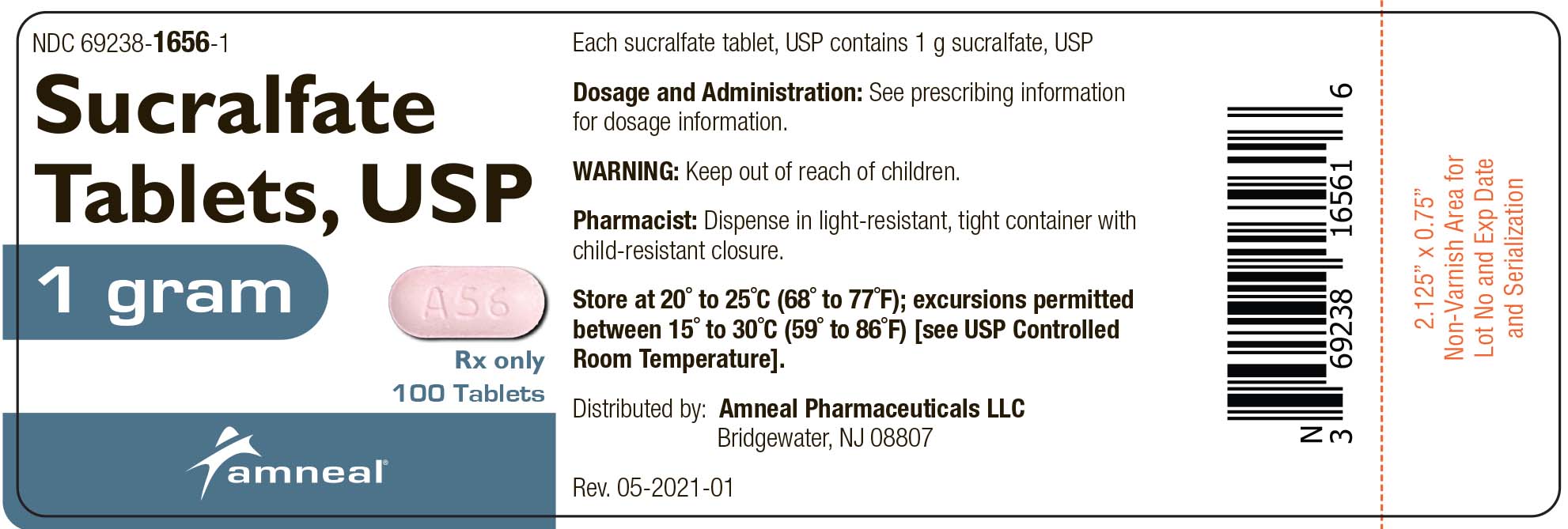
Sucralfate 1 g Tablet, 100-count — NDC 69238-1656-1 (Billing 69238-1656-01)
This is a package of 100 tablets of Sucralfate 1 g Tablet from Amneal Pharmaceuticals NY LLC, marketed since Apr 2022 and currently FDA-listed; retail pharmacies pay about $0.1727 per tablet (NADAC). It is the main listing for this product, which comes in 2 package sizes.
NDC database record
One package, one record: these facts belong to NDC 69238-1656-1 alone.
- Record
- FDA NDC Directory package listing · Human prescription drug
- Code segments
- 69238 labeler · 1656 product · 1 package
- Package marketed since
- Apr 22, 2022
- Sample package
- No — commercial package
- Listing certified through
- Dec 31, 2027
- Billing quantity
- 100 EA per package
- Barcode (UPC)
- 0369238165616
- Medicaid fills, this package
- 296 prescriptions in the last four reported quarters
- FDA record last changed
- Oct 8, 2026
Identity & classification
Regulatory identifiers FDA, NLM and CMS codes for this package
Drug-database identifiers Medi-Span GPI and First Databank GCN / HICL / AHFS classification
- GSN (GCN sequence number): 002766
- GCN: 08200
- GPI-14 (Medi-Span): 49300010000305
- HICL (First Databank): 001186
- AHFS class code: 56:28.32.00
- RxCUI (RxNorm): 314234
Where does this data come from?
- FDA openFDA NDC Directory · synced Oct 8, 2026
- FDA label on DailyMed · label index refreshed Oct 6, 2026
- RxNorm (NLM RxNav) · catalog refreshed Oct 1, 2026
- Medi-Span GPI (licensed)
- First Databank (licensed) · refreshed Oct 8, 2026
RxNorm drug class
This medicine belongs to the Aluminum Complex class.
Where does this data come from?
- RxClass (NLM) · catalog refreshed Oct 1, 2026
Clinical
Sucralfate is used to treat and prevent the return of duodenal ulcers (ulcers located in first part of the small intestine). Treatment with other medications, such as antibiotics, may also be necessary to treat and prevent the return of ulcers caused by a certain type of bacteria (H. pylori) Sucralfate is in a class of medications called protectants. It sticks to damaged ulcer tissue and protects against acid and enzymes so healing can occur.
Read the full MedlinePlus article ↗- It treats an active duodenal ulcer, which is a sore in the first part of your small intestine. Treatment usually lasts up to 8 weeks. The tablets can also be used at a lower dose t...
- Take it by mouth on an empty stomach, as your prescriber directs. For an active ulcer, the label describes four doses a day. Keep going for the full course even if you feel better,...
- Yes, for pain relief if your doctor allows. Just keep them at least 30 minutes before or after your sucralfate dose.
- Constipation is the most common one, though most people have no trouble. Some get nausea, diarrhea, dry mouth, dizziness or a rash. Call your doctor if something bothers you or doe...
Patient education
Supplement & herbal interactions
Some supplements/herbs that may interact with Sucralfate — tap one for details:
Sucralfate may be associated with lower levels of 1 nutrient — worth a chat with your pharmacist, not a cause for alarm.
Where does this data come from?
- MedlinePlus (NLM) · refreshed Oct 1, 2026
- FDA label on DailyMed · label index refreshed Oct 6, 2026
Ask a licensed pharmacist directly — free, answered by our team.
Pricing
A drug doesn't have one price. Each row is a different public payment system, and none is what you'd pay at the counter — that depends on your insurance. The ⓘ on each row explains what it measures.
| Price system | Per ea | Per package |
|---|---|---|
| Retail pharmacies payNADAC · weekly | $0.173 | $17.27 / 100 tablets |
| Medicaid paysCMS SDUD · 12 mo | $0.2363 | $23.63 / 100 tablets |
| Medicare drug plans payPart D · quarterly | No Part D plan price is available for this NDC in our data. | |
Where does this data come from?
- CMS NADAC weekly file · file of Oct 7, 2026
- CMS ASP pricing files · refreshed Sep 20, 2026
- CMS Medicaid State Drug Utilization Data · through Q1 2026
- CMS Part D plan pricing files · refreshed Sep 24, 2026
- VA National Acquisition Center price file
Packaging — all sizes for this product
| Package NDC | Description | Per unit | Per pack | Marketing start | Marketing end | Status |
|---|---|---|---|---|---|---|
| 69238-1656-01 You're viewing this Main listing | 100 TABLET in 1 BOTTLE | $0.1727 / ea | $17.27 | 2022-04-22 | — | Active |
| 69238-1656-05 69238-1656-5 | 500 TABLET in 1 BOTTLE | — | — | 2022-05-23 | — | Active |
You're viewing the smallest of 2 pack sizes for this product.
In Medicaid, this is the most-dispensed pack of this product — about 100% of fills over the last four reported quarters. See all packs ↓
Pack size FAQ
What quantity is in this package?
How does this package differ from NDC 69238-1656-05?
What NDC number is used to bill for this package of Sucralfate 1 g Tablet?
Prices are the latest CMS NADAC pharmacy acquisition cost per NDC; per-pack figures are per-unit × pack quantity, shown only when the pack is denominated in the same measure NADAC prices.
Therapeutic equivalents
| Product | Labeler | Pack | NADAC/unit | TE | Status | Price vs. this |
|---|---|---|---|---|---|---|
| Sucralfate 1 g 00093-2210-01 | Teva | 100 tablets | $0.173 | AB | Availability likely | — |
| Sucralfate 1 g 51079-0753-20 | Mylan | 100 tablets | $0.173 | AB | Availability likely | — |
| Sucralfate 1 g 59762-0401-01 | Mylan | 100 tablets | $0.173 | AB | Availability likely | — |
| Sucralfate 1 g 60219-1656-01 | Amneal | 100 tablets | $0.173 | AB | Availability likely | — |
| Sucralfate 1 g 62135-0436-90 | Chartwell | 90 tablets | $0.173 | AB | Availability likely | — |
| Sucralfate 1 gthis 69238-1656-01 | Amneal | 100 tablets | $0.173 | AB | Availability likely | — |
| Sucralfate 1 g 72578-0081-01 | Viona | 100 tablets | $0.173 | AB | Availability likely | — |
| Sucralfate 1 g 60687-0695-01 | American | 100 tablets | $0.179 | AB | Discontinued | +3% |
| Carafate 1 g 58914-0171-10 | Allergan, | 100 tablets | $4.731 | AB | Availability likely | +2639% |
| Sucralfate 1 g 00615-4517-30 | NCS | 30 tablets | — | AB | Discontinued | — |
| Sucralfate 1 g 00615-8653-39 | NCS | 30 tablets | — | AB | FDA listed | — |
| Sucralfate 1 g 42291-0936-90 | AvKARE | 90 tablets | — | AB | FDA listed | — |
| Sucralfate 1 g 48433-0091-20 | Safecor | 100 tablets | — | AB | FDA listed | — |
| Sucralfate 1 g 50090-5287-00 | A-S | 60 tablets | — | AB | FDA listed | — |
| Sucralfate 1 g 50090-6455-00 | A-S | 60 tablets | — | AB | FDA listed | — |
| Sucralfate 1 g 51407-0881-90 | Golden | 90 tablets | — | AB | Discontinued | — |
| Sucralfate 1 g 51655-0031-52 | Northwind | 30 tablets | — | AB | FDA listed | — |
| Sucralfate 1 g 51655-0475-52 | Northwind | 30 tablets | — | AB | FDA listed | — |
| Sucralfate 1 g 55154-4379-00 | Cardinal | 10 tablets | — | AB | FDA listed | — |
| Sucralfate 1 g 63629-1307-00 | Bryant | 28 tablets | — | AB | FDA listed | — |
| Sucralfate 1 g 63629-9152-01 | Bryant | 100 tablets | — | AB | FDA listed | — |
| Sucralfate 1 g 63629-9153-01 | Bryant | 500 tablets | — | AB | FDA listed | — |
| Sucralfate 1 g 67046-1469-03 | Coupler | 30 tablets | — | AB | FDA listed | — |
| Sucralfate 1 g 67296-2147-04 | Redpharm | 40 tablets | — | AB | FDA listed | — |
| Sucralfate 1 g 68071-1749-01 | NuCare | 100 tablets | — | AB | FDA listed | — |
| Sucralfate 1 g 68071-3478-03 | NuCare | 30 tablets | — | AB | FDA listed | — |
| Sucralfate 1 g 68071-3812-03 | NuCare | 30 tablets | — | AB | FDA listed | — |
| Sucralfate 1 g 68788-8316-01 | Preferred | 100 tablets | — | AB | FDA listed | — |
| Sucralfate 1 g 68788-8779-03 | Preferred | 30 tablets | — | AB | FDA listed | — |
| Sucralfate 1 g 68788-8946-01 | Preferred | 100 tablets | — | AB | FDA listed | — |
| Sucralfate 1 g 70771-1833-01 | Zydus | 100 tablets | — | AB | FDA listed | — |
| Sucralfate 1 g 71335-2114-00 | Bryant | 28 tablets | — | AB | FDA listed | — |
| Sucralfate 1 g 71335-2461-00 | Bryant | 28 tablets | — | AB | FDA listed | — |
| Sucralfate 1 g 71335-2637-00 | Bryant | 28 tablets | — | AB | FDA listed | — |
| Sucralfate 1 g 71610-0017-60 | Aphena | 90 tablets | — | AB | FDA listed | — |
| Sucralfate 1 g 71610-0541-60 | Aphena | 90 tablets | — | AB | FDA listed | — |
| Sucralfate 1 g 72162-2264-01 | Bryant | 100 tablets | — | AB | FDA listed | — |
| Sucralfate 1 g 72189-0234-20 | DIRECT | 20 tablets | — | AB | FDA listed | — |
| Sucralfate 1 g 72189-0429-20 | Direct_Rx | 20 tablets | — | AB | FDA listed | — |
| Sucralfate 1 g 80425-0091-01 | Advanced | 30 tablets | — | AB | FDA listed | — |
| Sucralfate 1 g 80425-0188-01 | Advanced | 30 tablets | — | AB | FDA listed | — |
| Sucralfate 1 g 80425-0213-01 | Advanced | 30 tablets | — | AB | FDA listed | — |
| Sucralfate 1 g 80425-0377-01 | Advanced | 30 tablets | — | AB | FDA listed | — |
| Sucralfate 1 g 82804-0063-30 | Proficient | 30 tablets | — | AB | FDA listed | — |
| Sucralfate 1 g 82804-0102-30 | Proficient | 30 tablets | — | AB | FDA listed | — |
| Sucralfate 1 g 87063-0176-01 | ASCLEMED | 100 tablets | — | AB | FDA listed | — |
| Sucralfate 1 g 55154-0281-00 | Cardinal | 10 tablets | — | AB | FDA listed | — |
Where does this data come from?
- FDA openFDA NDC Directory · synced Oct 8, 2026
- FDA Orange Book · refreshed Oct 3, 2026
- CMS NADAC weekly file · file of Oct 7, 2026
Availability & generic status
This product is an FDA-approved generic. Other versions of the same drug are listed under Therapeutic equivalents, least expensive first.
Where does this data come from?
- FDA Orange Book · refreshed Oct 3, 2026
What it looks like
Where does this data come from?
- FDA label on DailyMed · label index refreshed Oct 6, 2026
Inactive Ingredients / Excipients
Inactive ingredients, also called excipients, are components of the drug product other than the active ingredient. They may include fillers, dyes, coatings, preservatives, flavors, or other formulation ingredients.
🧪 Avoiding an ingredient? See Sucralfate inactive ingredients by manufacturer: every current product's list side by side, so you can ask your pharmacy for the version that does not list it.
💡 Tap an ingredient (hover on desktop) to see what it is and why it’s used.
-
UNII 2S42T2808B
A synthetic red dye used as a colorant to give the medicine its red color. It helps make pills or liquids visually distinct and easier to identify.
-
UNII J9EQA3S2JM
FD&C Blue No. 1 Aluminum Lake is a blue colorant made by combining FD&C Blue No. 1 dye with aluminum salts. It is used to color tablets, capsules, and other medicines for easy identification and appearance.
-
UNII 70097M6I30
Magnesium stearate is a salt made from magnesium and stearic acid, a fatty substance. It's used in tablets and capsules as a lubricant and glidant to help ingredients flow smoothly during manufacturing and prevent sticking.
-
UNII OP1R32D61U
Microcrystalline cellulose is a purified form of cellulose, a natural fiber from plant sources. It acts as a binder and filler in tablets and capsules, helping hold ingredients together and give the medicine its shape and size.
-
UNII O8232NY3SJ
A plant-based carbohydrate derived from corn kernels. It acts as a filler to add bulk, a binder to hold ingredients together, and a disintegrant to help the tablet break apart in your stomach for absorption.
5 inactive ingredients listed in the exact product block matched to this NDC.
Where does this data come from?
ingredient classCode="IACT" elements from the exact product block matched by this NDC. Label-section narrative from DailyMed / the openFDA label index is shown separately when available.- FDA label on DailyMed · label index refreshed Oct 6, 2026
- FDA openFDA NDC Directory · synced Oct 8, 2026
Inactive ingredient FAQ
Are inactive ingredients the same for every manufacturer?
Why might an inactive ingredient be missing?
Can inactive ingredients matter?
Manufacturer & labeler
More NDCs from Amneal Pharmaceuticals NY LLC labeler code 69238
- Estradiol .075 mg/d Patch, Extended Release NDC 69238-1632-7
- Estradiol .1 mg/d Patch, Extended Release NDC 69238-1633-7
- Aminocaproic acid 500 mg Tablet NDC 69238-1637-3
- Pirfenidone 267 mg Tablet, Film Coated NDC 69238-1640-8
- Pirfenidone 801 mg Tablet, Film Coated NDC 69238-1641-9
- Pirfenidone 267 mg Capsule NDC 69238-1642-7
- Tavaborole 43.5 mg/mL Solution NDC 69238-1657-4
- Scopolamine 1 mg/3d Patch, Extended Release NDC 69238-1662-2
- fluphenazine hydrochloride 1 mg Tablet, Film Coated NDC 69238-1678-1
- fluphenazine hydrochloride 2.5 mg Tablet, Film Coated NDC 69238-1679-1
- fluphenazine hydrochloride 5 mg Tablet, Film Coated NDC 69238-1680-1
- fluphenazine hydrochloride 10 mg Tablet, Film Coated NDC 69238-1681-1
Where does this data come from?
- FDA openFDA NDC Directory · synced Oct 8, 2026
- Drugs@FDA
Full prescribing information FDA SPL
🎯 Indications and Usage ▾
INDICATIONS AND USAGE Sucralfate tablets are indicated in: Short-term treatment (up to 8 weeks) of active duodenal ulcer. While healing with sucralfate may occur during the first week or two, treatment should be continued for 4 to 8 weeks unless healing has been demonstrated by x-ray or endoscopic examination. Maintenance therapy for duodenal ulcer patients at reduced dosage after healing of acute ulcers.
⏱️ Dosage and Administration ▾
DOSAGE AND ADMINISTRATION Active Duodenal Ulcer. The recommended adult oral dosage for duodenal ulcer is 1 g four times per day on an empty stomach. Antacids may be prescribed as needed for relief of pain but should not be taken within one-half hour before or after sucralfate.
While healing with sucralfate may occur during the first week or two, treatment should be continued for 4 to 8 weeks unless healing has been demonstrated by x-ray or endoscopic examination. Maintenance Therapy: The recommended adult oral dosage is 1 g twice a day. Elderly: In general, dose selection for an elderly patient should be cautious, usually starting at the low end of the dosing range, reflecting the greater frequency of decreased hepatic, renal, or cardiac function, and of concomitant disease or other drug therapy (See PRECAUTIONS Geriatric Use ).
Call your doctor for medical advice about side effects. You may report side effects to Amneal Pharmaceuticals at 1-877-835-5472 or FDA at 1-800-FDA-1088 or www.fda.gov/medwatch.
⛔ Contraindications ▾
CONTRAINDICATIONS Sucralfate tablets are contraindicated in patients with known hypersensitivity reactions to the active substance or to any of the excipients.
🤒 Adverse Reactions ▾
ADVERSE REACTIONS Adverse reactions to sucralfate in clinical trials were minor and only rarely led to discontinuation of the drug. In studies involving over 2,700 patients treated with sucralfate tablets, adverse effects were reported in 129 (4.7%). Constipation was the most frequent complaint (2%).
Other adverse effects reported in less than 0.5% of the patients are listed below by body system: Gastrointestinal: diarrhea, nausea, vomiting, gastric discomfort, indigestion, flatulence, dry mouth Dermatological: pruritus, rash Nervous System: dizziness, insomnia, sleepiness, vertigo Other: back pain, headache Post-marketing cases of hypersensitivity have been reported with the use of sucralfate tablets, including dyspnea, lip swelling, pruritus, rash, and urticaria. Cases of anaphylactic reactions, bronchospasm, laryngeal edema, edema of the mouth, pharyngeal edema, respiratory tract edema and swelling of the face have been reported with an unknown oral formulation of sucralfate.
Bezoars have been reported in patients treated with sucralfate. The majority of patients had underlying medical conditions that may predispose to bezoar formation (such as delayed gastric emptying) or were receiving concomitant enteral tube feedings. Inadvertent injection of insoluble sucralfate and its insoluble excipients has led to fatal complications, including pulmonary and cerebral emboli.
Sucralfate is not intended for intravenous administration. To report SUSPECTED ADVERSE REACTIONS, contact Amneal Pharmaceuticals at 1-877-835-5472 or FDA at 1-800-FDA-1088 or www.fda.gov/medwatch.
🔄 Drug Interactions ▾
Drug Interactions Some studies have shown that simultaneous sucralfate administration in healthy volunteers reduced the extent of absorption (bioavailability) of single doses of the following: cimetidine, digoxin, fluoroquinolone antibiotics, ketoconazole, l-thyroxine, phenytoin, quinidine, ranitidine, tetracycline, and theophylline. Subtherapeutic prothrombin times with concomitant warfarin and sucralfate therapy have been reported in spontaneous and published case reports. However, two clinical studies have demonstrated no change in either serum warfarin concentration or prothrombin time with the addition of sucralfate to chronic warfarin therapy.
The mechanism of these interactions appears to be nonsystemic in nature, presumably resulting from sucralfate binding to the concomitant agent in the gastrointestinal tract. In all case studies to date (cimetidine, ciprofloxacin, digoxin, norfloxacin, ofloxacin, and ranitidine), dosing the concomitant medication 2 hours before sucralfate eliminated the interaction. Because of the potential of sucralfate to alter the absorption of some drugs, sucralfate should be administered separately from other drugs when alterations in bioavailability are felt to be critical.
In these cases, patients should be monitored appropriately.
🤰 Pregnancy ▾
Pregnancy Teratogenic effects Teratogenicity studies have been performed in mice, rats, and rabbits at doses up to 50 times the human dose and have revealed no evidence of harm to the fetus due to sucralfate. There are, however, no adequate and well-controlled studies in pregnant women. Because animal reproduction studies are not always predictive of human response, this drug should be used during pregnancy only if clearly needed.
🧒 Pediatric Use ▾
Pediatric Use Safety and effectiveness in pediatric patients have not been established.
🆘 Overdosage ▾
OVERDOSAGE Due to limited experience in humans with overdosage of sucralfate, no specific treatment recommendations can be given. Acute oral toxicity studies in animals, however, using doses up to 12 g/kg body weight, could not find a lethal dose. Sucralfate is only minimally absorbed from the gastrointestinal tract.
Risks associated with acute overdosage should, therefore, be minimal. In rare reports describing sucralfate overdose, most patients remained asymptomatic. Those few reports where adverse events were described included symptoms of dyspepsia, abdominal pain, nausea, and vomiting.
🧬 Clinical Pharmacology ▾
CLINICAL PHARMACOLOGY Sucralfate is only minimally absorbed from the gastrointestinal tract. The small amounts of the sulfated disaccharide that are absorbed are excreted primarily in the urine. Although the mechanism of sucralfate’s ability to accelerate healing of duodenal ulcers remains to be fully defined, it is known that it exerts its effect through a local, rather than systemic, action.
The following observations also appear pertinent: Studies in human subjects and with animal models of ulcer disease have shown that sucralfate forms an ulcer-adherent complex with proteinaceous exudate at the ulcer site. In vitro , a sucralfate-albumin film provides a barrier to diffusion of hydrogen ions. In human subjects, sucralfate given in doses recommended for ulcer therapy inhibits pepsin activity in gastric juice by 32%.
In vitro , sucralfate adsorbs bile salts. These observations suggest that sucralfate’s antiulcer activity is the result of formation of an ulcer-adherent complex that covers the ulcer site and protects it against further attack by acid, pepsin, and bile salts. There are approximately 14 to 16 mEq of acid-neutralizing capacity per 1 g dose of sucralfate.
📦 How Supplied / Storage and Handling ▾
HOW SUPPLIED Sucralfate tablets, USP 1 g are available as light pink, oblong tablets debossed with “A56” on one side and plain on the other side with a score line. They are supplied as follows: Bottles of 100 with child-resistant closure: NDC 69238-1656-1 Bottles of 500 with child-resistant closure: NDC 69238-1656-5 Store at 20° to 25°C (68° to 77°F); excursions permitted between 15° to 30°C (59° to 86°F) [see USP Controlled Room Temperature]. Rx Only Distributed by: Amneal Pharmaceuticals LLC Bridgewater, NJ 08807 Rev.
05-2021-01 www.amneal.com
📋 Description ▾
DESCRIPTION Sucralfate tablets, USP contain sucralfate, USP and sucralfate, USP is an α-D-glucopyranoside, β-D-fructofuranosyl-, octakis-(hydrogen sulfate), aluminum complex. Tablets for oral administration contain 1 g of sucralfate, USP. Also contain: D&C Red #30 Lake, FD&C Blue #1 Lake, magnesium stearate, microcrystalline cellulose, and starch. Therapeutic category: antiulcer. Structural Formula
⚠️ Precautions ▾
PRECAUTIONS The physician should read the " PRECAUTIONS " section when considering the use of this drug in pregnant or pediatric patients, or patients of childbearing potential. Duodenal ulcer is a chronic, recurrent disease. While short-term treatment with sucralfate can result in complete healing of the ulcer, a successful course of treatment with sucralfate should not be expected to alter the post healing frequency or severity of duodenal ulceration.
Isolated reports of sucralfate tablet aspiration with accompanying respiratory complications have been received. Therefore, sucralfate tablets should be used with caution by patients who have known conditions that may impair swallowing, such as recent or prolonged intubation, tracheostomy, prior history of aspiration, dysphagia, or any other conditions that may alter gag and cough reflexes, or diminish oropharyngeal coordination or motility. Special Populations: Chronic Renal Failure and Dialysis Patients When sucralfate is administered orally, small amounts of aluminum are absorbed from the gastrointestinal tract.
Concomitant use of sucralfate with other products that contain aluminum, such as aluminum-containing antacids, may increase the total body burden of aluminum. Patients with normal renal function receiving the recommended doses of sucralfate and aluminum-containing products adequately excrete aluminum in the urine. Patients with chronic renal failure or those receiving dialysis have impaired excretion of absorbed aluminum.
In addition, aluminum does not cross dialysis membranes because it is bound to albumin and transferrin plasma proteins. Aluminum accumulation and toxicity (aluminum osteodystrophy, osteomalacia, encephalopathy) have been described in patients with renal impairment. Sucralfate should be used with caution in patients with chronic renal failure.
Drug Interactions Some studies have shown that simultaneous sucralfate administration in healthy volunteers reduced the extent of absorption (bioavailability) of single doses of the following: cimetidine, digoxin, fluoroquinolone antibiotics, ketoconazole, l-thyroxine, phenytoin, quinidine, ranitidine, tetracycline, and theophylline. Subtherapeutic prothrombin times with concomitant warfarin and sucralfate therapy have been reported in spontaneous and published case reports. However, two clinical studies have demonstrated no change in either serum warfarin concentration or prothrombin time with the addition of sucralfate to chronic warfarin therapy.
The mechanism of these interactions appears to be nonsystemic in nature, presumably resulting from sucralfate binding to the concomitant agent in the gastrointestinal tract. In all case studies to date (cimetidine, ciprofloxacin, digoxin, norfloxacin, ofloxacin, and ranitidine), dosing the concomitant medication 2 hours before sucralfate eliminated the interaction. Because of the potential of sucralfate to alter the absorption of some drugs, sucralfate should be administered separately from other drugs when alterations in bioavailability are felt to be critical.
In these cases, patients should be monitored appropriately. Carcinogenesis, Mutagenesis, Impairment of Fertility Chronic oral toxicity studies of 24 months’ duration were conducted in mice and rats at doses up to 1 g/kg (12 times the human dose). There was no evidence of drug-related tumorigenicity.
A reproduction study in rats at doses up to 38 times the human dose did not reveal any indication of fertility impairment. Mutagenicity studies were not conducted. Pregnancy Teratogenic effects Teratogenicity studies have been performed in mice, rats, and rabbits at doses up to 50 times the human dose and have revealed no evidence of harm to the fetus due to sucralfate.
There are, however, no adequate and well-controlled studies in pregnant women. Because animal reproduction studies are not always predictive of human response, this drug should be used during pregnancy only if clearly needed. Nursing Mothers It is… [Excerpted — this section continues on DailyMed.]
🍼 Nursing Mothers ▾
Nursing Mothers It is not known whether this drug is excreted in human milk. Because many drugs are excreted in human milk, caution should be exercised when sucralfate is administered to a nursing woman.
📄 Carcinogenesis, Mutagenesis, Impairment of Fertility ▾
Carcinogenesis, Mutagenesis, Impairment of Fertility Chronic oral toxicity studies of 24 months’ duration were conducted in mice and rats at doses up to 1 g/kg (12 times the human dose). There was no evidence of drug-related tumorigenicity. A reproduction study in rats at doses up to 38 times the human dose did not reveal any indication of fertility impairment. Mutagenicity studies were not conducted.
📄 Package Label / Principal Display Panel ▾
PRINCIPAL DISPLAY PANEL 100ct label