
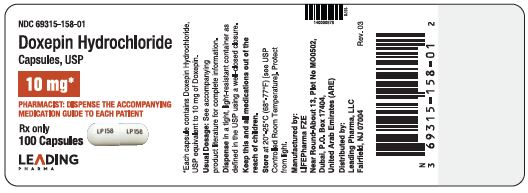
Doxepin Hydrochloride 10 mg Capsule, 1,000-count — NDC 69315-158-10 (Billing 69315-0158-10)
This is a package of 1,000 capsules of Doxepin Hydrochloride 10 mg Capsule from Leading Pharma, LLC, marketed since Apr 2021 and currently FDA-listed.
Other active recalls for Doxepin Hydrochloride (different manufacturers) — 1 · tap to view
Identity & classification
Regulatory identifiers FDA, NLM and CMS codes for this package
Drug-database identifiers Medi-Span GPI and First Databank GCN / HICL / AHFS classification
- GSN (GCN sequence number): 046086
- GCN: 16563
- GPI-14 (Medi-Span): 58200040100105
- HICL (First Databank): 001650
- AHFS class code: 28:16.04.28
- RxCUI (RxNorm): 1000048
Where does this data come from?
- FDA openFDA NDC Directory · synced Oct 1, 2026
- FDA label on DailyMed · label index refreshed Oct 1, 2026
- RxNorm (NLM RxNav) · catalog refreshed Oct 1, 2026
- Medi-Span GPI (licensed)
- First Databank (licensed) · refreshed Oct 1, 2026
RxNorm drug class
This medicine belongs to the Tricyclic Antidepressant class.
Where does this data come from?
- RxClass (NLM) · catalog refreshed Oct 1, 2026
Clinical
- It depends on the product. Capsules treat depression and anxiety, the oral solution treats major depressive disorder in adults, tablets such as Silenor treat trouble staying asleep...
- Take it within 30 minutes of bedtime. Do not take it within 3 hours of a meal. A meal can slow absorption and may cause more next-day effects.
- Sleepiness is the most common, along with nausea, cold-like symptoms and dizziness. Dry mouth, blurred vision and constipation can also happen. Call me or your doctor if anything b...
- Avoid it. Doxepin can make alcohol’s sedating effects stronger. Also avoid driving until you know how it affects you.
Patient education
Supplement & herbal interactions
Doxepin may be associated with lower levels of 1 nutrient — worth a chat with your pharmacist, not a cause for alarm.
Where does this data come from?
- MedlinePlus (NLM) · refreshed Oct 1, 2026
- FDA label on DailyMed · label index refreshed Oct 1, 2026
Ask a licensed pharmacist directly — free, answered by our team.
Pricing
A drug doesn't have one price. Each row is a different public payment system, and none is what you'd pay at the counter — that depends on your insurance. The ⓘ on each row explains what it measures.
| Price system | Per each | Per package |
|---|---|---|
| Retail pharmacies payNADAC · weekly | Not in the retail survey — common for institutional, discontinued, or low-volume packs. | |
| Medicaid paysCMS SDUD · 12 mo | No recent Medicaid claims on file for this NDC — rare and low-volume NDCs are suppressed in the public data. | |
| Medicare drug plans payPart D · Q2 2026 | $0.4302 | $430.20 / 1000 capsules |
Where does this data come from?
- CMS NADAC weekly file
- CMS ASP pricing files · refreshed Sep 20, 2026
- CMS Medicaid State Drug Utilization Data · refreshed Oct 3, 2026
- CMS Part D plan pricing files · refreshed Sep 24, 2026
- VA National Acquisition Center price file
Packaging — all sizes for this product
| Package NDC | Description | Per unit | Per pack | Marketing start | Marketing end | Status |
|---|---|---|---|---|---|---|
| 69315-0158-01 69315-158-01 Main listing | 100 CAPSULE in 1 PACKAGE | $0.0996 / ea | $9.96 | 2021-04-15 | — | Active |
| 69315-0158-10 You're viewing this | 1000 CAPSULE in 1 PACKAGE | — | — | 2021-04-15 | — | Active |
You're viewing the largest of 2 pack sizes for this product.
Pack size FAQ
What quantity is in this package?
How does this package differ from NDC 69315-0158-01?
What NDC number is used to bill for this package of Doxepin Hydrochloride 10 mg Capsule?
Prices are the latest CMS NADAC pharmacy acquisition cost per NDC; per-pack figures are per-unit × pack quantity, shown only when the pack is denominated in the same measure NADAC prices.
Therapeutic equivalents
| Product | Labeler | Pack | NADAC/unit | TE | Status | Price vs. this |
|---|---|---|---|---|---|---|
| Doxepin Hydrochloride 10 mg 42806-0529-01 | Epic | 100 capsules | $0.078 | AB | Availability likely | — |
| Doxepin Hydrochloride 10 mg 71921-0162-01 | Florida | 100 capsules | $0.078 | AB | Availability likely | — |
| Doxepin Hydrochloride 10 mg 00378-1049-01 | Mylan | 100 capsules | $0.078 | AB | Availability likely | — |
| Doxepin Hydrochloride 10 mg 00904-7052-61 | Major | 100 capsules | $0.078 | AB | Availability likely | — |
| Doxepin Hydrochloride 10 mg 23155-0794-01 | Heritage | 100 capsules | $0.078 | AB | Availability likely | — |
| Doxepin Hydrochloride 10 mg 24658-0793-01 | PURACAP | 100 capsules | $0.078 | AB | Availability likely | — |
| Doxepin hydrochloride 10 mg 27241-0167-01 | Ajanta | 100 capsules | $0.078 | AB | Availability likely | — |
| Doxepin Hydrochloride 10 mg 51079-0436-20 | Mylan | 100 capsules | $0.078 | AB | Availability likely | — |
| Doxepin Hydrochloride 10 mg 59651-0173-01 | Aurobindo | 100 capsules | $0.078 | AB | Availability likely | — |
| Doxepin Hydrochloride 10 mg 62135-0560-90 | Chartwell | 90 capsules | $0.078 | AB | Availability likely | — |
| Doxepin Hydrochloride 10 mg 62332-0637-31 | Alembic | 100 capsules | $0.078 | AB | Availability likely | — |
| Doxepin hydrochloride 10 mg 64980-0594-01 | Rising | 100 capsules | $0.078 | AB | Availability likely | — |
| Doxepin Hydrochloride 10 mg 70756-0424-11 | Lifestar | 100 capsules | $0.078 | AB | Availability likely | — |
| Doxepin Hydrochloride 10 mg 72205-0088-91 | Novadoz | 100 capsules | $0.078 | AB | Availability likely | — |
| Doxepin Hydrochloride 10 mg 72603-0390-01 | NorthStar | 100 capsules | $0.078 | AB | Availability likely | — |
| Doxepin Hydrochloride 10 mg 69238-1166-01 | Amneal | 1000 capsules | $0.208 | AB | FDA listed | — |
| Doxepin Hydrochloride 10 mg 10267-5059-04 | Contract | 1000 capsules | — | AB | FDA listed | — |
| Doxepin Hydrochloride 10 mg 42571-0420-01 | Micro | 100 capsules | — | AB | Discontinued | — |
| Doxepin Hydrochloride 10 mg 43353-0329-09 | Aphena | 9000 capsules | — | AB | FDA listed | — |
| Doxepin Hydrochloride 10 mg 46708-0637-31 | Alembic | 100 capsules | — | AB | FDA listed | — |
| Doxepin Hydrochloride 10 mg 48433-0035-20 | Safecor | 100 capsules | — | AB | FDA listed | — |
| Doxepin Hydrochloride 10 mg 55801-0527-01 | Appco | 100 capsules | — | AB | FDA listed | — |
| Doxepin Hydrochloride 10 mg 67296-2165-02 | Redpharm | 20 capsules | — | AB | FDA listed | — |
| Doxepin Hydrochloride 10 mg 68071-5179-09 | NuCare | 90 capsules | — | AB | FDA listed | — |
| Doxepin Hydrochloride 10 mgthis 69315-0158-10 | Leading | 1000 capsules | — | AB | FDA listed | — |
| Doxepin hydrochloride 10 mg 70518-3594-00 | REMEDYREPACK | 30 capsules | — | AB | Discontinued | — |
| Doxepin Hydrochloride 10 mg 70518-4252-00 | REMEDYREPACK | 30 capsules | — | AB | FDA listed | — |
| Doxepin Hydrochloride 10 mg 71205-0534-30 | Proficient | 30 capsules | — | AB | FDA listed | — |
| Doxepin hydrochloride 10 mg 71205-0695-30 | Proficient | 30 capsules | — | AB | FDA listed | — |
| Doxepin Hydrochloride 10 mg 71335-0072-01 | Bryant | 30 capsules | — | AB | FDA listed | — |
| Doxepin hydrochloride 10 mg 71335-2092-01 | Bryant | 30 capsules | — | AB | FDA listed | — |
| Doxepin Hydrochloride 10 mg 71335-2452-01 | Bryant | 30 capsules | — | AB | FDA listed | — |
| Doxepin Hydrochloride 10 mg 71335-2647-01 | Bryant | 30 capsules | — | AB | FDA listed | — |
| Doxepin HCL 10 mg 72189-0355-30 | Direct_Rx | 30 capsules | — | — | FDA listed | — |
| Doxepin HCL 10 mg 72189-0574-30 | Direct_rx | 30 capsules | — | AB | FDA listed | — |
| Doxepin HCL 10 mg 72189-0590-30 | Direct_rx | 30 capsules | — | AB | FDA listed | — |
| Doxepin HCL 10 mg 72189-0633-30 | Direct_Rx | 30 capsules | — | AB | FDA listed | — |
| Doxepin Hydrochloride 10 mg 72789-0072-30 | PD-Rx | 30 capsules | — | AB | FDA listed | — |
| Doxepin Hydrochloride 10 mg 72789-0220-30 | PD-Rx | 30 capsules | — | AB | FDA listed | — |
| Doxepin Hydrochloride 10 mg 81469-0415-01 | First | 100 capsules | — | AB | FDA listed | — |
| Doxepin Hydrochloride 10 mg 83209-0424-30 | Boswell | 30 capsules | — | AB | FDA listed | — |
| Doxepin Hydrochloride 10 mg 50090-8009-00 | A-S | 90 capsules | — | AB | FDA listed | — |
| Doxepin Hydrochloride 10 mg 82804-0305-30 | Proficient | 30 capsules | — | AB | FDA listed | — |
Where does this data come from?
- FDA openFDA NDC Directory · synced Oct 1, 2026
- FDA Orange Book · refreshed Sep 3, 2026
- CMS NADAC weekly file
Availability & generic status
This product is an FDA-approved generic. Other versions of the same drug are listed under Therapeutic equivalents, least expensive first.
Where does this data come from?
- FDA Orange Book · refreshed Sep 3, 2026
What it looks like
Where does this data come from?
- FDA label on DailyMed · label index refreshed Oct 1, 2026
Inactive Ingredients / Excipients
Inactive ingredients, also called excipients, are components of the drug product other than the active ingredient. They may include fillers, dyes, coatings, preservatives, flavors, or other formulation ingredients.
Where does this data come from?
IACT rows and label-wide narrative are kept separate; availability and product-level specificity depend on the submitted label.- FDA label on DailyMed · label index refreshed Oct 1, 2026
- FDA openFDA NDC Directory · synced Oct 1, 2026
Inactive ingredient FAQ
Are inactive ingredients the same for every manufacturer?
Why might an inactive ingredient be missing?
Can inactive ingredients matter?
Manufacturer & labeler
Where does this data come from?
- FDA openFDA NDC Directory · synced Oct 1, 2026
- Drugs@FDA
Full prescribing information FDA SPL
🚨 Boxed Warning ▾
Suicidality and Antidepressant Drugs Antidepressants increased the risk compared to placebo of suicidal thinking and behavior (suicidality) in children, adolescents, and young adults in short-term studies of major depressive disorder (MDD) and other psychiatric disorders. Anyone considering the use of doxepin hydrochloride or any other antidepressant in a child, adolescent, or young adult must balance this risk with the clinical need. Short-term studies did not show an increase in the risk of suicidality with antidepressants compared to placebo in adults beyond age 24; there was a reduction in risk with antidepressants compared to placebo in adults aged 65 and older.Depression and certain other psychiatric disorders are themselves associated with increases in the risk of suicide.
Patients of all ages who are started on antidepressant therapy should be monitored appropriately and observed closely for clinical worsening, suicidality, or unusual changes in behavior. Families and caregivers should be advised of the need for close observation and communication with the prescriber. Doxepin Hydrochloride is not approved for use in pediatric patients.
(See WARNINGS : Clinical Worsening and Suicide Risk , PRECAUTIONS : Information for Patients , and PRECAUTIONS : Pediatric Use ).
🎯 Indications and Usage ▾
INDICATIONS AND USAGE Doxepin Hydrochloride is recommended for the treatment of: Psychoneurotic patients with depression and/or anxiety. Depression and/or anxiety associated with alcoholism (not to be taken concomitantly with alcohol). Depression and/or anxiety associated with organic disease (the possibility of drug interaction should be considered if the patient is receiving other drugs concomitantly).
Psychotic depressive disorders with associated anxiety including involutional depression and manic-depressive disorders. The target symptoms of psychoneurosis that respond particularly well to doxepin hydrochloride include anxiety, tension, depression, somatic symptoms and concerns, sleep disturbances, guilt, lack of energy, fear, apprehension and worry. Clinical experience has shown that doxepin hydrochloride is safe and well tolerated even in the elderly patient.
Owing to lack of clinical experience in the pediatric population, doxepin hydrochloride is not recommended for use in children under 12 years of age.
⏱️ Dosage and Administration ▾
DOSAGE AND ADMINISTRATION For most patients with illness of mild to moderate severity, a starting daily dose of 75 mg is recommended. Dosage may subsequently be increased or decreased at appropriate intervals and according to individual response. The usual optimum dose range is 75 mg/day to 150 mg/day.
In more severely ill patients higher doses may be required with subsequent gradual increase to 300 mg/day if necessary. Additional therapeutic effect is rarely to be obtained by exceeding a dose of 300 mg/day. In patients with very mild symptomatology or emotional symptoms accompanying organic disease, lower doses may suffice.
Some of these patients have been controlled on doses as low as 25 to 50 mg/day. The total daily dosage of doxepin hydrochloride may be given on a divided or once-a-day dosage schedule. If the once a day schedule is employed, the maximum recommended dose is 150 mg/day.
This dose may be given at bedtime. The 150 mg capsule strength is intended for maintenance therapy only and is not recommended for initiation of treatment. Antianxiety effect is apparent before the antidepressant effect.
Optimal antidepressant effect may not be evident for 2 to 3 weeks.
⛔ Contraindications ▾
CONTRAINDICATIONS Doxepin Hydrochloride is contraindicated in individuals who have shown hypersensitivity to the drug. Possibility of cross sensitivity with other dibenzoxepines should be kept in mind. Doxepin Hydrochloride is contraindicated in patients with glaucoma or a tendency to urinary retention. These disorders should be ruled out, particularly in older patients.
⚠️ Warnings ▾
WARNINGS Clinical Worsening and Suicide Risk Patients with major depressive disorder (MDD), both adult and pediatric, may experience worsening of their depression and/or the emergence of suicidal ideation and behavior (suicidality) or unusual changes in behavior, whether or not they are taking antidepressant medications, and this risk may persist until significant remission occurs. Suicide is a known risk of depression and certain other psychiatric disorders, and these disorders themselves are the strongest predictors of suicide.
There has been a long-standing concern, however, that antidepressants may have a role in inducing worsening of depression and the emergence of suicidality in certain patients during the early phases of treatment. Pooled analyses of short-term placebo-controlled trials of antidepressant drugs (SSRIs and others) showed that these drugs increase the risk of suicidal thinking and behavior (suicidality) in children, adolescents, and young adults (ages 18-24) with major depressive disorder (MDD) and other psychiatric disorders.
Short-term studies did not show an increase in the risk of suicidality with antidepressants compared to placebo in adults beyond age 24; there was a reduction with antidepressants compared to placebo in adults aged 65 and older. The pooled analyses of placebo-controlled trials in children and adolescents with MDD, obsessive compulsive disorder (OCD), or other psychiatric disorders included a total of 24 short- term trials of 9 antidepressant drugs in over 4,400 patients. The pooled analyses of placebo- controlled trials in adults with MDD or other psychiatric disorders included a total of 295 short- term trials (median duration of 2 months) of 11 antidepressant drugs in over 77,000 patients.
There was considerable variation in risk of suicidality among drugs, but a tendency toward an increase in the younger patients for almost all drugs studied. There were differences in absolute risk of suicidality across the different indications, with the highest incidence in MDD. The risk differences (drug vs placebo), however, were relatively stable within age strata and across indications.
These risk differences (drug-placebo difference in the number of cases of suicidality per 1,000 patients treated) are provided in Table 1. Table 1 Age Range Drug-Placebo Difference in Number of Cases of Suicidality per 1,000 Patients Treated Increases Compared to Placebo <18 14 additional cases 18-24 5 additional cases Decreases Compared to Placebo 25-64 1 fewer case ≥65 6 fewer cases No suicides occurred in any of the pediatric trials. There were suicides in the adult trials, but the number was not sufficient to reach any conclusion about drug effect on suicide.
It is unknown whether the suicidality risk extends to longer-term use, i.e., beyond several months. However, there is substantial evidence from placebo-controlled maintenance trials in adults with depression that the use of antidepressants can delay the recurrence of depression. All patients being treated with antidepressants for any indication should be monitored appropriately and observed closely for clinical worsening, suicidality, and unusual changes in behavior, especially during the initial few months of a course of drug therapy, or at times of dose changes, either increases or decreases.
The following symptoms, anxiety, agitation, panic attacks, insomnia, irritability, hostility, aggressiveness, impulsivity, akathisia (psychomotor restlessness), hypomania, and mania, have been reported in adult and pediatric patients being treated with antidepressants for major depressive disorder as well as for other indications, both psychiatric and nonpsychiatric. Although a causal link between the emergence of such symptoms and either the worsening of depression and/or the emergence of suicidal impulses has not been established, there is concern that such symptoms may represent precursors to emerging suicidality.
Consideration should be given to changing t… [Excerpted — this section continues on DailyMed.]
🤒 Adverse Reactions ▾
ADVERSE REACTIONS NOTE: Some of the adverse reactions noted below have not been specifically reported with doxepin hydrochloride use. However, due to the close pharmacological similarities among the tricyclics, the reactions should be considered when prescribing doxepin hydrochloride. Anticholinergic Effects Dry mouth, blurred vision, constipation, and urinary retention have been reported.
If they do not subside with continued therapy, or become severe, it may be necessary to reduce the dosage. Central Nervous System Effects Drowsiness is the most commonly noticed side effect. This tends to disappear as therapy is continued.
Other infrequently reported CNS side effects are confusion, disorientation, hallucinations, numbness, paresthesias, ataxia, extrapyramidal symptoms, seizures, tardive dyskinesia, and tremor. Cardiovascular Cardiovascular effects including hypotension, hypertension, and tachycardia have been reported occasionally. Allergic Skin rash, edema, photosensitization, and pruritus have occasionally occurred.
Hematologic Eosinophilia has been reported in a few patients. There have been occasional reports of bone marrow depression manifesting as agranulocytosis, leukopenia, thrombocytopenia, and purpura. Gastrointestinal Nausea, vomiting, indigestion, taste disturbances, diarrhea, anorexia, and aphthous stomatitis have been reported.
(See Anticholinergic Effects .) Endocrine Raised or lowered libido, testicular swelling, gynecomastia in males, enlargement of breasts and galactorrhea in the female, raising or lowering of blood sugar levels, and syndrome of inappropriate antidiuretic hormone secretion have been reported with tricyclic administration. Other Dizziness, tinnitus, weight gain, sweating, chills, fatigue, weakness, flushing, jaundice, alopecia, headache, exacerbation of asthma, angle closure glaucoma, mydriasis and hyperpyrexia (in association with chlorpromazine) have been occasionally observed as adverse effects.
The possibility of development of withdrawal symptoms upon abrupt cessation of treatment after prolonged doxepin hydrochloride administration should be borne in mind. These are not indicative of addiction and gradual withdrawal of medication should not cause these symptoms.
🆘 Overdosage ▾
OVERDOSAGE Deaths may occur from overdosage with this class of drugs. Multiple drug ingestion (including alcohol) is common in deliberate tricyclic antidepressant overdose. As the management is complex and changing, it is recommended that the physician contact a poison control center for current information on treatment.
Signs and symptoms of toxicity develop rapidly after tricyclic antidepressant overdose; therefore, hospital monitoring is required as soon as possible. Manifestations Critical manifestations of overdose include: cardiac dysrhythmias, severe hypotension, convulsions, and CNS depression, including coma. Changes in the electrocardiogram, particularly in QRS axis or width, are clinically significant indicators of tricyclic antidepressant toxicity.
Other signs of overdose may include: confusion, disturbed concentration, transient visual hallucinations, dilated pupils, agitation, hyperactive reflexes, stupor, drowsiness, muscle rigidity, vomiting, hypothermia, hyperpyrexia, or any of the symptoms listed under ADVERSE REACTIONS . Deaths have been reported involving overdoses of doxepin. CALL YOUR DOCTOR FOR MEDICAL ADVICE ABOUT SIDE EFFECTS.
YOU MAY REPORT SIDE EFFECTS TO THE FDA AT 1-800-FDA-1088 OR LEADING PHARMA, LLC AT 1-844-740-7500. General Recommendations: General Obtain an ECG and immediately initiate cardiac monitoring. Protect the patient’s airway, establish an intravenous line and initiate gastric decontamination.
A minimum of six hours of observation with cardiac monitoring and observation for signs of CNS or respiratory depression, hypotension, cardiac dysrhythmias and/or conduction blocks, and seizures is strongly advised. If signs of toxicity occur at any time during this period, extended monitoring is recommended. There are case reports of patients succumbing to fatal dysrhythmias late after overdose; these patients had clinical evidence of significant poisoning prior to death and most received inadequate gastrointestinal decontamination.
Monitoring of plasma drug levels should not guide management of the patient. Gastrointestinal Decontamination All patients suspected of tricyclic antidepressant overdose should receive gastrointestinal decontamination. This should include large volume gastric lavage followed by activated charcoal.
If consciousness is impaired, the airway should be secured prior to lavage. Emesis is contraindicated. Cardiovascular A maximal limb lead QRS duration of ≥ 0.10 seconds may be the best indication of the severity of the overdose.
Intravenous sodium bicarbonate should be used to maintain the serum pH in the range of 7.45 to 7.55. If the pH response is inadequate, hyperventilation may also be used. Concomitant use of hyperventilation and sodium bicarbonate should be done with extreme caution, with frequent pH monitoring.
A pH >7.60 or a pCO2 <20 mm Hg is undesirable. Dysrhythmias unresponsive to sodium bicarbonate therapy/hyperventilation may respond to lidocaine, bretylium or phenytoin. Type 1A and 1C antiarrhythmics are generally contraindicated (e.g., quinidine, disopyramide, and procainamide).
In rare instances, hemoperfusion may be beneficial in acute refractory cardiovascular instability in patients with acute toxicity. However, hemodialysis, peritoneal dialysis, exchange transfusions, and forced diuresis generally have been reported as ineffective in tricyclic antidepressant poisoning. CNS In patients with CNS depression, early intubation is advised because of the potential for abrupt deterioration.
Seizures should be controlled with benzodiazepines, or if these are ineffective, other anticonvulsants (e.g., phenobarbital, phenytoin). Physostigmine is not recommended except to treat life-threatening symptoms that have been unresponsive to other therapies, and then only in consultation with a poison control center. Psychiatric Follow-up Since overdosage is often deliberate, patients may attempt suicide by other means during the recovery phase.
Psychiatric referral may be… [Excerpted — this section continues on DailyMed.]
🧬 Clinical Pharmacology ▾
CLINCAL PHARMACOLOGY The mechanism of action of doxepin is not definitely known. It is not a central nervous system stimulant nor a monoamine oxidase inhibitor. The current hypothesis is that the clinical effects are due, at least in part, to influences on the adrenergic activity at the synapses so that deactivation of norepinephrine by reuptake into the nerve terminals is prevented.
Animal studies suggest that doxepin hydrochloride does not appreciably antagonize the antihypertensive action of guanethidine. In animal studies anticholinergic, antiserotonin and antihistamine effects on smooth muscle have been demonstrated. At higher than usual clinical doses, norepinephrine response was potentiated in animals.
This effect was not demonstrated in humans. At clinical dosages up to 150 mg per day, doxepin hydrochloride can be given to man concomitantly with guanethidine and related compounds without blocking the antihypertensive effect. At dosages above 150 mg per day blocking of the antihypertensive effect of these compounds has been reported.
Doxepin Hydrochloride is virtually devoid of euphoria as a side effect. Characteristic of this type of compound, doxepin hydrochloride has not been demonstrated to produce the physical tolerance or psychological dependence associated with addictive compounds.
📦 How Supplied / Storage and Handling ▾
HOW SUPPLIED Doxepin Hydrochloride Capsule USP are available containing doxepin hydrochloride, USP equivalent to 10 mg, 25mg, 50mg, 75mg or 100 mg of doxepin. The 10 mg capsule is a Hard Gelatin Capsule Shell with Opaque white cap imprinted in black with LP 158 and opaque white body imprinted in black with LP 158.They are available as follows: NDC 69315-158-01 bottles of 100 capsules NDC 69315-158-10 bottles of 1000 capsules The 25 mg capsule is a Hard Gelatin Capsule Shell with Opaque ivory cap imprinted in black with LP 159 and opaque white body imprinted in black with LP 159.
They are available as follows: NDC 69315-159-01 bottles of 100 capsules NDC 69315-159-10 bottles of 1000 capsules The 50 mg capsule is a Hard Gelatin Capsule Shell with Opaque ivory cap imprinted in black with LP 160 and Opaque ivory body imprinted in black with LP 160. They are available as follows: NDC 69315-160-01 bottles of 100 capsules NDC 69315-160-10 bottles of 1000 capsules The 75 mg capsule is a Hard Gelatin Capsule Shell with Opaque bright light green cap imprinted in black with LP 161 and Opaque bright light green body imprinted in black with LP 161.
They are available as follows: NDC 69315-161-01 bottles of 100 capsules NDC 69315-161-10 bottles of 1000 capsules The 100 mg capsule is a Hard Gelatin Capsule Shell- Opaque bright light green cap imprinted in black with LP 162 and opaque white body imprinted in black with LP 162. They are available as follows: NDC 69315-162-01 bottles of 100 capsules NDC 69315-162-10 bottles of 1000 capsules Store at 20° to 25°C (68° to 77°F). [See USP Controlled Room Temperature] Protect from light. Dispense in a tight, light-resistant container as defined in the USP using a well-closed closure.
PHARMACIST: Dispense the accompanying Medication Guide to each patient. Rx only Manufactured by: LIFEPharma FZE Near Round-About 13, Plot No MO0502, Dubai, P.O. Box 17404, United Arab Emirates (ARE).
Distributed by: Leading Pharma LLC, Fairfield, NJ-07004 Rev.02 12/21
📋 Description ▾
DESCRIPTION Doxepin Hydrochloride, USP is one of a class of psychotherapeutic agents known as dibenzoxepin tricyclic compounds. The molecular formula of the compound is C19H21NO∙HCl having a molecular weight of 315.8. It is a white or almost white crystalline powder freely soluble in Water, Ethyl Alcohol (96%) and Dichlormethane. it may be represented by the following structural formula: Chemically, doxepin hydrochloride, USP is a dibenzoxepin derivative and is the first of a family of tricyclic psychotherapeutic agents.
Specifically, it is an isomeric mixture of: 1-Propanamine, 3-dibenz[b,e]oxepin-11 (6H)ylidene-N,N-dimethyl-hydrochloride. Each 10 mg, 25 mg, 50 mg, 75 mg and 100 mg doxepin capsule for oral administration contains doxepin hydrochloride, USP equivalent to 10 mg, 25 mg, 50 mg, 75 mg and 100 mg of doxepin, respectively and the following inactive ingredients: Corn Starch, Dehydrate Alcohol, Dibasic Calcium Phosphate Dihydrate, Magnesium Stearate, Microcrystalline Cellulose, Silicon Dioxide, Sodium Lauryl Sulfate. The empty gelatin capsule shells contain gelatin and titanium dioxide.
In addition, the 25 mg and 50 mg empty gelatin capsule shells contain FD&C Yellow No. 6 and D&C Yellow No. 10, the 75 mg and 100 mg empty gelatin capsule shells contain FD&C Green No.
3 and D&C Yellow No. 10. The imprinting ink contains Black iron oxide, Butyl Alcohol, Dehydrated Alcohol, Isopropyl Alcohol, Potassium Hydroxide, Propylene Glycol, Purified Water, Shellac and Strong Ammonia Solution.
Chemical-structure
💬 Patient Medication Information ▾
Medication Guide Antidepressant Medicines, Depression and other Serious Mental Illnesses, and Suicidal Thoughts or Actions Read the Medication Guide that comes with you or your family member’s antidepressant medicine. This Medication Guide is only about the risk of suicidal thoughts and actions with antidepressant medicines. Talk to your, or your family member’s, healthcare provider about: all risks and benefits of treatment with antidepressant medicines all treatment choices for depression or other serious mental illness What is the most important information I should know about antidepressant medicines, depression and other serious mental illnesses, and suicidal thoughts or actions?
Antidepressant medicines may increase suicidal thoughts or actions in some children, teenagers, and young adults within the first few months of treatment. Depression and other serious mental illnesses are the most important causes of suicidal thoughts and actions. Some people may have a particularly high risk of having suicidal thoughts or actions.
These include people who have (or have a family history of) bipolar illness (also called manic-depressive illness) or suicidal thoughts or actions. How can I watch for and try to prevent suicidal thoughts and actions in myself or a family member? Pay close attention to any changes, especially sudden changes, in mood, behaviors, thoughts, or feelings.
This is very important when an antidepressant medicine is started or when the dose is changed. Call the healthcare provider right away to report new or sudden changes in mood, behavior, thoughts, or feelings. Keep all follow-up visits with the healthcare provider as scheduled.
Call the healthcare provider between visits as needed, especially if you have concerns about symptoms. Call a healthcare provider right away if you or your family member has any of the following symptoms, especially if they are new, worse, or worry you: thoughts about suicide or dying attempts to commit suicide new or worse depression new or worse anxiety feeling very agitated or restless panic attacks trouble sleeping (insomnia) new or worse irritability acting aggressive, being angry, or violent acting on dangerous impulses an extreme increase in activity and talking (mania) other unusual changes in behavior or mood Visual problems eye pain, change in vision, swelling or redness in or around the eye Only some people are at risk for these problems.
You may want to undergo an eye examination to see if you are at risk and receive preventative treatment if you are. What else do I need to know about antidepressant medicines? • Never stop an antidepressant medicine without first talking to a healthcare provider. Stopping an antidepressant medicine suddenly can cause other symptoms. • Antidepressants are medicines used to treat depression and other illnesses.
It is important to discuss all the risks of treating depression and also the risks of not treating it. Patients and their families or other caregivers should discuss all treatment choices with the healthcare provider, not just the use of antidepressants. • Antidepressant medicines have other side effects. Talk to the healthcare provider about the side effects of the medicine prescribed for you or your family member. • Antidepressant medicines can interact with other medicines.
Know all of the medicines that you or your family member takes. Keep a list of all medicines to show the healthcare provider. Do not start new medicines without first checking with your healthcare provider. • Not all antidepressant medicines prescribed for children are FDA approved for use in children .
Talk to your child’s healthcare provider for more information. CALL YOUR DOCTOR FOR MEDICAL ADVICE ABOUT SIDE EFFECTS. YOU MAY REPORT SIDE EFFECTS TO THE FDA AT 1-800-FDA-1088 OR LEADING PHARMA, LLC AT 1-844-740-7500.
Manufactured by: LIFEPharma FZE Near Round-About 13, Plot No MO0502, Dubai, P.O. Box 17404, United Arab Emirates (ARE). Distributed by: Leading Ph… [Excerpted — this section continues on DailyMed.]
⚠️ Precautions ▾
PRECAUTIONS Information for Patients Prescribers or other health professionals should inform patients, their families, and their caregivers about the benefits and risks associated with treatment with doxepin hydrochloride and should counsel them in its appropriate use. A patient Medication Guide about “Antidepressant Medicines, Depression and other Serious Mental Illness, and Suicidal Thoughts or Actions” is available for doxepin hydrochloride. The prescriber or health professional should instruct patients, their families, and their caregivers to read the Medication Guide and should assist them in understanding its contents.
Patients should be given the opportunity to discuss the contents of the Medication Guide and to obtain answers to any questions they may have. The complete text of the Medication Guide is reprinted at the end of this document. Patients should be advised of the following issues and asked to alert their prescriber if these occur while taking doxepin hydrochloride.
Clinical Worsening and Suicide Risk Patients, their families, and their caregivers should be encouraged to be alert to the emergence of anxiety, agitation, panic attacks, insomnia, irritability, hostility, aggressiveness, impulsivity, akathisia (psychomotor restlessness), hypomania, mania, other unusual changes in behavior, worsening of depression, and suicidal ideation, especially early during antidepressant treatment and when the dose is adjusted up or down. Families and caregivers of patients should be advised to look for the emergence of such symptoms on a day-to day basis, since changes may be abrupt.
Such symptoms should be reported to the patient's prescriber or health professional, especially if they are severe, abrupt in onset, or were not part of the patient's presenting symptoms. Symptoms such as these may be associated with an increased risk for suicidal thinking and behavior and indicate a need for very close monitoring and possibly changes in the medication. Patients should be advised that taking doxepin hydrochloride can cause mild pupillary dilation, which in susceptible individuals, can lead to an episode of angle closure glaucoma.
Pre-existing glaucoma is almost always open-angle glaucoma because angle closure glaucoma, when diagnosed, can be treated definitively with iridectomy. Open-angle glaucoma is not a risk factor for angle closure glaucoma. Patients may wish to be examined to determine whether they are susceptible to angle closure, and have a prophylactic procedure (e.g., iridectomy), if they are susceptible.
Pediatric Use Safety and effectiveness in the pediatric population have not been established (see BOX WARNING and WARNINGS-Clinical Worsening and Suicide Risk ). Anyone considering the use of doxepin hydrochloride in a child or adolescent must balance the potential risks with the clinical need. Drug Interactions Drugs Metabolized by P450 2D6 The biochemical activity of the drug metabolizing isozyme cytochrome P450 2D6 (debrisoquin hydroxylase) is reduced in a subset of the Caucasian population (about 7% to 10% of Caucasians are so-called “poor metabolizers”); reliable estimates of the prevalence of reduced P450 2D6 isozyme activity among Asian, African and other populations are not yet available.
Poor metabolizers have higher than expected plasma concentrations of tricyclic antidepressants (TCAs) when given usual doses. Depending on the fraction of drug metabolized by P450 2D6, the increase in plasma concentration may be small, or quite large (8-fold increase in plasma AUC of the TCA). In addition, certain drugs inhibit the activity of this isozyme and make normal metabolizers resemble poor metabolizers.
An individual who is stable on a given dose of TCA may become abruptly toxic when given one of these inhibiting drugs as concomitant therapy. The drugs that inhibit cytochrome P450 2D6 include some that are not metabolized by the enzyme (quinidine; cimetidine) and many that are substrates for P450 2D6 (many other anti… [Excerpted — this section continues on DailyMed.]
📄 Package Label / Principal Display Panel ▾
PACKAGE LABEL.PRINCIPAL DISPLAY PANEL Container-10mg100count Container-10mg1000count Container-25mg100count Container-25mg1000count Container-50mg100count Container-50mg1000count Container-75mg100count Container-75mg1000count Container-100mg100count Container-100mg1000count
About this NDC listing & data coverage
What data is (and isn’t) available for this NDC — tap to expand
| NDC identity (package / product / labeler codes) | ✓ Available |
| Labeler | ✓ Available |
| Product & package description | ✓ Available |
| Marketing category & status | ✓ Available |
| Active ingredient / dosage form / route | ✓ Available |
| FDA label (SPL via DailyMed) | ✓ Available |
| Package photos | ✓ Available |
| Inactive ingredients (structured) | — Not published for this NDC The labeler did not submit a structured excipient list, or no SPL is available. |
| NADAC pharmacy acquisition price (CMS) | — Not published for this NDC CMS publishes NADAC only for NDCs reported in its retail-pharmacy survey. |
| Orange Book / therapeutic-equivalence data | ✓ Available |
| HCPCS J-code billing crosswalk | — Not published for this NDC Most self-administered / retail products have no J-code — that is normal. |
| Medicaid utilization (CMS SDUD) | — Not published for this NDC CMS reports utilization only for NDCs with Medicaid claims above its privacy threshold. |