
Home › NDC Lookup › Ingredients › Triprolidine Hydrochloride › 69367-0253-30
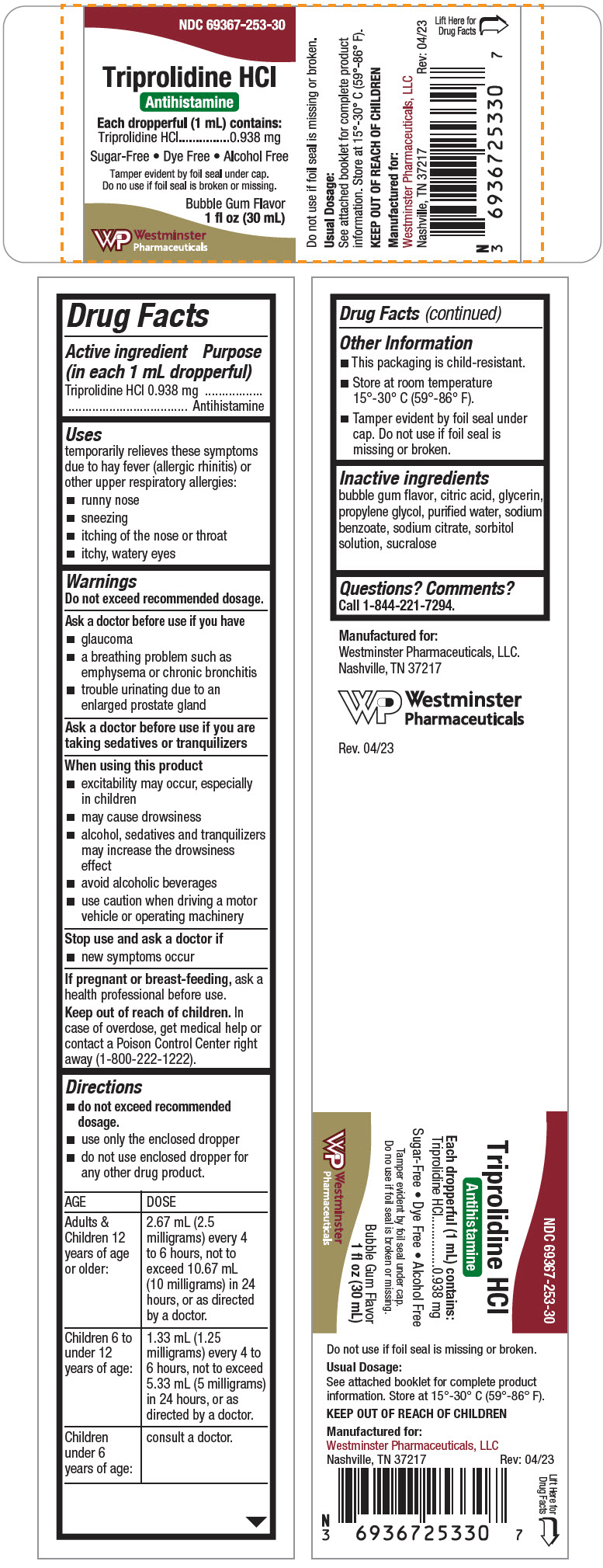
TRIPROLIDINE HYDROCHLORIDE .938 mg/mL Syrup — NDC 69367-0253-30 package photo

TRIPROLIDINE HYDROCHLORIDE .938 mg/mL Syrup

by Westminster Pharmaceuticals, LLC · 1 BOTTLE, DROPPER in 1 CARTON (69367-253-30) / 30 mL in 1 BOTTLE, DROPPER
NDC 69367-0253-30
🏷️ FDA NDC (as labeled) 69367-253-30 billing pads the product segment with a zero
OTC On market Non-controlled
🗂️ Data synced Aug 27, 2026 · sources: openFDA · FDA label (DailyMed) · FDA Orange & Purple Book · First Databank · CMS NADAC, ASP, Medicare & Medicaid · RxNorm
📋 All sources & update times →

🆔 Identity & classification

FDA NDC (as labeled) 69367-253-30
Product NDC 69367-253
11-digit billing NDC 69367025330
NCPDP billing unit ML — per mL (volume)
RxCUI 1491649
UNII YAN7R5L890
Application # M012
SPL Set ID a9f01760-e335-4410-a9b8-8edce2841270
DEA schedule Non-controlled
Marketing category OTC MONOGRAPH DRUG
Marketing status On market
FDA listing status Listed (active directory)
Marketing start 2020-03-09
Route ORAL
Dosage form SYRUP
Substance TRIPROLIDINE HYDROCHLORIDE
GCN Seq No 072165
GCN 36284
HICL code 004508
Ingredient (HICL) Triprolidine Hcl
HIC1 code Z
Therapeutic class — broad (HIC1) Body As A Whole
HIC2 code Z2
Therapeutic class — intermediate (HIC2) Antihistamines, Antiserotonins, Immunosuppressants
HIC3 code Z2P
Therapeutic class — specific (HIC3) Antihistamines - 1St Generation
AHFS code 04:04.00.00
AHFS class First Generation Antihistamines
FDB label name TRIPROLIDINE 0.938 MG/ML DROPS
FDB brand name Triprolidine Hcl
Legend status O — Over-the-counter (OTC) drug or device
Why two NDCs? The FDA registers this code as 69367-253-30 — a 5-3-2 layout, and that's what's printed on the package and shown on DailyMed. For insurance claims, every NDC is standardized to a uniform 11-digit 5-4-2 format by adding a zero to the product segment → 69367-0253-30. Same drug, same package — only the format differs.
Where does this data come from?
Identifiers from the FDA openFDA NDC Directory and Structured Product Labeling; RxCUI from RxNorm (NLM); GPI from Medi-Span; GCN / HIC / AHFS / legend from First Databank.

🏷️ RxNorm drug class

This medicine belongs to the Other antihistamines for systemic use class.

Drug family (ATC) Other antihistamines for systemic use
Where does this data come from?
Therapeutic classes from RxNorm RxClass (U.S. National Library of Medicine) — Established Pharmacologic Class (FDA), ATC drug family (WHO) and mechanism of action, matched by this product’s RxCUI.

🏭 Manufacturer & labeler

LabelerWestminster Pharmaceuticals, LLC
FDA applicationM012 (OTC MONOGRAPH DRUG)
Labeler code69367
First marketedMar 2020
Product typeHuman Otc Drug
Portfolio186 products on file
The labeler markets the product; the application holder owns the FDA approval. They’re often the same company but can differ (e.g. a repackager or an authorized generic). A mailing address / phone appears here when the manufacturer includes it in the product’s FDA label (not all do).
Where does this data come from?
Labeler, application holder and registered establishment from the FDA openFDA NDC Directory and Drugs@FDA; address/contact from the product’s FDA label.

🩺 Clinical

Label name TRIPROLIDINE 0.938 MG/ML DROPS Ingredient Triprolidine Hcl
📗 Our plain-language guide HelloPharmacist
  • Triprolidine helps relieve the common, uncomfortable symptoms of hay fever and other upper respiratory allergies — things like a runny nose, sneezing, itchy or watery eyes, and itc...
  • Yes, drowsiness is a real possibility with triprolidine, and it's something to take seriously. Avoid driving, operating machinery, or doing anything that needs sharp focus until yo...
  • For children under 6 years old, you should check with a doctor before giving any triprolidine product. The labels for these products don't include dosing for that age group without...
  • Yes — if you have emphysema, chronic bronchitis, glaucoma, or trouble urinating due to an enlarged prostate, you should not take triprolidine without talking to a doctor first. The...
📖 Read our full Triprolidine guide →
Where does this data come from?
Plain-language summary from MedlinePlus (U.S. National Library of Medicine); supplement & herbal interactions and nutrient depletion data from the Natural Medicines database; our full guide is HelloPharmacist editorial content.

💊 What it looks like

FlavorBubble Gum
One label can cover several strengths, so colors may be combined — always confirm a loose pill against the dispensed prescription label or a pharmacist.
Where does this data come from?
Physical description (imprint, shape, color, scoring, coating) from this product’s FDA Structured Product Labeling (SPL), mirrored from DailyMed / openFDA.

🧪 Inactive Ingredients / Excipients

Inactive ingredients, also called excipients, are components of the drug product other than the active ingredient. They may include fillers, dyes, coatings, preservatives, flavors, or other formulation ingredients.

💡 Tap an ingredient (hover on desktop) to see what it is and why it’s used.

  • UNII 2968PHW8QP
    A weak organic acid derived from citrus fruits or made through fermentation. It works as a buffer to control pH, a preservative to extend shelf life, and a flavoring agent in medications.
  • UNII PDC6A3C0OX
    Glycerin is a clear, thick liquid derived from plant oils or fats. It acts as a humectant to retain moisture, a sweetener, and a solvent in medications.
  • UNII 6DC9Q167V3
    Propylene glycol is a clear liquid derived from petroleum or vegetable sources. It acts as a solvent, humectant, and preservative in medicines, helping dissolve active ingredients and maintain product stability.
  • UNII OJ245FE5EU
    Sodium benzoate is a salt derived from benzoic acid, a preservative. It's added to medicines to prevent growth of bacteria, fungi, and other microorganisms that could spoil the product.
  • UNII 1Q73Q2JULR
    Sodium citrate is a salt derived from citric acid. It works as a buffer to maintain the medicine's pH level and may also help improve taste or act as a preservative in the formulation.
  • UNII 506T60A25R
    Sorbitol is a natural sugar alcohol derived from glucose. It serves as a sweetener, humectant, and bulking agent in medications to improve taste and help maintain moisture in the product.
  • UNII 96K6UQ3ZD4
    Sucralose is a synthetic sweetener made from sugar. It's added to medicines to improve taste without adding calories, helping make bitter or unpleasant-tasting drugs easier to take.
  • UNII 059QF0KO0R
    Water is a liquid solvent that dissolves and mixes ingredients together in liquid medicines, syrups, and injections. It helps distribute the active drug evenly throughout the product.

8 inactive ingredients listed in the exact product block matched to this NDC.

The official label also statesbubble gum flavor, citric acid, glycerin, propylene glycol, purified water, sodium benzoate, sodium citrate, sorbitol solution, sucralose

Label-section wording can be broader than the structured product block and may mention additional formulation ingredients.

Where does this data come from?
Data sourced from official FDA Structured Product Labeling (SPL) via DailyMed — ingredient classCode="IACT" elements from the exact product block matched by this NDC. Label-section narrative from DailyMed / the openFDA label index is shown separately when available.

Inactive ingredient FAQ

Are inactive ingredients the same for every manufacturer?
No. Inactive ingredients can differ by manufacturer, dosage form, strength, and package / product version.
Why might an inactive ingredient be missing?
Some SPLs do not provide a complete structured inactive-ingredient list, and older or unusual labels may only include the information in narrative text.
Can inactive ingredients matter?
Yes. They can matter for allergies, intolerances, dyes, gluten / lactose concerns, preservatives, and formulation differences — but confirm with a pharmacist or the manufacturer when it’s clinically important.

💲 Pricing

A drug doesn't have one price. Each row is a different public payment system, and none is what you'd pay at the counter — that depends on your insurance. The ⓘ on each row explains what it measures.

Price systemPer mLPer package
Retail pharmacies payNADAC · weekly $0.401 $12.04 / 30 ml
Medicaid paysCMS SDUD · 12 mo $0.3747 $11.24 / 30 ml
Medicare drug plans payPart D · quarterly No Part D plan price is available for this NDC in our data.
NADAC price history (per mL) — tap or hover for the price & month
Oct 2021 Jun 2022 Feb 2026 Sep 2026 $0.549 $0.386
▼ Down 23% over the last 21 months.
Where does this data come from?
NADAC (National Average Drug Acquisition Cost) is the CMS weekly pharmacy-acquisition-cost survey — what pharmacies pay. ASP (Average Sales Price) is the CMS Medicare Part B drug-payment file, published quarterly. Medicaid pays is computed by us from CMS State Drug Utilization Data (total reimbursed ÷ units, trailing 12 months) — gross of rebates and inclusive of dispensing fees, so it reflects what Medicaid paid, not an acquisition cost. Medicare drug plans pay is the median negotiated point-of-sale unit cost across plans listing this NDC in the CMS quarterly Prescription Drug Plan pricing files, before rebates. The VA pays is the federal contract price (FSS, and the statutory Big 4 ceiling where listed) from the VA National Acquisition Center pharmaceutical price file. All are free public government data; each measures a different payer, so the figures are not directly comparable.

🔁 Therapeutic equivalents

ProductLabelerPackNADAC/unitTEStatusPrice vs. this
Triprolidine Hydrochloride .938 mg/mLthis 69367-0253-30 Westminster 1 bottle $0.401 — Availability likely —
About this product: other versions of the same ingredient, strength and form are listed above, least expensive first, with FDA equivalence ratings where available.
Where does this data come from?
Equivalents are other NDCs of the same ingredient, form and route from the openFDA NDC Directory, ranked least-expensive-first by NADAC. Therapeutic-equivalence (AB) ratings come from the FDA Orange Book; biologics use the FDA Purple Book for biosimilar & interchangeable status.

⏳ Availability & generic status

🏛️
2020
On the market since
Mar 2020
📍
2026
Currently FDA-listed
6 years listed
🔒
·
No generic listed yet
brand only
ℹ️No FDA-approved generic found

We did not find an FDA-approved generic match for this exact strength, form and route.

Where does this data come from?
Patents and exclusivity from the FDA Orange Book (small-molecule drugs), refreshed from public FDA data. Generic launch timing is an estimate, not a guarantee.

🗺️ Medicaid utilization & spend

📍 This exact package only: Medicaid data is reported per full 11-digit NDC — labeler, product and pack size — so every number here is for 69367-0253-30, not the drug overall. Other pack sizes report separately.
💊 Pharmacy benefit only: These are Medicaid outpatient pharmacy claims, billed by NDC. They exclude the medical benefit — clinic- or hospital-administered drugs billed under HCPCS J-codes — so drugs used mostly that way (e.g. Avastin, Lucentis, Keytruda) can look low or missing here. That’s expected, not an error.
📅 Q1 2025 – Q1 2026 · 5 quarters of data
ⓘ The newest quarter is usually incomplete when first published; states restate recent quarters in later CMS releases, so the latest figures typically revise upward. State coverage-policy changes can also shift quarter-to-quarter totals.
Prescriptions last 4 qtrs
57.7K
Units reimbursed last 4 qtrs
1.8M
Gross reimbursed last 4 qtrs
$669.1K
Avg / prescription
$11.59
Avg / unit
$0.3747
Latest quarter Q1 2026
13.7KRx
Medicaid pays / mL
$0.3747
gross reimbursed
vs
NADAC / mL
$0.4012
acquisition cost
=
Spread
−$0.0265
-7% vs cost
What Medicaid paid per mL (before rebates; includes the pharmacy’s dispensing fee) compared with NADAC — the average price pharmacies pay to buy the drug. A positive spread means Medicaid reimbursed more than the purchase price, before manufacturer rebates.
Fee-for-service vs managed care ⓘ
99% MCO
Fee-for-service · 356 Rx Managed care · 57,372 Rx
State Medicaid map
Alaska: no data reported AK Maine: no data reported ME Washington: no data reported WA Idaho: no data reported ID Montana: no data reported MT North Dakota: no data reported ND Minnesota: no data reported MN Wisconsin: no data reported WI Michigan: no data reported MI New York: no data reported NY Vermont: no data reported VT New Hampshire: no data reported NH Oregon: no data reported OR Nevada: no data reported NV Wyoming: no data reported WY South Dakota: no data reported SD Iowa: no data reported IA Illinois: no data reported IL Indiana: no data reported IN Ohio: no data reported OH Pennsylvania: no data reported PA New Jersey: no data reported NJ Massachusetts: no data reported MA California: no data reported CA Utah: no data reported UT Colorado: no data reported CO Nebraska: no data reported NE Missouri: no data reported MO Kentucky: no data reported KY West Virginia: no data reported WV Virginia: no data reported VA Maryland: no data reported MD Connecticut: no data reported CT Rhode Island: no data reported RI Arizona: no data reported AZ New Mexico: no data reported NM Kansas: no data reported KS Arkansas: no data reported AR Tennessee: no data reported TN North Carolina: no data reported NC South Carolina: no data reported SC Delaware: no data reported DE Oklahoma: no data reported OK Louisiana: no data reported LA Mississippi: no data reported MS Alabama: no data reported AL Georgia: no data reported GA D.C.: no data reported DC Hawaii: no data reported HI Texas: 1,785,700 units · 5,854 per 100k residents TX Florida: no data reported FL
Units reimbursed · per 100k residents
5,8545,854
gray = no data reported ⓘ
Colors are per 100,000 residents, so big states don’t automatically dominate. Tap or hover a state for its actual totals.
Tap or hover a state
…for its Medicaid breakdown
🏆 Top states by units · per 100k residents
1 Texas 5,854 /100k
National units — by quarter
💵 About the dollar figures: “reimbursed” is what Medicaid paid pharmacies before confidential manufacturer rebates, so the program’s real net cost is lower than these numbers. Fee-for-service and managed-care claims are combined unless split above. Source: CMS State Drug Utilization Data; per-100k rates use 2023 Census population estimates.

📦 Packaging — all sizes for this product

Package NDCDescription Marketing startStatus
69367-0253-30 You're viewing this 1 BOTTLE, DROPPER in 1 CARTON (69367-253-30) / 30 mL in 1 BOTTLE, DROPPER 2020-03-09 Active

📄 FDA label — Drug Facts FDA SPL

The complete FDA label for this product — the official Drug Facts labeling, verbatim, section by section. Jump with a chip, search within the label, or expand everything.
🎯 Indications and Usage 28 words ▾

Uses temporarily relieves these symptoms due to hay fever (allergic rhinitis) or other upper respiratory allergies: runny nose sneezing itching of the nose or throat itchy, watery eyes

⏱️ Dosage and Administration 99 words ▾

Directions do not exceed recommended dosage. use only the enclosed dropper do not use enclosed dropper for any other drug product. AGE DOSE Adults & Children 12 years of age or older: 2.67 mL (2.5 milligrams) every 4 to 6 hours, not to exceed 10.67 mL (10 milligrams) in 24 hours, or as directed by a doctor. Children 6 to under 12 years of age: 1.33 mL (1.25 milligrams) every 4 to 6 hours, not to exceed 5.33 mL (5 milligrams) in 24 hours, or as directed by a doctor.

Children under 6 years of age: consult a doctor

⚠️ Warnings 111 words ▾

Warnings Do not exceed recommended dosage. Ask a doctor before use if you have glaucoma a breathing problem such as emphysema or chronic bronchitis trouble urinating due to an enlarged prostate gland Ask a doctor before use if you are taking sedatives or tranquilizers When using this product may cause drowsiness excitability may occur, especially in children alcohol, sedatives and tranquilizers may increase the drowsiness effect avoid alcoholic beverages use caution when driving a motor vehicle or operating machinery Stop use and ask a doctor if new symptoms occur Keep out of reach of children In case of overdose, get medical help or contact a Poison Control Center right away (1-800-222-1222).

📦 Storage and Handling 35 words ▾

Other Information This packaging is child-resistant. Store at room temperature 15° - 30° C (59° - 86° F). Tamper evident by foil seal under cap. Do not use if foil seal is missing or broken.

🧪 Active Ingredient 11 words ▾

Active ingredient (in each 1 mL dropperful) Triprolidine HCl 0.938 mg

🧪 Inactive Ingredients 19 words ▾

Inactive ingredients bubble gum flavor, citric acid, glycerin, propylene glycol, purified water, sodium benzoate, sodium citrate, sorbitol solution, sucralose

🎯 Purpose 2 words ▾

Purpose Antihistamine

Source: FDA Structured Product Labeling, mirrored from DailyMed / openFDA. Prefer the government’s original formatting? View this label on DailyMed ↗
For educational and professional reference only — not medical advice. Pricing reflects published NADAC and CMS ASP (free public data) and may differ from your acquisition cost; always verify before billing or dispensing.