
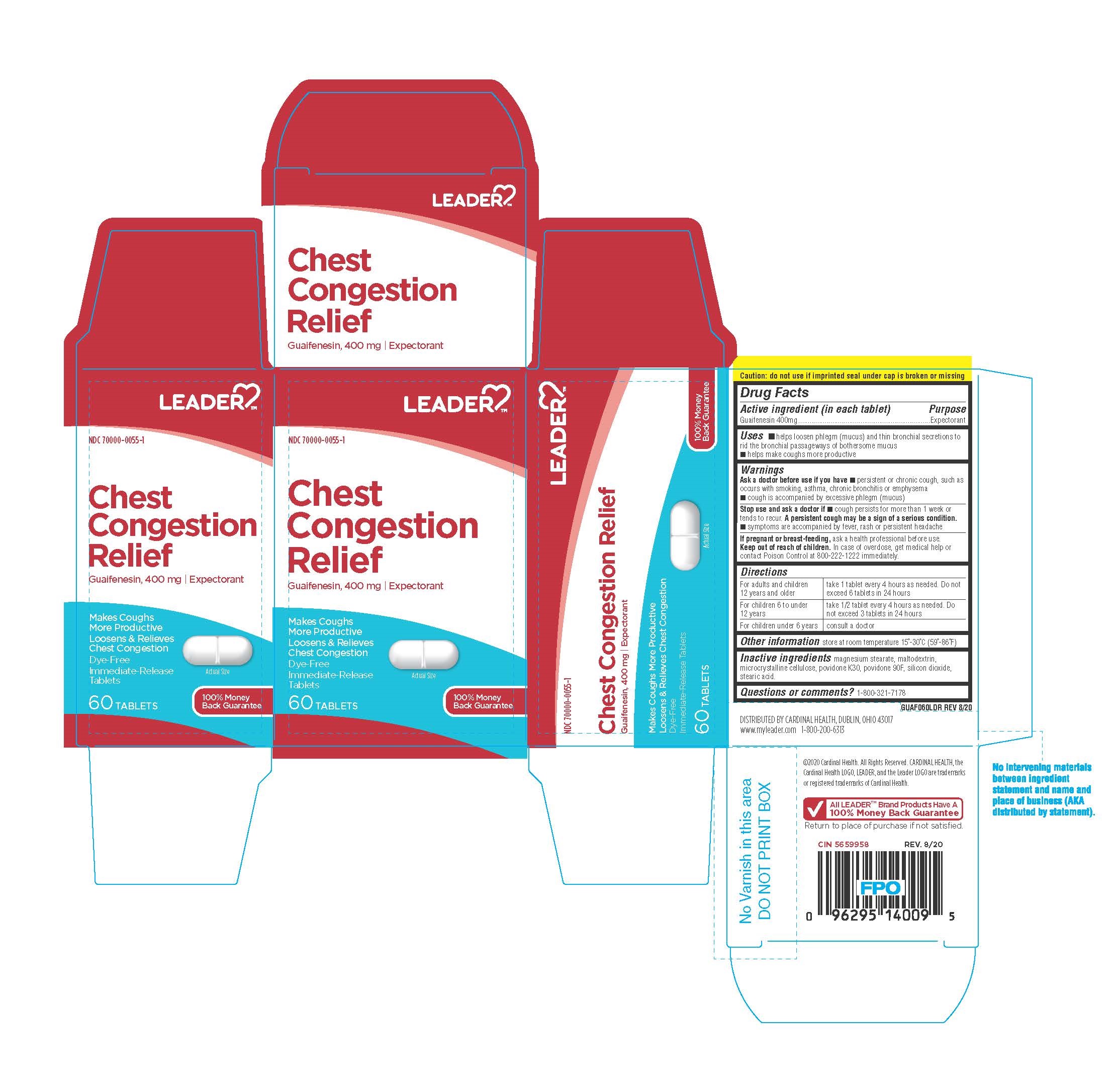
Leader Chest Congestion Relief G450 Guaifenesin 400 mg Tablet, 60-count — NDC 70000-0055-1 (Billing 70000-0055-01)
This is a package of 60 tablets of Leader Chest Congestion Relief G450 Guaifenesin 400 mg Tablet from Cardinal Health, marketed since Sep 2020 and currently FDA-listed; retail pharmacies pay about $0.0656 per tablet (NADAC). It is this product's only package size.
NDC database record
One package, one record: these facts belong to NDC 70000-0055-1 alone.
- Record
- FDA NDC Directory package listing · Human OTC drug
- Code segments
- 70000 labeler · 0055 product · 1 package
- Package marketed since
- Sep 1, 2020
- Sample package
- No — commercial package
- Listing certified through
- Dec 31, 2026
- Billing quantity
- 60 EA per package
- Barcode (UPC)
- 0096295140095
- Medicaid fills, this package
- 962 prescriptions in the last four reported quarters
- FDA record last changed
- Jul 24, 2026
Identity & classification
Regulatory identifiers FDA, NLM and CMS codes for this package
Drug-database identifiers Medi-Span GPI and First Databank GCN / HICL / AHFS classification
- GSN (GCN sequence number): 051583
- GCN: 18906
- GPI-14 (Medi-Span): 43200010000340
- HICL (First Databank): 000271
- AHFS class code: 48:16.00.00
- RxCUI (RxNorm): 359601
Where does this data come from?
- FDA openFDA NDC Directory · synced Oct 8, 2026
- FDA label on DailyMed · label index refreshed Oct 6, 2026
- RxNorm (NLM RxNav) · catalog refreshed Oct 1, 2026
- Medi-Span GPI (licensed)
- First Databank (licensed) · refreshed Oct 8, 2026
RxNorm drug class
This medicine belongs to the Expectorant class.
Where does this data come from?
- RxClass (NLM) · catalog refreshed Oct 1, 2026
Clinical
- Guaifenesin doesn't suppress your cough — it actually makes it work better. It loosens and thins the mucus in your chest so your cough can move it out of your airways more effectiv...
- What exactly does guaifenesin do — does it actually stop my cough?
- No — extended-release tablets like 12 Hour Mucus Relief and 365 Whole Foods Market Guaifenesin must be swallowed whole. Crushing, chewing, or breaking them releases the medicine al...
- Can I crush or split the extended-release tablet to make it easier to swallow?
Patient education
Supplement & herbal interactions
Some supplements/herbs that may interact with Guaifenesin — tap one for details:
Where does this data come from?
- MedlinePlus (NLM) · refreshed Oct 1, 2026
- FDA label on DailyMed · label index refreshed Oct 6, 2026
Ask a licensed pharmacist directly — free, answered by our team.
Pricing
A drug doesn't have one price. Each row is a different public payment system, and none is what you'd pay at the counter — that depends on your insurance. The ⓘ on each row explains what it measures.
| Price system | Per ea | Per package |
|---|---|---|
| Retail pharmacies payNADAC · weekly | $0.066 | $3.94 / 60 tablets |
| Medicaid paysCMS SDUD · 12 mo | $0.2811 | $16.87 / 60 tablets |
| Medicare drug plans payPart D · quarterly | No Part D plan price is available for this NDC in our data. | |
Where does this data come from?
- CMS NADAC weekly file · file of Oct 7, 2026
- CMS ASP pricing files · refreshed Sep 20, 2026
- CMS Medicaid State Drug Utilization Data · through Q1 2026
- CMS Part D plan pricing files · refreshed Sep 24, 2026
- VA National Acquisition Center price file
Packaging — all sizes for this product
| Package NDC | Description | Marketing start | Marketing end | Status |
|---|---|---|---|---|
| 70000-0055-01 You're viewing this Main listing | 1 BOTTLE, PLASTIC in 1 CARTON / 60 TABLET in 1 BOTTLE, PLASTIC | 2020-09-01 | — | Active |
Therapeutic equivalents
| Product | Labeler | Pack | NADAC/unit | TE | Status | Price vs. this |
|---|---|---|---|---|---|---|
| Quality Choice Mucus Relief 400 mg 63868-0998-50 | Chain | 50 tablets | $0.063 | — | FDA listed | save 4% |
| Rugby Chest Congestion Relief G450 400 mg 00536-1311-08 | Rugby | 60 tablets | $0.066 | — | Availability likely | — |
| Good Neighbor Pharmacy Mucus Relief 400 mg 24385-0602-65 | AmerisourceBergen | 30 tablets | $0.066 | — | Availability likely | — |
| Guaifenesin 400 mg 24689-0144-01 | APNAR | 100 tablets | $0.066 | — | Availability likely | — |
| Mucus Relief 400 mg 46122-0794-61 | Amerisource | 50 tablets | $0.066 | — | Availability likely | — |
| Leader Chest Congestion Relief G450 400 mgthis 70000-0055-01 | Cardinal | 60 tablets | $0.066 | — | Availability likely | — |
| Foster and Thrive Chest Congestion Relief 400 mg 70677-1054-01 | Strategic | 50 tablets | $0.066 | — | Availability likely | — |
| HealthMart Chest Congestion Relief 400 mg 62011-0060-01 | Strategic | 50 tablets | $0.066 | — | FDA listed | +1% |
| Chest Congestion Relief 400 mg 49348-0729-09 | Strategic | 24 tablets | $0.067 | — | FDA listed | +2% |
| Mucus Relief 400 mg 00363-0532-01 | Walgreen | 30 tablets | — | — | FDA listed | — |
| Guaifenesin 400mg 400 mg 10135-0790-30 | Marlex | 30 tablets | — | — | FDA listed | — |
| DG Health Immediate Release Mucus Relief 400 mg 10956-0059-30 | Reese | 30 tablets | — | — | FDA listed | — |
| Refenesen Mucus Relief 400 mg 10956-0845-30 | Reese | 30 tablets | — | — | FDA listed | — |
| Guaifenesin 400 mg 16103-0379-04 | Pharbest | 30 tablets | — | — | FDA listed | — |
| Mucus Relief 400 mg 17714-0152-01 | Advance | 100 tablets | — | — | FDA listed | — |
| Kroger Mucus Relief 400 mg 30142-0471-30 | THE | 30 tablets | — | — | FDA listed | — |
| TopCare Chest Congestion Relief 400 mg 36800-0794-50 | TOPCO | 50 tablets | — | — | FDA listed | — |
| Mucus Relief 400 mg 37835-0401-40 | Bi-Mart | 40 tablets | — | — | FDA listed | — |
| Equaline Chest Congestion Relief 400 mg 41163-0113-50 | United | 50 tablets | — | — | FDA listed | — |
| Mucus Relief 400 mg 41226-0272-03 | KROGER | 30 tablets | — | — | FDA listed | — |
| Meijer Chest Congestion Relief 400 mg 41250-0713-50 | Meijer | 50 tablets | — | — | FDA listed | — |
| Mucosa 400 mg 49483-0272-00 | TIME | 100000 tablets | — | — | FDA listed | — |
| Mucus Relief Immediate Release 400 mg 50804-0371-30 | Good | 30 tablets | — | — | FDA listed | — |
| Mucus Relief 400 mg 50804-0857-30 | Good | 30 tablets | — | — | Discontinued | — |
| Respiratory Relief 400 mg 53499-5295-00 | Schwabe | 30 tablets | — | — | FDA listed | — |
| Mucosa Guifenesin 400 mg 54257-0776-21 | Magno-Humphries, | 60 tablets | — | — | FDA listed | — |
| Mucus Relief 400 mg 54738-0981-30 | Richmond | 30 tablets | — | — | FDA listed | — |
| Family Wellness Chest Congestion Relief 400 mg 55319-0891-30 | Family | 30 tablets | — | — | FDA listed | — |
| Mucus Relief 400 mg 55681-0311-03 | TWIN | 300 tablets | — | — | FDA listed | — |
| Guaifenesin 400 400 mg 57631-0012-00 | InvaTech | 28000 tablets | — | — | FDA listed | — |
| Mucus Relief 400 mg 57896-0714-01 | Geri-Care | 100 tablets | — | — | FDA listed | — |
| Mucus Relief 400 mg 57896-0794-01 | Geri-Care | 100 tablets | — | — | FDA listed | — |
| Always Save Chest Congestion Relief GUAF 400 mg 63941-0987-50 | Valu | 50 tablets | — | — | FDA listed | — |
| Mucus Relief 400 mg 66424-0001-01 | SDA | 100 tablets | — | — | FDA listed | — |
| Mucus Relief 400 mg 68210-4158-01 | Prodose, | 15 tablets | — | — | FDA listed | — |
| Marcs Mucus Relief 400 mg 68998-0845-50 | Marc | 50 tablets | — | — | FDA listed | — |
| Mucus Relief Immediate Release 400 mg 69168-0370-01 | Allegiant | 100 tablets | — | — | FDA listed | — |
| Mucus Relief Immediate Release 400 mg 69168-0916-60 | Allegiant | 60 tablets | — | — | Discontinued | — |
| Mucus Relief 400 mg 69517-0005-02 | HealthLife | 200 tablets | — | — | Discontinued | — |
| Guaifenesin 400 mg 69618-0061-06 | Reliable | 60 tablets | — | — | FDA listed | — |
| Mucus Relief 400 mg 71335-1035-01 | Bryant | 30 tablets | — | — | FDA listed | — |
| Mucus Relief 400 mg 71335-2032-01 | Bryant | 30 tablets | — | — | FDA listed | — |
| Guaifenesin 400 mg 71335-9616-01 | Bryant | 30 tablets | — | — | FDA listed | — |
| Mucus Relief 400 mg 71679-0119-02 | Health | 200 tablets | — | — | FDA listed | — |
| Guaifenesin 400 mg 71679-0309-00 | Health | 38500 tablets | — | — | FDA listed | — |
| Mucus Relief 400 mg 72090-0009-02 | Pioneer | 300 tablets | — | — | FDA listed | — |
| Mucus Relief 400 mg 72090-0013-01 | Pioneer | 200 tablets | — | — | FDA listed | — |
| Mucus Relief 400 mg 72090-0019-01 | Pioneer | 200 tablets | — | — | FDA listed | — |
| Mucus Relief 400 mg 72090-0035-01 | Pioneer | 200 tablets | — | — | FDA listed | — |
| Mucus Relief 400 mg 72090-0044-01 | Pioneer | 200 tablets | — | — | FDA listed | — |
| Pharbinex 400 mg 73057-0379-04 | Ulai | 30 tablets | — | — | FDA listed | — |
| Mucus Relief Immediate Release 400 mg 76162-0004-01 | TopCo | 100 tablets | — | — | FDA listed | — |
| SIMPEX Guaifenesin 400 mg 76457-0004-00 | Simpex | 100 tablets | — | — | FDA listed | — |
| Guaifenesin 400Mg Caplets 400 mg 77333-0360-10 | Gendose | 100 tablets | — | — | FDA listed | — |
| Chest Congestion Relief 400 mg 79481-0714-05 | Meijer, | 50 tablets | — | — | FDA listed | — |
| Mucus Relief 400 mg 82725-1012-01 | Cabinet | 200 tablets | — | — | FDA listed | — |
| Quality Choice Mucus Relief 400 mg 83324-0194-50 | Chain | 50 tablets | — | — | FDA listed | — |
| Mucus Relief 400 mg 84324-0009-01 | NUVICARE | 100 tablets | — | — | FDA listed | — |
| Mucus Relief 400 mg 57896-0718-01 | Geri-Care | 100 tablets | — | — | FDA listed | — |
Where does this data come from?
- FDA openFDA NDC Directory · synced Oct 8, 2026
- FDA Orange Book · refreshed Oct 3, 2026
- CMS NADAC weekly file · file of Oct 7, 2026
Availability & generic status
FDA-approved generic versions are listed, and recent pricing/market data suggests they may be available — see Therapeutic equivalents.
Where does this data come from?
- FDA Orange Book · refreshed Oct 3, 2026
What it looks like
Where does this data come from?
- FDA label on DailyMed · label index refreshed Oct 6, 2026
Inactive Ingredients / Excipients
Inactive ingredients, also called excipients, are components of the drug product other than the active ingredient. They may include fillers, dyes, coatings, preservatives, flavors, or other formulation ingredients.
🧪 Avoiding an ingredient? See Guaifenesin inactive ingredients by manufacturer: every current product's list side by side, so you can ask your pharmacy for the version that does not list it.
💡 Tap an ingredient (hover on desktop) to see what it is and why it’s used.
-
UNII D9C330MD8B
Copovidone is a synthetic polymer made by combining two types of plastic-like molecules. It acts as a binder and film-former to help hold tablet ingredients together and improve how the medicine dissolves in your body.
-
UNII 70097M6I30
Magnesium stearate is a salt made from magnesium and stearic acid, a fatty substance. It's used in tablets and capsules as a lubricant and glidant to help ingredients flow smoothly during manufacturing and prevent sticking.
-
UNII 7CVR7L4A2D
A starch-derived carbohydrate produced by breaking down corn, potato, or tapioca starch. It functions as a filler and binder to give the medicine bulk and texture, and sometimes as a mild sweetener or texture enhancer in powders and tablets.
-
UNII ETJ7Z6XBU4
Silicon dioxide is a naturally occurring mineral used as a glidant and anti-caking agent. It helps powder ingredients flow smoothly and prevents clumping during manufacturing and storage.
-
UNII 4ELV7Z65AP
Stearic acid is a fatty acid derived from plant or animal sources. It acts as a binder and lubricant in tablets and capsules, helping them hold together and flow smoothly during manufacturing.
5 inactive ingredients listed in the exact product block matched to this NDC.
Label-section wording can be broader than the structured product block and may mention additional formulation ingredients.
Where does this data come from?
ingredient classCode="IACT" elements from the exact product block matched by this NDC. Label-section narrative from DailyMed / the openFDA label index is shown separately when available.- FDA label on DailyMed · label index refreshed Oct 6, 2026
- FDA openFDA NDC Directory · synced Oct 8, 2026
Inactive ingredient FAQ
Are inactive ingredients the same for every manufacturer?
Why might an inactive ingredient be missing?
Can inactive ingredients matter?
Manufacturer & labeler
More NDCs from Cardinal Health labeler code 70000
- Famotidine 20 mg Tablet, Film Coated NDC 70000-0049-1
- Flu HBP Maximum Strength Acetaminophen, Chlorpheniramine maleate, Dextromethorphan HBr 325 mg; 2 mg; 10 mg Tablet, Film Coated NDC 70000-0050-1
- Cardinal Health Infants Gas Relief Simethicone 20 mg/.3mL Suspension/ Drops NDC 70000-0051-1
- Anti Nausea dextrose(glucose),Levulose(fructose),Phosphoric acid 1.87 g/5mL; 1.87 g/5mL; 21.5 mg/5mL Liquid NDC 70000-0052-1
- Eye Allergy Itch Relief Olopatadine HCl 2 mg/mL Solution/ Drops NDC 70000-0053-1
- Eye Allergy Itch and Redness Relief Olopatadine Hydrochloride 1 mg/mL Solution/ Drops NDC 70000-0054-1
- Leader Chest Congestion Relief DM Dextromethorphan Hydrobromide / Guaifenesin 20 mg; 400 mg Tablet NDC 70000-0056-1
- Childrens Dibromm Cold and Allergy Brompheniramine maleate, Phenylephrine HCl 2 mg/10mL; 5 mg/10mL Liquid NDC 70000-0057-1
- CR-5667753 Leader Daily Moisturizer 41 g/100g Ointment NDC 70000-0059-1
- Leader Povidone-Iodine 10% Topical Solution Povidone Iodine Prep 10 mg/mL Liquid NDC 70000-0060-1
- MILK OF MAGNESIA magnesium hydroxide 1200 mg/15mL Suspension NDC 70000-0061-1
- MAXIMUM STRENGTH ANTACID aluminum hydroxide, magnesium hydroxide, dimethicone 800 mg/10mL; 800 mg/10mL; 80 mg/10mL Suspension NDC 70000-0062-1
Where does this data come from?
- FDA openFDA NDC Directory · synced Oct 8, 2026
- Drugs@FDA
FDA label — Drug Facts FDA SPL
🎯 Indications and Usage ▾
Uses helps loosen phlegm (mucus) and thin bronchial secretions to rid the bronchial passageways of bothersome mucus helps make coughs more productive
⏱️ Dosage and Administration ▾
Directions Adults and children 12 years of age and over: take 1 tablet every 4 hours as needed Children 6 to 10 under 12 years of age: take 1/2 tablet every 4 hours as needed Children under 6 years of age: consult a doctor Do not exceed 6 doses in a 24 hour period or as directed by a doctor
⚠️ Warnings ▾
Warnings Ask doctor before use if you have persistent or chronic cough, such as occurs with smoking, asthma, bronchitis or emphysema cough is accompanied by excessive phlegm (mucus)
📦 Storage and Handling ▾
Other Information store at 15°-30°C (59°-86°F)
🧪 Active Ingredient ▾
Active ingredient (per tablet) Guaifenesin 400mg
🧪 Inactive Ingredients ▾
Inactive ingredients magnesium stearate, microcrystalline cellulose. May also contain (colloidal) silicon dioxide, (co) povidone, dicalcium phosphate, maltodextrin, sodium starch glycolate, stearic acid.
🎯 Purpose ▾
Purpose Expectorant
📄 Stop Use and Ask a Doctor If ▾
Stop use and ask doctor if Symptoms are accompanied by fever, rash or persistent headache cough persists for more than 1 week or tends to recur A persistent cough may be a sign of a serious condition.
🤰 If Pregnant or Breast-Feeding ▾
If pregnant or breast-feeding , ask a health professional before use.
📄 Keep Out of Reach of Children ▾
Keep out of reach of children. In case of overdose, get medical help or contact a Poison Control Center immediately.
📄 Package Label / Principal Display Panel ▾
image of carton label