
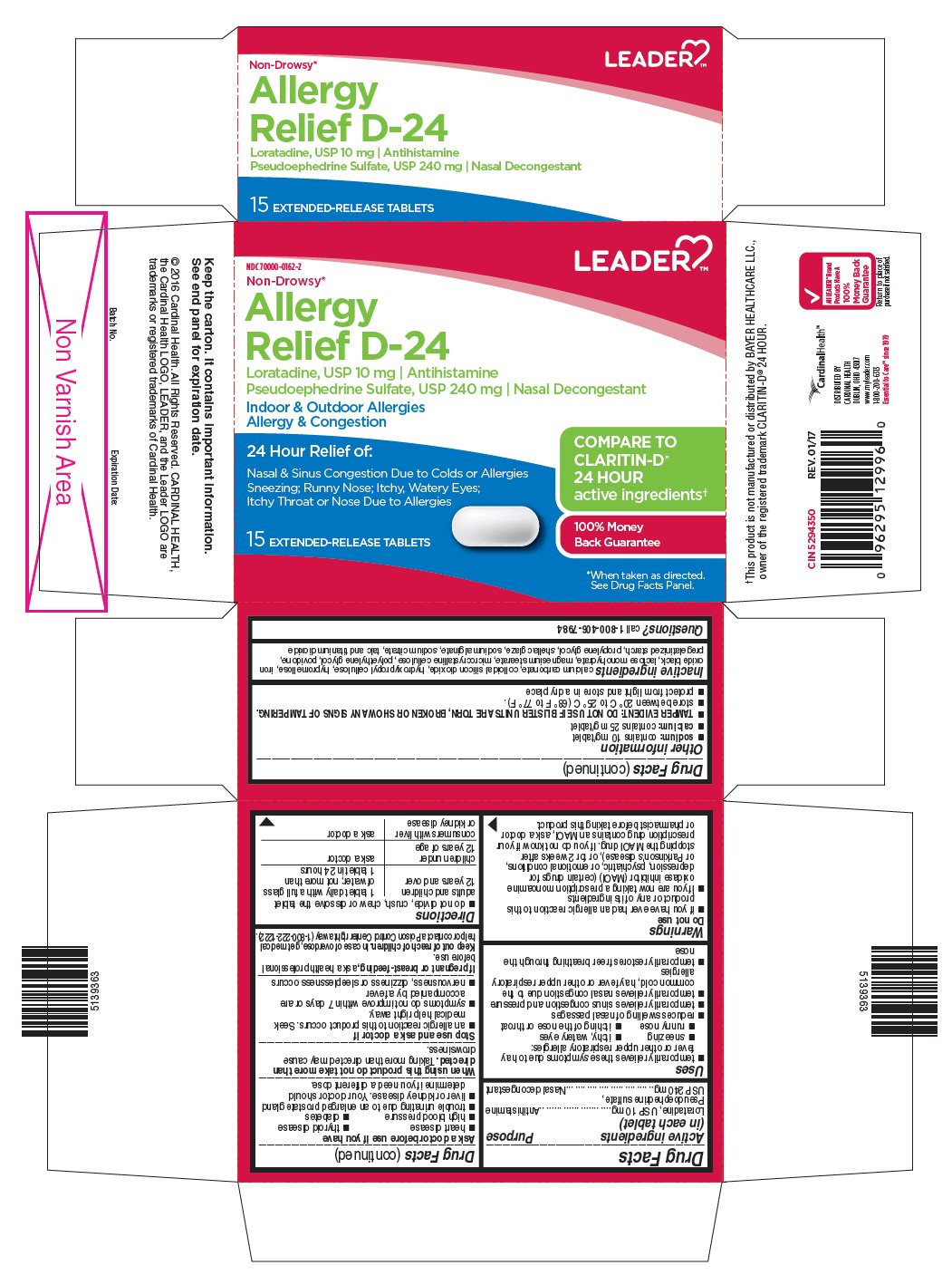
Leader Allergy Relief D-24 Loratadine and Pseudoephedrine Sulfate 10 mg; 240 mg Tablet, Film Coated, Extended Release, 15-count — NDC 70000-0162-02 package photo

Leader Allergy Relief D-24 Loratadine and Pseudoephedrine Sulfate 10 mg; 240 mg Tablet, Film Coated, Extended Release, 15-count

by Cardinal Health · 15 TABLET, FILM COATED, EXTENDED RELEASE in 1 BLISTER PACK (70000-0162-2)
NDC 70000-0162-02
🏷️ FDA NDC (as labeled) 70000-0162-2 billing pads the package segment with a zero
This package
Contains15-count Cost per ea$0.5535 NADAC Per package$8.30 / 15 tablets Pack sizes2 compare ↓
Also priced by: Medicaid pays $0.8326/unit — full pricing hub ↓
Also comes in: 10 tablets 70000-0162-01
OTC Generic On market Non-controlled
🗂️ Data synced Jul 24, 2026 · sources: openFDA · FDA label (DailyMed) · FDA Orange & Purple Book · First Databank · CMS NADAC, ASP, Medicare & Medicaid · RxNorm
📋 All sources & update times →

🆔 Identity & classification

FDA NDC (as labeled) 70000-0162-2
Product NDC 70000-0162
11-digit billing NDC 70000016202
NCPDP billing unit EA — each (per item)
RxCUI 1117562
UNII 7AJO3BO7QN, Y9DL7QPE6B
Application # ANDA076557
SPL Set ID f1bcd2aa-e8cd-4364-87b4-c544537cdb50
Established class (EPC) alpha-Adrenergic Agonist
Mechanism of action Adrenergic alpha-Agonists
DEA schedule Non-controlled
Marketing category ANDA
Marketing status On market
FDA listing status Listed (active directory)
Marketing start 2017-02-15
Route ORAL
Dosage form TABLET, FILM COATED, EXTENDED RELEASE
Substance LORATADINE; PSEUDOEPHEDRINE SULFATE
GPI-14 43993002597520
GPI class Allergy Relief D-24
GCN Seq No 027622
GCN 63577
HICL code 006605
Ingredient (HICL) Loratadine/Pseudoephedrine
HIC1 code Z
Therapeutic class — broad (HIC1) Body As A Whole
HIC2 code Z2
Therapeutic class — intermediate (HIC2) Antihistamines, Antiserotonins, Immunosuppressants
HIC3 code Z2O
Therapeutic class — specific (HIC3) 2Nd Gen Antihistamine And Decongestant Combination
AHFS code 04:08.00.00
AHFS class Second Generation Antihistamines
FDB label name ALLERGY RELIEF D-24HR TABLET
FDB brand name Allergy Relief D-24Hr
Legend status O — Over-the-counter (OTC) drug or device
Why two NDCs? The FDA registers this code as 70000-0162-2 — a 5-4-1 layout, and that's what's printed on the package and shown on DailyMed. For insurance claims, every NDC is standardized to a uniform 11-digit 5-4-2 format by adding a zero to the package segment → 70000-0162-02. Same drug, same package — only the format differs.
Where does this data come from?
Identifiers from the FDA openFDA NDC Directory and Structured Product Labeling; RxCUI from RxNorm (NLM); GPI from Medi-Span; GCN / HIC / AHFS / legend from First Databank.

🏷️ RxNorm drug class

This medicine belongs to the Other antihistamines for systemic use class.

Drug family (ATC) Other antihistamines for systemic use
Where does this data come from?
Therapeutic classes from RxNorm RxClass (U.S. National Library of Medicine) — Established Pharmacologic Class (FDA), ATC drug family (WHO) and mechanism of action, matched by this product’s RxCUI.

🏭 Manufacturer & labeler

LabelerCardinal Health
Application holderSUN PHARMACEUTICAL INDUSTRIES LTD
FDA applicationANDA076557 (ANDA)
Labeler code70000
First marketedFeb 2017
Product typeHuman Otc Drug
Portfolio84 products on file
The labeler markets the product; the application holder owns the FDA approval. They’re often the same company but can differ (e.g. a repackager or an authorized generic). A mailing address / phone appears here when the manufacturer includes it in the product’s FDA label (not all do).
Where does this data come from?
Labeler, application holder and registered establishment from the FDA openFDA NDC Directory and Drugs@FDA; address/contact from the product’s FDA label.

🩺 Clinical

Label name ALLERGY RELIEF D-24HR TABLET Ingredient Loratadine/Pseudoephedrine
📗 Our plain-language guide HelloPharmacist
  • Great question. The two ingredients each do something different. Loratadine is an antihistamine — it targets the sneezing, runny nose, itchy eyes, and throat itching that come with...
  • What exactly does this medicine do, and why does it have two ingredients?
  • You take it by mouth with a full glass of water — but it's really important that you swallow it whole. Do not crush, split, chew, or dissolve it. These are extended-release tablets...
  • How do I take it, and does it matter if I crush or split the tablet?
📖 Read our full Loratadine / Pseudoephedrine guide →
Where does this data come from?
Plain-language summary from MedlinePlus (U.S. National Library of Medicine); supplement & herbal interactions and nutrient depletion data from the Natural Medicines database; our full guide is HelloPharmacist editorial content.

🧪 Inactive Ingredients / Excipients

Inactive ingredients, also called excipients, are components of the drug product other than the active ingredient. They may include fillers, dyes, coatings, preservatives, flavors, or other formulation ingredients.

Loading inactive ingredients from the official FDA label in the background. No external source is being called by this page request.
Where does this data come from?
Source: official FDA Structured Product Labeling (SPL) via DailyMed and the openFDA label index. Structured IACT rows and label-wide narrative are kept separate; availability and product-level specificity depend on the submitted label.

Inactive ingredient FAQ

Are inactive ingredients the same for every manufacturer?
No. Inactive ingredients can differ by manufacturer, dosage form, strength, and package / product version.
Why might an inactive ingredient be missing?
Some SPLs do not provide a complete structured inactive-ingredient list, and older or unusual labels may only include the information in narrative text.
Can inactive ingredients matter?
Yes. They can matter for allergies, intolerances, dyes, gluten / lactose concerns, preservatives, and formulation differences — but confirm with a pharmacist or the manufacturer when it’s clinically important.

💲 Pricing

A drug doesn't have one price. Each row is a different public payment system, and none is what you'd pay at the counter — that depends on your insurance. The ⓘ on each row explains what it measures.

Price systemPer eaPer package
Retail pharmacies payNADAC · weekly $0.554 $8.30 / 15 tablets
Medicaid paysCMS SDUD · 12 mo $0.8326 $12.49 / 15 tablets
Medicare drug plans payPart D · quarterly No Part D plan price is available for this NDC in our data.
NADAC price history (per ea) — tap or hover for the price & month
Jan 2022 Aug 2022 Jan 2026 Sep 2026 $0.585 $0.506
▲ Up 9% over the last 24 months.
Where does this data come from?
NADAC (National Average Drug Acquisition Cost) is the CMS weekly pharmacy-acquisition-cost survey — what pharmacies pay. ASP (Average Sales Price) is the CMS Medicare Part B drug-payment file, published quarterly. Medicaid pays is computed by us from CMS State Drug Utilization Data (total reimbursed ÷ units, trailing 12 months) — gross of rebates and inclusive of dispensing fees, so it reflects what Medicaid paid, not an acquisition cost. Medicare drug plans pay is the median negotiated point-of-sale unit cost across plans listing this NDC in the CMS quarterly Prescription Drug Plan pricing files, before rebates. The VA pays is the federal contract price (FSS, and the statutory Big 4 ceiling where listed) from the VA National Acquisition Center pharmaceutical price file. All are free public government data; each measures a different payer, so the figures are not directly comparable.

🔁 Therapeutic equivalents

ProductLabelerPackNADAC/unitTEStatusPrice vs. this
allergy d 10 mg/1; 240 mg 00113-9004-22 L. 1 tablet $0.553 — Availability likely —
Loratadine and Pseudoephedrine Sulfate 10 mg/1; 240 mg 00904-5833-15 Major 10 tablets $0.553 — Availability likely —
Loratadine and Pseudoephedrine Sulfate 10 mg/1; 240 mg 46122-0167-52 Amerisource 10 tablets $0.553 — Availability likely —
Loratadine and Pseudoephedrine 10 mg/1; 240 mg 46122-0383-22 AMERISOURCE 15 tablets $0.553 — Availability likely —
Loratadine and Pseudoephedrine 10 mg/1; 240 mg 51660-0724-04 Ohm 5 tablets $0.553 — Availability likely —
Leader Allergy Relief D-24 10 mg/1; 240 mgthis 70000-0162-02 Cardinal 15 tablets $0.553 — Availability likely —
Loratadine and Pseudoephedrine 10 mg/1; 240 mg 70677-1018-01 STRATEGIC 10 tablets $0.553 — Availability likely —
Loratadine and Pseudoephedrine Sulfate 10 mg/1; 240 mg 49348-0543-01 STRATEGIC 10 tablets $0.574 — FDA listed +4%
Loratadine and Pseudoephedrine Sulfate 10 mg/1; 240 mg 62011-0071-01 Strategic 10 tablets $0.574 — FDA listed +4%
Loratadine and Pseudoephedrine 10 mg/1; 240 mg 00363-0725-15 Walgreen 15 tablets — — FDA listed —
Allergy Relief D 10 mg/1; 240 mg 00363-2010-22 Walgreen 1 tablet — — FDA listed —
Claritin-D 24 Hour 10 mg/1; 240 mg 11523-0102-01 Bayer 10 tablets — — FDA listed —
Claritin-D 24 Hour 10 mg/1; 240 mg 11523-4332-01 Bayer 5 tablets — — Discontinued —
Loratadine and Pseudoephedrine 10 mg/1; 240 mg 11822-9990-00 Rite 10 tablets — — FDA listed —
Loratadine and Pseudoephedrine Sulfate 10 mg/1; 240 mg 21130-0724-15 Safeway 15 tablets — — FDA listed —
Loratadine and Pseudoephedrine Sulfate 10 mg/1; 240 mg 30142-0724-15 The 1 tablet — — FDA listed —
allergy congestion relief 10 mg/1; 240 mg 30142-0846-22 Kroger 1 tablet — — FDA listed —
topcare allergy and congestion relief 10 mg/1; 240 mg 36800-0706-22 Topco 1 tablet — — FDA listed —
Loratadine and Pseudoephedrine Sulfate 10 mg/1; 240 mg 37808-0427-69 HEB 10 tablets — — FDA listed —
Loratadine and Pseudoephedrine Sulfate 10 mg/1; 240 mg 37808-0724-69 HEB 10 tablets — — FDA listed —
Allergy Relief-D 240 mg/1; 10 mg 37808-0787-07 HEB 5 tablets — — FDA listed —
Loratadine and Pseudoephedrine Sulfate 10 mg/1; 240 mg 41250-0724-52 Meijer 15 tablets — — FDA listed —
Loratadine and Pseudoephedrine Sulfate 10 mg/1; 240 mg 49035-0488-15 WAL-MART 15 tablets — — FDA listed —
Loratadine and Pseudoephedrine 10 mg/1; 240 mg 51660-0491-15 Ohm 15 tablets — — Discontinued —
Loratadine and Pseudoephedrine Sulfate 10 mg/1; 240 mg 56062-0724-15 Publix 15 tablets — — FDA listed —
Allergy Relief-D 10 mg/1; 240 mg 59779-0726-15 CVS 5 tablets — — FDA listed —
Loratadine and Pseudoephedrine 10 mg/1; 240 mg 63187-0305-10 Proficient 10 tablets — — FDA listed —
kirkland signature allerclear d 24 hr 10 mg/1; 240 mg 63981-0138-22 Costco 1 tablet — — FDA listed —
KIRKLAND SIGNATURE ALLERCLEAR D 24 HR Extended Release 10 mg/1; 240 mg 63981-0724-15 Kirkland-COSTCO 15 tablets — — FDA listed —
Loratadine and Pseudoephedrine 10 mg/1; 240 mg 85766-0048-10 Sportpharm 10 tablets — — FDA listed —
About this product: this is a generic version of the medicine. FDA equivalence ratings are shown when available, and other versions are listed above, least expensive first.
Where does this data come from?
Equivalents are other NDCs of the same ingredient, form and route from the openFDA NDC Directory, ranked least-expensive-first by NADAC. Therapeutic-equivalence (AB) ratings come from the FDA Orange Book; biologics use the FDA Purple Book for biosimilar & interchangeable status.

⏳ Availability & generic status

🏛️
2017
On the market since
Feb 2017
📍
2026
Currently FDA-listed
9 years listed
🔓
·
Generic on the market
this product is a generic
✅This is a generic drug

This product is an FDA-approved generic. Other versions of the same drug are listed under Therapeutic equivalents, least expensive first.

Where does this data come from?
Patents and exclusivity from the FDA Orange Book (small-molecule drugs), refreshed from public FDA data. Generic launch timing is an estimate, not a guarantee.

🗺️ Medicaid utilization & spend

📍 This exact package only: Medicaid data is reported per full 11-digit NDC — labeler, product and pack size — so every number here is for 70000-0162-02, not the drug overall. Other pack sizes report separately.
💊 Pharmacy benefit only: These are Medicaid outpatient pharmacy claims, billed by NDC. They exclude the medical benefit — clinic- or hospital-administered drugs billed under HCPCS J-codes — so drugs used mostly that way (e.g. Avastin, Lucentis, Keytruda) can look low or missing here. That’s expected, not an error.
📅 Q1 2025 – Q4 2025 · 4 quarters of data
ⓘ The newest quarter is usually incomplete when first published; states restate recent quarters in later CMS releases, so the latest figures typically revise upward. State coverage-policy changes can also shift quarter-to-quarter totals.
Prescriptions last 4 qtrs
2.3K
Units reimbursed last 4 qtrs
67.3K
Gross reimbursed last 4 qtrs
$56K
Avg / prescription
$23.96
Avg / unit
$0.8326
Latest quarter Q4 2025
404Rx
Medicaid pays / ea
$0.8326
gross reimbursed
vs
NADAC / ea
$0.5535
acquisition cost
=
Spread
+$0.2791
+50% vs cost
What Medicaid paid per ea (before rebates; includes the pharmacy’s dispensing fee) compared with NADAC — the average price pharmacies pay to buy the drug. A positive spread means Medicaid reimbursed more than the purchase price, before manufacturer rebates.
Fee-for-service vs managed care ⓘ
57% FFS 43% MCO
Fee-for-service · 1,332 Rx Managed care · 1,005 Rx
State Medicaid map
Alaska: no data reported AK Maine: no data reported ME Washington: no data reported WA Idaho: no data reported ID Montana: no data reported MT North Dakota: no data reported ND Minnesota: no data reported MN Wisconsin: 2,148 units · 36.3 per 100k residents WI Michigan: 1,120 units · 11.2 per 100k residents MI New York: 30,374 units · 155 per 100k residents NY Vermont: no data reported VT New Hampshire: no data reported NH Oregon: no data reported OR Nevada: no data reported NV Wyoming: no data reported WY South Dakota: no data reported SD Iowa: no data reported IA Illinois: no data reported IL Indiana: no data reported IN Ohio: 10,727 units · 91.0 per 100k residents OH Pennsylvania: 7,148 units · 55.2 per 100k residents PA New Jersey: 3,919 units · 42.2 per 100k residents NJ Massachusetts: no data reported MA California: no data reported CA Utah: no data reported UT Colorado: no data reported CO Nebraska: 1,260 units · 63.7 per 100k residents NE Missouri: 2,358 units · 38.1 per 100k residents MO Kentucky: 6,136 units · 136 per 100k residents KY West Virginia: 1,000 units · 56.5 per 100k residents WV Virginia: no data reported VA Maryland: 1,069 units · 17.3 per 100k residents MD Connecticut: no data reported CT Rhode Island: no data reported RI Arizona: no data reported AZ New Mexico: no data reported NM Kansas: no data reported KS Arkansas: no data reported AR Tennessee: no data reported TN North Carolina: no data reported NC South Carolina: no data reported SC Delaware: no data reported DE Oklahoma: no data reported OK Louisiana: no data reported LA Mississippi: no data reported MS Alabama: no data reported AL Georgia: no data reported GA D.C.: no data reported DC Hawaii: no data reported HI Texas: no data reported TX Florida: no data reported FL
Units reimbursed · per 100k residents
11.2155
gray = no data reported ⓘ
Colors are per 100,000 residents, so big states don’t automatically dominate. Tap or hover a state for its actual totals.
Tap or hover a state
…for its Medicaid breakdown
🏆 Top states by units · per 100k residents
1 New York 155 /100k
2 Kentucky 136 /100k
3 Ohio 91.0 /100k
4 Nebraska 63.7 /100k
5 West Virginia 56.5 /100k
6 Pennsylvania 55.2 /100k
7 New Jersey 42.2 /100k
8 Missouri 38.1 /100k
National units — by quarter
💵 About the dollar figures: “reimbursed” is what Medicaid paid pharmacies before confidential manufacturer rebates, so the program’s real net cost is lower than these numbers. Fee-for-service and managed-care claims are combined unless split above. Source: CMS State Drug Utilization Data; per-100k rates use 2023 Census population estimates.

💊 Medicaid utilization by pack size

Medicaid (SDUD) totals over the four most recent reported quarters for every package size of this drug — handy when a specific package (e.g. a starter/titration pack) carries little or no Medicaid volume on its own.
15 tablets this page70000-0162-02 2,337 Rx · $56,003
10 tablets70000-0162-01 651 Rx · $13,666
Drug total (last 4 qtrs): 2,988 Rx · 83,558 units · $69,669 gross reimbursed
Tap a pack size to open its page. Source: CMS State Drug Utilization Data, last 4 quarters.

🔬 Reported adverse events (FAERS)

Read carefully: FAERS reports are voluntary and unverified. Counts are not incidence, do not establish causation, are subject to reporting bias, and cannot be used to compare one drug to another. Shown for signal context only. Reports for Leader Allergy Relief D-24 (this brand).

Top reported reactions

Insomnia82
Dizziness39
Headache22
Nausea22
Incorrect Product Administration Duration18
Hypersensitivity17
Dry Mouth15

Age at onset

Child1
Adult24
Elderly12

Reporter sex

613 reports
Male · 32%
Female · 68%

Serious outcomes

Hospitalization44
Death12
Life-threatening5
Disabling2
Reports over time (by year) — tap or hover for the count & year
2019 2021 2023 2026 114 0
Most recent year is provisional (FAERS lags ~3 months).
Where does this data come from?
Adverse-event reports from the FDA Adverse Event Reporting System (FAERS) via openFDA. FAERS reports are voluntary and unverified — counts are not incidence and don’t establish causation.

📦 Packaging — all sizes for this product

Package NDCDescription Per unit Per pack Marketing startStatus
70000-0162-01 10 TABLET, FILM COATED, EXTENDED RELEASE in 1 BLISTER PACK (70000-0162-1) $0.5535 / ea $5.53 2020-01-15 Active
70000-0162-02 You're viewing this 15 TABLET, FILM COATED, EXTENDED RELEASE in 1 BLISTER PACK (70000-0162-2) $0.5535 / ea $8.30 2020-01-15 Active

You're viewing the largest of 2 pack sizes for this product.

This pack effectively ties for the lowest per-ea cost of the 2 priced pack sizes ($0.5535 NADAC).

In Medicaid, this is the most-dispensed pack of this product — about 78% of fills over the last four reported quarters. See all packs ↓

Pack size FAQ

What quantity is in NDC 70000-0162-02?
NDC 70000-0162-02 is a 15-count package — 15 tablet, film coated, extended release in 1 blister pack.
What is the difference between NDC 70000-0162-02 and NDC 70000-0162-01?
Both are Leader Allergy Relief D-24 Loratadine and Pseudoephedrine Sulfate 10 mg; 240 mg Tablet, Film Coated, Extended Release — the drug itself is identical. NDC 70000-0162-02 is the 15-count package, while NDC 70000-0162-01 is the 10 tablets package.
What NDC number is used to bill for this package of Leader Allergy Relief D-24 Loratadine and Pseudoephedrine Sulfate 10 mg; 240 mg Tablet, Film Coated, Extended Release?
Bill NDC 70000-0162-02 — the 11-digit billing format is 70000016202. Pharmacy and medical claims use the 11-digit form; the FDA label may print a shorter form of the same code.

Prices are the latest CMS NADAC pharmacy acquisition cost per NDC; per-pack figures are per-unit × pack quantity, shown only when the pack is denominated in the same measure NADAC prices.

📄 FDA label — Drug Facts FDA SPL

The complete FDA label for this product — the official Drug Facts labeling, verbatim, section by section. Jump with a chip, search within the label, or expand everything.
🎯 Indications and Usage 69 words ▾

Uses ■ temporarily relieves these symptoms due to hay fever or other upper respiratory allergies: ■ sneezing ■ itchy, watery eyes ■ runny nose ■ itching of the nose or throat ■ reduces swelling of nasal passages ■ temporarily relieves sinus congestion and pressure ■ temporarily relieves nasal congestion due to the common cold, hay fever or other upper respiratory allergies ■ temporarily restores freer breathing through the nose

⏱️ Dosage and Administration 53 words ▾

Directions ■ do not divide, crush, chew or dissolve the tablet adults and children 12 years and over 1 tablet daily with a full glass of water; not more than 1 tablet in 24 hours children under 12 years of age ask a doctor consumers with liver or kidney disease ask a doctor

⚠️ Warnings 208 words ▾

Warnings Do not use ■ if you have ever had an allergic reaction to this product or any of its ingredients ■ if you are now taking a prescription monoamine oxidase inhibitor (MAOI) (certain drugs for depression, psychiatric, or emotional conditions, or Parkinson's disease), or for 2 weeks after stopping the MAOI drug. If you do not know if your prescription drug contains an MAOI, ask a doctor or pharmacist before taking this product. Ask a doctor before use if you have ■ heart disease ■ thyroid disease ■ high blood pressure ■ diabetes ■ trouble urinating due to an enlarged prostate gland ■ liver or kidney disease.

Your doctor should determine if you need a different dose . When using this product do not take more than directed. Taking more than directed may cause drowsiness.

Stop use and ask a doctor if ■ an allergic reaction to this product occurs. Seek medical help right away. ■ symptoms do not improve within 7 days or are accompanied by a fever ■ nervousness, dizziness or sleeplessness occurs If pregnant or breast-feeding, ask a health professional before use. Keep out of reach of children.

In case of overdose, get medical help or contact a Poison Control Center right away (1-800-222-1222).

🧪 Active Ingredient 11 words ▾

Active ingredients Loratadine, USP 10 mg Pseudoephedrine Sulfate, USP 240 mg

🧪 Inactive Ingredients 35 words ▾

InactiveIngredients calcium carbonate, colloidal silicon dioxide, hydroxypropyl cellulose, hypromellose, iron oxide black, lactose monohydrate, magnesium stearate, microcrystalline cellulose, polyethylene glycol, povidone, pregelatinized starch, propylene glycol, shellac glaze, sodium alginate, sodium citrate, talc and titanium dioxide

🎯 Purpose 4 words ▾

Purpose Antihistamine Nasal Decongestant

Source: FDA Structured Product Labeling, mirrored from DailyMed / openFDA. Prefer the government’s original formatting? View this label on DailyMed ↗
For educational and professional reference only — not medical advice. Pricing reflects published NADAC and CMS ASP (free public data) and may differ from your acquisition cost; always verify before billing or dispensing.