
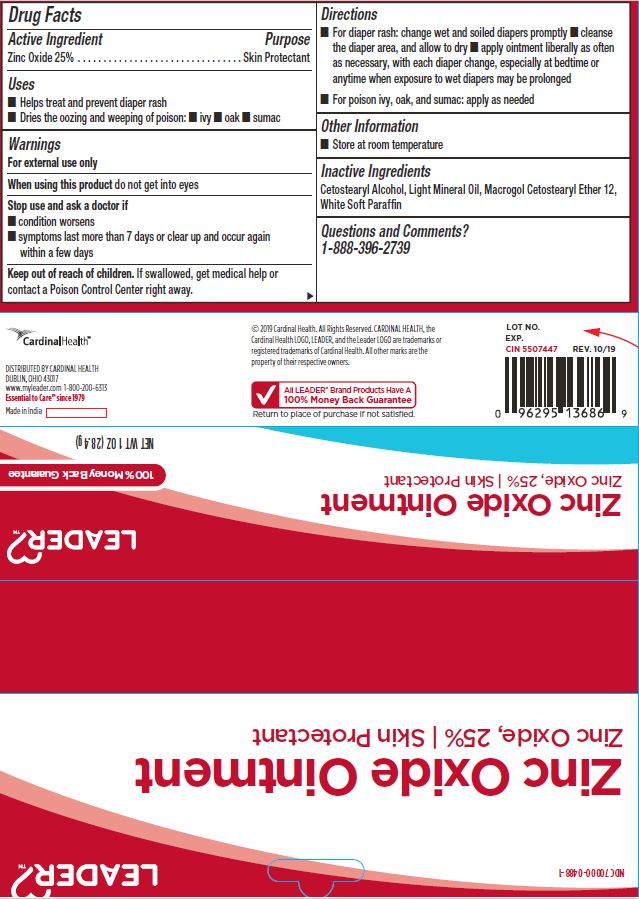
Skin Protectant Zinc Oxide 25% 25 mg/100mg Ointment — NDC 70000-0488-1 (Billing 70000-0488-01)
This is a package of Skin Protectant Zinc Oxide 25% 25 mg/100mg Ointment from Cardinal Health, marketed since Jan 2019 and currently FDA-listed; retail pharmacies pay about $0.0445 per g (NADAC). It is this product's only package size.
NDC database record
One package, one record: these facts belong to NDC 70000-0488-1 alone.
- Record
- FDA NDC Directory package listing · Human OTC drug
- Code segments
- 70000 labeler · 0488 product · 1 package
- Listing certified through
- Dec 31, 2026
- Barcode (UPC-A, from the NDC)
- 3 7000004881 5
- Medicaid fills, this package
- 190 prescriptions in the last four reported quarters
- FDA record last changed
- Oct 8, 2026
Identity & classification
Regulatory identifiers FDA, NLM and CMS codes for this package
Drug-database identifiers Medi-Span GPI and First Databank GCN / HICL / AHFS classification
- GSN (GCN sequence number): 005577
- GCN: 22081
- GPI-14 (Medi-Span): 90971020004215
- HICL (First Databank): 002361
- AHFS class code: 84:24.12.00
- RxCUI (RxNorm): 238405
Where does this data come from?
- FDA openFDA NDC Directory · synced Oct 8, 2026
- FDA label on DailyMed · label index refreshed Oct 8, 2026
- RxNorm (NLM RxNav) · catalog refreshed Oct 8, 2026
- Medi-Span GPI (licensed)
- First Databank (licensed) · refreshed Oct 8, 2026
Clinical
This is an over-the-counter topical ointment containing 25% zinc oxide, marketed under FDA's OTC monograph rules for skin protectants. Zinc oxide is commonly used in skincare products to form a protective barrier on the skin surface. It is typically used to help protect skin from moisture loss and minor irritation.
Patient education
Supplement & herbal interactions
Where does this data come from?
- MedlinePlus (NLM) · refreshed Oct 8, 2026
- FDA label on DailyMed · label index refreshed Oct 8, 2026
Ask a licensed pharmacist directly — free, answered by our team.
Pricing
A drug doesn't have one price. Each row is a different public payment system, and none is what you'd pay at the counter — that depends on your insurance. The ⓘ on each row explains what it measures.
| Price system | Per g | Per package |
|---|---|---|
| Retail pharmacies payNADAC · weekly | $0.045 | — |
| Medicaid paysCMS SDUD · 12 mo | $0.1458 | — |
| Medicare drug plans payPart D · quarterly | No Part D plan price is available for this NDC in our data. | |
Where does this data come from?
- CMS NADAC weekly file · file of Oct 7, 2026
- CMS ASP pricing files · refreshed Sep 20, 2026
- CMS Medicaid State Drug Utilization Data · through Q1 2026
- CMS Part D plan pricing files · refreshed Sep 24, 2026
- VA National Acquisition Center price file
Packaging — all sizes for this product
| Package NDC | Description | Marketing start | Marketing end | Status |
|---|---|---|---|---|
| 70000-0488-01 You're viewing this Main listing | 72 BOX in 1 CASE / 1 TUBE in 1 BOX / 28400 mg in 1 TUBE | 2019-01-16 | — | Active |
Therapeutic equivalents
| Product | Labeler | Pack | NADAC/unit | TE | Status | Price vs. this |
|---|---|---|---|---|---|---|
| Skin Protectant 25 mg/100mgthis 70000-0488-01 | Cardinal | 1 tube | $0.045 | — | Availability likely | — |
Where does this data come from?
- FDA openFDA NDC Directory · synced Oct 8, 2026
- FDA Orange Book · refreshed Oct 3, 2026
- CMS NADAC weekly file · file of Oct 7, 2026
Availability & generic status
We did not find an FDA-approved generic match for this exact strength, form and route.
Where does this data come from?
- FDA Orange Book · refreshed Oct 3, 2026
Inactive Ingredients / Excipients
Inactive ingredients, also called excipients, are components of the drug product other than the active ingredient. They may include fillers, dyes, coatings, preservatives, flavors, or other formulation ingredients.
💡 Tap an ingredient (hover on desktop) to see what it is and why it’s used.
-
UNII 7V4MR24V5P
Ceteareth-12 is a synthetic emulsifier made from cetyl and stearyl alcohols combined with ethylene oxide. It helps blend oil and water-based ingredients in medicines, creating a stable, uniform texture.
-
UNII 2DMT128M1S
A waxy solid derived from plant or animal sources. It acts as an emulsifier to blend oil and water components, and also thickens the medicine to give it the right texture and consistency.
-
UNII N6K5787QVP
Light mineral oil is a clear, odorless liquid derived from petroleum. In medicines, it acts as a lubricant and emollient to help the product spread smoothly and improve texture.
-
UNII 4T6H12BN9U
Petrolatum is a purified mineral oil-based jelly derived from petroleum. In medicines, it acts as an emollient, lubricant, and moisture barrier to soften skin, reduce friction, and help prevent water loss from formulations.
4 inactive ingredients listed in the exact product block matched to this NDC.
Label-section wording can be broader than the structured product block and may mention additional formulation ingredients.
Where does this data come from?
ingredient classCode="IACT" elements from the exact product block matched by this NDC. Label-section narrative from DailyMed / the openFDA label index is shown separately when available.- FDA label on DailyMed · label index refreshed Oct 8, 2026
- FDA openFDA NDC Directory · synced Oct 8, 2026
Inactive ingredient FAQ
Are inactive ingredients the same for every manufacturer?
Why might an inactive ingredient be missing?
Can inactive ingredients matter?
Manufacturer & labeler
More NDCs from Cardinal Health labeler code 70000
- LEADER Ear Drops for Swimmers 950 mg/mL Liquid NDC 70000-0478-1
- Mucus Relief Extended Release Maximum Strength Guaifenesin 1200 mg Tablet NDC 70000-0479-1
- Medicated Chest Rub camphor, eucalyptus oil, menthol 48 mg/g; 12 mg/g; 26 mg/g Ointment NDC 70000-0480-1
- leader childrens pain and fever Acetaminophen 160 mg/5mL Suspension NDC 70000-0481-1
- Hydrocortisone Anti-pruritic 1 g/100g Cream NDC 70000-0485-1
- White Petrolatum Skin Protectant 100 g/100g Ointment NDC 70000-0487-1
- Hydrocortisone Anti-Itch 1 g/100g Ointment NDC 70000-0489-1
- Mucus Relief DM Guaifenesin, Dextromethorphan HBr 600 mg; 30 mg Tablet NDC 70000-0491-1
- leader childrens pain and fever Acetaminophen 160 mg/5mL Suspension NDC 70000-0496-1
- Isopropyl alcohol 70 percent 70 mL/100mL Liquid NDC 70000-0497-1
- Isopropyl Rubbing Alcohol 91 percent 91 mL/100mL Liquid NDC 70000-0498-1
- Hydrogen Peroxide 3 Percent 3 mL/100mL Liquid NDC 70000-0500-1
Where does this data come from?
- FDA openFDA NDC Directory · synced Oct 8, 2026
- Drugs@FDA
FDA label — Drug Facts FDA SPL
🎯 Indications and Usage ▾
Uses Helps treat and prevent diaper rash Dries the oozing and weeping of poison: ivy, oak, sumac
⏱️ Dosage and Administration ▾
Directions For diaper rash: change wet and soiled diapers promptly, cleanse the diaper area and allow to dry, apply ointment liberally as often as necessary, with each diaper change, especially at bedtime or anytime when exposure to wet diapers may be prolonged. for poison ivy, oak, and sumac: apply as needed.
⚠️ Warnings ▾
Warnings For external use only When using this product do not get into eyes Stop use and ask a doctor if condition worsens symptoms last more than 7 days or clear up and occur again within a few days If swallowed, get medical help or contact a Poison Control Center right away.
📦 Storage and Handling ▾
Other Information Store at room temperature
🧪 Active Ingredient ▾
Active Ingredient Zinc Oxide 25%
🧪 Inactive Ingredients ▾
Inactive Ingredients Cetostearyl Alcohol, Light Mineral Oil, Macrogol Cetostearyl Ether 12, White Soft Paraffin
🎯 Purpose ▾
Purpose Skin Protectant
📄 When Using This Product ▾
When using this product do not get into eyes
📄 Stop Use and Ask a Doctor If ▾
Stop use and ask a doctor if condition worsens symptoms last more than 7 days or clear up and occur again within a few days
📄 Keep Out of Reach of Children ▾
If swallowed, get medical help or contact a Poison Control Center right away.
📄 Questions or Comments ▾
Questions and Comments? 1-888-396-2739
📄 Package Label / Principal Display Panel ▾
Label CR-1190 Zinc Oxide Ointment PDP